
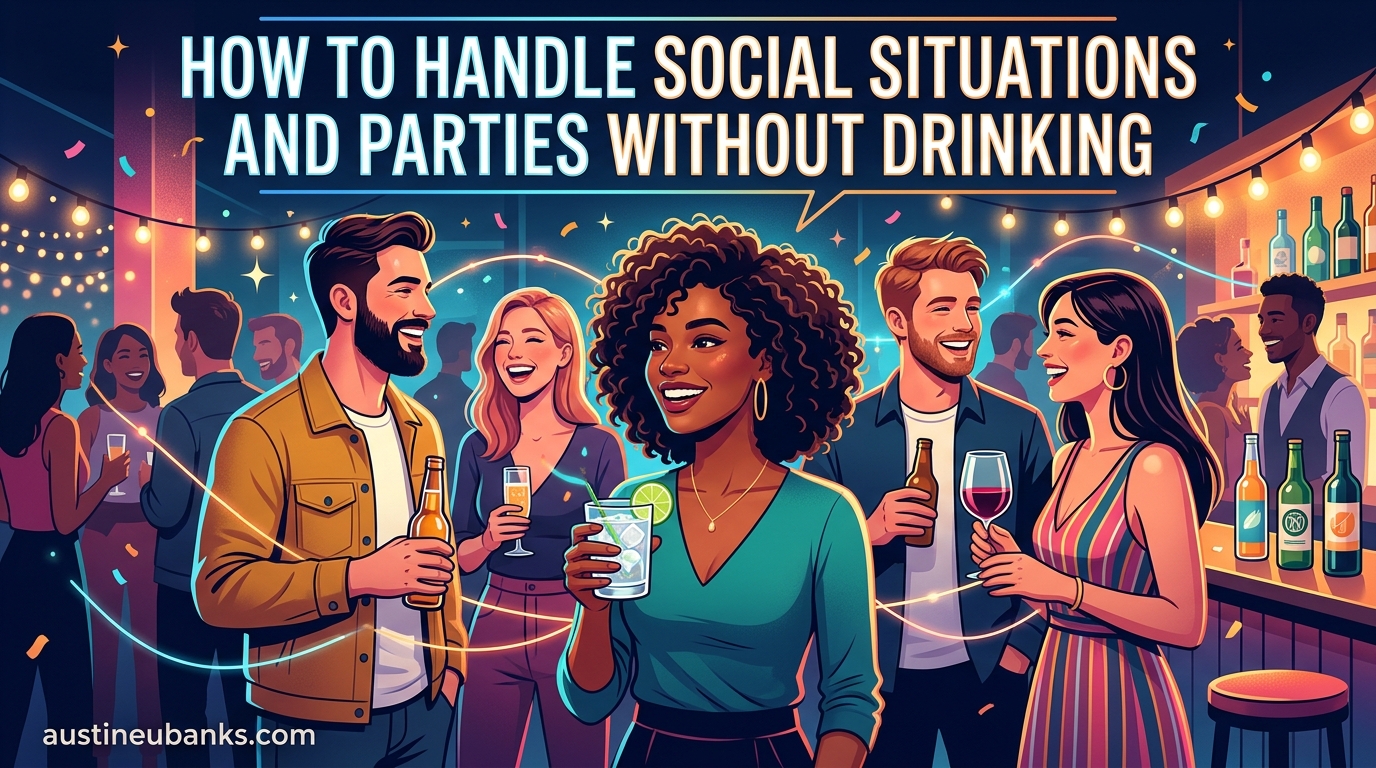
Walking into a party without a drink in your hand can feel like showing up to a costume party without a costume. Everyone else seems to have their social lubricant, and you are standing there wondering how people make small talk without it. If you have ever felt that knot in your stomach before a social event because you knew you would not be drinking, you are in exactly the right place.
Learning how to handle social situations and parties without drinking is a skill that takes practice, but it is completely learnable. Whether you are in recovery, doing Dry January, taking a break for your health, or simply questioning your relationship with alcohol, the strategies in this guide will help you show up confidently at any event.
I have talked with dozens of people from communities like r/stopdrinking and r/socialskills who have navigated this exact transition. Their real-world experience, combined with evidence-based techniques from therapists and recovery specialists, forms the backbone of what follows. You will get specific scripts for handling pressure, situation-by-situation guidance, and practical tools for managing anxiety in the moment.
The first few events are always the hardest. Then something shifts, and you start to realize something surprising: you can connect with people more authentically than you ever did with a drink in your hand. Let us get into exactly how to make that happen.
Table of Contents
Why Socializing Feels Different Without Alcohol
Socializing without alcohol feels different because alcohol genuinely changes how your brain processes social interaction. It depresses the prefrontal cortex, which is the part of your brain responsible for self-monitoring and social inhibition. When that area quiets down, you stop overthinking every word you say. That is the relaxation you feel after one or two drinks.
Here is what most people miss, though. That loosening effect is not something only alcohol can provide. Your brain can learn to access a similar state of social ease through practice, preparation, and the techniques we cover below. The awkwardness you feel without a drink is not a permanent personality trait. It is a conditioned response that fades over time.
The Alcohol-Social Connection in Your Brain
From college parties to work happy hours, our culture has trained us to associate alcohol with connection. Every celebration, every milestone, every networking event seems to come with a drink in hand. Over years of repetition, your brain creates a powerful association: social setting equals need a drink to function here.
This is classical conditioning at work, and it is the same mechanism that makes former smokers crave a cigarette when they drink coffee. The good news is that conditioned associations can be broken. Every time you attend a social event sober and survive it, you weaken that neural pathway a little more.
You Are Not Broken for Feeling This Way
Members of the r/stopdrinking community share this experience constantly. One user put it perfectly: they said the first three events without drinking felt like they were speaking a foreign language, but by event number ten, it felt completely natural. If you feel awkward right now, that is not a sign you cannot do this. It is a sign you are in the early part of the learning curve.
Social anxiety without alcohol is incredibly common. According to the research cited by the American Psychological Association, many people who identify as sober-curious report that alcohol had become a crutch for basic social interaction. Recognizing that is the first step toward building genuine social confidence that does not depend on a substance.
How to Handle Social Situations and Parties Without Drinking: 7 Proven Strategies
These seven strategies form a practical toolkit you can use at any social event. They come from recovery specialists, therapists, and people who have successfully rebuilt their social lives without alcohol. Pick two or three to focus on for your next event rather than trying to implement all seven at once.
1. Always Have a Drink in Your Hand
This is the single most effective tip I have found across every community and expert source. When you hold a drink, even a non-alcoholic one, people stop offering you alcohol. It signals that you are participating, and it gives your hands something to do when you feel restless. Sparkling water with lime looks almost identical to a gin and tonic, and nobody asks questions.
The key is to never let your glass stay empty for long. As soon as it gets low, head to the bar or kitchen for a refill. A drink in hand is social armor that prevents the most common uncomfortable conversations before they start.
2. Prepare Your Script Before You Arrive
The worst time to figure out what you will say when offered a drink is when someone is standing in front of you holding a bottle. Decide your response in advance and rehearse it until it rolls off your tongue naturally. Something as simple as “No thanks, I am good with this” works for most situations.
The coobi.health guide emphasizes this point strongly. When you have a practiced response ready, you avoid the awkward pause that makes things feel weird. Your delivery matters more than your actual words. Say it casually, like declining is the most normal thing in the world, and people will treat it that way.
3. Find the Other Non-Drinkers
At almost every party, there are other people not drinking. They might be the designated driver, someone on medication, a person in recovery, or someone who just does not feel like it that night. Finding even one other sober person at an event changes everything about how the night feels.
Look for the person nursing the same drink for an hour, or someone who keeps reaching for sparkling water. These are your people. Forum users from talkingsober.com consistently report that having one ally at an event made the difference between a miserable night and a genuinely enjoyable one.
4. Use the Delay Technique When Cravings Hit
The delay technique is simple but powerful. When you feel the urge to drink, tell yourself you will wait fifteen minutes before making a decision. In the vast majority of cases, the craving passes within that window. Cravings are waves, not permanent states, and they peak and subside on their own.
During those fifteen minutes, do something specific. Get a glass of water. Step outside for fresh air. Find a conversation to join. Text a supportive friend. The point is to break the automatic loop between trigger and action. With practice, the delay technique becomes almost effortless.
5. Ask Questions and Shift the Spotlight
Without alcohol, you might feel pressure to be entertaining or witty. Here is the secret that socially skilled people know: being genuinely interested is far more powerful than being interesting. Ask open-ended questions and let other people do the talking. Most people love talking about themselves, and a good listener is always welcome at any gathering.
Try questions like “What have you been excited about lately?” or “How did you get into your line of work?” These open doors to real conversations instead of surface-level small talk. Before you know it, you are deep in a conversation that has nothing to do with drinks.
6. Give Yourself Permission to Leave Early
You do not have to stay until the bitter end of every event. One of the biggest advantages of sober socializing is that you can drive yourself home anytime. Set an exit time before you arrive, and give yourself full permission to use it. Leaving at 10 PM instead of midnight is not a failure. It is a strategy.
Multiple forum users from r/stopdrinking mention that knowing they could leave whenever they wanted actually made them more relaxed during events. The freedom to go reduces the pressure, and paradoxically, you often end up staying longer because you are enjoying yourself.
7. Practice Grounding Techniques for Anxiety
When social anxiety spikes, your nervous system goes into fight-or-flight mode. Grounding techniques bring you back to the present moment and calm your body’s stress response. The simplest one is the 5-4-3-2-1 method: notice five things you can see, four things you can physically feel, three things you can hear, two things you can smell, and one thing you can taste.
You can do this discreetly while holding a conversation or while taking a bathroom break. No one will know you are doing it. Recovery Centers of America specifically recommends mindful relaxation techniques as their top strategy for overcoming social anxiety without alcohol, and grounding is one of the most accessible forms.
What to Say When People Ask Why You Are Not Drinking
The question “Why aren’t you drinking?” is the one that causes the most anxiety for people new to sober socializing. The truth is, most people ask it out of casual curiosity, not judgment. Having a few ready responses removes the anxiety entirely and lets you move on with the conversation.
The golden rule is this: you owe no one a detailed explanation. Your reasons for not drinking are personal, and you get to decide how much to share. Here are scripts for different situations and comfort levels.
Casual and Low-Key Responses
For most parties and casual gatherings, a brief deflection works perfectly. These responses are vague enough to end the conversation without making it a thing:
- “I am taking a break from drinking for a while.”
- “Just not feeling it tonight.”
- “I have got an early morning tomorrow.”
- “I am driving tonight, so I am sticking with sparkling water.”
- “Trying to be healthier lately, so I am skipping the drinks.”
Deliver these with a smile and immediately follow up with a question or a comment about something else. This signals that the topic is closed and you are ready to move on.
Humor-Based Deflections
If you are comfortable with humor, it can instantly diffuse any awkwardness and show that you are relaxed about your choice:
- “I have reached my lifetime quota.”
- “I am allergic. Every time I drink it, I break out in bad decisions.”
- “My doctor told me to cut back. Turns out doctors are real buzzkills.”
- “I am on a see-food diet. I see food and I eat it, but no drinks.”
Humor works because it puts the other person at ease. When you are comfortable enough to joke about it, they realize there is nothing to worry about.
Direct Responses for Persistent Pressure
Sometimes someone will not let it go. They keep pushing, insisting you should “just have one.” For these moments, you need firm but friendly responses that close the door:
- “I really am not drinking tonight, but thanks for offering.”
- “I have made a commitment to myself and I am sticking with it.”
- “I appreciate it, but I am happy with what I have.”
- “No thanks. Hey, how is your project going?”
If someone continues to push after a clear decline, that is about them, not you. It usually means they feel uncomfortable about their own drinking and your abstinence makes them question themselves. You are not responsible for their discomfort.
Professional Responses for Work Events
Workplace events require a slightly different approach because professional relationships are at stake. Keep it simple and redirect to work topics:
- “I am sticking with water tonight, but I would love to hear about that client you mentioned.”
- “Not drinking these days. How long have you been with the company?”
- “I have a busy week ahead so I am keeping it clear tonight.”
The redirect is especially important at work events. Move the conversation to professional topics quickly, and your choice not to drink becomes a non-issue.
When to Stop Explaining
You never have to explain yourself beyond what feels comfortable. If someone keeps pressing, you can simply say “I just prefer not to” and walk away to refill your drink or join another conversation. Setting boundaries is healthy, and people who respect you will respect your choices.
Situation-by-Situation Guide to Sober Socializing
Different social settings present different challenges. A house party with close friends feels very different from a networking event with colleagues or a first date with someone you barely know. Here is how to handle each type of situation specifically.
Parties and House Parties
House parties are often the most alcohol-centric environment you will encounter. The key is to arrive with a plan. Bring your own non-alcoholic drinks so you always have something you enjoy. Scope out the layout when you arrive so you know where the food, bathrooms, and outdoor spaces are. Having an escape route to a quieter area reduces anxiety significantly.
Position yourself near the food table or kitchen. Food creates natural conversation starters, and being in a high-traffic area means people cycle through and talk to you without effort. Help the host if you can. Offering to refill chip bowls or clear plates gives you a purpose and a reason to move around naturally.
Bars and Nightlife
Bars are challenging because the entire environment is built around drinking. Go with a plan and a time limit. Order a specific non-alcoholic drink right away so you have something to hold. Tonic water with lime, ginger beer in a glass, or a mocktail all look the part.
Focus on the social aspect rather than the drinking aspect. Play pool or darts if they are available. If the bar is too loud for conversation, suggest moving somewhere else. And remember, you can always leave early. Being sober at a bar is not a test of endurance.
Dinner Parties and Restaurants
Dinner parties are often the easiest sober social setting because the focus is on food and conversation rather than drinking. When you arrive, let the host know you are not drinking but do not make it a big deal. Most hosts are happy to provide sparkling water or soda if you ask.
At restaurants, order your non-alcoholic drink first, before anyone else orders wine or cocktails. This sets the tone and makes it clear what you are having. Engage with the menu and food conversation, which gives you plenty to talk about beyond drinks.
Dates and Sober Dating
Sober dating can feel intimidating because so many first dates default to drinks or dinner with wine. The key is to suggest activities that do not revolve around alcohol. Coffee, hiking, museum visits, or cooking classes all make excellent first dates and remove the drinking question entirely.
If your date suggests drinks, you can counter with “I actually do not drink, but I would love to grab coffee or dinner instead.” How they respond tells you a lot about whether they are worth your time. Someone who respects your choice and adapts is someone worth getting to know.
Workplace Events and Happy Hours
Workplace happy hours are the one situation almost no resource covers well, which is surprising because they cause enormous anxiety. The stakes feel higher because your professional reputation is involved. Here is the approach that works.
Attend the event but set a time limit. One hour is often enough to show your face and make connections without being surrounded by increasingly drunk colleagues. Always have a non-alcoholic drink in hand. If anyone asks, a simple “I am sticking with water tonight” is sufficient and immediately forgettable in a professional context.
Use work events as networking opportunities. Focus on building professional relationships rather than socializing in the party sense. Ask colleagues about their projects, their teams, and their goals. People remember good listeners, and being the sober, attentive person at a work event actually makes you stand out in a positive way.
If the drinking culture at your workplace is intense and you feel pressured, remember that you can decline these events entirely. You are not obligated to attend optional social gatherings. Your work performance speaks louder than your presence at a happy hour.
Family Gatherings and Holidays
Family events come with their own unique challenges because family members often feel entitled to ask personal questions. If you choose to share your reasons, do so briefly and move on. If not, use the same casual deflections you would use anywhere else.
Bring your own drinks so you are not dependent on what the host provides. Volunteer to help with cooking, serving, or cleanup. Having a role gives you purpose and reduces the standing-around time that leads to temptation or awkwardness.
Managing Social Anxiety and Cravings Without Liquid Courage
Social anxiety is often the underlying reason people started relying on alcohol in social settings. When you remove the alcohol, the anxiety does not disappear overnight. But you can manage it effectively with the right techniques.
The 3-3-3 Rule for Anxiety and Cravings
The 3-3-3 rule is a grounding technique that helps interrupt anxiety spirals. When you feel panic or a craving building, do three things: name three things you can see around you, name three sounds you can hear, and move three parts of your body. This exercise pulls your brain out of the anxiety loop and back into your physical surroundings.
Some people use a different version of the 3-3-3 rule for addiction recovery: acknowledge three triggers you are experiencing, reach out to three people in your support network, and list three reasons you chose sobriety. Both versions work because they force your prefrontal cortex back online when your emotional brain is trying to take over.
This rule is simple enough to do anywhere without anyone noticing. You can run through it while standing in a circle of people or during a quick bathroom break. It takes about thirty seconds and can completely change how you feel in the moment.
Breathing Techniques for Social Settings
Box breathing is a technique used by Navy SEALs to manage stress, and it works just as well at a party. Inhale for four counts, hold for four, exhale for four, and hold for four. Repeat this cycle three or four times and your heart rate will drop noticeably.
You can practice box breathing discreetly during any social interaction. No one will notice you are counting in your head. The technique works because it activates your parasympathetic nervous system, which counteracts the fight-or-flight response that social anxiety triggers.
Identify Your Personal Triggers Before Events
Before attending an event, take five minutes to identify what might trigger a desire to drink. Is it seeing other people laugh and relax with cocktails? Is it a specific person who always pressures you? Is it the transition from arriving to settling in, when anxiety is highest?
When you name your triggers in advance, they lose much of their power. You can prepare specific responses for each one. Knowing that the first thirty minutes are always the hardest, for example, lets you push through that window with the confidence that it will get easier.
What to Do If You Feel Overwhelmed
If you reach a point where the anxiety or craving feels unmanageable, step away. Go to the bathroom, step outside for air, or take a short walk. Call or text someone from your support network. There is absolutely no shame in taking a break to reset.
If the event is truly too much, leave. Exiting a situation that threatens your sobriety or mental health is an act of strength, not weakness. You can always try again at the next event. Each attempt builds your skills and resilience, even if it does not go perfectly.
The Surprising Upsides of Sober Socializing
Once you get past the initial adjustment period, sober socializing reveals benefits that alcohol never could provide. These upsides are what keep people choosing sobriety long after the hard part is over.
Authentic Connections Replace Alcohol Friendships
Alcohol friendships are relationships built on the shared activity of drinking together. When you remove alcohol, some of these friendships fade, and that is actually a good thing. The connections you build sober are real. A user from r/stopdrinking shared a powerful insight: “The people who like sober you actually like you. The people who only liked drunk you were only there for the party.”
Sober conversations tend to go deeper. Without the superficiality that alcohol brings, you talk about things that actually matter. You remember what people tell you, follow up on their stories, and build genuine intimacy that drunk socializing simply cannot replicate.
Better Memory and Full Presence
You remember every conversation, every laugh, every moment. No more trying to piece together what happened last night. No more cringing at things you said but barely recall. Being fully present at social events is a gift that many people do not appreciate until they experience it.
Your conversations are sharper and more intentional. You catch nuances and body language that alcohol would have blurred. You notice when someone is struggling and can reach out. Presence makes you a better friend, partner, and colleague.
Physical and Mental Benefits
No hangovers means your weekends are yours again. You wake up clear-headed and energetic. Your sleep improves dramatically because alcohol is no longer disrupting your sleep cycles. Your skin looks better, your mood is more stable, and your anxiety actually decreases over time without the rebound effect that drinking causes.
Many people in recovery communities report that their general social anxiety decreased significantly after several months of sobriety. This makes sense scientifically. Alcohol provides temporary relief but worsens anxiety overall by disrupting your neurotransmitter balance. Removing it allows your brain to heal and regulate naturally.
Confidence That Comes From Within
The biggest benefit is the confidence you build. When you can walk into a party, hold a conversation, make people laugh, and enjoy yourself without any chemical assistance, you know that social ability is genuinely yours. No substance created it, and no substance can take it away. That is a deeply empowering realization.
How to Support a Friend Who Is Not Drinking
If you are reading this because someone you care about has stopped drinking, your support matters more than you know. Here is how to be a good friend to someone navigating sober socializing.
First, do not make a big deal about it. Drawing attention to their choice not to drink puts them on the spot and makes things uncomfortable. Treat it the same way you would treat someone choosing a vegetarian meal. It is their choice, and it does not require commentary.
Second, always have non-alcoholic options available without being asked. Stock sparkling water, juice, soda, or mocktail ingredients when they come over. When you host gatherings, make sure there are appealing non-alcoholic choices alongside the beer and wine. This small gesture shows that you thought about them and respect their choice.
Third, check in privately. A quick text before an event saying “Hey, there will be plenty of non-alcoholic options at the party” or “I have got your back tonight if anyone gives you a hard time” can make an enormous difference. Do this one-on-one rather than in front of others.
Finally, be willing to do alcohol-free activities. Suggest coffee dates, hikes, movie nights, or museum visits instead of always defaulting to bars and parties. Showing that you value their company outside of drinking contexts demonstrates that your friendship is not contingent on alcohol.
FAQs
How to have fun in social situations without alcohol?
You can have fun at social events without alcohol by focusing on genuine connections, playing games, engaging in activities like dancing or trivia, asking people interesting questions, and being fully present in the moment. Many people find that sober socializing becomes more enjoyable once the initial awkwardness fades, because you remember conversations and form authentic connections.
How to avoid alcohol in social situations?
To avoid alcohol in social situations, always keep a non-alcoholic drink in your hand, prepare a brief response for when offered a drink, arrive with a plan and time limit, find other non-drinkers at the event, and position yourself away from the bar or drink stations. Having a practiced script ready removes the awkwardness of declining.
How to survive a party without drinking?
You can survive and enjoy a party without drinking by bringing your own non-alcoholic beverages, arriving with a friend who supports your choice, helping the host with tasks to stay busy, finding quieter areas when you need a break, and giving yourself permission to leave early if needed. The first few parties are the hardest, and it gets easier each time.
What is the 3 3 3 rule for addiction?
The 3-3-3 rule for addiction involves acknowledging three triggers or feelings you are experiencing, reaching out to three people in your support network, and listing three reasons you chose sobriety. A related version for anxiety involves naming three things you see, three sounds you hear, and moving three body parts to ground yourself in the present moment.
What is the 1 2 3 rule for alcohol?
The 1-2-3 rule for alcohol generally refers to a guideline for moderate drinking: limit yourself to one drink per hour, no more than two drinks per day, and no more than three drinks in a single occasion. For people choosing not to drink, this rule becomes less relevant than strategies like the delay technique and having prepared responses for social pressure.
How to get through social events without drinking?
To get through social events without drinking, prepare in advance by identifying your triggers, bring or plan non-alcoholic drink options, practice grounding techniques like the 3-3-3 rule for anxiety, have an exit strategy if things get overwhelming, and focus on connecting with people through conversation rather than shared drinking. Each event builds your confidence for the next one.
Conclusion: You Can Do This
Learning how to handle social situations and parties without drinking is not about willpower or pretending you do not feel awkward. It is about building a practical toolkit of strategies, scripts, and techniques that make sober socializing feel natural over time. Every strategy in this guide comes from real people who have been exactly where you are right now and found their way through.
Start small. Pick your next event and choose two or three techniques to focus on. Maybe that means arriving with a non-alcoholic drink already in your plan, preparing a casual response for when someone offers you a beer, and giving yourself permission to leave after ninety minutes. That is a complete strategy for one event, and it is enough.
Remember that the first few events are always the hardest. Forum users across r/stopdrinking, talkingsober.com, and other recovery communities echo the same sentiment repeatedly: it gets easier. By your fifth sober social event, you will start to notice moments of genuine enjoyment that catch you by surprise. By your twentieth, you will wonder why you ever thought you needed a drink to have a good time.
The connections you build sober are real. The confidence you develop is yours. The memories you make are clear and lasting. Socializing without alcohol does not mean socializing less. It means socializing better, with deeper relationships and fuller presence in every moment. You already have everything you need to show up, connect, and enjoy yourself. Now go prove it to yourself.