
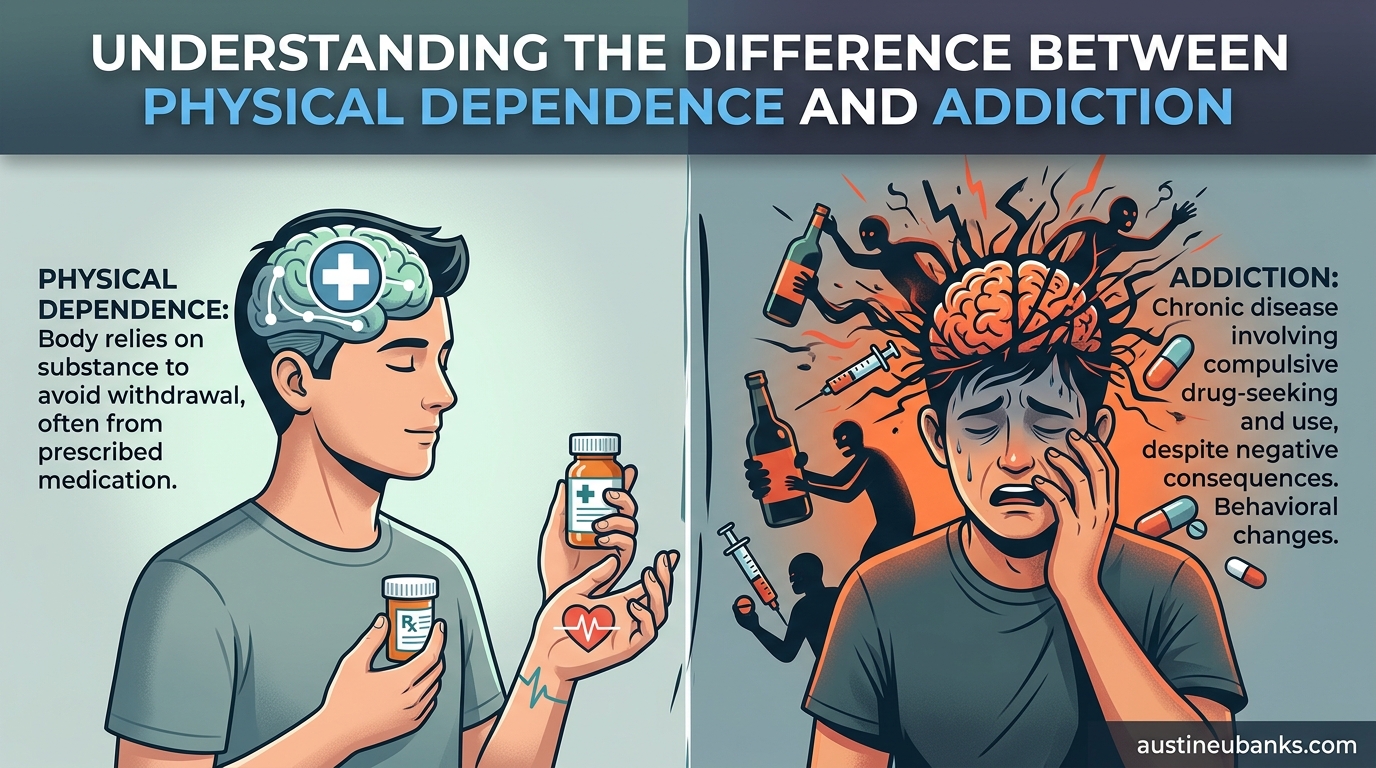
If you have ever taken a prescription medication for months and felt sick when you tried to stop, you have experienced something millions of people confuse with addiction every single day. The truth is far more nuanced, and understanding the difference between physical dependence and addiction can change how you view yourself, your medications, and your treatment options.
Patients in chronic pain communities constantly share stories of being treated like drug seekers simply because their bodies need a medication to function normally. One person on a chronic pain forum wrote about how their pharmacist treated them like a criminal for refilling a legitimate prescription. Another described how family members accused them of being “still addicted” because they were on medication-assisted treatment. These stories happen because most people, and even some medical professionals, use the words “dependence” and “addiction” as if they mean the same thing.
They do not. And that confusion has real consequences, from misdiagnosis to denied treatment to deep personal stigma.
In this guide, we break down exactly what separates physical dependence from addiction, how tolerance fits into the picture, and why this distinction matters more than you might think. Whether you are navigating long-term medication use, supporting a loved one, or simply trying to understand these terms clearly, this article will give you the knowledge to tell the difference with confidence.
Table of Contents
The Quick Answer: Physical Dependence and Addiction in Plain Terms
Physical dependence is a biological adaptation where your body adjusts to the regular presence of a substance and reacts with withdrawal symptoms when that substance is removed. Addiction is a chronic brain disorder involving compulsive substance use or behaviors despite harmful consequences, driven by changes in the brain’s reward and decision-making systems.
Here is the most important distinction: someone who is physically dependent is not necessarily addicted. A person taking prescribed antidepressants, beta-blockers, or even certain blood pressure medications will develop physical dependence, but that does not mean they are compulsively seeking the drug or using it despite harm.
The key differences come down to these points:
- Dependence is physical — the body adapts neurologically and chemically to a substance.
- Addiction is behavioral and neurological — it involves compulsive use, cravings, and continued use despite negative consequences.
- Dependence can occur with legitimate medication — antidepressants, beta-blockers, and prescribed opioids all cause it.
- Addiction involves loss of control — the person cannot stop even when they want to, even when the substance is destroying their life.
- You can have dependence without addiction — millions of medication users do.
- You can have addiction without physical dependence — gambling and gaming addictions involve no physical withdrawal.
- They often overlap — many people with substance addictions also develop physical dependence, but the two are not the same condition.
What Is Physical Dependence?
Physical dependence develops when your body adapts to having a substance in its system on a regular basis. Your brain and nervous system actually reorganize their chemistry to account for the substance, adjusting neurotransmitter levels, receptor sensitivity, and signaling pathways. When the substance is suddenly removed, your body has to readjust, and that readjustment process produces what we call withdrawal symptoms.
Think of it like your body recalibrating its baseline. If you drink coffee every morning for years, your brain compensates for the regular caffeine by adjusting its own chemistry. Stop the coffee abruptly, and you get headaches, fatigue, and irritability. That is physical dependence in its simplest form.
This process happens with far more substances than most people realize. It occurs with opioids, alcohol, benzodiazepines, and nicotine, yes. But it also happens with antidepressants like SSRIs, blood pressure medications like beta-blockers, and even some anti-seizure drugs. Many of these are medications people take for legitimate, life-improving medical reasons under careful doctor supervision.
The withdrawal symptoms of physical dependence vary depending on the substance. Opioid withdrawal can include muscle aches, nausea, sweating, anxiety, and insomnia. Antidepressant discontinuation can produce what doctors call “discontinuation syndrome” with dizziness, brain zaps, and mood swings. Beta-blocker withdrawal can cause dangerous spikes in heart rate and blood pressure.
None of these symptoms indicate addiction. They indicate that the body has adapted to a substance and needs time to readjust when it is removed. This is why doctors typically recommend tapering, gradually reducing the dose over time, rather than stopping abruptly.
What Is Addiction?
Addiction is fundamentally different from physical dependence, even though the two often co-exist. The DSM-5 (Diagnostic and Statistical Manual of Mental Disorders, Fifth Edition) classifies addiction under the umbrella term “substance use disorder,” which ranges from mild to severe based on how many diagnostic criteria a person meets.
According to the DSM-5, substance use disorder is diagnosed when a person meets at least two of eleven criteria within a 12-month period. These criteria include taking the substance in larger amounts or over a longer period than intended, persistent desire or unsuccessful efforts to cut down, craving the substance, failure to fulfill major role obligations at work, school, or home due to use, continued use despite social or interpersonal problems caused by use, giving up important activities because of use, and using in physically hazardous situations.
Additional criteria include continued use despite knowing it is causing physical or psychological problems, developing tolerance, experiencing withdrawal, and spending excessive time obtaining, using, or recovering from the substance.
What separates addiction from mere dependence is the compulsive behavioral component. A person with addiction continues to seek and use the substance despite real, ongoing harm to their health, relationships, finances, or legal standing. The brain’s reward pathway has been so fundamentally altered that the substance becomes prioritized above basic survival needs, social bonds, and personal values.
Importantly, addiction is not limited to substances. The DSM-5 recognizes gambling disorder as a behavioral addiction, and the World Health Organization’s ICD-11 includes gaming disorder. These behavioral addictions involve no physical dependence at all, which further proves that addiction and physical dependence are separate phenomena.
Physical Dependence and Addiction: Key Differences
Understanding the specific differences between physical dependence and addiction helps cut through decades of confused terminology. Here is a clear breakdown of how they differ.
1. Nature of the condition: Physical dependence is a physiological adaptation, meaning the body has chemically adjusted to a substance. Addiction is a chronic brain disorder involving structural and functional changes to the brain’s reward, motivation, and decision-making circuits.
2. The control factor: Someone who is physically dependent can typically control their use. They take their medication as prescribed and do not feel compelled to take more. Someone with addiction has lost that control and uses compulsively, often in larger amounts than intended.
3. Behavioral component: Physical dependence does not involve behavioral changes. The person does not lie, steal, or manipulate to obtain the substance. Addiction frequently involves these behaviors as the person tries to maintain their supply.
4. Response to consequences: A person with physical dependence who experiences negative side effects can usually discuss alternatives with their doctor and switch medications. A person with addiction continues using despite severe, accumulating consequences like job loss, relationship destruction, or legal trouble.
5. Craving: Physical dependence does not produce cravings. The body may feel unwell without the substance, but there is no intense psychological drive to obtain it. Addiction is characterized by powerful cravings that can feel impossible to resist.
6. Tolerance: Physical dependence often comes with tolerance, meaning the body needs more of the substance over time to achieve the same effect. However, tolerance can exist without addiction. Many patients on long-term pain medication develop tolerance but take their medication exactly as prescribed.
7. Presence without the other: You can absolutely have physical dependence without addiction, as is the case with millions of people on antidepressants, beta-blockers, and other prescribed medications. You can also have addiction without physical dependence, as is the case with gambling and gaming disorders.
8. Treatment approach: Physical dependence is typically managed through medical tapering, gradually reducing the dose under medical supervision. Addiction requires comprehensive treatment that may include medication-assisted treatment, behavioral therapy, counseling, support groups, and long-term recovery support.
Dependence vs Tolerance vs Addiction
The confusion gets even worse when you add tolerance into the mix. Many people use all three terms interchangeably, but they describe three distinct phenomena that often overlap without being the same thing.
Tolerance means your body has become less responsive to a substance over time. You need a higher dose to achieve the same effect you once got from a lower dose. Tolerance develops with many substances, including caffeine, alcohol, prescription opioids, and even some over-the-counter pain relievers.
Tolerance is a natural physiological response. When your brain detects that a substance is regularly present, it adjusts its receptors and signaling pathways to try to maintain balance. This is why your morning coffee hits harder after a month off caffeine than it does when you drink it every day.
Physical dependence is the next step beyond tolerance. Your body has not just adjusted to the substance but has come to rely on it to function normally. Remove the substance, and you experience withdrawal symptoms as your body scrambles to rebalance itself.
Addiction goes further still. It includes the compulsive behavioral component, the craving, the continued use despite harm. Tolerance and dependence are often present in addiction, but they are not what makes it addiction. The behavioral and neurological loss of control is what defines it.
Consider this real-world example. A patient taking prescribed opioids for chronic back pain develops tolerance, needing a higher dose for the same pain relief. Over months, they also develop physical dependence, experiencing withdrawal if they miss a dose. But they take their medication exactly as prescribed, never seek early refills, do not crave the medication, and function well at work and home. This person has tolerance and dependence but does not have addiction.
Now consider someone who started taking prescription opioids for the same back pain but began taking extra pills, visiting multiple doctors for prescriptions, spending money meant for groceries on obtaining more pills, and continuing to use even after their pain resolved. This person has tolerance, dependence, and addiction.
Mental vs Physical Dependence
Another layer of confusion comes from the term “psychological dependence” or “mental dependence.” This is different from both physical dependence and addiction, though it relates to both.
Physical dependence, as we have covered, involves the body’s chemical adaptation to a substance and the withdrawal symptoms that occur when use stops.
Psychological dependence involves emotional and mental reliance on a substance to cope with stress, anxiety, boredom, or other emotional states. Someone with psychological dependence feels they need the substance to feel normal, to relax, to socialize, or to handle difficult emotions.
Psychological dependence overlaps with addiction but is not identical. For example, someone who uses cannabis to manage anxiety may develop psychological dependence, feeling unable to cope without it, without necessarily having the compulsive, consequence-ignoring pattern that characterizes addiction.
The distinction matters because it affects treatment. Physical dependence is addressed through medical tapering. Psychological dependence requires therapy to develop alternative coping strategies. Addiction requires comprehensive treatment addressing both the physical and psychological components, plus the behavioral patterns that drive compulsive use.
Many people ask whether psychological addiction is somehow “less real” than physical dependence. It is not. The brain changes involved in psychological dependence are measurable and significant. Emotional reliance on a substance can be just as disruptive to a person’s life as physical withdrawal, sometimes more so.
Can You Have Both Addiction and Dependence at the Same Time?
Yes, and this is extremely common. In fact, when people think of “drug addiction,” they are usually thinking of someone who has both physical dependence and addiction simultaneously. The two conditions frequently co-occur with substances like opioids, alcohol, benzodiazepines, and nicotine.
When both are present, the body is chemically dependent on the substance, producing withdrawal when use stops, while the brain simultaneously drives compulsive use and craving despite harm. This combination is what makes substance use disorders so challenging to treat and why comprehensive treatment is essential.
What typically comes first? It varies by substance and individual. For prescription opioids, physical dependence often develops first as the body adapts to the medication. Addiction may follow in some individuals, particularly those with genetic, environmental, or psychological risk factors. For other substances, the compulsive behavioral pattern of addiction can develop before significant physical dependence sets in.
But the reverse situations are equally important to understand. You can have physical dependence without addiction. Millions of people taking SSRIs for depression, beta-blockers for heart conditions, corticosteroids for inflammation, or gabapentin for nerve pain are physically dependent on their medications. They would experience withdrawal if they stopped abruptly. But they are not compulsively seeking more medication, they are not using despite harm, and they are not losing control.
You can also have addiction without physical dependence. Gambling disorder, gaming disorder, and certain patterns of stimulant use do not necessarily produce physical withdrawal symptoms. But the compulsive behavior, the loss of control, and the continued engagement despite harm are unmistakably present.
This is why medical professionals increasingly use the term “substance use disorder” rather than “addiction” or “dependence.” It captures the full spectrum of severity and recognizes that the condition involves biological, psychological, and social components.
Signs and Symptoms: How to Tell the Difference
Recognizing whether you or someone you care about is dealing with physical dependence, addiction, or both requires looking at specific signs and symptoms. Here is what to watch for.
Signs of physical dependence:
- Withdrawal symptoms when the substance is reduced or stopped (nausea, sweating, tremors, anxiety, insomnia, muscle aches)
- Tolerance, needing a higher dose to achieve the same therapeutic effect
- The substance is taken exactly as prescribed, at the recommended dose and schedule
- No cravings or compulsive desire to take more than prescribed
- The person functions normally in daily life, work, and relationships while taking the substance
- Stopping the substance is a matter of medical tapering, not a battle against cravings
Signs of addiction:
- Strong, persistent cravings for the substance
- Taking more than prescribed or intended, or using for longer than intended
- Repeated, unsuccessful attempts to cut down or stop
- Continuing to use despite negative consequences like relationship damage, job loss, health problems, or legal trouble
- Spending significant time obtaining, using, or recovering from the substance
- Giving up activities, hobbies, or responsibilities because of substance use
- Using in dangerous situations, like before driving
- Needing the substance to feel normal or function at all
- Doctor shopping, seeking prescriptions from multiple providers
- Hiding use from family, friends, or doctors
Warning signs that require immediate professional help:
- Using increasingly dangerous amounts of the substance
- Experiencing overdoses or near-overdoses
- Combining substances in dangerous ways
- Having suicidal thoughts, especially during withdrawal
- Being unable to stop despite wanting to and trying repeatedly
If you or someone you know is experiencing these warning signs, contact a healthcare provider, addiction specialist, or a helpline immediately. In the United States, the SAMHSA National Helpline at 1-800-662-4357 provides free, confidential, 24/7 treatment referral and information.
Why the Distinction Matters: Stigma, Misdiagnosis, and Treatment
You might be wondering why it matters so much to separate these terms. After all, both involve substances, both can be challenging, and both may require medical help. The reality is that the confusion between physical dependence and addiction causes real, measurable harm every day.
The stigma problem: When people hear the word “addiction,” they think of compulsive drug-seeking, loss of control, and destructive behavior. When a chronic pain patient who is simply following their doctor’s orders gets labeled as an “addict,” that stigma follows them everywhere. Pharmacists may treat them with suspicion. Family members may question their need for medication. Employers may make assumptions. Insurance companies may deny coverage.
Reddit users in chronic pain communities frequently describe this experience. One person wrote about crying in their car after a pharmacist publicly questioned their legitimate opioid prescription. Another described how their own family stopped trusting them after learning they were on long-term pain medication, despite never misusing it.
The MAT stigma: Medication-assisted treatment uses medications like buprenorphine and methadone to help people recover from opioid use disorder. These medications reduce cravings and prevent withdrawal, allowing people to rebuild their lives. But because these medications themselves cause physical dependence, people on MAT are often told they are “not really in recovery” or are “just replacing one drug with another.”
This could not be more wrong. MAT is an evidence-based treatment with strong research support. The physical dependence on buprenorphine or methadone is a medical reality, but the compulsive, destructive behavior of addiction has stopped. Telling someone on MAT that they are “still addicted” is not just incorrect, it is harmful. It discourages people from pursuing a treatment that saves lives.
Misdiagnosis and coding problems: A research paper published by the National Institutes of Health highlighted a serious problem with how medical records handle these terms. The ICD (International Classification of Diseases) coding system used by healthcare providers has historically conflated dependence and addiction. The study found that diagnostic codes had only about 57.7% accuracy when it came to correctly distinguishing between dependence and addiction.
This is not just a paperwork issue. Incorrect diagnostic codes follow patients through their medical records. A code that says “opioid dependence” when the patient actually has a substance use disorder can lead to wrong treatment. A code that implies addiction when the patient only has physical dependence can affect insurance coverage, future prescribing decisions, and even legal situations like child custody cases.
Racial disparities: The same NIH paper noted that racial disparities exist in how these terms are applied. Black patients are more likely to be labeled with “addiction” while white patients are more likely to be described as “dependent,” even when presenting with similar clinical pictures. This bias has profound implications for treatment access, legal outcomes, and social support.
Impact on chronic pain treatment: Perhaps the most damaging consequence of confusing these terms is that patients in genuine pain go undertreated. Doctors, fearing their patients will become “addicted,” may prescribe inadequate pain relief. Patients, fearing the stigma of “addiction,” may avoid seeking treatment altogether. The result is unnecessary suffering for people who could be helped by appropriate, carefully managed medication.
As the medical journal The Lancet stated plainly: addiction and physical dependence are not the same thing, and the problems with prescribed drug dependence are not restricted to the small minority who develop addiction.
DSM-5 vs ICD Classification: Why the Terminology Is So Confusing
Part of the reason everyone, including doctors, struggles with these terms is that the two major diagnostic systems used worldwide define and code them differently.
The DSM-5, published by the American Psychiatric Association, made a significant change in 2013. It replaced the separate categories of “substance abuse” and “substance dependence” with a single umbrella term: “substance use disorder.” This condition is rated as mild, moderate, or severe based on how many of the eleven diagnostic criteria a person meets.
The idea was to simplify the language and recognize that substance-related problems exist on a spectrum. But the change created a new problem. The word “dependence” disappeared from the official diagnosis, even though physical dependence remains a real and measurable physiological phenomenon. So now, doctors using DSM-5 terminology talk about “substance use disorder,” while the concept of physical dependence still exists but has no clean diagnostic label.
The ICD system, maintained by the World Health Organization, still uses separate codes for “dependence” and “harmful use.” ICD-10 and the newer ICD-11 maintain codes that reference dependence as a clinical condition. This means a patient’s medical record might use ICD codes that say “dependence” while their psychiatric evaluation uses DSM-5 language about “substance use disorder.”
The result is a mess. Two patients with the same condition might have completely different labels in their records depending on which coding system their provider used and how the provider interpreted the terms. A patient with legitimate physical dependence on prescribed opioids might end up with a code that looks like addiction to a casual reader of their medical history.
This coding confusion has real consequences. Insurance companies review these codes when deciding what treatment to cover. Other doctors review them when making prescribing decisions. Attorneys may review them in legal proceedings. And the patient has little control over how accurately their condition is represented in the system.
The NIH research paper called for an update to the ICD coding system to better distinguish between physical dependence and addiction. Until that happens, patients and advocates need to be aware of how these terms appear in medical records and be prepared to discuss them with their healthcare providers.
Treatment Approaches: Addiction vs Dependence
Because physical dependence and addiction are different conditions, they require different treatment approaches. Understanding this helps patients and families know what to expect and what to ask for.
Treatment for physical dependence focuses on safely managing the body’s adjustment to reduced or eliminated substance use. The primary approach is medical tapering, gradually reducing the dose over days, weeks, or months depending on the substance and how long it has been used.
Tapering must be supervised by a healthcare provider. Stopping certain substances abruptly can be dangerous, even life-threatening. Benzodiazepine withdrawal can cause seizures. Alcohol withdrawal can cause delirium tremens. Beta-blocker withdrawal can cause heart problems. Opioid withdrawal, while rarely life-threatening, can be intensely uncomfortable and difficult to endure without support.
During tapering, doctors may prescribe medications to ease withdrawal symptoms. They monitor the patient’s vital signs, mental health, and comfort level. The goal is to allow the body to slowly readjust its chemistry without overwhelming the patient with withdrawal symptoms.
For most forms of physical dependence, tapering is the primary treatment needed. Once the body has adjusted to functioning without the substance, no further treatment is necessary unless an underlying addiction is also present.
Treatment for addiction is far more comprehensive. It must address the physical dependence that may be present, but it also must address the neurological, psychological, and behavioral components of compulsive substance use.
Medication-assisted treatment (MAT) is the gold standard for opioid use disorder. Medications like buprenorphine, methadone, and naltrexone help reduce cravings, prevent withdrawal, and block the effects of opioids if the person relapses. Research consistently shows that MAT significantly reduces overdose deaths, improves treatment retention, and increases the likelihood of long-term recovery compared to abstinence-only approaches.
For alcohol use disorder, medications include naltrexone (which reduces craving), acamprosate (which reduces withdrawal symptoms and stabilizes brain chemistry), and disulfiram (which causes unpleasant reactions if alcohol is consumed). These medications work best when combined with behavioral therapy.
Behavioral therapies are essential for addiction treatment. Cognitive-behavioral therapy (CBT) helps patients identify and change the thought patterns and behaviors that drive substance use. Contingency management provides incentives for maintaining sobriety. Motivational enhancement therapy helps patients build internal motivation for change. Family therapy addresses the impact of addiction on relationships and builds a support system. Mindfulness-based therapies help patients develop awareness and emotional regulation skills.
Support groups like Alcoholics Anonymous, Narcotics Anonymous, and SMART Recovery provide ongoing community support that many people find essential for long-term recovery. These groups offer connection, accountability, and shared experience that professional treatment alone cannot provide.
The key point is this: treating physical dependence without addressing addiction leaves the compulsive behavior untreated. And treating addiction without managing physical dependence can make the process unnecessarily painful and increase the risk of relapse. Comprehensive treatment addresses both.
Common Myths and Misconceptions
Let us address some of the most damaging myths about physical dependence and addiction that continue to circulate.
Myth 1: If you are dependent on a medication, you are addicted to it. This is false. Physical dependence is a physiological adaptation that occurs with many medications taken as prescribed. It does not involve compulsive behavior, craving, or loss of control. Taking an antidepressant exactly as your doctor prescribed and feeling unwell when you miss a dose is not addiction.
Myth 2: MAT is just replacing one drug with another. This myth has prevented countless people from accessing life-saving treatment. Buprenorphine and methadone do cause physical dependence, but they eliminate the compulsive, destructive behavior of addiction. They allow people to work, parent, and participate in their communities. Calling this “replacing one drug with another” is like saying insulin replaces one sugar problem with another. Both are medical treatments that address a physiological condition.
Myth 3: Addiction is a choice or a moral failing. Addiction is a chronic brain disorder with strong genetic, environmental, and developmental components. The brain’s reward pathway undergoes measurable structural and functional changes. No one chooses to develop addiction any more than someone chooses to develop diabetes. Stigma around addiction as a moral failing prevents people from seeking treatment.
Myth 4: Willpower alone can overcome addiction. While personal motivation and effort are part of recovery, addiction involves deep neurological changes that make willpower insufficient on its own. This would be like telling someone with clinical depression to just try harder to feel happy. Comprehensive treatment, including medication and therapy, gives people the tools they need to recover.
Myth 5: You cannot become dependent on prescribed medications. Many people believe that if a doctor prescribed a medication, taking it cannot cause dependence. In reality, physical dependence is a well-known effect of many common medications, including opioids, benzodiazepines, antidepressants, corticosteroids, and beta-blockers. This is not a sign that anything has gone wrong. It is a normal physiological response.
Myth 6: If you experience withdrawal, you must be addicted. Withdrawal is a sign of physical dependence, not necessarily addiction. If you stop your morning coffee and get a headache, you are experiencing caffeine withdrawal. That does not make you a caffeine addict. The same principle applies to prescription medications.
How to Talk to Your Doctor About Dependence vs Addiction
One of the biggest gaps in existing resources is practical guidance for patients. No competitor we reviewed provides clear advice on how to discuss this distinction with your healthcare provider. Here is what we recommend.
Before your appointment, write down your concerns. If you are worried about becoming dependent on a medication, write down exactly what you are feeling. Are you experiencing withdrawal when you miss a dose? Are you needing more medication to get the same effect? Do you feel like you cannot function without it? Having specific details helps your doctor understand your situation.
Ask direct questions. Here are some you can use verbatim. “Am I developing physical dependence on this medication?” “What is the plan for eventually tapering off this medication?” “What signs should I watch for that might indicate a problem?” “How common is dependence with this medication?” “What are my alternative treatment options?”
Be honest about your use. If you are taking more medication than prescribed, tell your doctor. If you are obtaining medication from other sources, tell your doctor. If you are drinking alcohol while taking the medication, tell your doctor. Your doctor cannot help you if they do not have accurate information. Honesty is not a sign of weakness or failure. It is the first step toward getting the right help.
If you feel you are being mislabeled, advocate for yourself. If your doctor uses the word “addiction” when you believe your situation is better described as physical dependence, ask for clarification. You might say, “Can you help me understand why you are using that term? I have been taking my medication exactly as prescribed and I am concerned about what this label means for my medical record.”
Bring a support person. Having a trusted family member or friend at your appointment can help you feel more confident and ensure you remember what was discussed. They can also take notes and ask questions you might forget.
Seek a second opinion if needed. If you feel your concerns are not being taken seriously or you are uncomfortable with how your situation is being characterized, you have the right to see another provider. Look for a doctor who specializes in pain management, addiction medicine, or the specific condition you are being treated for.
Know your rights. Patients with substance use disorders are protected against discrimination under the Americans with Disabilities Act. You have the right to appropriate medical treatment, confidentiality of your medical records, and freedom from discrimination in employment and housing based on your medical condition.
Frequently Asked Questions
Is physical dependence the same as addiction?
No. Physical dependence is a physiological adaptation where the body relies on a substance to function normally, causing withdrawal when use stops. Addiction is a chronic brain disorder involving compulsive use despite harmful consequences. You can have physical dependence without addiction, as millions of people on prescribed antidepressants and blood pressure medications do.
Can you have physical dependence without being addicted?
Yes, absolutely. Physical dependence without addiction is extremely common. Anyone taking SSRIs for depression, beta-blockers for heart conditions, corticosteroids for inflammation, or prescribed opioids for chronic pain under medical supervision can develop physical dependence. They would experience withdrawal if they stopped abruptly, but they do not have compulsive behavior, cravings, or loss of control.
What comes first, addiction or dependence?
It depends on the substance and the individual. With prescription opioids, physical dependence often develops first as the body adapts to the medication, and addiction may follow in some people. With other substances, compulsive behavioral patterns of addiction can develop before significant physical dependence. The two conditions frequently co-occur but are independent phenomena.
What are two signs of physical dependence?
The two clearest signs of physical dependence are withdrawal symptoms (such as nausea, sweating, tremors, or anxiety) when the substance is reduced or stopped, and tolerance (needing a higher dose to achieve the same effect over time). Neither of these signs alone indicates addiction.
What is the difference between physical dependence, tolerance, and addiction?
Tolerance means the body needs more of a substance over time for the same effect. Physical dependence means the body relies on the substance to function and produces withdrawal when it is removed. Addiction is a brain disorder involving compulsive use despite harm. Tolerance and dependence can exist without addiction, as they do in millions of medication users.
Is addiction worse than dependence?
Neither is simply worse; they are different conditions requiring different approaches. Physical dependence can be uncomfortable and requires medical tapering, but it does not involve compulsive behavior or loss of control. Addiction involves deeper neurological changes and typically requires comprehensive treatment including therapy, medication, and support. Both deserve proper medical attention.
Does needing medication to function make me an addict?
No. Needing a medication to manage a health condition is not addiction, even if your body has developed physical dependence. A diabetic needing insulin is not an addict. A person taking blood pressure medication is not an addict. Physical dependence on a prescribed medication taken as directed is a normal physiological response, not a sign of addiction.
Understanding the Difference Between Physical Dependence and Addiction: The Bottom Line
Physical dependence and addiction are distinct conditions that the medical community, the general public, and even diagnostic coding systems have long struggled to separate clearly. Physical dependence is a normal physiological response to regular substance use, managed through medical tapering. Addiction is a chronic brain disorder involving compulsive behavior and loss of control, requiring comprehensive treatment.
Understanding the difference between physical dependence and addiction matters because it affects how we treat patients, how we structure treatment, and how we view the millions of people who take prescribed medications responsibly. If you or someone you know is struggling with substance use, dependence, or questions about medication, reach out to a qualified healthcare provider. The SAMHSA National Helpline at 1-800-662-4357 is available 24/7 for free, confidential support. Knowledge is the first step toward reducing stigma and getting the right help.