
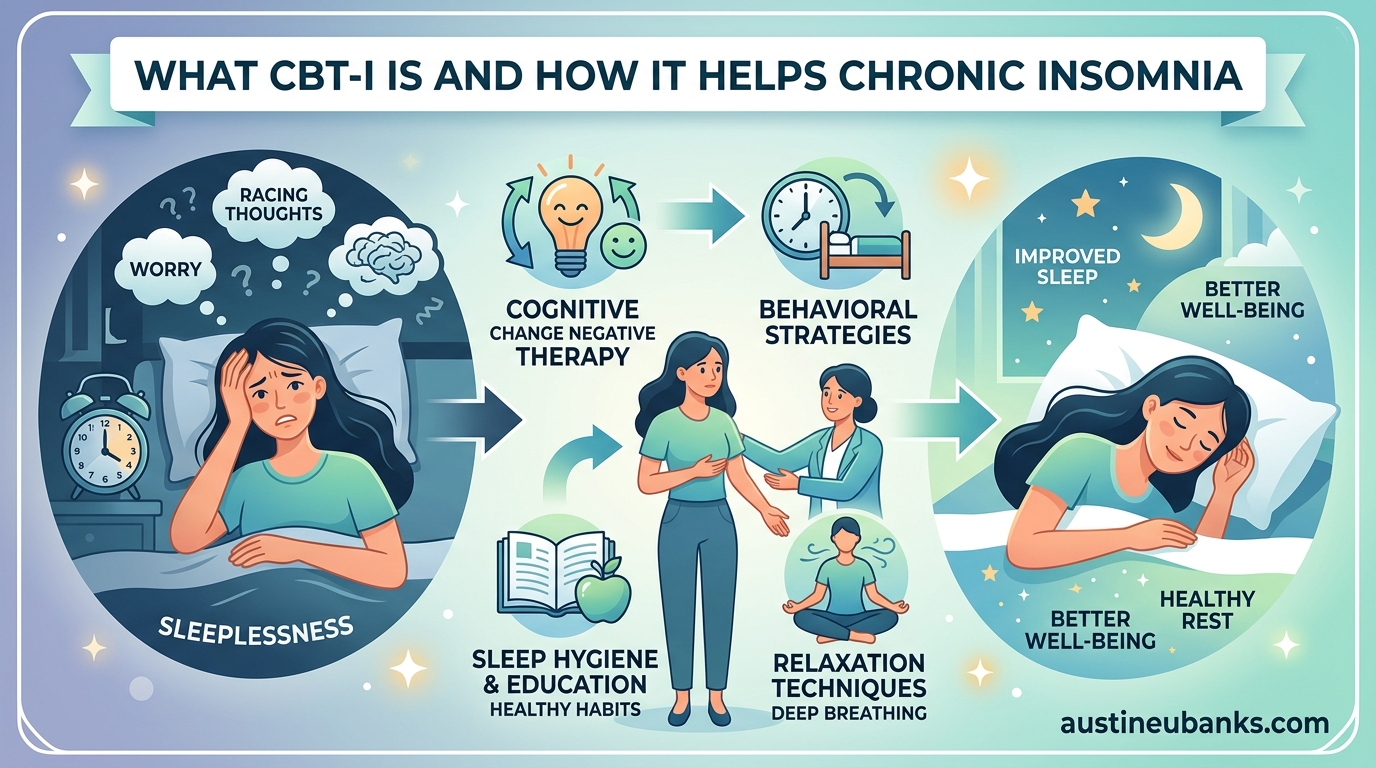
If you have ever lain awake night after night, watching the hours crawl by while your mind refuses to quiet down, you are not alone. Chronic insomnia affects roughly 10% of adults, and many of them feel trapped between sleep medications they do not want to rely on and exhaustion they cannot seem to fix. That is where CBT-I chronic insomnia treatment comes in. Cognitive behavioral therapy for insomnia, or CBT-I, is a structured, evidence-based, non-medication approach that targets the root thoughts and behaviors keeping you awake. It is not talk therapy about your childhood, and it is not a pill. It is a practical, skill-based program that teaches your brain and body how to sleep again.
The American College of Physicians recommends CBT-I as the first-line treatment for chronic insomnia, ahead of sleep medications. That recommendation is not based on hype. Multiple meta-analyses show that 70 to 80% of people who complete CBT-I experience meaningful improvement in their sleep. Some go from two or three sleepless nights per week to zero. In this guide, our team breaks down exactly what CBT-I is, how each component works, what the evidence says, and what you can realistically expect week by week.
I have spent years researching behavioral sleep medicine, and I have talked with dozens of people who have completed CBT-I programs. The pattern is remarkably consistent. The first few weeks are genuinely hard. Then something shifts. Sleep starts to consolidate, the anxiety loosens its grip, and people rediscover what it feels like to fall asleep naturally. Whether you are considering in-person therapy, a digital program, or self-guided work, this article will give you the full picture so you can make an informed decision about whether CBT-I is right for you.
Table of Contents
Key Takeaways: CBT-I at a Glance
Before diving into the details, here are the essentials you need to know about what CBT-I is and how it helps chronic insomnia.
- Definition: CBT-I is a structured, non-medication therapy that combines behavioral techniques and cognitive strategies to treat chronic insomnia at its source.
- Effectiveness: Studies show 70 to 80% of patients experience significant sleep improvement, making it one of the most effective psychological treatments in all of medicine.
- Duration: Most CBT-I programs run 6 to 8 sessions, typically delivered weekly or biweekly over 8 to 12 weeks.
- Recommendation: The American College of Physicians recommends CBT-I as first-line treatment for chronic insomnia, before prescribing sleep medications.
- Long-term results: Unlike sleep pills, the benefits of CBT-I often persist long after treatment ends because you learn lasting skills.
- Components: CBT-I typically includes stimulus control, sleep restriction, cognitive restructuring, sleep hygiene education, and relaxation training.
What Is CBT-I? Understanding the Gold Standard for Insomnia
CBT-I stands for cognitive behavioral therapy for insomnia. It is a specialized, multi-component treatment designed specifically for people who have persistent difficulty falling asleep, staying asleep, or experiencing restorative sleep. Unlike general cognitive behavioral therapy, which addresses a broad range of mental health concerns like depression and anxiety, CBT-I is tightly focused on sleep. Every technique, every session, and every homework assignment is aimed at one goal: helping you sleep better.
Think of it this way. General CBT might explore why you feel anxious in social situations and help you reframe those thoughts. CBT-I explores why your brain has learned to associate your bed with wakefulness and frustration, then systematically retrains that association. The therapy combines cognitive interventions that target unhelpful sleep beliefs with behavioral interventions that reshape your sleep patterns. Together, these components address the perpetuating factors that keep chronic insomnia alive long after whatever originally triggered it has faded.
The term gold standard gets thrown around loosely in healthcare, but in the case of CBT-I, it is well earned. No other insomnia treatment has been studied as extensively or shown as consistent results across diverse populations. Whether you are dealing with primary insomnia or insomnia linked to depression, PTSD, cancer recovery, or chronic pain, CBT-I has demonstrated effectiveness. It works for older adults, younger adults, and people who have relied on sleep medications for years.
How CBT-I Helps Chronic Insomnia: The 3P Model
To understand how CBT-I helps chronic insomnia, you need to understand why insomnia becomes chronic in the first place. Sleep specialists use something called the 3P model, also known as the Spielman three-factor model, to explain this. The three Ps stand for predisposing factors, precipitating factors, and perpetuating factors.
Predisposing factors are the traits that make you vulnerable to insomnia in the first place. These might include a genetic tendency toward hyperarousal, a perfectionist personality, or a naturally sensitive circadian system. You cannot change these factors, but they help explain why some people develop chronic insomnia while others sleep fine under similar circumstances.
Precipitating factors are the events that trigger acute insomnia. A stressful job change, a medical diagnosis, a bereavement, or even a bout of jet lag can kick off a period of poor sleep. Most people recover from acute insomnia within a few weeks as the stressor resolves. But for some, the poor sleep takes on a life of its own.
That is where perpetuating factors come in, and this is exactly what CBT-I targets. Perpetuating factors are the behaviors and thought patterns that keep insomnia going long after the original trigger has disappeared. You start going to bed earlier to compensate for lost sleep, which fragments your sleep further. You lie in bed for hours feeling frustrated, which teaches your brain that the bed is a place of stress. You nap during the day, which weakens your natural sleep drive. You develop catastrophic beliefs about sleep, telling yourself that if you do not get eight hours, you will be useless tomorrow. CBT-I breaks this cycle by systematically addressing each perpetuating factor.
Core Components of CBT-I: Five Pillars of Better Sleep
CBT-I is not a single technique. It is a multicomponent treatment that combines several evidence-based interventions. Most CBT-I programs include some combination of the five core components below. Different therapists may emphasize different elements based on your specific sleep issues, but these are the foundational pillars.
1. Stimulus Control Therapy (SCT)
Stimulus control therapy is about rebuilding the mental association between your bed and sleep. If you have chronic insomnia, your brain has likely learned to associate your bed with wakefulness, frustration, tossing, turning, and anxiety. The goal of stimulus control is to retrain that association so that bed equals sleep.
The rules are straightforward but require discipline. First, use your bed only for sleep and intimacy. No reading, no scrolling, no watching TV, no worrying. Second, go to bed only when you feel genuinely sleepy, not just tired. Third, if you cannot fall asleep within about 20 minutes, get out of bed and do something quiet and dimly lit in another room until you feel sleepy again. This is the famous 15 to 20 minute rule, and it is one of the most powerful tools in CBT-I.
Fourth, maintain a consistent wake time every single day, regardless of how much you slept the night before. Yes, that means weekends too. A fixed wake time anchors your circadian rhythm and stabilizes your sleep-wake cycle. Finally, avoid napping during the day. Naps steal from your nighttime sleep drive and undermine the entire process.
2. Sleep Restriction Therapy (SRT)
Sleep restriction therapy is often the hardest part of CBT-I, but it is also one of the most effective. The concept sounds counterintuitive: to sleep better, you temporarily spend less time in bed. Here is why it works.
When you have chronic insomnia, you probably spend a lot of time in bed not sleeping. You might go to bed at 10 PM, toss until midnight, sleep fitfully until 4 AM, then lie awake until your alarm goes off at 7 AM. That is nine hours in bed with maybe five hours of actual sleep. Your sleep efficiency, which is the percentage of time in bed that you actually spend sleeping, is only about 55%. Your brain has learned that the bed is a place for fragmented, shallow sleep.
Sleep restriction therapy flips this. Your therapist calculates your average actual sleep time from your sleep diary, then prescribes a limited sleep window. If you currently sleep about five hours per night, your initial prescribed time in bed might be five and a half hours. You might be instructed to go to bed at midnight and wake up at 5:30 AM. This creates a powerful build-up of homeostatic sleep drive, the internal pressure that makes you feel sleepy. When you finally get into bed, your brain recognizes it as a sleep opportunity and sleep consolidates. Instead of five fragmented hours, you get five solid, efficient hours.
As your sleep efficiency improves above a target threshold, usually 85 to 90%, your therapist gradually extends your sleep window in 15 or 20 minute increments. Over several weeks, most people build up to a full seven or eight hours of consolidated, high-quality sleep. The process is genuinely uncomfortable in the first two to three weeks. You will feel more tired initially. But as countless Reddit users who have completed CBT-I report, it gets better, and the results can be transformative.
3. Sleep Compression: A Gentler Alternative
Some CBT-I programs use sleep compression instead of strict sleep restriction. Sleep compression follows the same principle but takes a more gradual approach. Instead of sharply cutting your time in bed to match your actual sleep time, your therapist reduces your time in bed incrementally over several weeks. This is often preferred for older adults, people with medical conditions that make severe sleep deprivation risky, or anyone who finds standard SRT too challenging.
The end goal is the same: increasing sleep efficiency by matching your sleep opportunity to your actual sleep ability. The difference is the pace. Sleep compression sacrifices some speed for comfort, which can improve treatment adherence for people who might otherwise quit during the rough early phase.
4. Cognitive Therapy and Cognitive Restructuring
Chronic insomnia does not just affect your body. It warps your thinking. After months or years of poor sleep, people develop what sleep specialists call dysfunctional sleep beliefs. These are the catastrophic, rigid, and inaccurate thoughts about sleep that fuel anxiety and make sleep harder.
You might tell yourself that you absolutely must get eight hours or tomorrow will be a disaster. You might believe that lying in bed resting is almost as good as sleeping. You might catastrophize about the long-term health effects of insomnia, convinced that one bad night will permanently damage your body. These thoughts create cognitive arousal, which is the mental equivalent of revving your engine while parked in the driveway.
Cognitive restructuring helps you identify, challenge, and replace these unhelpful thoughts. Your therapist may ask you to keep thought records where you write down sleep-related worries, examine the evidence for and against them, and develop more balanced alternative thoughts. Instead of telling yourself that a bad night of sleep will ruin your entire week, you learn to acknowledge that you have survived bad nights before and will cope fine. This cognitive shift reduces sleep effort, the desperate trying-hard-to-sleep that paradoxically keeps you awake.
5. Sleep Hygiene Education
Sleep hygiene education covers the environmental and lifestyle factors that affect sleep quality. While sleep hygiene alone is rarely enough to fix chronic insomnia, it creates the foundation upon which the other CBT-I components build. Your therapist will review your caffeine intake, alcohol consumption, exercise timing, light exposure, bedroom environment, and screen habits.
Key sleep hygiene principles include avoiding caffeine within eight hours of bedtime, limiting alcohol which fragments sleep despite its initial sedative effect, maintaining a cool and dark bedroom, and reducing exposure to blue light from screens in the hour before bed. Your therapist may also discuss the importance of a consistent wind-down routine to signal to your brain that sleep is approaching.
One important caveat that forum users frequently highlight: sleep hygiene tips alone will not cure chronic insomnia. If you have had insomnia for months or years, simply cutting back on coffee will not fix the deeply ingrained behavioral and cognitive patterns maintaining your sleep problem. Sleep hygiene is necessary but not sufficient. That is why CBT-I combines it with the more powerful interventions described above.
6. Relaxation Training
Many CBT-I programs include relaxation training to help reduce both physical tension and mental arousal at bedtime. The specific technique varies by therapist and patient preference, but common options include progressive muscle relaxation, diaphragmatic breathing, guided imagery, biofeedback, autogenic training, and mindfulness meditation.
Progressive muscle relaxation involves systematically tensing and releasing each muscle group in your body, moving from your toes to your head. This releases stored physical tension and signals to your nervous system that it is safe to relax. Diaphragmatic breathing focuses on slow, deep belly breathing at a rate of about five or six breaths per minute, which activates the parasympathetic nervous system and lowers heart rate.
The key with relaxation training is regular practice. These techniques work best when you use them consistently, not just on nights when you are already struggling to sleep. Many therapists recommend practicing relaxation during the day first, so the skill becomes automatic before you deploy it at bedtime.
Is CBT-I Effective? Success Rates and Evidence Base
The short answer is yes, CBT-I is highly effective. The longer answer involves understanding what effective means in this context and what the research actually shows.
Multiple randomized controlled trials and meta-analyses have demonstrated that CBT-I produces significant improvements in both sleep onset latency, which is how long it takes to fall asleep, and sleep efficiency. On average, CBT-I reduces the time it takes to fall asleep by 20 to 30 minutes and reduces wakefulness during the night by a similar margin. Many patients see their sleep efficiency improve from below 60% to above 85%.
The success rate commonly cited is 70 to 80%, meaning that roughly three out of four people who complete a full CBT-I program experience clinically significant improvement. Some patients achieve complete remission of their insomnia. Others see substantial but partial improvement. A small percentage, perhaps 15 to 20%, do not respond significantly, and research is ongoing to understand why.
The American College of Physicians issued a landmark clinical guideline recommending that CBT-I be the first-line treatment for chronic insomnia in adults, before medication. The guideline specifically states that CBT-I should be offered as initial therapy, with sleep medications reserved for cases where CBT-I is unsuccessful or unavailable. This recommendation is based on the strength of evidence and the favorable risk-benefit profile compared to medications.
What sets CBT-I apart from sleep medications is its durability. Studies that follow patients for months or years after treatment find that the benefits of CBT-I persist and sometimes even improve over time. You are learning skills, not taking a substance, and those skills continue to work for you long after the therapy sessions end. In contrast, sleep medications typically stop working when you stop taking them, and long-term use carries risks of tolerance, dependence, and side effects.
CBT-I vs Sleep Medications: Which Works Better?
This is one of the most common questions people ask, and it is a gap in most competitor content. Here is an honest, evidence-based comparison.
In the short term, typically defined as the first two to eight weeks, sleep medications and CBT-I are roughly equally effective. Both can help you fall asleep faster and stay asleep longer during active treatment. If you need immediate relief tonight, a sleep medication will likely work faster than CBT-I, which takes several weeks to show full results.
But the picture changes dramatically when you look at long-term outcomes. Studies that compare CBT-I to sleep medications over periods of six months or longer consistently show CBT-I as superior. Patients who complete CBT-I maintain their sleep improvements, while patients who rely on medications often see their sleep deteriorate once they stop taking the pills. This is because medications manage symptoms without addressing the underlying behavioral and cognitive patterns driving the insomnia.
Side effect profiles also differ significantly. Common side effects of prescription sleep medications include daytime grogginess, cognitive impairment, increased fall risk (especially in older adults), complex sleep behaviors like sleepwalking or sleep-eating, and the risk of psychological or physical dependence. CBT-I side effects are primarily limited to the initial increase in daytime sleepiness during the sleep restriction phase, which resolves as treatment progresses.
Cost is another factor. While CBT-I sessions with a therapist can be expensive upfront, the long-term cost is often lower because you complete treatment in a few months and maintain the benefits indefinitely. Sleep medications, by contrast, may be needed for months or years, with ongoing costs and potential health risks accumulating over time.
For many people, the best approach is a combination. Some clinicians recommend short-term medication to provide immediate relief while you work through the CBT-I program, then tapering off the medication as your sleep skills take hold. This is a decision to make with your healthcare provider based on your specific situation.
What to Expect: A Week-by-Week CBT-I Timeline
One of the biggest content gaps our team identified is that almost no one provides a realistic week-by-week timeline of what CBT-I actually feels like. Forum users consistently say this is what they wished they had known before starting. So here is an honest breakdown based on the standard 6 to 8 session CBT-I protocol.
Weeks 1 to 2: Assessment and Baseline
Your first one or two sessions focus on assessment, not intervention. Your therapist will take a detailed sleep history, ask about your daily schedule, caffeine and alcohol use, medical conditions, medications, and stress levels. You will start keeping a consensus sleep diary, recording your bedtime, wake time, estimated sleep time, number of awakenings, and daytime functioning each day.
This phase can feel frustrating if you are eager to fix your sleep immediately. But the assessment is critical because it gives your therapist the data needed to design your personalized sleep prescription. Be honest in your sleep diary. Estimates are fine, but try to record entries each morning rather than trying to reconstruct a week of sleep from memory at your next appointment.
Weeks 2 to 4: Sleep Restriction Begins
This is the phase that every forum user warns about. Your therapist will calculate your average sleep time from your diary and prescribe a restricted sleep window. If you have been spending nine hours in bed but only sleeping five, you may be asked to limit your time in bed to five and a half hours.
The first one to two weeks of sleep restriction are genuinely hard. You will feel more tired during the day. Your sleep drive will be high, which is the point, but the limited sleep window can feel punishing if you are used to spending extra time in bed hoping to catch more sleep. Expect some irritability, brain fog, and a strong temptation to nap or sleep in on weekends.
Here is the critical message from people who have been through it: push through. The discomfort is temporary and serves a purpose. Your sleep drive needs to build up high enough to consolidate your sleep, and that requires a period of restriction. By the end of week 3 or 4, most people start to notice that their sleep is becoming more solid. They fall asleep faster when they get into bed and wake up less during the night.
Weeks 4 to 6: Cognitive Work and Adjustments
Once your sleep starts to stabilize, your therapist will shift more attention to cognitive restructuring. This is where you examine the thoughts and beliefs that have been fueling your sleep anxiety. You might work on challenging the belief that you must get a specific number of hours to function, or reframe catastrophic predictions about what will happen after a bad night.
Your therapist will also begin adjusting your sleep window. If your sleep efficiency has improved above the target threshold, you will gradually add time back in 15 or 20 minute increments. This is typically done weekly based on your ongoing sleep diary data. The adjustments are conservative and data-driven, not arbitrary.
This is also when many people start to feel hopeful for the first time in months or years. The sleep improvements become noticeable enough to build confidence in the process, which itself reduces sleep anxiety. It is a positive feedback loop: better sleep leads to less anxiety, which leads to even better sleep.
Weeks 6 to 8: Consolidation and Relapse Prevention
The final sessions focus on maintaining your gains and preventing relapse. Your therapist will help you develop a personalized relapse prevention plan. This typically includes identifying your early warning signs of insomnia returning, knowing which CBT-I techniques to deploy if sleep deteriorates, and having a plan for how to respond.
Relapse prevention is not about being perfect. Almost everyone has occasional bad nights, even after successful CBT-I. The difference is that after treatment, you have the tools to get back on track quickly instead of spiraling back into chronic insomnia. Your therapist will emphasize that a bad night is not a relapse, but abandoning your sleep schedule and reverting to old habits can lead to one.
After Treatment: Long-Term Maintenance
Most people who complete CBT-I maintain their improvements for months or years afterward. Studies show that the skills you learn continue to work without ongoing therapy sessions. Some people benefit from occasional booster sessions if they hit a rough patch, but the majority manage independently using the techniques they learned.
A key insight from forum users: the people who maintain their results long-term are those who internalize the principles rather than just following rules mechanically. Understanding why stimulus control works, why sleep restriction helps, and why catastrophic sleep beliefs are counterproductive makes it much easier to stay on track when life gets stressful.
Who Can Benefit from CBT-I?
CBT-I is appropriate for most adults with chronic insomnia disorder. Chronic insomnia is defined clinically as difficulty falling asleep or staying asleep at least three nights per week for three months or longer, accompanied by daytime impairment. If that describes your situation, CBT-I is likely appropriate for you.
CBT-I is particularly valuable for people with comorbid conditions. Research shows it is effective for people whose insomnia coexists with depression, anxiety disorders, PTSD, chronic pain, cancer recovery, and obstructive sleep apnea being treated with CPAP. In fact, CBT-I can sometimes improve the comorbid condition itself, as better sleep reduces depression severity, anxiety levels, and pain sensitivity.
Older adults respond well to CBT-I, sometimes even better than younger adults. This is significant because older adults are also at higher risk for medication side effects like falls and cognitive impairment. For this population, CBT-I is not just effective but safer than pharmaceutical alternatives.
CBT-I also works for people who have been taking sleep medications for years. In fact, it is often used as part of a medication tapering protocol. If you have been relying on prescription sleep aids and want to reduce or eliminate them, CBT-I gives you the behavioral tools to maintain sleep without pharmacological support.
Who might not respond as well? CBT-I may be less effective for people whose primary sleep problem is not insomnia but rather a circadian rhythm disorder like delayed sleep phase syndrome, a sleep breathing disorder, or periodic limb movement disorder. It is also important to note what one Reddit psychologist who practices CBT-I pointed out: not everyone who cannot sleep has insomnia. Sleep apnea, restless legs syndrome, and other sleep disorders require different treatments. A proper diagnosis is essential before starting CBT-I.
People with severe, untreated mental health conditions, active substance use disorders, or unstable medical conditions may need those issues addressed first. CBT-I requires a certain level of cognitive engagement and behavioral consistency. If you are in acute crisis, stabilizing your immediate situation should take priority.
Digital and Online CBT-I Options
One of the most common questions on forums is whether you can do CBT-I without a therapist. The answer is yes, and the options have expanded significantly in recent years. Digital CBT-I, sometimes abbreviated as dCBT-I, includes everything from free government apps to prescription digital therapeutics.
The CBT-I Coach app is a free tool developed by the Department of Veterans Affairs and Stanford University. It provides sleep diary tracking, psychoeducational content, relaxation exercises, and guidance on stimulus control and sleep restriction. It is designed as a companion to therapy, not a replacement for it, but many people use it as a self-help tool. The app has strong reviews on Reddit and is frequently recommended by sleep specialists.
Sleepio is a well-studied digital CBT-I program that uses an animated sleep expert to guide users through six weekly sessions. It has been tested in multiple randomized controlled trials and shows effectiveness comparable to in-person therapy for many users. Somryst is another digital therapeutic that has received FDA clearance as a prescription treatment for chronic insomnia. Your doctor can prescribe it, and some insurance plans cover it.
SHUTi, which stands for Sleep Healthy Using the Internet, is another evidence-based online program. It has been studied extensively and demonstrates solid results in clinical trials. These digital programs typically cost less than in-person therapy and offer the convenience of completing sessions on your own schedule.
Telehealth CBT-I is another growing option. Many licensed therapists now offer CBT-I via video sessions, which expands access for people who do not have a qualified provider nearby. This format provides the personal guidance of working with a therapist while eliminating geographic barriers. The Society of Behavioral Sleep Medicine maintains a directory of certified providers, many of whom offer telehealth.
Self-help books can also be effective for motivated individuals. There are several well-regarded CBT-I workbooks available that walk readers through the core techniques. The advantage of a workbook is low cost and flexibility. The disadvantage is lack of personalized guidance, which matters most during the challenging sleep restriction phase.
Here is how the formats compare. In-person therapy offers the most personalized guidance but is the most expensive and may be hard to find locally. Digital programs are convenient and affordable but require self-discipline. Telehealth CBT-I splits the difference, offering professional guidance with geographic flexibility. Self-help books are the most affordable but offer the least support. For most people, the best approach is the one they will actually stick with.
Tips for Success with CBT-I
Based on the experiences of people who have completed CBT-I programs and the clinical literature on treatment adherence, here are the most important tips for getting the most out of CBT-I.
Commit to the full program. CBT-I is typically 6 to 8 sessions over 8 to 12 weeks. The biggest reason people fail to improve is that they quit during the difficult early phase of sleep restriction. Understand going in that the first two to three weeks will be challenging and plan accordingly. Clear your calendar of non-essential commitments if possible.
Keep your sleep diary every single day. Your sleep diary is the primary tool your therapist uses to adjust your treatment. Skipping entries or filling them out retroactively reduces accuracy. Keep your diary by your bedside and fill it in within minutes of waking up each morning.
Stick to your prescribed wake time, especially on weekends. This is the single most important behavioral rule in CBT-I. A consistent wake time anchors your circadian rhythm and stabilizes your sleep-wake cycle. Sleeping in on weekends to catch up after a bad week feels good in the moment but undermines your progress. Forum users consistently identify weekend schedule lapses as the most common reason for treatment setbacks.
Do not nap. Napping reduces your homeostatic sleep drive and makes it harder to consolidate your nighttime sleep. If you absolutely must rest during the day, keep it under 20 minutes and do it before 3 PM. Better yet, use relaxation techniques that do not involve actually falling asleep.
Practice your relaxation techniques during the day. Do not wait until you are lying awake at 2 AM to try progressive muscle relaxation for the first time. Practice during calm moments so the technique becomes automatic and accessible when you need it at bedtime.
Be honest with your therapist. If you are struggling with the sleep restriction, say so. If you have been napping or sleeping in on weekends, report it. Your therapist cannot help you adjust your plan if they do not have accurate information. There is no judgment in CBT-I, only data-driven problem solving.
Find a qualified provider. Not every therapist is trained in CBT-I. Look for providers certified in behavioral sleep medicine. The Society of Behavioral Sleep Medicine and the American Board of Sleep Medicine both maintain directories of certified providers. If no one is available locally, consider telehealth options.
Address sleep anxiety early. If your primary struggle is anxiety about sleep rather than the mechanics of falling asleep, emphasize this with your therapist. Cognitive restructuring techniques can be front-loaded to help you manage the fear and catastrophic thinking that often accompanies chronic insomnia.
Risks and Considerations
CBT-I is considered very safe compared to pharmacological treatments, but it is not without considerations. Understanding these upfront helps you make an informed decision.
The primary side effect is the temporary increase in daytime sleepiness during the sleep restriction phase. For most people, this lasts one to three weeks and resolves as sleep consolidates. However, if you operate heavy machinery, drive for a living, or have a job where daytime drowsiness poses safety risks, discuss this with your therapist. Sleep compression may be a more appropriate alternative.
People with bipolar disorder should be monitored carefully, as sleep deprivation can potentially trigger manic episodes in susceptible individuals. If you have a history of mania, your psychiatrist should be involved in the decision to pursue CBT-I and the sleep restriction parameters should be adjusted accordingly.
People with seizure disorders may need modified protocols, as significant sleep deprivation can lower seizure thresholds. Pregnant women should discuss their situation with their healthcare provider, though CBT-I is generally considered safe during pregnancy and is often preferred over medications.
CBT-I is not a quick fix. It requires active participation, homework completion, and behavioral consistency over several weeks. If you are not in a place where you can commit to the process, the results will likely be disappointing. This is not a passive treatment where something is done to you. It is an active skill-building program where you are the primary agent of change.
Finally, as noted earlier, CBT-I treats insomnia. If your sleep problem is caused by untreated sleep apnea, restless legs syndrome, circadian rhythm disorders, or other primary sleep disorders, CBT-I alone will not solve it. A comprehensive sleep evaluation is important to ensure you have the right diagnosis before investing time and money in CBT-I.
Common Myths About CBT-I
Several myths about CBT-I circulate on forums and even in some popular articles. Let me address the most common ones.
Myth: CBT-I is just sleep hygiene advice. Reality: Sleep hygiene is one small component of CBT-I, and by itself it is rarely enough to fix chronic insomnia. The powerful elements are stimulus control, sleep restriction, and cognitive restructuring, none of which are covered by basic sleep hygiene tips.
Myth: CBT-I takes too long to work. Reality: Most people see meaningful improvement within 2 to 4 weeks of starting the behavioral components, and full results within 6 to 8 weeks. For a condition that has lasted months or years, 8 weeks is a relatively short investment.
Myth: If you have severe insomnia, CBT-I will not work. Reality: CBT-I has been shown effective across the spectrum of insomnia severity. Some of the most dramatic improvements occur in people with the most entrenched, long-standing insomnia.
Myth: You need a therapist to do CBT-I. Reality: While working with a trained provider produces the best results, digital programs, telehealth, and self-help workbooks can also be effective for motivated individuals.
Myth: CBT-I is just relaxation training. Reality: Relaxation is one optional component. The core of CBT-I is behavioral change through stimulus control and sleep restriction, plus cognitive change through restructuring unhelpful sleep beliefs.
FAQs
What is CBT-I and how does it work?
CBT-I, or cognitive behavioral therapy for insomnia, is a structured, non-medication treatment that helps people with chronic insomnia by targeting the thoughts, behaviors, and habits that interfere with sleep. It works through stimulus control to re-associate your bed with sleep, sleep restriction to build a stronger natural sleep drive, and cognitive restructuring to challenge unhelpful beliefs about sleep.
How effective is CBT-I for chronic insomnia?
CBT-I has a success rate of approximately 70 to 80%, meaning the majority of people who complete a full program experience clinically significant improvement in their sleep. The American College of Physicians recommends CBT-I as the first-line treatment for chronic insomnia, ahead of sleep medications, based on decades of research demonstrating its effectiveness.
How long does CBT-I treatment take?
Most CBT-I programs consist of 6 to 8 sessions delivered weekly or biweekly over 8 to 12 weeks. Many people begin noticing sleep improvements within the first 2 to 4 weeks of starting the behavioral components, particularly sleep restriction and stimulus control therapy.
What is the 15 to 20 minute rule for insomnia?
The 15 to 20 minute rule is a core part of stimulus control therapy in CBT-I. If you cannot fall asleep within about 20 minutes, you should get out of bed, go to another room, and do something quiet and calming under dim lighting until you feel genuinely sleepy. Then return to bed. This prevents your brain from associating your bed with wakefulness and frustration.
What is the gold standard treatment for chronic insomnia?
CBT-I is widely recognized as the gold standard treatment for chronic insomnia. The American College of Physicians formally recommends it as first-line therapy, and it is endorsed by major organizations including the Sleep Research Society and the American Academy of Sleep Medicine based on its strong evidence base and favorable long-term outcomes compared to medications.
Can I do CBT-I at home without a therapist?
Yes, you can do CBT-I at home using digital programs, apps like CBT-I Coach, online platforms such as Sleepio or Somryst, or self-help workbooks. These options are generally more affordable and convenient than in-person therapy. However, working with a certified behavioral sleep medicine specialist typically produces the best results, especially during the challenging sleep restriction phase.
Is CBT-I covered by insurance?
Coverage for CBT-I varies widely depending on your insurance plan and location. Many plans cover CBT-I when provided by a licensed mental health professional, though you may need a referral or pre-authorization. Digital programs like Somryst may be covered as a prescription digital therapeutic. Check with your insurance provider to understand your specific benefits and any out-of-pocket costs.
What is the hardest part of CBT-I?
The hardest part of CBT-I is typically the first 2 to 3 weeks of sleep restriction therapy. During this phase, you temporarily reduce your time in bed, which initially increases daytime sleepiness. Forum users consistently report that this period is challenging but emphasize that pushing through it leads to significant sleep improvements. Having a clear plan and understanding why the discomfort is temporary helps many people stay committed.
Conclusion: Taking the Next Step Toward Better Sleep
CBT-I chronic insomnia treatment represents the best that evidence-based medicine has to offer for persistent sleep problems. It addresses the root causes of chronic insomnia rather than masking symptoms, it teaches skills that last a lifetime, and it carries a fraction of the risk associated with long-term sleep medication use. With a 70 to 80% success rate and the backing of the American College of Physicians as a first-line recommendation, it is the treatment most worth trying if you have been struggling with sleep for three months or longer.
If you are ready to take the next step, start by talking to your doctor about whether CBT-I is appropriate for your situation. Ask about local providers certified in behavioral sleep medicine, or explore telehealth and digital options if local access is limited. Check whether your insurance covers CBT-I sessions, and consider starting a sleep diary now so you have baseline data ready for your first appointment. You can also download the free CBT-I Coach app to begin learning the core concepts.
Chronic insomnia can feel inescapable, but it is treatable. Thousands of people who once lay awake every night have used CBT-I to rebuild their relationship with sleep. The process requires commitment and the first few weeks are hard. But the evidence, the clinical guidelines, and the real experiences of people who have completed the program all point to the same conclusion: CBT-I works, and it is worth the effort.