
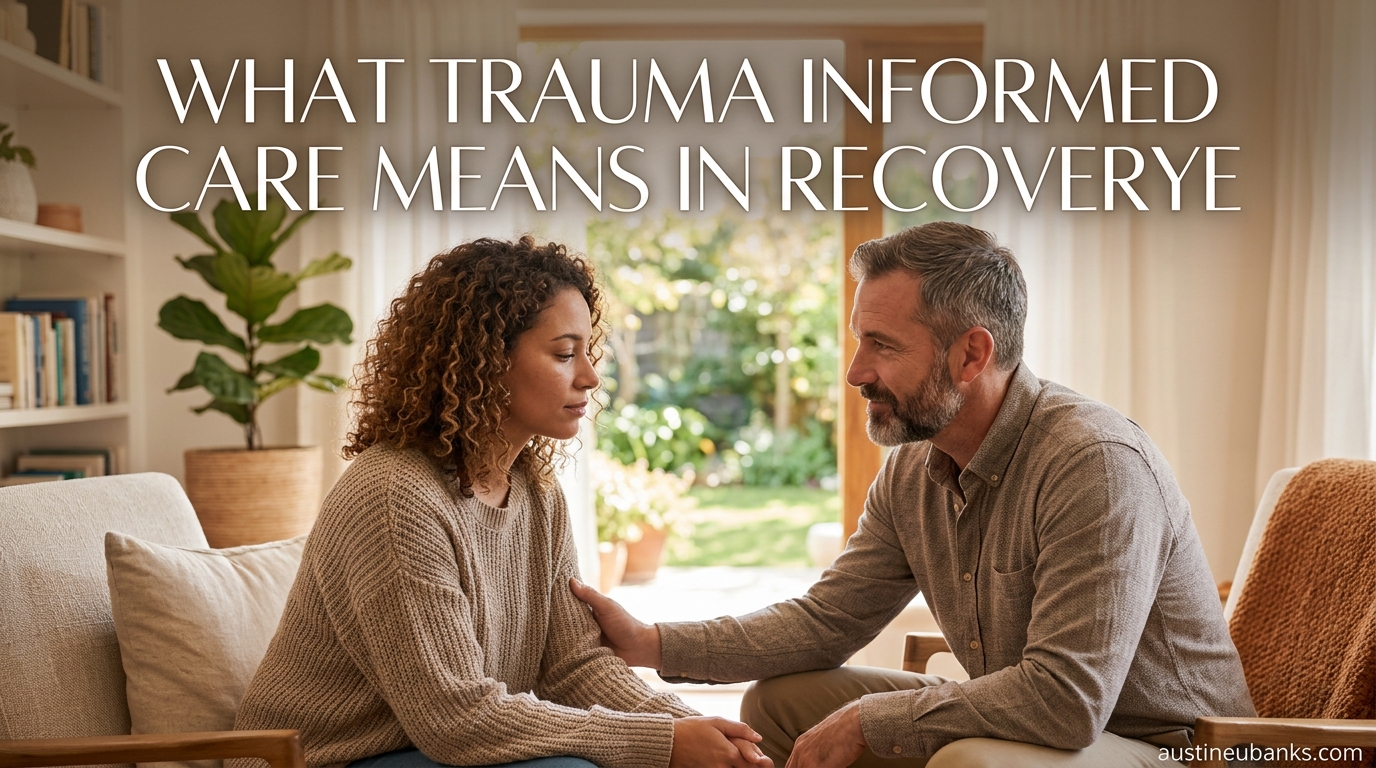
If you have ever sat in a treatment setting and felt like the program was checking boxes instead of actually seeing you, you are not alone. Many people entering recovery carry wounds that go far deeper than the substance, behavior, or condition they are being treated for. Understanding what trauma-informed care means in recovery can change everything about how healing happens.
Our team has spent years researching recovery models, talking with people in treatment, and studying the frameworks that actually move the needle. What we have found is that trauma-informed care is not a buzzword or a marketing label. It is a fundamentally different way of approaching healing that asks “what happened to you?” instead of “what is wrong with you?”
In this guide, we break down exactly what trauma-informed care in recovery looks like, why it matters, and how you can tell whether your treatment is truly trauma-informed. Whether you are navigating your own recovery, supporting a loved one, or working in the field, this information could reshape how you think about the healing process.
Table of Contents
What Trauma-Informed Care Means in Recovery
Trauma-informed care in recovery is an approach that recognizes the widespread impact of trauma on people seeking healing from addiction, mental health challenges, or both, and integrates that understanding into every part of the treatment experience. It shifts the core question from “what is wrong with you?” to “what happened to you?” and then to “what is strong with you?”
The Substance Abuse and Mental Health Services Administration (SAMHSA) defines a trauma-informed approach as one that realizes the widespread impact of trauma, recognizes the signs and symptoms, responds by integrating trauma knowledge into practices, and actively resists re-traumatization. This definition provides the foundation for how trauma-informed care operates across recovery settings.
Here is the key distinction that many people miss. Trauma-informed care is not the same as trauma-specific therapy. Trauma-specific therapies like EMDR or Trauma-Focused CBT are specific treatments designed to process traumatic memories. Trauma-informed care is the broader environment and philosophy that wraps around all treatment. It is how care is delivered, not just what treatment is used.
Think of it this way. A trauma-specific therapy is the tool. Trauma-informed care is the hand that holds it. You can offer the best evidence-based trauma therapy in the world, but if the environment feels unsafe, the intake process feels punitive, or the staff lacks training in trauma sensitivity, the therapy may never get the chance to work.
This is why trauma-informed care matters at every level of recovery. From the first phone call to a treatment center, to the layout of the waiting room, to how group therapy is facilitated, to how medication is managed, every touchpoint either builds safety or erodes it. For someone whose nervous system has been shaped by trauma, those details are not small. They are the difference between staying in treatment and walking out the door.
The Trauma-Recovery Connection
To understand why trauma-informed care matters so much in recovery, you need to understand how deeply trauma and recovery challenges are connected. Research consistently shows that trauma is not a side issue in recovery. For most people, it is the central issue.
SAMHSA reports that approximately 75 percent of people in addiction treatment have experienced trauma. The CDC’s Adverse Childhood Experiences (ACEs) study found that nearly two-thirds of people who inject drugs reported at least one ACE, and the risk of substance use increases dramatically with each additional ACE score. These are not marginal correlations. They represent the lived reality of most people walking into treatment.
What Are Adverse Childhood Experiences (ACEs)?
ACEs are potentially traumatic events that occur in childhood, from abuse and neglect to household dysfunction like living with someone who has a substance use disorder or experiencing parental separation. The ACE study identified 10 specific experiences and found that higher ACE scores correlate with dramatically higher risks for addiction, depression, heart disease, and a range of other health conditions in adulthood.
An ACE score of 4 or more increases the risk of substance use disorders by 500 percent compared to someone with a score of zero. A score of 6 or more reduces life expectancy by an average of 20 years. These numbers are not abstract. They represent real people whose bodies and brains were shaped by experiences that were never their fault.
Why Self-Medication Is Not a Moral Failure
The connection between trauma and substance use is often described through the self-medication hypothesis. When someone experiences trauma, especially chronic trauma in childhood, their nervous system becomes locked in a state of hyperarousal or dissociation. Substances can temporarily quiet that internal alarm system.
Alcohol can numb emotional pain. Opioids can create a sense of safety and warmth that trauma survivors may never have felt. Stimulants can counteract the flatness and exhaustion that come with chronic stress. What looks like a destructive choice from the outside is often a survival strategy from the inside.
This is why telling someone to “just stop” without addressing the underlying trauma is like removing a bandage without treating the wound underneath. The bleeding does not stop. It just finds another way out.
Beyond Addiction: Trauma in Mental Health Recovery
Most content about trauma-informed care focuses exclusively on addiction recovery. But trauma plays an equally central role in recovery from depression, anxiety disorders, PTSD, eating disorders, and other mental health conditions.
Depression and trauma are frequently co-occurring, with studies showing that people with high ACE scores are significantly more likely to experience chronic depression. Anxiety disorders often have roots in traumatic experiences that taught the nervous system that the world is fundamentally unsafe. Eating disorders frequently develop as a way to regain control after experiences that stripped it away.
When we talk about trauma-informed care in recovery, we are talking about an approach that applies whether someone is recovering from opioid addiction, treatment-resistant depression, complex PTSD, or an eating disorder. The principles are the same because the underlying mechanism is the same. Trauma changes how the brain and body process threat, and recovery requires an environment that understands that.
Co-Occurring Disorders and Dual Diagnosis
In reality, most people in recovery do not have just one thing. Co-occurring disorders, also called dual diagnosis, are the norm rather than the exception. Someone may struggle with both addiction and PTSD, or depression and substance use, or an eating disorder and anxiety.
Trauma-informed care recognizes that these conditions do not exist in silos. They are interconnected responses to underlying experiences. Treating them requires an integrated approach that addresses the whole person, not just a diagnostic label.
The 4 R’s Framework: SAMHSA’s Foundation
SAMHSA organizes its trauma-informed approach around what it calls the Four R’s. These four concepts provide the foundation for understanding how any organization or individual can become trauma-informed.
1. Realize the widespread impact of trauma and understand potential paths for recovery. This means recognizing that trauma affects people across every demographic and that it shapes behavior, relationships, and health in profound ways. Realization is about awareness at the organizational and individual level.
2. Recognize the signs and symptoms of trauma in clients, families, staff, and others involved with the system. Recognition means being able to identify trauma responses, understanding that behaviors like anger, withdrawal, or resistance are often trauma-driven rather than willful defiance.
3. Respond by integrating knowledge about trauma into policies, procedures, practices, and settings. Response is where awareness becomes action. It means changing how intake is conducted, how rules are enforced, how feedback is given, and how treatment plans are developed.
4. Resist re-traumatization by actively working to prevent practices that may trigger or worsen trauma responses. This means examining every policy and practice through a trauma lens and asking whether it could cause harm, even unintentionally.
The Four R’s are not a checklist you complete once. They are an ongoing practice of awareness, recognition, response, and resistance that should permeate every aspect of a recovery program.
The Core Principles of Trauma-Informed Care in Recovery
Beyond the Four R’s, SAMHSA identifies six core principles that guide trauma-informed approaches. These principles, originally developed from the work of Drs. Maxine Harris and Roger Fallot, provide a practical framework for what trauma-informed care looks like in action.
Understanding these principles can help you evaluate whether a treatment program, therapist, or recovery community is genuinely trauma-informed or simply using the label.
1. Safety
Safety in trauma-informed care means both physical and psychological safety. Physically, the environment should feel calm, welcoming, and free from threats. Psychologically, people should feel respected, heard, and free to express themselves without fear of judgment or punishment.
In recovery settings, safety looks like private spaces for difficult conversations, clear and predictable schedules, staff who introduce themselves and explain what they are doing, and an atmosphere where asking for help is met with support rather than consequences. For someone whose trauma involved loss of control, predictability and transparency are not luxuries. They are therapeutic necessities.
2. Trustworthiness and Transparency
Trust is built through consistent, honest, and clear communication. Trauma-informed programs operate with transparency about decisions, policies, and expectations. There are no hidden agendas, no surprise consequences, and no information withheld as a form of control.
In practice, this means explaining why certain rules exist, giving advance notice of changes, being honest about what treatment can and cannot do, and following through on promises. For trauma survivors whose trust has been violated, consistency is the only thing that rebuilds it.
3. Peer Support
Peer support involves individuals with lived experience of trauma and recovery helping guide others through the process. Peer supporters bring credibility that clinical staff alone cannot provide because they have walked the path themselves.
In recovery, peer support looks like certified peer specialists, alumni mentors, and peer-led groups where people can connect with others who truly understand. This principle recognizes that healing happens in relationship and that shared experience is a powerful therapeutic tool.
4. Collaboration and Mutuality
Collaboration means partnering with individuals in recovery rather than doing things to them or for them. The provider is not the authority who dispenses treatment to a passive recipient. Instead, provider and client work together as equal partners in the healing process.
This principle shows up in shared decision-making, treatment plans developed with the client rather than handed down to them, and an organizational culture where power is shared rather than hoarded. It also extends to how staff relate to each other, since hierarchical, punitive workplaces cannot truly deliver trauma-informed care.
5. Empowerment, Voice, and Choice
Empowerment means recognizing and building on individual strengths rather than focusing solely on deficits. Voice means ensuring that people in recovery have a meaningful say in their treatment. Choice means offering options and respecting autonomy whenever possible.
For trauma survivors, whose choices were often overridden or ignored, having a voice in their own recovery is itself therapeutic. This principle shows up in offering multiple treatment modalities, allowing clients to set the pace of trauma work, respecting the right to decline certain activities, and celebrating progress rather than punishing setbacks.
6. Cultural, Historical, and Gender Issues
Trauma does not happen in a vacuum. It intersects with culture, race, gender identity, sexual orientation, and historical experience. Trauma-informed care actively addresses these dynamics rather than treating everyone as though their identities and histories do not matter.
This principle means offering gender-responsive programming, being LGBTQ+ affirming, acknowledging historical and racial trauma, providing culturally competent care, and recognizing that systemic oppression is itself a form of trauma. It also means examining implicit bias within the organization and actively working to create inclusive environments.
For many people in recovery, cultural and historical trauma is not a footnote. It is central to their experience. A recovery program that ignores these dimensions cannot truly call itself trauma-informed.
Trauma-Informed Therapies Used in Recovery
While trauma-informed care is the broader environment, trauma-specific therapies are the evidence-based tools used within that environment to help people process and heal from traumatic experiences. Here are the most widely used and researched trauma therapies in recovery settings.
EMDR (Eye Movement Desensitization and Reprocessing)
EMDR uses bilateral stimulation, typically through guided eye movements, to help the brain reprocess traumatic memories so they lose their emotional charge. It is one of the most researched trauma therapies and is recommended by the APA and VA for PTSD treatment. Many people in recovery find that EMDR helps them address the root experiences that drove their substance use or mental health symptoms without needing to talk about them in exhaustive detail.
Trauma-Focused Cognitive Behavioral Therapy (TF-CBT)
TF-CBT is a structured therapy that helps individuals identify and change negative thought patterns related to traumatic experiences. Originally developed for children and adolescents, it has been adapted for adults and is widely used in recovery settings. It combines cognitive restructuring with exposure techniques and skills building.
Somatic Experiencing
Somatic experiencing is based on the understanding that trauma is stored in the body, not just the mind. This approach helps individuals become aware of physical sensations associated with trauma and gradually release stored stress responses. For people in recovery who feel disconnected from their bodies, somatic work can be a powerful complement to traditional talk therapy.
Cognitive Processing Therapy (CPT)
CPT is a 12-session structured therapy specifically designed for PTSD. It helps individuals examine and challenge beliefs that formed after trauma, such as “I am to blame” or “the world is completely dangerous.” CPT has strong evidence for treating trauma in veterans, assault survivors, and people with co-occurring substance use disorders.
Dialectical Behavior Therapy (DBT)
DBT was originally developed for borderline personality disorder but has proven effective for trauma-related conditions, especially when emotional dysregulation is a primary challenge. DBT teaches skills in four areas: mindfulness, distress tolerance, emotion regulation, and interpersonal effectiveness. For people in early recovery who are struggling to manage intense emotions without substances, DBT skills can be lifesaving.
Brainspotting
Brainspotting is a newer therapy that uses visual field positions to access and process trauma stored in the brain. The therapist helps the client identify a “brainspot” related to a traumatic experience, and the processing happens through fixed eye position rather than bilateral movement. Many people who have not responded to other therapies report significant improvement with brainspotting.
Neurofeedback
Neurofeedback uses real-time brain wave monitoring to help individuals train their brain activity toward more regulated patterns. For trauma survivors whose nervous systems are stuck in fight-or-flight mode, neurofeedback can help build the capacity for calm and present-moment awareness. It is increasingly used in recovery programs as a complement to traditional therapy.
No single therapy works for everyone. What matters is that the recovery program offers options, respects individual preferences, and integrates these therapies within a trauma-informed environment where people feel safe enough to do the work.
What Trauma-Informed Care Looks Like in Practice
Principles and frameworks are important, but what does trauma-informed care actually look like when you walk through the door of a treatment center or join a recovery community? Here are concrete examples of how these principles translate into everyday practice.
Intake and Assessment
In a trauma-informed program, intake is not an interrogation. Staff explain who they are, what they will ask, and why. They give the person control over what to share and when. Sensitive questions are introduced gradually, with permission sought before proceeding. The person is told they can take breaks, decline to answer, or stop the process entirely.
Compare this to a traditional intake where someone is handed a clipboard with a long questionnaire, asked about their most painful experiences by a stranger within the first ten minutes, and given no context for why the information is needed. For a trauma survivor, that experience can feel like a violation before treatment has even begun.
Group Therapy Modifications
In trauma-informed group therapy, sharing is always voluntary. No one is pressured to tell their story before they are ready. The facilitator establishes ground rules that include confidentiality, respect, and the right to pass. Trigger warnings are given before difficult topics are discussed. The physical space allows people to sit where they feel comfortable, near an exit if needed.
This stands in contrast to traditional group models that may use confrontation, require sharing as a condition of participation, or pressure people to “be honest” in ways that feel unsafe. Many people in recovery report that traditional group formats felt re-traumatizing because they were forced to share before they were ready or were challenged in ways that felt like attack rather than support.
Community-Based Recovery and Peer Support
Trauma-informed care does not stop at the treatment center door. It extends into community-based recovery settings like 12-step meetings, SMART Recovery, and peer support groups. While these programs were not originally designed with trauma in mind, many are evolving to become more trauma-aware.
In a trauma-informed meeting, sharing is optional, crosstalk is minimized, and no one is told they are not working hard enough if they need to go at their own pace. Speakers avoid graphic descriptions that could trigger others. Newcomers are welcomed without pressure. The message is that you belong here, exactly as you are, and you can participate at whatever level feels right.
If you have ever left a meeting feeling worse than when you arrived, you are not alone. Many people in recovery report that traditional meeting formats felt re-traumatizing due to forced sharing, lack of trauma awareness among members, or being told that questioning the program means they are “in denial.” A trauma-informed approach to community recovery recognizes that one size does not fit all and that safety comes first.
The Physical Environment
Trauma-informed care pays attention to physical space. Lighting is soft rather than fluorescent. Waiting areas feel calm rather than clinical. Private spaces are available for difficult conversations. Rooms are arranged so no one feels trapped. Artwork and decor are chosen to create warmth rather than sterility.
These details may seem small, but for a nervous system shaped by trauma, the physical environment sends constant signals about whether this place is safe or dangerous. A harsh environment can keep someone in a state of low-grade alertness that makes therapeutic work nearly impossible.
Re-Traumatization: What It Is and How to Recognize It
Re-traumatization happens when an experience in the present triggers a trauma response that mirrors or intensifies the original trauma. It can happen in treatment settings, in relationships, in community spaces, or anywhere that someone encounters a situation that echoes their original wounding.
Understanding re-traumatization is essential because well-meaning treatment providers can unintentionally cause it. A rigid rule enforcement that mirrors authoritarian abuse. A forced disclosure that echoes being made to feel powerless. A confrontational group dynamic that recreates the feeling of being attacked. None of these are intentional, but the impact is real.
Common Re-Traumatization Scenarios in Recovery
Re-traumatization can happen in ways that are easy to miss. Being searched or having belongings gone through without explanation can echo experiences of violation. Being awakened abruptly or having a door opened without knocking can trigger responses in people whose trauma involved a loss of bodily autonomy.
Being told that relapse is a “choice” or that you are “not ready” can echo the blame and shame that many trauma survivors already carry. Being placed in a mixed-gender group without being asked can feel unsafe for survivors of sexual trauma. Being given ultimatums or having treatment withdrawn as punishment can recreate the powerlessness that defined the original trauma.
Recognizing Re-Traumatization in Yourself
If you are in recovery, learning to recognize re-traumatization can help you protect your healing process. Signs include sudden anxiety or panic that seems disproportionate to the situation, a strong urge to flee, dissociation or feeling disconnected from your body, intense anger or shutdown in response to a specific interaction, or feeling “small” or helpless in a way that reminds you of the past.
None of these responses mean you are failing at recovery. They mean your nervous system is doing exactly what it was trained to do. The goal is not to eliminate these responses but to create environments where they happen less often and are met with understanding rather than judgment when they do.
Preventing Re-Traumatization
Prevention starts with universal precaution, the idea that every person in a recovery setting should be treated as though they may have trauma history, because statistically, most do. This means designing policies, practices, and environments that are safe for trauma survivors by default, rather than waiting for someone to disclose trauma before making accommodations.
Think of it like infection control in a hospital. You do not wait for someone to test positive before using sterile technique. You use it with everyone because the cost of prevention is far lower than the cost of harm. The same principle applies to trauma in recovery settings.
How to Know If Your Care Is Truly Trauma-Informed
Many treatment programs use the phrase “trauma-informed” in their marketing without necessarily living up to the principles. Here is a practical guide to help you evaluate whether your care is genuinely trauma-informed or whether the label is just window dressing.
Questions to Ask a Provider
Ask what specific trauma training their staff has received and how recently. Ask how they handle it when someone becomes distressed during a session or group. Ask whether treatment plans are developed collaboratively with the client or handed down by the clinical team.
Ask what their policy is on forced sharing in groups. Ask how they accommodate cultural, gender, and identity needs. Ask whether peer support is available. Ask what happens if someone needs a break or wants to slow down the pace of treatment. The answers to these questions will tell you far more than any brochure.
Green Flags: Signs of Genuine Trauma-Informed Care
Staff introduce themselves, explain what they are doing, and ask permission before physical contact or sensitive questions. The environment feels calm and welcoming. You are given choices about your treatment. Your feedback is solicited and acted upon.
Rules are explained with reasons, not just imposed. Relapse or setbacks are treated as part of the process, not as failures requiring punishment. Multiple therapy modalities are available. Peer support is integrated into the program. Cultural and identity needs are proactively addressed.
You feel heard, respected, and like a partner in your own recovery. Your pace is respected. Your “no” is honored. These are not extras. They are the baseline of trauma-informed care.
Red Flags: Warning Signs of Non-Trauma-Informed Care
Rigid, one-size-fits-all programming with no room for individual needs. Forced sharing or confrontation as a standard practice. Punitive responses to setbacks or rule violations. Staff who dismiss trauma as irrelevant to recovery or tell you to “focus on the addiction first.”
A physical environment that feels clinical, cold, or institutional. Lack of privacy during sensitive conversations. No peer support options. No cultural competence or responsiveness. A hierarchical structure where clients have no voice in their treatment.
Marketing that uses “trauma-informed” as a buzzword without any specifics about training, policies, or practices. If a program cannot tell you concretely what makes them trauma-informed, they probably are not.
Self-Advocacy in Recovery
You have the right to ask questions, request accommodations, and speak up when something does not feel right. If a provider becomes defensive when you ask about their trauma practices, that is information. If they welcome your questions and engage thoughtfully, that is also information.
You can also advocate for trauma-informed practices in community recovery settings. Suggest that your meeting adopt guidelines around voluntary sharing and trigger warnings. Recommend that graphic details be avoided in shares. Model trauma-aware language for others.
Recovery is your process. You deserve to do it in an environment that understands your history, respects your pace, and treats you as a whole person, not a diagnosis.
How is trauma related to addiction?
Trauma and addiction are deeply intertwined. Research from SAMHSA shows that approximately 75% of people in addiction treatment have trauma histories, and the CDC found that an ACE score of 4 or more increases substance use disorder risk by 500%. Substance use often begins as a coping mechanism to manage the unbearable emotions, flashbacks, and nervous system dysregulation that trauma causes. Over time, this self-medication becomes dependency. Without addressing the underlying trauma, addiction treatment risks only treating surface symptoms rather than the root cause.
What are the 5 principles of trauma-informed care?
The five core principles of trauma-informed care, originally defined by Drs. Maxine Harris and Roger Fallot, are: 1) Safety, creating physically and emotionally safe environments; 2) Trustworthiness and Transparency, building trust through clear and consistent communication; 3) Choice, giving individuals control over their treatment decisions; 4) Collaboration, partnering with individuals as equal participants in their healing; and 5) Empowerment, recognizing and strengthening the individual’s inherent resilience and capabilities.
What are the 3 C’s of trauma-informed care?
The 3 C’s of trauma-informed care are Collaboration (working alongside individuals rather than directing or controlling them), Choice (offering options and respecting individual autonomy in treatment decisions), and Connection (building trusting therapeutic relationships that support healing). These three concepts complement the broader SAMHSA framework by emphasizing the relational and empowering nature of trauma-informed recovery.
What are the 4 R’s of trauma-informed care?
SAMHSA’s 4 R’s of a trauma-informed approach are: 1) Realize the widespread impact of trauma and understand paths for recovery; 2) Recognize the signs and symptoms of trauma in clients, families, and staff; 3) Respond by integrating knowledge about trauma into policies, procedures, and practices; and 4) Resist re-traumatization by actively working to prevent practices that may trigger or worsen trauma responses.
Is trauma-informed care effective for recovery?
Yes, research consistently shows that trauma-informed care improves recovery outcomes. Studies demonstrate that trauma-informed programs have higher client retention rates, better engagement in treatment, lower relapse rates, and improved staff satisfaction. A 2023 study published in PMC found that a trauma-informed care model in residential substance use treatment showed positive outcomes for both organizations and clients. By addressing the root causes of addiction and mental health challenges rather than just the symptoms, trauma-informed care supports more sustainable, long-term recovery.
Conclusion: Healing Happens in Safety
Understanding what trauma-informed care means in recovery comes down to one fundamental shift. Instead of asking what is wrong with you, we ask what happened to you, and then we build an environment that honors the answer.
The research is clear. Most people in recovery have trauma histories. Self-medication is not a moral failure. And treating addiction, depression, anxiety, or any other condition without addressing the underlying trauma is like treating a symptom while ignoring the disease. Trauma-informed care in recovery changes that equation by creating environments where the whole person can heal.
If you are in recovery, you deserve care that sees your full story. You deserve providers who are trained in trauma, environments that feel safe, and the right to move at your own pace. If your current treatment does not meet that standard, you have every right to ask questions, request changes, or seek care elsewhere. Your healing is too important to settle for less.
And if you are supporting someone in recovery, the most powerful thing you can do is listen without judgment, educate yourself about trauma, and create a space where their experience is honored rather than dismissed. Recovery does not happen in isolation. It happens in relationship, in community, and in safety. That is what trauma-informed care means in recovery, and that is why it matters.