
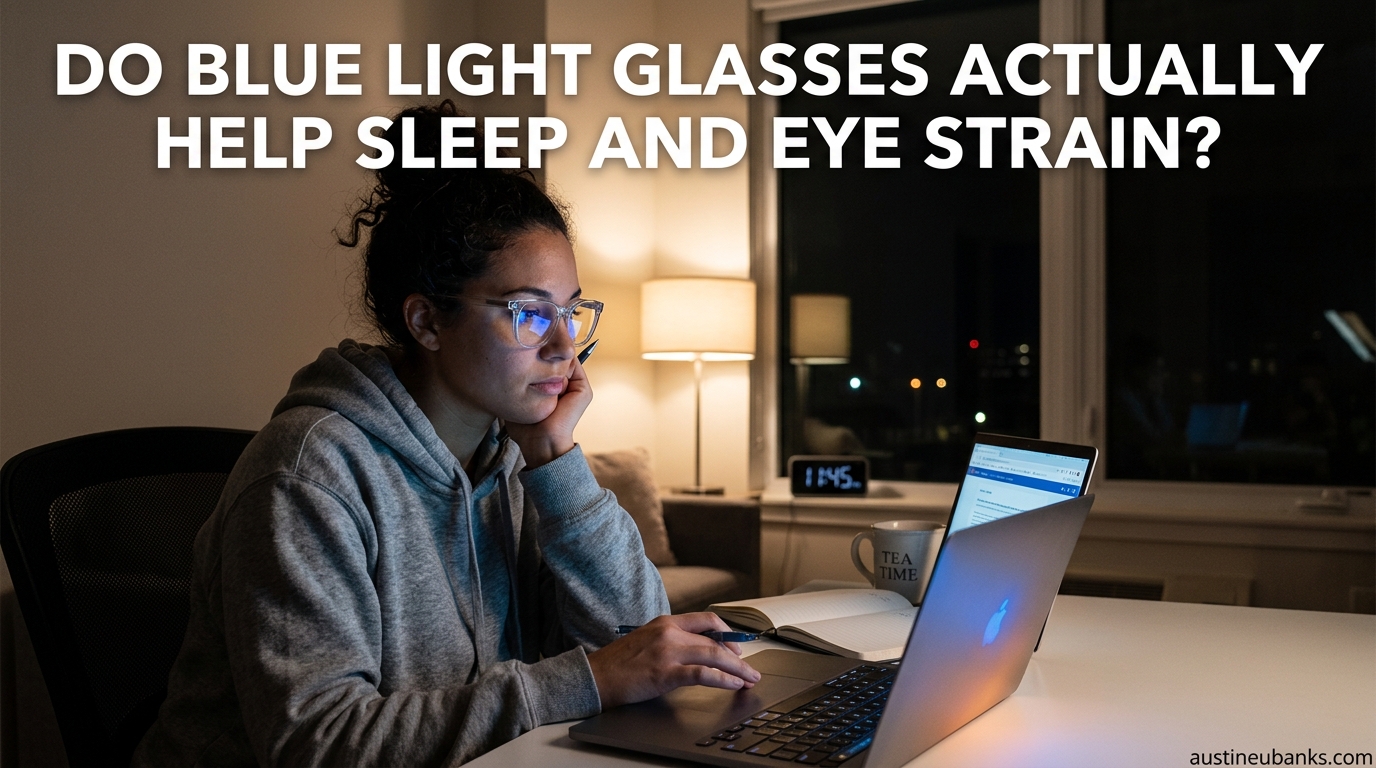
If you spend eight or more hours a day staring at screens, you have probably wondered whether blue light glasses are worth it. The marketing claims are everywhere: better sleep, less eye fatigue, no more headaches. But when you look past the advertising, the science tells a more nuanced story.
Blue light glasses may help some people fall asleep faster when worn before bedtime, but current research shows they do not reduce digital eye strain. A 2023 Cochrane systematic review found no significant difference in eye strain symptoms between people wearing blue-light-filtering lenses and those wearing clear lenses. Major health institutions, including Harvard Medical School and the Cleveland Clinic, echo this conclusion.
In this guide, we break down what blue light actually does to your body, what the strongest studies say about blue light glasses, and what works better if your goal is protecting your eyes and improving your sleep. We will answer whether blue light glasses help sleep and eye strain using the best available evidence from 2026.
Table of Contents
What Is Blue Light and Where Does It Come From?
Blue light is a portion of the visible light spectrum with short wavelengths between 380 and 500 nanometers. It sits right next to ultraviolet light on the electromagnetic spectrum, which means it carries more energy per photon than longer-wavelength colors like red or orange.
The biggest source of blue light in your life is not your phone or laptop. It is the sun. Sunlight contains far more blue wavelength radiation than any digital device ever could. Your body evolved under this natural blue light exposure, and it plays an important role in keeping your internal clock synchronized with the day-night cycle.
Artificial blue light comes from LED screens, fluorescent bulbs, computer monitors, tablets, and smartphones. The intensity of blue light from these devices is a fraction of what the sun produces. However, the concern is not about intensity alone. It is about timing and proximity. Most people hold screens close to their faces for hours, often late into the evening when natural blue light would normally be fading.
This is where blue light filtering glasses enter the picture. These lenses have special coatings or tints designed to block or absorb a percentage of blue wavelength light before it reaches your eyes. Clear lenses typically filter 10 to 25 percent of blue light, while amber or yellow-tinted lenses can block 50 to 99 percent.
How Blue Light Affects Your Sleep Cycle
Your body runs on a roughly 24-hour internal clock called the circadian rhythm. This biological system regulates when you feel alert, when you feel drowsy, and when your body releases key hormones. Light exposure is the single most powerful signal that keeps your circadian rhythm aligned with the outside world.
Specialized cells in your retina called intrinsically photosensitive retinal ganglion cells contain a light-sensitive protein called melanopsin. Melanopsin is especially sensitive to blue wavelength light in the 460 to 480 nanometer range. When these cells detect blue light, they send signals to your brain’s suprachiasmatic nucleus, the master clock that controls circadian rhythm.
In the evening, as natural light fades, your pineal gland starts producing melatonin, the hormone that makes you feel sleepy. This is the normal biological sequence that has governed human sleep for hundreds of thousands of years. The problem arises when you introduce bright blue light from screens after sunset.
Research from Harvard Medical School has shown that blue light exposure at night suppresses melatonin production significantly more than other wavelengths of light. One Harvard study found that 6.5 hours of blue light exposure suppressed melatonin for about twice as long as green light of comparable brightness. This melatonin suppression can shift your circadian rhythm by as much as 1.5 to 2 hours, making it harder to fall asleep and reducing overall sleep quality.
So do blue light glasses help with sleep? The evidence here is more encouraging than for eye strain, though still mixed. A systematic review published in 2023 suggested that blue-light-blocking glasses may modestly improve sleep quality for certain people, particularly those with insomnia or delayed sleep phase issues. However, Dr. Steven Lockley, a Harvard sleep researcher, cautions that many of these studies lack standardization in lens type, timing, and measurement methods.
The key insight is that not all blue light glasses are equal when it comes to sleep. Amber-tinted lenses that block 90 percent or more of blue light appear more effective than clear lenses that only filter 10 to 20 percent. Timing also matters. Studies that showed sleep benefits typically had participants wear the glasses 2 to 3 hours before bedtime, not just during screen use.
Do Blue Light Glasses Help With Eye Strain?
Here is where the marketing and the science diverge most sharply. Blue light glasses are heavily advertised as a solution for digital eye strain, but the evidence does not support this claim.
Digital eye strain, also known as computer vision syndrome, affects an estimated 60 million people worldwide. Common symptoms include dry eyes, blurred vision, headaches, neck and shoulder pain, and a general feeling of ocular fatigue. If you work at a computer all day, you probably know the feeling well.
But blue light from screens is not the primary cause of these symptoms. Eye doctors point to several factors that actually drive digital eye strain, and blue light exposure is not among the top ones. The real culprits are reduced blink rate, uncorrected vision problems, screen glare, poor lighting, improper viewing distance, and prolonged focusing without breaks.
When you stare at a screen, your blink rate drops dramatically. Most people blink about 15 times per minute normally, but this drops to 5 to 7 times per minute during screen use. This reduced blinking leads to tear film evaporation, which causes the dry, gritty, burning sensation associated with eye fatigue. No pair of glasses can make you blink more often.
A landmark 2023 Cochrane systematic review examined multiple randomized controlled trials comparing blue-light-filtering lenses to standard clear lenses. The review found no significant difference in eye strain symptoms, visual fatigue, or contrast sensitivity between the two groups. The researchers concluded that blue-light-filtering lenses are unlikely to provide meaningful relief from digital eye strain.
Reddit communities like r/glasses and r/skeptic reflect this scientific reality. Many users who tested blue light glasses report that their eye strain did not improve. Some even noted that certain tinted lenses made their vision feel slightly distorted, which actually worsened their visual comfort during detailed work.
This does not mean blue light glasses are harmful. For most people, they simply function as clear lenses with a coating that does not hurt anything but does not help with eye strain either. The eye strain relief you might feel from wearing them is more likely due to a placebo effect or to other changes you made at the same time, like adjusting your screen brightness or taking more breaks.
What the Scientific Research Actually Shows
To separate fact from marketing, let us look at the major studies that have examined whether blue light glasses actually work. The research falls into two categories: sleep studies and eye strain studies, and the results differ significantly between them.
The most authoritative review on eye strain comes from the Cochrane Library, widely considered the gold standard for evidence-based medicine. The 2023 Cochrane review pooled data from multiple randomized controlled trials and found no clinically meaningful difference in digital eye strain symptoms between blue-light-filtering lenses and clear lenses. The review examined outcomes including eye fatigue, dry eye symptoms, headaches, and visual comfort. In every category, the results were essentially the same regardless of lens type.
For sleep, the evidence is more positive but still limited. A systematic review suggested that blue-light-blocking glasses could improve sleep quality for some individuals, particularly those who already experience sleep difficulties. The improvements were modest, typically in the range of 10 to 15 minutes faster sleep onset. However, the researchers noted significant variability in study quality, lens specifications, and participant populations.
Are blue light glasses a gimmick? That is a question many skeptical consumers and Reddit users ask. The answer is nuanced. The glasses themselves do filter blue light as advertised, so they are not fake or fraudulent products. But the health claims, particularly around eye strain relief, are not supported by scientific evidence. The American Academy of Ophthalmology explicitly states that blue light from screens does not cause eye damage or eye strain, and they do not recommend blue light glasses for the general public.
Ophthalmologists and optometrists generally agree on this point. During our research across forum discussions and expert statements, we found that eye doctors consistently point out that digital eye strain is a focusing and blinking problem, not a light-wavelength problem. The Cleveland Clinic, Mayo Clinic, and Harvard Health all publish guidance aligning with this consensus.
One important note about study limitations: many existing trials have small sample sizes, short durations, and inconsistent lens quality. Some use lenses that block as little as 10 percent of blue light, while others use amber lenses blocking over 90 percent. This makes it difficult to draw broad conclusions. More large-scale, standardized studies are needed before stronger claims can be made.
Who Might Actually Benefit From Blue Light Glasses
While the general population may not need blue light glasses, certain groups could see real benefits. Understanding who falls into these categories can help you decide whether to try them.
People with diagnosed sleep disorders may benefit the most. If you have insomnia, delayed sleep phase syndrome, or difficulty falling asleep after evening screen use, amber-tinted blue light glasses worn 2 to 3 hours before bed could help. The sleep research, while mixed, shows the most promise for this specific group. Talk to a sleep specialist about whether this approach makes sense for your situation.
Night shift workers represent another group that might benefit. If your work schedule forces you to be exposed to screens during nighttime hours, managing your blue light intake becomes more important. Blue light blocking glasses, combined with strategic light exposure during your waking hours, can help your body maintain a functional rhythm even with an unconventional schedule.
Some people simply cannot or will not reduce their evening screen time. If you are someone who scrolls your phone in bed or watches TV right before sleep and has no intention of stopping, blue light glasses are a harm-reduction approach. They will not be as effective as putting the screens away, but they are better than nothing.
Regarding post-LASIK use, there is no medical evidence suggesting that blue light glasses are necessary after laser eye surgery. Your ophthalmologist may recommend protective eyewear for physical protection during healing, but this is unrelated to blue light filtering. Always follow your surgeon’s specific post-operative instructions rather than relying on general blue light glasses marketed to LASIK patients.
Proven Alternatives That Work Better Than Blue Light Glasses
If blue light glasses are not the answer for eye strain, what actually works? Here are evidence-based strategies that eye care professionals consistently recommend, and they cost little or nothing.
The 20-20-20 rule is the single most effective habit for preventing digital eye strain. Here is how it works: every 20 minutes, look at something 20 feet away for at least 20 seconds. This simple practice gives your eye muscles a chance to relax from close-up focusing and allows your tear film to redistribute across the surface of your eyes. Set a timer on your phone or use a free app like Eye Care 20 20 20 to remind yourself.
Device-level blue light reduction is available on practically every modern screen, and it is free. Here are the main options:
- Apple Night Shift (iOS and Mac): Automatically shifts your display to warmer colors based on your local sunset time. You can adjust the warmth level and schedule it to turn on at specific times.
- Windows Night Light: Built into Windows 10 and 11. Access it through Settings, System, Display, and toggle Night Light. You can set a custom schedule and color temperature.
- f.lux: A free third-party app for Windows, Mac, and Linux that gradually adjusts your screen color temperature throughout the day based on your location. Many users prefer it over built-in options for its smoothness and customization.
- Twilight (Android): A popular app that overlays a warm red filter on your screen after sunset. You can control intensity and schedule.
Proper workspace ergonomics play a massive role in eye comfort. Position your monitor so the top of the screen is at or slightly below eye level. Keep the screen about an arm’s length away from your face. Adjust brightness so your screen matches the ambient lighting in the room, not brighter or significantly dimmer.
Artificial tears and blink awareness can address the dry eye component of digital eye strain directly. Keep preservative-free artificial tears at your desk and use them every few hours. Make a conscious effort to blink fully and frequently while working. Some eye care specialists recommend placing a small note on your monitor that says “blink” as a visual reminder.
Reducing glare is another free fix. Position your screen perpendicular to windows rather than directly in front of or behind them. Use an anti-glare screen filter if overhead lighting causes reflections. Adjust window blinds or use a desk lamp with a warm bulb instead of harsh overhead fluorescent lights.
FAQs
Will blue light glasses stop eye strain?
No. According to a 2023 Cochrane systematic review, blue-light-filtering lenses do not significantly reduce digital eye strain symptoms compared to clear lenses. Eye strain from screens is primarily caused by reduced blink rate, prolonged close-up focusing, screen glare, and improper viewing distance, none of which blue light glasses address. The American Academy of Ophthalmology does not recommend blue light glasses for eye strain relief.
What is the 20 second rule for eye strain?
The 20-20-20 rule states that every 20 minutes, you should look at an object 20 feet away for at least 20 seconds. This gives your eye muscles a break from close-up focusing, allows your tear film to redistribute, and helps prevent the dry eyes, blurred vision, and fatigue associated with digital eye strain. Set a recurring timer or use a free reminder app to build the habit.
Are blue light glasses a gimmick?
Blue light glasses are not a scam since they do filter blue light as advertised, but many of the health claims behind them are not supported by science. Research shows they do not reduce eye strain, and the American Academy of Ophthalmology does not recommend them for eye health. They may offer modest sleep benefits for some people when amber lenses are worn 2 to 3 hours before bedtime, but even this evidence is limited.
Do I need blue light glasses after LASIK?
There is no medical evidence that blue light glasses are necessary after LASIK surgery. Your surgeon may recommend protective eyewear for physical protection during the healing process, but this is unrelated to blue light filtering. Follow your ophthalmologist’s specific post-operative instructions. Blue light from screens does not interfere with LASIK recovery.
The Bottom Line on Blue Light Glasses
After reviewing the strongest available evidence, the answer to whether blue light glasses help sleep and eye strain is clear but divided. For eye strain, the science says no. The 2023 Cochrane review and expert consensus from major health institutions show that blue light glasses do not meaningfully reduce digital eye strain symptoms. The real causes of screen-related eye fatigue are reduced blinking, prolonged focusing, and poor ergonomics.
For sleep, the picture is slightly more hopeful. Amber-tinted blue light glasses worn 2 to 3 hours before bed may help some people fall asleep faster, particularly those with existing sleep difficulties. But the evidence is limited and the benefits are modest compared to simply reducing screen time in the evening.
If you want real relief from digital eye strain, start with the free, proven strategies. Practice the 20-20-20 rule. Enable Night Shift or install f.lux on your devices. Use artificial tears. Adjust your workspace ergonomics. These methods target the actual causes of your discomfort and cost nothing. If you still want to try blue light glasses for sleep specifically, choose amber lenses with high blue light blocking percentages and wear them consistently before bedtime.