
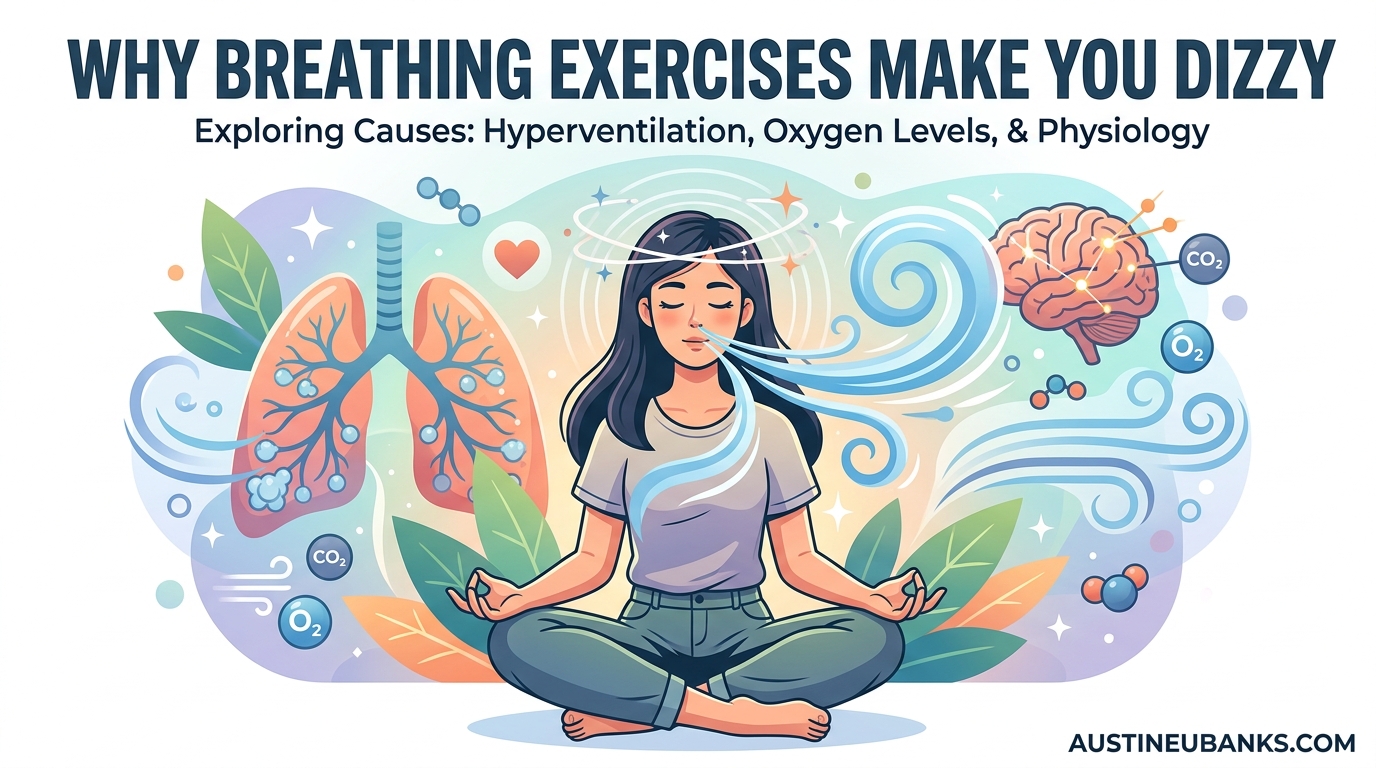
You sit down to calm your mind. You follow the instructions, take a deep breath in, hold it, and exhale slowly. A few rounds later, the room feels like it is tilting. Your vision might blur slightly. You feel lightheaded, maybe even a little dizzy.
If this has happened to you, you are not alone. It is one of the most common experiences people report when they start breathwork, meditation, or anxiety management techniques. In fact, search forums like Reddit’s meditation communities and you will find hundreds of threads from people asking the same question: why do breathing exercises make me dizzy?
The short answer is that some breathing exercises make you feel lightheaded because they cause mild hyperventilation, which reduces carbon dioxide levels in your blood and temporarily decreases blood flow to your brain. Understanding why this happens can help you practice safely and avoid the anxiety spiral that makes the sensation feel worse than it actually is.
In this guide, I will walk you through exactly what is happening in your body, which techniques are most likely to trigger dizziness, and practical steps you can take to prevent it.
Table of Contents
The Science: Why Breathing Exercises Make You Feel Lightheaded
Breathing exercises make you feel lightheaded primarily because of hyperventilation, a process where breathing too deeply or too quickly expels more carbon dioxide than your body produces. This shifts the oxygen-carbon dioxide balance in your blood and triggers a chain reaction that reduces blood flow to your brain.
Here is what happens step by step. When you breathe more than your body needs, you exhale excessive amounts of carbon dioxide (CO2). Most people assume that breathing deeply gives them more oxygen, but the reality is more nuanced. Your body depends on a specific ratio of oxygen to carbon dioxide to function properly.
When CO2 levels drop too low, a condition called hypocapnia sets in. This triggers respiratory alkalosis, meaning your blood pH rises and becomes more alkaline than normal. One of the direct effects of this pH shift is cerebral vasoconstriction. In plain terms, the blood vessels in your brain narrow, reducing the amount of oxygen-rich blood reaching your brain tissue.
This is where the lightheadedness comes from. Even though you are breathing in plenty of oxygen, your brain is actually receiving less of it because the vessels delivering that oxygen have constricted. The result is a temporary sensation of dizziness, lightheadedness, tingling in your fingers or lips, and sometimes mild visual changes.
It sounds counterintuitive, but breathing more can actually deliver less oxygen to your brain in the short term. This is the core reason why some breathing exercises make you feel lightheaded, and it is a completely normal physiological response, not a sign that something is wrong with you.
Primary Causes of Dizziness During Breathwork
While hyperventilation is the underlying mechanism, several specific factors determine whether you will actually feel lightheaded during a breathing exercise. Understanding these triggers helps you identify what is causing your symptoms and adjust your practice accordingly.
Breathing Too Deeply or Too Quickly
This is the most common trigger. When you consciously take in much more air than your body needs at rest, you accelerate CO2 loss. Techniques that emphasize large, forceful inhales or rapid breathing patterns are particularly likely to cause this. If you have ever felt lightheaded after just a few rounds of deep breathing, this is why.
The key issue is the mismatch between how much you are breathing and how much oxygen your body actually requires. When you are sitting still, your body needs relatively little air. Flooding your system with far more than necessary tips the balance and produces symptoms.
Holding Your Breath Too Long
Breath retention is a powerful technique used in many traditions, but it can also contribute to dizziness. When you hold your breath after an exhale, CO2 begins to build up. When you hold after a large inhale, the combination of retained oxygen and prior hyperventilation can intensify the lightheaded feeling.
The body’s oxygen buffer is surprisingly generous, meaning breath holds are generally safe for healthy individuals. However, the transitional moment when you resume breathing can produce a rush of lightheadedness, especially if you gasp or breathe heavily immediately after the hold.
Poor Posture and Physical Positioning
How you sit or lie down matters more than most people realize. Slouching compresses your diaphragm and limits its range of motion, forcing you to compensate by breathing more forcefully through your chest. This chest-dominant breathing pattern is less efficient and more likely to trigger hyperventilation symptoms.
Sitting perfectly straight with rigid posture can also be problematic. Some people unconsciously tense their abdominal muscles when focusing on their breath, which restricts diaphragmatic movement. The ideal position allows your belly to expand freely on each inhale without strain.
Anxiety Amplifying the Sensation
If you came to breathing exercises to manage anxiety, there is an ironic twist worth understanding. Anxiety itself can make you more sensitive to bodily sensations. When you notice a slight lightheaded feeling, an anxious mind may interpret it as dangerous, which triggers more anxiety and faster breathing.
This creates a feedback loop. The anxiety makes you breathe faster, the faster breathing causes more lightheadedness, and the lightheadedness fuels more anxiety. Breaking this cycle starts with knowing that the dizziness is a harmless physiological response, not a sign of a medical emergency.
Which Breathing Techniques Are Most Likely to Cause Lightheadedness
Not all breathing exercises carry the same risk. Some techniques are designed to be activating and energizing, which means they intentionally alter your CO2 levels. Others are inherently calming and much less likely to produce dizziness. Knowing the difference helps you choose the right practice for your situation.
Techniques That Commonly Trigger Dizziness
The 4-7-8 breathing method, popularized by Dr. Andrew Weil, involves inhaling for 4 counts, holding for 7, and exhaling for 8. The extended exhale and breath hold can significantly reduce CO2 levels, especially for beginners who are not accustomed to the pattern. Many people report feeling lightheaded after just 3 to 4 cycles.
Wim Hof breathing combines rounds of deep, rhythmic breathing with breath retention. The deliberate hyperventilation phase is specifically designed to alter blood chemistry, and lightheadedness is essentially a built-in feature of the practice rather than an unexpected side effect.
Box breathing, used by military personnel and athletes, involves equal-length inhales, holds, exhales, and holds. While it can be calming at moderate paces, doing it with deep breaths or long durations can lead to CO2 depletion and the familiar dizzy sensation.
Kapalabhati, or skull-shining breath, involves rapid forceful exhales and passive inhales. The fast pace and emphasis on expulsion make it one of the techniques most likely to cause hyperventilation symptoms, particularly for those new to the practice.
Techniques That Are Less Likely to Cause Issues
Alternate nostril breathing, or Nadi Shodhana, is generally well tolerated. Because the pace is slow and the volume of air is moderate, it rarely triggers significant CO2 changes. The alternating pattern also encourages nasal breathing, which naturally regulates air intake.
Coherent breathing, which targets approximately 5 to 6 breaths per minute, is designed to stay within a comfortable range that does not over-ventilate. Research suggests this pace optimizes heart rate variability without tipping into hyperventilation territory.
Simple diaphragmatic breathing, when done gently and without forcing large volumes of air, is another safe option. The focus here is on using your diaphragm efficiently rather than maximizing how much air you move. This is often the best starting point for people who have experienced dizziness with other techniques.
The Anxiety-Breathing Connection
If you have ever felt like your breathing exercises made you more anxious rather than less, there is a clear physiological explanation. The anxiety-breathing connection runs in both directions, and understanding it can help you avoid a frustrating cycle.
When you are anxious, your body is often already in a state of mild over-breathing. Your breathing rate increases, often without you noticing. Then you sit down to do a calming exercise and start breathing deeply on top of an already elevated baseline. Instead of calming your nervous system, you end up pushing CO2 levels even lower.
The lightheadedness that follows feels alarming, especially if you have health anxiety. Your brain interprets the physical sensation as a threat, which activates your fight-or-flight response. Now your heart is racing, your breathing gets faster, and the dizziness intensifies. I have spoken with many people who abandoned breathing exercises entirely because of this loop, assuming the practice was harmful when really the approach just needed adjustment.
The fix is not to stop breathing exercises but to start differently. Begin with slow, gentle nasal breathing at your natural pace before attempting any structured technique. Give your body time to settle. If you notice anxiety rising, return to normal breathing rather than pushing through. The goal is regulation, not force.
It is also worth noting that focusing intensely on your breath can itself cause anxiety for some people. If you are someone who becomes hyper-aware of every sensation when you pay attention to breathing, try a guided practice where you follow a voice rather than counting or monitoring yourself. This external focus can reduce the self-monitoring that feeds anxiety.
How to Prevent Dizziness When Doing Breathing Exercises
Preventing lightheadedness during breathwork comes down to working with your body instead of overriding it. The following tips come from both physiological research and the real experiences of practitioners who have dealt with this issue and found ways around it.
1. Start with nasal breathing. Breathing through your nose naturally limits the volume of air you take in, which helps prevent over-breathing. It also engages the diaphragm more effectively than mouth breathing and produces nitric oxide, which supports healthy blood flow.
2. Keep your pace moderate. Aim for 5 to 7 breaths per minute rather than the very slow or very fast patterns that extreme techniques prescribe. This pace stays within a range that calms your nervous system without depleting CO2 significantly.
3. Do not force deep breaths. Let your inhales be full but comfortable. If you feel like you are gulping air or straining to take in more, you are probably breathing more than your body needs. Gentle is more effective than forceful for most calming practices.
4. Sit or lie down in a supported position. Make sure your spine is elongated but not rigid. If you are new to breathing exercises or have experienced dizziness before, practicing while lying down or reclining can reduce the intensity of any lightheadedness and eliminate the risk of falling.
5. Limit the number of rounds. If you are trying a new technique, start with just 3 to 4 rounds rather than pushing to 10 or more. You can always build up gradually as your body adapts to the pattern. More is not better when it comes to breathwork.
6. Take breaks between techniques. If you are combining different breathing exercises in a session, return to your natural breathing for 30 to 60 seconds between them. This allows your CO2 levels to normalize and prevents cumulative effects from building up.
7. Return to normal breathing if you feel dizzy. The moment you notice lightheadedness, stop the structured exercise and breathe normally. The sensation will pass within 15 to 30 seconds as your CO2 levels rebalance. There is no benefit to pushing through discomfort.
When Dizziness Is a Concern: Safety Considerations
For the vast majority of people, lightheadedness during breathing exercises is harmless and temporary. But it is important to know the difference between a normal physiological response and symptoms that warrant medical attention.
Normal breathwork-related dizziness feels like a mild floating sensation, slight wooziness, or brief visual changes. It comes on gradually, aligns with the breathing pattern you were doing, and resolves within seconds of returning to normal breathing. You might also notice mild tingling in your fingers or around your mouth, which is a classic sign of temporary hypocapnia.
Certain symptoms should prompt you to stop immediately and seek medical evaluation. These include chest pain or pressure, a racing or irregular heartbeat that does not slow down when you stop the exercise, fainting or loss of consciousness, severe shortness of breath that persists after stopping, confusion, or numbness on one side of your body. These are not typical breathwork side effects and could indicate an underlying cardiac or neurological issue.
Some people should approach breathwork with extra caution. If you have a history of cardiovascular disease, high or low blood pressure that is not well managed, epilepsy or seizure disorders, severe anxiety or panic disorder, or are pregnant, consult with a healthcare provider before starting intensive breathing practices. Certain techniques, particularly those involving extended breath holds or rapid breathing, may not be appropriate.
People with Postural Orthostatic Tachycardia Syndrome (POTS) or other forms of dysautonomia may find that some breathing exercises affect them differently. While gentle breathwork can sometimes help with nervous system regulation, techniques that significantly alter blood chemistry or involve rapid position changes should be approached carefully and ideally under professional guidance.
Cardiac-related dizziness tends to feel different from breathwork dizziness. It often comes with a sense of pressure or tightness in the chest, may occur during physical exertion rather than during rest, and does not resolve quickly when you change your breathing pattern. If dizziness hits suddenly and severely without an obvious connection to your breathing, that warrants immediate medical attention.
FAQs
Why do I feel weird after breathwork?
Feeling weird after breathwork is usually caused by temporary changes in your blood chemistry. Breathing exercises that involve deep or rapid breathing reduce carbon dioxide levels, which alters blood pH and narrows blood vessels in the brain. This can produce lightheadedness, tingling, mild euphoria, or a spaced-out sensation. These effects are typically harmless and resolve within a few minutes of returning to normal breathing.
Who should not do breathing exercises?
People with cardiovascular disease, uncontrolled blood pressure issues, epilepsy or seizure disorders, severe panic disorder, or recent surgery should consult a doctor before starting breathwork. Pregnant women should also check with their healthcare provider. Techniques involving extended breath holds or rapid breathing, such as Wim Hof method, carry higher risks and are not recommended for these groups without medical supervision.
Can breathwork help with POTS?
Some people with Postural Orthostatic Tachycardia Syndrome find that gentle, slow breathing techniques help regulate their autonomic nervous system. Coherent breathing at around 5 to 6 breaths per minute may be beneficial. However, techniques involving rapid breathing or breath holds should be approached with caution, ideally under the guidance of a healthcare professional familiar with dysautonomia.
What does cardiac dizziness feel like?
Cardiac dizziness often comes with chest pressure or pain, a racing or irregular heartbeat, shortness of breath, and sometimes sweating or nausea. Unlike breathwork-related lightheadedness, it does not resolve quickly when you change your breathing pattern and may occur during physical exertion. If you experience these symptoms, seek immediate medical attention.
Is it normal to feel dizzy when doing deep breathing?
Yes, feeling dizzy during deep breathing is very common and usually not dangerous. It happens because breathing more than your body needs lowers carbon dioxide levels, which reduces blood flow to the brain. The sensation typically passes within seconds of returning to normal breathing. Starting with gentler techniques and nasal breathing can help prevent it.
How long does lightheadedness from breathing exercises last?
Lightheadedness from breathing exercises usually lasts 15 to 30 seconds after you stop the technique and return to normal breathing. In some cases, mild symptoms like slight wooziness or tingling may linger for a minute or two. If dizziness persists beyond a few minutes or comes with other symptoms like chest pain or fainting, seek medical attention.
Wrapping Up
Understanding why some breathing exercises make you feel lightheaded comes down to one key mechanism: hyperventilation lowers carbon dioxide levels, which narrows blood vessels in your brain and temporarily reduces oxygen delivery. The sensation is real, but it is not dangerous for most people.
The techniques most likely to trigger dizziness are those involving deep or rapid breathing and extended breath holds, such as 4-7-8 breathing, Wim Hof, and Kapalabhati. Slower, gentler approaches like coherent breathing and alternate nostril breathing carry far less risk. If you do feel lightheaded, simply return to your normal breathing pattern and the sensation will pass within seconds.
Start small, breathe through your nose, and choose techniques that match your experience level. Your breath is one of the most powerful tools you have for regulating your nervous system. With the right approach, you can use it without the dizziness getting in the way.