
You flinch when someone raises their voice. Your heart races for no obvious reason. You feel exhausted even after a full night’s sleep. For years, you may have called these things anxiety, sensitivity, or just “how you are.”
But for many adults who experienced trauma as children, these are not personality traits. They are signs of a nervous system that learned to survive danger and never got the signal that the danger was over.
Understanding how childhood trauma affects the adult nervous system changes everything. It explains why your body reacts before your mind catches up, why relationships feel so hard, and why willpower alone cannot fix the exhaustion. I have spent years studying the research behind trauma and the brain, and the science tells a story that is both sobering and deeply hopeful.
In this guide, I will walk you through exactly what happens to the nervous system when a child experiences trauma, how those changes show up in adulthood, and what the science says about healing. If you have ever felt broken, the research offers a different word: adaptive. Your nervous system did what it needed to do to keep you alive. Now we can talk about how to help it feel safe again.
Table of Contents
The Short Answer: How Childhood Trauma Affects the Adult Nervous System
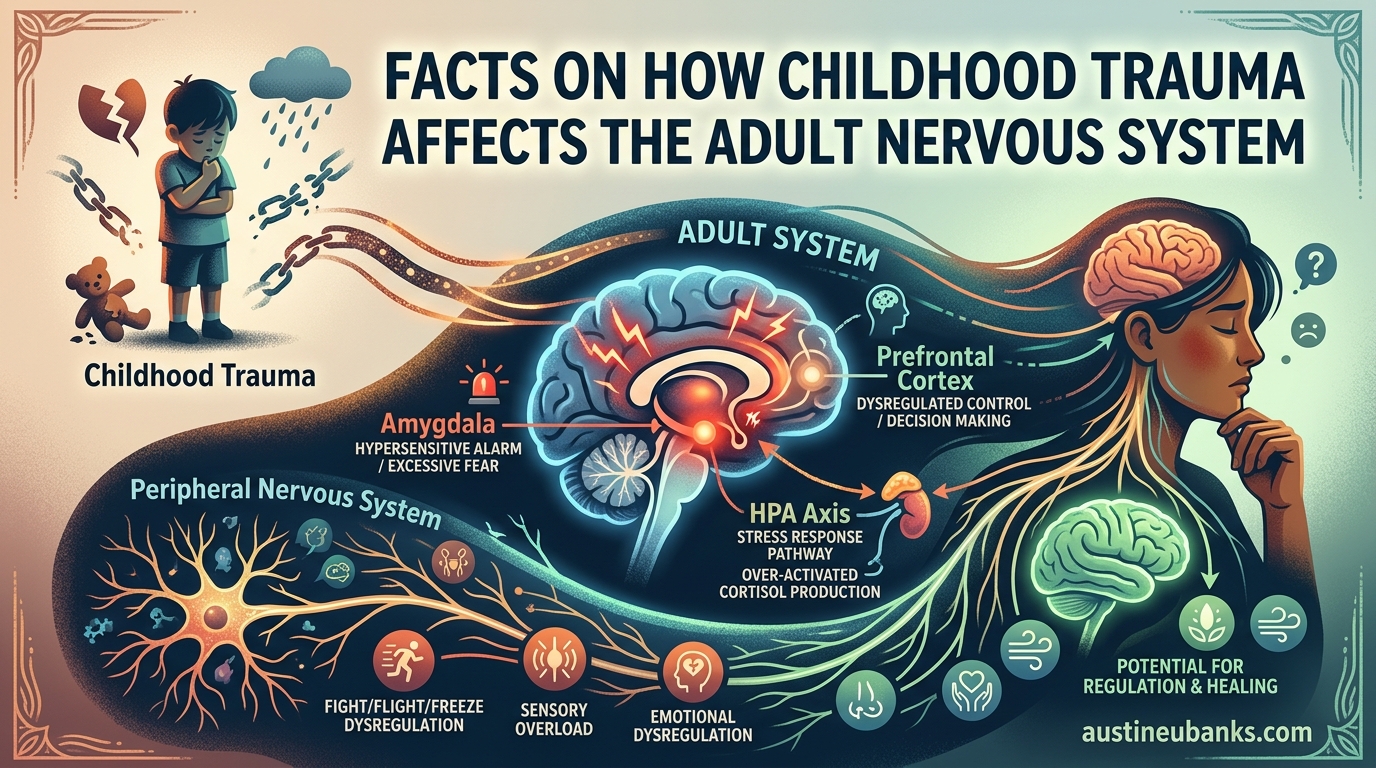
Childhood trauma affects the adult nervous system by permanently altering the brain’s stress response pathways. The amygdala (the fear center) becomes enlarged and hypersensitive, the hippocampus (the memory center) shrinks, and the prefrontal cortex (the reasoning center) loses its ability to calm the fear response. The result is a nervous system stuck in chronic fight-or-flight mode, flooding the body with stress hormones even when no real danger exists.
The five main effects of childhood trauma on the adult nervous system are:
- Dysregulated stress response: The HPA axis stays overactive, keeping cortisol levels chronically elevated
- Structural brain changes: The amygdala enlarges, the hippocampus shrinks, and prefrontal cortex connections weaken
- Autonomic nervous system imbalance: The sympathetic nervous system dominates while the parasympathetic system underperforms
- Chronic physical health effects: Increased risk of cardiovascular disease, immune dysfunction, chronic pain, and sleep disorders
- Mental health vulnerability: Higher rates of anxiety, depression, PTSD, complex PTSD (CPTSD), and substance use disorders
The CDC-Kaiser ACE Study, one of the largest investigations of childhood adversity ever conducted, found a powerful dose-response relationship between the number of adverse childhood experiences and adult health problems. The more trauma a child endures, the greater the physical and neurological impact decades later. But here is what matters most: researchers consistently emphasize that these changes, while significant, are not necessarily permanent.
What Is Childhood Trauma? (And What Counts as Adverse)
Childhood trauma refers to experiences that threaten a child’s safety or sense of safety between birth and age 18. The landmark Adverse Childhood Experiences (ACE) Study identified 10 specific categories of adversity, grouped into three types.
The three categories of adverse childhood experiences are:
- Abuse: Physical, emotional, or sexual
- Neglect: Physical or emotional
- Household dysfunction: Growing up with a family member who has substance use disorder, mental illness, or who is incarcerated; witnessing domestic violence; or losing a parent to separation or divorce
But trauma is not limited to the ACE list. Community violence, bullying, racism, poverty, medical procedures, and the loss of a loved one can all produce the same neurological effects. What matters is not the specific event but the child’s subjective experience of threat, especially when that threat is chronic, unpredictable, and occurs without the buffer of a safe adult relationship.
Researchers call this toxic stress. Unlike positive stress (which builds resilience) or tolerable stress (which is brief and buffered by support), toxic stress is prolonged, severe, and unrelieved. It is the kind of stress that physically rewires a developing brain. Your ACE score, which counts how many of the 10 categories you experienced, has been shown to predict adult health outcomes with striking accuracy. A score of 4 or more dramatically increases the risk of chronic disease, mental illness, and even early mortality.
The Nervous System 101: How It’s Supposed to Work
To understand how trauma changes the nervous system, you first need to understand what a healthy one looks like. Your autonomic nervous system runs every automatic function in your body, from heart rate to digestion. It has two main branches that work like a gas pedal and a brake.
The two branches of the autonomic nervous system are:
- Sympathetic nervous system (SNS): The gas pedal. It activates the fight-or-flight response, increasing heart rate, sharpening focus, and releasing energy when you face a threat
- Parasympathetic nervous system (PNS): The brake. It activates the rest-and-digest response, slowing the heart rate, calming the body, and allowing healing and recovery
In a healthy nervous system, these two branches trade off smoothly throughout the day. You hit the gas when you need to meet a deadline or react to danger. You hit the brake when you sit down to eat or lie down to sleep. The system is flexible, responsive, and self-regulating.
The vagus nerve is the main highway of the parasympathetic system. This long cranial nerve runs from your brainstem down to your heart, lungs, and gut, constantly scanning your environment for safety or danger. When the vagus nerve detects safety, it signals the body to rest, connect, and heal. When it detects threat, it steps aside and lets the sympathetic system take over. This constant scanning process is what researchers call neuroception, and it happens entirely below conscious awareness.
How Childhood Trauma Affects the Adult Nervous System: The Core Mechanism
Here is where the biology gets sobering. When a child lives in an environment of chronic threat, the developing nervous system adapts for survival. The sympathetic nervous system stays switched on. The parasympathetic system goes offline. And the body’s master stress regulation system, called the HPA axis, gets locked into overdrive.
The HPA axis (hypothalamic-pituitary-adrenal axis) is the command center for your stress response. When it detects a threat, the hypothalamus releases corticotropin-releasing factor (CRF), which signals the pituitary gland, which signals the adrenal glands to release cortisol. Cortisol is the body’s primary stress hormone. In short bursts, it is life-saving. It sharpens focus, mobilizes energy, and suppresses non-essential functions like digestion and immunity so the body can fight or flee.
But in a child living with chronic trauma, this system never shuts off. The brain is bathed in cortisol day after day, year after year. Dr. Michael De Bellis, one of the foremost researchers on childhood trauma and the brain, found that chronically elevated CRF causes generalized arousal, anxiety, aggression, hypervigilance, and persistent stimulation of the sympathetic nervous system. These are the core features of what we now call nervous system dysregulation.
Over time, something even more damaging happens. The HPA axis itself becomes dysregulated. Some trauma survivors develop an exaggerated cortisol response, producing too much stress hormone in reaction to minor triggers. Others develop a blunted response, producing too little cortisol at baseline but spiking unpredictably. Either way, the system loses its precision. The nervous system can no longer distinguish between a real tiger in the room and an email from your boss.
This is why adults with childhood trauma histories often describe feeling constantly on edge, easily startled, or exhausted for no reason. Their nervous system is running a survival program in an environment that no longer requires one. The stress response system is not broken; it is doing exactly what it learned to do. It just learned the wrong lesson.
Brain Structures Affected: Trauma Brain vs Normal Brain
One of the most searched questions on this topic is about how a trauma-affected brain compares to a typical brain. The research here is extensive and consistent across dozens of imaging studies. Childhood trauma produces measurable structural and functional changes in three key brain regions.
The amygdala (fear center) becomes enlarged and overactive. In a typical brain, the amygdala detects genuine threats and triggers an appropriate fear response. In a trauma-affected brain, the amygdala is larger and reacts to a far wider range of stimuli. Brain scans show that adults with childhood trauma histories have heightened amygdala reactivity even to neutral faces or mildly stressful situations. This translates to real life as hypervigilance, an exaggerated startle response, and a constant feeling that something bad is about to happen.
The hippocampus (memory center) shrinks. The hippocampus is responsible for forming new memories, distinguishing between past and present, and contextualizing experiences. Chronic exposure to cortisol damages hippocampal neurons, causing this structure to lose volume. Adults with childhood trauma often struggle with memory problems, difficulty concentrating, and a tendency to react to present situations as if they were past threats. The hippocampus cannot properly tell the amygdala, “This is now, not then.”
The prefrontal cortex (reasoning center) develops weaker connections. The prefrontal cortex is the brain’s executive center, responsible for impulse control, emotional regulation, decision-making, and the ability to calm the amygdala. In a trauma-affected brain, the neural pathways between the prefrontal cortex and the amygdala are weaker. This means the thinking brain has less power to override the fear brain. It is why adults with trauma histories often describe knowing logically that they are safe but feeling physically that they are not.
Additional changes include a smaller corpus callosum (the bridge between the brain’s hemispheres, which affects emotional regulation and integration) and altered activity in the default mode network and salience network. These changes help explain why trauma survivors struggle with dissociation, identity disturbance, and difficulty staying present in their bodies.
The Fight-Flight-Freeze-Fawn Response: Why Your Nervous System Gets Stuck
Most people know about fight or flight. But the trauma community, drawing on polyvagal theory and decades of clinical observation, recognizes four distinct survival responses. Understanding which one your nervous system defaults to is often the first breakthrough in understanding your own trauma patterns.
Fight: The nervous system responds to threat with aggression, confrontation, or a need to control. In adulthood, this can look like irritability, anger that flares quickly, or pushing people away when you feel vulnerable.
Flight: The nervous system responds by escaping. In adulthood, this shows up as workaholism, perfectionism, over-scheduling, chronic busyness, or the urge to literally leave the room when conflict arises.
Freeze: The nervous system responds by shutting down. This is the most primitive survival response, triggered when neither fight nor flight can save you. The body goes numb, the mind dissociates, and everything slows down. In adulthood, freeze looks like chronic exhaustion, brain fog, difficulty making decisions, emotional numbness, and the feeling of being “stuck.” Many people in trauma communities describe this as nervous system shutdown.
Fawn: The least-known response, fawning is the survival strategy of appeasing the threat to stay safe. The child learns to read the abuser’s moods, anticipate their needs, and suppress their own needs to avoid conflict. In adulthood, fawning looks like chronic people-pleasing, difficulty saying no, losing yourself in relationships, and an inability to identify your own preferences.
Polyvagal theory, developed by Dr. Stephen Porges, helps explain why these responses get stuck. According to polyvagal theory, the vagus nerve has two branches. The ventral vagal branch supports social engagement, connection, and feeling safe with others. The dorsal vagal branch triggers shutdown and freeze when fight-or-flight fails. Childhood trauma tends to push the nervous system out of the ventral vagal (safe and connected) state and into chronic sympathetic (fight-flight) or dorsal vagal (freeze-shutdown) states.
This is why adults with trauma histories often feel like they are either running on overdrive or completely collapsed, with very little middle ground. The nervous system has lost access to the safety state. Polyvagal-informed therapy aims to help the nervous system find its way back.
Signs Your Nervous System Was Affected by Childhood Trauma
Nervous system dysregulation from childhood trauma shows up in everyday life in ways that are easy to misread. You may have spent years thinking you were lazy, overly sensitive, or broken. Here are the most common signs that your nervous system is still running a survival program.
Common signs of nervous system dysregulation from childhood trauma include:
- Hypervigilance: Constantly scanning for danger, reading the room, monitoring other people’s moods
- Exaggerated startle response: Jumping at sounds or sudden movements that do not bother others
- Emotional dysregulation: Big emotional reactions that seem out of proportion to the situation, or sudden emotional numbness
- Chronic anxiety or depression: Persistent low-grade fear, dread, or hopelessness that does not respond to logical reasoning
- Sleep disturbances: Difficulty falling asleep, staying asleep, or feeling rested (because the nervous system cannot downshift into rest mode)
- Difficulty trusting others: Expecting betrayal, testing relationships, or avoiding closeness entirely
- Somatic symptoms: Unexplained headaches, digestive issues, muscle tension, or chronic pain with no clear medical cause
- Dissociation: Spacing out, losing time, feeling disconnected from your body or surroundings
If you recognize yourself in this list, you are not broken. These are the predictable results of a nervous system that had to stay on high alert for too long. Every single one of these responses was, at some point, a survival adaptation that kept you safe.
Physical Health Effects: How Trauma Lives in the Body
“The body keeps the score.” Dr. Bessel van der Kolk’s famous words capture the central truth about childhood trauma: it does not stay in the past. It lives in the body, and it shows up in the medical chart.
The ACE Study found that adults with an ACE score of 4 or more had dramatically higher rates of physical health problems compared to those with a score of 0. This is not a coincidence or a correlation without mechanism. Chronic nervous system dysregulation produces measurable physical damage over time.
The physical health effects of childhood trauma on the adult body include:
- Cardiovascular disease: Chronic cortisol elevation damages blood vessels, raises blood pressure, and increases the risk of heart attack and stroke
- Immune dysfunction: The same stress hormones that suppress acute inflammation cause chronic systemic inflammation, increasing risk for autoimmune conditions and reducing the body’s ability to fight infection
- Chronic pain: A sensitized nervous system amplifies pain signals, leading to fibromyalgia, chronic fatigue, and unexplained pain syndromes
- Metabolic disorders: Cortisol dysregulation contributes to insulin resistance, weight gain, and type 2 diabetes
- Gastrointestinal problems: The gut is heavily innervated by the vagus nerve, making digestive disorders like IBS extremely common in trauma survivors
- Sleep disorders: A nervous system stuck in sympathetic activation cannot transition into the deep, restorative sleep stages needed for healing
The University of Rochester Medical Center noted that trauma influences our stress response system and may be associated with compromised immunity and poor cardiovascular health. This is why trauma-informed medical care is so important. Treating the physical symptoms without addressing the underlying nervous system dysregulation is like mopping the floor while the faucet is still running.
Why Trauma Symptoms Can Take Years or Decades to Surface
One of the most common and confusing experiences for trauma survivors is the feeling that things were manageable for years and then suddenly fell apart. I have read hundreds of accounts in trauma support communities from people who describe symptoms emerging in their 20s, 30s, 40s, or even 50s. They ask the same question: why now?
The answer lies in the concept of accumulated stress load. Your nervous system has a finite capacity for adaptation. For years, it may have compensated for early trauma through sheer survival energy: staying busy, achieving, people-pleasing, or dissociating. These strategies work, sometimes for decades. But they come at a cost.
Eventually, a tipping point arrives. It might be a major life event: a breakup, a job loss, the birth of a child, the death of a parent, or a health crisis. It might be something smaller: a move, a new boss, or simply the accumulated exhaustion of decades of hypervigilance. The coping strategies that once held the system together stop working. The nervous system, finally able to lower its defenses or pushed past its limit, begins to show the wear.
There is also a developmental component. The brain goes through sensitive periods during childhood and adolescence when specific structures are most vulnerable to stress. Dr. Katie Campbell and colleagues noted in their 2022 review published in the NIH that sensitive and critical periods in the development of structures like the amygdala render the nervous system more vulnerable to trauma occurring at those specific times. The effects may not become fully apparent until the brain reaches full maturation in the mid-20s, or until the demands of adult life exceed the capacity of a system that developed under chronic stress.
This is not a sign that you are getting worse. It is a sign that your nervous system is finally revealing what it has been carrying. Many people in recovery communities say this moment of breakdown is actually the beginning of real healing, because it is the first time they are addressing the root cause instead of just managing symptoms.
Can the Nervous System Heal? (Neuroplasticity and Hope)
This is the question I hear most often, and the answer is a resounding yes. The word “permanent” does not belong in the same sentence as childhood trauma, because the brain possesses one of the most remarkable properties in all of biology: neuroplasticity.
Neuroplasticity is the brain’s ability to reorganize itself by forming new neural connections throughout life. The same property that allowed trauma to rewire the brain in childhood allows healing to rewire it in adulthood. The brain that learned to be afraid can learn to feel safe. The nervous system that got stuck in survival mode can be guided back to regulation.
Dr. Norman Doidge’s research and Bessel van der Kolk’s clinical work both demonstrate that the brain remains changeable well into old age. Studies on trauma-focused therapy show measurable reductions in amygdala reactivity, improvements in hippocampal function, and strengthened prefrontal-amygdala connectivity after months of treatment. The brain literally changes shape in response to healing experiences.
The key insight from trauma recovery communities is this: healing happens from the bottom up, not just the top down. Traditional talk therapy works from the top down, engaging the thinking brain to change patterns. But trauma is stored in the body and the nervous system, below the reach of words. Bottom-up healing approaches work with the body, the breath, and the autonomic nervous system directly, helping the body complete survival responses that got interrupted and teaching the nervous system that the danger is over.
Many people in recovery communities report that they only made real progress when they started treating their trauma as a nervous system injury rather than a psychological problem. This shift in framing is not just semantic. It changes everything about how you approach healing.
Nervous System Regulation Techniques You Can Practice Today
One of the biggest gaps in existing articles on this topic is the lack of concrete, practical techniques. Research is valuable, but people in pain need tools. Here are nervous system regulation techniques that draw on polyvagal theory, somatic experiencing, and clinical neuroscience.
Practical nervous system regulation techniques include:
- Slow diaphragmatic breathing: Inhale for 4 counts, exhale for 6 to 8 counts. Longer exhales activate the vagus nerve and shift the body into parasympathetic mode. Practice for 5 minutes, three times daily
- Vagus nerve stimulation: Humming, singing, chanting, or gargling stimulates the vagus nerve through the throat. Cold water splashed on the face triggers the mammalian dive reflex, which slows the heart rate
- Orienting: Slowly look around your environment and name objects you see. This signals to your nervous system that you are in the present and the current environment is safe
- Grounding (5-4-3-2-1): Name 5 things you see, 4 you can touch, 3 you hear, 2 you smell, and 1 you taste. This pulls attention out of the threat response and into present-moment sensory experience
- Co-regulation: Spend time near a calm, safe person or a pet. Mammalian nervous systems sync with each other, and a regulated nervous system can help bring yours into balance
- Movement and discharge: Shake, dance, walk, or do light exercise to help the body complete the fight-or-flight response. Trauma discharge work teaches that the survival energy needs somewhere to go
- Bilateral stimulation: Alternate tapping left and right sides of the body, or follow a moving object with your eyes. This is the foundation of EMDR therapy and helps the brain process stuck material
None of these techniques are a substitute for therapy. But they are tools you can use today, in the moments when your nervous system spikes and you need something to hold onto. Start with one. Practice it consistently. The goal is not to never feel activated again but to build your capacity to return to regulation when you do.
Therapy Approaches for Healing Childhood Trauma
Self-regulation is powerful, but most people with significant childhood trauma benefit from professional support. Different therapies work for different people, and many of the most effective approaches directly target the nervous system rather than just thoughts and beliefs.
The most evidence-supported therapies for childhood trauma include:
- Trauma-focused cognitive behavioral therapy (TF-CBT): A structured approach that helps identify and change trauma-related thought patterns and behaviors. Particularly well-supported for children and adolescents but adapted for adults
- EMDR (Eye Movement Desensitization and Reprocessing): Uses bilateral stimulation to help the brain reprocess traumatic memories so they no longer trigger intense nervous system activation
- Somatic experiencing (SE): Developed by Dr. Peter Levine, this bottom-up approach focuses on helping the body release trapped survival energy and complete interrupted fight-flight-freeze responses
- Polyvagal-informed therapy: Uses the framework of vagal nerve states (safe, fight-flight, freeze) to help clients identify their current state and practice shifting into regulation
- Cognitive processing therapy (CPT): A structured 12-session approach specifically designed for PTSD that helps patients challenge and modify unhelpful beliefs about the trauma
- Internal Family Systems (IFS): Works with the different “parts” of the psyche that developed as survival strategies, helping them find new roles once the danger has passed
Many people benefit from combining approaches. A common pattern in recovery communities is starting with body-based work like somatic experiencing to calm the nervous system, then moving into cognitive or memory-based therapies once the body feels safer. The right approach is the one that works for your nervous system, and it may take trying more than one to find it.
FAQs
How does childhood trauma affect the brain in adulthood?
Childhood trauma affects the adult brain by enlarging the amygdala (making it more reactive to threats), shrinking the hippocampus (impairing memory and the ability to distinguish past from present), and weakening connections in the prefrontal cortex (reducing the thinking brain’s ability to calm the fear response). These changes create a brain wired for survival rather than connection.
What are the symptoms of childhood trauma in adults?
Common symptoms include hypervigilance, an exaggerated startle response, chronic anxiety or depression, emotional dysregulation, sleep disturbances, difficulty trusting others, chronic pain or digestive issues with no clear medical cause, dissociation, and patterns of fight, flight, freeze, or fawn responses in relationships.
Can childhood trauma cause permanent nervous system damage?
No. While childhood trauma produces significant and measurable changes to the brain and nervous system, these changes are not permanent. The brain’s neuroplasticity means that with proper therapy and nervous system regulation practices, stress response pathways can be recalibrated and the brain can form new, healthier connections throughout life.
What part of the brain is most affected by childhood trauma?
Three areas are most affected: the amygdala (fear and threat detection), the hippocampus (memory and context), and the prefrontal cortex (reasoning and emotional regulation). The amygdala typically becomes enlarged and overactive, the hippocampus shrinks, and prefrontal-amygdala connections weaken.
What is an ACE score and what does it mean?
An ACE score counts how many of the 10 categories of adverse childhood experiences (abuse, neglect, and household dysfunction) a person experienced before age 18. A higher score predicts greater risk for physical and mental health problems in adulthood. A score of 4 or more significantly increases the risk of chronic disease, mental illness, and early mortality.
Can therapy actually rewire the brain after childhood trauma?
Yes. Brain imaging studies show that trauma-focused therapies like EMDR, somatic experiencing, and trauma-focused CBT produce measurable changes in the brain, including reduced amygdala reactivity, improved hippocampal function, and strengthened prefrontal cortex connections. The brain remains capable of rewiring throughout life due to neuroplasticity.
Why do trauma symptoms sometimes appear years later in adulthood?
Trauma symptoms often surface years later because the nervous system has a finite capacity for adaptation. Coping strategies like staying busy, achieving, or dissociating may work for decades until a tipping point (a life transition, accumulated stress, or reaching the limit of the system’s reserves) causes the strategies to fail, revealing what the nervous system has been carrying.
How do you regulate your nervous system after childhood trauma?
Effective regulation techniques include slow diaphragmatic breathing with longer exhales, vagus nerve stimulation through humming or cold water, orienting to your environment, grounding exercises, co-regulation with safe people, movement to discharge survival energy, and bilateral stimulation. Working with a trauma-informed therapist trained in EMDR, somatic experiencing, or polyvagal-informed therapy accelerates the process.
Conclusion: Your Nervous System Is Not Broken
Understanding how childhood trauma affects the adult nervous system is the first step toward real healing. The changes are real, they are physical, and they affect everything from your brain structure to your heart rate to your ability to trust another person. But the science is equally clear that these changes are not a life sentence.
Your nervous system did what it had to do. It adapted to danger so you could survive. The hypervigilance, the freeze response, the chronic anxiety, the people-pleasing, the pain in your body that no doctor can explain: all of these were survival strategies that worked when you needed them. They are not character flaws. They are adaptations.
The same neuroplasticity that allowed trauma to rewire your brain allows healing to rewire it again. Whether you start with slow breathing, a trauma-informed therapist, a somatic practice, or simply the recognition that you are not broken, the path forward is real. People heal from this. Thousands in recovery communities are living proof. Your nervous system learned to be afraid. It can also learn to feel safe.
If you take one thing from this article, let it be this: you are not damaged beyond repair. You are carrying the effects of something that happened to you, and those effects have a biological explanation and a path to healing. That healing does not happen overnight, and it does not happen alone. But it does happen. And it can start today.