
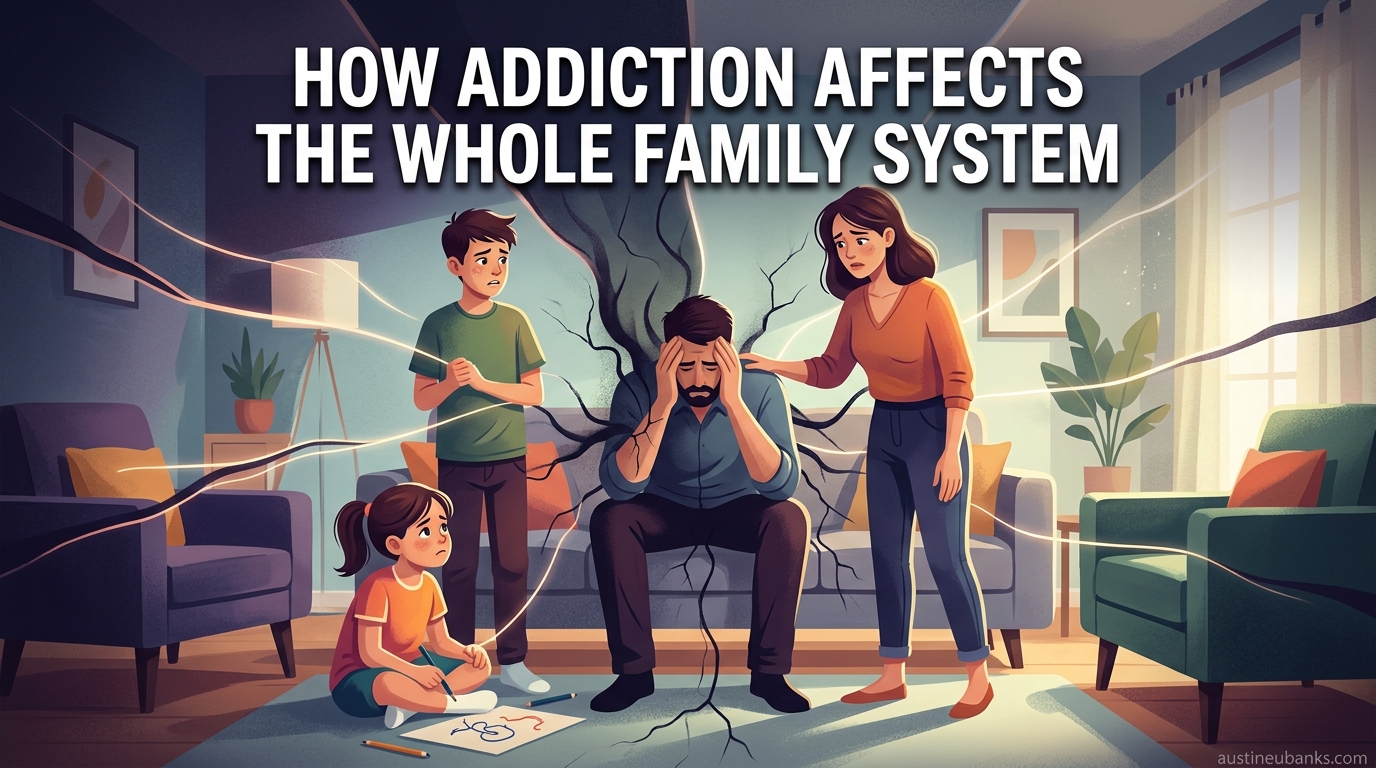
When someone develops a substance use disorder, the illness rarely stays contained to one person. It spreads outward like a stone dropped into still water, sending ripples through every relationship in the household. Understanding how addiction affects the whole family system is the first step toward healing for everyone involved, not just the person using substances.
If you are reading this because someone you love is struggling, you already know the weight of what that carries. The confusion, the fear, the exhaustion of trying to hold everything together. You may even feel responsible for fixing it. This guide breaks down exactly what happens to a family when addiction enters the picture and what you can do about it.
We will cover the six family roles that emerge in addicted households, how children and spouses are affected differently, the physical and emotional toll on family members, and practical steps for coping and recovery. Every section draws on research from clinical sources and real experiences shared by families who have lived through it.
Table of Contents
Addiction as a Family Disease: What That Means
Addiction is classified as a chronic, progressive disease of the brain that affects not only the individual but the entire family system. In clinical terms, a substance use disorder (SUD) changes how the brain processes dopamine, driving compulsive substance-seeking behavior despite negative consequences. But the damage extends far beyond brain chemistry.
Family systems theory, developed by Dr. Murray Bowen in the 1950s, explains why. This framework views the family as an interconnected emotional unit rather than a collection of separate individuals. When one member develops an addiction, every other member adjusts their behavior to compensate. These adjustments happen unconsciously and become entrenched over time.
The family reorganizes itself around the addiction. Rules change, communication distorts, and roles shift to maintain a fragile sense of balance. This is why addiction is called a family disease. Even if only one person is using substances, the entire system is affected. Recovery, then, must also involve the entire system, not just the person with the substance use disorder.
A useful comparison: imagine a mobile hanging above a crib. Touch one piece, and every other piece moves in response. Families work the same way. When addiction disrupts one member, the whole structure shifts and sways until it finds a new equilibrium, often an unhealthy one.
The 6 Family Roles in Addiction
When addiction takes hold of a household, family members unconsciously adopt specific roles to cope with the chaos. These roles were first identified by addiction researchers and family therapists as recurring patterns across thousands of families. Understanding them helps individuals recognize their own behavior and begin to change it.
Here are the six family roles that commonly emerge:
- The Dependent — This is the person with the substance use disorder. Their addiction drives the family dysfunction. They often deny the severity of the problem and manipulate family members to maintain access to substances.
- The Enabler (Caretaker) — Usually a spouse or parent who shields the dependent from consequences. The enabler makes excuses, pays debts, covers for missed work, and tries to keep the family looking normal to outsiders. Enabling comes from love and fear, but it unintentionally prolongs the addiction.
- The Hero — Often the oldest child, this family member overachieves to restore pride and stability. The hero excels in school or work, takes on adult responsibilities too early, and projects an image of success. Internally, they carry enormous pressure and rarely feel good enough.
- The Scapegoat — This person draws negative attention away from the addict through rebellious or defiant behavior. The scapegoat acts out, gets into trouble at school, or develops their own behavioral issues. They are often blamed for family problems that actually stem from the addiction.
- The Lost Child — Quiet, withdrawn, and easy to overlook. The lost child avoids conflict by becoming invisible. They spend time alone, avoid drawing attention, and suppress their own needs. As adults, they often struggle with intimacy and assertiveness.
- The Mascot — The family comedian who uses humor to defuse tension. The mascot tries to keep everyone laughing, often masking their own anxiety and pain. While they lighten the mood, they also avoid dealing with real emotions.
These roles are not fixed labels. A person may shift between roles over time, and not every family develops all six. But recognizing these patterns helps family members understand why they behave the way they do and how those behaviors connect to the addiction.
Reddit communities like r/SiblingsOfAddicts and r/REDDITORSINRECOVERY are filled with people who identified with these roles years after the fact. One user shared: “I was the hero my entire childhood and never understood why I couldn’t relax until a therapist explained family roles to me at 35.”
How Addiction Affects Children in the Family
Children are the most vulnerable members of any family system touched by addiction. Research from the National Survey on Drug Use and Health (NSDUH) and CDC consistently shows that children growing up in homes with substance use disorders face significantly higher risks across multiple areas of development.
Three primary ways children are impacted by addiction in a family:
1. Emotional Impact — Children of addicts often experience chronic anxiety, depression, and difficulty regulating emotions. They live in constant unpredictability, never sure which version of their parent they will encounter on any given day. This creates hypervigilance, a state of elevated alertness that can persist into adulthood. Many children blame themselves for the addiction, believing that if they were better, quieter, or smarter, the parent would stop using.
2. Developmental Impact — Addiction disrupts normal childhood development. Children may miss developmental milestones because their emotional energy is spent surviving rather than growing. According to Adverse Childhood Experiences (ACE) research, children in addicted homes are at significantly higher risk for learning disabilities, delayed language development, and attachment disorders. The younger the child, the more profound the impact.
3. Behavioral Impact — Children respond to addiction with a range of behaviors. Some become perfectionists who never cause trouble. Others act out, mirroring the chaos they see at school. Many develop people-pleasing tendencies or struggle to trust authority figures. Without intervention, these behavioral patterns often follow them into adulthood, affecting their own relationships and parenting.
Role reversal is one of the most damaging dynamics for children in addicted homes. This happens when a child takes on adult responsibilities like cooking meals, caring for younger siblings, or managing household tasks because the addicted parent cannot. Known as parentification, this experience robs children of their childhood and can lead to deep resentment and burnout later in life.
The ACE study found that children who grow up with a substance-abusing parent are two to four times more likely to develop their own substance use disorder. This is not because addiction is purely genetic, though genetics play a role, but because the family environment teaches coping patterns that can persist across generations.
Impact on Spouses and Partners
The spouse or partner of someone with an addiction often bears the most direct and sustained damage. They live closest to the chaos, and their own identity can become consumed by the relationship. Many partners describe feeling like they are losing themselves slowly, one crisis at a time.
Trust is usually the first casualty. Addiction breeds lies, broken promises, and manipulative behavior that erodes the foundation of the relationship. A partner may discover hidden debt, secret substance use, or infidelity. Each discovery damages trust further, and rebuilding it, even in recovery, is a long and painful process.
Codependency frequently develops in spouses of addicts. Codependency is a pattern where a person becomes emotionally and psychologically dependent on the addicted partner, often defining their own self-worth through the relationship. The codependent partner may neglect their own needs, isolate from friends, and focus entirely on managing the addict’s life. Without awareness and treatment, codependency can persist long after the addiction is addressed.
Financial strain adds another layer of damage. Substance use disorders are expensive, and money meant for household needs, savings, or children’s expenses may be diverted to fund the addiction. Spouses often discover depleted bank accounts, maxed-out credit cards, or unpaid bills that threaten the family’s stability. The stress of financial insecurity compounds the emotional toll.
In some cases, partners experience emotional or physical abuse. Substance use lowers inhibitions and impairs judgment, which can escalate to dangerous behavior. Domestic violence rates are significantly higher in households with active addiction. If you or someone you know is in this situation, the National Domestic Violence Hotline (1-800-799-7233) provides confidential support 24/7.
How Addiction Affects Siblings
Siblings of addicts face a unique set of challenges that are often overlooked in discussions about family addiction. When parents focus their attention and energy on the addicted sibling, the others frequently feel neglected or invisible. This dynamic can create lasting resentment and emotional distance between siblings.
Reddit’s r/SiblingsOfAddicts community highlights how common this experience is. One user wrote: “My parents spent ten years focused entirely on my brother’s addiction. By the time they looked up, I had graduated college, gotten married, and had two kids, all without them noticing.”
Siblings often fall into different family roles. One may become the hero who overachieves to compensate for the addicted sibling’s failures. Another may become the lost child, quietly withdrawing to avoid adding to the family’s problems. These divergent paths can drive siblings apart, creating fractures that last well beyond the addiction itself.
Guilt is also common among siblings. They may feel guilty for being healthy while their brother or sister struggles, or guilty for setting boundaries to protect themselves. Some siblings also carry anxiety about their own risk of developing addiction, aware that genetics and family environment both play a role.
Physical and Psychological Effects on Family Members
Living with addiction takes a measurable toll on the physical and mental health of everyone in the household. The body does not distinguish between physical danger and emotional danger. When the nervous system is chronically activated by the stress of addiction, it produces a constant flood of stress hormones like cortisol and adrenaline.
Physical symptoms commonly reported by family members include headaches, gastrointestinal problems, insomnia, weight changes, chronic fatigue, and muscle tension. These are not imagined symptoms. They are the body’s response to prolonged stress and are documented in research on families living with chronic illness and addiction.
The psychological effects are equally significant. Family members of people with substance use disorders have higher rates of anxiety disorders, depression, post-traumatic stress symptoms, and emotional dysregulation. Children in these homes are particularly vulnerable, but spouses and extended family members also report significant mental health struggles.
Many family members develop symptoms that resemble trauma responses. They may startle easily, avoid certain topics or places, experience intrusive thoughts about the addict’s behavior, or feel emotionally numb. This is because living with active addiction can be traumatic, even when there is no single dramatic event to point to. The accumulation of small crises, broken trust, and chronic fear creates a trauma environment.
The University of New Hampshire’s psychological and counseling services resource notes that family members may also turn to unhealthy coping mechanisms themselves, including overeating, excessive exercise, or even substance use, as a way to manage the stress.
The 3 C’s of Family Addiction
The 3 C’s is one of the most widely taught frameworks in family addiction recovery. Originally developed for children of alcoholics and now used across Al-Anon, Nar-Anon, and family therapy settings, it provides a simple but powerful reminder for anyone affected by a loved one’s addiction.
The 3 C’s are:
- You didn’t Cause it. No amount of being better, smarter, kinder, or more accommodating could have prevented the addiction. Substance use disorders develop from a complex interaction of genetics, environment, trauma, and brain chemistry. Blaming yourself is both inaccurate and harmful.
- You can’t Control it. You cannot control another person’s substance use through willpower, arguments, threats, or love. Attempts to control the addiction, through monitoring, hiding substances, or pleading, typically create more conflict without changing the behavior. Control is an illusion that keeps families stuck.
- You can’t Cure it. Addiction is a chronic disease that requires professional treatment. You are not a treatment provider, and your love alone cannot cure a substance use disorder. Accepting this is not giving up. It is acknowledging reality so that you can focus on what you can actually change.
The 3 C’s are often posted on mirrors, refrigerators, and phone lock screens by family members in recovery. They serve as a daily anchor when guilt and the urge to fix things become overwhelming. They are also a core teaching in Al-Anon, the support group for families and friends of alcoholics, and Nar-Anon, its counterpart for those affected by drug addiction.
Trust and Communication Breakdown
Trust erodes slowly in families affected by addiction, then all at once. Each broken promise to stop using, each lie about where money went, each episode of denial chips away at the foundation until family members stop believing anything the addicted person says. This protective skepticism is rational, but it also poisons the relationship.
Communication patterns distort in predictable ways. Family members learn to withhold information to avoid triggering the addict. They avoid certain topics. They speak in code or around the issue rather than addressing it directly. This is sometimes called the “elephant in the living room” phenomenon, where everyone knows the addiction exists but no one is allowed to name it.
Children become particularly adept at reading the emotional temperature of a room. They learn to assess whether a parent is sober before asking for something, sharing news, or expressing a need. This hypervigilance, while adaptive in childhood, can lead to people-pleasing and difficulty expressing needs in adult relationships.
Even when the addicted person enters recovery, rebuilding trust is a slow process. Trust is not restored by promises. It is rebuilt through consistent, trustworthy behavior over months and years. Family members may need professional help to process the accumulated betrayal and learn to communicate openly again.
Enabling vs. Helping: Understanding the Difference
One of the most common questions in Reddit’s family addiction communities is some version of: “Am I helping or am I enabling?” The distinction matters because enabling, no matter how well-intentioned, keeps the addiction alive by removing the consequences that might otherwise motivate change.
Enabling means doing something for the addicted person that they could and should do for themselves. Examples include paying their rent or bills, calling in sick to their employer, bailing them out of jail repeatedly, lying to cover for them, or giving them cash. Enabling removes the natural consequences of substance use, making it easier for the addiction to continue.
Helping means supporting the person’s recovery without shielding them from consequences. Examples include researching treatment options, attending family therapy, listening without judgment when they want to talk, providing emotional encouragement, and offering transportation to appointments. Helping empowers the person to take responsibility for their own recovery.
The line between the two can be blurry, and well-meaning family members frequently cross it. A parent who lets an adult child live at home rent-free while they “get back on their feet” may be enabling if there is no expectation of treatment or employment. The same parent offering a place to stay contingent on active participation in a recovery program is helping.
Setting boundaries is the bridge between enabling and helping. A clear boundary might sound like: “I love you and I will support your recovery, but I will not give you money or lie for you.” Boundaries are not punishments. They are statements of what you will and will not do, and they protect both you and the addicted family member.
How to Deal With a Family Member Who Has an Addiction
Dealing with a family member’s addiction is one of the hardest challenges any family can face. There is no single right approach, because every situation, every addiction, and every family is different. But research and clinical experience point to several steps that consistently help families navigate this terrain.
Step 1: Educate yourself. Learn about substance use disorders as medical conditions, not moral failings. Understanding how addiction affects the brain reduces blame and stigma, both toward the addicted person and toward yourself. Resources like SAMHSA (Substance Abuse and Mental Health Services Administration) and NIDA (National Institute on Drug Abuse) offer free, evidence-based information.
Step 2: Stop enabling behaviors. Identify the specific ways you may be shielding the addicted person from consequences. This does not mean cutting them off. It means choosing responses that support recovery rather than perpetuating the addiction. Start small if needed.
Step 3: Set and communicate clear boundaries. Decide what you will no longer tolerate or participate in, and communicate it directly and without anger when possible. Be prepared to follow through, because boundaries without consequences are just suggestions.
Step 4: Consider a professionally guided intervention. An intervention is a structured conversation led by a trained interventionist where family and friends express their concerns and present a treatment plan. Research shows that interventions led by professionals have a higher success rate than informal confrontations. The Association of Intervention Specialists can help you find a certified interventionist.
Step 5: Seek support for yourself. You cannot pour from an empty cup. Al-Anon, Nar-Anon, and therapy are not just for when things are at their worst. They are ongoing resources for anyone affected by a loved one’s addiction. Connecting with others who understand your experience reduces isolation and provides practical coping strategies.
Step 6: Practice self-care without guilt. Many family members feel selfish for focusing on their own wellbeing when a loved one is struggling. But chronic stress has real health consequences, as we covered earlier. Taking care of yourself is not abandonment. It is what allows you to remain a stable, healthy presence in your family.
Family Recovery and Treatment Options
Recovery from addiction is not just for the person with the substance use disorder. Families also need to recover. The patterns, roles, and communication styles that developed during active addiction do not simply disappear when the using stops. They require conscious effort to identify and change.
Family therapy is one of the most effective tools for this work. A trained family therapist helps members identify dysfunctional patterns, improve communication, and rebuild trust. Several evidence-based models exist, including Behavioral Couples Therapy for addiction, Family Behavior Therapy, and Multidimensional Family Therapy for adolescents.
Support groups provide community and ongoing encouragement. Al-Anon serves families and friends of alcoholics, while Nar-Anon serves those affected by drug addiction. Adult Children of Alcoholics (ACA) focuses specifically on adults who grew up in addicted or dysfunctional homes. These groups are free, widely available both in person and online, and require no registration or commitment.
Individual therapy is equally important. Each family member may carry their own wounds from the addiction that need dedicated attention. Therapists trained in trauma, codependency, and family-of-origin issues can help individuals process their experiences and develop healthier patterns for the future.
Remember that family recovery is not linear. There will be setbacks, relapses, and moments of discouragement. But families who commit to the process, who stay willing to learn and grow, can emerge from addiction with stronger, more honest, and more connected relationships than they had before.
FAQs
How does drug addiction affect the entire family?
Drug addiction affects the entire family by disrupting trust, communication, finances, and emotional stability. Family members often develop unhealthy coping roles, experience chronic stress, and may suffer physical and mental health problems. Children face developmental risks, spouses struggle with codependency, and siblings may feel neglected. The entire family system reorganizes around the addiction, creating patterns that can persist for generations without intervention.
What are the 7 family roles in addiction?
The family roles in addiction are the Dependent (the person with the substance use disorder), the Enabler or Caretaker (who shields the dependent from consequences), the Hero (who overachieves to compensate), the Scapegoat (who draws negative attention through acting out), the Lost Child (who withdraws to avoid conflict), and the Mascot (who uses humor to defuse tension). Some frameworks add a seventh role, the Responsible One, which overlaps with the Hero but emphasizes taking on adult duties and maintaining order.
How to deal with a family member who has an addiction?
To deal with a family member who has an addiction, start by educating yourself about substance use disorders as medical conditions. Stop enabling behaviors that shield them from consequences. Set clear, enforceable boundaries and communicate them directly. Consider a professionally guided intervention if the person refuses treatment. Seek support through Al-Anon, Nar-Anon, or individual therapy, and prioritize your own physical and mental health throughout the process.
What are three ways children can be impacted by addiction in a family?
Three primary ways children are impacted by addiction in a family are emotional (chronic anxiety, depression, guilt, and hypervigilance), developmental (missed milestones, learning difficulties, and attachment disorders linked to Adverse Childhood Experiences), and behavioral (perfectionism, acting out, people-pleasing, or mirroring chaotic behavior). Children may also experience parentification, where they take on adult responsibilities prematurely because the addicted parent cannot function in that role.
Conclusion
Understanding how addiction affects the whole family system changes the conversation from blame to awareness. Addiction is not a personal failing or a character flaw. It is a chronic disease that reshapes every relationship it touches, from the spouse who loses trust to the child who takes on adult responsibilities far too early.
The six family roles, the 3 C’s, and the patterns of enabling and codependency are not just clinical concepts. They are maps that help you understand what is happening in your own home and why. With that understanding comes the ability to change course, set boundaries, seek help, and begin the slow work of recovery for the whole family.
If you are living with a family member’s addiction, start with one step today. Call Al-Anon or Nar-Anon. Look up a family therapist. Read about the 3 C’s. Talk to someone who understands. You are not alone, and the patterns that addiction created in your family can be broken with awareness, support, and time.