
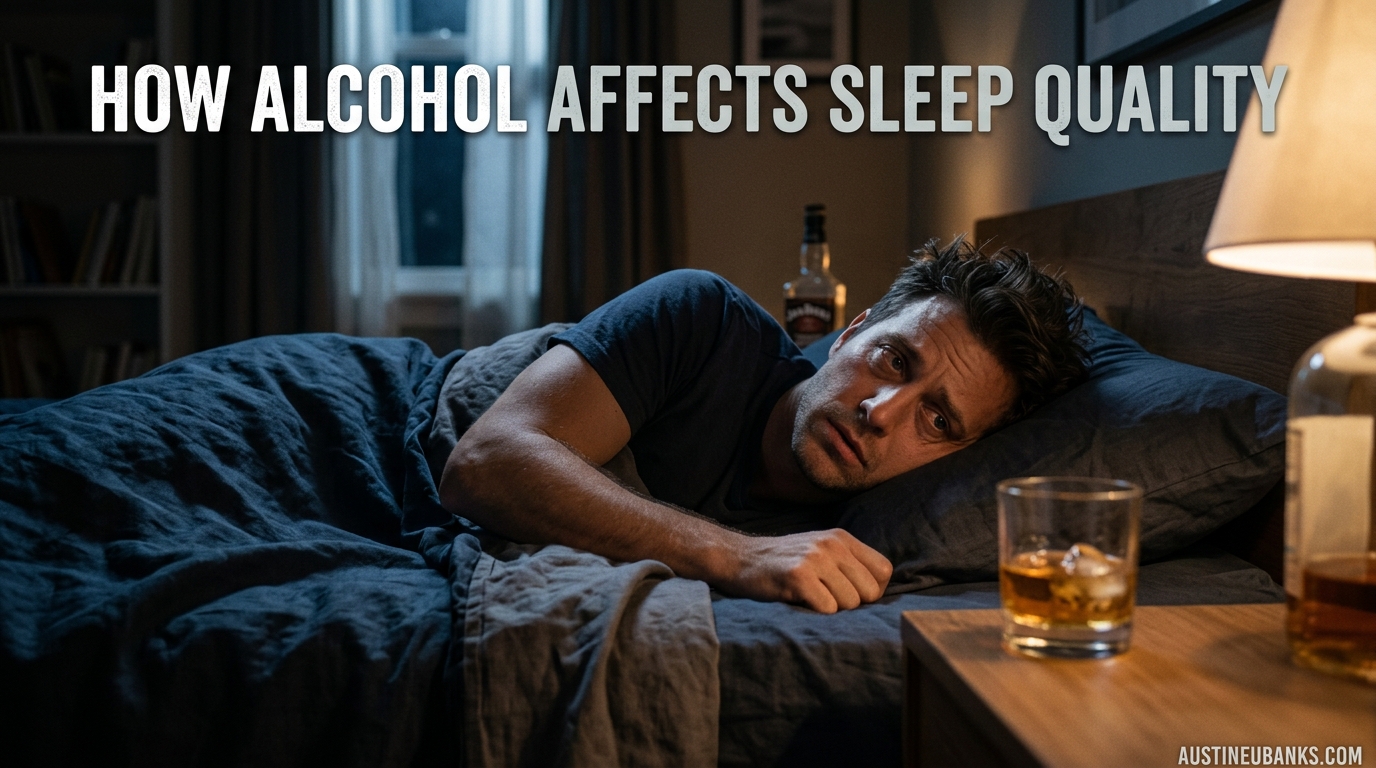
You pour a glass of wine at dinner, finish it by 8 PM, and head to bed feeling relaxed. You fall asleep quickly, maybe faster than usual. But at 3 AM, your eyes snap open. Your heart is racing. You toss and turn until your alarm goes off, and you wake up feeling like you barely slept at all.
If this sounds familiar, you are experiencing one of the most well-documented but least understood effects of alcohol on the body. Research shows that even small amounts of alcohol, as little as one drink, can decrease your overall sleep quality by 9.3%. That is not a typo. A single glass of wine, beer, or cocktail can measurably reduce how rested you feel the next day.
In this guide, our team breaks down exactly how alcohol affects sleep quality even in small amounts. We will cover the science behind sleep disruption, the dose-dependent effects from one drink to several, why you wake up in the middle of the night after drinking, and what you can do to protect your sleep without giving up social drinking entirely.
This article draws on peer-reviewed research from the National Institutes of Health, clinical data from sleep medicine specialists, and real-world experiences shared by thousands of people across sleep communities who track their sleep with wearables like Oura rings, Garmin watches, and Apple Watches.
Whether you are a nightly glass-of-wine person, a weekend social drinker, or someone who just wants to understand why their sleep has been off lately, you will find clear, evidence-based answers here.
Table of Contents
Key Takeaways
- Even one drink can reduce sleep quality by 9.3%, according to large-scale sleep research from Hackensack Meridian Health.
- Alcohol suppresses REM sleep, the stage responsible for memory consolidation and emotional processing, which leads to brain fog and poor focus the next day.
- The sedative effect of alcohol helps you fall asleep faster, but this initial drowsiness masks what is happening underneath: fragmented, shallow, non-restorative sleep.
- Most people experience a “rebound effect” between 2 and 3 AM when the body finishes metabolizing alcohol, causing sudden wakefulness.
- Alcohol relaxes throat muscles, worsening snoring and potentially triggering sleep apnea episodes even in people without a prior diagnosis.
- The recommended cutoff is at least 3 hours before bed, though 4 to 6 hours is ideal for avoiding sleep disruption entirely.
- Women are more sensitive to alcohol’s sleep-disrupting effects due to differences in body composition and enzyme levels.
The Short Answer: How Alcohol Affects Sleep Quality Even in Small Amounts
Alcohol is a central nervous system depressant that initially makes you feel drowsy and helps you fall asleep faster. But as your body metabolizes it over the course of the night, alcohol disrupts your normal sleep architecture in three major ways: it suppresses REM sleep, fragments your sleep cycles, and causes a rebound wakefulness effect that jolts you awake in the early morning hours.
This happens even with small amounts. A study analyzing data from over 4,000 adults found that a single serving of alcohol (under two drinks for men, under one for women) reduced sleep quality by 9.3%. Moderate consumption (about two drinks for men, one for women) cut quality by 24%. Large amounts (more than two drinks for men, more than one for women) slashed sleep quality by 39.2%.
The reason small amounts still matter is that alcohol affects the neurotransmitters that regulate your sleep cycle, particularly GABA and glutamate. Even a small dose alters the balance between your sleep stages, trading deep, restorative REM sleep for lighter, more fragmented sleep that leaves you feeling unrefreshed.
For anyone wondering “does alcohol affect sleep quality,” the answer is an unambiguous yes. The better question is how much it affects your sleep, and that depends on dose, timing, your biology, and the type of alcohol you consume.
How Alcohol Affects Sleep Quality Even in Small Amounts: The Science
To understand how alcohol affects sleep quality even in small amounts, you need to understand what happens in your brain when you drink. Alcohol acts on multiple neurotransmitter systems simultaneously, and several of those systems are directly responsible for regulating your sleep cycle.
When alcohol enters your bloodstream, it enhances the effect of GABA (gamma-aminobutyric acid), the brain’s primary inhibitory neurotransmitter. GABA slows down brain activity, which is why alcohol makes you feel relaxed, drowsy, and sedated. This is the same neurotransmitter targeted by sleep medications like Ambien and benzodiazepines.
At the same time, alcohol inhibits glutamate, the brain’s primary excitatory neurotransmitter. By simultaneously turning up the “brakes” (GABA) and turning down the “accelerator” (glutamate), alcohol creates a powerful sedative effect. This is why even a small amount can make your eyelids heavy and help you drift off to sleep.
But here is where the problem starts. Alcohol also affects adenosine, a chemical that builds up in your brain throughout the day and creates “sleep pressure.” Alcohol artificially boosts adenosine levels, making you feel sleepier than you naturally would be. When the alcohol wears off, your adenosine levels drop abruptly, contributing to that sudden middle-of-the-night wakefulness.
The sedative effect of alcohol is not the same as natural sleep. Natural sleep is an active, highly regulated process where your brain cycles through distinct stages, each serving a specific function. Alcohol hijacks the onset of sleep but disrupts the architecture that follows.
Even in small amounts, alcohol begins altering these neurotransmitter systems within 15 to 45 minutes of consumption. The effects on sleep architecture can last for 4 to 6 hours after your last drink, depending on how much you consumed and how quickly your body metabolizes alcohol.
How Alcohol Disrupts Your Sleep Architecture
Sleep architecture refers to the structural organization of your sleep cycles throughout the night. A healthy night of sleep consists of four to six complete cycles, each lasting roughly 90 minutes, moving through distinct stages. When alcohol enters the picture, it fundamentally restructures this architecture.
In a normal sleep cycle, your brain progresses through three NREM (non-rapid eye movement) stages and one REM (rapid eye movement) stage. NREM sleep includes light sleep (N1 and N2) and deep slow-wave sleep (N3). REM sleep is when most dreaming occurs, and it plays a critical role in memory consolidation, emotional regulation, and cognitive function.
Here is how alcohol changes each part of this cycle:
First Half of the Night (The Sedative Phase): In the first few hours after drinking, alcohol increases the proportion of deep slow-wave sleep (N3). This is why people often report falling into a deep, heavy sleep after a nightcap. It feels like high-quality sleep, but it is actually an artificial deepening caused by alcohol’s sedative properties.
The problem is that this early-night deep sleep comes at a cost. Alcohol simultaneously suppresses REM sleep during the first half of the night. REM sleep, which normally begins about 90 minutes after you fall asleep and recurs throughout the night, gets pushed aside. Your brain is not getting the REM cycles it needs for memory processing and emotional regulation.
Second Half of the Night (The Rebound Phase): As your body metabolizes the alcohol, typically completing the process within 4 to 5 hours of your last drink, the sedative effect wears off. Your brain, starved of REM sleep during the first half of the night, tries to compensate with what sleep researchers call “REM rebound.”
During this rebound, your brain attempts to cram missed REM sleep into the remaining hours. But this REM sleep is fragmented and poor quality. Instead of smooth transitions between sleep stages, your brain jumps between lighter sleep stages and intense, fragmented REM activity.
This is why you might experience vivid dreams, nightmares, or a racing mind when you wake up at 2 or 3 AM after drinking. Your brain is essentially experiencing REM sleep in short, chaotic bursts rather than the sustained, orderly cycles of a normal night.
Sleep Fragmentation: Throughout the entire night, alcohol increases the number of brief awakenings you experience. These micro-arousals may not fully wake you up, but they pull you out of deeper sleep stages into lighter sleep. By morning, you may have spent significantly more time in light sleep (N1 and N2) and far less time in restorative deep sleep and REM than you would on an alcohol-free night.
Studies using polysomnography, the gold-standard sleep monitoring technique, consistently show that alcohol increases total sleep time in the first half of the night but decreases it dramatically in the second half. The overall result is more time in bed but less restorative sleep.
How Much Alcohol Disrupts Sleep: Dose-Dependent Effects
One of the most important findings in sleep research is that alcohol’s effect on sleep is dose-dependent. This means the more you drink, the worse your sleep gets. But critically, the disruption begins at even the smallest doses.
A landmark analysis published by Hackensack Meridian Health examined how different amounts of alcohol affected sleep quality across thousands of adults. The findings are striking in their clarity:
Small serving of alcohol (under two drinks for men, under one for women): Sleep quality decreased by 9.3%. Even this minimal amount measurably reduced restorative sleep, increased sleep fragmentation, and suppressed REM sleep.
Moderate serving of alcohol (about two drinks for men, one for women): Sleep quality decreased by 24%. At this level, the disruption becomes very noticeable. Most people at this dose will experience the classic pattern of falling asleep quickly, then waking up between 2 and 4 AM unable to get back to restful sleep.
Large serving of alcohol (more than two drinks for men, more than one for women): Sleep quality decreased by 39.2%. At this level, the sleep architecture is severely disrupted. Deep sleep is initially enhanced but then crashes. REM sleep is heavily suppressed, and the second-half rebound effect is intense.
What makes these numbers so important is the “small serving” category. Many people assume that one drink is harmless or even beneficial for sleep because it helps them fall asleep. The 9.3% reduction shows that this assumption is wrong. One drink does not ruin your sleep entirely, but it does make it measurably worse.
Think of it this way: if your sleep quality is normally an 8 out of 10, one drink drops it to about a 7.3. You might not notice a single night, but over weeks and months of nightly wine or beer, that 9.3% reduction compounds. You are essentially living with chronically reduced sleep quality, accumulating sleep debt without realizing it.
The dose-dependent relationship also means that timing matters as much as quantity. One drink consumed 6 hours before bed will have far less impact than one drink consumed 30 minutes before bed, because your body has more time to metabolize the alcohol before sleep begins.
Why You Wake Up at 3 AM: The Rebound Effect
If you have ever asked yourself “why do I wake up at 3 AM after drinking even a little,” you are not alone. This is one of the most common complaints in sleep communities, and it has a clear biological explanation.
The phenomenon is called the “rebound effect,” and it is a direct consequence of how your body processes alcohol. Here is what happens step by step.
When you drink, your liver metabolizes alcohol at a rate of roughly one standard drink per hour. During this active metabolism period, alcohol is exerting its sedative effect on your brain, keeping you in artificially deepened sleep. Your brain is under the influence, so to speak.
Once your liver finishes processing the alcohol, typically 4 to 5 hours after your last drink, the sedative effect vanishes. But your brain does not simply return to normal. It overcorrects. The GABA suppression that was keeping you sedated suddenly lifts, and the glutamate inhibition that was calming your brain reverses. Your brain becomes more active than it would be during normal sleep.
This neurological rebound is compounded by a second factor: REM sleep debt. If alcohol suppressed your REM sleep during the first half of the night, your brain is now desperate to recover that lost REM time. It tries to initiate intense REM activity, which can manifest as vivid dreams, nightmares, or a racing, anxious mind.
The combination of neurological rebound and REM debt creates the perfect storm for a 3 AM awakening. Your brain is too activated to stay in deep sleep, but too tired to be fully awake. You end up in a miserable limbo, tossing and turning, unable to get back to quality sleep.
This effect occurs even after small amounts of alcohol. One drink consumed at 9 PM will be fully metabolized by approximately 10 to 11 PM if you go to bed at 11 PM. But if you drink that same one drink at 10:30 PM and go to bed at 11 PM, your body will still be processing the alcohol during the first part of the night, and the rebound will hit right around 2 or 3 AM.
This is why timing matters so much. The same amount of alcohol can cause significantly different sleep outcomes depending on when you consume it relative to when you go to bed.
Some people also report night sweats during this rebound period. As your body works to metabolize alcohol, it generates heat. When the metabolism process ends, your core body temperature can fluctuate, contributing to sweating and discomfort that further fragment your sleep.
Alcohol and REM Sleep: Why You Feel Exhausted
REM (rapid eye movement) sleep is one of the most important stages of your sleep cycle, and it is also the stage most disrupted by alcohol. Understanding what REM sleep does helps explain why even small amounts of alcohol leave you feeling exhausted despite spending 8 hours in bed.
During REM sleep, your brain is almost as active as it is when you are awake. Your eyes dart rapidly behind closed lids (hence the name), your breathing becomes irregular, and most of your voluntary muscles become temporarily paralyzed to prevent you from acting out your dreams.
REM sleep serves several critical functions. It consolidates memories from the previous day, helping transfer information from short-term to long-term storage. It processes emotional experiences, helping you regulate mood and respond appropriately to stress. It supports creative problem-solving and cognitive flexibility.
When alcohol suppresses REM sleep, all of these functions suffer. You wake up with brain fog, difficulty concentrating, and a shorter emotional fuse. You might feel like you got 8 hours of sleep, but your brain did not complete the essential maintenance work that REM provides.
Research shows that even a single drink can reduce REM sleep by 10 to 20% in the first half of the night. While your brain attempts to compensate with REM rebound later, this compensatory REM is fragmented and less effective than natural REM cycles.
The next-day effects of REM suppression are measurable. Studies have shown reduced performance on memory tasks, slower reaction times, and impaired emotional regulation in people who consumed alcohol before bed compared to those who did not, even when total sleep time was the same.
This is why people who track their sleep with wearables often report a direct correlation between any alcohol consumption and a drop in their sleep score. The devices are picking up on reduced REM duration, increased sleep fragmentation, and more time spent in light sleep stages.
Alcohol and Sleep Apnea: The Snoring Connection
If you or your partner has ever noticed that snoring gets dramatically worse after a night of drinking, you are observing one of alcohol’s most direct effects on the respiratory system during sleep. Alcohol is a muscle relaxant, and it does not discriminate between which muscles it relaxes, including the muscles in your airway.
Your upper airway is kept open during sleep by a set of dilator muscles in your throat. When these muscles are functioning normally, air flows freely in and out of your lungs. When they relax too much, the soft tissues in your throat vibrate as air passes through, producing the sound of snoring.
Alcohol relaxes these airway muscles significantly more than normal sleep does. Even one or two drinks can cause the throat muscles to slacken to the point where the airway partially collapses. For someone who already snores, alcohol makes it louder and more frequent. For someone who does not normally snore, alcohol can trigger snoring on nights when they drink.
More concerning is the connection between alcohol and sleep apnea. Obstructive sleep apnea (OSA) is a condition where the airway repeatedly collapses during sleep, causing pauses in breathing that can last 10 seconds or longer. Each pause triggers a survival reflex that briefly wakes you up to reopen the airway, fragmenting your sleep severely.
Alcohol worsens sleep apnea in two ways. First, it relaxes the airway muscles even further, making complete airway collapse more likely. Second, it reduces your brain’s respiratory drive, meaning your body is slower to respond to oxygen drops and slower to reopen the airway.
Research has shown that alcohol consumed within 3 hours of bedtime significantly increases the frequency and severity of apnea episodes in people who already have OSA. But even people without a formal sleep apnea diagnosis can experience alcohol-induced breathing disruptions.
A study published in the National Institutes of Health’s PMC database found that alcohol increased the number of apnea-like events even in otherwise healthy individuals. The effect was dose-dependent: more alcohol led to more breathing disruptions.
If you have ever woken up gasping or choking after a night of drinking, this is likely the mechanism at work. Your airway collapsed, your oxygen levels dropped, and your brain triggered an emergency wake-up to restore breathing.
The snoring-apnea connection is also why some people feel especially terrible the morning after drinking. It is not just the alcohol itself; it is the repeated oxygen deprivation throughout the night, which places stress on your cardiovascular system and prevents restorative sleep.
Does the Type of Alcohol Matter for Sleep?
One of the most common questions in sleep forums is whether the type of alcohol you drink affects your sleep differently. People want to know if wine is worse than beer, if clear spirits are better than dark ones, and whether certain drinks are gentler on sleep than others.
The short answer is that all forms of alcohol disrupt sleep because ethanol is the active compound responsible for the neurological effects. But there are real differences between types of alcohol that can influence the severity and nature of sleep disruption.
Wine: Wine, particularly red wine, contains higher levels of compounds called congeners. Congeners are byproducts of the fermentation process that give alcoholic beverages their color, flavor, and aroma. Red wine has the highest congener content among common alcoholic drinks. These compounds can contribute to inflammation and may worsen hangover symptoms, which indirectly affects next-day sleep quality. Wine also contains histamines and tannins, which can trigger mild allergic reactions in some people, potentially contributing to nasal congestion that worsens snoring and breathing during sleep.
Beer: Beer has a lower alcohol concentration per volume, which means you typically consume less ethanol per drink compared to wine or spirits. This can make it easier to control your total alcohol intake. However, beer is also carbonated and consumed in larger volumes, which can lead to bloating, acid reflux, and nighttime bathroom trips that fragment sleep. The hops in beer have mild sedative properties, but the alcohol content overwhelms any sleep-promoting benefit.
Spirits (vodka, gin, whiskey, rum): Clear spirits like vodka and gin contain fewer congeners than dark spirits like whiskey, rum, and brandy. The lower congener content may result in slightly less severe next-day symptoms. However, spirits have the highest alcohol concentration, making it easier to accidentally consume more ethanol than intended. A single cocktail can contain two or three standard drinks’ worth of alcohol, significantly amplifying sleep disruption.
The sugar factor: Many cocktails and mixed drinks contain significant amounts of sugar. Sugar consumed close to bedtime can cause blood sugar spikes followed by crashes, which can trigger cortisol release and contribute to middle-of-the-night wakefulness. Sweet mixed drinks may compound alcohol’s sleep-disrupting effects with a secondary blood sugar roller coaster.
Carbonation: Carbonated alcoholic beverages like champagne, beer, and mixed drinks with soda can increase bloating and acid reflux. Lying down with a stomach full of carbonated liquid can cause discomfort and heartburn that make it harder to fall asleep and stay asleep.
In practical terms, no type of alcohol is “good” for sleep. If you are choosing what to drink on an evening when sleep matters, clear spirits with minimal sugar mixers consumed earlier in the evening will likely cause the least disruption. But the most important factors remain the total amount of alcohol and how close to bedtime you consume it.
Gender Differences: Why Alcohol Hits Women’s Sleep Harder
If you have noticed that women seem more affected by small amounts of alcohol than men, there is solid science behind that observation. Gender plays a significant role in how the body processes alcohol, and these differences directly impact sleep.
Women generally have a higher percentage of body fat and lower percentage of body water than men of comparable weight. Since alcohol distributes primarily in water, a given amount of alcohol results in a higher blood alcohol concentration in women than in men. This means the same drink hits women harder, neurologically speaking.
Women also produce less of an enzyme called alcohol dehydrogenase, which is responsible for breaking down alcohol in the stomach before it reaches the bloodstream. With less of this enzyme, more intact alcohol enters a woman’s system from the same drink, leading to higher peak blood alcohol levels and a longer metabolism time.
For sleep, these differences mean that the dose-dependent effects described earlier apply at lower drink counts for women. The research from Hackensack Meridian Health defined a “small serving” as under two drinks for men but under one drink for women. One drink for a woman can produce blood alcohol levels and sleep disruption comparable to two drinks for a man.
Hormonal fluctuations also play a role. Estrogen appears to influence how the body metabolizes alcohol, and fluctuations in estrogen levels during the menstrual cycle can affect alcohol sensitivity. Some women report that the same drink affects their sleep very differently depending on where they are in their cycle.
During and after menopause, when estrogen levels drop significantly, alcohol’s effects on sleep can become even more pronounced. Menopausal women already face sleep challenges from hot flashes and night sweats, and alcohol can amplify both of these symptoms while simultaneously disrupting sleep architecture.
This is not to say that men are immune to alcohol’s sleep effects. Men absolutely experience sleep disruption from alcohol. But the threshold at which disruption begins is lower for women, and the severity at any given dose tends to be higher. If you are a woman who feels that one drink wrecks your sleep while your male partner seems unaffected, biology is on your side.
Age and Alcohol: Why Sleep Gets More Sensitive Over Time
As we age, our sleep naturally changes. Total sleep time tends to decrease, deep slow-wave sleep diminishes, and sleep fragmentation increases. Adding alcohol to an already fragile sleep system amplifies these age-related changes, which is why many people find that alcohol affects their sleep more severely as they get older.
In your 20s and 30s, your sleep architecture is relatively robust. You spend a healthy proportion of the night in deep sleep and REM sleep, and your body can often bounce back from a night of disrupted sleep more quickly. A single drink might cause minimal noticeable effects because your baseline sleep quality is high enough to absorb the disruption.
Starting in your 40s, natural age-related changes in sleep begin to accelerate. Deep sleep decreases by roughly 2% per decade after age 40. The proportion of light sleep (N1 and N2) increases. Sleep efficiency, the percentage of time in bed that you actually spend sleeping, begins to decline.
When you add alcohol to this already-aging sleep system, the effects become more pronounced. The same amount of alcohol that barely registered in your 20s can cause noticeable sleep fragmentation in your 40s and significant disruption in your 50s and beyond. This is partly because there is less deep sleep to spare. When alcohol suppresses REM sleep or causes rebound wakefulness, an older brain has a harder time compensating because its baseline sleep resources are already reduced.
Metabolism also slows with age. Your liver processes alcohol more slowly as you get older, meaning the same drink stays in your system longer and affects your brain for more of the night. A drink that might have been fully metabolized in 90 minutes at age 25 could take 2 to 3 hours at age 55.
Many people in their 40s, 50s, and 60s report that they used to drink without sleep issues but now find that even one drink disrupts their night. This is a real physiological change, not imagination. The combination of reduced sleep architecture, slower metabolism, and accumulated effects of decades of drinking creates a perfect storm for alcohol-related sleep disruption.
Older adults are also more likely to be taking medications that interact with alcohol. Blood pressure medications, antidepressants, and sleep aids can all interact dangerously with alcohol, amplifying its sedative effects and increasing the risk of breathing problems during sleep.
When Should I Stop Drinking Before Bed?
The single most effective step you can take to reduce alcohol’s impact on your sleep is to stop drinking early enough that your body has time to fully metabolize the alcohol before you go to sleep. Sleep specialists universally recommend cutting off alcohol at least 3 hours before bedtime, with 4 to 6 hours being ideal.
Here is why that window matters. Your liver metabolizes alcohol at an average rate of one standard drink per hour. A standard drink is defined as 14 grams of pure alcohol, which equals approximately 12 ounces of regular beer (5% ABV), 5 ounces of wine (12% ABV), or 1.5 ounces of spirits (40% ABV).
If you have one drink and wait 3 hours, your body has had enough time to process most of the alcohol. The sedative effect will have largely worn off, and your brain can enter natural sleep without the artificial deepening and subsequent rebound that alcohol causes.
However, several factors can extend the necessary cutoff window:
Number of drinks: Each additional drink adds approximately one more hour to your metabolism time. Two drinks require about 2 to 3 hours. Three drinks need 3 to 4 hours. Four or more drinks can take 5 to 6 hours or longer.
Your body weight and composition: People with lower body weight or higher body fat percentage will metabolize alcohol more slowly, requiring a longer cutoff window.
Food intake: Drinking on an empty stomach causes alcohol to absorb more rapidly, leading to higher peak blood alcohol levels. Eating before or while drinking slows absorption but does not speed up overall metabolism time.
Age: As discussed, metabolism slows with age. Older adults should add 30 to 60 minutes to the standard cutoff recommendations.
Biological sex: Women should add extra time due to slower alcohol metabolism and lower body water content.
Medications: Many common medications, including over-the-counter antihistamines and prescription drugs, can interact with alcohol and extend its effects.
A practical framework some people use is the “2-2-2 rule” for alcohol consumption: no more than 2 drinks, no more than 2 nights per week, and stop at least 2 hours before bed. While this rule is more of a guideline than a clinical recommendation, it captures the spirit of moderation and timing that sleep specialists recommend.
For anyone serious about protecting their sleep, the gold standard is to avoid alcohol entirely on nights when quality sleep matters. If you do drink, finishing your last drink 4 to 6 hours before bedtime gives your body the best chance of metabolizing the alcohol completely before sleep begins.
It is also worth noting that the timing of your last drink matters more than the timing of dinner or other evening activities. Alcohol is the variable most likely to disrupt your sleep architecture, so prioritizing the alcohol cutoff window is the highest-impact change you can make.
Practical Tips for Better Sleep Without Alcohol
If you have been using alcohol as a sleep aid or simply enjoy an evening drink and want to minimize its impact on your sleep, there are several practical strategies you can implement.
1. Shift your drinking earlier in the evening. Instead of a nightcap right before bed, move your drink to accompany dinner. Finishing your last drink by 7 PM if you go to bed at 11 PM gives your body 4 hours to metabolize the alcohol before sleep.
2. Alternate alcoholic drinks with water. This slows your overall consumption rate and helps maintain hydration. Dehydration from alcohol contributes to poor sleep quality and next-day fatigue, so staying hydrated can partially mitigate the effects.
3. Choose lower-alcohol options. A 4% ABV beer instead of an 8% IPA, or a 5-ounce pour of wine instead of an 8-ounce pour, reduces your total ethanol intake without eliminating the social or enjoyment aspect of drinking.
4. Establish an alcohol-free wind-down routine. If you have been relying on a drink to signal to your brain that it is time to relax, you need a replacement. A warm bath, reading, gentle stretching, or listening to calming music can serve the same psychological purpose without disrupting your sleep architecture.
5. Try tart cherry juice or other natural sleep aids. Tart cherry juice contains natural melatonin and has been shown in small studies to improve sleep quality. While the evidence is modest, it provides a ritual replacement for an evening drink without the sleep-disrupting effects of alcohol.
6. Track your sleep to see the impact. Wearable sleep trackers like Oura, Garmin, Apple Watch, and Whoop can show you exactly how alcohol affects your sleep stages. Seeing your REM sleep drop by 15% after a single drink can be powerful motivation to change your habits.
7. Consider non-alcoholic alternatives. The market for non-alcoholic beers, spirits, and mocktails has exploded in 2026. Many offer the social and sensory experience of drinking without the ethanol that disrupts sleep. These can be particularly useful in social situations where you want to participate without paying the sleep cost.
8. Designate alcohol-free nights. You do not have to quit drinking entirely to improve your sleep. Simply committing to 3 or 4 alcohol-free nights per week can give your brain the recovery time it needs to maintain healthy sleep architecture.
The Insomnia-Alcohol Cycle: A Dangerous Loop
One of the most insidious aspects of alcohol’s relationship with sleep is the cycle it can create with insomnia. Many people who have trouble falling asleep turn to alcohol as a self-medication strategy, which ultimately makes their insomnia worse.
Here is how the cycle typically works. You have trouble falling asleep, so you have a drink to help you relax and drift off. The alcohol’s sedative effect works, and you fall asleep faster than you would have without it. This reinforces the belief that alcohol helps you sleep.
But as we have seen, alcohol fragments your sleep and causes rebound wakefulness. You wake up at 3 AM and have trouble getting back to sleep. The next day, you feel tired and unrefreshed. That evening, you feel even more tired and have even more trouble falling asleep naturally, so you reach for a drink again.
Over time, this cycle can escalate. You may need more alcohol to achieve the same sedative effect as you build tolerance. More alcohol means more sleep disruption, which means more daytime fatigue, which means more reliance on alcohol to fall asleep.
Research has shown that people who use alcohol as a sleep aid are at significantly higher risk for developing alcohol dependence. The very substance they are using to solve their sleep problem is causing the problem to worsen.
The caffeine-alcohol cycle is a related problem. Poor sleep from alcohol leads to excessive caffeine consumption the next day to combat fatigue. Caffeine consumed too late in the afternoon then interferes with falling asleep that night, leading to another round of alcohol use to overcome the caffeine-induced wakefulness.
Breaking this cycle requires addressing the root cause of the sleep difficulty. If anxiety is keeping you awake, alcohol masks the symptom temporarily but worsens the underlying dysregulation. Cognitive behavioral therapy for insomnia (CBT-I), sleep hygiene improvements, and stress management techniques address the root cause without the sleep-disrupting side effects of alcohol.
How Long Does Alcohol Affect Sleep?
The duration of alcohol’s sleep-disrupting effects depends on several factors, but as a general rule, a single night of drinking affects your sleep for one to two nights afterward.
On the night of drinking, the acute effects last from the time you fall asleep until you wake up. For most people, this means 6 to 8 hours of disrupted sleep architecture. The severity depends on the dose and timing, as discussed.
The following night, even if you do not drink again, you may still experience lingering effects. Your brain may still be recovering from REM deprivation, potentially causing REM rebound with vivid dreams or more fragmented sleep. This is especially common after heavier drinking episodes.
For people who drink regularly, the effects are cumulative. Each night of alcohol-disrupted sleep adds to your sleep debt. Over weeks and months, chronic alcohol-related sleep disruption can lead to persistently poor sleep quality, daytime fatigue, and impaired cognitive function.
Users in sleep communities who have quit drinking report that sleep improvement begins within days. The first few nights without alcohol can actually be difficult, with rebound insomnia and intense REM activity causing vivid dreams and restless sleep. But within one to two weeks, most people report dramatically improved sleep quality, longer deep sleep and REM durations, and significantly better daytime energy.
This recovery timeline suggests that alcohol’s effects on sleep are largely reversible when consumption stops. However, long-term heavy drinking can cause more persistent changes to sleep architecture that take months to fully resolve.
When to See a Doctor About Alcohol and Sleep
If you are experiencing persistent sleep problems that you suspect are related to alcohol consumption, there are several signs that indicate it may be time to consult a healthcare professional.
You wake up gasping or choking during the night. This is a potential sign of sleep apnea, which alcohol can trigger or worsen. Sleep apnea is a serious medical condition that requires evaluation and treatment.
You cannot fall asleep without alcohol. If you have become dependent on alcohol to initiate sleep, this is a sign of both an alcohol use concern and an underlying sleep disorder that needs professional attention.
Your partner reports that you stop breathing during sleep. Observed apnea episodes, especially after drinking, warrant a sleep study to evaluate for obstructive sleep apnea.
You feel exhausted every day despite getting 7 to 8 hours of sleep. Chronic non-restorative sleep can have many causes, including alcohol-related sleep disruption, sleep apnea, or other sleep disorders.
You are drinking increasing amounts to achieve the same sleep effect. Tolerance development is a sign of potential alcohol dependence and should be discussed with a healthcare provider.
You experience anxiety, tremors, or sweating when you stop drinking. These can be signs of alcohol withdrawal, which requires medical supervision to manage safely.
A sleep medicine specialist can conduct a sleep study (polysomnography) to evaluate your sleep architecture and identify any underlying disorders. They can also provide guidance on safe approaches to reducing alcohol use if it is interfering with your sleep.
Frequently Asked Questions About Alcohol and Sleep
Can just one drink affect your sleep?
Yes. Research shows that even a single serving of alcohol (under two drinks for men, under one for women) can decrease overall sleep quality by 9.3%. One drink suppresses REM sleep, fragments sleep cycles, and can cause middle-of-the-night wakefulness as your body metabolizes the alcohol. The effect is small but measurable and compounds over time with regular drinking.
How long after drinking can I sleep normally?
Most sleep specialists recommend waiting at least 3 hours after your last drink before going to bed, with 4 to 6 hours being ideal. Your liver processes approximately one standard drink per hour. For one drink, a 3-hour buffer is usually sufficient. For two drinks, plan on 4 hours. For three or more, allow 5 to 6 hours or more depending on your metabolism, age, and body composition.
Why does alcohol make me tired but I wake up at 3am?
Alcohol is a sedative that helps you fall asleep quickly by enhancing GABA and suppressing glutamate in your brain. But once your body finishes metabolizing the alcohol, typically 4 to 5 hours after your last drink, the sedative effect wears off abruptly. Your brain experiences a rebound activation, and if REM sleep was suppressed during the first half of the night, your brain attempts intense REM recovery that manifests as vivid dreams and sudden wakefulness. This is why the 2 to 3 AM wake-up pattern is so common after drinking.
Does alcohol affect sleep quality the next day?
Yes. Alcohol’s effects on sleep architecture can linger into the following night even if you do not drink again. Your brain may still be recovering from REM sleep deprivation, causing fragmented sleep and vivid dreams the next night. Additionally, hangover symptoms including headache, dehydration, and gastrointestinal distress can reduce sleep quality on the night after drinking as well.
What is the worst alcohol for sleep?
All types of alcohol disrupt sleep, but red wine is often considered among the worst due to its high congener content, histamines, and tannins, which can worsen inflammation and nasal congestion. Dark spirits like whiskey, rum, and brandy also contain high congener levels. Sweet cocktails with high sugar content can compound sleep disruption through blood sugar spikes and crashes. Clear spirits like vodka and gin tend to cause fewer side effects due to lower congener content.
Can small amounts of alcohol cause insomnia?
Yes. Regular consumption of even small amounts of alcohol can contribute to insomnia by fragmenting sleep and causing rebound wakefulness. Many people develop a cycle where they use alcohol to fall asleep, but the alcohol disrupts their sleep quality, leading to worse insomnia over time. Breaking this cycle usually requires stopping alcohol use as a sleep aid and addressing underlying causes of sleep difficulty through sleep hygiene improvements or cognitive behavioral therapy for insomnia.
Why do I sleep worse after drinking even a little?
Even small amounts of alcohol affect the neurotransmitters that regulate your sleep cycle. Alcohol enhances GABA (causing sedation) and suppresses glutamate, which artificially deepens early-night sleep but suppresses REM sleep. When the alcohol is metabolized, your brain experiences rebound activation that fragments the second half of your night. Individual sensitivity varies based on genetics, age, biological sex, and baseline sleep quality. Some people are simply more sensitive to alcohol’s neurological effects on sleep than others.
Does building tolerance reduce alcohol’s effect on sleep?
Not significantly. While you may develop behavioral tolerance to alcohol’s sedative effects (needing more to feel drunk), your sleep architecture remains sensitive to alcohol at any dose. Studies show that even people with high alcohol tolerance experience REM sleep suppression and sleep fragmentation after drinking. Tolerance may change how alcohol feels subjectively, but it does not protect your sleep architecture from disruption.
AuthorJerry
The Bottom Line on Alcohol and Sleep
Understanding how alcohol affects sleep quality even in small amounts comes down to one core truth: alcohol trades short-term sedation for long-term sleep disruption. It helps you fall asleep faster but costs you REM sleep, deep restorative sleep, and overall sleep quality.
The research is clear. One drink reduces sleep quality by 9.3%. Two drinks by 24%. The effects compound with regular consumption, and the disruption begins at doses most people consider harmless.
If quality sleep is a priority for your health, cognitive performance, and emotional well-being, the most impactful change you can make is to stop drinking at least 3 to 4 hours before bed. If you drink nightly, even reducing to 3 or 4 alcohol-free nights per week can give your brain the recovery time it needs to maintain healthy sleep architecture.
You do not have to quit drinking entirely to sleep better. But you do have to respect the fact that alcohol and quality sleep are fundamentally at odds. The more you understand about how alcohol affects sleep quality even in small amounts, the better equipped you are to make choices that serve both your social life and your health.
Research and Sources
This article draws on peer-reviewed research and clinical data from the following sources:
Hackensack Meridian Health (2026). “Here’s How Alcohol Affects Your Sleep.” Provides the dose-dependent sleep quality reduction percentages (9.3%, 24%, 39.2%) based on analysis of over 4,000 adults. Expert input from Dr. Georges Ghacibeh, neurologist and sleep medicine specialist.
Sleep Foundation (2026). “Alcohol and Sleep.” Comprehensive review of alcohol’s effects on sleep architecture, including REM suppression, circadian rhythm disruption, and parasomnias. Expert-reviewed by Dr. Abhinav Singh, board-certified sleep medicine physician.
National Institutes of Health (NIH) PMC. “The Effects of Alcohol on Quality of Sleep.” Peer-reviewed analysis of the relationship between alcohol consumption patterns and subjective sleep quality, sleep duration, and sleep disturbances across multiple population studies.
Sleep Advances (Oxford Academic). “Alcohol use and poor sleep quality: a longitudinal twin study.” Research demonstrating that even relatively small amounts of alcohol before bedtime increase sleep fragmentation and impair REM sleep.
Baptist Health (2026). “Can Just One Drink Ruin Sleep?” Clinical perspective on how alcohol consumed close to bedtime disrupts the sleep cycle and shortens REM sleep duration.
MD Anderson Cancer Center (2026). “Alcohol affects sleep, here’s how.” Overview of alcohol’s effects on sleep efficiency, rebound insomnia, hangover-sleep connection, and the dangers of mixing alcohol with sleep medications.
Additional insights incorporated from community-reported experiences on sleep tracking data from wearable devices including Oura, Garmin, Apple Watch, and Whoop, as well as discussions from sleep-focused communities.
This article is for informational purposes only and does not constitute medical advice. If you are experiencing persistent sleep problems or have concerns about your alcohol consumption, please consult a qualified healthcare professional or sleep medicine specialist.