
Your heart is pounding. Your chest feels tight. Your thoughts are racing so fast you can barely keep up with them. If you have ever felt this way during a stressful moment, you already know how quickly your body can shift into full alarm mode.
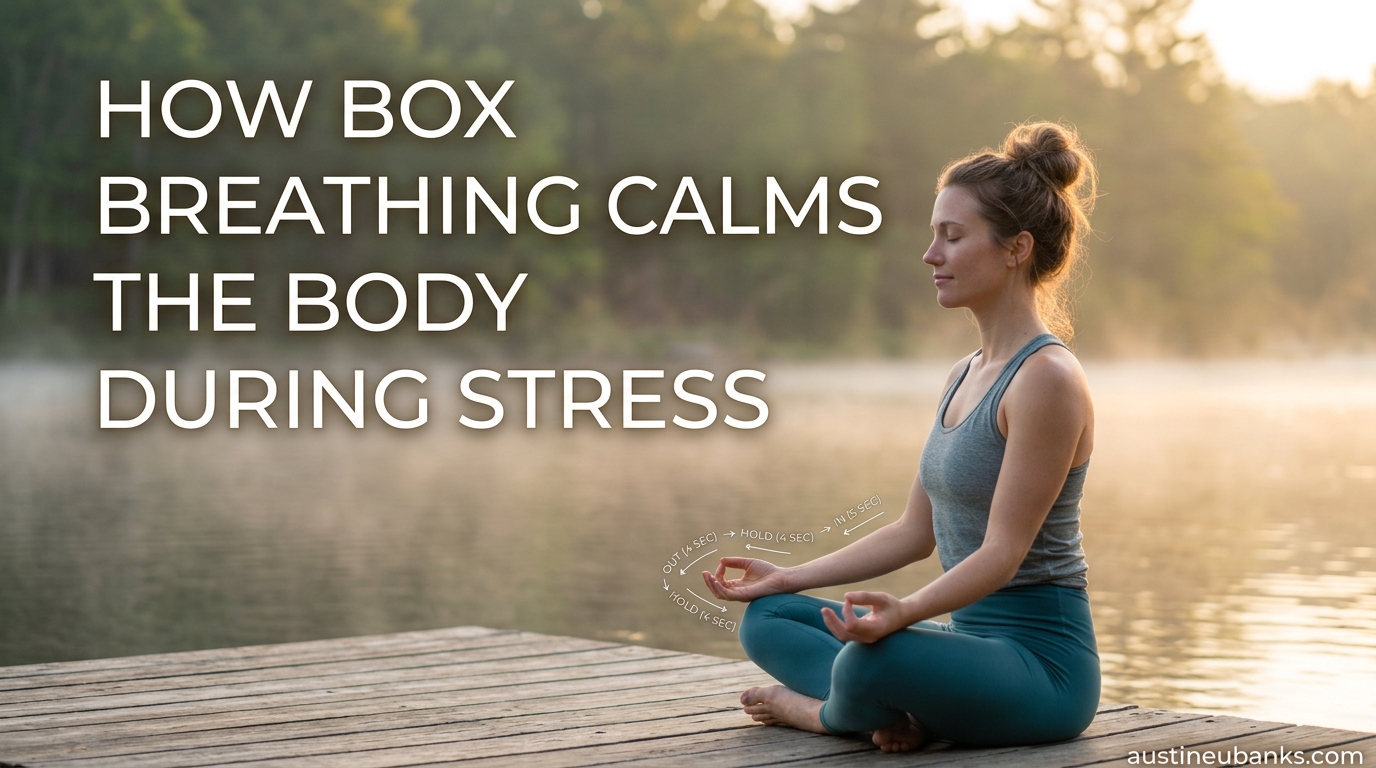
Box breathing is a simple deep breathing technique where you inhale for 4 counts, hold for 4 counts, exhale for 4 counts, and hold for 4 counts in a repeating cycle. It calms the body during stress by activating the parasympathetic nervous system, which directly counteracts the fight-or-flight response, lowering cortisol, slowing your heart rate, and restoring a sense of control within minutes.
I first discovered box breathing during a particularly brutal period of work deadlines. A colleague noticed me gripping my desk and quietly said, “Try breathing in a square.” That offhand tip changed how I handle pressure forever. In this guide, I will walk you through exactly how box breathing calms the body during stress, the science behind why it works, and how you can start using it today.
Table of Contents
Quick Summary: Box Breathing at a Glance
Box breathing, also known as square breathing, four-square breathing, or sama vritti pranayama, is a structured breathing exercise that uses a simple 4-4-4-4 rhythm. Each side of the “box” represents one phase of breathing that lasts for four counts.
The technique is famously used by Navy SEALs to manage stress in high-stakes combat situations. It has also been studied by researchers at institutions including the Cleveland Clinic, the University of Arizona, and the American Heart Association for its effects on stress, blood pressure, and emotional regulation.
You can practice it anywhere, at any time, without any equipment. All you need is your breath and the ability to count to four.
Alternative names: square breathing, 4-4-4-4 breathing, equal breathing, sama vritti pranayama, four-square breathing, tactical breathing.
What Is Box Breathing?
Box breathing is a deep breathing technique built around a symmetrical pattern of inhaling, holding, exhaling, and holding again, each for the same count of four. The name comes from the visual of tracing a square or box with your breath, where each side represents one four-count phase.
Unlike many breathing exercises that focus only on the inhale and exhale, box breathing adds intentional breath holds on both sides. These holds are what make the technique unique and what give the pattern its distinctive calming effect.
The Origin Story
Box breathing is often associated with Navy SEALs, who use it as a tactical tool to manage adrenaline and maintain clarity in life-or-death situations. Mark Divine, a former SEAL commander, popularized the technique through his training programs and described it as a way to build mental toughness under extreme pressure.
But the roots of box breathing go much deeper than modern military training. The practice shares a direct lineage with sama vritti pranayama, a yogic breathing technique that translates to “equal fluctuation breath control.” Ancient yoga practitioners discovered thousands of years ago that equalizing the length of each breath phase produces a profound sense of mental stillness.
So while Navy SEALs gave box breathing its modern reputation, the core principle has been helping people find calm for centuries.
Other Names You Might Hear
You will see this technique called many things depending on the source. Medical sites like Cleveland Clinic and Healthline tend to use “box breathing” or “square breathing.” Yoga and meditation communities use “sama vritti pranayama” or “equal breathing.” Military and tactical sources sometimes call it “combat tactical breathing.” All of these refer to the same 4-4-4-4 pattern.
How Box Breathing Calms the Body During Stress
This is the heart of the matter. Understanding how box breathing calms the body during stress requires a basic look at what happens inside you when stress hits and how controlled breathing reverses that process.
The Fight-or-Flight Response
When your brain perceives a threat, whether it is a physical danger or an email from your boss that says “we need to talk,” it activates the sympathetic nervous system. This is the body’s fight-or-flight response. Your adrenal glands release cortisol and adrenaline. Your heart rate spikes. Your breathing becomes shallow and rapid. Blood rushes to your muscles and away from your digestive system and prefrontal cortex.
This response is useful if you need to outrun a predator. It is far less useful when you are sitting at a desk trying to think clearly. The problem for most modern humans is that this system gets triggered constantly by non-life-threatening stressors and has no natural off switch.
Activating the Parasympathetic Nervous System
Box breathing manually flips the switch. When you slow your breathing to a controlled, rhythmic pattern, you stimulate the vagus nerve, a major nerve that runs from your brainstem to your abdomen. The vagus nerve is the main highway of the parasympathetic nervous system, which is responsible for the body’s rest-and-digest response.
Research has shown that slow, deep breathing increases vagal tone, which is a measure of how effectively your parasympathetic nervous system is functioning. Higher vagal tone means your body can shift out of stress mode faster and more completely.
As the parasympathetic system takes over, your heart rate slows. Your blood vessels relax, which can lower blood pressure. Your digestive system resumes normal function. The prefrontal cortex, responsible for rational thinking and decision-making, comes back online.
Reducing Cortisol Levels
Cortisol is often called the stress hormone, and for good reason. Chronic stress keeps cortisol elevated, which over time can contribute to weight gain, sleep problems, immune system suppression, and cardiovascular issues. Studies cited by the Cleveland Clinic show that regulating your breath through techniques like box breathing can lower cortisol levels measurably.
The mechanism is straightforward. When you breathe slowly and rhythmically, your brain interprets the calm pattern as a signal that you are safe. It stops pumping out cortisol and adrenaline and begins producing calming neurotransmitters instead.
Improving Heart Rate Variability
Heart rate variability, or HRV, is the variation in time between each heartbeat. Counterintuitively, a higher HRV is a sign of good health and strong stress resilience. It means your heart can rapidly adjust to changing demands.
Slow breathing exercises like box breathing have been shown to improve HRV by balancing the two branches of the autonomic nervous system. When your sympathetic and parasympathetic systems are in harmony, your heart can respond flexibly rather than being stuck in stress overdrive.
The Cognitive Distraction Factor
There is another layer to how box breathing calms the body during stress that many sources overlook. The act of counting to four, over and over, occupies your working memory. This gives your brain a structured task that interrupts anxious thought loops.
When you are stressed, your mind tends to spiral into catastrophic thinking. “What if this goes wrong? What if I fail? What if they are upset?” The counting required in box breathing acts as a cognitive circuit breaker. You cannot simultaneously count to four and obsess over worst-case scenarios with the same intensity.
WebMD describes this as a distraction mechanism that creates a cognitive shift away from anxious rumination. I have found this to be one of the most powerful aspects in practice. The counting gives your mind something to do while your body recalibrates.
Carbon Dioxide Regulation
When you are stressed, you tend to overbreathe without realizing it. This means you exhale too much carbon dioxide, which can lead to symptoms like dizziness, tingling, and a sense of panic. Box breathing counteracts this by slowing your respiratory rate and allowing carbon dioxide levels to stabilize.
By adding the breath-hold phases, box breathing specifically helps prevent the carbon dioxide depletion that triggers hyperventilation. This is one reason it can be particularly effective during panic attacks.
How to Do Box Breathing: Step-by-Step Guide
Here is exactly how to practice box breathing. Before you start, sit comfortably with your feet flat on the floor and your back straight. Relax your shoulders and let your hands rest in your lap.
Before you begin: Take a moment to notice your current breathing pattern without trying to change it. Just observe. Are your breaths shallow? Is your chest doing the work instead of your belly? This awareness helps you track the shift as you move into the technique.
Step 1: Inhale for 4 Counts
Close your mouth and breathe in slowly through your nose for a count of four. Let the air fill your lungs from the bottom up, expanding your belly first and then your chest. Keep the inhale smooth and controlled rather than gulping air all at once.
Step 2: Hold for 4 Counts
At the top of your inhale, hold your breath for a count of four. Keep your throat and facial muscles relaxed. You should not feel like you are clamping down. Simply pause and let the air sit comfortably in your lungs.
Step 3: Exhale for 4 Counts
Release the air slowly through your mouth for a count of four. Purse your lips slightly and let the breath exit in a controlled, even stream. Empty your lungs completely by the time you reach four.
Step 4: Hold for 4 Counts
At the bottom of your exhale, hold your breath again for a count of four. This is the phase many people find challenging at first. Stay relaxed and trust that your next inhale is coming in just four counts.
That completes one full cycle or one “box.” Repeat the four-step cycle for at least three to four rounds, which takes roughly two to three minutes. The Cleveland Clinic recommends starting with three or four rounds and gradually increasing as you become more comfortable.
After your rounds: Sit quietly for a few seconds and notice any changes in your body. Has your heart rate slowed? Do your muscles feel less tense? Is your mind clearer? This post-practice check-in helps you build awareness of the technique’s effects.
Key Benefits of Box Breathing
The benefits of box breathing go well beyond simple relaxation. Research and clinical experience point to a wide range of positive effects on both mental and physical health.
1. Rapid Stress and Cortisol Reduction
The most immediate and well-documented benefit of box breathing is stress relief. By activating the parasympathetic nervous system, the technique directly reduces cortisol production and helps your body exit the fight-or-flight state. Many people report feeling noticeably calmer after just two to three minutes of practice.
A 2023 study published in the National Center for Biotechnology Information found that structured breathwork practices produced greater improvement in mood and greater reduction in respiratory rate compared to mindfulness meditation alone. Both approaches reduced anxiety, but breathwork worked faster.
2. Lower Blood Pressure
The American Heart Association has highlighted slow breathing exercises as a tool for blood pressure management. When you slow your breathing rate, your blood vessels dilate and your cardiovascular system operates under less strain. Over time, regular practice may contribute to sustained improvements in resting blood pressure.
The British Heart Foundation also recommends deep breathing exercises as part of a heart-healthy lifestyle, noting that they help prevent heart rate and blood pressure from spiking during stressful moments.
3. Anxiety and Panic Attack Relief
For people dealing with anxiety disorders, box breathing offers a portable, discreet tool that can be used anywhere. The structured counting helps interrupt panic spirals, while the breath regulation prevents hyperventilation. Mental health professionals frequently teach box breathing as part of cognitive behavioral therapy for anxiety and panic disorder.
I have used it in waiting rooms before medical appointments, in my car before difficult conversations, and in bathroom stalls at conferences. Nobody knows you are doing it, which is part of what makes it so practical.
4. Improved Focus and Decision-Making
Stress impairs the prefrontal cortex, the part of your brain responsible for planning, reasoning, and decision-making. By reducing stress chemistry, box breathing helps restore access to these higher cognitive functions. Navy SEALs use it specifically because it allows them to think clearly in situations where most people would freeze or panic.
WebMD notes that box breathing can be particularly valuable before important decisions or high-pressure situations, helping you approach challenges from a place of calm rather than reactivity.
5. Better Sleep
Many people use box breathing as part of their bedtime routine to quiet a racing mind and prepare the body for sleep. The technique activates the relaxation response, lowers heart rate, and shifts brain activity away from the beta waves associated with active thinking toward the alpha and theta waves associated with relaxation and sleep onset.
Reddit users in communities like r/Meditation and r/breathwork frequently report success using box breathing to fall asleep, especially when stress or anxiety is keeping them awake.
6. Emotional Regulation
Box breathing creates a buffer between a triggering event and your emotional response. Instead of reacting impulsively to stress, the technique gives you a few minutes to process your feelings from a calmer physiological state. Over time, this can lead to improved emotional resilience and fewer regrettable reactions.
This benefit is particularly relevant for anger management. Taking a few rounds of box breathing before responding to a provocation can prevent the kind of escalation that leads to damaged relationships.
7. Support for PTSD Symptom Management
Healthline highlights box breathing as a complementary tool for managing symptoms of post-traumatic stress disorder. By helping regulate the autonomic nervous system, the technique can reduce the intensity of flashbacks, hyperarousal, and anxiety spikes. It is not a standalone treatment, but when used alongside professional therapy, it can provide meaningful relief.
Box Breathing vs Other Breathing Techniques
People often ask whether box breathing is better than other popular breathing exercises. The honest answer is that each technique has strengths suited to different situations. Here is how box breathing compares to two of the most common alternatives.
Box Breathing vs 4-7-8 Breathing
The 4-7-8 method, popularized by Dr. Andrew Weil, involves inhaling for 4 counts, holding for 7, and exhaling for 8. The longer exhale makes it particularly effective for sleep onset and acute anxiety relief. Box breathing, with its equal counts, is more mentally engaging due to the counting pattern and tends to be better for focus and daytime stress management.
If your primary goal is falling asleep, 4-7-8 may have a slight edge. If you need to stay alert but calm, box breathing is usually the better choice.
Box Breathing vs Diaphragmatic Breathing
Diaphragmatic breathing, or belly breathing, focuses on breathing deeply into your diaphragm rather than shallowly into your chest. It does not use a specific count pattern. Box breathing actually incorporates diaphragmatic breathing as a component, since you are encouraged to breathe deeply from the belly during each phase.
Think of diaphragmatic breathing as the foundation and box breathing as a structured application of that foundation with added cognitive benefits from the counting rhythm.
Common Mistakes to Avoid
Box breathing is simple, but that does not mean people always get it right on the first try. Here are the most common mistakes I have seen and experienced, along with how to fix them.
Rushing the Count
When you are stressed, your natural instinct is to speed everything up. People often start counting faster without realizing it, turning a slow four-count into a rushed two-second cycle. To fix this, use a consistent tempo. You can silently say “one-thousand-one, one-thousand-two” for each count to keep the pace steady.
Shallow Chest Breathing
If you are breathing into your chest instead of your belly, you are not getting the full benefit. Place one hand on your stomach and make sure it rises and falls with each breath. If your chest is moving but your belly is not, slow down and focus on drawing air deeper into your lungs.
Tensing Up During the Holds
The breath-hold phases are meant to be relaxed pauses, not clenched-teeth struggles. If you find yourself tightening your jaw, shoulders, or throat during the holds, you may be holding too much air or counting too fast. Keep your facial muscles soft and your shoulders dropped.
Inconsistent Practice
Using box breathing only during a crisis is like only exercising when you are already injured. The technique works best when you practice it regularly, even when you are not stressed. This builds the neural pathways and muscle memory that make the technique instantly accessible when you actually need it.
Tips for Getting the Most Out of Box Breathing
Some Reddit users in r/Anxiety and r/breathwork report that box breathing feels uncomfortable or even slightly increases their anxiety at first. If that happens to you, you are not alone and there is nothing wrong with you. Here are some tips to help.
If the four-count hold feels too long, start with a three-count or even a two-count box. The equal-rhythm principle is what matters most, not the specific number. You can gradually increase the count as your comfort grows.
Practice when you are already calm, not just when stressed. Try doing three rounds every morning after waking up or every evening before bed. Consistency matters more than duration.
If you feel lightheaded, you are likely breathing too forcefully. The inhale and exhale should be gentle, not aggressive. Ease off the intensity and let the breath flow naturally.
Combine box breathing with other grounding techniques for stronger results. Some people like to trace a square in the air or on their thigh with a finger while counting, which adds a tactile element that reinforces the rhythm.
When and Where to Practice Box Breathing
One of the greatest advantages of box breathing is that it works anywhere. Here are some of the best scenarios to use it.
Before a Stressful Meeting or Presentation
Take three to four rounds of box breathing in the minutes before a high-pressure meeting, presentation, or difficult conversation. It will lower your heart rate and help you walk in with a clear head instead of a racing mind.
During a Panic Attack
When panic hits, box breathing can serve as an anchor. Focus entirely on the counting and the rhythm. The structured task gives your mind something predictable to hold onto while your nervous system shifts out of crisis mode. Start with shorter counts if four feels too challenging in the moment.
Before Bed for Better Sleep
Lie in bed, close your eyes, and do five to ten rounds of box breathing. The technique quiets mental chatter and activates the relaxation response, making it easier to transition into sleep. Many users on Reddit report this as their most effective use case.
During Exam or Test Anxiety
Students can use box breathing before and even during exams. A quick three-round session before a test can reduce anxiety enough to improve recall and performance. During the test, a single round between questions can help reset focus.
While Flying or During Other Phobias
Reddit’s r/fearofflying community frequently recommends box breathing for managing flight anxiety. The same applies to dental visits, blood draws, and other situation-specific fears. The portability and discretion of the technique make it ideal for these moments.
Safety Considerations
Box breathing is safe for the vast majority of people. However, there are a few situations where caution is warranted.
If you have a heart condition, consult your doctor before starting any breath-hold practice. The holds cause brief changes in blood pressure and heart rate that are usually harmless but could be an issue for certain cardiac conditions.
Pregnant women should also check with a healthcare provider, as breath-holding exercises can sometimes reduce oxygen availability. Modified versions with shorter holds may be more appropriate.
If you feel dizzy, lightheaded, or more anxious during practice, stop immediately. Return to your normal breathing pattern and try again later with a shorter count. Discomfort that persists may warrant a conversation with a healthcare professional.
Box breathing is a wellness tool, not a medical treatment. It should complement, not replace, professional care for anxiety disorders, PTSD, hypertension, or any other medical condition.
FAQs
How to relax the nervous system?
You can relax the nervous system by activating the parasympathetic branch through slow, controlled breathing. Box breathing is one of the most effective methods because the 4-4-4-4 pattern stimulates the vagus nerve, which signals your body to shift from fight-or-flight into rest-and-digest mode. Other effective approaches include progressive muscle relaxation, gentle movement, meditation, and spending time in nature.
Why do I hold my breath when stressed?
Holding your breath when stressed is part of the body’s freeze response, a lesser-known cousin of fight or flight. When the nervous system becomes overwhelmed, it can signal the breathing muscles to freeze as a protective mechanism. Box breathing helps by giving you a structured way to consciously override this response and reestablish a healthy breathing rhythm.
How to stop manually breathing anxiety?
The sensation of manually breathing, where you become hyperaware of each breath, is common during anxiety. Box breathing helps by giving your breathing a structured pattern to follow, which removes the decision-making burden. After a few rounds, your autonomic nervous system typically resumes control and breathing becomes automatic again. Distraction and gentle physical activity can also help break the cycle.
How long should you do box breathing to calm down?
The Cleveland Clinic recommends starting with three to four rounds of box breathing, which takes about two to three minutes. Most people begin to feel calmer within the first two rounds. For ongoing stress management, practicing five to ten minutes daily can produce cumulative benefits. During acute stress or panic, continue until you notice your heart rate slow and your thoughts settle.
Conclusion
Box breathing calms the body during stress by working on multiple levels simultaneously. It activates the parasympathetic nervous system, reduces cortisol, slows your heart rate, stabilizes carbon dioxide levels, and gives your mind a structured task that breaks anxious thought loops. Few stress management tools are this simple, this portable, and this well-supported by research.
Start small. Try three rounds right now, wherever you are sitting. Inhale for four, hold for four, exhale for four, hold for four. Notice what shifts. Then practice again tomorrow. The technique gets more effective with repetition because you are training your nervous system to access calm on demand.
Stress will always be part of life. But with box breathing, you carry the antidote with you everywhere you go, hidden in the rhythm of your own breath.