
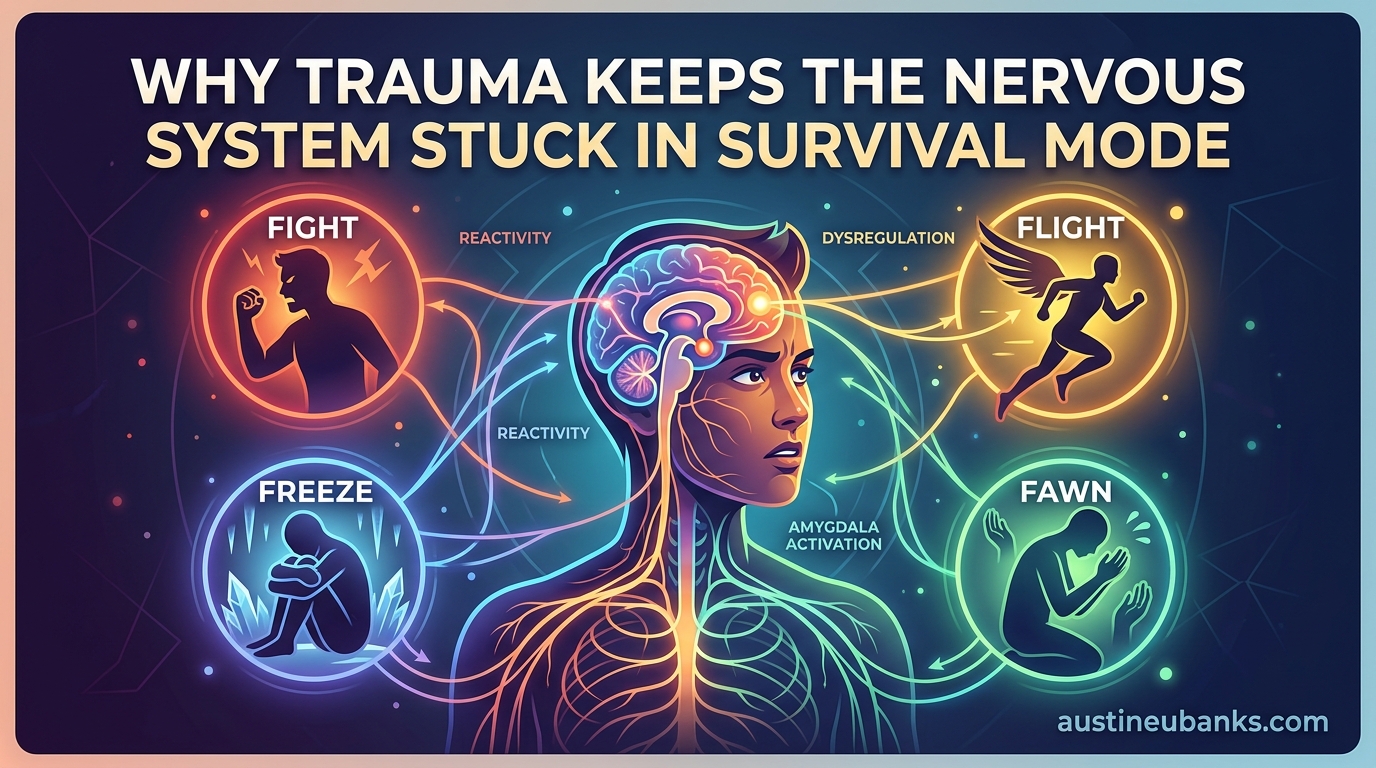
Trauma can keep your nervous system stuck in survival mode because your brain and body lose the ability to distinguish between past danger and present safety. When a traumatic event overwhelms your coping capacity, your autonomic nervous system activates a threat response to protect you. If that response never fully completes, your body stays locked in a state of alertness, scanning for the next threat even when none exists.
If you have ever felt constantly on edge, emotionally exhausted, or unable to relax despite desperately wanting to, this is not a personal failing. It is a physiological response. Your nervous system is doing exactly what it evolved to do: keeping you alive by erring on the side of caution. The problem is that this protective mechanism, when left on indefinitely, starts working against you.
Many people who have lived through trauma describe feeling like they are stuck in a loop, reliving the same survival patterns for years or even decades. They know logically that they are safe, but their bodies disagree. This disconnect between what your mind knows and what your body feels is one of the most frustrating aspects of trauma recovery, and it is also the key to understanding why healing requires more than just changing your thoughts.
In this article, we will break down exactly why trauma can keep the nervous system stuck in survival mode, what happens in your brain and body, and what you can start doing today to help your system recognize that the danger has passed.
Table of Contents
How Your Nervous System Is Supposed to Work
Your autonomic nervous system runs everything that happens below conscious awareness: heart rate, breathing, digestion, immune function, and your stress response. It operates automatically, which is why you cannot simply think your way out of a panic attack or will yourself to stop being anxious.
This system has two main branches that work like a gas pedal and a brake. The sympathetic nervous system is your gas pedal. It activates the fight-or-flight response when you face a threat, flooding your body with adrenaline and cortisol, increasing your heart rate, and sharpening your focus. The parasympathetic nervous system is your brake. It triggers the rest-and-digest state, slowing your heart rate, supporting digestion, and allowing your body to repair and recover.
In a healthy, non-traumatized system, these two branches trade off smoothly throughout the day. You encounter a stressor, your sympathetic system activates, the stressor resolves, and your parasympathetic system brings you back to baseline. This cycle is natural and necessary. The problem with trauma is that it disrupts the completion of this cycle.
Think of it like a smoke detector. A well-functioning detector sounds the alarm when there is actual smoke, then goes silent when the air clears. A trauma-affected nervous system is like a detector that goes off and never resets, blaring constantly even when the room is perfectly clear. Your body keeps allocating energy to survival functions instead of the healing, digesting, and resting functions that keep you healthy.
This constant allocation toward survival has real consequences. Over time, the systems responsible for long-term health, like digestion, immune function, and sleep regulation, get shortchanged. Your body is quite literally prioritizing immediate survival over long-term wellbeing, which made sense during the original traumatic event but becomes destructive when the response never shuts off.
Why Trauma Can Keep the Nervous System Stuck in Survival Mode
To understand why trauma can keep the nervous system stuck in survival mode, you need to understand one fundamental fact: your nervous system does not distinguish between past and present. When a trauma memory gets triggered, your body responds as though the original threat is happening right now, in this moment. Your heart races, your muscles tense, your digestion shuts down. The logical part of your brain knows you are safe on your couch, but your survival brain does not care what your logical brain thinks.
This happens because trauma is stored differently than ordinary memories. When you go through an overwhelming experience, the emotional and sensory parts of your brain encode it intensely, while the parts of your brain responsible for organizing memories and placing them in time, specifically the hippocampus, can become impaired. The result is that trauma memories feel current rather than historical. They are not filed away as past events. They live in your body as active, present-moment threat signals.
This is why cognitive understanding alone rarely fixes the problem. You can read every book about trauma, understand every mechanism, and still find your body reacting to triggers as though your life is in danger. Knowing you are safe is not the same as feeling safe, and the nervous system responds to feelings, not facts. This gap between knowing and feeling is what keeps so many people trapped, and it is also why body-based approaches to healing are so effective.
Chronic trauma compounds this effect. When threats are repeated, especially during childhood when your nervous system is still developing, your brain learns that the world is fundamentally dangerous. It adapts by making survival mode the default setting rather than a temporary state. This is not a malfunction. It is an intelligent adaptation. Your nervous system learned that staying alert kept you alive, so it stays alert. The cost of this constant vigilance is your health, your relationships, and your ability to rest, but your survival brain prioritizes staying alive over feeling good.
Unprocessed trauma keeps the threat-response cycle incomplete. When you could not fight back or run away during a traumatic event, the survival energy that your body mobilized had nowhere to go. Animals in the wild shake off this energy after a close call, completing the stress cycle and returning to baseline. Humans often suppress it, either because the threat was ongoing or because social conditioning taught us to hold it together. That incomplete cycle keeps your nervous system primed, waiting for the moment it can finally discharge, which never comes on its own.
The Neuroscience: What Actually Happens in Your Brain
The changes that keep your nervous system stuck after trauma are measurable and well-documented in neuroscience research. Understanding these changes can help reduce self-blame, because what you are experiencing is not a psychological weakness. It is a structural and functional shift in how your brain processes information.
The amygdala, your brain’s threat detection center, becomes hyperactive after trauma. This almond-shaped cluster of neurons sits deep in your brain and constantly scans your environment for danger. After a traumatic experience, it becomes sensitized, meaning it reacts more quickly and more intensely to potential threats. A raised voice, a particular smell, or an unexpected touch can trigger a full survival response in milliseconds, long before your conscious mind has time to evaluate whether the threat is real.
The hippocampus, which helps encode memories and place them in time, often shows reduced volume and impaired function in people with trauma histories. This matters because the hippocampus is responsible for telling your brain that a memory is from the past. When it is not functioning well, trauma memories lose their timestamp and feel like they are happening now. This is why a triggered memory does not feel like a memory at all. It feels like a reliving.
The prefrontal cortex, the part of your brain responsible for rational thinking, impulse control, and emotional regulation, also takes a hit. Under chronic stress, its ability to calm the amygdala diminishes. So not only is your threat detector more sensitive, but the part of your brain that could talk it down is less effective. This is the neurological basis for that frustrating experience of knowing you are overreacting but being unable to stop.
Cortisol, your primary stress hormone, stays elevated when your nervous system is stuck. While short bursts of cortisol are protective, chronically high levels damage nearly every system in your body. They disrupt sleep, suppress immune function, interfere with digestion, contribute to anxiety and depression, and even affect memory formation. The constant flood of stress hormones keeps your sympathetic nervous system activated and makes it harder for your parasympathetic system to bring you back to rest.
The good news is that these changes are not permanent. Neuroplasticity, the brain’s ability to rewire itself, works in both directions. Just as trauma rewired your nervous system toward hypervigilance, targeted practices and therapies can rewire it toward safety and regulation. This is not quick or easy work, but it is entirely possible, and the science is clear on this point.
Polyvagal Theory: A Framework for Understanding Survival States
Polyvagal theory, developed by neuroscientist Stephen Porges, offers one of the most useful frameworks for understanding why trauma can keep the nervous system stuck. None of the top resources on this topic cover it in depth, which is a missed opportunity because it explains the survival response better than almost anything else.
According to polyvagal theory, your autonomic nervous system has three distinct states, not just two. The ventral vagal state is your social engagement mode, where you feel safe, connected, and able to relax and interact with others. The sympathetic state is your fight-or-flight mode, activated when your nervous system detects a threat you can handle through action. The dorsal vagal state is your freeze or shutdown mode, activated when your nervous system decides the threat is overwhelming and the best option is to immobilize and conserve energy.
Under normal conditions, you move fluidly between these states throughout the day. You might shift into sympathetic activation during a stressful meeting, then return to ventral vagal when you sit down to dinner with a friend. Trauma disrupts this fluidity. Your nervous system gets stuck cycling between sympathetic activation and dorsal shutdown, rarely accessing the ventral vagal state of safety and connection.
Central to polyvagal theory is the concept of neuroception, which is your nervous system’s subconscious, below-awareness process of evaluating whether your environment is safe or dangerous. Neuroception happens instantaneously and without your conscious input. Your body reads cues from facial expressions, tone of voice, body language, and environmental factors, then shifts your physiological state accordingly. After trauma, neuroception becomes biased toward detecting threat, meaning your body interprets neutral or even safe signals as dangerous.
This explains why someone with a trauma history might feel anxious in a perfectly safe environment. Their nervous system is misreading cues. A coworker’s neutral expression gets interpreted as anger. A partner stepping out of the room triggers abandonment panic. The body is not being irrational. It is applying a threat-detection algorithm that was calibrated during a genuinely dangerous time and has not been updated since.
Understanding polyvagal theory gives you a map. If you can identify which state you are in, sympathetic activation, dorsal shutdown, or ventral vagal safety, you can choose practices that help you shift toward the state you want. This is far more useful than simply being told to calm down, because different states require different interventions.
Signs Your Nervous System Is Stuck in Survival Mode
Recognizing the signs of a nervous system stuck in survival mode is the first step toward addressing it. These signs fall into three categories: physical, emotional, and behavioral. If you recognize yourself in several of these, it does not mean something is wrong with you. It means your body is doing its best to protect you with outdated information.
Physical signs include chronic tension, especially in the jaw, shoulders, and neck. You may experience digestive issues like bloating, constipation, or irritable bowel symptoms, because your body is diverting resources away from digestion. Sleep problems are extremely common, including difficulty falling asleep, staying asleep, or feeling rested. You might also experience frequent headaches, a racing heart, shallow breathing, chronic fatigue, or a heightened startle response.
Emotional signs include persistent anxiety or a low-level sense of dread that you cannot explain. You might feel emotionally numb or disconnected, as though you are watching your life through a screen. Irritability, mood swings, and emotional exhaustion are common. Some people describe a sense of being disconnected from their own body, while others feel overwhelmed by physical sensations that seem to come from nowhere.
Behavioral signs often fly under the radar because they feel like personality traits rather than trauma responses. Hypervigilance, constantly scanning your environment for threats, is one of the most common. You might struggle to be fully present in conversations because part of you is always monitoring exits or tracking other people’s moods. Avoidance of anything that might trigger a trauma response is another sign. People-pleasing, difficulty setting boundaries, and overworking can also be survival strategies gone into overdrive.
Many people in online trauma recovery communities describe living in survival mode for years without recognizing it. They thought they were just anxious, lazy, or broken. Understanding that these patterns are physiological survival responses, not character flaws, is often a turning point. It shifts the question from what is wrong with me to what happened to me and how is my body still trying to protect me.
How to Tell Your Body It Is Safe Again
Because trauma lives in the body, not just the mind, healing requires body-based approaches. Top-down strategies, meaning approaches that work through thinking and talking, can help you understand what happened. But bottom-up strategies, meaning approaches that work through the body and nervous system directly, are what actually shift your physiological state from survival to safety.
Breathing is the most direct lever you have over your autonomic nervous system. When you are in survival mode, your breathing becomes shallow and rapid, which reinforces the sympathetic state. Slow, deep breathing activates the vagus nerve, which stimulates your parasympathetic system. Box breathing, where you inhale for four counts, hold for four, exhale for four, and hold for four, is a simple technique you can use anywhere. The physiological sigh, a double inhale through the nose followed by a long exhale through the mouth, has been shown to reduce stress within seconds.
Grounding techniques bring your nervous system into the present moment, interrupting the cycle of threat detection. The 5-4-3-2-1 method works well: name five things you can see, four things you can physically feel, three things you can hear, two things you can smell, and one thing you can taste. This forces your brain to process current sensory input rather than reliving past threat. It is simple, but it works because it gives your nervous system evidence that you are here, now, and not in danger.
Movement helps discharge the survival energy that got locked in your body during trauma. This does not mean intense workouts, which can actually reinforce sympathetic activation if you are already in survival mode. Gentle, intentional movement like walking, stretching, swaying, or trauma-sensitive yoga helps your body complete the stress cycle. Shaking, the same thing animals do after a threatening encounter, is also a powerful way to release stored survival energy.
Consistency matters more than intensity. Five minutes of conscious breathing every day will do more for your nervous system than a two-hour session once a month. Your nervous system learns through repetition, so the goal is to give it repeated experiences of safety. Each time you successfully calm your body, you strengthen the neural pathways that support regulation and weaken the ones keeping you stuck in survival mode. This is neuroplasticity in action, and it is how lasting change happens.
Social connection is one of the most powerful regulators of the nervous system, a fact that polyvagal theory emphasizes strongly. When you feel genuinely safe with another person, your ventral vagal system activates, which directly calms your sympathetic and dorsal responses. This is why isolation makes trauma worse and why supportive relationships are so central to recovery. Even brief, positive interactions with a trusted friend, a therapist, or a pet can signal safety to your nervous system.
When to Seek Professional Help
Self-help techniques can make a meaningful difference, but they are not always enough. If you have been living in survival mode for years, or if your symptoms are significantly impacting your daily life, professional support can be transformative. There is no medal for doing it alone, and working with a trauma-informed practitioner can accelerate your healing in ways that solo practice rarely matches.
Consider seeking professional help if your symptoms are getting worse over time, if self-help techniques are not producing any change after consistent practice, or if you are using substances to cope. Difficulty maintaining relationships, inability to work, or thoughts of self-harm are all clear indicators that you need and deserve professional support.
Several therapy modalities are specifically designed to address trauma at the nervous system level. EMDR, or Eye Movement Desensitization and Reprocessing, helps your brain reprocess traumatic memories so they stop feeling like current threats. Somatic experiencing works directly with the body to complete interrupted survival responses. Polyvagal-informed therapy helps you map your nervous system states and develop tools to shift between them. Each approach works differently, and what helps one person may not be the right fit for another.
Some practitioners also offer newer treatments like transcranial magnetic stimulation, known as TMS, or ketamine-assisted therapy. These options are typically reserved for treatment-resistant cases and should be discussed with a qualified medical professional. The important thing is that options exist, and they are expanding every year as our understanding of trauma and the nervous system continues to grow.
If cost is a barrier, look for sliding-scale therapy clinics, community mental health centers, or online therapy platforms that offer reduced rates. Many trauma-focused organizations also provide free resources, workbooks, and support groups. Recovery does not require expensive treatment, though it can help. What it does require is consistency, patience, and a willingness to work with your body rather than against it.
FAQs
Can your nervous system really get stuck in survival mode?
Yes. When trauma overwhelms your coping capacity, your autonomic nervous system activates a threat response that may never fully complete. This leaves your body locked in a state of alertness, scanning for danger even when you are safe. Research shows that chronic or repeated trauma, especially during childhood, can make survival mode the default setting rather than a temporary response.
Can trauma make you stuck in the past?
Trauma can make you feel stuck in the past because trauma memories are stored differently than ordinary memories. The hippocampus, which helps place memories in time, often becomes impaired after trauma. This means traumatic experiences lose their timestamp and feel like they are happening now rather than in the past. When a trigger activates these memories, your body responds as though the original threat is present.
Can you get stuck in fight-or-flight after trauma?
Yes. After trauma, your sympathetic nervous system can become chronically activated, keeping you in fight-or-flight mode indefinitely. The amygdala becomes hyperactive, detecting threats faster and more intensely, while the prefrontal cortex loses some ability to calm the response. This keeps cortisol and adrenaline elevated, which is why you may feel constantly on edge, have trouble sleeping, or startle easily.
How to rewire a nervous system stuck in survival mode?
Rewiring requires consistent, body-based practices that give your nervous system repeated experiences of safety. Effective approaches include slow breathing techniques like box breathing and the physiological sigh, grounding exercises like the 5-4-3-2-1 method, gentle movement to discharge stored survival energy, and social connection to activate your ventral vagal system. Trauma-focused therapies like EMDR, somatic experiencing, and polyvagal-informed therapy can also help rewire neural pathways over time.
Moving Forward: You Are Not Broken
Understanding why trauma can keep the nervous system stuck in survival mode changes the conversation. What you are experiencing is not weakness, laziness, or a personality defect. It is a biological adaptation gone into overtime. Your nervous system learned to keep you safe during a genuinely dangerous time, and it has not yet received the message that the danger has passed.
That message can be delivered, slowly and consistently, through the practices and approaches we have covered. Breathing, grounding, movement, connection, and professional support all work by giving your body new evidence that it is safe. Each small experience of safety rewires your nervous system a little more, strengthening the pathways of regulation and quieting the pathways of survival.
Healing from trauma is not about erasing what happened. It is about completing the survival cycle that got interrupted, telling your body it can stand down. This work takes time, patience, and often support, but it works. Your nervous system is not permanently damaged. It is adaptable, responsive, and capable of learning new patterns at any age. If you take one thing from this article, let it be this: recovery is possible, and it starts with giving your body the safety signals it has been waiting for.