
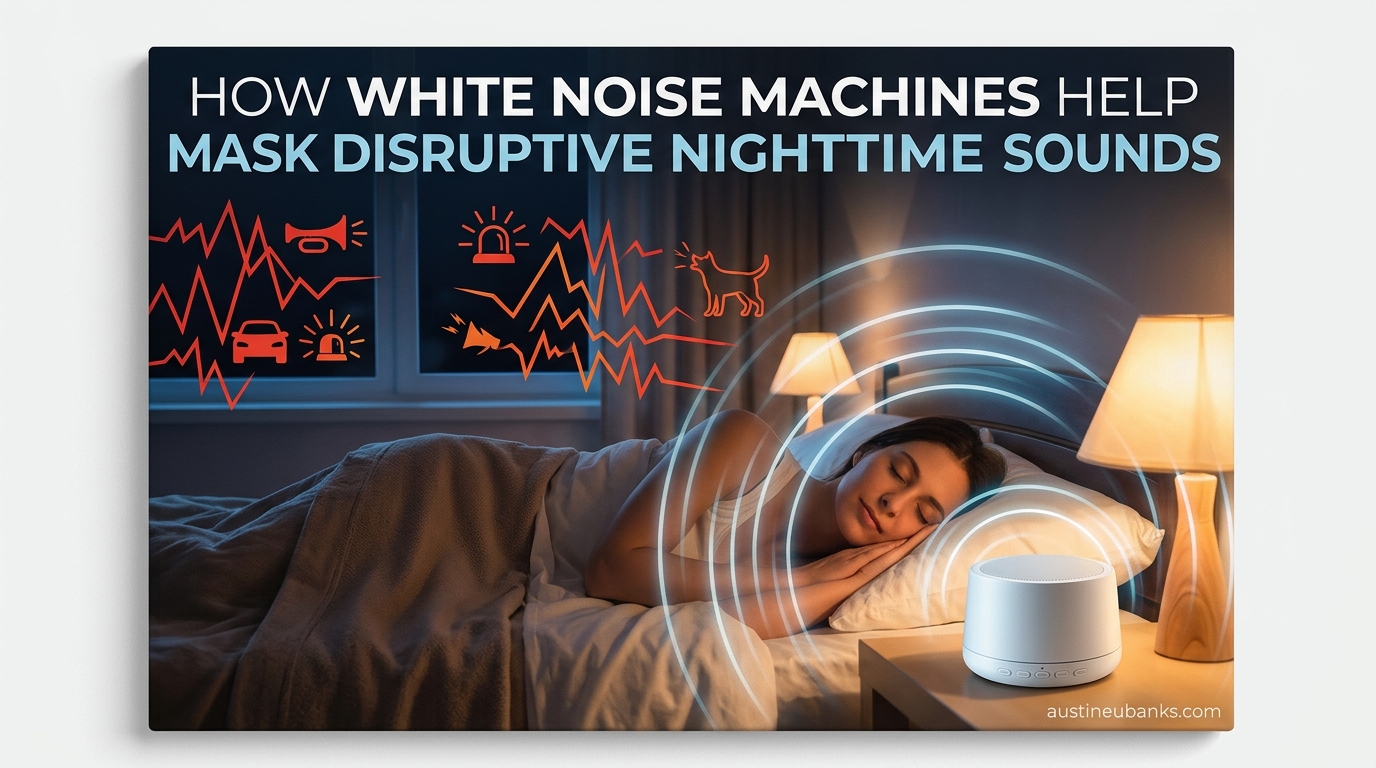
It is 2:47 AM. A car door slams outside your bedroom window. Your neighbor’s dog starts barking. A garbage truck beeps as it reverses down the street. You were sleeping peacefully thirty seconds ago, and now you are wide awake, staring at the ceiling, wondering if you will ever get back to sleep before your alarm goes off.
If this scenario sounds familiar, you are far from alone. Millions of people deal with disruptive nighttime sounds that fragment their sleep and leave them exhausted the next day. Environmental noise is one of the most common yet underaddressed causes of poor sleep quality, and it does not just affect people in noisy city apartments. Suburban traffic, snoring partners, early-morning garbage collection, and even household pets can all break the sleep cycle in ways you might not fully remember but your body certainly feels.
White noise machines have become one of the most popular sleep aids on the market, and for good reason. In this guide, we will break down exactly how white noise machines help mask disruptive nighttime sounds, the science behind sound masking, which types of noise work best, who benefits the most, and how to use a white noise machine effectively for maximum results. We will also cover safety considerations, volume guidelines, and how white noise compares to other sound solutions like earplugs and fans.
Whether you are a light sleeper, a shift worker trying to sleep during the day, a new parent, or simply someone whose bedroom faces a busy street, understanding how white noise machines help mask disruptive nighttime sounds can be the difference between a restless night and deep, restorative sleep.
Table of Contents
Quick Answer: How White Noise Masks Nighttime Sounds
White noise is a type of sound masking that contains all audible frequencies across the spectrum at equal intensity. When a white noise machine produces this consistent broadband sound, it raises your brain’s arousal threshold, which is the level of stimulus needed to wake you up. Sudden, unpredictable noises like car horns, barking dogs, or slamming doors blend into the steady background hum instead of standing out as sharp, attention-grabbing events. The result is fewer micro-awakenings and deeper, more continuous sleep throughout the night.
What Is White Noise and How Does Sound Masking Work?
White noise is a specific type of broadband sound that contains every audible frequency the human ear can detect, played simultaneously at equal intensity. The name comes from an analogy to white light, which similarly contains all the colors of the visible spectrum combined together. When you hear white noise, you are hearing roughly 20 to 20,000 Hertz of sound frequencies all at once, which creates that characteristic steady hiss often compared to TV static, a whirring fan, or rushing air.
Sound masking is the process by which a consistent background sound reduces the perceivability of other sounds in the environment. It does not actually eliminate or block external noises in the way that soundproofing or noise-canceling headphones do. Instead, it changes the ratio between the background sound floor and any new incoming sound. Think of it like stars in the sky. On a dark night in the countryside, you can see individual stars clearly because the background is dark. In a brightly lit city, those same stars disappear, not because they are gone, but because the ambient light raises the baseline brightness and drowns them out.
White noise works the same way with sound. By filling your acoustic environment with a steady, even wall of sound, the machine raises your baseline noise floor. When an external sound like a door slam or a dog bark occurs, the difference between that sound and the background is much smaller than it would be in a quiet room. Your brain simply does not register the new sound as a significant event worth waking up for.
This is fundamentally different from noise cancellation, which uses microphones and inverted sound waves to physically neutralize incoming sound. Noise cancellation works well in headphones but is impractical for an entire bedroom. Sound masking, on the other hand, is a passive, whole-room solution that changes how your brain perceives sounds rather than trying to eliminate them.
It is worth noting that not all white noise is created equal. True white noise is mathematically precise, with equal energy at every frequency. But many machines and apps labeled as white noise actually produce pink noise, brown noise, or other sound profiles that emphasize lower frequencies for a more natural, less harsh sound. We will cover those differences in detail later in this article.
The Science: How White Noise Masks Disruptive Nighttime Sounds
To understand how white noise machines help mask disruptive nighttime sounds, we need to look at what happens in your brain when you sleep and how sounds are processed during different sleep stages.
Your brain does not fully shut off its auditory processing when you fall asleep. Even in deep sleep, your brain continues to monitor the acoustic environment for potential threats. This is an evolutionary survival mechanism. Your sleeping brain is constantly evaluating incoming sounds and deciding whether each one is important enough to trigger an arousal, which is a shift from deeper sleep to lighter sleep or full wakefulness.
The key concept here is the arousal threshold. This is the minimum level of sound stimulus required to wake you from sleep. When you are in a perfectly quiet room, your arousal threshold is very low because any new sound, even a relatively soft one, stands out dramatically against the silence. A creaking floorboard or a distant car door can easily exceed that low threshold and pull you out of deep sleep.
White noise raises your arousal threshold by filling the room with consistent sound. When the background noise floor is higher, an incoming sound needs to be significantly louder and more distinct to exceed the threshold and wake you. The garbage truck that would have jolted you awake in a silent room barely registers against the steady hum of a white noise machine.
This matters because of micro-awakenings. These are brief interruptions in your sleep cycle that you may not even remember but that nonetheless fragment your sleep architecture. Research has shown that environmental noise causes semi-awakenings throughout the night, pulling you out of restorative deep sleep and slow-wave sleep stages even when you do not consciously wake up. Over the course of a night, dozens of these micro-awakenings can leave you feeling unrefreshed and groggy despite technically getting eight hours of sleep.
One study found that using white noise reduced sleep onset latency, which is the time it takes to fall asleep, by approximately 38 percent in participants. Other research has shown benefits for specific populations including ICU patients, where hospital noise is a major cause of sleep disruption, and for newborns, who have a strong startle reflex that can be triggered by sudden sounds.
The neuroscience behind this involves the auditory cortex, the part of your brain that processes sound. During sleep, the brain engages in a process called sensory gating, where it actively filters which sensory inputs get through to conscious awareness. White noise appears to enhance this gating process by providing a predictable, uniform sound that the brain can safely tune out. Sudden sounds against a quiet background break through the gate easily. The same sounds against a white noise background are far less likely to pass through because they blend into the existing sound pattern the brain has already categorized as safe and ignorable.
This also explains why white noise helps some people but not others. Individual differences in sensory gating, sleep architecture, and baseline sensitivity to sound all play a role. Some people are naturally light sleepers with low arousal thresholds, making them ideal candidates for sound masking. Others sleep deeply enough that environmental noise rarely disturbs them.
Common Disruptive Sounds White Noise Can Help Mask
Not all nighttime sounds are created equal. White noise machines are highly effective at masking certain types of sounds, moderately effective for others, and less effective for very specific categories. Understanding which sounds your machine can handle will help you set realistic expectations and optimize your setup.
Traffic Noise
Traffic is one of the most common and persistent sources of nighttime sleep disruption. Car engines, sirens, honking horns, and motorcycle exhausts all produce sounds that vary widely in frequency and intensity. White noise machines are generally effective at masking traffic noise because the consistent broadband sound fills in the frequency gaps where traffic sounds would otherwise poke through. Users in Reddit’s homeowner and sleep communities frequently report that white noise machines are life-changing for blocking street traffic, though many note that the machine needs to be louder than expected to truly mask close-proximity sounds like a loud motorcycle passing directly outside your window.
Noisy Neighbors and Voices
Voices are among the hardest sounds to mask because the human brain is specifically evolved to detect and pay attention to speech patterns. Muffled conversations from an adjacent apartment or people talking outside your window can cut through a quiet room with surprising clarity. White noise helps with voices by raising the noise floor so that the consonants and syllables that make speech intelligible become harder to distinguish. However, for very close or very loud voices, white noise alone may not be sufficient, and you may need to combine it with other solutions like strategic furniture placement or acoustic panels.
Snoring
If your partner snores, you already know how disruptive this can be. Snoring is particularly challenging because it is close in proximity and often rhythmic, which means the brain may partially adapt to it but still be jolted by sudden volume changes or gasping sounds. White noise machines can help mask moderate snoring, especially when placed between the snorer and the listener. Many CPAP users on Reddit report pairing a white noise machine with their CPAP device to mask the machine noise for their partners, creating a win-win solution for both people in the bed.
Pets and Household Animals
Dogs barking, cats racing through hallways at 3 AM, and birds chirping at dawn are all common sleep disruptors in households with pets. White noise is quite effective at masking pet sounds because many of these noises fall within the frequency ranges that white noise covers well. The steady hum of a white noise machine can effectively drown out a dog barking several houses away or a cat knocking items off shelves in another room.
Construction and Industrial Noise
If you live near a construction site or industrial area, you may face early-morning noise that starts before you need to wake up. Construction sounds like hammering, drilling, and heavy machinery are loud and sharp, making them harder to mask than steady traffic noise. White noise can help take the edge off these sounds but may not fully eliminate the jarring impact of a sudden hammer strike or a reversing truck alarm. In these cases, combining white noise with earplugs may provide the best results.
Understanding why some sounds are harder to mask comes down to two factors: proximity and intensity. A sound that is both close and loud will always be harder to mask than a sound that is distant and moderate. This is why users in RV and travel communities often seek out particularly powerful white noise machines, since RV walls provide minimal sound insulation compared to a house.
Types of Sounds That Work Best for Masking
While the term white noise is used colloquially to describe any steady background sound, there are actually several distinct types of noise color, each with different frequency profiles and different effects on sleep. Understanding these differences can help you choose the right sound for your specific situation.
White Noise
True white noise contains all audible frequencies at equal intensity. It sounds like TV static or a hissing steam valve. White noise is the most studied and most commonly recommended type for sound masking because its even frequency distribution makes it effective at covering a wide range of potential disruptive sounds. However, some people find pure white noise harsh or tinny, especially at higher volumes.
Pink Noise
Pink noise is similar to white noise but with more energy in the lower frequencies and less in the higher frequencies. It sounds deeper and softer than white noise, often compared to steady rain, a waterfall, or wind rustling through trees. Many people find pink noise more pleasant for sleep than pure white noise. Research has also suggested that pink noise may be associated with improved memory consolidation during sleep, though more studies are needed to confirm this effect.
Brown Noise
Brown noise emphasizes even lower frequencies than pink noise, producing a deep, rumbling sound similar to a distant thunderstorm or the low roar of the ocean. Brown noise has gained significant popularity in recent years, particularly among people with ADHD who report that the deep, immersive sound helps quiet racing thoughts. For sleep masking, brown noise can be especially effective against low-frequency disruptive sounds like bass from a neighbor’s music or the rumble of heavy truck traffic.
Green Noise
Green noise is a lesser-known variation that focuses on mid-range frequencies and is often described as sounding like nature ambient sounds. It is sometimes marketed as a relaxation tool rather than a dedicated sleep aid. While less research exists on green noise compared to white, pink, and brown noise, some users prefer it for its natural, soothing quality.
Which type is best for blocking out sound? For maximum masking effectiveness across the widest range of disruptive sounds, white noise remains the top choice due to its full-spectrum coverage. However, if you find white noise too harsh, pink or brown noise can be equally effective for many types of nighttime disruption while providing a more pleasant listening experience. The best approach is to experiment with different options and see which your brain responds to most positively.
Who Benefits Most From White Noise Machines
Certain groups of people stand to benefit significantly more from using white noise machines to mask disruptive nighttime sounds. If you fall into any of these categories, sound masking could make a meaningful difference in your sleep quality.
Light Sleepers
Light sleepers have naturally low arousal thresholds, meaning even soft sounds can pull them out of deep sleep. If you wake up easily to sounds that do not bother others, white noise can be transformative. By raising your baseline noise floor, the machine makes it harder for small sounds to cross the threshold required to wake you.
Shift Workers
People who work night shifts and need to sleep during daylight hours face a unique challenge. Daytime is inherently noisier than nighttime, with lawn mowers, construction, children playing, and general daytime activity creating a constant stream of disruptive sounds. Research on night-shift nurses has shown that white noise machines can significantly improve daytime sleep quality for shift workers by masking the environmental noise that makes daytime sleeping so difficult.
Urban Apartment Dwellers
If you live in a city apartment, you are likely exposed to a constant stream of traffic, sirens, foot traffic, and neighbor noise. Urban environments present a uniquely challenging acoustic landscape for sleep. White noise machines are particularly valuable in apartments because they address multiple noise sources simultaneously without requiring permanent modifications to the space.
Babies and Infants
Newborns and young infants have a strong startle reflex, also known as the Moro reflex, which can be triggered by sudden sounds and cause them to wake abruptly. White noise machines are widely recommended by pediatricians and sleep consultants for nurseries because the consistent sound mimics the noisy environment of the womb. Studies have shown that white noise can help babies fall asleep faster and stay asleep longer. However, safe volume levels are especially important for infants, which we will cover in the safety section.
People with Tinnitus
Tinnitus is the perception of ringing, buzzing, or other sounds in the ears when no external sound is present. Tinnitus often becomes more noticeable in quiet environments, which is why it can be particularly disruptive at bedtime. White noise machines provide sound masking that helps cover the internal tinnitus sound, making it less prominent and easier to ignore. Many audiologists recommend sound therapy using white or pink noise as part of a comprehensive tinnitus management strategy.
ADHD and Neurodivergent Individuals
Many people with ADHD report that white noise helps them both focus during the day and sleep at night. The consistent background sound appears to help occupy the part of the brain that might otherwise become distracted by every small noise in the environment. Brown noise has become especially popular in the ADHD community for its deep, immersive quality. This is not just anecdotal. Research has suggested that white noise may improve cognitive performance and attention in some individuals with ADHD, possibly by providing optimal levels of neural stimulation.
White Noise vs Other Sound Solutions
One question that comes up repeatedly in sleep forums is whether you really need a dedicated white noise machine or if simpler alternatives like a fan, a smartphone app, or earplugs can do the job. Let us break down how these options compare.
White Noise Machines vs Fans
Running a box fan or ceiling fan is the original DIY white noise solution, and it genuinely works for many people. A fan produces broadband mechanical noise that functions similarly to a white noise machine. The main differences are control and consistency. A dedicated machine lets you adjust volume independently of airflow, choose from multiple sound profiles, and often includes features like sleep timers. A fan also moves air, which may be undesirable in winter or in air-conditioned rooms. That said, if a fan works for you and you do not mind the airflow, it is a perfectly valid and cost-effective option.
White Noise Machines vs Smartphone Apps
There are dozens of free and paid white noise apps available for phones and tablets. These apps are convenient, portable, and often offer a wide variety of sounds. However, there are meaningful differences in masking effectiveness. Most apps use digitally looped audio, meaning a short sound clip repeats continuously. Even high-quality apps may have subtle transitions or gaps in the loop that your brain can detect, especially in a quiet room. Dedicated machines, particularly mechanical ones, produce truly continuous, non-looping sound. Forum users consistently mention that non-looping, gapless audio is a critical quality factor for effective sound masking. Additionally, phones emit electromagnetic radiation and notifications can still break through, making them less reliable than a dedicated device.
White Noise Machines vs Earplugs
Earplugs physically block sound from entering your ear canal, which is a fundamentally different approach from sound masking. Foam earplugs can reduce incoming sound by 20 to 30 decibels, which is substantial. The advantage of earplugs is that they work against all sounds regardless of frequency or proximity. The disadvantage is comfort, fit, and the fact that they can feel isolating or cause ear irritation with prolonged use. Many people find that combining earplugs with a white noise machine provides the best of both worlds. The earplugs reduce the overall volume of all sounds, and the white noise fills in the remaining acoustic space so that no single sound stands out.
White Noise Machines vs Soundproofing
True soundproofing involves acoustic panels, mass-loaded vinyl, double-pane windows, and structural modifications that physically prevent sound from entering a room. Soundproofing is the most effective solution for noise reduction but also the most expensive and least practical for renters or those on a budget. Soundproofing and sound masking actually work well together. Soundproofing reduces the volume of incoming noise, and then white noise masks whatever sound does get through. If you cannot soundproof your bedroom, a white noise machine is the next best thing and costs a tiny fraction of what structural acoustic treatment would run.
Benefits of Using White Noise for Sleep
The benefits of white noise for sleep go beyond simply masking disruptive nighttime sounds. Regular use of a white noise machine can improve several aspects of your sleep experience.
Reduced sleep onset latency is one of the most commonly reported benefits. People using white noise tend to fall asleep faster because the consistent sound helps quiet a racing mind and signals to the brain that it is time to sleep. The sound creates a sort of psychological association that, over time, becomes a sleep cue similar to dimming the lights.
Fewer nighttime awakenings are perhaps the most significant benefit for people dealing with environmental noise. By raising the arousal threshold, white noise prevents the micro-awakenings that fragment sleep architecture. Even if you do not remember waking up, these brief interruptions pull you out of deep, restorative sleep stages and reduce overall sleep quality.
Improved sleep quality overall has been demonstrated in multiple research settings. Studies involving ICU patients, newborns, and healthy adults have all shown improvements in sleep metrics when white noise is introduced to the sleep environment. Better sleep quality translates to improved daytime alertness, better cognitive function, and improved mood.
Another often-overlooked benefit is sleep privacy. If you live in close quarters with roommates or family members, a white noise machine prevents sounds from traveling both in and out of your room. This is why white noise machines are sometimes called sound conditioners. They are commonly used in offices, therapy rooms, and medical settings where speech privacy is important.
Safety Considerations and Safe Volume Levels
While white noise machines are generally safe and non-invasive, there are important safety considerations to keep in mind, particularly around volume and prolonged use.
The primary safety concern with white noise machines is hearing damage from excessive volume. The CDC and other health organizations recommend that prolonged exposure to sound should be kept below 70 decibels to prevent noise-induced hearing loss. For sleep specifically, most audiologists and sleep experts recommend keeping white noise at or below 50 decibels, which is roughly the volume of a quiet conversation or gentle rainfall.
To put this in perspective, a typical bedroom without any noise source measures around 30 decibels. A white noise machine set to a comfortable sleep level usually sits between 40 and 50 decibels. For comparison, normal conversation is about 60 decibels, city traffic is around 80 decibels, and a lawn mower is about 90 decibels. Keeping your machine in the 40 to 50 decibel range provides effective masking while staying well within safe listening levels.
For babies and infants, the safety guidelines are stricter. The American Academy of Pediatrics recommends that any sound machine used in a nursery should be kept below 50 decibels and placed at least 7 feet away from the crib. Some hospital studies have found that certain machines can produce sounds exceeding 85 decibels at close range, which is well above safe levels for infant ears. Always test the volume yourself by standing where the baby’s head would be and ensuring the sound is gentle and not overwhelming.
Another common concern is whether sleeping with white noise all night is harmful. Current research does not show any significant negative effects from continuous overnight use at safe volumes. However, some sleep specialists note that becoming reliant on white noise to fall asleep can create a psychological dependency. If you travel frequently or sleep in different environments, you may want to occasionally practice falling asleep without the machine to maintain flexibility.
Habituation, the concern that white noise might stop working over time, is rarely a significant issue. Unlike the brain’s tendency to tune out predictable sounds during wakefulness, the sleep state actually benefits from consistency. The same sound that helped you sleep six months ago will likely continue to work because the mechanism is based on raising the arousal threshold, not on novelty. If you do notice decreased effectiveness, switching between white, pink, and brown noise profiles can provide a refresh without starting over entirely.
How to Use a White Noise Machine Effectively
Getting the most out of a white noise machine is not just about turning it on. Placement, volume, sound selection, and integration with your overall sleep routine all matter. Here is a step-by-step guide to setting up your machine for maximum sound masking effectiveness.
Step 1 is placement. Position the white noise machine between yourself and the primary source of disruptive noise. If traffic is your main problem and your bedroom window faces the street, place the machine near the window. If a snoring partner is the issue, position the machine on the nightstand between their side of the bed and yours. The goal is to create a wall of sound between the noise source and your ears.
Step 2 is volume calibration. Start at a low setting and gradually increase until the machine effectively covers the disruptive sounds without being uncomfortably loud. A good test is to have someone talk at a normal volume in the next room or outside your door. Adjust the machine until that voice becomes indistinct and difficult to make out. This is your effective masking volume.
Step 3 is sound selection. If pure white noise feels harsh, try pink or brown noise instead. The best sound is the one your brain can most easily tune out while still providing effective masking. Many machines offer multiple options, so spend a few nights experimenting with different profiles.
Step 4 is consistency. Use the machine every night as part of your regular sleep routine. Over time, the sound becomes a psychological sleep cue that signals to your brain it is time to wind down. This consistency also helps establish a stable arousal threshold that your brain comes to expect.
Step 5 is combining with other sleep hygiene practices. White noise works best as part of a broader sleep optimization strategy. Keep your room cool, dark, and well-ventilated. Maintain a consistent sleep schedule. Avoid screens and caffeine before bed. The white noise machine addresses the acoustic component of sleep disruption, but it works best when the rest of your sleep environment is also optimized.
One frequently asked question is why a bed partner might not be bothered by sounds that keep you awake. This comes down to individual differences in arousal thresholds and sleep architecture. Some people naturally have higher thresholds and sleep more deeply, making them less susceptible to environmental noise. Others are more sensitive. White noise helps level this playing field by raising the threshold for everyone in the room, though it cannot fully equalize deep differences in individual sleep biology.
Room size also affects effectiveness. In a small bedroom, a single machine can fill the space easily. In a large, open-concept bedroom or a room with hard surfaces like tile floors and bare walls, sound reflects and dissipates differently. You may need a more powerful machine or even two units placed strategically for full coverage in larger or acoustically challenging spaces.
Frequently Asked Questions
Is it bad to sleep with white noise all night?
Sleeping with white noise all night is generally safe when the volume stays at or below 50 decibels. Current research shows no significant negative effects from continuous overnight use at safe listening levels. The main concern is keeping the volume reasonable and the machine at an appropriate distance from your bed, especially for infants who require stricter volume limits.
What type of noise is best for blocking out sound?
White noise is the most effective type for blocking out the widest range of sounds because it contains all audible frequencies at equal intensity. Pink noise and brown noise are also effective and many people find them more pleasant due to their deeper, softer tones. The best choice depends on personal preference and the specific types of sounds you need to mask.
Why do ADHD people like white noise?
Many people with ADHD find that white noise helps quiet racing thoughts and reduces distractibility during both focus tasks and sleep. Research suggests white noise may provide optimal neural stimulation that helps regulate attention in some individuals with ADHD, and brown noise has become especially popular in the ADHD community for its deep, immersive quality.
How does white noise block out other sounds?
White noise blocks out other sounds through a process called sound masking. It fills the room with consistent broadband sound that raises the baseline noise floor, so sudden noises like a door slam or barking dog blend into the background instead of standing out. This raises the brain’s arousal threshold, meaning louder and more distinct sounds are needed to wake you from sleep.
Conclusion
Understanding how white noise machines help mask disruptive nighttime sounds comes down to a simple but powerful principle: consistency. By filling your sleep environment with a steady wall of broadband sound, a white noise machine raises your brain’s arousal threshold so that sudden, unpredictable noises no longer register as events worth waking for. Whether you are dealing with traffic, snoring, noisy neighbors, pets, or early-morning construction, sound masking reduces the micro-awakenings that fragment your sleep and leave you exhausted.
We have covered the neuroscience behind sound masking, the differences between white, pink, brown, and green noise, who benefits most from white noise, how it compares to other solutions like fans and earplugs, and the practical steps for setting up your machine for maximum effectiveness. We have also addressed the safety considerations around volume and prolonged use, so you can use your machine with confidence night after night.
If you are struggling with disruptive nighttime sounds, a white noise machine is one of the simplest, most affordable, and most effective tools you can add to your sleep toolkit. Start with proper placement, find the noise profile that works best for your ears, keep the volume in a safe range, and be consistent. Your brain will adapt, your arousal threshold will rise, and those 2:47 AM garbage trucks may finally stop stealing your sleep.