
When anxiety hits hard and your thoughts start spiraling, your brain needs something tangible to hold onto. That is exactly where self-soothing techniques using the five senses come in. They give your nervous system real, physical input to anchor you in the present moment instead of getting swept away by emotional overwhelm.
I have spent years studying and practicing these techniques, both personally and with people navigating anxiety, trauma, and everyday stress. What I can tell you is that self-soothing is not some vague wellness concept. It is a structured, evidence-based skill set rooted in Dialectical Behavior Therapy (DBT), developed by psychologist Marsha Linehan. It works because it directly communicates safety to your brain through your body.
In this guide, you will learn how each of your five senses can become a tool for emotional regulation. We will cover the neuroscience behind why sensory grounding works, walk through specific techniques for sight, sound, smell, taste, and touch, and show you how to build a personal sensory toolkit you can use anywhere. Whether you are dealing with a panic attack, workplace stress, or sleepless nights at 2 AM, these techniques give you something practical to reach for.
Let us break it all down so you can start using these tools today.
Table of Contents
Quick Answer: What Are Self-Soothing Techniques Using the Five Senses?
Self-soothing techniques using the five senses are grounding exercises that use sight, sound, smell, taste, and touch to calm your nervous system during emotional distress. By deliberately engaging each sense with pleasant or comforting stimuli, you interrupt the fight-or-flight stress response and bring your attention back to the present moment.
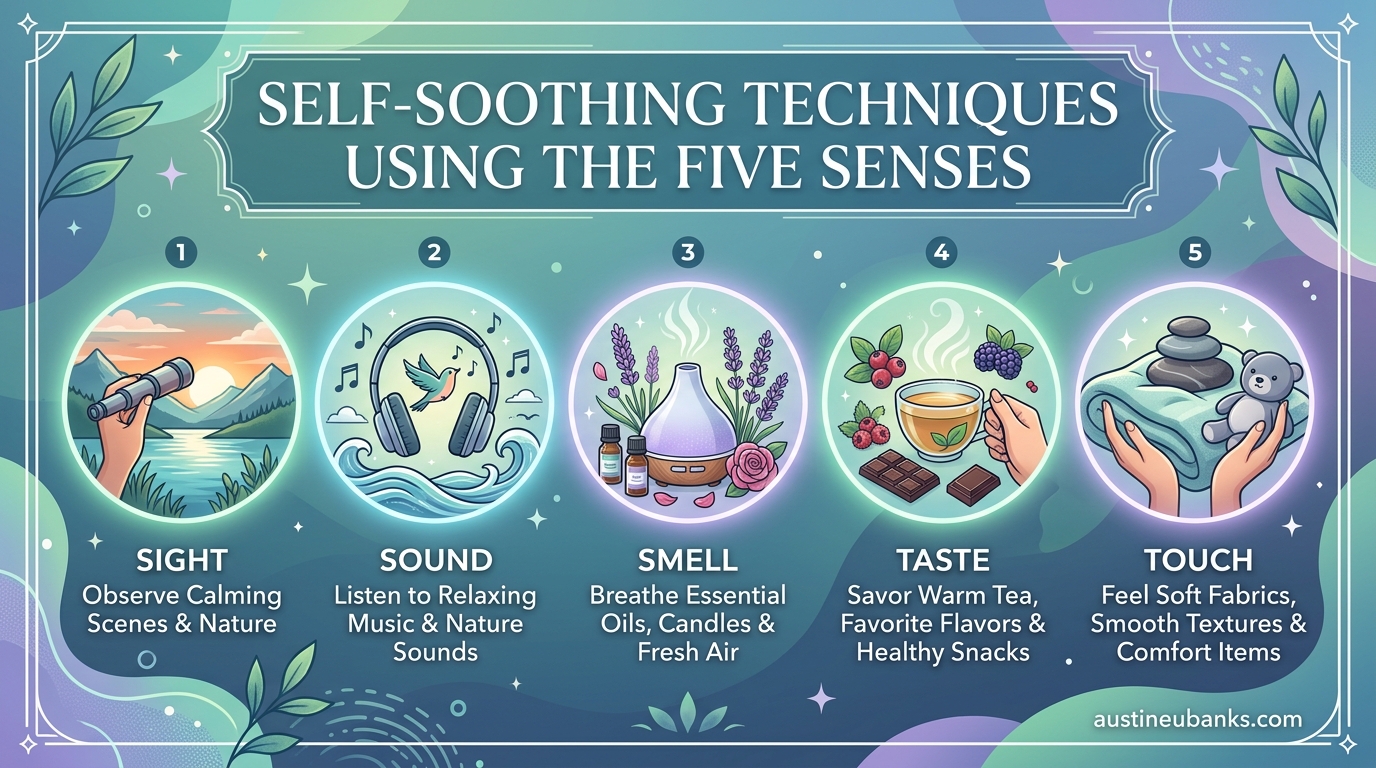
Here is a quick overview of how each sense is used:
- Sight: Looking at calming images, nature, soft lighting, or a favorite photo
- Sound: Listening to nature sounds, calming music, or a familiar voice
- Smell: Using essential oils, fresh air, coffee, or a favorite scent
- Taste: Sipping warm tea, eating slowly with full attention, or sucking on a mint
- Touch: Holding something warm, using a weighted blanket, or feeling different textures
These techniques come from the DBT distress tolerance module, which teaches practical skills for surviving emotional crises without making things worse. You do not need any special equipment, training, or money to start using them. Your five senses are always with you.
The Science: Why Engaging Your Senses Calms the Nervous System
To understand why self-soothing works, you need to understand what happens in your body during stress. When you feel threatened, whether by real danger or an anxious thought, your amygdala sounds the alarm. This triggers your sympathetic nervous system, the fight-or-flight response. Your heart rate jumps, your breathing quickens, your muscles tense, and cortisol floods your bloodstream.
This stress response is helpful if you are running from a predator. It is far less helpful when you are sitting at your desk feeling overwhelmed by an email. The problem is that your brain cannot always tell the difference. A stressful thought feels just as dangerous to your nervous system as a physical threat.
Here is where sensory grounding changes the equation. When you deliberately engage your senses with safe, pleasant input, you activate the parasympathetic nervous system. This is your body’s rest-and-digest mode, the biological opposite of fight-or-flight. It slows your heart rate, relaxes your muscles, and signals to your brain that you are safe.
Research on polyvagal theory, developed by Dr. Stephen Porges, helps explain this process in more detail. According to this framework, your vagus nerve constantly monitors your environment for signs of safety or danger. When it receives signals of safety through soothing sensory input, it activates the social engagement system. This lowers cortisol levels, regulates your heart rate through what is called vagal tone, and brings your limbic system back into balance.
Studies have shown that specific sensory inputs produce measurable calming effects. For example, research published in the Journal of Alternative and Complementary Medicine found that inhaling lavender essential oil significantly reduced cortisol levels in stressed adults. Other studies have demonstrated that slow, rhythmic sounds can synchronize brainwave patterns and induce relaxation. Weighted blankets, which provide deep pressure stimulation, have been shown to reduce anxiety in clinical settings.
The bottom line is that your senses are a direct line to your nervous system. You cannot always think your way out of anxiety. But you can give your body the physical evidence it needs to stand down.
Self-Soothing Techniques Using the Five Senses: A Complete Breakdown
Now let us get into specific, actionable techniques for each sense. I recommend reading through all five categories, then experimenting to find which ones resonate with your nervous system. Most people discover that two or three senses work especially well for them, while others feel less effective. That is completely normal, and personalization is key.
One important note before we start. Many people on forums like Reddit’s r/DBT and r/AnxiousAttachment report that combining multiple senses at once produces stronger calming effects than using a single sense. Holding a warm cup of tea while listening to rain sounds and wrapping yourself in a soft blanket engages three senses simultaneously, which creates a more powerful grounding effect.
Here is a comparison of the five senses and what each one is best suited for:
- Sight: Best for redirecting racing thoughts and creating visual calm
- Sound: Best for shifting your mental state and drowning out internal noise
- Smell: Best for fast, direct nervous system regulation through the olfactory nerve
- Taste: Best for mindful grounding and bringing attention to the present moment
- Touch: Best for physical comfort and releasing body tension
Sight (Vision) Self-Soothing Techniques
Your visual environment has a powerful effect on your emotional state. What you look at shapes how you feel, often within seconds. When you are anxious, your vision often narrows into a tunnel focus on the perceived threat. Sight-based self-soothing works by widening that focus and giving your eyes something safe and beautiful to rest on.
Here are specific sight techniques you can try:
- Look at nature: Step outside and look at trees, clouds, or water. Even a houseplant on your desk can help. Research shows that viewing natural scenes reduces stress markers within minutes.
- Surround yourself with soft lighting: Harsh fluorescent lights increase tension. Switch to warm lamp light or candles when you feel stressed.
- Look at a favorite photo: Keep a photo that makes you feel safe or happy on your phone. A picture of a loved one, a pet, or a place you love can instantly shift your emotional state.
- Watch something visually soothing: Slow-moving water, a lava lamp, fish swimming in an aquarium, or clouds drifting across the sky. Gentle, rhythmic visual motion calms the brain.
- Surround yourself with calming colors: Blues, greens, and soft earth tones have been shown to lower heart rate. Keep a calming color nearby, whether it is a piece of clothing, a mug, or a wall in your space.
- Count objects in your environment: Look around and name five blue things, or count all the circles you can see. This redirects your visual attention away from anxious thoughts.
- Look at art or beautiful design: Keep a piece of art, a coffee table book, or an image that moves you within reach. Beauty is genuinely soothing to the nervous system.
- Star gaze or cloud watch: Lying on your back and looking at the vastness of the sky can create a sense of perspective that shrinks your problems down to size.
I have personally found that nature is the most reliable visual soother. Even looking out a window at a single tree for sixty seconds can take the edge off a stressful moment. The key is to actually focus your eyes on something pleasant, not just glance at it while your mind races.
Sound (Hearing) Self-Soothing Techniques
Sound travels directly to your brainstem, bypassing the conscious thinking parts of your mind. This means audio input can shift your nervous system state faster than almost anything else. A sudden loud noise can spike your anxiety instantly. Conversely, the right sounds can calm you just as quickly.
Here are specific sound techniques to try:
- Listen to nature sounds: Rain, ocean waves, birdsong, or a babbling brook. These sounds contain natural white noise patterns that are deeply calming to the human nervous system. We evolved in nature, so these sounds signal safety.
- Play calming music: Slow tempo music, around 60 beats per minute, can synchronize with your heart rate and slow it down. Classical, ambient, or lo-fi music work well for many people.
- Listen to a familiar, comforting voice: Call someone who grounds you, or listen to a podcast hosted by someone whose voice you find soothing. Familiar voices signal safety to your brain.
- Use a sound machine: White noise, pink noise, or brown noise can drown out the internal chatter of anxiety. Many people find brown noise especially effective because of its deeper, bass-heavy frequencies.
- Hum or sing: Humming stimulates the vagus nerve through vibration in your throat. This is why singing often feels good when you are stressed. Try humming a single sustained note for thirty seconds.
- Listen to singing bowls or tuning forks: These produce sustained, harmonic tones that many people find deeply relaxing. There are excellent recordings available for free on YouTube.
- Step outside and just listen: Close your eyes and identify every sound you can hear. Wind, traffic, distant voices, a dog barking. This simple exercise pulls you into the present moment quickly.
- Try bilateral stimulation sounds: Music or tones that alternate between left and right ears can help process difficult emotions. This technique is used in EMDR therapy and has growing research support.
One thing to keep in mind: silence is not always soothing. If your internal monologue is loud, silence can give it more room to run. Filling that space with gentle sound can actually be more regulating than trying to sit in quiet.
Smell (Olfactory) Self-Soothing Techniques
Smell is unique among the five senses because it has a direct, unfiltered connection to your brain’s emotional center. The olfactory nerve sends signals straight to the amygdala and hippocampus, the areas that process emotion and memory. This is why a single scent can trigger an instant emotional response, sometimes before you even consciously register what you are smelling.
This direct pathway makes smell one of the fastest routes to nervous system regulation. Here are techniques to try:
- Use essential oils: Lavender is the most researched calming scent, with multiple studies showing it reduces anxiety. Other options include bergamot, chamomile, frankincense, and ylang-ylang. Put a drop on your wrist or use a diffuser.
- Smell something familiar and comforting: The scent of a loved one’s clothing, a favorite candle, or the soap you have used for years. Familiarity signals safety to your brain.
- Brew coffee or tea and breathe it in: The ritual of making a warm drink, combined with its aroma, engages both smell and the comfort of routine. Take slow, deliberate breaths over your cup.
- Step outside for fresh air: Sometimes the simple act of breathing outdoor air, especially in a green space, is enough to shift your state. The smell of rain, fresh-cut grass, or pine trees can be remarkably grounding.
- Keep a scent trigger with you: Carry a small bottle of essential oil, a scented hand cream, or a sachet of dried lavender in your bag. Having a scent available means you can use it anywhere.
- Bake or cook something aromatic: The smell of bread baking, cinnamon, or vanilla can fill your whole space with warmth and comfort. The process of cooking itself is also a grounding activity.
- Use a scented bath or shower product: Eucalyptus shower steamers, scented bath salts, or a body wash with a scent you love can turn a daily routine into a self-soothing practice.
- Smell an orange or citrus fruit: Citrus scents are uplifting and energizing. Peeling an orange releases essential oils into the air, engaging smell and touch simultaneously.
I always keep a small bottle of lavender oil in my desk drawer. On stressful days, I put a drop on my palms, cup them over my nose, and take five slow breaths. It takes less than a minute, but the effect is immediate. The key is finding a scent that you personally associate with safety and comfort, because that association is what does the heavy lifting in your brain.
Taste (Gustatory) Self-Soothing Techniques
Taste-based self-soothing is about bringing mindful attention to what you eat and drink. This is not about emotional eating or using food to numb out. It is about slowing down and using the sensory experience of taste to anchor yourself in the present moment.
Here are specific taste techniques:
- Sip something warm slowly: Herbal tea, warm milk, or hot chocolate. The warmth is comforting, and the act of sipping slowly forces you to stay present. Focus on the temperature, the flavor, and the sensation as it moves down your throat.
- Eat a small piece of dark chocolate: Let it melt slowly on your tongue instead of chewing. Dark chocolate contains compounds that boost serotonin and endorphins, and the slow melting process is inherently mindful.
- Suck on a strong mint or hard candy: The intense flavor and the physical sensation of sucking give your brain strong sensory input to focus on. This is one of the most discreet techniques you can use in public.
- Practice mindful eating: Take one bite of food and experience it fully. Notice the texture, the layers of flavor, the way it feels in your mouth. Most people eat on autopilot. Slowing down transforms eating into a grounding exercise.
- Try something sour: A lemon wedge, sour candy, or a sip of pickle juice. Strong sour flavors produce an immediate, intense sensory experience that can snap you out of a spiral quickly. This is a favorite technique in trauma recovery communities.
- Drink cold water mindfully: The sensation of cold liquid moving through your body is grounding. Hold the glass, feel its temperature, and drink slowly.
- Chew gum: The repetitive motion of chewing is regulating for many people. It also engages the jaw muscles, which can release tension. Peppermint gum combines taste with the alerting properties of mint.
- Make a comfort food ritual: Not as emotional eating, but as a deliberate, mindful experience of a food that brings you genuine comfort. Prepare it with care, plate it nicely, and eat it without distractions.
An important distinction: self-soothing with taste is about the quality of attention, not the quantity of food. One square of chocolate eaten slowly and mindfully is far more soothing than an entire bar eaten while staring at your phone. The magic is in the awareness.
Touch (Tactile) Self-Soothing Techniques
Touch is perhaps the most instinctively comforting of all the senses. From the moment we are born, physical contact regulates our nervous system. A mother holding her baby is not just showing affection; she is literally helping regulate the infant’s heart rate, breathing, and body temperature. Adults need tactile comfort just as much, though we often forget it.
Here are specific touch techniques to try:
- Use a weighted blanket: The deep pressure stimulation from a weighted blanket mimics the feeling of being held. Research shows it reduces activity in the sympathetic nervous system and increases serotonin and melatonin production.
- Hold something warm: A warm mug, a heating pad, or warm water on your hands. Warmth signals safety to the body because it mimics the warmth of another person. This is why holding a hot cup of tea feels instantly comforting.
- Feel different textures: Keep a soft piece of fabric, a smooth stone, or a textured object nearby. Run your fingers over it and focus on the sensation. This is sometimes called using a grounding object.
- Take a warm shower or bath: The combination of warm water, the physical sensation of water on skin, and the sound of running water engages multiple senses at once. Many people find showers resetting.
- Apply gentle pressure to your chest: Place your hand flat on your chest and apply slight pressure. This stimulates the vagus nerve and can create a feeling similar to being held.
- Use a self-hug or butterfly hug: Cross your arms over your chest and alternately tap each shoulder. This bilateral stimulation technique is used in EMDR therapy and helps process difficult emotions.
- Get a massage or use a foam roller: Physical tension often accompanies emotional distress. Releasing muscle tension through pressure can help release emotional tension as well.
- Walk barefoot on grass or sand: Known as earthing or grounding, direct contact between your bare feet and the earth provides tactile input that many people find deeply calming. The physical sensation reconnects you to your body and the ground beneath you.
Forum users on Reddit frequently mention proprioception as an additional sense worth paying attention to. This is your body’s awareness of its position in space. Activities like stretching, yoga, or even doing pushups can provide proprioceptive input that is powerfully regulating, especially for people who feel disconnected from their bodies during stress.
The 5-4-3-2-1 Grounding Technique: A Structured Five-Senses Practice
The 5-4-3-2-1 grounding technique is one of the most popular self-soothing exercises in the world. It is simple, structured, and uses all five senses in sequence. I recommend memorizing it because you will not always have time to look up a list of techniques when you are in distress.
Here is how to do it step by step:
Step 1: Name 5 things you can see. Look around your environment and identify five objects. Say them out loud or in your mind. “I see a lamp, a book, a plant, a window, and a cup.” This anchors you visually.
Step 2: Name 4 things you can feel. Notice four physical sensations. The chair beneath you, the fabric of your shirt, the floor under your feet, the air on your skin. This brings you into your body.
Step 3: Name 3 things you can hear. Identify three sounds. The hum of a refrigerator, distant traffic, your own breathing. This connects you to your auditory environment.
Step 4: Name 2 things you can smell. Find two scents. If you cannot smell anything immediately, think of two smells you enjoy, or seek them out by moving to a different spot.
Step 5: Name 1 thing you can taste. Notice the taste in your mouth right now, or take a sip of water, a mint, or a bite of food and focus on the flavor.
The beauty of this technique is that it moves you through all five senses in a structured way, forcing your brain to shift attention repeatedly. Each shift interrupts anxious thought loops. By the time you finish, your nervous system has received substantial evidence that you are safe in this moment.
Does the 5-4-3-2-1 technique work for everyone? Based on user reports and clinical experience, it works very well for most people, but not all. Some individuals with severe dissociation or PTSD find that focusing on their environment can initially increase awareness of distressing sensations. If that happens, modify the technique. Focus on pleasant stimuli only, or try a single-sense approach instead. There is no one-size-fits-all in self-soothing.
Discreet Self-Soothing Techniques for Work, School, and Public Settings
One of the biggest challenges people report is using self-soothing techniques in environments where they cannot exactly pull out a weighted blanket or start doing yoga. You need techniques that are effective but invisible to others. Here are discreet options organized by situation.
At your desk: Suck on a mint, rub a smooth stone in your pocket, put on noise-canceling headphones with ambient sound, adjust the lighting on your screen to warmer tones, or sip warm tea slowly.
In a meeting: Press your feet firmly into the floor, apply gentle pressure to your own thigh under the table, focus your eyes on a single calming object in the room, or breathe slowly and deliberately.
In a social situation: Hold a cold drink and focus on the temperature, excuse yourself to the restroom and splash cold water on your face, carry a scented hand cream and apply it while focusing on the fragrance.
During a commute: Listen to nature sounds or calming music through earbuds, carry a small grounding object like a coin or smooth stone in your pocket, or practice the 5-4-3-2-1 technique silently.
In a classroom: Squeeze a stress ball discreetly, trace shapes on your desk with your finger, smell a scented lip balm, or chew gum if permitted.
The key with discreet techniques is advance preparation. Decide what your go-to discreet options are before you need them. When you are already in a stressful situation, decision-making becomes harder. Having a pre-planned list removes that barrier. Keep a small kit with a mint, a smooth stone, and a travel-size scented lotion in your bag or desk.
Self-Soothing for Neurodivergent Brains (ADHD, Autism, SPD)
Standard self-soothing advice often falls flat for neurodivergent individuals. If you have ADHD, autism, or sensory processing differences, your nervous system works differently. Some sensory inputs that soothe neurotypical people may feel overwhelming or even painful to you. The key is understanding whether you are sensory seeking or sensory avoiding, and adjusting accordingly.
Sensory seeking means your nervous system craves more input to feel regulated. If this sounds like you, you might benefit from intense sensory experiences. Deep pressure from a weighted blanket, strong-tasting foods like spicy or sour items, loud rhythmic music, vigorous exercise, or textured fidget tools can provide the input your brain needs to settle.
Sensory avoiding means your nervous system is easily overloaded by sensory input. If this is you, self-soothing might actually involve reducing sensory input. Dimming lights, wearing noise-canceling headphones, wearing sunglasses indoors, removing scratchy clothing tags, or retreating to a quiet, low-stimulation space may be more regulating than adding more sensory input.
Many autistic adults use a tool called a sensory diet, which is a personalized plan of sensory activities scheduled throughout the day. This proactive approach prevents overload rather than just responding to it after the fact. If you are neurodivergent, consider tracking which sensory inputs feel calming versus overstimulating for a week. Patterns will emerge that help you build a more effective toolkit.
For people with ADHD, the challenge is often not that self-soothing techniques do not work, but that you forget to use them. External reminders are essential. Set phone alarms, put sticky notes on your mirror, or use a habit-tracking app. Building the habit of checking in with your nervous system throughout the day, not just during crises, is especially important.
How to Build Your Personal Sensory Toolkit
A sensory toolkit is a personalized collection of items and practices you can turn to when you need to self-soothe. Think of it as a first-aid kit for your nervous system. The goal is to have everything ready before you need it, because trying to figure out what works in the middle of a crisis is far too difficult.
Here is a step-by-step process for building yours:
Step 1: Identify your most regulating senses. Think about times you have felt calm recently. What sensory inputs were present? Were you listening to music? Holding something warm? Outdoors in fresh air? Your answers tell you which senses to prioritize.
Step 2: Gather physical items for each priority sense. For sight, maybe a photo or a small piece of art. For sound, a playlist or noise-canceling headphones. For smell, an essential oil or scented candle. For taste, a favorite tea or mints. For touch, a weighted blanket, smooth stone, or soft fabric.
Step 3: Create two versions of your toolkit. One for home and one for on-the-go. Your home toolkit can be larger and more immersive. Your mobile toolkit should fit in a bag or pocket and focus on discreet items.
Step 4: Write your toolkit down. When you are distressed, your brain has trouble accessing information. Having a written list of your go-to techniques removes the need to think. Keep it in your phone notes, on a card in your wallet, or on your refrigerator.
Step 5: Practice when you are calm. This is the step most people skip. Use your techniques during mild or moderate stress, not just full-blown crisis. Your brain learns the association between the sensory input and feeling calmer. By the time you face a real crisis, the pathway is already established.
Step 6: Review and refine monthly. Your sensory preferences will change over time. What worked three months ago might not work today. Revisit your toolkit regularly and swap out items that have stopped being effective.
Common Mistakes to Avoid When Self-Soothing
Based on forum discussions and clinical experience, here are the most common mistakes people make with self-soothing techniques, and how to avoid them.
Mistake 1: Only using techniques during full-blown crises. Many people report that techniques feel too weak when their distress is at maximum intensity. The fix is to practice during moderate distress, building the neural pathway before you need it at full strength.
Mistake 2: Confusing self-soothing with numbing. Having three glasses of wine, binge-eating, or doomscrolling social media might feel like soothing in the moment. These are numbing behaviors, not self-soothing. Self-soothing increases your awareness and helps you process emotions. Numbing decreases awareness and pushes emotions aside temporarily.
Mistake 3: Giving up too quickly. A single deep breath will not cure a panic attack. Self-soothing is a skill that strengthens with practice. If a technique does not work the first time, try it again, try a different sense, or try combining senses.
Mistake 4: Believing your interfering mind. When you try to self-soothe, your anxious mind may tell you it will not work, that you are too far gone, or that this is stupid. This is called the interfering mind in DBT. Acknowledge the thought, then try the technique anyway. Your mind does not have to agree for your body to respond.
Mistake 5: Using a one-size-fits-all approach. What calms your friend might not calm you. Some people need intense sensory input. Others need gentle, minimal input. Experiment freely and trust your own experience over generic advice.
FAQs
What are the five senses of self-soothing?
What are examples of self-soothing techniques?
What is the 5 sense trick for anxiety?
How to self soothe when dysregulated?
What is self-soothing in DBT?
When should you use self-soothing techniques?
Can self-soothing help with panic attacks?
Bringing It All Together
Self-soothing techniques using the five senses are among the most practical, accessible tools you have for managing anxiety, stress, and emotional overwhelm. They are free, always available, and backed by neuroscience. Your senses connect directly to your nervous system, which means you can influence how you feel by changing what you see, hear, smell, taste, and touch.
Start by picking two or three techniques from this guide and trying them today, while you are calm enough to focus. Build your personal sensory toolkit. Practice regularly, not just in crises. And remember that this skill strengthens over time. The more you use it, the more effective it becomes.
If you find that self-soothing techniques are not enough to manage persistent anxiety, trauma, or emotional difficulties, please reach out to a licensed therapist or counselor. These techniques are a powerful complement to professional support, not a replacement for it. You deserve to feel calm and in control of your emotional life, and help is available.