
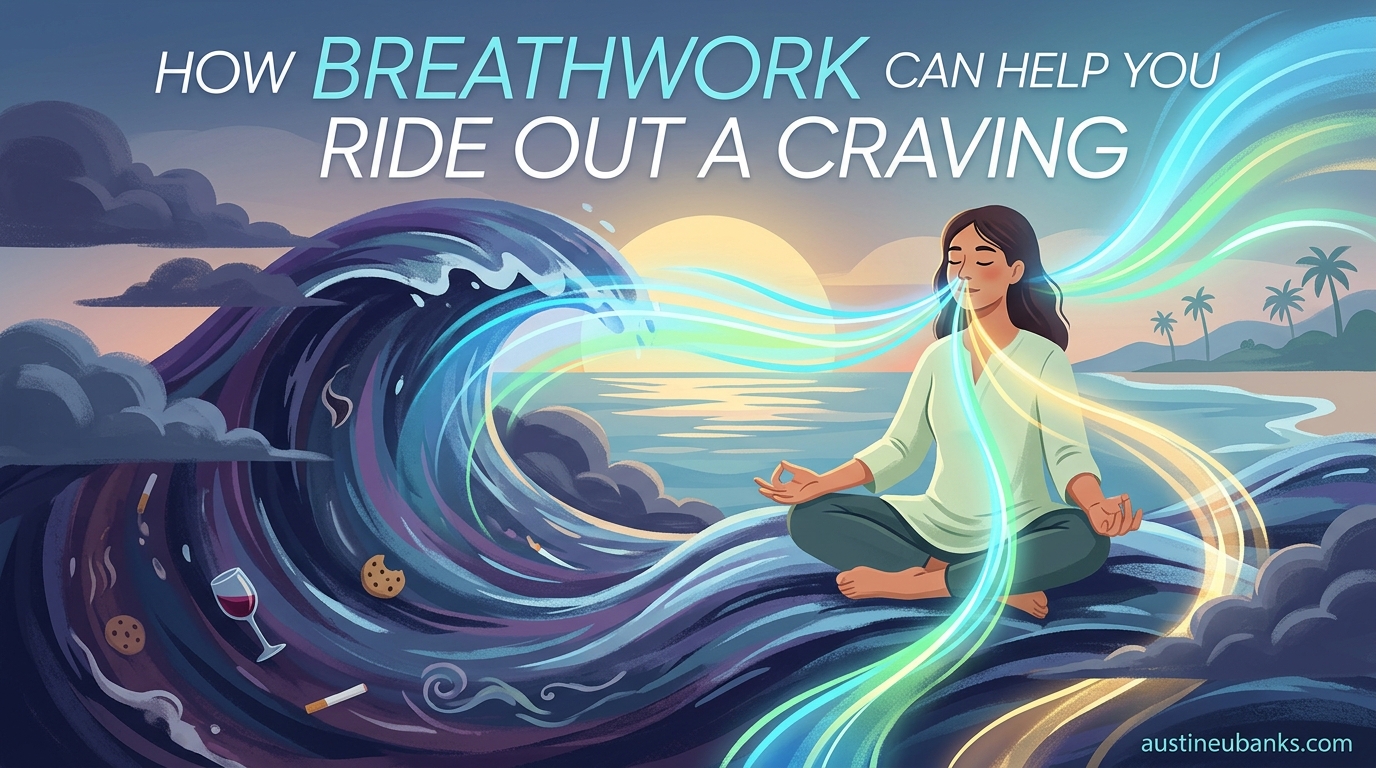
If you have ever felt a craving crash over you like a wave, you know how overwhelming it can be. Your heart races. Your thoughts narrow to one thing. Every cell in your body seems to scream for relief. In those moments, willpower alone often is not enough, and that is not a personal failure. It is biology.
That is exactly where breathwork comes in. Learning how breathwork can help you ride out a craving gives you a practical, free, and private tool that works in real time. No app required. No therapist in the room. No special equipment. Just your lungs, your attention, and a few minutes.
In this guide, I will walk you through what happens in your brain during a craving, why controlled breathing interrupts that process, and four specific breathing techniques you can use the next time a craving hits. I will also cover how to build a daily practice so you are not just reacting to cravings but actively reducing their intensity over time.
Whether you are in early recovery, working through a habit change, or supporting someone who is, these techniques are backed by research and real-world experience. Let us get into it.
Table of Contents
What Happens in Your Brain During a Craving
Understanding what is physically happening during a craving makes it much easier to respond instead of react. A craving is not just a passing thought or a lack of discipline. It is a full nervous system event.
When a craving hits, your sympathetic nervous system fires up. This is the same fight-or-flight response that kicks in when you face physical danger. Your heart rate increases. Blood flows away from your digestive system and toward your muscles. Cortisol and adrenaline flood your bloodstream. Your body is preparing for action, and the action it wants is the substance or behavior you are trying to avoid.
At the same time, your prefrontal cortex, the part of your brain responsible for rational decision-making and impulse control, goes partially offline. This is why logic fails in the middle of a craving. You know you should not do the thing, but the knowing does not feel like enough. Your brain’s reward pathway, driven by dopamine anticipation, is louder than your reasoning.
This creates a feedback loop. The stress of feeling the craving produces more cortisol. More cortisol amplifies the sense of urgency. The urgency makes the prefrontal cortex even less effective. Within seconds, you can feel trapped in a loop that seems impossible to break through thinking alone.
The good news is that this loop has a physical vulnerability. It depends on your nervous system staying in sympathetic overdrive. If you can shift your body out of that state, the loop weakens. The craving does not disappear instantly, but its grip loosens. Your rational mind comes back online. And the fastest way to trigger that shift is through your breath.
How Breathwork Can Help You Ride Out a Craving
Breathwork is the practice of using controlled, intentional breathing to regulate your nervous system. When you learn how breathwork can help you ride out a craving, you are essentially learning how to hack the physiological loop I just described.
Here is the mechanism in plain terms. Your breathing rate is one of the few autonomic functions you can consciously control. When you slow your breath and extend your exhales, you stimulate the vagus nerve. That stimulation activates your parasympathetic nervous system, which is the rest-and-digest counterpart to fight-or-flight. Your heart rate drops. Cortisol levels begin to decrease. Blood flow returns to your prefrontal cortex.
This is not a theory. Research supports it directly. A meta-analysis of breathing interventions for craving and anxiety management found that structured breathing techniques can reduce craving intensity by 35 to 50 percent in the moment. Stanford research on the physiological sigh, popularized by neurobiologist Dr. Andrew Huberman, demonstrated that specific breathing patterns lower stress markers faster than meditation in some cases.
What makes breathwork so effective for cravings specifically is that it addresses the physiological root, not just the mental symptom. Trying to think your way out of a craving often fails because your body is in a stress response. Breathwork works from the body up. It changes the physiological state first, and the mental clarity follows.
It is also worth noting what I have seen echoed across recovery communities online. Many people say they dismissed deep breathing as too simple or too woo-woo until they actually tried it during a real craving. One Reddit user in the r/breathwork community put it this way: they used to dismiss the whole deep breath stuff but started doing it whenever they felt anxiety building, and it helped a ton. That is a common experience. The simplicity is the point.
Technique 1: Box Breathing (4-4-4-4)
Box breathing is the technique I recommend starting with. It is simple, rhythmic, and you can do it anywhere without anyone noticing. Navy SEALs use it to stay calm under pressure. It works just as well for riding out a craving.
The technique gets its name from the four equal parts of the breath cycle. Each phase lasts for a count of four, creating a box pattern. Here is exactly how to do it:
Step 1: Inhale slowly through your nose for a count of four. Fill your lungs from the bottom up.
Step 2: Hold your breath for a count of four. Keep your body relaxed, not tense.
Step 3: Exhale slowly through your mouth for a count of four. Let the air out steadily.
Step 4: Hold your breath again for a count of four before your next inhale.
That is one round. Aim for five rounds, which takes about 80 seconds total. Most people feel a noticeable drop in craving intensity after three to five rounds. The rhythm of the counts gives your mind something specific to focus on, which pulls attention away from the craving itself.
Box breathing shines in situations where you need to stay composed. You can do it in a bathroom stall, at your desk, in a parked car, or standing in line at a store. No one will know you are doing it. That makes it ideal for moments when you are caught off guard by a trigger in public.
A common mistake is rushing through the counts. If four counts feel too long at first, start with three. The key is that all four phases are equal in length. Once four feels comfortable, you can experiment with five or six counts per phase for a deeper effect.
Technique 2: 4-7-8 Breathing
The 4-7-8 breathing technique was developed by Dr. Andrew Weil and is one of the most widely recommended breathing exercises for anxiety and impulse control. It works especially well for cravings that hit at night, when you are trying to sleep, or when anxiety is the main driver behind the urge.
The pattern is an inhale of four counts, a hold of seven, and an exhale of eight. That long exhale is where the magic happens. Extended exhales signal your nervous system that you are safe, which accelerates the shift into parasympathetic mode.
Here is how to practice 4-7-8 breathing step by step:
Step 1: Place the tip of your tongue against the ridge of tissue just behind your upper front teeth. Keep it there throughout the exercise.
Step 2: Exhale fully through your mouth, making a whoosh sound. Get all the air out.
Step 3: Close your mouth and inhale quietly through your nose for a count of four.
Step 4: Hold your breath for a count of seven.
Step 5: Exhale completely through your mouth, making a whoosh sound, for a count of eight.
That is one cycle. Start with four cycles. You can work up to eight cycles as you get more comfortable. The total time is about two minutes for four cycles, which is usually enough to take the edge off a craving.
The seven-count hold is what makes this technique more challenging than box breathing but also more powerful. Holding after the inhale allows carbon dioxide to build slightly in your bloodstream, which has a calming effect on the nervous system. The eight-count exhale then fully activates the parasympathetic response.
Use 4-7-8 breathing for those 2 AM cravings that wake you up or when racing thoughts keep sleep at bay. Forum discussions consistently highlight nighttime as one of the hardest periods for people in recovery. This technique is designed for exactly that scenario.
If you feel lightheaded during the first few tries, that is normal. It passes as your body adjusts. Never force the counts if they feel uncomfortable. You can shorten all three phases proportionally and still get the benefit.
Technique 3: The Physiological Sigh
If you need something faster than box breathing or 4-7-8, the physiological sigh is your go-to. This technique takes about 60 to 90 seconds and is the quickest way to drop stress levels in real time. Dr. Andrew Huberman and his colleagues at Stanford studied this pattern extensively, and it is one of the most effective tools for acute stress and craving spikes.
The physiological sigh is a double inhale through the nose followed by a long, extended exhale through the mouth. Here is how it works:
Step 1: Take a deep inhale through your nose, filling your lungs as much as possible.
Step 2: Without exhaling, immediately take a second, shorter sip of air through your nose to fully expand the lungs.
Step 3: Exhale slowly and fully through your mouth, letting the air out in a long, steady stream.
Step 4: Repeat for a total of three to five rounds.
The double inhale is what sets this apart. When you take that second quick breath, you reopen collapsed alveoli, the tiny air sacs in your lungs. This allows the long exhale to be more complete, which accelerates the release of carbon dioxide and triggers a rapid parasympathetic response.
Use the physiological sigh when a craving hits hard and fast. If you feel panic rising, if you get an unexpected text from someone associated with old habits, or if you walk into a situation that triggers an immediate urge, this is the technique to reach for first. It works in under two minutes and requires no setup.
I have seen people in recovery communities describe this as their emergency button. It is not the technique you practice for 20 minutes a day. It is the one you deploy when something hits you and you need to bring your system down right now.
Technique 4: Urge Surfing with Mindful Breathing
Urge surfing is a concept from mindfulness-based relapse prevention, and it pairs perfectly with breathwork. The idea is simple but powerful. Instead of fighting a craving, you observe it like a wave in the ocean. It rises, peaks, and eventually falls on its own.
Cravings are not constant. They come in waves that typically last 15 to 30 minutes if you do not act on them. The problem is that most people interpret the peak of the wave as permanent, which leads to giving in. Urge surfing teaches you to ride through the peak using your breath as an anchor.
Here is how to practice urge surfing with mindful breathing:
Step 1: When you notice a craving, do not try to push it away. Acknowledge it without judgment. Say to yourself, I am having a craving right now.
Step 2: Bring your attention to your breath. Take slow, natural breaths. You do not need a specific count pattern here. Just breathe at a pace that feels steady.
Step 3: Notice where you feel the craving in your body. Is it tightness in your chest? Restlessness in your hands? A pit in your stomach? Observe the sensation without trying to change it.
Step 4: Each time your mind gets pulled toward the craving, gently return your focus to your breath. You are not fighting the craving. You are breathing through it.
Step 5: Continue for 15 to 20 minutes or until you feel the wave subside.
This technique requires more time than the others, but it is the most effective for prolonged cravings. Some people in recovery report cravings that linger for an hour or more, especially during the first weeks. Urge surfing gives those cravings somewhere to go. You stop resisting and start observing, and the craving loses much of its power.
One person on Reddit described it this way: they just breathe in deeply, hold the breath, then breathe out for around 10 minutes, sometimes longer. That kind of sustained breathing through the peak of an urge is exactly what urge surfing looks like in practice.
Technique Comparison: Which One Should You Use?
Each technique has a sweet spot. Here is a quick guide to help you choose the right one for the situation:
Box breathing (4-4-4-4) is best for everyday craving management. Use it when you need something discreet, portable, and reliable. It works well for triggers at work, in social settings, or any time you need to stay functional while calming down.
4-7-8 breathing is best for nighttime cravings and anxiety-driven urges. The long exhale and breath hold make it ideal for when you are trying to sleep, dealing with racing thoughts, or facing a craving that feels more anxious than urgent.
Physiological sigh is best for sudden, intense craving spikes. It is your emergency tool. Use it when something catches you off guard and you need to bring your system down in under two minutes.
Urge surfing with mindful breathing is best for prolonged cravings lasting 15 minutes or more. Use it when the wave keeps coming and you need to settle in for the long haul. It is also the best technique for building long-term resilience against future cravings.
You do not have to pick just one. In fact, combining them works well. Start with a few physiological sighs to take the edge off, then settle into box breathing or urge surfing to ride out the rest. Experiment and find what works for your body and your specific triggers.
Combining Breathwork with Grounding Techniques
Breathwork is powerful on its own, but pairing it with grounding techniques makes it even more effective. Grounding exercises pull your attention into the present moment and away from the internal loop of craving and stress.
The most popular grounding technique is the 5-4-3-2-1 senses method. While you breathe slowly, identify the following:
Five things you can see around you. Name them silently.
Four things you can physically feel. The chair under you, the fabric of your shirt, your feet on the floor.
Three things you can hear. Traffic, a fan, birds outside.
Two things you can smell. Or two of your favorite scents if nothing is present.
One thing you can taste. A sip of water, a mint, or just the inside of your mouth.
What this does is engage your sensory processing system, which competes with the craving for bandwidth in your brain. You cannot fully focus on a craving while also cataloging five things you see and four things you feel. The breathing keeps your nervous system calm while the grounding redirects your attention.
Another effective pairing is cold water on your face. Splashing cold water or holding an ice pack against your cheeks triggers the mammalian dive reflex. This is an involuntary response that instantly slows your heart rate and shifts your nervous system toward calm. Combine that with a few rounds of box breathing and you have a potent craving-busting combo.
I have seen forum users recommend this exact combination for late-night cravings when willpower is at its lowest. The physical jolt of cold water plus the rhythmic breathing creates enough of an interruption to break the craving cycle and get back to sleep.
Building a Daily Breathwork Practice
The biggest mistake people make with breathwork is only using it when a craving hits. That is like only going to the gym when you need to lift something heavy. It works better if you build strength beforehand.
Consistency is what separates people who find breathwork transformative from those who try it once and move on. Forum users who reported the best results all mentioned daily practice as the key factor. One person shared that after three weeks of consistent breathwork and meditation, cravings to scroll social media disappeared entirely. That same principle applies to substance cravings.
Here is a simple daily structure to get you started. It takes 10 minutes total.
Morning (5 minutes): Start your day with five rounds of box breathing before you check your phone. This sets a calm baseline for your nervous system and makes you less reactive to triggers throughout the day.
Evening (5 minutes): Do four cycles of 4-7-8 breathing before bed. This helps with sleep, which is critical because poor sleep is one of the strongest predictors of next-day cravings. Better sleep means fewer and weaker cravings.
Throughout the day, do not wait for a craving to practice. Take three physiological sighs when you transition between tasks. Do a round of box breathing before a meeting or a stressful conversation. The more you practice when you are calm, the more automatic the techniques become when you actually need them.
Consider tracking your practice in a journal. Note what time of day cravings hit, which technique you used, and how long it took for the urge to pass. Over time, patterns will emerge. You might find that your toughest cravings come at a specific hour or after a particular type of trigger. That information is gold for building a personalized recovery strategy.
If you are working with a therapist, attending support groups, or involved in a 12-step program, breathwork is not a replacement for any of that. It is a complement. Share what you are doing with your support network. Many sponsors, counselors, and group leaders actively encourage breathing techniques as part of a broader recovery toolkit.
Common Mistakes to Avoid
Breathwork is simple, but a few common mistakes can limit its effectiveness. Here is what to watch out for.
Trying to breathe too fast. The benefit comes from slow, controlled breathing, not from getting through as many rounds as possible. If you are breathing quickly, you are staying in a stressed state. Slow down. Count deliberately. Let each phase last the full duration.
Giving up after one try. If you try a technique once and the craving does not completely vanish, that does not mean it failed. Breathwork reduces intensity, and sometimes that reduction is the difference between acting on a craving and riding it out. Try it several times across different situations before deciding whether it works for you.
Not practicing outside of craving moments. This is the most common mistake. If you only breathe when you are in crisis, the technique feels foreign and hard to execute. Daily practice makes it second nature so that when a craving hits, your body already knows what to do.
Using breathwork as a replacement for professional support. Breathing techniques are a powerful self-regulation tool, but they are not a substitute for therapy, medical care, or structured treatment programs. If you are dealing with serious addiction, breathwork is one tool in the kit, not the whole toolkit. Use it alongside professional support, not instead of it.
Frequently Asked Questions
What is the 4 7 8 rule for breathing?
The 4-7-8 breathing rule means you inhale through your nose for 4 counts, hold your breath for 7 counts, and exhale through your mouth for 8 counts. Developed by Dr. Andrew Weil, this technique uses the long exhale to activate your parasympathetic nervous system and reduce stress. Start with 4 cycles and work up to 8.
Does breathwork release dopamine?
Breathwork does not directly release dopamine the way a substance does. However, slow controlled breathing helps regulate your dopamine system by reducing stress and stabilizing your nervous system. Over time, consistent breathwork practice can improve your baseline dopamine regulation, which may reduce the intensity of cravings that are driven by dopamine-seeking behavior.
What is the 7 second breathing trick?
The 7 second breathing trick typically refers to the 4-7-8 technique, where you hold your breath for 7 counts. A simpler version is inhaling for 4 seconds and exhaling for 7 seconds. The extended exhale is what calms your nervous system. This works because longer exhales signal safety to your brain through vagus nerve stimulation, which lowers heart rate and reduces the intensity of cravings and anxiety.
How long does a typical craving last?
A typical craving lasts between 15 and 30 minutes if you do not act on it. Cravings come in waves, meaning they rise to a peak and then naturally subside. Understanding this timeline is key to urge surfing. When you know the wave will pass, it becomes easier to breathe through the peak rather than giving in at the most intense moment.
Can breathwork replace therapy or rehab for addiction?
No, breathwork cannot replace therapy, medical treatment, or structured rehab programs for addiction. It is a powerful self-regulation tool that complements professional support. If you are dealing with serious substance use or compulsive behavior, breathwork should be used alongside therapy, support groups, medical care, or a formal treatment program. Always consult with a qualified healthcare provider for an addiction treatment plan.
Conclusion
Learning how breathwork can help you ride out a craving is one of the most practical skills you can build in recovery. It is free, it is private, and it works directly on the physiology that drives cravings in the first place. You are not just distracting yourself. You are actively shifting your nervous system out of fight-or-flight and back into a state where your rational mind can operate.
Start with one technique. Box breathing is the easiest to learn and the most versatile. Practice it daily for a week, not just when a craving hits. Once it feels natural, add the physiological sigh as your emergency tool and the 4-7-8 method for nighttime. When you face a prolonged craving, bring in urge surfing.
Remember that cravings come in waves. They peak and they pass. Your job is not to eliminate the wave but to breathe through it until it breaks on its own. The more you practice, the easier that becomes. Every craving you ride out without acting on it strengthens your resilience for the next one.
If you are in early recovery or dealing with serious addiction, please use these techniques alongside professional support. Breathwork is a tool, and a powerful one, but it works best as part of a broader plan that includes therapy, community, and medical care when needed. You do not have to do this alone. But the next time a craving hits, you will have something in your corner that no one can take away from you. Your breath.