
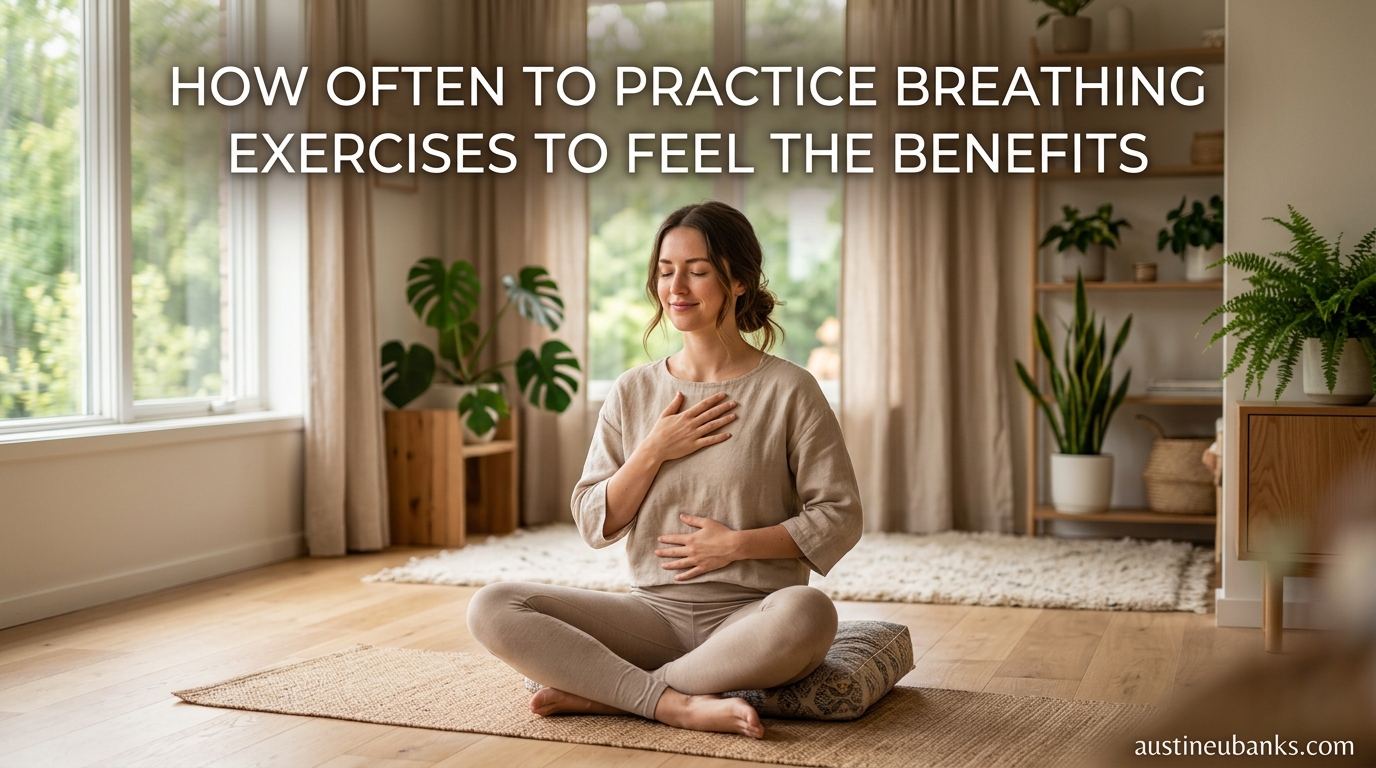
Most people should practice breathing exercises for 5 to 10 minutes, one to two times per day, to start feeling noticeable benefits. I have tested different frequencies myself over the past two years, and this daily range consistently delivers results within the first week. The key is consistency rather than duration.
If you have ever wondered how often to practice breathing exercises to feel the benefits, you are not alone. Forum discussions on Reddit’s r/Mindfulness and r/breathwork show this is one of the most common questions people ask when starting out. Everyone wants a specific number, not vague advice like “do it daily.”
In this guide, I break down exactly how often you should practice based on your experience level, which techniques work best for different goals, and when you can expect to feel real changes in your stress levels, sleep quality, and focus.
Table of Contents
The Short Answer: How Often to Practice Breathing Exercises
For most adults, practicing breathing exercises for 5 to 10 minutes once or twice daily produces measurable benefits within 7 to 14 days. This matches recommendations from the American Lung Association, which suggests 5 to 10 minutes of belly breathing per session.
I want to give you more than a one-size-fits-all answer though. Here is how frequency should change based on your experience level.
Beginner Schedule (Weeks 1 to 2)
Start with one session of 5 minutes per day. Pick a single technique, such as diaphragmatic breathing, and practice it at the same time daily. Do not worry about getting it perfect. The goal is building the habit first.
Limit 4-7-8 breathing to four cycles per session when you are just learning. Dr. Andrew Weil, who developed the technique, recommends this cap for beginners to avoid lightheadedness.
Intermediate Schedule (Weeks 3 to 6)
Once daily practice feels natural, increase to two sessions of 5 to 10 minutes each. Many people do one session in the morning for energy and focus, and another before bed for relaxation and sleep. This is when the deeper benefits really start compounding.
You can also begin experimenting with different techniques at this stage. Try box breathing in the morning and 4-7-8 breathing at night.
Advanced Schedule (Weeks 6 and Beyond)
Advanced practitioners often do 15 to 20 minutes per session, up to twice daily. At this level, you can integrate shorter 2 to 3 minute breathing resets throughout your day, such as before stressful meetings or during transitions between tasks.
I found that after about two months of consistent practice, even brief 60-second breathing resets became effective because my nervous system had been trained to respond quickly.
Why Frequency Matters: The Science Behind Daily Practice
Daily practice matters because of how your autonomic nervous system works. Breathing exercises stimulate the vagus nerve, which activates your parasympathetic nervous system. This is the branch responsible for rest, digestion, and recovery.
When you breathe slowly and deeply, your heart rate slows, blood pressure drops, and cortisol levels decrease. A single session can lower cortisol for several hours. But the effects fade without consistent practice.
Think of it like exercise. One workout feels good, but daily training is what builds lasting cardiovascular fitness. Breathing works the same way. The diaphragm is a muscle, and regular practice strengthens it over time.
Research shows that consistent daily practice over 8 weeks produces structural changes in brain regions associated with emotional regulation. This is why sporadic practice produces sporadic results.
Another reason daily practice outperforms occasional sessions is that repetition trains your nervous system to enter a calm state more quickly. After weeks of daily practice, just three slow breaths can trigger the relaxation response. This is called conditioned learning, and it only happens with regular repetition.
Diaphragmatic Breathing (Belly Breathing)
Diaphragmatic breathing, also called belly breathing, is the foundation technique that every beginner should master first. It involves breathing deeply into your belly rather than taking shallow breaths into your chest.
Here is how to do it step by step.
Step 1: Lie on your back with your knees bent, or sit comfortably in a chair. Place one hand on your belly and the other on your chest.
Step 2: Breathe in slowly through your nose for about 4 seconds. Feel your belly push your hand outward while your chest stays relatively still.
Step 3: Exhale slowly through pursed lips for about 6 seconds. Feel your belly fall back inward.
Step 4: Repeat for 5 to 10 minutes. The American Lung Association recommends keeping your hands on your belly throughout, as it helps you focus on the air moving in and out.
Recommended frequency: Once or twice daily for 5 to 10 minutes. This technique is especially beneficial for people with COPD, asthma, or general stress. It is also the best starting point for absolute beginners.
4-7-8 Breathing Technique
The 4-7-8 breathing technique involves inhaling for 4 seconds, holding for 7 seconds, and exhaling for 8 seconds. This pattern, popularized by Dr. Andrew Weil, is rooted in pranayama traditions and has become one of the most widely recommended techniques for sleep and anxiety.
Here is exactly how to practice it.
Step 1: Sit or lie down in a comfortable position. Place the tip of your tongue against the ridge of tissue behind your upper front teeth. Keep it there throughout the exercise.
Step 2: Exhale completely through your mouth, making a whoosh sound.
Step 3: Close your mouth and inhale quietly through your nose for a count of 4.
Step 4: Hold your breath for a count of 7.
Step 5: Exhale completely through your mouth, making a whoosh sound, for a count of 8.
Step 6: That completes one cycle. Repeat for a total of 4 cycles when you are beginning.
Recommended frequency: Dr. Weil recommends practicing at least twice daily. Start with 4 cycles per session and gradually increase to 8 cycles over the first few weeks. Many people use this technique specifically before bed to fall asleep faster.
Box Breathing
Box breathing uses a simple 4-4-4-4 pattern. You inhale for 4 seconds, hold for 4 seconds, exhale for 4 seconds, and hold empty for 4 seconds. This creates a “box” of equal time intervals.
This technique is used by Navy SEALs and first responders to stay calm under pressure. It is particularly effective for improving focus and managing acute stress.
Here is how to practice box breathing.
Step 1: Sit upright in a comfortable chair with your feet flat on the floor.
Step 2: Slowly exhale all the air from your lungs.
Step 3: Inhale through your nose for a slow count of 4.
Step 4: Hold your breath for a count of 4.
Step 5: Exhale through your mouth for a count of 4.
Step 6: Hold your lungs empty for a count of 4, then repeat the cycle.
Recommended frequency: One to three minutes as needed for acute stress, or 5 to 10 minutes daily as a regular practice. Box breathing is ideal for morning routines or before high-pressure situations like presentations or exams.
Pursed Lip Breathing
Pursed lip breathing helps you control your breathing rate and keep your airways open longer. It is especially helpful for people with COPD, asthma, or other respiratory conditions where air gets trapped in the lungs.
The technique is simple but powerful.
Step 1: Relax your neck and shoulder muscles.
Step 2: Breathe in through your nose for 2 seconds with your mouth closed. You should feel your abdomen rise.
Step 3: Pucker your lips as if you are about to whistle or blow out a candle.
Step 4: Exhale slowly and gently through your pursed lips for 4 seconds. The exhale should always take at least twice as long as the inhale.
Recommended frequency: Practice for 5 to 10 minutes, 2 to 3 times daily. This technique is also useful during physical activity when you feel short of breath. Use it whenever you need to slow your breathing down quickly.
How Long Does It Take for Breathing Exercises to Work
This is the question I see most often on forums, and the answer depends on what kind of benefit you are looking for. Here is a realistic timeline based on research and personal experience.
Immediate Effects (Within Minutes)
A single session of slow, deep breathing can lower your heart rate and blood pressure within minutes. You may notice reduced muscle tension, a sense of calm, and clearer thinking almost immediately. This is the quick win that keeps most people coming back.
Short-Term Benefits (1 to 2 Weeks)
With daily practice over 1 to 2 weeks, most people report better sleep quality, reduced daytime anxiety, and improved focus. Your body begins to recognize the breathing pattern as a signal to relax. The relaxation response becomes faster and more reliable.
I personally noticed my sleep onset time improving by about 10 minutes after just 5 days of nightly 4-7-8 breathing. Forum users on r/breathwork report similar timelines.
Long-Term Benefits (4 to 8 Weeks)
After 4 to 8 weeks of consistent daily practice, deeper changes begin to take hold. Research shows sustained breathing practice can produce measurable reductions in baseline cortisol levels, improved heart rate variability, and changes in brain activity patterns associated with emotional regulation.
People with chronic conditions like hypertension may see improvements in resting blood pressure. Those with anxiety disorders often report fewer panic episodes and lower overall anxiety scores.
How to Build a Consistent Breathing Practice
Knowing how often to practice breathing exercises to feel the benefits is only half the battle. Actually building the habit is where most people struggle. Here are the strategies that worked for me and that I recommend based on behavioral science.
Anchor It to an Existing Habit
The single most effective strategy is to attach your breathing practice to something you already do every day. Practice right after brushing your teeth in the morning. Do a session right after you get into bed at night. Link it to your morning coffee routine.
This technique, called habit stacking, eliminates the need for willpower because the existing habit serves as your trigger.
Choose the Best Time of Day
Morning breathing exercises set a calm tone for the entire day and help regulate your circadian rhythm. Evening sessions help transition your nervous system from sympathetic (fight or flight) to parasympathetic (rest and digest) mode.
If you can only do one session, choose based on your primary goal. Morning is better for energy and focus. Evening is better for sleep and relaxation.
Track Your Practice
Use a simple habit tracker, a journal, or a notes app to mark each day you complete your practice. Research on habit formation shows that tracking increases consistency significantly. I use a paper calendar on my desk and put an X on each day I complete my breathing session.
After about 21 days of marking your calendar, the streak itself becomes a motivator. Missing a day feels like breaking something valuable.
Common Mistakes to Avoid
The biggest mistake beginners make is trying to do too much too fast. Starting with 20-minute sessions on day one usually leads to quitting by day three. Start with 5 minutes and build slowly.
Another common error is practicing only when stressed. This is like only exercising when you feel out of shape. Daily practice during calm moments trains your nervous system so that breathing techniques actually work when you need them most.
Finally, many beginners breathe too forcefully. Deep breathing should feel relaxed, not strained. If you feel lightheaded, you are breathing too hard. Ease off and let the breath be natural.
When to Talk to Your Doctor Before Starting
Breathing exercises are safe for the vast majority of people. However, certain medical conditions warrant a conversation with your healthcare provider before starting a regular practice.
If you have COPD, asthma, heart disease, or any condition that affects your breathing or cardiovascular system, talk to your doctor first. They can help you choose the safest technique and frequency for your situation.
People with postural orthostatic tachycardia syndrome (POTS) or other dysautonomia conditions should be particularly cautious. Some breathing techniques that involve breath holding or extended exhales can affect blood pressure and heart rate in ways that may trigger symptoms. That said, certain breathwork practices may help with POTS symptoms by improving autonomic nervous system function. Always consult your specialist before starting.
Pregnant women should also check with their healthcare provider, particularly before trying techniques that involve breath retention.
If you ever feel dizzy, lightheaded, or uncomfortable during breathing exercises, stop immediately and return to normal breathing. These sensations usually mean you are breathing too deeply or too quickly.
FAQs
How often should I practice breathwork?
Practice breathwork for 5 to 10 minutes, once or twice daily. Beginners should start with one 5-minute session per day and gradually increase to two sessions as the habit becomes consistent. Most people feel noticeable benefits within 7 to 14 days of daily practice.
What is the 4-7-8 rule for breathing?
The 4-7-8 breathing rule involves inhaling through your nose for 4 seconds, holding your breath for 7 seconds, and exhaling through your mouth for 8 seconds. Developed by Dr. Andrew Weil, this technique activates the parasympathetic nervous system and is particularly effective for sleep and anxiety. Beginners should start with 4 cycles per session and practice at least twice daily.
What type of breathing helps lower blood pressure?
Slow, deep diaphragmatic breathing at a rate of about 6 breaths per minute has been shown to help lower blood pressure. The 4-7-8 technique and paced breathing with extended exhales are particularly effective because they stimulate the vagus nerve and activate the parasympathetic nervous system, which reduces heart rate and relaxes blood vessels.
Can breathwork help with POTS?
Breathwork may help some people with postural orthostatic tachycardia syndrome (POTS) by improving autonomic nervous system regulation. However, techniques involving breath holding or extended exhales can trigger symptoms in some patients. Always consult your cardiologist or specialist before starting any breathing practice if you have POTS or any form of dysautonomia.
Conclusion
Now you know exactly how often to practice breathing exercises to feel the benefits. The formula is straightforward: 5 to 10 minutes, once or twice daily, with a single technique for the first two weeks. Start small, stay consistent, and give it at least 14 days before judging the results.
Pick one technique from this guide, choose a time of day that fits your routine, and start today. The sooner you begin daily practice, the sooner your nervous system learns to access calm on demand. Your future self will thank you for the 5 minutes you invest right now.