
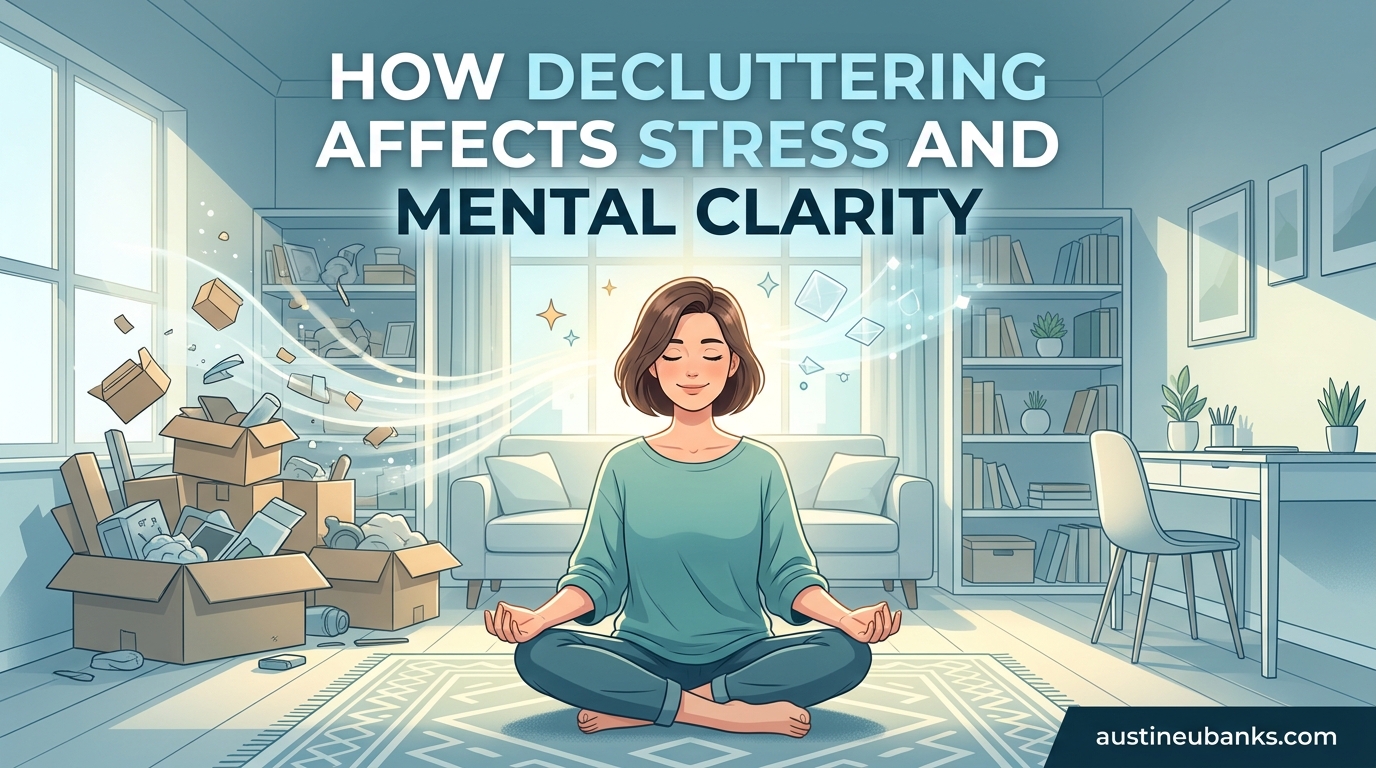
Clutter does more than take up space. Decluttering reduces stress by lowering cortisol levels, easing cognitive overload, and freeing up working memory so your brain can focus, relax, and think clearly. When you remove excess visual stimuli from your environment, you give your mind permission to breathe.
I used to think a messy desk was just a sign of being busy. Then I spent two weeks clearing out my home office, and the mental shift was immediate. My shoulders unclenched. My racing thoughts slowed. I stopped waking up at 3 a.m. replaying everything I hadn’t finished.
If you have ever wondered how decluttering affects stress and mental clarity, the answer goes far beyond “a clean room looks nice.” There is real neuroscience behind why a tidy space calms your nervous system and sharpens your thinking. In this guide, I will walk you through what the research says, how clutter actually changes your brain chemistry, and practical ways to start clearing your space without getting overwhelmed.
Table of Contents
The Short Answer: How Decluttering Affects Stress and Mental Clarity
Decluttering affects stress and mental clarity by reducing the amount of sensory information your brain has to process at once. Every pile of papers, every stack of dishes, every unopened box on the floor sends visual signals that your brain must sort, categorize, and respond to, even if you are not consciously thinking about them.
This constant processing drains a limited resource called working memory. When working memory is overloaded, your stress hormone cortisol rises. Your focus fragments. Your anxiety increases. Over time, chronic clutter creates a low-grade stress response that never fully turns off.
Removing clutter reverses this process. With fewer visual distractions competing for attention, cortisol drops, working memory recovers, and your brain can direct energy toward thinking, creating, and relaxing instead of filtering out noise. That is the core mechanism behind how decluttering affects stress and mental clarity.
What Clutter Actually Does to Your Brain
Cortisol and the Clutter-Stress Connection
Cortisol is your body’s primary stress hormone. It spikes when your brain perceives threats, and as far as your nervous system is concerned, a chaotic environment qualifies. Research from the University of Connecticut found that people who described their homes as cluttered or disorganized had higher cortisol levels throughout the day, especially in the evening.
That evening cortisol spike matters more than it sounds. Cortisol is supposed to naturally decline as the day winds down so your body can transition into rest mode. When clutter keeps cortisol elevated into the evening, your sleep suffers. Your immune function weakens. Your mood dips.
A landmark study by researchers at UCLA’s Center on Everyday Lives of Families measured cortisol levels in women who described their homes as cluttered. The findings were striking: women who perceived their homes as more cluttered had higher cortisol patterns from morning to night, and they reported more depressed mood throughout the day.
This is not a minor effect. Your physical environment is literally regulating your stress hormones in real time.
Cognitive Overload and Working Memory
Working memory is your brain’s scratchpad. It holds the information you need right now to think, decide, and act. When you are in a cluttered room, every object in your field of vision competes for a slot on that scratchpad.
A 2011 study by Stephanie McMains and Sabine Kastner at Princeton University mapped exactly how this works. Using fMRI brain imaging, they showed that the visual cortex processes multiple stimuli simultaneously, but the brain cannot fully represent all of them at once. The result is what neuroscientists call cognitive overload: a state where too much incoming information overwhelms your processing capacity.
Cognitive overload manifests as brain fog. You start a task and get distracted. You walk into a room and forget why. You sit down to work and feel mentally exhausted before you have done anything. That exhaustion is not laziness. It is your brain burning through working memory trying to filter out irrelevant stimuli.
When you declutter, you remove those competing stimuli. Working memory frees up. Focus sharpens. Decision-making improves. The mental clarity people describe after clearing a space is not a placebo. It is measurable cognitive recovery.
The Princeton Visual Distraction Study
The Princeton University research on visual distraction is one of the most cited studies in this space. Researchers found that an organized, uncluttered environment directly improves task performance and focus. When participants worked in a tidy space, their ability to complete tasks increased significantly compared to a cluttered environment.
The study confirmed what many people intuit: your brain processes everything in your visual field, even when you think you are ignoring it. A messy desk does not stay in the background. It actively drains cognitive resources in the foreground.
For me, this explained why I always felt more productive in coffee shops than at my cluttered home desk. The coffee shop had fewer visual distractions. My brain was not working overtime filtering out stacks of paper and unsorted mail.
7 Science-Backed Mental Health Benefits of Decluttering
Understanding how decluttering affects stress and mental clarity means looking at the specific, documented benefits. Here are seven that the research and real-world experiences consistently support.
1. Lower Stress and Cortisol Levels
The most immediate benefit of decluttering is stress reduction. By removing visual chaos, you reduce the constant low-grade stress response that clutter triggers. The UCLA and University of Connecticut studies both confirm that people in organized homes have healthier cortisol patterns throughout the day.
Reddit users on the r/declutter community echo this finding constantly. One user wrote: “It helped SO much because there are less things to take care of and manage, and a clearer place to put things.” That feeling of relief is your nervous system stepping out of fight-or-flight mode.
2. Reduced Anxiety
Clutter and anxiety feed each other. A cluttered space creates a sense of unfinished business, and your brain interprets unfinished tasks as threats. This keeps anxiety circuits activated even when nothing is actually wrong.
Decluttering breaks this loop. When your space is organized, your brain stops sending alarm signals about things that need attention. Psychology Today notes that several studies show a direct correlation between disorganization, clutter, and clinical anxiety levels.
Multiple Reddit users in anxiety-focused threads report that decluttering their bedroom alone reduced their daily anxiety noticeably. One user shared: “I didn’t realize how much my cluttered room was contributing to my anxiety until I cleared it. The difference was night and day.”
3. Sharper Focus and Concentration
When working memory is not consumed by visual clutter, it becomes available for the task in front of you. The Princeton studies show that people in organized environments complete tasks faster and with fewer errors.
Decluttering and focus go hand in hand because you are not fighting your environment for attention. Your brain can stay on one task longer without being pulled away by competing stimuli. This is why tidy workspaces consistently outperform messy ones in productivity research.
4. Better Sleep Quality
Clutter and sleep quality are deeply connected, and this is one of the most under-discussed benefits of decluttering. Your bedroom should signal rest to your brain, but a cluttered bedroom sends the opposite signal: there is work left undone, things are unresolved, stay alert.
When evening cortisol stays elevated because of environmental clutter, falling asleep becomes harder and sleep quality drops. People who declutter their bedrooms frequently report falling asleep faster and waking up feeling more rested.
One Reddit user described the effect plainly: “I started sleeping better within a week of clearing my bedroom. I didn’t change anything else. Just the clutter.”
5. Higher Self-Esteem and Sense of Control
Clutter creates a subtle but persistent feeling of failure. Every pile you walk past is a reminder of something you have not dealt with. Over time, this erodes self-esteem and creates a sense of helplessness about your environment.
Decluttering reverses this. Each area you clear is visible proof that you can take control of your life. Psychology Today highlights that organizing your space rebuilds self-worth by demonstrating agency. You are not at the mercy of your stuff. You are in charge of it.
6. Boosted Productivity
Decluttering productivity gains are real and measurable. When you spend less time looking for things, cleaning around clutter, and mentally processing visual noise, you reclaim hours each week.
The USU Extension office references the Princeton study showing that organized environments activate productivity mode. People in tidy spaces start tasks faster, complete them more efficiently, and experience less procrastination. The mental friction of a chaotic workspace simply disappears.
7. Enhanced Creativity and Mental Space
There is a reason artists and writers often describe needing a clean studio before they can create. Mental space and physical space are linked. When your environment is overloaded, your thinking becomes overloaded too.
A decluttered space creates room for new ideas. Working memory that was spent filtering noise becomes available for creative problem-solving. Many people report their best ideas arriving shortly after a decluttering session, and the cognitive science supports this: a less distracted brain is a more creative brain.
Cluttered vs Decluttered: How Your Environment Changes Your Mind
To make the contrast concrete, here is a side-by-side comparison of how a cluttered environment versus a decluttered one affects key mental health metrics.
Cortisol levels: Elevated and slow to decline in cluttered spaces. Normalized with healthy daily patterns in organized environments.
Focus and attention: Fragmented and easily derailed amid clutter. Sustained and sharp in a tidy space.
Sleep quality: Disrupted by elevated evening cortisol and visual reminders of unfinished tasks. Improved when the bedroom signals calm and completion.
Anxiety: Heightened by constant visual reminders of disorder. Reduced when the environment feels manageable and complete.
Productivity: Slowed by cognitive overload and time spent navigating clutter. Accelerated by freed working memory and faster task initiation.
Mood: Lowered by feelings of helplessness and overwhelm. Lifted by visible evidence of control and accomplishment.
Self-esteem: Eroded by piles that represent unfinished business. Strengthened by organized spaces that reflect personal agency.
The pattern is consistent across every metric. Your environment is not a backdrop. It is an active participant in your mental state.
Digital Clutter: The Hidden Mental Drain
No major competitor in this space covers digital clutter, and that is a significant gap. In 2026, the clutter stressing you out may not be on your floor. It might be on your screen.
Digital clutter takes many forms. A phone with 14,000 unread emails. A computer desktop covered in files. Forty browser tabs open at once. Notification badges screaming for attention. A contacts list full of people you will never message again.
Every one of these digital elements creates the same cognitive overload as physical clutter. Your brain processes a red notification badge the same way it processes a pile of unopened mail: as an unresolved task demanding attention. Research on attention residue shows that each notification, even ignored, fragments your focus and reduces performance on your current task.
The effect compounds when you consider how much time we spend in digital environments. If you work at a computer, your screen may be the space you inhabit most. A cluttered digital workspace generates the same cortisol response as a cluttered physical one, but because it is invisible, most people never identify it as a stress source.
Here is how to start addressing digital clutter:
1. Turn off non-essential notifications. Every badge you eliminate removes one demand on your attention.
2. Close browser tabs you are not actively using. Each open tab consumes a sliver of working memory.
3. Clear your computer desktop. Move files into folders and remove unused shortcuts.
4. Unsubscribe from emails you never read. A cleaner inbox reduces the visual reminder of unfinished tasks.
5. Delete unused apps from your phone. Every icon is a visual stimulus competing for attention.
I spent one weekend decluttering my digital life, and the effect on my focus was comparable to clearing my physical desk. The mental noise dropped noticeably. I was not checking my phone as often. My browser felt calm instead of chaotic.
Why Decluttering Is So Hard (And How to Push Through)
If decluttering is so good for you, why is it so difficult? Understanding the barriers is essential because most people who know the benefits still struggle to act on them.
Emotional Attachment and Sentimental Items
Sentimental items are the hardest thing to get rid of when decluttering. A sweater your grandmother knitted. A stack of cards from a past relationship. Your child’s first pair of shoes. These objects carry identity and memory, and letting go of them can feel like letting go of the person or moment they represent.
The key is recognizing that the memory lives in you, not in the object. Taking a photo of a sentimental item before donating it preserves the memory while freeing the physical space. This technique is widely recommended by professional organizers and frequently praised on decluttering forums.
Perfectionism Paralysis
Many people never start decluttering because they cannot do it perfectly. If I cannot organize the entire house in one weekend, what is the point of starting with one drawer? This all-or-nothing thinking is one of the most common barriers.
The reality is that decluttering is a process, not a one-time event. Forum users consistently recommend starting small: one drawer, one shelf, one corner. Perfection is not the goal. Progress is. Users on r/declutter repeatedly emphasize that giving yourself permission to be imperfect is what makes decluttering sustainable.
ADHD and Executive Function Challenges
For people with ADHD, decluttering presents a specific neurological challenge. ADHD involves deficits in executive function, which is the brain system responsible for planning, prioritizing, initiating tasks, and sustaining attention. Decluttering requires all of these at once.
This is why many people with ADHD describe decluttering as feeling like a full-time job. The brain cannot efficiently sort, decide, and execute the way a neurotypical brain can. Psychology Today highlights this connection between ADHD and organization difficulties.
The solution is external structure. Set a timer for 10 minutes. Pick one small area. Make simple binary decisions: keep or donate. Break the task into steps so small that starting feels effortless. Remove the pressure to finish. Just start.
Trauma and the Roots of Clutter
Clutter is sometimes connected to past trauma. People who have experienced loss, scarcity, or instability may accumulate items as a subconscious way to create a sense of security. Letting things go can trigger feelings of vulnerability.
This is important context because it explains why decluttering can feel emotionally intense. It is not always about the stuff. Sometimes it is about what the stuff represents: safety, identity, control over a life that once felt out of control.
If you suspect trauma is connected to your clutter, patience is essential. Consider working with a therapist who understands hoarding behaviors or attachment issues. Decluttering is a mental health tool, but it is not a replacement for professional support when deeper patterns are at play.
The Decluttering-Anxiety Paradox
Here is something no competitor talks about: the act of decluttering can temporarily increase anxiety. Making decisions about what to keep and what to let go of triggers the brain’s uncertainty response. For some people, this spike in anxiety is enough to stop them before they start.
A user on a mental health forum described feeling “upset, nervous, anxious and close to tears” when thinking about decluttering their wardrobe. This is a real and valid experience. The anxiety spike is temporary, but if you are not expecting it, it can derail the entire process.
Knowing this paradox exists is half the battle. Expect the anxiety. Acknowledge it. Keep going. The anxiety fades as decisions get made and visible progress appears. Most people on forums report that the anxiety lifts within a single session once they get into a rhythm.
How to Start Decluttering When You Feel Overwhelmed
Practical action is where the research meets real life. Here is a step-by-step approach that works whether you have 10 minutes or an entire weekend.
Step 1: Pick One Small Area
Do not try to declutter your whole house at once. Pick one drawer, one shelf, or one corner of a room. Small wins build momentum, and momentum carries you through bigger tasks later.
Step 2: Set a Timer
Ten minutes is enough. Set a timer on your phone and commit to working for just that long. When the timer goes off, you can stop or keep going. Removing the pressure to finish makes starting easier.
Step 3: Use the Four-Box Method
Bring four boxes or bags labeled: Keep, Donate, Trash, and Relocate. Every item you touch goes into one of these four categories. This forces a decision on every item and prevents you from simply moving clutter from one surface to another.
Step 4: Try the 50% Rule
The 50% rule in decluttering is simple: once you have sorted an area, try to remove at least half of what was there. If a shelf had 20 items, aim to keep 10. This creates visible space rather than just reorganizing the same amount of stuff. The rule is not about being ruthless. It is about creating breathing room.
Step 5: Handle Sentimental Items Last
Start with easy categories: expired food, old papers, broken items, clothes that do not fit. Build decision-making confidence on low-stakes items. Save photos, gifts, and heirlooms for a separate session when your decluttering muscles are stronger.
Step 6: Adopt the Ten-Second Tidy
The USU Extension office recommends a daily ten-second tidy routine. Each day, spend ten seconds putting things back where they belong. This prevents clutter from accumulating and keeps your space in a state that your brain reads as calm and controlled.
Step 7: Maintain With a One-In, One-Out Rule
For every new item you bring into your home, remove one item. This keeps clutter from creeping back and forces you to evaluate whether new purchases are worth the space they take up.
How Long Until You Notice Results?
This is one of the most common questions in decluttering forums, and no competitor answers it clearly. Based on user reports and the cortisol research timeline, most people notice a mood shift within the first session of meaningful decluttering. Sleep improvements often appear within a few days of clearing the bedroom. Sustained reductions in anxiety and improvements in focus typically become noticeable within one to two weeks of regular decluttering.
One Reddit user summarized it well: “I felt lighter after the first drawer. After a week of working on my apartment, I felt like a different person.”
Signs Your Clutter Is Affecting Your Mental Health
Sometimes the connection between clutter and mental health is obvious. Other times it creeps up slowly. Here are signs that your clutter may be actively undermining your well-being.
You feel tense or irritable when you look around your space. You avoid inviting people over because of the mess. You spend more than 15 minutes a day looking for things you cannot find. You start tasks but cannot finish them because the environment feels distracting. You feel guilty every time you see certain piles but never address them. Your sleep is poor and your bedroom feels chaotic.
If several of these resonate, your environment is likely contributing to your stress levels. The good news is that this is one stressor you have the power to change, starting today.
Frequently Asked Questions
What is the hardest thing to get rid of when decluttering?
Sentimental items are the hardest thing to get rid of when decluttering. Objects tied to memories, relationships, or identity, such as old photographs, gifts, children’s artwork, and inherited belongings, carry emotional weight that makes them difficult to part with. Taking a photo of the item before letting it go can preserve the memory while freeing the physical space.
What is the 50% rule in decluttering?
The 50% rule in decluttering means that when you sort an area, you aim to remove at least half of the items that were there. If a shelf had 20 items, you try to keep only 10. The goal is to create visible empty space rather than simply reorganizing the same amount of stuff into a tidier arrangement.
What kind of trauma causes clutter?
Clutter can be connected to several types of trauma, including loss of a loved one, childhood scarcity or poverty, forced displacement, divorce, and emotional abandonment. People who have experienced instability sometimes accumulate items as a subconscious way to create security and control. Letting things go can trigger feelings of vulnerability tied to those past experiences.
Can decluttering help with anxiety and depression?
Yes, decluttering can help reduce symptoms of anxiety and depression. Research shows that cluttered environments elevate cortisol and increase feelings of helplessness, while organized spaces lower stress hormones and restore a sense of control. Studies from Princeton, UCLA, and the University of Connecticut all document correlations between clutter and mental health conditions including anxiety, depression, and chronic stress.
How long does it take to notice mental clarity after decluttering?
Most people notice a mood shift after their first meaningful decluttering session. Sleep improvements often appear within a few days of clearing the bedroom. Sustained reductions in anxiety and improvements in focus typically become noticeable within one to two weeks of regular decluttering activity.
Can a messy room cause anxiety?
Yes, a messy room can contribute to anxiety. Cluttered environments overload working memory and keep cortisol elevated, which activates the brain’s stress response. A disorganized bedroom is particularly impactful because it interferes with the rest signals your brain needs to wind down for sleep.
Why does decluttering make some people anxious?
Decluttering can temporarily increase anxiety because it forces decision-making under uncertainty. The brain’s stress response activates when faced with choices about what to keep and what to let go of, especially for sentimental items. This anxiety spike is usually temporary and fades as decisions are made and visible progress appears.
Clear Space, Clear Mind
Understanding how decluttering affects stress and mental clarity comes down to one core truth: your environment and your mind are connected systems. A cluttered space keeps your brain in a low-grade stress state, drains working memory, and fragments your focus. A cleared space lowers cortisol, restores cognitive bandwidth, and gives you room to think, rest, and create.
You do not need to declutter your entire home in one day. Start with one drawer. Set a timer. Give yourself permission to be imperfect. The mental clarity that follows is not a theory. It is your brain finally getting the breathing room it has been asking for.