
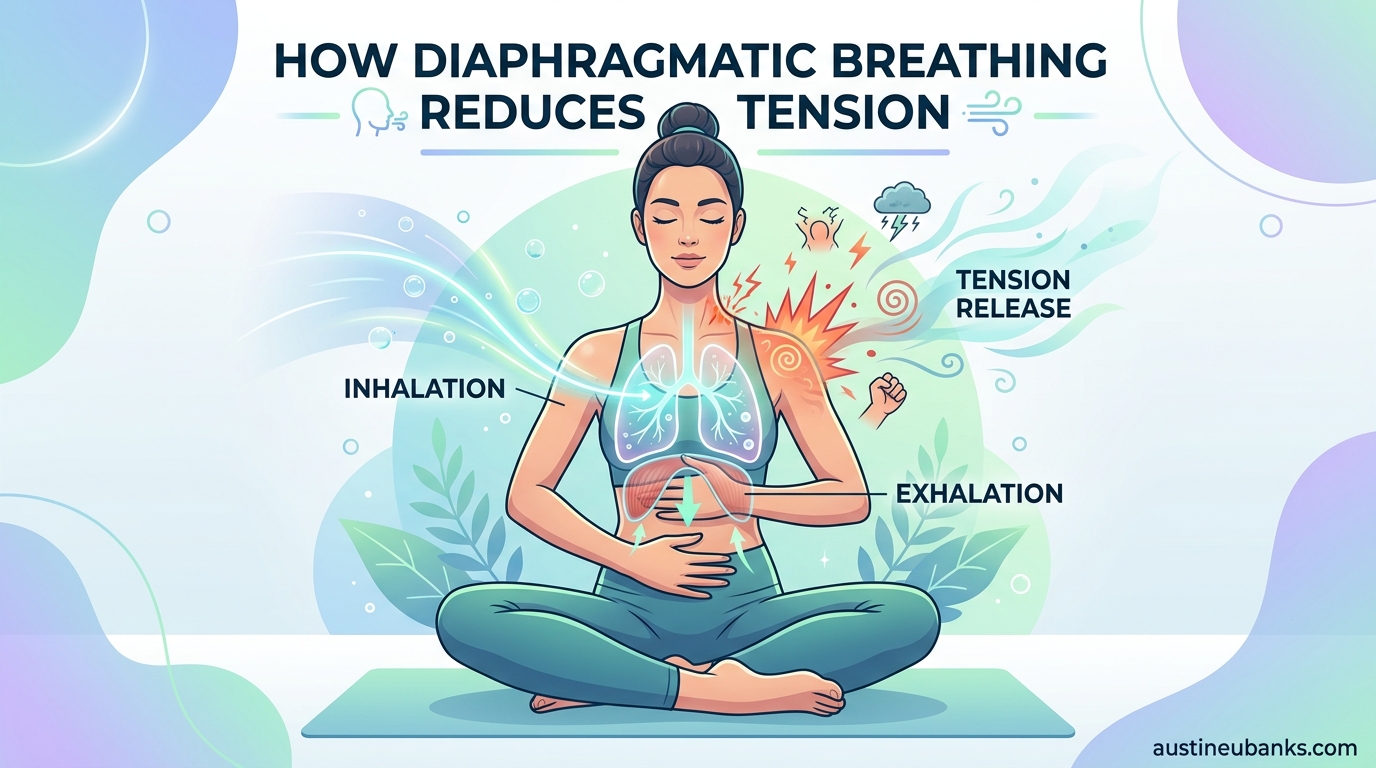
Your shoulders are tight. Your jaw is clenched. Your stomach feels like it is tied in knots. If this sounds familiar, you are not alone. Most adults carry tension in their bodies every single day without realizing that the way they breathe is a major part of the problem.
When I first learned about diaphragmatic breathing, I was skeptical. How could something as simple as breathing differently actually release the physical tension I had been carrying for years? But after understanding the science behind it and practicing consistently, the results were undeniable. My shoulders dropped. My resting heart rate slowed. The constant background hum of anxiety faded.
Understanding how diaphragmatic breathing reduces tension starts with recognizing that your breath is not just a passive function. It is a direct control lever for your nervous system. The way you breathe right now is either telling your body to stay on high alert or signaling that it is safe to relax. For most people reading this, shallow chest breathing has been quietly keeping the body locked in a low-grade stress response for years or even decades.
In this guide, I will walk you through exactly what happens in your body when you switch to diaphragmatic breathing, why it works at a physiological level, how to do it correctly, and when to use it for maximum tension relief. You will also learn about specific types of tension it targets, a timeline of effects you can expect, and common mistakes that hold beginners back.
Table of Contents
Quick Answer: The Short Version
Diaphragmatic breathing reduces tension by activating your parasympathetic nervous system through vagus nerve stimulation. When you breathe slowly and deeply using your diaphragm, the extended exhalation sends signals to your brain that it is safe to relax. This lowers cortisol levels, slows your heart rate, reduces blood pressure, and directly releases the muscle tension that chest breathing and chronic stress create in your neck, shoulders, jaw, and core.
What Is Diaphragmatic Breathing?
Diaphragmatic breathing is a breathing technique where you engage the diaphragm, a large dome-shaped muscle at the base of your lungs, to draw air deeply into your body. Instead of your chest rising and falling with each breath, your belly expands on the inhale and contracts on the exhale. This is why it is also called belly breathing or abdominal breathing.
Your diaphragm is the most efficient breathing muscle you have. It sits just below your lungs and above your abdominal organs, separating your chest cavity from your abdominal cavity. When it contracts and flattens, it creates negative pressure that pulls air into your lungs. When it relaxes and returns to its dome shape, air flows out. This is the way your body was designed to breathe.
Here is something that surprises most people: you were born breathing this way. Watch a baby sleep and you will see their belly rise and fall naturally. Their chest barely moves. Babies do not need to be taught diaphragmatic breathing because it is the default human breathing pattern. Somewhere between childhood and adulthood, most of us lose this natural ability.
The shift usually happens gradually. Stress, sitting at desks for hours, sucking in our stomachs for appearance, and chronic anxiety all train us to breathe shallowly using the muscles in our chest and neck instead of our diaphragm. Over time, this becomes the new default. The diaphragm becomes underused and sometimes even feels tight or frozen, as many people on breathwork forums report.
The good news is that this pattern can be reversed. Diaphragmatic breathing is a skill you can relearn, and doing so is one of the fastest ways to start releasing stored tension from your body.
How Diaphragmatic Breathing Reduces Tension: The Science
This is where things get interesting. The connection between how you breathe and how much tension you carry is not just psychological. It is deeply physiological, rooted in the design of your autonomic nervous system.
Your autonomic nervous system has two main branches that work in opposition to each other. The sympathetic nervous system is your gas pedal. It triggers the fight-or-flight response, floods your body with stress hormones like cortisol and adrenaline, increases your heart rate, raises your blood pressure, and tenses your muscles to prepare for action. The parasympathetic nervous system is your brake. It triggers the relaxation response, slows your heart rate, lowers blood pressure, promotes digestion, and releases muscle tension.
Most adults today spend far too much time with their sympathetic nervous system engaged and not enough time in parasympathetic mode. This is not because we are constantly running from predators. It is because modern stressors like work deadlines, financial pressure, relationship conflicts, information overload, and even poor posture keep the stress response simmering at a low level all day long.
Here is the critical piece: your breathing pattern is directly wired into this system. You cannot consciously control your heart rate, blood pressure, or hormone production. But you can control your breath. And your breath is the back door to your autonomic nervous system.
The Vagus Nerve Connection
The bridge between your breath and your nervous system is the vagus nerve. This is the longest cranial nerve in your body, running from your brainstem down through your neck, chest, and into your abdomen. It is the main highway of the parasympathetic nervous system, carrying signals between your brain and your major organs.
When you breathe using your diaphragm, the movement of your diaphragm stimulates mechanoreceptors that send signals up the vagus nerve to your brain. Specifically, slow breathing with extended exhalation activates vagal afferent pathways that tell your brainstem to engage the relaxation response. Your brain interprets this signal as proof that you are safe, and it begins dialing down the stress response.
This is not a theory. A 2018 review published in Frontiers in Human Neuroscience by researcher Roderick Gerritsen and colleagues found that slow breathing techniques increase vagal tone and parasympathetic activity, leading to measurable reductions in anxiety and arousal. The extended exhale is particularly powerful because it maximizes vagus nerve stimulation.
Cortisol and Stress Hormone Reduction
When the fight-or-flight response is active, your adrenal glands release cortisol, often called the stress hormone. Cortisol is useful in short bursts when you need to respond to actual danger. But when it stays elevated day after day due to chronic stress, it causes widespread problems including muscle tension, inflammation, poor sleep, weight gain, and anxiety.
Diaphragmatic breathing directly lowers cortisol levels. A 2019 study published in Frontiers in Psychology reviewed multiple trials and concluded that diaphragmatic breathing significantly reduces cortisol levels as measured by both physiological biomarkers and psychological self-report tools. Participants who practiced diaphragmatic breathing showed measurable decreases in salivary cortisol compared to control groups.
As cortisol drops, your muscles receive the signal that they no longer need to stay braced for action. The tension in your neck, shoulders, jaw, and core begins to release. This is not a conscious decision your muscles make. It is an automatic physiological response to the shifting hormonal environment in your body.
Heart Rate Variability and Cardiovascular Effects
One of the most significant effects of diaphragmatic breathing is its impact on heart rate variability, or HRV. HRV measures the variation in time between each heartbeat. Counterintuitively, higher variability is a sign of good health and strong nervous system fitness. It means your heart can rapidly adjust to changing demands.
Slow diaphragmatic breathing at around 5 to 6 breaths per minute has been shown to maximize HRV by creating a state called respiratory sinus arrhythmia. This is a natural synchronization between your breathing rhythm and your heart rate. When you inhale, your heart rate slightly increases. When you exhale, it slightly decreases. The deeper and slower you breathe, the more pronounced this effect becomes.
Along with improved HRV, diaphragmatic breathing lowers resting heart rate and reduces blood pressure. Cleveland Clinic notes that this technique consistently produces improvements in both measurements. For people carrying tension-related hypertension, this is a significant benefit that compounds over weeks and months of practice.
Intrathoracic Pressure and Blood Flow
The diaphragm does more than move air. As the Department of Veterans Affairs Whole Health Library explains, when the diaphragm contracts during inhalation, it generates negative intrathoracic pressure that creates a vacuum effect, pulling blood into the thorax and improving venous return to the heart. This enhanced circulation means better oxygen delivery throughout your body.
Better blood flow helps tense muscles receive the oxygen and nutrients they need to relax. When muscles are chronically tense, they can develop areas of reduced blood flow called ischemic bands. These areas become painful and resistant to stretching. By improving overall circulation, diaphragmatic breathing supports the physical conditions muscles need to release stored tension.
Carbon Dioxide Balance
Shallow, rapid chest breathing often leads to a condition called overbreathing, where you exhale too much carbon dioxide. While CO2 is commonly thought of as a waste product, your body actually needs a certain level of it in your blood to function properly. Low CO2 levels can cause symptoms that mimic tension and anxiety: lightheadedness, tingling, chest tightness, and a sense of air hunger.
Diaphragmatic breathing promotes slower, deeper breaths that maintain healthy CO2 levels. This eliminates the artificial tension and anxiety symptoms that overbreathing creates, leaving you with genuine physiological calm rather than just the appearance of relaxation.
Chest Breathing vs Diaphragmatic Breathing: What Changes
To understand why switching your breathing pattern has such a dramatic effect on tension, it helps to compare the two modes side by side.
When you chest breathe, you use the secondary breathing muscles in your neck, shoulders, and upper chest. These muscles are designed to assist during exercise or stress. They are not meant to handle the 20,000-plus breaths you take each day. When they are forced into constant use, they become chronically tight, sore, and fatigued. This is a major source of the neck and shoulder tension that millions of people experience.
Chest breathing also signals to your nervous system that you are under threat. Rapid, shallow breathing is a hallmark of the fight-or-flight response. Even if you are just sitting at a desk, chest breathing tells your brain that danger is present. Your body responds by keeping cortisol elevated, muscles tensed, and digestion suppressed.
Diaphragmatic breathing changes all of this. The primary breathing muscle takes over, and the overworked neck and shoulder muscles can finally rest. The slower rhythm signals safety to your nervous system. Hormone production shifts from stress hormones to relaxation chemistry. Blood pressure and heart rate decrease. The entire system moves from threat mode into recovery mode.
The switch from chest breathing to belly breathing is not just about taking deeper breaths. It is about fundamentally changing which message your body is sending to your brain.
How to Do Diaphragmatic Breathing: Step-by-Step
Learning diaphragmatic breathing is straightforward, but it does take practice. Most adults have been chest breathing for so long that the diaphragm muscle needs to be gradually retrained. Here are two positions to try, starting with the easiest.
Lying Down Position (Best for Beginners)
Start here. Lying down removes the effects of gravity and makes it much easier to feel your diaphragm working.
Step 1: Lie on your back on a flat, comfortable surface. Bend your knees slightly, or place a pillow under your knees for support. This relaxes your abdominal muscles and gives your belly room to expand.
Step 2: Place one hand on your chest, just below your collarbones. Place your other hand on your belly, just below your rib cage. This hand placement gives you immediate feedback about which part of your body is moving.
Step 3: Breathe in slowly through your nose. Focus on sending the air downward so that the hand on your belly rises. The hand on your chest should stay relatively still. If your chest hand rises significantly, you are still chest breathing.
Step 4: Let the air out slowly through pursed lips or a relaxed mouth. Feel your belly hand fall as your diaphragm returns to its resting position. The exhale should take longer than the inhale. Aim for a ratio of about 1 to 2. For example, inhale for 3 seconds, exhale for 6 seconds.
Step 5: Continue this pattern for 5 to 10 minutes. Focus on keeping each breath smooth and unhurried. There is no need to force large amounts of air. The goal is slow, gentle, rhythmic breathing.
Once you can comfortably do this lying down, try placing a small book on your belly. The slight resistance gives your diaphragm something to work against, strengthening the muscle over time. Cleveland Clinic recommends this progressive approach for building diaphragm strength.
Sitting Position (For Daily Use)
Once you are comfortable lying down, transition to a seated position. This is the position you will use most often in daily life.
Step 1: Sit in a chair with your feet flat on the floor and your back supported. Relax your shoulders. Let them drop away from your ears.
Step 2: Place one hand on your belly. This is your primary feedback tool. You do not need the chest hand once you are more experienced.
Step 3: Inhale through your nose, directing the breath into your belly so your hand moves outward. Keep your chest and shoulders still.
Step 4: Exhale slowly through your mouth or nose, feeling your belly move inward under your hand.
Step 5: Practice for 5 to 10 minutes, 2 to 3 times per day.
A helpful trick from Johns Hopkins Medicine: if you have trouble feeling your stomach move while sitting, try placing your hands behind your head. This locks your chest muscles and forces your diaphragm to do the work. You will feel your belly expanding much more clearly.
Diaphragmatic Breathing for Specific Tension Types
One thing that most guides miss is that diaphragmatic breathing does not just reduce general stress. It targets specific types of physical tension in ways that are surprisingly direct. Here is how it helps with the most common areas where people carry tension.
Neck and Shoulder Tension
Every time you chest breathe, you recruit the scalene muscles in your neck and the trapezius muscles in your shoulders to lift your rib cage. Over thousands of breaths per day, these muscles become chronically overworked and tight. Switching to diaphragmatic breathing takes the load off these muscles entirely. Many people report that neck and shoulder tension they have carried for years begins releasing within days of consistent practice.
Jaw Tension and TMJ
Jaw clenching is intimately connected to your stress response. When cortisol is elevated, your jaw muscles brace involuntarily. Diaphragmatic breathing reduces the cortisol that drives this clenching. Additionally, the general relaxation response helps you become aware of jaw tension you may have been ignoring. Many people find that once they start practicing belly breathing regularly, they catch themselves clenching and can consciously release it.
Pelvic Floor Tension
The diaphragm and the pelvic floor work as a coordinated team. When you inhale and your diaphragm descends, your pelvic floor naturally relaxes and lengthens. When you exhale, it gently recoils. Chronic chest breathing disrupts this coordination, leading to a tense, held pelvic floor. Practitioners in pelvic floor therapy communities report that diaphragmatic breathing combined with consciously relaxing the stomach, rather than constantly sucking it in, resolves a significant portion of pelvic floor dysfunction symptoms.
Digestive Tension (GERD and IBS)
The diaphragm forms the upper boundary of your digestive system. When it moves fully and rhythmically, it creates a gentle massaging effect on your stomach and intestines. This promotes healthy digestion and can reduce symptoms of acid reflux and irritable bowel syndrome. Users with GERD have reported dramatic symptom reductions when combining diaphragmatic breathing with diaphragm massage. The breathing helps strengthen the crural portion of the diaphragm, which wraps around the esophagus and acts as a natural anti-reflux barrier.
What Happens in Your Body: The Timeline of Effects
One of the most common questions I see in forums is how long it takes for diaphragmatic breathing to start working. The answer depends on what type of effect you are looking for. The changes happen on three distinct timelines.
Immediate Effects (Seconds to Minutes)
Within the first few diaphragmatic breaths, your vagus nerve begins sending relaxation signals to your brain. Your heart rate starts to slow. Blood pressure begins to drop. Cortisol production starts to decrease. You may notice your shoulders dropping, your jaw unclenching, and a subjective sense of calm settling over you. This is why even 3 breaths can interrupt an acute stress response or panic attack.
Short-Term Effects (Days to Weeks)
With daily practice over 1 to 2 weeks, most people notice a shift in their baseline tension levels. The diaphragm muscle becomes more responsive and easier to engage. Neck and shoulder muscles start to feel less tight because they are no longer being recruited for every breath. Sleep quality often improves as evening breathing practice helps transition the body into rest mode. Overall anxiety levels decrease as the nervous system spends more time in parasympathetic mode.
Long-Term Effects (Months and Beyond)
Over months of consistent practice, diaphragmatic breathing becomes your default pattern rather than something you have to consciously initiate. Harvard Health describes this as building a buffer against the fight-or-flight response. Your nervous system becomes less reactive to stress triggers. Heart rate variability improves permanently. Blood pressure may show sustained reductions. The chronic tension you have carried for years gradually unwinds as your body learns that it no longer needs to stay braced for constant threats.
Common Mistakes and Troubleshooting
Starting any new practice comes with challenges. Here are the most common issues people encounter and how to address them.
Problem: I cannot feel my stomach moving. This is the number one complaint from beginners. If your diaphragm has been underused for years, it can feel weak or disconnected. Start in the lying down position, which makes it easiest to feel belly movement. Try the hands-behind-head trick to force the diaphragm to work. Be patient. The connection builds over days and weeks.
Problem: My chest still moves even when I try to belly breathe. This usually means you are trying too hard or breathing too forcefully. Slow down. Take smaller, gentler breaths. Focus on keeping your shoulders completely relaxed. It is better to take a small diaphragmatic breath than a large chest breath.
Problem: I feel lightheaded or dizzy. This can happen if you are breathing too deeply or too quickly. Reduce the volume of each breath. Make sure you are not holding your breath between inhale and exhale. If dizziness persists, return to your normal breathing for a minute before resuming.
Problem: I feel emotional or start crying during practice. This is more common than you might think. Many people hold emotional tension in their diaphragm without realizing it. When the muscle finally starts to release, stored emotions can surface. Forum users frequently describe unexpected crying or a sense of relief and release. This is a normal part of the process, not a sign that something is wrong. If it happens, let the emotions move through you and continue breathing gently.
Problem: I keep forgetting to practice. Consistency is the hardest part of any habit. Link your practice to existing routines. Do 5 minutes when you wake up, 5 minutes before lunch, and 5 minutes before bed. Set phone reminders. The more consistently you practice, the faster it becomes automatic.
How Often Should You Practice?
The research and expert recommendations converge on a clear answer. For general tension reduction and stress management, aim for 10 to 30 minutes of diaphragmatic breathing per day. You can split this into multiple shorter sessions.
A practical schedule that works well for most people is 5 to 10 minutes in the morning, 5 minutes during a midday break, and 5 to 10 minutes before bed. This gives your nervous system regular input throughout the day, preventing tension from building up unchecked.
Harvard Health recommends an even more integrated approach. Their experts suggest taking 3 diaphragmatic breaths whenever you feel stressed, which could be 10 to 15 times throughout the day. This mini-strategy keeps your nervous system regulated in real time, rather than waiting for a dedicated practice session.
The key insight is that frequency matters more than duration. Five minutes practiced 4 times per day is more effective for tension reduction than one 20-minute session, because it provides repeated signals to your nervous system throughout your waking hours.
Start wherever you can. Even 5 minutes per day will produce noticeable benefits within the first week. Build from there as the habit becomes more natural.
Breathing Techniques to Combine With Diaphragmatic Breathing
Once you have mastered the basic diaphragmatic breathing technique, you can add structured breathing patterns that enhance its tension-reducing effects. These techniques all use diaphragmatic breathing as their foundation.
4-7-8 Breathing
This technique, popularized by Dr. Andrew Weil, uses a specific breath ratio to maximize vagus nerve stimulation. Inhale through your nose for 4 seconds, hold your breath for 7 seconds, and exhale through your mouth for 8 seconds. The extended exhale is what makes this technique so effective at activating the relaxation response. The hold phase allows carbon dioxide to build slightly, which enhances the calming effect. Practitioners often use this technique before bed to release the day’s accumulated tension. It is based on pranayama yoga traditions and has become one of the most recommended breathing exercises for anxiety.
Box Breathing
Used by Navy SEALs to manage stress in high-pressure situations, box breathing follows a simple 4-4-4-4 pattern. Inhale for 4 seconds, hold for 4 seconds, exhale for 4 seconds, and hold empty for 4 seconds. This creates a balanced, rhythmic pattern that calms the nervous system while maintaining alertness. It is particularly useful during work situations where you need to stay sharp while reducing tension.
Coherent Breathing
Coherent breathing involves breathing at a rate of approximately 5 breaths per minute, which means about 6 seconds per breath (3 seconds in, 3 seconds out). Research has shown that this specific rate maximizes heart rate variability and cardiovascular benefit. It is the sweet spot where your breathing rhythm synchronizes most effectively with your heart rate patterns.
Pursed Lip Breathing
This technique is especially helpful for people with COPD, asthma, or anyone who tends to exhale too quickly. Inhale through your nose for 2 counts, then exhale slowly through pursed lips for 4 counts. The slight resistance created by pursed lips slows the exhale and helps keep airways open longer, improving oxygen exchange.
Combining With Progressive Muscle Relaxation
For a powerful tension-release combination, pair diaphragmatic breathing with progressive muscle relaxation. Breathe diaphragmatically while systematically tensing and releasing each muscle group from your feet up to your face. The breathing enhances the relaxation response between each muscle release, making the overall effect much stronger than either technique alone.
FAQs
Why does diaphragmatic breathing reduce stress?
Diaphragmatic breathing reduces stress by activating the vagus nerve, which triggers your parasympathetic nervous system, the body’s natural relaxation response. This lowers cortisol levels, slows your heart rate, reduces blood pressure, and shifts your body out of the fight-or-flight stress response. Research published in Frontiers in Psychology in 2019 confirmed that diaphragmatic breathing measurably reduces stress as measured by both physiological biomarkers and psychological assessments.
What is the 4-7-8 rule for breathing?
The 4-7-8 breathing rule involves inhaling through your nose for 4 seconds, holding your breath for 7 seconds, and exhaling through your mouth for 8 seconds. This technique, popularized by Dr. Andrew Weil, maximizes vagus nerve stimulation through the extended exhalation. The hold phase allows CO2 to build slightly, enhancing the relaxation effect. It is typically practiced while using the diaphragm for 4 full breath cycles.
Does diaphragmatic breathing calm the vagus nerve?
Yes, diaphragmatic breathing directly stimulates and calms the vagus nerve. The mechanical movement of the diaphragm activates sensory receptors that send signals up the vagus nerve to the brainstem, triggering the parasympathetic relaxation response. Slow breathing with extended exhalation specifically activates vagal afferent pathways, signaling the brain to reduce stress hormone production and release muscle tension.
Can diaphragmatic breathing help with COPD?
Yes, diaphragmatic breathing can help manage COPD symptoms by strengthening the diaphragm muscle, which is often weakened in people with chronic obstructive pulmonary disease. It improves breathing efficiency, reduces the work of breathing, and helps decrease shortness of breath. The American Lung Association and Cleveland Clinic both recommend it as part of pulmonary rehabilitation. Always consult your healthcare provider before starting any new breathing practice for a medical condition.
What is the best breathing exercise for the vagus nerve?
The best breathing exercises for vagus nerve stimulation all share one key feature: a slow rhythm with an extended exhalation. Top options include 4-7-8 breathing (4 second inhale, 7 second hold, 8 second exhale), coherent breathing at 5 breaths per minute, and basic diaphragmatic breathing with an exhale that is twice as long as the inhale. The extended exhale is what specifically triggers vagal activation.
What is the quickest way to reset the vagus nerve?
The quickest vagus nerve reset is to take 3 to 5 slow diaphragmatic breaths with an extended exhale, such as inhaling for 4 seconds and exhaling for 8 seconds. Other rapid reset methods include splashing cold water on your face, humming or singing to vibrate the vocal cords which stimulates the vagus nerve, and combining diaphragmatic breathing with gentle neck stretches where the vagus nerve passes through.
Can breathwork help with POTS?
Some evidence suggests that slow breathwork, including diaphragmatic breathing, may help manage POTS, or postural orthostatic tachycardia syndrome, by slowing heart rate and improving oxygenation. However, research on breathing techniques specifically for POTS is limited. Anyone with POTS should consult their cardiologist or healthcare provider before beginning a breathing practice, as individual responses can vary.
Does 4-7-8 breathing stimulate the vagus nerve?
Yes, the 4-7-8 breathing technique is one of the most effective ways to stimulate the vagus nerve. The 8-second exhalation is the key component, as extended exhalation is what specifically activates vagal afferent pathways. The 7-second breath hold allows carbon dioxide to build up slightly, which further enhances the relaxation response. This technique is rooted in pranayama yoga breathing traditions.
Conclusion
Understanding how diaphragmatic breathing reduces tension gives you one of the most powerful, accessible, and free tools available for managing stress and physical tightness. The mechanism is straightforward: belly breathing activates your vagus nerve, engages your parasympathetic nervous system, lowers cortisol, and signals to every muscle in your body that it is safe to let go. Whether you are dealing with neck pain, jaw clenching, anxiety, digestive issues, or just the general background tension of modern life, your breath is the most direct way to tell your body to stand down.
Start with 5 minutes today. Lie down, put one hand on your belly, and breathe slowly through your nose. Feel your hand rise and fall. That is your diaphragm doing the work it was designed to do. Within a week, you will feel the difference. Within a month, the changes will be undeniable.