
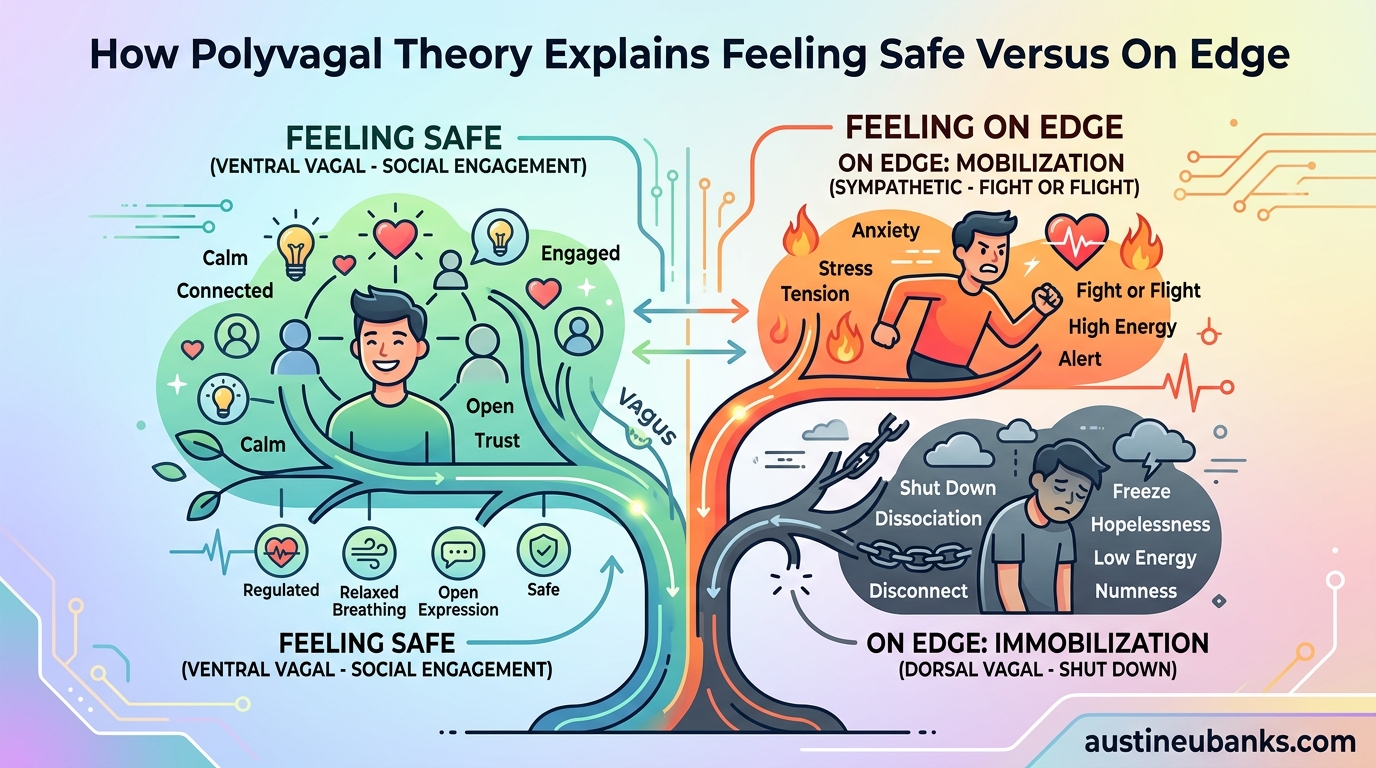
Polyvagal Theory explains how the autonomic nervous system regulates your internal state in response to safety and threat, shifting between feeling calm and connected versus anxious and on edge. Developed by neuroscientist Stephen Porges in 1994, this framework describes three distinct nervous system states that control whether you feel safe, mobilized, or shut down.
If you have ever wondered why you feel perfectly calm in one moment and suddenly on edge the next, even when nothing obvious has changed, this theory offers a compelling explanation. Your nervous system is constantly scanning your environment for cues of danger or safety, a process called neuroception, and responding automatically based on what it finds.
For anyone dealing with chronic anxiety, trauma responses, or that persistent feeling of being unable to relax, understanding polyvagal theory can be genuinely transformative. It reframes those experiences not as personal failings but as your nervous system doing exactly what it evolved to do. In this guide, our team breaks down how polyvagal theory explains feeling safe versus on edge, what the three nervous system states look like in daily life, and practical steps you can take to shift your system toward calm.
Table of Contents
What Is Polyvagal Theory?
Polyvagal Theory is a scientific framework developed by Dr. Stephen Porges that describes how the autonomic nervous system regulates our physiological state in response to safety and danger. The word “poly” means “many,” and “vagal” refers to the vagus nerve, the longest cranial nerve in your body. The theory gets its name because Porges identified that the vagus nerve actually has multiple branches that serve different functions.
Before this theory emerged, the dominant model of the autonomic nervous system was relatively simple. It described a two-part system: the sympathetic branch (fight or flight) and the parasympathetic branch (rest and digest). That model could not fully explain certain responses, particularly why people sometimes freeze or shut down instead of fighting or running.
Porges proposed a more nuanced view based on evolutionary biology. He suggested that the autonomic nervous system actually has three distinct branches, not two, and that these branches operate in a specific hierarchy. Each branch corresponds to a different evolutionary stage of nervous system development, from the most ancient (found in reptile) to the most recent (unique to mammals).
This matters because it changes how we understand stress responses. Under the old model, if someone froze during a threatening situation, that response was poorly understood. Polyvagal Theory explains that freeze and shutdown are not failures of the fight-or-flight system but rather a completely separate, evolutionarily older survival response. This reframing has had major implications for trauma therapy, anxiety treatment, and how we understand emotional regulation.
The theory has gained significant traction in therapeutic circles since the mid-1990s. Clinicians working with trauma, anxiety, and stress-related disorders use it to help clients understand their own nervous system patterns and develop strategies for regulation.
The Three Nervous System States Explained
At the heart of polyvagal theory are three distinct autonomic states. Each state produces a specific set of physiological changes, emotional experiences, and behavioral patterns. Understanding these three states is the key to understanding why you feel safe in some situations and on edge in others.
Ventral Vagal: Safe and Social
The ventral vagal complex is the most evolutionarily recent branch of your autonomic nervous system. It is unique to mammals and is associated with feelings of safety, social connection, and engagement with the world. When you are in this state, your body supports health, growth, and restoration.
In the ventral vagal state, your heart rate is calm and steady. Your breathing is slow and regular. The muscles in your face are relaxed and expressive, allowing you to smile, make eye contact, and modulate the tone of your voice. This is the state where you feel most like yourself, most connected to others, and most able to handle life’s challenges with clarity.
When you are in ventral vagal, you can listen to others without feeling defensive. You can think creatively and solve problems effectively. You feel present in your body rather than disconnected. Your digestion works well, your immune system functions properly, and your body can focus on repair and maintenance.
Here is what the ventral vagal state feels like in daily life: you are sitting with a trusted friend, having a meaningful conversation, and you feel completely at ease. Or you are doing work you enjoy and feel focused but not stressed. Or you are walking in nature and notice a sense of peace and connection to your surroundings.
Sympathetic: Fight or Flight
The sympathetic nervous system is the mobilization system. When your nervous system detects a threat, it activates this branch to prepare your body for action. This is the state most people associate with feeling “on edge.”
In sympathetic activation, your heart rate increases and your breathing becomes faster and shallower. Blood flows away from your digestive system and toward your large muscle groups, preparing you to fight or run. Your pupils dilate, your mouth goes dry, and your muscles tense up. Adrenaline and cortisol flood your system.
Emotionally, the sympathetic state feels like anxiety, irritability, hypervigilance, or anger. You might notice yourself being easily startled, snapping at people, or feeling unable to sit still. Your thoughts race, and it becomes hard to focus on anything other than the perceived threat. Problem-solving becomes narrow and reactive rather than creative.
This state is not inherently bad. It evolved to keep you alive in genuinely dangerous situations, and it does that job exceptionally well. The problem arises when your nervous system gets stuck in sympathetic activation, keeping you on edge even when there is no actual threat present. Many people with chronic anxiety live in this state for extended periods without realizing it.
In daily life, the sympathetic state shows up as that keyed-up feeling before a big presentation, the jolt of alarm when a car cuts you off in traffic, or the ongoing low-level tension of a stressful work environment. It feels like you are bracing for impact, even when nothing is wrong.
Dorsal Vagal: Shutdown and Freeze
The dorsal vagal complex is the oldest branch of the autonomic nervous system in evolutionary terms. It is shared with reptiles and other ancient species. When activated strongly, it produces what we commonly call the freeze or shutdown response.
If the ventral vagal state is your highest-level response and sympathetic is your backup, the dorsal vagal response is the last resort. Your nervous system goes here when it determines that neither fighting nor running is possible. It is essentially a survival mechanism for situations perceived as inescapable.
In the dorsal vagal state, your heart rate drops significantly. Your breathing becomes very shallow. You might feel numb, disconnected, or spaced out. Many people describe this state as feeling like they are watching themselves from outside their body. Energy drops dramatically, and even basic tasks feel overwhelming.
Emotionally, the dorsal vagal state feels like depression, hopelessness, emptiness, or emotional flatness. You might feel like you are moving through molasses, or like you have shut down entirely. Motivation disappears, and the world feels distant and meaningless.
In daily life, this state shows up when you feel so overwhelmed that you just disconnect. Maybe you are scrolling your phone for hours without actually absorbing anything. Maybe you are lying in bed unable to get up, not because you are tired, but because your system has essentially powered down. People who have experienced trauma often describe “checking out” during stressful situations, which is the dorsal vagal response in action.
Neuroception: How Your Nervous System Detects Safety
Neuroception is the term Porges coined to describe your nervous system’s automatic, subconscious scanning for cues of safety or danger. This is different from perception, which involves conscious awareness. Neuroception happens entirely below the level of conscious thought.
Your nervous system is constantly evaluating your environment through neuroception. It takes in information from your face, your voice, your internal organs, and your surroundings. Based on these inputs, it determines whether you are safe or in danger, and it shifts your autonomic state accordingly.
This process happens incredibly fast, often before you even register what triggered the shift. Have you ever walked into a room and instantly felt uncomfortable without knowing why? That is neuroception at work. Your nervous system picked up on something, a tone of voice, a facial expression, a subtle change in atmosphere, and responded before your conscious mind could catch up.
Neuroception can also work in the positive direction. When you are around someone with a warm, calm presence, your nervous system picks up on those cues and moves toward the ventral vagal state. This is why certain people make you feel relaxed just by being around them. Their cues of safety literally help regulate your nervous system.
The challenge for many people is that their neuroception has become overly sensitive to threat. This is particularly common after trauma or chronic stress. The nervous system learns to detect danger everywhere, even in situations that are actually safe. This hypervigilant neuroception keeps people stuck in sympathetic or dorsal vagal states, making it hard to relax even when there is no objective reason to feel threatened.
Understanding neuroception helps explain why you cannot simply think your way out of anxiety. If your nervous system has detected a threat, no amount of logical self-talk will convince it otherwise. The threat response is happening at a physiological level, below conscious awareness. This is why body-based approaches, rather than purely cognitive ones, are often more effective for nervous system regulation.
The Vagal Brake: Your Built-In Calming System
The vagal brake is one of the most practical concepts in polyvagal theory. It refers to the influence that the myelinated (well-insulated) fibers of the vagus nerve exert on your heart, specifically through the sinoatrial node, which is your heart’s natural pacemaker.
Think of the vagal brake like the brakes on a bicycle. When you are pedaling hard (sympathetic activation), the vagal brake can slow you down, bringing your heart rate back to a calm baseline. When the brake is working well, you can respond to a stressor and then quickly return to a regulated state afterward.
When the vagal brake is strong, you can handle stressful situations without getting stuck in fight or flight. Something stressful happens, your heart rate goes up, and then your vagal brake kicks in and brings everything back down. You feel resilient and able to recover quickly from challenges.
When the vagal brake is weak, the opposite happens. Your heart rate stays elevated after a stressor, and you stay in sympathetic activation longer than necessary. Small stressors feel overwhelming because your system cannot effectively calm itself down. This is a key reason why some people feel chronically on edge.
The good news is that vagal tone, which is the strength of your vagal brake, can be improved. Specific breathing exercises, social connection, humming, singing, and other practices that stimulate the vagus nerve can strengthen this system over time. We cover some of these exercises later in this article.
Co-Regulation: Why Other People Help You Feel Safe
Co-regulation is the process by which one nervous system helps calm and regulate another. It is a fundamental mammalian need, and polyvagal theory places it at the center of how we achieve and maintain the ventral vagal state.
As mammals, we are biologically wired to regulate our nervous systems through connection with others. This is why a hug from someone you trust can lower your anxiety. It is why a calm, steady voice on the phone can help you settle down when you are panicked. Your nervous system is responding to their cues of safety and using them to shift your own state.
The social engagement system, which Porges describes as the mechanism behind co-regulation, involves specific neural pathways that control the muscles of your face, your middle ear, your larynx, and your pharynx. These are the tools you use to communicate safety to others through facial expressions, vocal tone, and head movements.
When someone smiles genuinely at you, makes soft eye contact, and speaks in a warm, melodic voice, your nervous system picks up those cues and moves toward safety. Conversely, when someone has a flat expression, avoids eye contact, or speaks in a harsh monotone, your nervous system may interpret those as cues of danger.
This explains why isolation and loneliness are so physically and emotionally taxing. Without access to co-regulation, your nervous system has to work much harder to maintain a regulated state on its own. Prolonged isolation can keep the nervous system in a defensive state, contributing to anxiety, depression, and chronic stress.
It also explains why therapy can be so effective. A skilled therapist provides consistent, reliable cues of safety through their presence, tone, and attention. Over time, this co-regulation helps the client’s nervous system learn new patterns of regulation.
How Polyvagal Theory Explains Feeling Safe Versus On Edge
This is where polyvagal theory becomes most personally relevant. The experience of feeling safe versus feeling on edge is not just a mood or a mindset. It is a physiological state, driven by which branch of your autonomic nervous system is currently dominant.
When you feel safe, your ventral vagal system is in charge. Your body is calm, your mind is clear, and you can engage with the world openly. You feel connected to others, capable of handling challenges, and present in the moment. Your physiology supports health, digestion, and immune function.
When you feel on edge, your sympathetic nervous system has taken over. Your body is primed for action, your mind is scanning for threats, and your whole system is bracing for something bad to happen. Even if nothing is wrong, you cannot fully relax. Your muscles are tense, your thoughts are racing, and you feel reactive and guarded.
Here are some clear signs that you are in the ventral vagal (safe) state:
- You feel calm and present in your body
- You can make eye contact and feel connected to others
- Your breathing is slow and regular
- You can think clearly and solve problems
- You feel curious and open to new experiences
- Your digestion and sleep are functioning well
And here are signs that you are stuck in sympathetic (on edge) activation:
- You feel tense, jittery, or unable to relax
- You startle easily at small noises or movements
- Your mind races and you cannot turn off your thoughts
- You feel irritable, short-tempered, or on guard
- Your sleep is disrupted, especially falling asleep
- You experience digestive issues, headaches, or muscle tension
The shift between these states can happen rapidly and often without warning. You might be having a perfectly calm morning and then receive a stressful email that flips you into sympathetic activation within seconds. Or you might walk into a familiar place that somehow triggers a threat response, and suddenly you feel on edge without understanding why.
For people who feel chronically on edge, the issue is often that their nervous system has gotten stuck in sympathetic activation. Their neuroception has become biased toward detecting threat, so even neutral or safe situations feel dangerous. This is not a character flaw or a willpower problem. It is a physiological pattern that can be changed with the right approaches.
The goal is not to eliminate the sympathetic response entirely. You need it for genuine emergencies. The goal is flexibility: the ability to move into sympathetic activation when needed and then return to ventral vagal calm once the threat has passed. This flexibility is what nervous system regulation is all about.
Practical Ways to Shift Your Nervous System State
Understanding the theory is valuable, but the real power comes from applying it. Here are practical, research-informed exercises you can use to help your nervous system shift toward the ventral vagal state and strengthen your vagal brake over time.
1. Slow, Extended Exhalation Breathing
Your breathing is one of the most direct pathways to your autonomic nervous system. When you exhale slowly, you directly stimulate the vagus nerve, which activates the vagal brake and brings your heart rate down.
Try this exercise: inhale through your nose for a count of four, then exhale slowly through pursed lips for a count of six to eight. The key is making the exhale longer than the inhale. Do this for two to five minutes, and notice how your body responds. Research on breathing and vagal tone consistently shows that extended exhalation is one of the fastest ways to shift toward the safe state.
2. Vagal Nerve Stimulation Through Voice
The vagus nerve passes through your throat and connects to your vocal cords. You can stimulate it through humming, singing, chanting, or gargling. These activities create vibrations in your throat and chest that directly activate the vagal brake.
Try humming a low, steady note for two minutes. Or sing along to a favorite song. Or chant “om” several times. Many people feel a noticeable shift toward calm after just a few minutes of vocal vibration. This is also why singing in a choir or group can feel so regulating. You get the double benefit of vagal stimulation and co-regulation with others.
3. Social Connection and Co-Regulation
Given what we know about co-regulation, it makes sense that connecting with safe people is one of the most powerful ways to shift your nervous system state. Spend time with someone whose presence feels calming. Make eye contact, have a conversation, and let your nervous system pick up on their cues of safety.
Even a brief, warm interaction with a trusted friend can help. A phone call where you hear a calm, familiar voice. A hug from a partner. These moments of connection give your nervous system the interpersonal cues it needs to move toward the ventral vagal state.
If you do not have access to safe people in the moment, even thinking about someone you trust can help. Visualizing a supportive presence can provide a mild version of the co-regulation effect.
4. Orienting to Your Environment
When your nervous system is in sympathetic activation, your attention narrows to focus on perceived threats. You can counteract this by deliberately broadening your attention to take in your surroundings.
Try this: look around the room you are in. Name three objects you can see, focusing on their colors and shapes. Let your eyes move slowly and take in the full space. This orienting behavior tells your nervous system that you are in a safe environment, which can help reduce the threat response.
This exercise is particularly useful when you feel on edge for no obvious reason. It interrupts the tunnel vision of sympathetic activation and reminds your nervous system that your current environment is not actually dangerous.
5. Body-Based Regulation Practices
Because polyvagal states are physiological, body-based approaches can be especially effective. Gentle movement like walking, stretching, or yoga can help discharge sympathetic energy and bring your system back into balance.
Weighted blankets, gentle self-massage, or placing a hand on your chest can provide comforting sensory input that supports the ventral vagal state. Some people find that warm baths, weighted eye masks, or slow rocking movements help them settle.
The key is experimentation. Different approaches work for different nervous systems. Pay attention to what actually helps you feel calmer, and build a personal toolkit of regulation strategies.
Signs You May Be Stuck in a Defensive State
One of the most valuable applications of polyvagal theory is recognizing when your nervous system has gotten stuck in a defensive state. Here are key signs to watch for.
If you are stuck in sympathetic activation, you may notice chronic muscle tension, especially in your jaw, shoulders, or neck. You may have difficulty falling asleep because your mind will not stop racing. You might feel reactive, easily angered, or constantly on guard. Digestive issues like acid reflux or irritable bowel symptoms are common. You may find it impossible to truly relax, even during leisure time.
If you are stuck in dorsal vagal shutdown, the signs look different. You may feel chronically fatigued, even after sleeping. Motivation feels impossible to access. You might dissociate, space out, or lose track of time frequently. Emotional numbness or a sense of going through the motions without feeling engaged is common. You may isolate yourself from others because social interaction feels like too much effort.
Both of these patterns are your nervous system’s attempt to protect you. They are not signs of weakness or brokenness. However, if you find yourself stuck in either state for extended periods, and especially if it is affecting your daily functioning, relationships, or quality of life, it may be time to seek professional support. A therapist trained in somatic therapy, EMDR, or other body-based approaches can help you work with your nervous system to develop greater flexibility and regulation.
Is Polyvagal Theory Scientifically Valid?
This is an important question, and one that comes up frequently in discussions about polyvagal theory. The short answer is that the theory has both strong support and legitimate scientific criticism, and an honest discussion requires acknowledging both sides.
On the supportive side, many of the theory’s core observations are well-documented. The vagus nerve does have multiple branches with different functions. The three-state model (social engagement, mobilization, and shutdown) is consistent with what clinicians observe in practice. Many therapists report that polyvagal theory helps their clients understand their experiences in ways that reduce shame and increase self-compassion.
On the critical side, some researchers have questioned specific claims of the theory, particularly regarding the evolutionary narrative and some of the physiological mechanisms. Critics have pointed out that certain aspects of the theory are difficult to test empirically and that some of Porges’s specific interpretations of the evolutionary data are debated among neuroscientists.
The balanced view is this: polyvagal theory may not be perfect in every detail, but it has provided an enormously useful framework for understanding nervous system regulation. Its clinical utility is widely acknowledged, even by those who have questions about specific mechanisms. If you find the framework helpful for understanding your own experiences and improving your regulation, that practical value is real, regardless of where the scientific debate ultimately lands.
FAQs
How do you feel safe in Polyvagal Theory?
In polyvagal theory, feeling safe means activating the ventral vagal state, which is achieved through cues of safety including warm social connection, soft eye contact, calm vocal tone, slow breathing with extended exhalations, and environments that feel familiar and non-threatening. Your nervous system shifts into this state automatically when it receives enough safety cues through neuroception.
Why has the polyvagal theory been debunked?
Polyvagal theory has not been fully debunked, but it faces legitimate scientific criticism. Some researchers question specific claims about evolutionary mechanisms and certain physiological details. However, many clinicians find the framework practically useful for helping clients understand nervous system regulation, and core observations about vagal nerve function and autonomic states are well-documented. The theory remains a topic of active scientific discussion.
What is the contribution of Polyvagal Theory to the biology of safety and danger?
Polyvagal Theory contributes the concept that safety and danger are not just psychological experiences but physiological states driven by specific autonomic nervous system circuits. It introduced neuroception (subconscious detection of safety or threat), described three distinct nervous system states rather than two, and highlighted the role of the vagus nerve and social connection in regulating our sense of safety.
How to trick your nervous system into feeling safe?
You can help your nervous system shift toward safety through slow breathing with extended exhalations, humming or singing to stimulate the vagus nerve, spending time with people whose presence feels calming, orienting to your surroundings by looking around the room, and using body-based practices like gentle movement or weighted blankets. These approaches provide physical cues of safety that encourage the ventral vagal state.
What are the three states of the nervous system in polyvagal theory?
The three states are ventral vagal (safe and social, where you feel calm, connected, and engaged), sympathetic (fight or flight, where you feel anxious, on edge, and mobilized for action), and dorsal vagal (shutdown and freeze, where you feel numb, disconnected, and overwhelmed). These states form a hierarchy, with your nervous system moving through them based on perceived safety or threat.
Can polyvagal theory help with anxiety?
Yes, many people find polyvagal theory helpful for understanding and managing anxiety. It reframes anxiety as a sympathetic nervous system response rather than a personal failing, which reduces shame. Practical applications like extended exhalation breathing, vagal nerve stimulation through humming or singing, social connection, and body-based regulation exercises can help shift the nervous system from anxious activation toward the calmer ventral vagal state.
Conclusion
Understanding how polyvagal theory explains feeling safe versus on edge gives you a powerful lens for making sense of your own experience. Your nervous system is not malfunctioning when you feel anxious or shut down. It is doing what it evolved to do, responding to perceived threats in the only ways it knows how.
The three states, ventral vagal, sympathetic, and dorsal vagal, are not good or bad. They are all adaptive responses designed to keep you safe under different circumstances. The goal is not to live permanently in any one state but to develop the flexibility to move between them as circumstances require, and to return to the ventral vagal state of calm and connection when the threat has passed.
If you find yourself chronically on edge, start with small, practical steps. Try extended exhalation breathing for a few minutes each day. Spend time with people who help you feel calm. Use your voice through humming or singing. Pay attention to what helps your body settle, and build from there. These are not instant fixes, but over time, they can help strengthen your vagal brake and give your nervous system more options.
If you are struggling with persistent anxiety, trauma responses, or feeling stuck in a defensive state, consider working with a therapist who understands polyvagal theory and body-based approaches. Professional support can make a significant difference in developing greater nervous system flexibility and regulation. The way your nervous system responds to the world is not your fault, but with understanding and practice, you can learn to work with it rather than against it.