
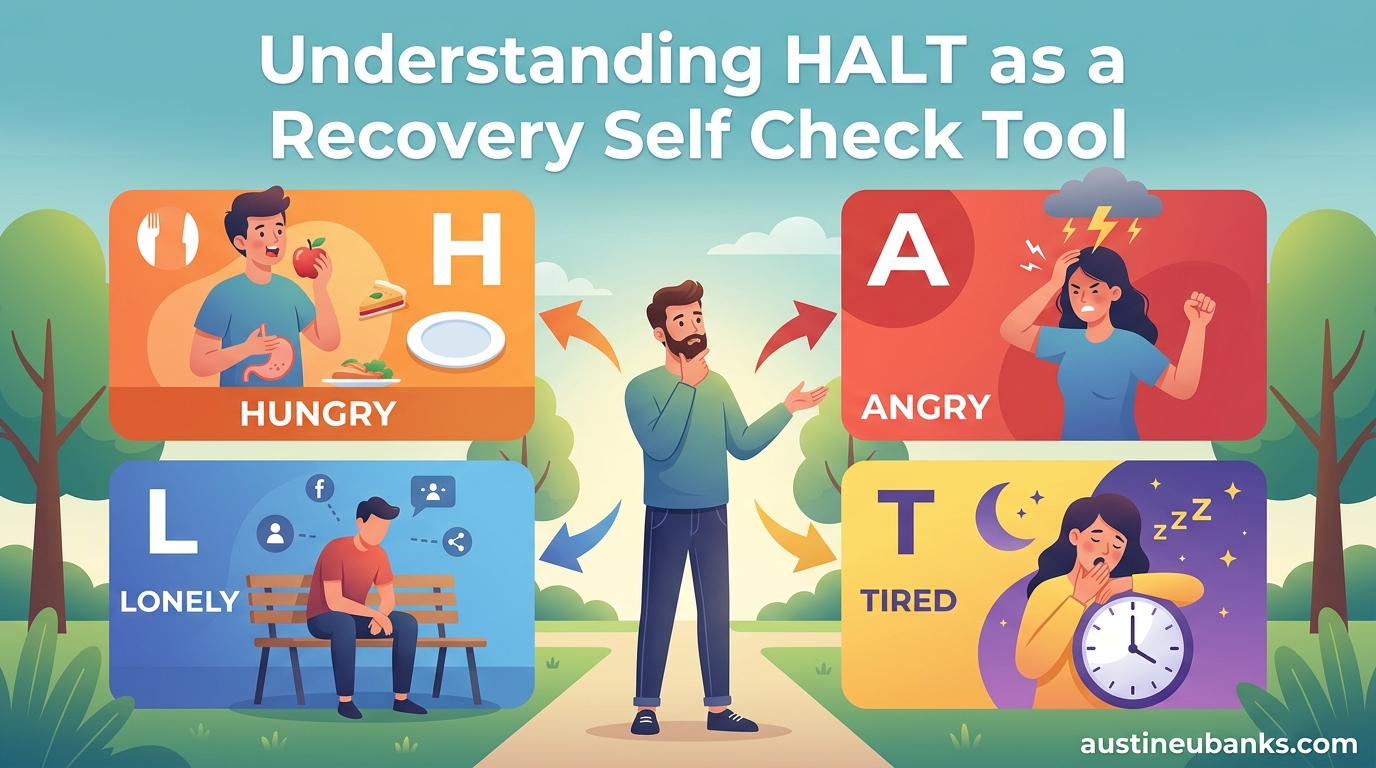
HALT is an acronym that stands for Hungry, Angry, Lonely, and Tired. It is one of the most widely used self-assessment tools in addiction recovery and mental health care. When I first encountered the HALT method, I was skeptical that four simple words could make a real difference. After watching countless people in recovery use it as a daily checkpoint, I understand why it has endured for decades.
The concept is straightforward. Before you react to a craving, make an impulsive decision, or spiral into emotional distress, you stop and ask yourself whether you are hungry, angry, lonely, or tired. These four states create what recovery professionals call windows of vulnerability. They are moments when your coping skills feel weaker and your cravings feel stronger.
In this guide, I will walk you through everything you need to know about HALT as a recovery self-check tool. You will learn what each letter means, where the method came from, how to use it step by step, and what to do when basic self-checks are not enough. I will also address the real questions people ask in recovery forums, because the textbook version of HALT rarely covers the messy reality of actually using it.
Table of Contents
What Does HALT Stand For?
HALT stands for Hungry, Angry, Lonely, and Tired. Each word represents a fundamental physical or emotional state that, when left unaddressed, undermines your ability to make sound decisions and resist cravings. The beauty of the HALT acronym is its simplicity. You do not need special training, a worksheet, or an app to use it. You just need to remember four words and the willingness to pause.
H – Hungry
Hunger in the HALT framework is not just about wanting a snack. It refers to genuine physical deprivation, especially low blood sugar, which directly affects mood regulation, impulse control, and decision-making capacity. When your body lacks adequate nutrition, your brain struggles to maintain the executive function needed to resist cravings.
Research has shown that blood sugar fluctuations can mimic anxiety symptoms, increase irritability, and weaken self-control. For someone in recovery, this matters enormously. A skipped meal can feel like an emotional crisis if you do not recognize that hunger is driving the distress.
A – Angry
The A in HALT stands for Angry, but it encompasses the full spectrum of anger-related emotions: frustration, resentment, irritation, and even suppressed rage. Anger is one of the most common relapse triggers because it floods the body with stress hormones like cortisol and adrenaline, which impair rational thinking.
Anger also tends to build over time. You might wake up mildly annoyed, ignore it, and by afternoon find yourself in a full emotional spiral. The HALT method encourages you to catch anger early, before it grows into something that feels unmanageable.
L – Lonely
Loneliness in HALT refers to the feeling of disconnection from others, not simply being alone. As people in recovery forums frequently point out, you can be surrounded by people and still feel profoundly lonely. You can also be alone and feel perfectly content. The distinction matters.
Loneliness is often described by people in recovery as the hardest HALT state to address. Unlike hunger or tiredness, you cannot always fix loneliness with a quick action. It requires reaching out to someone when you least feel like it, which is exactly when you need connection the most.
T – Tired
Tiredness covers both physical exhaustion and mental fatigue. Sleep deprivation is one of the most significant predictors of relapse because it degrades nearly every cognitive function you rely on in recovery: emotional regulation, impulse control, decision-making, and stress tolerance.
Several Reddit users in recovery communities have noted that being tired is their biggest trigger, often setting off a cascade of other HALT states. When you are exhausted, you become more irritable, less social, and more likely to skip meals. Tiredness is the HALT state that compounds all the others.
The Origins of HALT in Recovery
HALT originated within Alcoholics Anonymous (AA) as a practical tool for members to monitor their vulnerability between meetings. The exact origin is difficult to trace, as AA’s culture has always been rooted in shared wisdom passed through sponsorship and group discussion rather than formal publications. What is clear is that HALT emerged from the lived experience of people in recovery who noticed that relapse rarely happened randomly. It followed patterns.
AA’s broader philosophy emphasizes the importance of rigorous self-honesty and daily self-inventory. HALT fits naturally into this framework as a quick, repeatable check-in that anyone can perform at any time. Sponsors began teaching it to their sponsees, and it spread organically through the recovery community.
Over time, HALT expanded far beyond AA. Today it is used in treatment centers, intensive outpatient programs, dual diagnosis care, and mental health counseling. Therapists incorporate it into cognitive behavioral therapy sessions. Support groups of all types reference it. The reason for its spread is simple: it works, and it is free.
It is worth noting that HALT is not an official AA doctrine written in the Big Book. It is a community-generated tool that aligns with AA principles. This distinction matters because some people wonder whether HALT is tied exclusively to the twelve-step model. It is not. You do not need to be in AA, attend meetings, or work the steps to benefit from the HALT method.
How HALT Works as a Self-Check Tool
HALT works by creating a deliberate pause between a triggering event and your response. In recovery, that pause can be the difference between acting on a craving and riding it out. The tool operates on a simple principle: unmet basic needs create emotional and physical vulnerability, and addressing those needs restores your capacity to cope.
Think of HALT as a diagnostic check, similar to checking your car’s dashboard before a long drive. You are scanning for warning lights. If hunger is flashing, you eat. If tiredness is glowing red, you rest. If anger is climbing, you use a coping skill. If loneliness is blinking, you reach out to someone.
Step-by-Step HALT Check-In Process
Here is the process I recommend, based on what people in recovery actually do rather than what textbooks suggest:
Step 1: Notice the urge. The moment you feel a craving, an emotional spike, or an impulse to do something you might regret, stop. Do not act yet. Just notice what is happening.
Step 2: Say the word HALT. Saying it out loud or in your mind creates a literal pause. The word itself is an instruction: halt means stop.
Step 3: Check each letter. Go through Hungry, Angry, Lonely, Tired one at a time. Ask yourself honestly: Am I hungry? Am I angry about something? Do I feel disconnected or alone? Am I exhausted?
Step 4: Address what you find. If you are hungry, eat something nutritious. If you are angry, try deep breathing, journaling, or physical movement. If you are lonely, text or call someone in your support network. If you are tired, rest if possible or acknowledge the deficit and lower your expectations for the day.
Step 5: Reassess. After addressing the identified state, check in with yourself again. Has the craving or emotional intensity decreased? If yes, you have successfully used HALT. If not, move to the next layer of your coping toolkit.
How Often Should You Do HALT Check-Ins?
This is one of the most common questions in recovery forums, and the answer depends on where you are in your journey. In early recovery, I recommend scheduled check-ins three times a day: morning, afternoon, and evening. Set phone reminders if needed. Early recovery is when you are most vulnerable, and building the habit of checking in regularly trains your brain to notice states before they escalate.
In long-term recovery, many people shift to using HALT reactively, meaning they run through it when they notice a shift in mood or an increase in cravings. Some continue daily check-ins as part of their routine because it reinforces self-awareness. There is no wrong answer here as long as the tool is part of your regular practice.
Understanding HALT: A Deep Dive Into Each State
The basic definitions are a starting point, but real recovery requires deeper understanding of how each HALT state manifests, why it is dangerous, and what to do about it. Let me break down each one in practical detail.
Hungry: More Than Just an Empty Stomach
Physical hunger affects your body in measurable ways. When blood sugar drops, your brain releases stress hormones to signal that something is wrong. This triggers irritability, difficulty concentrating, and in some cases, symptoms that mimic anxiety or panic. For someone in recovery, these sensations can feel indistinguishable from cravings or emotional distress.
The confusion between physical hunger and psychological cravings is one of the most discussed topics in recovery forums. Many people report that what felt like an overwhelming craving turned out to be hunger that resolved after eating a real meal. Food does not cure addiction, but it addresses a physiological need that, when unmet, makes everything harder.
Practical strategies for the Hungry state:
Keep nutritious, easy-to-prepare snacks accessible at all times. Nuts, protein bars, fruit, and yogurt require no preparation and stabilize blood sugar quickly. Eat regular meals rather than waiting until hunger becomes urgent. If you struggle with remembering to eat, set meal reminders. If you are unsure whether you are hungry or craving, try eating a small nutritious snack first. If the craving persists after eating, it was not hunger. If it fades, you have addressed the root cause.
Avoid using sugar as a quick fix. It causes a rapid blood sugar spike followed by a crash, which can leave you feeling worse and trigger the cycle again. Protein and complex carbohydrates provide steadier energy and better emotional regulation.
Angry: The Emotion That Hijacks Judgment
Anger is a normal human emotion, but in recovery it carries particular risks. When anger spikes, your body enters fight-or-flight mode. Stress hormones flood your system, your heart rate increases, and your prefrontal cortex, the part of your brain responsible for rational decision-making, becomes less active. In this state, you are biologically primed to act first and think later.
Anger in recovery often stems from unresolved issues: guilt about the past, frustration with the pace of healing, resentment toward people who do not understand what you are going through. Left unaddressed, anger simmers beneath the surface and erupts at unexpected moments.
Practical strategies for the Angry state:
Acknowledge the anger without judgment. Saying to yourself, I am angry, and that is okay, prevents the secondary emotion of guilt from compounding the situation. Use deep breathing to counteract the physiological stress response. Four seconds in, hold for four, exhale for six. This activates the parasympathetic nervous system and begins to calm the body.
Physical movement helps discharge the stress hormones that accompany anger. A brisk walk, a workout, or even a few minutes of stretching can shift your physiological state. Journaling about what triggered the anger can help you process it rather than suppress it. If the anger is directed at a specific person, consider writing a letter you do not send. This allows you to express the emotion without creating new problems.
If anger feels constant, explosive, or disproportionate to the situation, that is a signal to seek professional support. Chronic anger can indicate underlying trauma, and a therapist can help you address root causes rather than just managing symptoms.
Lonely: The Hardest State to Address
Loneliness is widely considered the most difficult HALT state to resolve, and for good reason. Hunger can be fixed with food. Tiredness can be addressed with rest. Anger can be processed through coping skills. Loneliness requires something harder: vulnerability and connection with another human being.
In recovery forums, users frequently describe loneliness as a paradox. You feel disconnected and do not want to reach out, but the only way out of loneliness is to reach out. This is particularly challenging for people in early recovery who may have damaged relationships or lost their social networks along with their addiction.
Practical strategies for the Lonely state:
Build a list of people you can contact before you need them. When loneliness hits, your brain will tell you that no one cares and reaching out is pointless. Having a pre-made list removes the decision-making burden in the moment. Include friends, family members, sponsors, support group contacts, and crisis line numbers.
Attend a support group meeting, even if you do not feel like talking. Simply being in a room with people who understand your experience can reduce the sense of isolation. Online meetings are available around the clock if in-person meetings are not accessible.
Distinguish between being alone and being lonely. Time alone can be restorative if you engage in activities that nourish you: reading, creating art, exercising, or spending time in nature. Loneliness is the feeling of disconnection, and sometimes addressing it means reframing your relationship with solitude while also building meaningful connections over time.
If loneliness is chronic and persistent, consider working with a therapist. Sometimes what feels like loneliness is actually a deeper issue around attachment, self-worth, or unresolved grief.
Tired: The Trigger That Cascades
Tiredness is the HALT state that amplifies all the others. When you are exhausted, your emotional regulation suffers, your patience shrinks, your social battery depletes, and your motivation to eat well or exercise disappears. Many people in recovery report that being tired is the first domino in a chain that leads to other vulnerable states.
Sleep deprivation has well-documented effects on cognitive function. Studies show that even one night of poor sleep reduces activity in the prefrontal cortex, the brain region responsible for impulse control and decision-making. For someone in recovery, this means that exhaustion directly weakens the mental muscles you rely on to resist cravings.
Practical strategies for the Tired state:
Prioritize sleep hygiene as a non-negotiable part of your recovery plan. This means consistent sleep and wake times, a dark and cool sleeping environment, and avoiding screens for at least thirty minutes before bed. If sleep problems persist for more than a few weeks, talk to a doctor. Sleep disorders are common in recovery and treatable.
When you cannot get adequate sleep, adjust your expectations. Recognize that you are operating at reduced capacity and lower the demands you place on yourself. Avoid making major decisions when tired. Use caffeine in moderation, as excessive caffeine can worsen anxiety and disrupt nighttime sleep further.
Take short rest breaks during the day. Even ten minutes of lying down with your eyes closed can help. If your schedule allows, a twenty-minute nap in the early afternoon can restore cognitive function without interfering with nighttime sleep.
When HALT States Overlap: What to Do When Multiple Hit at Once
One of the most common frustrations people share in recovery forums is that HALT states rarely arrive one at a time. You come home from a long day at work, exhausted and irritated, and you have not eaten since noon. You are tired, angry, and hungry simultaneously. The standard advice to address one state feels insufficient when multiple needs are competing.
This is where many recovery guides fall short, so let me address it directly. When multiple HALT states overlap, they compound each other. Exhaustion makes anger harder to control. Hunger amplifies irritability. Loneliness feels unbearable when you are also tired. The combined effect is greater than any single state alone.
Here is a practical decision framework for when HALT states overlap:
1. Address hunger first. If hunger is one of the active states, eat something before anything else. Food is the fastest need to address, and resolving it often reduces the intensity of other states. Many recovery forum users confirm that eating something nutritious when hungry improves energy levels and emotional regulation, making other states easier to manage.
2. Address tiredness second. If you can rest, do so. Even a brief rest period reduces the cognitive load that feeds anger and deepens loneliness. If you cannot rest, acknowledge the deficit and commit to getting proper sleep at the next opportunity.
3. Process anger third. Once your body’s basic needs are partially met, anger becomes more manageable. Use deep breathing, journaling, or physical movement to discharge the emotional energy. Trying to process anger while hungry or exhausted rarely works well.
4. Address loneliness last. Connection requires emotional energy that you will not have if other states are active. Once you have eaten, rested, and processed your anger, reaching out to someone becomes more feasible. This is also why building a support network in advance matters so much. When the moment comes, the path to connection is already established.
This priority order is not rigid. If you are in immediate crisis, calling someone comes first regardless of other states. But for the common scenario of overlapping HALT states in everyday recovery, this framework gives you a logical sequence to follow.
HALT Beyond Addiction: Mental Health and General Self-Care
HALT was created for addiction recovery, but its usefulness extends far beyond substance use disorders. I have seen people apply it to anxiety management, depression support, stress reduction, and general emotional wellness. The reason it transfers so well is that the four HALT states are universal human vulnerabilities. Everyone gets hungry, angry, lonely, and tired. These states affect mental health regardless of whether someone has an addiction history.
HALT for Anxiety
Anxiety thrives on physiological dysregulation. Hunger and tiredness both amplify anxiety symptoms by increasing cortisol levels and reducing cognitive resources. Anger and anxiety share similar physiological pathways, and unresolved anger often manifests as free-floating anxiety. Loneliness can create a sense of unsafety that feeds anxious thinking.
Using HALT for anxiety means treating these states as anxiety triggers rather than relapse triggers. When anxiety spikes, run through the HALT checklist. You may discover that your anxiety is significantly worsened by skipped meals or poor sleep, and addressing those factors provides real relief.
HALT for Depression
Depression often disrupts the exact systems HALT addresses. It suppresses appetite, disrupts sleep, increases isolation, and generates anger or irritability. Using HALT as a self-check tool for depression means gently tracking whether you are meeting basic needs despite the depression’s pull to neglect them.
This is not a substitute for professional treatment. Depression is a clinical condition that often requires therapy, medication, or both. But HALT can serve as a daily maintenance tool that complements treatment by ensuring basic needs do not go unmet during depressive episodes.
HALT for Stress Management
Anyone dealing with high stress can benefit from HALT check-ins. Chronic stress often causes people to skip meals, suppress emotions, withdraw socially, and sacrifice sleep. These behaviors create a vicious cycle where stress leads to neglected needs, which in turn increases stress. HALT interrupts this cycle by prompting regular self-assessment.
Building Your Personal HALT Checklist
One of the most requested resources in recovery communities is a HALT worksheet or printable checklist. Forum users repeatedly ask for structured tools that go beyond simply remembering the acronym. Building a personal HALT checklist makes the tool concrete and actionable rather than abstract.
Here is how to create your own HALT checklist:
Section 1: Warning Signs. For each HALT state, write down your personal warning signs. What does hunger look like for you? Maybe you get a specific type of headache, or your thoughts become racing and scattered. What does your anger feel like before it explodes? The more specific you are, the earlier you can catch each state.
Section 2: Action Steps. For each state, list two or three actions you can take when you identify it. Keep them realistic and immediate. If loneliness is your trigger, list three people you can text right now. If tiredness is the issue, list one place you can rest and one adjustment you can make to your day.
Section 3: Escalation Plan. What happens when addressing the HALT state does not resolve the craving or emotional distress? This is where you list your next-level resources: your therapist’s number, your sponsor, a crisis line, a trusted friend who knows your situation. Having this written in advance means you do not have to figure it out in the moment.
Section 4: Daily Tracking. Keep a simple log of your HALT check-ins. Note the time, which states were active, what you did, and whether it helped. Over time, patterns will emerge. You might discover that you are consistently tired on certain days or that loneliness peaks at specific times. This data helps you address root causes rather than just managing symptoms.
Some people use physical journals for their HALT checklist. Others prefer digital tools. There are recovery apps that include mood tracking, and a simple notes app on your phone works fine. The format matters less than the consistency of use.
When HALT Is Not Enough: Knowing When to Seek Help
HALT is a valuable tool, but it is not a complete recovery program. One of the most honest things I can tell you about HALT is that sometimes it will not be enough. You will run through the checklist, address every identified state, and still feel overwhelmed. That is not a failure of the tool or of you. It is a signal that you need additional support.
Here are signs that HALT alone is not sufficient:
If cravings persist or intensify after addressing all four HALT states, reach out to your support network or sponsor immediately. If you experience HALT states that feel unmanageable for extended periods, such as chronic insomnia lasting weeks or persistent loneliness despite social connection, this may indicate an underlying condition that requires professional attention. If you are having thoughts of self-harm or relapse that feel urgent and overwhelming, call a crisis line or go to an emergency room.
HALT works best as part of a broader toolkit. Combining it with therapy, support groups, medication when prescribed, mindfulness practices, and healthy lifestyle habits creates a more comprehensive recovery foundation. The people I have seen succeed in long-term recovery do not rely on any single tool. They use HALT alongside other strategies, adjusting their approach based on what each situation requires.
It is also important to recognize that HALT addresses symptoms, not root causes. If your anger stems from unresolved trauma, eating a snack will not fix it. If your loneliness is rooted in attachment patterns from childhood, a phone call helps in the moment but does not address the deeper issue. This is why therapy and professional support are so valuable alongside self-check tools like HALT.
FAQs
What is the HALT method for self-care?
The HALT method is a self-assessment tool where you pause and check whether you are Hungry, Angry, Lonely, or Tired before reacting to emotional distress or cravings. It is used in addiction recovery and general mental health self-care to identify unmet basic needs that increase vulnerability to poor decisions.
What does the A stand for in the HALT tool for self-assessment?
The A in HALT stands for Angry. This includes the full range of anger-related emotions such as frustration, irritation, resentment, and suppressed rage. Anger impairs rational thinking by flooding the body with stress hormones, making it one of the most common triggers for relapse and emotional relapse.
What does AA say about HALT?
AA promotes HALT as a practical self-check tool that aligns with its emphasis on daily self-inventory and rigorous honesty. While HALT is not officially written in the AA Big Book, it emerged from the AA community through sponsorship and group sharing. It encourages members to pause and assess whether hunger, anger, loneliness, or tiredness is driving their emotional state before acting on cravings.
What is the HALT checklist?
The HALT checklist is a personal tool where you assess four states (Hungry, Angry, Lonely, Tired), identify your individual warning signs for each, list specific action steps to address them, and track patterns over time. A typical checklist includes warning signs, immediate actions, and an escalation plan for when self-checks are not enough.
How often should I do HALT check-ins?
In early recovery, aim for scheduled check-ins three times a day: morning, afternoon, and evening. In long-term recovery, many people shift to using HALT reactively when they notice mood shifts or cravings. There is no wrong frequency as long as the practice remains consistent and becomes a natural part of your self-awareness routine.
Can HALT help with anxiety and depression?
Yes. HALT addresses four states that directly worsen anxiety and depression. Hunger and tiredness amplify anxiety symptoms through cortisol elevation and cognitive impairment. Anger and anxiety share physiological pathways, and loneliness feeds depressive thinking. HALT is not a replacement for professional treatment but serves as a useful daily maintenance tool that complements therapy and medication.
What if addressing a HALT state does not make the craving go away?
This is common and not a sign of failure. If a craving persists after you have addressed all four HALT states, escalate to the next layer of your recovery toolkit. Call your sponsor, contact a support person, attend a meeting, or use additional coping skills like grounding techniques. HALT is one tool in a larger system, not a complete solution.
Is HALT only for people in addiction recovery?
No. While HALT originated in addiction recovery, the four states it addresses (hunger, anger, loneliness, tiredness) are universal human vulnerabilities. Anyone can use HALT for stress management, emotional regulation, anxiety support, depression maintenance, or general self-care. It is widely used in mental health counseling and behavioral therapy beyond addiction contexts.
Conclusion
Understanding HALT as a recovery self-check tool gives you a simple but powerful framework for monitoring your vulnerability in real time. The four states, Hungry, Angry, Lonely, and Tired, represent the most common triggers for cravings, emotional spirals, and impulsive decisions. By checking them regularly and addressing them proactively, you build a foundation of self-awareness that supports every other aspect of your recovery.
HALT is not a cure-all, and I would never suggest it replaces therapy, medication, support groups, or professional treatment. What it does is give you a portable, always-available tool that you can use in any moment to pause, assess, and respond rather than react. That pause, brief as it is, can change the trajectory of your day and sometimes your entire recovery.
If you are new to HALT, start simple. Memorize the four words. Set reminders to check in three times a day. Track your patterns. Build your personal checklist. And remember that reaching out for help when HALT is not enough is not a failure. It is exactly what the tool is designed to signal. The path forward is not about never struggling. It is about recognizing when you are vulnerable and taking action before the struggle takes control.