
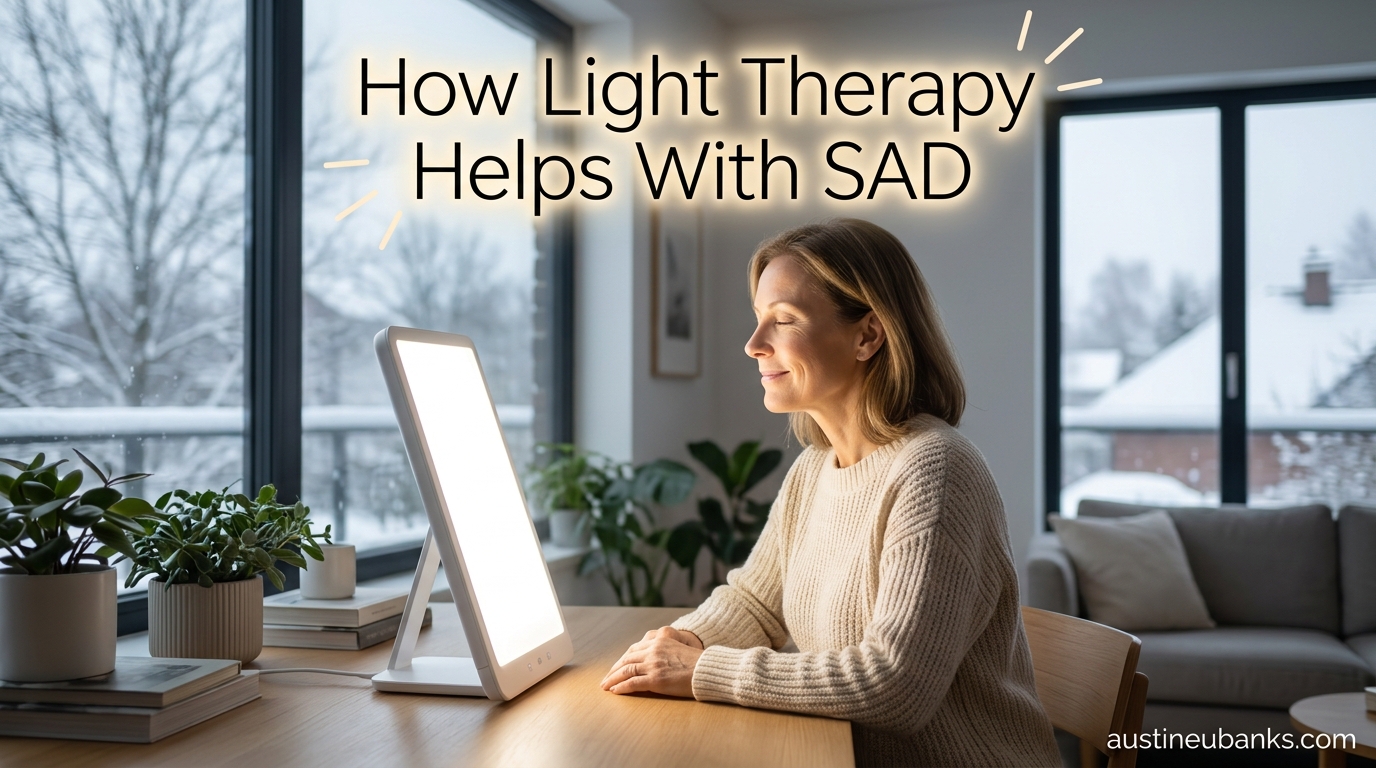
Every year, as the days get shorter and the sunlight fades, millions of people feel the shift. Your energy dips. Your motivation to get out of bed in the morning disappears. You might find yourself craving carbs, sleeping longer, and feeling a persistent low mood that does not lift until spring arrives.
If that sounds familiar, you are not imagining it. You may be experiencing seasonal affective disorder (SAD), a type of depression that follows a seasonal pattern. And one of the most effective, research-backed treatments does not involve medication at all. It involves light.
In this guide, I will explain exactly how light therapy lamps help with seasonal affective disorder. We will cover the science behind why bright light works, how serotonin and melatonin are involved, what 10,000 lux really means, and how to use a SAD lamp correctly for maximum benefit. I will also share real user experiences from people who have tried light therapy, address common safety concerns, and answer the questions people ask most frequently.
Whether you are researching light therapy for the first time or you have tried a lamp before without results, this guide will give you the practical knowledge you need to make it work.
Table of Contents
Quick Answer: How Light Therapy Lamps Help With Seasonal Affective Disorder
Light therapy lamps treat seasonal affective disorder by exposing your eyes to bright, UV-filtered artificial light that mimics natural sunlight. This bright light stimulus signals your brain to regulate serotonin and melatonin production, resetting your circadian rhythm and improving mood, energy, and sleep patterns disrupted by reduced winter daylight.
Here is the quick-reference summary for effective use:
- Intensity: Use a lamp rated for 10,000 lux at the recommended sitting distance
- Duration: 20 to 30 minutes per session, daily
- Timing: First thing in the morning, ideally within one hour of waking up
- Distance: Sit about 16 to 24 inches from the lamp, depending on the manufacturer’s specifications
- Consistency: Daily use from early fall through spring for best results
- UV safety: Only use lamps that filter out UV light
Most people notice improvements within 2 to 14 days of consistent use.
What Is Seasonal Affective Disorder (SAD)?
Seasonal affective disorder is a form of depression that follows a predictable seasonal pattern. For most people, symptoms begin in late fall or early winter and resolve naturally when spring arrives. This is known as winter-pattern SAD, and it is the most common form.
A smaller percentage of people experience summer-pattern SAD, where depression occurs during the warmer months. This guide focuses on winter-pattern SAD, which is the type that responds to light therapy.
SAD is not just “feeling a little down in winter.” It is a recognized medical condition, formally classified as major depressive disorder with seasonal pattern. The symptoms can be just as severe as non-seasonal depression and can significantly impact daily functioning, work performance, and relationships.
Symptoms of Seasonal Affective Disorder
The symptoms of winter-pattern SAD typically include:
- Persistent low mood lasting most of the day, nearly every day
- Loss of interest in activities you usually enjoy
- Low energy and fatigue, even after a full night’s sleep
- Oversleeping or difficulty waking up in the morning
- Increased appetite, especially cravings for carbohydrates
- Weight gain during winter months
- Difficulty concentrating and making decisions
- Feelings of hopelessness, guilt, or worthlessness
- Social withdrawal and desire to “hibernate”
- In severe cases, thoughts of death or suicide
If you or someone you know is experiencing thoughts of self-harm, please contact the 988 Suicide and Crisis Lifeline immediately by calling or texting 988.
What Causes SAD
The exact cause of seasonal affective disorder is not fully understood, but research points to several interconnected factors. The primary trigger is reduced sunlight exposure during fall and winter months, which sets off a chain reaction in the brain.
Three key biological mechanisms are involved:
1. Circadian rhythm disruption. Your circadian rhythm is your body’s internal 24-hour clock. It relies on light signals from your environment to stay synchronized. When winter reduces your daily light exposure, this clock gets thrown off. Your body is not sure when to be alert and when to wind down, which leads to grogginess, oversleeping, and low energy.
2. Serotonin imbalance. Serotonin is a neurotransmitter that regulates mood, appetite, and sleep. Sunlight exposure helps your brain produce and maintain healthy serotonin levels. Studies show that people with SAD have lower serotonin activity during winter months, which directly contributes to depressive symptoms.
3. Melatonin overproduction. Melatonin is the hormone that makes you feel sleepy. Your brain produces more of it in darkness and less in light. During winter, the longer nights cause your body to produce melatonin for extended periods. This excess melatonin leaves you feeling sluggish, sleepy during the day, and unmotivated.
Who Is at Risk for SAD
Seasonal affective disorder affects an estimated 5% of adults in the United States, and another 10-20% experience a milder form often called the “winter blues.” Several factors increase your risk:
- Geography: The farther you live from the equator, the higher your risk. Residents of Alaska, the Pacific Northwest, and northern New England are particularly affected.
- Sex: Women are about four times more likely to experience SAD than men.
- Age: SAD is most common in adults aged 18 to 30, with risk decreasing as you get older.
- Family history: Having a close relative with SAD or another form of depression increases your risk.
- Existing mental health conditions: People with bipolar disorder, major depressive disorder, or ADHD are at higher risk.
- Work environment: Shift workers and people who work in windowless environments are more susceptible.
How Light Therapy Lamps Help with Seasonal Affective Disorder: The Science
Now let’s get into the heart of how light therapy lamps help with seasonal affective disorder. The mechanism is surprisingly direct. Bright light enters your eyes and stimulates specialized cells in your retina called intrinsically photosensitive retinal ganglion cells (ipRGCs). These cells are specifically designed to detect light and send signals to your brain’s master clock.
Your brain’s master clock is the suprachiasmatic nucleus (SCN), a tiny cluster of cells in the hypothalamus. Think of it as your body’s central timekeeper. The SCN controls your circadian rhythm, and it depends almost entirely on light input from your eyes to stay on schedule.
When you use a light therapy lamp, the intense bright light travels through your retina to the SCN, triggering a cascade of biological responses. Let’s break down exactly what happens.
Circadian Rhythm and Your Biological Clock
Your circadian rhythm governs the sleep-wake cycle, hormone release, body temperature, and dozens of other biological processes. It runs on a roughly 24-hour cycle, but it is not perfectly self-sustaining. It needs daily light signals to stay aligned with the natural day-night cycle.
In summer, morning sunlight provides this signal naturally. You wake up, sunlight hits your eyes, and your SCN locks onto the time. Your body knows it is morning, suppresses melatonin, ramps up cortisol for alertness, and sets a timer for melatonin release about 14-16 hours later.
In winter, this system breaks down. The sun rises later, sets earlier, and even during daylight hours, the intensity is far lower. Your SCN gets confused. Without a strong morning light signal, your body cannot figure out when “morning” is. Your circadian rhythm drifts, and everything downstream suffers.
A light therapy lamp replaces that missing morning sunlight signal. The 10,000 lux intensity is strong enough to trigger your SCN just like natural daylight would, resetting your internal clock and restoring proper timing to your biological processes.
Serotonin and Melatonin Regulation
The effects of light therapy on serotonin and melatonin are what make it so effective for SAD. These two chemicals work in opposition, and light controls the balance between them.
Serotonin production increases with bright light exposure. This is why you feel happier and more energized on sunny days. Light therapy lamps stimulate the same serotonin pathways, boosting production to compensate for the reduced winter sunlight. Research has shown that bright light exposure increases serotonin turnover in the brain, which directly counteracts the mood-related symptoms of SAD.
Melatonin production decreases with light exposure. When bright light hits your eyes in the morning, your brain gets the signal to stop producing melatonin. This is why light therapy helps with the oversleeping and daytime fatigue that plague SAD sufferers. The morning light session essentially tells your brain, “It is daytime now. Stop making sleep hormones.”
This dual action is what makes light therapy so effective. It simultaneously increases the mood-boosting chemical (serotonin) and decreases the sleep-inducing chemical (melatonin). Medications typically target one or the other. Light therapy addresses both at once.
What Is 10,000 Lux and Why It Matters
You will see 10,000 lux mentioned constantly in connection with light therapy. But what does that number actually mean?
Lux is a unit that measures light intensity as perceived by the human eye. To put 10,000 lux in context:
- A typical living room at night measures about 50 lux
- Standard office lighting is around 300-500 lux
- An overcast winter day produces about 1,000-2,000 lux
- Direct morning sunlight ranges from 10,000 to 25,000 lux
- Bright midday summer sun can exceed 50,000 lux
So 10,000 lux is designed to replicate the intensity of natural morning sunlight. This is the threshold that clinical studies have established as effective for treating seasonal affective disorder. Lamps that produce less than 10,000 lux at the recommended distance may not provide enough light to trigger the biological response needed.
Here is the critical detail that confuses many people: 10,000 lux must be measured at the distance where you actually sit. A lamp advertised as “10,000 lux” might only deliver that intensity at 6 inches away. At 24 inches, it might only produce 2,500 lux. Always check the manufacturer’s specified distance for achieving 10,000 lux.
Lower intensity lamps can still work, but they require longer session times. A 2,500 lux lamp typically needs about 2 hours of exposure to achieve the same effect as 30 minutes with a 10,000 lux lamp.
Circadian Light (CLA) Measurement Explained
Most discussions about light therapy stop at lux, but there is a more precise measurement that few resources cover. It is called Circadian Light, or CLA. This metric was developed by the Lighting Research Center at Rensselaer Polytechnic Institute.
The key insight behind CLA is that not all light affects your circadian rhythm equally. Your eyes contain specialized photoreceptors (those ipRGCs mentioned earlier) that are most sensitive to short-wavelength light in the blue spectrum (around 460-480 nanometers). Light in this blue range has a much stronger effect on your circadian system than warmer, yellow-red light, even when both have the same lux measurement.
This is why many modern light therapy lamps use blue-enriched white light rather than full-spectrum fluorescent. The blue component is what actually drives the circadian response. CLA quantifies this effect, measuring how much a given light source will actually influence your biological clock.
For practical purposes, this means two things. First, a lamp with more blue-enriched light may be more effective at lower lux levels. Second, this is also why you should avoid bright screens before bed. The blue light from your phone or computer sends the same wake-up signal to your SCN, which is the last thing you want at night.
Phase Advance: Why Morning Light Works
You will see morning use recommended everywhere, and there is a specific scientific reason for it. It comes down to a concept called phase advance.
Your circadian rhythm can shift in two directions. Light exposure in the morning shifts your clock earlier (phase advance). Light exposure in the evening shifts your clock later (phase delay).
People with winter SAD typically have a delayed circadian phase. Their internal clock is running late, making them feel groggy in the morning and alert at night. Morning light therapy produces a phase advance, pushing the clock back to where it should be.
This is also why people on Reddit frequently ask, “Why should I use my lamp at 5:30 AM when it is still dark outside?” The answer is that the darkness outside does not matter. Your brain is not checking the weather. It is responding to whatever light reaches your retinas. If you use a 10,000 lux lamp at 5:30 AM, your brain reads it as bright morning light and begins the wake-up process, regardless of what is happening outside your window.
Using a light therapy lamp in the evening can actually make SAD worse by delaying your circadian phase further. This is why timing matters so much.
Benefits of Light Therapy for SAD
The benefits of light therapy extend well beyond simply feeling a bit brighter in the morning. Clinical research and user reports show meaningful improvements across multiple areas of daily life.
Mood Improvement and Energy Boost
The most immediate benefit people notice is an improvement in mood and energy. Within the first one to two weeks of consistent use, many people report feeling more like their “summer selves.” The persistent heaviness lifts. Motivation returns. Tasks that felt overwhelming suddenly feel manageable.
Clinical studies consistently show that light therapy produces response rates of 60-80% in people with winter SAD. This means that the majority of users experience significant symptom reduction. A study published in JAMA Psychiatry found that bright light therapy was as effective as fluoxetine (Prozac) for treating seasonal depression, with fewer side effects.
The mood benefits are not subtle. Many people describe the effect as a switch being flipped, especially those who have suffered through multiple winters without treatment.
Better Sleep Patterns
Light therapy directly addresses the sleep problems that come with SAD. By resetting your circadian rhythm, it helps normalize your sleep-wake cycle. People who previously overslept by 2-3 hours find themselves waking naturally at a reasonable time. Sleep quality often improves as well, because your body is following a consistent biological schedule rather than a chaotic one.
This is one of the reasons light therapy is sometimes used for non-seasonal sleep disorders, including circadian rhythm sleep disorders and shift work sleep disorder. The mechanism is the same: bright morning light anchors your internal clock to a regular schedule.
What Real Users Say About Light Therapy
One thing missing from most medical articles is what actual users experience. I spent time reading through Reddit communities where people share their honest experiences with light therapy. Here is what I found.
A user on r/productivity wrote: “SHOCKED at how much clean, non-frenetic, focused energy I am experiencing after using my light therapy lamp for a couple weeks.” This theme of clean energy without jitters came up repeatedly. Unlike caffeine, light therapy does not produce a crash or anxiety. The energy feels natural.
On r/adhdwomen, a user reported that their light therapy lamp was “making a huge difference in my mood, energy” and the post received over 80 comments agreeing with similar experiences. People with ADHD seem particularly responsive to light therapy, possibly because ADHD involves circadian rhythm dysregulation.
A user on r/SeasonalAffective described their simple routine: “I sit in front of a Beurer daylight lamp 20 minutes every morning during winter, helps a lot with mood and energy.” This reflects the most common success pattern: consistent, daily morning use.
Not every experience was positive. A user on r/AutisticAdults reported that their lamp caused immediate migraine symptoms with visual disturbances. This highlights the importance of starting with shorter sessions and lower intensity if you are sensitive to light. Another user on r/HubermanLab tested over 35 different SAD lamps and noted significant differences in glare and effectiveness between models.
The overall pattern from user reports is clear. People who use their lamp consistently every morning, position it correctly, and give it at least two weeks to work tend to see meaningful results. Inconsistency and incorrect positioning are the most common reasons for failure.
Benefits Beyond SAD
While seasonal affective disorder is the most well-studied application, light therapy shows promise for several other conditions:
- Non-seasonal depression: Harvard Health reports that light therapy can be effective for major depressive disorder, not just seasonal depression. Some psychiatrists combine it with antidepressant medications for enhanced results.
- ADHD: People with ADHD often have delayed circadian phases. Morning light therapy may help regulate sleep and improve daytime focus.
- Jet lag: Strategic light exposure can help shift workers and travelers adjust their circadian clocks to new time zones.
- Shift work sleep disorder: Timed light therapy sessions can help shift workers maintain alertness during night shifts and sleep better during the day.
- Prenatal depression: Some studies suggest light therapy may be a safe option for pregnant women experiencing depression, though more research is needed.
If you are considering light therapy for a condition other than SAD, talk to your healthcare provider about the most appropriate protocol.
How to Use a Light Therapy Lamp (Step-by-Step Guide)
Using a light therapy lamp is straightforward, but getting the details right makes the difference between success and frustration. Follow these steps for the best results.
Step 1: Choose the Right Time
Use your light therapy lamp in the morning, ideally within the first hour of waking up. This timing is critical for producing the phase advance that resets your circadian rhythm. Most experts recommend starting your session between 6:00 AM and 8:00 AM.
If you wake up very early and it is still completely dark outside, that is actually the perfect time to use your lamp. The whole point is to provide your brain with a bright light signal that is missing because the sun has not risen yet.
Try to use your lamp at the same time every day. Consistency reinforces your circadian rhythm. If you sleep in on weekends, your clock gets confused all over again.
Step 2: Position the Lamp Correctly
Proper positioning is where most people go wrong. The lamp needs to be close enough to deliver the full therapeutic light intensity, but not so close that it causes discomfort.
Here are the general guidelines:
- Place the lamp on a table or desk at eye level or slightly above
- Sit 16 to 24 inches away from the lamp (check your specific model’s instructions)
- Angle the lamp so the light reaches your eyes indirectly rather than staring directly into it
- Keep the lamp slightly off-center, about 30 degrees to one side
- Your face should be illuminated, but you should not need to squint
If you have to squint or the light feels harsh, you are either too close or the lamp has poor glare control. Move back a few inches or consider a model with better light diffusion.
Step 3: Set Your Session Duration
For a 10,000 lux lamp, the standard session length is 20 to 30 minutes. This is the duration that clinical studies have established as effective for most people.
If you are just starting out, begin with 15 minutes for the first few days to let your eyes adjust. Gradually increase to the full 20-30 minutes over the course of a week.
If your lamp produces a lower intensity, you will need more time:
- 10,000 lux: 20-30 minutes
- 5,000 lux: 40-60 minutes
- 2,500 lux: 1-2 hours
This is why 10,000 lux lamps are recommended. They deliver the therapeutic dose in a practical amount of time that fits into a morning routine.
Step 4: What to Do During Your Session
You do not need to sit still and stare at the lamp. In fact, most people multitask during their light therapy sessions. The light just needs to reach your eyes indirectly while you go about your morning.
Popular activities during a light therapy session include:
- Eating breakfast
- Reading a book or newspaper
- Checking email on a computer or phone
- Working at your desk
- Doing light stretching or yoga
- Putting on makeup or getting dressed
The key is that your face is generally facing the lamp and the light is reaching your eyes. Glancing away periodically is fine. You do not need to maintain constant eye contact with the light.
Step 5: Track Your Progress
Keep a simple log for the first two to three weeks. Note your mood, energy level, and sleep quality each day on a scale of 1-10. This helps you identify whether the therapy is working and when improvements begin.
Most people notice changes within 3 to 14 days. If you see no improvement after two weeks of consistent use, review your positioning and timing. You may need to adjust your distance from the lamp, try an earlier start time, or increase your session length.
Troubleshooting: What If Light Therapy Is Not Working?
This is a question that comes up constantly in forums, and most articles do not address it. If you have been using your lamp consistently for two weeks without noticeable improvement, try these adjustments:
- Check your distance: You may be sitting too far from the lamp. Move closer and verify you are getting the full lux intensity.
- Try an earlier session: If you have been using the lamp at 9 AM, try 7 AM. The earlier the light exposure, the stronger the phase advance effect.
- Extend your session: Increase from 20 minutes to 30-45 minutes, especially if your lamp is under 10,000 lux.
- Verify your lamp’s specifications: Some inexpensive lamps claim 10,000 lux but do not actually deliver it at a practical distance.
- Combine with other treatments: Light therapy works best as part of a broader approach. Exercise, outdoor walks when possible, talk therapy, and in some cases medication can work synergistically with light therapy.
If you still see no improvement after four weeks of correct, consistent use, consult your healthcare provider. You may have a form of depression that requires a different treatment approach.
Types of Light Therapy Lamps
Not all light therapy lamps are created equal. Understanding the differences will help you make sense of the options and understand why some people get great results while others do not.
Medical-Grade vs Wellness-Grade Lamps
This is a distinction that very few resources explain, but it matters a lot for effectiveness.
Medical-grade light therapy lamps are built to clinical standards. They deliver verified 10,000 lux at a specified distance, use high-quality UV-filtering components, and are often the models used in clinical research studies. They tend to have larger light panels, better light diffusion, and more consistent light output. Some have FDA clearance as medical devices. These are typically the lamps recommended by psychologists and psychiatrists.
Wellness-grade lamps are consumer products marketed for general wellbeing. They may look similar and advertise 10,000 lux, but the actual light output can vary significantly. They often have smaller panels, more glare, and less precise specifications. They can still be effective for mild cases of winter blues, but may not deliver the consistent intensity needed for diagnosed SAD.
The practical difference comes down to whether the lamp actually delivers 10,000 lux of UV-filtered light to your eyes at a comfortable sitting distance. A medical-grade lamp provides this reliably. A wellness-grade lamp might, or might not, depending on the specific model and how close you sit.
Light Boxes vs Dawn Simulators
Light boxes are the standard flat-panel devices you sit in front of for 20-30 minutes each morning. They are the most researched and most effective type of light therapy device for SAD.
Dawn simulators are alarm clocks that gradually increase light in your bedroom over 30-90 minutes before your wake time, mimicking a natural sunrise. They are gentler and some people find them helpful for waking up more naturally. However, they typically do not produce the 10,000 lux intensity needed for full therapeutic effect. They can be a good complement to a light box, but are not a replacement.
Some people use both: a dawn simulator to wake up gradually, followed by a light box session for the therapeutic intensity.
Key Features to Look For
If you are evaluating light therapy lamps, these are the features that actually matter:
- 10,000 lux output: Verified at a practical sitting distance of at least 12-16 inches
- UV filtering: Essential for eye safety. The lamp should explicitly state that UV is filtered out
- Large light panel: A bigger surface area means you do not need to keep your head perfectly still. It also reduces glare because the light is spread over a larger area
- White light, not colored: Blue, green, or red light therapy lamps are marketed for different purposes. For SAD, you want broad-spectrum white or blue-enriched white light
- Adjustable angle: The ability to tilt the lamp helps you position it correctly
- Glare reduction: Look for models with diffused light rather than bare bulbs visible through a screen
- Timer function: Helpful for maintaining consistent session lengths
Safety Considerations and Side Effects
Light therapy is generally very safe, especially compared to medication-based treatments. But it is not completely without risks. Here is what you need to know.
Common Side Effects
Most side effects are mild and tend to resolve within a few days as your body adjusts. They include:
- Eye strain: The most common complaint. Reducing session length or increasing distance usually helps.
- Headaches: Often caused by glare rather than the light itself. A lamp with better diffusion can help.
- Nausea: Some people experience mild queasiness, especially in the first few sessions.
- Jitteriness or agitation: Similar to the feeling of too much caffeine. Reducing session duration or moving the session earlier usually resolves this.
- Dry mouth: Less common but reported by some users.
- Sleep difficulty: If you use the lamp too late in the day, it can interfere with falling asleep at night.
If side effects persist beyond the first week or are severe, stop using the lamp and consult your healthcare provider.
Who Should Consult a Doctor First
Certain medical conditions require extra caution with light therapy. Always talk to your doctor before starting if you have:
- Bipolar disorder: Light therapy can trigger manic episodes in people with bipolar disorder. A doctor may recommend using it alongside a mood stabilizer or at a lower intensity.
- Eye conditions: If you have glaucoma, cataracts, retinopathy, or macular degeneration, consult an ophthalmologist first. Certain eye conditions can be aggravated by intense light.
- Photosensitivity: Some medications (including certain antibiotics, anti-inflammatories, and St. John’s Wort) increase light sensitivity.
- History of skin cancer: While UV-filtered lamps should not increase skin cancer risk, discuss with your dermatologist if you have concerns.
- Pregnancy: Light therapy appears to be safe during pregnancy, but always check with your prenatal care provider.
You do not need a prescription to buy a light therapy lamp. However, if you have been diagnosed with SAD or any other mood disorder, your healthcare provider can give you specific guidance on timing, duration, and intensity.
Sunscreen and Light Therapy: Clearing Up the Confusion
This question comes up constantly in online forums, and the conflicting advice causes real confusion. Let me clear it up directly.
Proper light therapy lamps filter out UV light. They emit visible light only, not ultraviolet radiation. Since sunscreen protects against UV, and there is no UV from a filtered lamp, you do not need sunscreen for light therapy sessions.
The confusion arises because some people confuse light therapy lamps with UV light boxes used for skin conditions like psoriasis. Those are completely different devices that deliberately emit UV light. A SAD lamp should never be used as a UV light box, and vice versa.
If your lamp does not specifically state that it filters UV light, do not use it. Replace it with a UV-filtered model.
Can You Overuse a Light Therapy Lamp?
Yes, it is possible to get too much of a good thing. Using a light therapy lamp for extended periods (more than 45-60 minutes per session) or using it multiple times throughout the day can cause agitation, irritability, and sleep disruption.
Stick to the recommended 20-30 minute morning session. More is not better. If you feel like you need longer sessions, the issue is more likely that your lamp is not delivering adequate intensity at your sitting distance.
Using the lamp too late in the day is another form of overuse. After about 2 PM, bright light exposure starts to delay your circadian phase rather than advance it. This can worsen the very symptoms you are trying to treat.
Frequently Asked Questions
What is light therapy and how does it work for SAD?
Light therapy involves sitting near a specialized lamp that emits bright, UV-filtered light at 10,000 lux intensity for 20-30 minutes each morning. The light stimulates photoreceptors in your eyes that signal your brain’s master clock to regulate serotonin and melatonin production, resetting your circadian rhythm and improving the mood, energy, and sleep disruptions caused by seasonal affective disorder.
How long should you use a light therapy lamp each day?
For a 10,000 lux lamp, use it for 20 to 30 minutes daily, ideally in the morning within the first hour of waking up. If your lamp produces lower intensity (such as 5,000 or 2,500 lux), you will need longer sessions of 40 minutes to 2 hours respectively to achieve the same therapeutic effect.
What are the side effects of light therapy?
Common side effects include mild eye strain, headaches, nausea, jitteriness, and dry mouth. These typically resolve within the first few days of use. More significant concerns include potential manic episodes in people with bipolar disorder and eye strain in those with pre-existing eye conditions. Side effects can usually be reduced by shortening session length or increasing distance from the lamp.
Do SAD lamps really work?
Yes. Clinical studies consistently show response rates of 60-80% for people with seasonal affective disorder. A study published in JAMA Psychiatry found bright light therapy as effective as fluoxetine (Prozac) for seasonal depression. Success depends on using the correct intensity (10,000 lux), proper positioning, consistent daily morning use, and giving the treatment at least 2 weeks to produce results.
When should you use a light therapy lamp?
Use your light therapy lamp in the morning, ideally within the first hour of waking up and between 6:00 AM and 8:00 AM. Morning timing produces a circadian phase advance that corrects the delayed biological clock common in SAD. Avoid using the lamp after 2 PM, as evening light exposure can delay your circadian rhythm and worsen symptoms.
Can light therapy help with regular depression?
Research suggests yes. Harvard Health reports that light therapy can be effective for non-seasonal major depressive disorder, not just seasonal depression. Some psychiatrists combine bright light therapy with antidepressant medications for enhanced results. If you are considering light therapy for non-seasonal depression, talk to your healthcare provider about the most appropriate protocol and treatment combination.
What is the best light therapy lamp for seasonal affective disorder?
The best lamp for SAD delivers verified 10,000 lux at a comfortable sitting distance of 16-24 inches, filters out UV light, has a large light panel for reduced glare, and uses broad-spectrum white or blue-enriched white light. Medical-grade lamps from established brands like Carex, Verilux, Northern Light Technologies, and Beurer are frequently recommended by clinicians and consistently mentioned by users in community discussions.
What lux level is best for SAD?
10,000 lux is the clinical standard for treating seasonal affective disorder. This intensity replicates natural morning sunlight and has been validated across decades of research. The 10,000 lux measurement must be at the distance where you actually sit. Lower lux levels (2,500-5,000) can work but require significantly longer session times of 40 minutes to 2 hours instead of the standard 20-30 minutes.
Conclusion
Understanding how light therapy lamps help with seasonal affective disorder comes down to one fundamental principle: your brain needs bright morning light to function properly, and winter takes that light away. Light therapy replaces what is missing.
The mechanism is well-established in clinical research. Bright light at 10,000 lux enters your eyes, stimulates your brain’s master clock, and triggers the regulation of serotonin and melatonin. This resets your circadian rhythm, lifts your mood, restores your energy, and normalizes your sleep patterns. Study after study confirms response rates of 60-80% for seasonal depression.
If you decide to try light therapy, the formula for success is simple. Get a UV-filtered lamp that genuinely delivers 10,000 lux at a comfortable distance. Use it for 20-30 minutes every morning within the first hour of waking. Position it correctly so the light reaches your eyes without glare. Give it at least two weeks of consistent daily use before judging the results.
You do not have to wait until spring to feel like yourself again. Light therapy puts the power of sunlight in your hands, every single morning, regardless of what the weather is doing outside.
If your symptoms are severe, if light therapy alone is not enough, or if you have concerns about underlying conditions, talk to your healthcare provider. Light therapy can be combined with talk therapy, exercise, and when appropriate, medication for a comprehensive approach to managing seasonal affective disorder.