
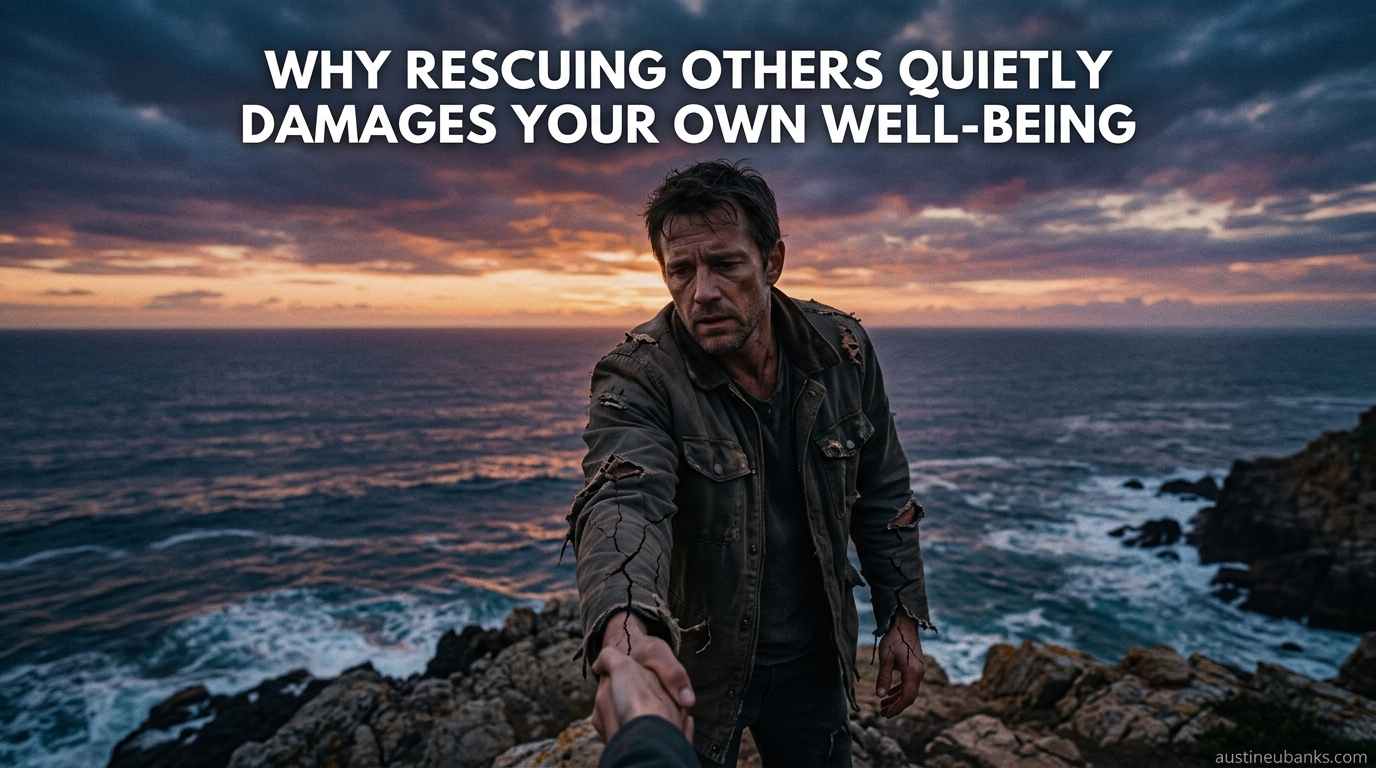
You know the feeling. Someone you care about is struggling, and before you even think about it, you are already three steps deep in fixing their problem. You did not ask if they wanted help. You did not check whether you had the energy to give. You just stepped in, quietly absorbed their stress, and carried it home with you like a second coat you forgot you were wearing.
Rescuing others quietly damages your own well-being because it is a pattern of compulsive helping that runs beneath your awareness, slowly draining your emotional, physical, and mental reserves until there is nothing left for yourself. Unlike overt rescuing, which is visible and often acknowledged, quiet rescuing happens in the background, making it far harder to recognize and even harder to stop.
I have lived this pattern. For years, I was the person everyone leaned on, and I wore that role like a badge of honor. I thought I was being kind. What I was actually doing was avoiding my own pain, tying my self-worth to how useful I could be, and slowly burning out in ways I could not name. If that sounds familiar, this article is for you.
We are going to explore what rescuer syndrome really is, why the quiet version is especially destructive, how it affects your body and mind, and practical steps to break free from the cycle without abandoning the people you love.
Table of Contents
What Is Rescuer Syndrome?
Rescuer syndrome is a behavioral pattern where a person compulsively takes responsibility for solving other people’s problems, often at the expense of their own needs, boundaries, and identity. It is not a formal psychiatric diagnosis but a well-documented psychological pattern recognized in therapy, attachment theory, and codependency research.
The rescuer syndrome falls under several related terms you may have encountered. The savior complex describes the same pattern with a slight twist: it often includes an unconscious belief that the rescuer is uniquely qualified to save the other person. White knight syndrome is another variation, rooted in a fantasy of rescuing someone in distress to earn love and validation. All three terms point to the same core dynamic: your sense of self-worth becomes tied to being needed.
Psychologist Stephen Karpman mapped this pattern in 1968 with the Karpman Drama Triangle. The triangle has three roles: the Rescuer, the Victim, and the Persecutor. The Rescuer steps in to help the Victim, often without being asked, and eventually feels overwhelmed, resentful, or unappreciated. The key insight is that all three roles are dysfunctional. The Rescuer is not actually helping from a place of freedom; they are stuck in a loop of compulsive caretaking that feeds their own unmet needs.
Codependency is closely linked to rescuer syndrome. In a codependent dynamic, your identity and emotional stability depend on managing another person’s feelings and problems. You lose track of where their needs end and yours begin. This is what professionals call enmeshment, and it is one of the hallmarks of chronic rescuing.
What makes this pattern so persistent is that it feels like love. It feels like compassion. Society praises self-sacrifice, especially in women and highly sensitive people. But rescuing and genuine compassion are not the same thing, and understanding the difference is the first step toward change.
Signs You Are a Quiet Rescuer
A quiet rescuer is someone who habitually takes on other people’s emotional burdens, solves problems that are not theirs to solve, and sacrifices their own needs, all without drawing attention to what they are doing. The behavior is covert, making it easy to dismiss as simply being a good friend, partner, or colleague.
If you are wondering whether this pattern applies to you, here are the signs I have seen in myself and in countless others who eventually recognized the cycle:
- You feel anxious or unsettled when someone you care about is upset, and the only thing that relieves that anxiety is jumping in to help.
- You rarely say no, even when you are exhausted, because saying no triggers guilt that feels worse than the exhaustion.
- You solve problems for people who did not ask you to, and you often do it behind the scenes so they will not even know.
- Your self-worth rises and falls based on how much you contributed to someone else’s life that day.
- You feel empty, restless, or purposeless when no one needs your help.
- You have been described as “too giving,” “selfless,” or “the strong one” your entire life.
- You attract people who seem to constantly need saving, and you feel a pull toward the most struggling person in any room.
- You minimize your own problems because they do not feel as serious as what others are going through.
- You feel resentful when your help goes unacknowledged, but you would never admit that resentment out loud.
- You cannot distinguish between wanting to help and feeling compelled to help; the urge feels automatic.
If you nodded along to five or more of these signs, you are likely caught in a quiet rescuing pattern. The good news is that recognizing it is the turning point. Most people spend years, sometimes decades, in this cycle before they even have language for it.
It is worth noting the difference between an overt rescuer and a quiet rescuer. An overt rescuer is visible about their helping. They might announce their sacrifices, seek validation, or become frustrated when their efforts are not recognized. A quiet rescuer does none of that. They help silently, often insisting they are “fine,” and bury their exhaustion so deeply that even they lose touch with it. This silence is what makes quiet rescuing so damaging: there is no external feedback loop to alert you that something is wrong.
The Difference Between Helping and Rescuing
One of the most common questions I hear is: “Where does helping end and rescuing begin?” It is a critical distinction, and most quiet rescuers have never been taught the difference.
Genuine helping is voluntary, bounded, and empowering. You offer support because you choose to, not because you feel compelled. You ask what the other person needs rather than assuming. You help in a way that builds their capacity, not in a way that makes them dependent on you. And when the helping is done, you return to your own life without carrying their emotional weight.
Rescuing, by contrast, is compulsive, unbounded, and disempowering. You step in without being asked. You take over responsibility that belongs to the other person. You help in a way that reinforces their helplessness, even though that is the opposite of your intention. And long after the interaction ends, you are still carrying their stress in your body.
Here is a breakdown of the three modes of support:
- Healthy helping: You ask what they need, you offer what you can genuinely give, you respect their autonomy, and you walk away with your energy intact.
- Overt rescuing: You take charge of their problem, you do things they could do themselves, you may feel frustrated when they do not follow your advice, and you feel drained afterward.
- Quiet rescuing: You absorb their emotions without them knowing, you manage their life from behind the scenes, you never mention what it costs you, and you feel depleted in ways you cannot explain.
The shift from healthy helping to rescuing usually happens gradually. It starts with genuine care, then slides into over-involvement, and eventually becomes a pattern so automatic that you cannot imagine relating to people any other way. Recognizing where you are on this spectrum is uncomfortable but necessary.
Why Quiet Rescuing Is Especially Damaging
Understanding why rescuing others quietly damages your own well-being requires looking at what makes the quiet form different from overt rescuing. The silence is not just a personality trait; it is what makes the damage invisible, prolonged, and cumulative.
When someone rescues overtly, there is at least a visible cost. Friends might say, “You are doing too much.” The rescuer might eventually burn out loudly enough to seek help. There is a feedback mechanism, however imperfect, that signals something is wrong.
The quiet rescuer has no such mechanism. Because you never complain, never ask for recognition, and never acknowledge the toll, no one around you sees what it is costing. You become the person who is always “fine.” Your exhaustion is invisible to others and, over time, invisible to yourself.
This invisibility has three compounding effects. First, it delays awareness. I have read countless forum posts from people who spent years, sometimes decades, quietly rescuing before they even realized the pattern existed. By the time they recognized it, the damage to their health and relationships was already significant.
Second, it prevents intervention. When your suffering is silent, no one checks on you. Friends and family assume you are coping well because you are the one who always handles everything. You become the emotional infrastructure for everyone around you, and no one thinks to ask whether the infrastructure is crumbling.
Third, it deepens isolation. Quiet rescuers often feel profoundly alone, even when surrounded by people. The loneliness comes from a specific place: no one knows the real you, because the real you is buried under everything you do for everyone else. Your identity has fused so completely with the helper role that you are not sure who you are without it.
The self-care neglect that accompanies quiet rescuing is not occasional. It is daily. It is the skipped meal, the missed workout, the appointment you never scheduled, the sleep you sacrificed to worry about someone else’s problem. Each instance seems small. Over months and years, they compound into a body and mind that are running on empty.
The Hidden Cost to Your Physical and Mental Health
The damage from chronic quiet rescuing is not just emotional. It shows up in your body, your nervous system, and your mental health in measurable, sometimes severe, ways. Let me break this down by category.
Physical Health Consequences
Your body keeps the score, as the saying goes. When you chronically absorb other people’s stress without replenishing your own reserves, your nervous system stays in a state of low-grade activation. This is what professionals call nervous system dysregulation, and it has real physical consequences.
The most commonly reported physical symptoms among chronic rescuers include tension headaches, digestive issues, disrupted sleep, chronic fatigue, and a weakened immune system. Many people in the forums I reviewed described getting sick the moment they finally slowed down, as if their body had been holding off illness through sheer willpower and collapsed the instant the pressure released.
Cortisol, the body’s primary stress hormone, stays elevated when you are constantly managing other people’s crises. Chronic cortisol elevation is linked to weight gain, high blood pressure, blood sugar imbalances, and inflammation. The connection between chronic emotional stress and physical illness is not speculative; it is well-established in medical research.
Emotional Health Consequences
Emotionally, the quiet rescuer operates on a slow path toward depletion. The first stage is emotional burnout, a state where you feel numb, flat, or unable to access joy even in moments that should feel good. This is your emotional system running on reserve power.
Resentment is the next stage. It builds quietly, the way the rescuing itself does. You start feeling irritated by the very people you are helping, even though you chose to help them. The resentment feels confusing because it contradicts your self-image as a caring person, so you push it down, which only makes it grow.
Then comes the identity crisis. When no one needs you, you feel empty. When someone does need you, you feel alive. This dependency is the emotional core of rescuer syndrome: your emotional stability has been outsourced to other people’s problems, and without those problems, you are not sure what you are supposed to feel.
Mental Health Impacts
Anxiety is the most common mental health consequence of quiet rescuing. It is driven by hypervigilance, the constant scanning of other people’s emotional states to determine whether you need to step in. Your brain treats other people’s distress as a personal emergency, and the nervous system responds accordingly.
Depression frequently follows. The combination of chronic exhaustion, unacknowledged self-sacrifice, and the gradual erosion of personal identity creates a fertile ground for depressive symptoms. Many quiet rescuers describe a pervasive sense of emptiness that no amount of helping seems to fill.
Compassion fatigue, a condition originally identified in healthcare workers and therapists, is increasingly recognized in non-professional caregivers and quiet rescuers. It is characterized by emotional numbing, cynicism, and a reduced capacity to feel empathy. In other words, the more you give without replenishing, the less you are actually able to give from a genuine place.
Why You Developed This Pattern: Root Causes
No one becomes a quiet rescuer by accident. This pattern has roots, and understanding those roots is essential for breaking the cycle. The research is clear: compulsive rescuing almost always traces back to childhood experiences that taught you your value was tied to what you could do for others.
Parentification
Parentification occurs when a child is placed in the role of caring for a parent, sibling, or the household in a way that exceeds their developmental capacity. You may have had a parent who was physically ill, emotionally unstable, struggling with addiction, or simply overwhelmed. In response, you learned to be the responsible one, the one who kept things together.
Children who experience parentification grow into adults who feel responsible for managing other people’s emotions. The pattern is so deeply wired that it feels like a personality trait rather than a learned survival strategy.
Emotional Neglect
Emotional neglect happens when your emotional needs were consistently not met during childhood. Maybe your parents were physically present but emotionally unavailable. Maybe they dismissed your feelings, told you to stop being dramatic, or only paid attention to you when you were being helpful.
Children who experience emotional neglect learn a specific lesson: your needs do not matter, but meeting other people’s needs earns you a place in their lives. This is the foundation of quiet rescuing. You learned early that love was conditional on usefulness.
Enmeshment
Enmeshment is a family dynamic where boundaries between family members are blurred or nonexistent. In an enmeshed family, one person’s emotional state dictates everyone else’s. If Mom is upset, the whole household walks on eggshells. You learned to monitor others’ emotions constantly and to adjust your own behavior to keep the peace.
Enmeshment creates adults who cannot distinguish their own emotions from other people’s. You feel your friend’s sadness as if it were your own. Your partner’s stress lives in your body. This emotional fusion is the engine of quiet rescuing.
The Fawn Response
You have likely heard of fight, flight, and freeze as stress responses. The fawn response is the fourth, identified by therapist Pete Walker. Fawning is the tendency to appease and care for others as a way to stay safe in threatening situations. Instead of fighting, running, or shutting down, you learned to make yourself useful, agreeable, and indispensable.
The fawn response is especially relevant for quiet rescuers. If you grew up in a volatile or unpredictable environment, becoming the person who smoothed things over may have been your primary survival strategy. It kept you safe then, but it is running your life now.
Attachment Wounds
Attachment theory describes how early relationships with caregivers shape your adult relationship patterns. Insecure attachment, particularly anxious and disorganized attachment, is strongly linked to rescuing behavior. If your caregivers were inconsistent, you may have learned that love is unreliable and that you must earn it through effort and sacrifice.
Low self-worth is the common thread across all of these root causes. At some level, often below conscious awareness, you concluded that you are not enough on your own. Rescuing became the way you proved your value, both to others and to yourself.
How Quiet Rescuing Damages Your Relationships
One of the cruelest ironies of quiet rescuing is that it damages the very relationships you are trying to protect. The help that feels like love often creates dynamics that are unhealthy for everyone involved.
In romantic relationships, quiet rescuing leads to enmeshment. Your partner stops handling their own responsibilities because they know you will pick up the slack. This is not malice on their part; it is a natural adaptation. When you consistently solve someone’s problems, you send the message that you do not believe they can handle them. Over time, this erodes their confidence and creates dependency. Some partners begin to feel infantilized, and the resentment goes both directions.
In family dynamics, the quiet rescuer often becomes the designated crisis manager. You are the one siblings call when things go wrong. You are the one who manages aging parents’ affairs, absorbs a relative’s financial chaos, or mediates conflicts that are not yours. The role feels important, and it is, but it also keeps the family system stuck. When you always step in, no one else has to grow.
In friendships, quiet rescuers tend to attract people who need rescuing. This is not a coincidence. People who struggle with boundaries, accountability, or emotional regulation are drawn to those who will absorb the consequences. Some people in the forums I reviewed described these individuals as “energy vampires,” people who unconsciously exploit the rescuer’s inability to say no.
The deepest damage, though, is to the rescuer’s sense of self. When your entire relational identity is built on what you do for others, you lose track of who you are independent of that role. People may love you, but you are not sure they love you. They love what you do for them. That distinction, whether accurate or not, creates a fear of abandonment that keeps you locked in the pattern.
How to Break the Rescuing Pattern
Breaking the rescuing pattern is not about becoming cold or selfish. It is about learning to help from a place of choice rather than compulsion, and building an identity that exists independent of what you do for others. Here are the steps that have worked for me and for countless others who have walked this path.
- Recognize the pattern. You cannot change what you cannot see. Start by noticing the moments when you feel the urge to step in. Ask yourself: “Did they ask for help? Is this my responsibility? Am I helping because I want to or because I cannot tolerate the discomfort of not helping?”
- Practice the pause. When someone shares a problem, your instinct is to fix it immediately. Instead, try waiting. Say something like, “That sounds really hard. What do you need right now?” You might be surprised how often people do not actually want you to solve anything. They want to be heard.
- Learn to say no without over-explaining. “I wish I could help with that, but I do not have the capacity right now” is a complete sentence. You do not need to justify, apologize, or offer a counter-sacrifice. The guilt will come, and you can tolerate it. Guilt is not dangerous; it is just uncomfortable.
- Set boundaries with specific language. Here are scripts you can use: “I can listen for fifteen minutes, but then I need to go.” “I am not the right person to help with this.” “I love you, and this is your problem to solve.” “I am taking a break from giving advice right now.” These feel harsh at first. With practice, they become natural.
- Rebuild your identity outside the helper role. What do you enjoy when no one needs anything from you? What did you love before you became the person who handles everything? Reconnect with hobbies, interests, and relationships that exist purely for your own enjoyment, not for their utility to others.
- Address the root causes. Understanding why you developed this pattern is essential for lasting change. If you have access to therapy, work with someone who understands attachment theory, codependency, or trauma-informed care. Approaches like cognitive behavioral therapy, somatic experiencing, and inner child work can help rewire the nervous system patterns that drive compulsive rescuing.
- Build a tolerance for other people’s discomfort. This is the hardest step and the most important. When someone you love is struggling, your entire system screams at you to fix it. Sitting with their pain without intervening feels unbearable. But learning to let others have their own experience, their own consequences, and their own growth is the ultimate act of respect, both for them and for yourself.
Breaking the pattern is not linear. You will have days where you fall back into old habits. That is normal and does not mean you have failed. Progress is measured over months, not moments.
What to Expect in Recovery: A Timeline
Recovery from quiet rescuing happens in stages, and knowing what to expect can help you stay committed when the process gets uncomfortable.
Stage 1: Awareness (Weeks 1 to 4). You start noticing the pattern everywhere. Every interaction becomes a data point. This stage is eye-opening but can also feel overwhelming as you realize how deeply the pattern is woven into your daily life.
Stage 2: Discomfort (Weeks 5 to 12). You start experimenting with boundaries and saying no. The guilt is intense. Anxiety spikes. You may feel like you are being selfish or unkind. This is the stage where most people abandon the process, because the discomfort of changing feels worse than the discomfort of staying the same.
Stage 3: Practice (Months 3 to 6). The guilt begins to ease. You get better at pausing before jumping in. Some relationships shift as people adjust to the new you, and some may resist the change. You start experiencing moments of genuine peace when no one needs anything from you, and those moments feel strange but liberating.
Stage 4: Integration (Months 6 and beyond). Boundaries become more natural. You can distinguish between choosing to help and feeling compelled to help. Your identity outside the helper role solidifies. You still care deeply about others, but your care is now intentional, bounded, and sustainable.
Everyone’s timeline is different. Some people move through these stages in months; others take years. What matters is not the speed but the direction.
FAQs
What is the rescuer syndrome in psychology?
Rescuer syndrome is a behavioral pattern in which a person compulsively takes responsibility for solving other people’s problems, often neglecting their own needs and well-being in the process. It is rooted in childhood attachment wounds and manifests as an unconscious need to feel needed or valuable. The pattern is closely related to codependency and is mapped by the Karpman Drama Triangle, where the Rescuer role perpetuates dysfunctional relationship dynamics.
What is the sickness where someone chronically tries to rescue or save someone else?
Chronic rescuing behavior is associated with several related psychological patterns: savior complex, white knight syndrome, codependency, and compulsive caregiving. While not a formal psychiatric diagnosis, these patterns involve an ongoing, compulsive need to fix or save others, often at the expense of the rescuer’s own mental and physical health. The behavior is frequently rooted in childhood trauma, parentification, or insecure attachment and is best addressed through therapy that targets the underlying attachment wounds.
What is the rescuer personality type?
The rescuer personality type is characterized by compulsive helping, difficulty saying no, chronic self-neglect, identity tied to being needed, and a tendency to attract people who require ongoing support. Rescuers often have low self-worth that they compensate for through usefulness, feel anxious when they cannot fix someone’s problem, and experience resentment that they rarely express. Quiet rescuers exhibit these traits covertly, helping behind the scenes without acknowledgment or complaint.
How do I break the role of rescuer?
Breaking the rescuer role involves seven key steps: recognize the pattern by noticing when you help compulsively, practice pausing before jumping in to fix problems, learn to say no without over-explaining, set clear boundaries using specific scripts, rebuild your identity outside the helper role, address root causes through therapy or self-reflection, and build a tolerance for other people’s discomfort without intervening. Recovery happens in stages over months and requires patience, self-compassion, and consistent practice.
Conclusion
Understanding why rescuing others quietly damages your own well-being is the first step toward changing a pattern that may have been with you since childhood. The quiet rescuer gives from a place of survival, not abundance, and the cost shows up in your body, your mind, and your relationships in ways that compound over time.
You do not have to stop caring. You do not have to become cold or distant. What you need is to learn the difference between helping from choice and helping from compulsion. You need to build an identity that exists independent of what you do for others. And you need to believe, even before the evidence arrives, that your worth is not measured by how many problems you solve.
If you recognized yourself in this article, take one small step today. Pause the next time you feel the urge to rescue. Ask whether you are choosing to help or whether the helping is choosing you. That single moment of awareness is where everything begins to change.