
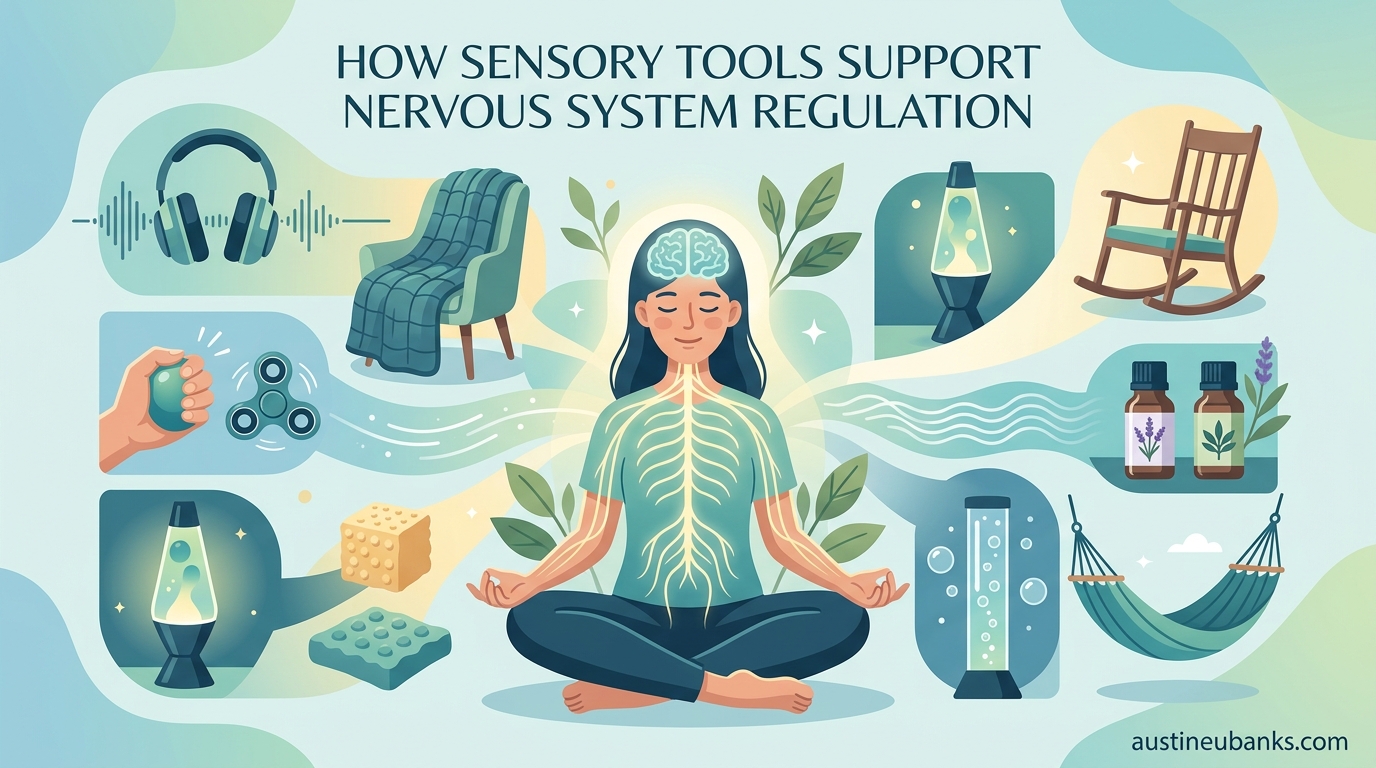
Have you ever noticed that telling yourself to “just calm down” never actually works when you are overwhelmed? That is because your nervous system does not respond to logic. It responds to sensation. This is exactly why understanding how sensory tools support nervous system regulation can change the way you manage stress, anxiety, and emotional overwhelm.
Sensory tools are not gadgets or toys. They are targeted inputs that speak directly to your nervous system through touch, sound, sight, movement, and pressure. When your brain feels threatened or overloaded, sensory input bypasses the thinking brain and reaches the survival brain first. That is why a weighted blanket can calm you faster than a rational pep talk.
In this guide, our team breaks down how sensory tools support nervous system regulation at a neurological level. We cover the difference between hyperarousal and hypoarousal, explain Polyvagal Theory in plain language, and walk you through building a personal sensory toolkit that actually works for your unique nervous system. Whether you are neurodivergent, healing from trauma, or simply looking for better ways to manage daily stress, these strategies are for you.
Table of Contents
What Is Sensory Regulation?
Sensory regulation is the process through which your nervous system integrates, filters, and adjusts sensory input from your environment. It allows you to maintain balance and an optimal level of arousal so you can think clearly, respond appropriately, and stay grounded.
Think of your nervous system as a thermostat. When sensory input comes in, your brain decides whether to turn the heat up or dial it down. If the system works smoothly, you stay within your window of tolerance, a zone where you feel calm, connected, and capable. When it does not, you spiral into sensory overwhelm or shut down entirely.
Sensory dysregulation happens when the system gets stuck. Lights feel too bright. Sounds feel like assaults. A tag on your shirt becomes unbearable. For neurodivergent individuals, people with trauma histories, and those living with chronic anxiety, sensory dysregulation is a daily reality that most resources never address for adults.
The key insight is this: sensory regulation forms the foundation for everything else. Emotional regulation, behavioral regulation, and executive functioning all depend on a regulated sensory system. You cannot reason your way through a dysregulated nervous system. You have to give it the right sensory input first.
How Sensory Tools Support the Nervous System
Sensory tools work because they provide structured, predictable input that helps your nervous system shift out of survival mode and back into a regulated state. They speak the language your nervous system already understands: pressure, temperature, rhythm, texture, and movement.
The Neurological Mechanism Behind Sensory Tools
Your autonomic nervous system has two main branches. The sympathetic nervous system controls your fight-or-flight response. The parasympathetic nervous system controls rest, digestion, and recovery. Sensory tools help activate the parasympathetic system, which acts as the brake pedal for your stress response.
Deep pressure, for example, stimulates receptors under the skin that send signals through the spinal cord to the brainstem. This triggers the release of serotonin and dopamine while reducing cortisol. It is the same mechanism behind why a firm hug feels calming or why a weighted blanket helps you sleep.
Cold exposure works differently. Splash cold water on your face and you activate the mammalian dive reflex, which slows your heart rate and shifts your nervous system toward parasympathetic dominance almost instantly. People in anxiety forums consistently report that cold water on the face snaps them out of panic spirals faster than anything else.
Polyvagal Theory and Sensory Safety
Polyvagal Theory, developed by Dr. Stephen Porges, explains how the vagus nerve governs your nervous system’s response to safety and threat. According to this framework, your nervous system moves through three states: ventral vagal (safe and social), sympathetic (fight or flight), and dorsal vagal (freeze and shutdown).
Sensory tools help because they signal safety to the vagus nerve. Soothing sounds, gentle touch, rhythmic movement, and familiar scents all communicate that the environment is not dangerous. When your nervous system receives these safety signals, it can shift from survival mode back into connection and calm.
This is why grounding techniques work. When you press your feet into the floor or hold something textured, you give your nervous system present-moment evidence that you are safe. The threat feels distant. The body settles.
Why Logic Alone Does Not Work
When you are in a state of hyperarousal, your prefrontal cortex, the part of the brain responsible for rational thinking, goes offline. Your amygdala takes over. No amount of positive self-talk reaches it because the survival brain does not process language the way the thinking brain does.
This is the frustration people share constantly in support communities. They know they should calm down. They know the threat is not real. But knowing does not help because their nervous system is running the show. Sensory tools succeed where logic fails because they communicate directly with the survival brain through bottom-up processing rather than top-down reasoning.
One Reddit user in the CPTSD community put it perfectly: “Telling me to calm down is like telling a drowning person to swim harder. Give me something to hold, something cold, something heavy, and I can find my way back.”
Hyperarousal vs Hypoarousal: Matching Tools to Your State
Your nervous system dysregulates in two directions, and each requires a completely different type of sensory intervention. Using the wrong tool for your state can make things worse. This hyperarousal vs hypoarousal framework is one of the most underexplained topics in sensory regulation content, and getting it right matters.
Hyperarousal: When Your System Is Overwhelmed
Hyperarousal is the fight-or-flight state. Your heart races, your thoughts spiral, your muscles tense, and you feel wired, frantic, or panicky. You might feel irritable, hypervigilant, or unable to sit still. Your nervous system has too much activation and needs help coming down.
For hyperarousal, you need calming and organizing sensory input. Deep pressure from weighted blankets or compression garments helps ground the system. Slow, rhythmic movement like gentle rocking or swaying soothes the vagus nerve. Cool temperatures, low lighting, and predictable sounds all help reduce the sensory load.
Specific tools that help with hyperarousal include weighted blankets, noise-canceling headphones, dim lighting, slow breathing with extended exhales, cold water on the face or wrists, and rhythmic humming or chanting.
Hypoarousal: When Your System Shuts Down
Hypoarousal is the freeze or shutdown state. You feel numb, disconnected, foggy, heavy, or emotionally flat. You might struggle to move, speak, or engage. Tasks feel impossible. Your nervous system has too little activation and needs stimulation to come back online.
For hypoarousal, you need alerting and engaging sensory input. Strong flavors like sour candy or peppermint wake up the system. Bright light, upbeat music, and brisk movement increase activation. Quick temperature changes and intense proprioceptive input like jumping or pushing against a wall help jump-start the nervous system.
Specific tools that help with hypoarousal include sour or spicy foods, bright lighting, upbeat or energizing music, brisk walking or jumping, strong scents like citrus or eucalyptus, and textured objects that require active grip and manipulation.
Quick Decision Framework
Ask yourself one question: am I wound up or shut down? If you feel wired, anxious, and overstimulated, choose calming tools. If you feel numb, foggy, and disconnected, choose alerting tools. When in doubt, start with grounding techniques that bring you into the present moment, then adjust based on how your body responds.
A simple way to check: try taking a slow breath with a long exhale. If your body softens, you were hyperaroused and calming tools are right. If nothing changes or you feel more disconnected, you were hypoaroused and need stimulation instead.
Types of Sensory Tools by Category
Sensory tools fall into distinct categories based on which sensory system they target. Understanding these categories helps you choose tools strategically rather than grabbing whatever is nearby.
Tactile and Deep Pressure Tools
Tactile input comes through the skin and is one of the fastest routes to nervous system regulation. Deep pressure stimulation, in particular, has decades of research supporting its calming effects. It activates the parasympathetic nervous system, increases serotonin production, and reduces cortisol levels.
Common tactile and deep pressure tools include weighted blankets, weighted lap pads, compression clothing, fidget tools, textured sensory items, massage balls, and acupressure mats. Forum users frequently mention weighted eye masks and soft blankets as nightly regulation staples that improve sleep quality.
For on-the-go regulation, small fidget tools fit in a pocket and provide discreet tactile input during meetings, classes, or social situations. The key is choosing textures that feel safe and soothing to your specific nervous system, since tactile preferences vary widely.
Auditory and Sound Tools
Sound directly affects the nervous system through the auditory nerve, which connects to both the brainstem and the vagus nerve. This is why certain sounds can instantly calm you or set you on edge. Auditory tools work by either reducing overwhelming noise or providing organizing, rhythmic sound.
Noise-canceling headphones reduce auditory overload by filtering out unpredictable background noise. Brown noise, white noise, and binaural beats provide consistent, predictable sound that helps the nervous system settle. Many people report that brown noise in particular creates a cocoon of safety that quiets racing thoughts.
For regulation through active sound, humming, singing, and chanting directly stimulate the vagus nerve through the muscles of the throat and voice box. This is why humming a tune can shift your state when nothing else works.
Visual and Environmental Tools
Visual input shapes how safe your nervous system feels. Harsh fluorescent lighting signals threat to a sensitive nervous system. Soft, warm lighting signals safety. Cluttered visual environments increase cognitive load and sensory overwhelm.
Visual sensory tools include dimmer switches, warm-toned light bulbs, lava lamps or slow-moving visual timers, organized and decluttered spaces, and blue-light filters for screens. For some people, visual grounding objects like a favorite photograph or a meaningful stone provide an anchor during dysregulation.
Nature views also matter. Research shows that even looking at images of natural environments reduces sympathetic nervous system activation. Opening a window or stepping outside for two minutes of natural light can reset an overwhelmed system.
Proprioceptive and Movement Tools
Proprioception is your body’s sense of where it is in space. Proprioceptive input comes through heavy work, deep muscle engagement, and joint compression. It is one of the most organizing forms of sensory input because it tells your nervous system exactly where your body ends and the world begins.
Proprioceptive tools include resistance bands, therapy putty, heavy lifting, pushing against walls, jumping on a trampoline, and bodyweight exercises. For hypoarousal states, brisk proprioceptive activity wakes up the nervous system quickly. For hyperarousal, slow, heavy movements provide grounding without adding stimulation.
Vestibular input, which comes through movement and balance, is closely related. Gentle rocking, swinging, or swaying soothes an overactive nervous system. This is why rocking chairs and hammocks have been used for calming across cultures for centuries.
Oral and Olfactory Tools
The mouth and nose have direct neural pathways to the brain’s emotional and survival centers. This is why chewing, sucking, and strong scents can regulate the nervous system faster than almost anything else. Chewing stimulates the vagus nerve through jaw movement, while olfactory input bypasses the thalamus and reaches the amygdala directly.
Oral sensory tools include chewable jewelry, hard candies, gum, crunchy snacks, and sour foods. Many neurodivergent adults report that chewing gum or eating crunchy textures helps them focus during demanding tasks. Food-seeking behavior is a legitimate form of sensory self-regulation, even though it remains under-researched.
Olfactory tools include essential oils like lavender for calming, citrus for energizing, and peppermint for alertness. Scented candles, incense, or fresh flowers can create a predictable sensory environment that signals safety to the nervous system.
Building a Personal Sensory Toolkit
A sensory toolkit is a personalized collection of tools and strategies that help you regulate your nervous system across different situations. Building one takes self-awareness and experimentation, but the payoff is enormous: you will always have a regulation strategy ready when you need it.
Step 1: Identify your patterns. Notice when you feel overwhelmed versus when you shut down. Track which sensations calm you and which stimulate you. Write down the sensory inputs you naturally gravitate toward when stressed. Do you reach for tight clothing or loose? Loud music or silence? Cold drinks or warm?
Step 2: Choose tools for each state. Select at least two calming tools for hyperarousal and two alerting tools for hypoarousal. Make sure some are portable so you can use them at work, in the car, or in social situations. Discreet options like fidget rings, earplugs, and essential oil rollers work well in public.
Step 3: Organize by environment. Create a home kit, a work kit, and a portable kit. Your home kit might include a weighted blanket, dim lighting, and noise-canceling headphones. Your portable kit might include gum, a fidget tool, earplugs, and a small bottle of lavender oil.
Step 4: Practice before you need it. Use your tools when you are only slightly dysregulated, not just during full crisis. This builds neural pathways that make the tools more effective when you truly need them. Your nervous system learns to associate specific inputs with safety through repetition.
Step 5: Adjust over time. Your sensory needs will change based on stress levels, seasons, hormones, and life circumstances. Revisit your toolkit every few months and remove tools that no longer serve you. Add new ones as you discover what works.
Practical Tips for Using Sensory Tools Effectively
Timing matters more than you might think. The earlier you intervene in a dysregulation cycle, the more effective sensory tools will be. Waiting until you are in full crisis mode makes regulation much harder because your nervous system has already committed to a survival response.
Combine tools for stronger effects. Deep pressure plus slow breathing works better than either alone. Cold water plus humming creates a powerful vagus nerve activation. Experiment with combinations to find what works for your system.
Co-regulation is equally important. Human nervous systems are designed to regulate with each other. Sometimes the most effective sensory tool is the calm presence of another person. This is why therapy, support groups, and safe relationships play such a significant role in long-term nervous system healing.
Avoid the common trap of thinking sensory needs are childish or indulgent. Adults in support forums frequently express shame about needing weighted blankets or fidget tools. Your sensory needs are biologically real. Honoring them is not indulgence. It is nervous system care.
Finally, remember that sensory tools are one part of a larger regulation picture. Sleep, nutrition, movement, relationships, and professional support all contribute to nervous system health. Sensory tools give you immediate relief and build long-term capacity, but they work best as part of a holistic approach.
FAQs
What are sensory strategies to support regulation?
Sensory strategies are techniques that use specific sensory input, such as deep pressure, rhythmic sound, cold temperature, or movement, to help the nervous system shift into a regulated state. Examples include weighted blankets for calming, sour candy for alerting, humming to stimulate the vagus nerve, and slow rocking for grounding.
What are nervous system regulation tools?
Nervous system regulation tools are items and techniques that provide structured sensory input to help shift the autonomic nervous system from survival states, such as fight, flight, or freeze, into calm and connected states. Common tools include weighted blankets, noise-canceling headphones, fidget items, essential oils, and cold exposure techniques.
What are sensory tools used for?
Sensory tools are used to regulate the nervous system by providing targeted sensory input that communicates safety, reduces overwhelm, and restores balance. They help manage anxiety, support focus and attention, aid in trauma recovery, assist with sleep, and help neurodivergent individuals process sensory information more effectively.
What is the sensory input nervous system regulation?
Sensory input for nervous system regulation refers to the deliberate use of sensory stimuli, including touch, sound, sight, movement, taste, and smell, to influence the autonomic nervous system. Different types of input activate different neural pathways. Deep pressure activates parasympathetic responses, cold triggers the dive reflex to slow heart rate, and rhythmic movement stimulates the vagus nerve to promote calm.
Can sensory tools help with anxiety and trauma?
Yes. Sensory tools are particularly effective for anxiety and trauma because they bypass the thinking brain and communicate directly with the survival brain through bottom-up processing. For anxiety, calming tools like weighted blankets and slow breathing activate the parasympathetic nervous system. For trauma recovery, grounding tools help bring the nervous system back to the present moment during flashbacks or dissociation.
Conclusion
Understanding how sensory tools support nervous system regulation gives you something that willpower alone never could: a reliable way to work with your biology instead of against it. By matching the right sensory input to your specific state, whether hyperaroused or hypoaroused, you give your nervous system exactly what it needs to find its way back to balance.
Start small. Pick one calming tool and one alerting tool. Practice using them before you are in crisis. Build your toolkit over time, and remember that your sensory needs are valid at any age. Your nervous system deserves care, and sensory tools are one of the most direct ways to provide it.