
Your heart is pounding. Your thoughts are spiraling. Your chest feels tight, and the room seems slightly unreal. If you have ever felt this way, you know how fast anxiety can take over your mind and body. The 5-4-3-2-1 grounding technique is one of the simplest, fastest ways to interrupt that spiral and pull yourself back into the present moment.
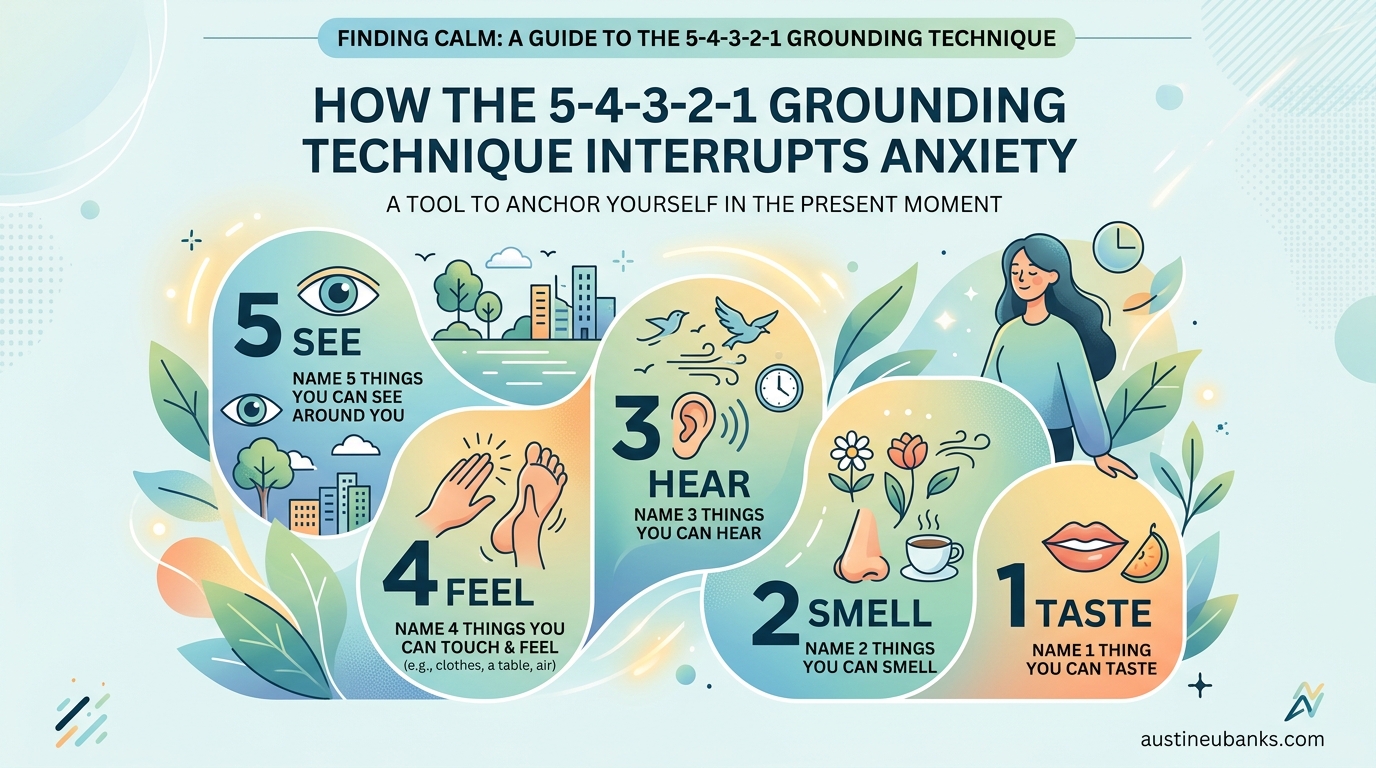
The 5-4-3-2-1 grounding technique interrupts anxiety by redirecting your attention away from racing thoughts and toward your five senses. You identify 5 things you can see, 4 things you can touch, 3 things you can hear, 2 things you can smell, and 1 thing you can taste. This sensory engagement activates your parasympathetic nervous system, shifting your brain out of fight-or-flight mode and back into a calm, present-moment state.
I first learned about this technique from a therapist who described it as an emergency brake for the mind. The idea sounded almost too simple. Name a few things around you and your anxiety just stops? After using it for over two years in situations ranging from crowded airports to difficult work meetings, I can tell you it works more often than not. But understanding why and how it works made me dramatically better at using it.
In this guide, our team breaks down exactly how the 5-4-3-2-1 grounding technique interrupts anxiety, walks you through each step with real examples, explains the neuroscience in plain language, and covers what to do when the technique does not work. We also compare it to other popular grounding methods so you can find the right tool for your specific situation.
Whether you deal with occasional stress, frequent panic attacks, social anxiety, or PTSD symptoms, this guide gives you a practical framework you can use today. No equipment, no app, no cost. Just your senses and a few minutes of focused attention.
Quick Reference: The 5-4-3-2-1 Grounding Technique
5 things you can SEE (look around the room)
4 things you can TOUCH (notice textures and temperatures)
3 things you can HEAR (listen for subtle sounds)
2 things you can SMELL (notice scents in the air)
1 thing you can TASTE (focus on a flavor or the inside of your mouth)
Time needed: 1-3 minutes. No equipment required. Can be done anywhere.
Table of Contents
What Is the 5-4-3-2-1 Grounding Technique?
The 5-4-3-2-1 grounding technique is a sensory-based mindfulness exercise designed to interrupt anxiety, panic, and emotional distress by systematically engaging all five of your senses. It belongs to a broader category of coping tools called grounding techniques, which mental health professionals use to help clients stay connected to the present moment when their minds start racing or dissociating.
The technique uses a countdown format. You start with five sensory observations and work your way down to one, moving through sight, touch, hearing, smell, and taste in sequence. This structured countdown gives your brain a task to focus on instead of the anxiety loop it is caught in.
Therapists frequently teach this method because it meets three criteria that matter during acute anxiety: it is simple enough to remember under stress, it requires no tools or preparation, and it can be practiced discreetly in almost any setting. You can do it on a train, in a meeting, at your desk, or lying in bed at 2 a.m. without anyone knowing.
The technique draws on principles from mindfulness-based stress reduction (MBSR), cognitive behavioral therapy (CBT), and dialectical behavior therapy (DBT). All three of these evidence-based therapeutic approaches use some form of present-moment awareness to help people manage distress. The 5-4-3-2-1 method packages those principles into a quick, memorable format that anyone can use without formal training.
One reason this technique has spread so widely is its accessibility. You do not need to understand neuroscience to benefit from it. You do not need to be in therapy. You do not need to meditate for 30 minutes a day. You just need to notice what your senses are picking up right now, count those observations, and let the counting anchor you back to reality.
Step-by-Step Guide: How to Do the 5-4-3-2-1 Grounding Technique
Here is exactly how to practice the 5-4-3-2-1 grounding technique, broken down step by step with practical examples for each sense. Take your time with each step. The goal is not to rush through the countdown but to genuinely notice and name what you perceive.
Before you begin, take one slow breath in through your nose and out through your mouth. This single breath signals to your nervous system that you are about to shift gears. Then proceed through the steps below.
Step 1: Name 5 Things You Can See
Look around your environment and name five distinct objects or details you can see. Be specific. Instead of just thinking “wall,” try to notice the particular details: the texture of the paint, a shadow in the corner, a crack in the ceiling, the way light falls on a book spine.
Examples of what you might notice:
- The grain pattern on a wooden desk
- A blue coffee mug sitting to your left
- Sunlight creating a rectangle on the floor
- A green plant with drooping leaves in the corner
- The woven texture of the rug beneath your feet
The specificity matters. When you are anxious, your visual attention narrows and turns inward, focusing on internal threat signals rather than external reality. Forcing yourself to scan your environment and pick out five distinct visual details pulls your attention outward and breaks that tunnel vision.
Some people find it helpful to say each item out loud if they are alone. Others prefer to name them silently. Either approach works. What matters is that you actively look, identify, and mentally label each object.
Step 2: Name 4 Things You Can Touch
Shift your attention to your sense of touch. Identify four things you can physically feel right now. This could include the texture of your clothing against your skin, the temperature of the air, the firmness of the chair beneath you, or the smooth surface of your phone.
Examples of what you might notice:
- The smooth, cool surface of your phone screen
- The fabric of your shirt against your shoulders
- The hard, flat surface of the floor under your shoes
- The warmth of your own hands resting in your lap
If you want to deepen this step, actually reach out and touch objects around you. Run your fingers along the edge of your desk. Press your feet firmly into the ground. Feel the weight of a pen in your hand. Physical contact sends strong proprioceptive signals to your brain, reinforcing the message that you are here, in this body, in this place, right now.
Many people find the touch step especially grounding because it reconnects them with their physical body. Anxiety often creates a sense of detachment or unreality, and tactile sensations are one of the fastest ways to counter that feeling.
Step 3: Name 3 Things You Can Hear
Close your eyes if you feel comfortable doing so, and listen for three distinct sounds. Start with the most obvious ones and then try to pick up subtle sounds you might normally filter out.
Examples of what you might hear:
- The low hum of a refrigerator or air conditioner
- Traffic passing outside your window
- The quiet rhythm of your own breathing
Auditory awareness is particularly powerful for anxiety interruption because it requires you to stop and be still. You cannot listen carefully while also replaying anxious thoughts at full volume. The act of tuning in to quiet sounds forces your internal monologue to lower its volume, creating space for calm.
If you are in a very quiet environment and struggle to find three sounds, that is okay. Notice the absence of sound. Notice the faintest background noise you can detect. Even the sound of silence is something your brain can observe and label.
Step 4: Name 2 Things You Can Smell
Identify two scents in your environment. Smell is the sense most closely linked to memory and emotion because olfactory signals travel directly to the limbic system, the emotional center of your brain, without passing through intermediate processing stations.
Examples of what you might smell:
- The faint scent of coffee from a mug nearby
- A clean, soapy fragrance from your hands or clothes
If you cannot identify two distinct smells, do not skip this step. Instead, take a deliberate sniff and notice whatever is there, even if it is just the neutral smell of indoor air. You can also try carrying a small bottle of essential oil, a favorite lotion, or a scented lip balm for moments when you need a reliable scent anchor.
Some people find smell the hardest sense to engage, especially in sterile environments like offices or hospitals. Having a portable scent source you associate with calm can make this step more reliable. Lavender, peppermint, and citrus scents are popular choices backed by research showing they can reduce stress markers.
Step 5: Name 1 Thing You Can Taste
Finally, identify one thing you can taste. If you have food or a drink nearby, take a small sip or bite and focus on the flavor. If not, notice the lingering taste in your mouth or the sensation of your tongue against your teeth.
Examples of what you might taste:
- The residual mint flavor from toothpaste
- A sip of water and the clean, neutral taste of it
- A piece of gum or a mint you carry for this purpose
Taste is the final step for a reason. By the time you reach this step, you have already engaged four other senses, and your nervous system has begun shifting toward calm. The taste step serves as a closing anchor, sealing the grounding experience with one final sensory observation.
Many therapists recommend keeping a hard candy, mint, or piece of gum specifically for grounding practice. The strong, distinct flavor gives you something unmistakable to focus on, and the act of sucking or chewing provides additional sensory input that supports regulation.
After completing all five steps, take one more slow breath. Notice how your body feels compared to when you started. You may not feel completely calm, but you should notice a shift. Your thoughts may be slower. Your breathing may be steadier. Your sense of being present in the room should feel stronger.
How the 5-4-3-2-1 Grounding Technique Interrupts Anxiety: The Science
Understanding the neuroscience behind the 5-4-3-2-1 grounding technique makes you better at using it. When you know what is happening in your brain during anxiety and how the technique counteracts it, you can practice with more intention and get better results. Let us walk through the science in plain language.
How Anxiety Works in the Brain
Anxiety originates in a small, almond-shaped structure in your brain called the amygdala. The amygdala acts as your internal alarm system. Its job is to scan your environment for threats and trigger a rapid stress response when it detects danger. This response happens in milliseconds, far faster than conscious thought.
When the amygdala fires, it activates your sympathetic nervous system, triggering the well-known fight-or-flight response. Your adrenal glands release stress hormones like cortisol and adrenaline. Your heart rate increases, your breathing quickens, your muscles tense, and blood flows away from your digestive system and toward your limbs, preparing you to fight or run.
This response is incredibly useful if you are facing a physical threat like a wild animal. The problem is that your amygdala cannot distinguish between a real physical danger and a psychological one. A stressful email, a crowded elevator, or a worrying thought can trigger the same cascade of stress hormones as a genuine threat to your survival.
In an anxiety spiral, the amygdala keeps firing because it receives feedback that reinforces the threat. Your heart is racing, so your brain concludes something must be wrong. Your breathing is shallow, so your brain interprets that as evidence of danger. The symptoms of anxiety themselves become additional triggers, creating a self-reinforcing loop that can escalate into a full panic attack.
Meanwhile, your prefrontal cortex, the area of your brain responsible for rational thinking, planning, and emotional regulation, gets overridden. Under acute stress, the amygdala essentially hijacks the brain, and the prefrontal cortex loses its ability to intervene with logic or perspective. This is why telling yourself to “just calm down” rarely works. The logical brain is not in charge anymore.
How Sensory Engagement Breaks the Loop
The 5-4-3-2-1 grounding technique interrupts this anxiety loop by doing something clever: it routes information through a different neural pathway. Instead of trying to reason with the amygdala (which does not work during acute anxiety), the technique floods the brain with sensory data.
When you deliberately look around the room, feel textures, listen for sounds, notice smells, and focus on taste, you are sending a massive amount of new sensory information to your brain. This information travels through your thalamus, the brain’s sensory relay station, and gets processed in your somatosensory cortex, the area that handles bodily sensations.
Here is where it gets interesting. Your brain has a limited capacity for simultaneous processing, a concept psychologists call cognitive load. When you overload the brain with sensory observation tasks like counting, naming, and noticing, there is simply less processing power available for the anxiety loop to maintain itself. The anxious thoughts do not disappear instantly, but they get crowded out by the sensory data you are actively generating.
Think of it like a computer with too many browser tabs open. Anxiety is a process running in the background, consuming memory and slowing everything down. The 5-4-3-2-1 technique opens several new, demanding tasks that force the system to reallocate resources. The anxiety process gets deprioritized because your brain cannot run everything at once.
Activating the Parasympathetic Nervous System
Beyond cognitive distraction, the technique also activates your parasympathetic nervous system. This is the branch of your autonomic nervous system responsible for rest, digestion, and recovery. It is essentially the brake pedal to the sympathetic nervous system’s gas pedal.
When you slow down enough to notice sensory details, several things happen in your body simultaneously. Your breathing naturally deepens and slows. Your heart rate begins to decrease. Your muscle tension starts to release. These physical changes send signals back to your brain that the environment is safe, which further calms the amygdala.
This feedback loop is mediated in part by the vagus nerve, the longest cranial nerve in your body. The vagus nerve connects your brain to your heart, lungs, and digestive system, and it plays a central role in regulating your stress response. When your vagus nerve is well-toned (meaning it is efficient at sending calming signals), you recover from stress more quickly.
Activities that engage multiple senses simultaneously, like the 5-4-3-2-1 technique, appear to stimulate vagal activity. The combination of deliberate attention, slowed breathing, and sensory engagement tells your vagus nerve to activate the relaxation response. This is why the technique does not just distract you temporarily. It actually initiates a physiological calming process.
The Role of Present-Moment Awareness
Anxiety is almost always future-oriented. You worry about what might happen, what could go wrong, what someone might think. Even when anxiety is triggered by a past event, the distress comes from anticipating that the event will repeat. The mind time-travels away from the present moment, and the body follows, generating stress hormones as if the feared future is happening now.
The 5-4-3-2-1 grounding technique forces your attention into the present moment. You cannot identify five things you see in the future. You cannot touch four things in the past. Every sensory observation you make is happening right now, in real time, in your immediate environment.
This is the same principle that underlies all mindfulness practice, from meditation to yoga to mindful walking. The difference is that the 5-4-3-2-1 method gives you a structured, specific task that is easy to execute even when your mind is chaotic. Instead of trying to clear your mind (nearly impossible during anxiety), you give your mind a job to do that happens to pull it into the present.
When to Use the 5-4-3-2-1 Grounding Technique
The 5-4-3-2-1 technique is versatile enough to use in many situations. Here are the most common scenarios where people report it being helpful, along with tips for getting the best results in each context.
During a Panic Attack
If you feel a panic attack building, start the technique as early as possible. Users on anxiety support forums consistently report that the 5-4-3-2-1 grounding technique works best as an early intervention tool. When you catch the first signs of escalating anxiety (a racing heart, quickened breathing, a sense of unreality), the technique can prevent the spiral from reaching full intensity.
During a full-blown panic attack, the technique can still help, but it may be harder to focus. If your mind is too scattered to remember the steps, try a simpler version: just name three things you can see. That alone can start breaking the loop. Keep a note on your phone or a card in your wallet with the five steps written out so you do not have to rely on memory when you are overwhelmed.
Before Presentations and Performances
Performance anxiety affects students, professionals, athletes, musicians, and public speakers. The 5-4-3-2-1 technique can help you ground yourself in the minutes before a high-pressure situation. Practice it while waiting in the wings, sitting at your desk before a presentation, or standing in the restroom before a big meeting.
The technique works here because performance anxiety is driven by anticipatory thoughts about what might go wrong. By pulling your attention into the present moment, you temporarily cut off those future-oriented worry patterns and give your nervous system a chance to settle before you perform.
At Bedtime for Nighttime Rumination
Nighttime is when anxiety often peaks for many people. The distractions of the day fall away, and the mind fills the silence with worries, regrets, and to-do lists. The 5-4-3-2-1 technique can be an effective part of a wind-down routine to interrupt rumination before it keeps you awake for hours.
Try practicing the technique while lying in bed with your eyes closed. Since you cannot visually scan the room in the dark, modify the technique. Instead of sight, start with touch: feel the sheets, the pillow, the mattress. Then move to hearing, smell, and taste. Some people find this variation even more relaxing because the darkness naturally reduces sensory input and promotes calm.
In Social Situations
Social anxiety can make conversations, parties, and networking events feel unbearable. The 5-4-3-2-1 technique can be practiced discreetly without anyone noticing. While sitting at a table, standing in a group, or waiting for a meeting to start, silently work through the five senses.
The technique helps in social settings because it redirects your attention away from self-monitoring (wondering if you said the right thing, worrying about how you look) and toward external observation. This outward focus naturally reduces the self-consciousness that fuels social anxiety.
At Work During Stressful Moments
Workplace stress is one of the most common triggers for anxiety. Tight deadlines, difficult colleagues, overwhelming workloads, and high-stakes meetings can all push your nervous system into overdrive. The 5-4-3-2-1 technique gives you a quick reset you can do at your desk between tasks or in the restroom during a stressful day.
Try pairing the technique with a brief walk. Step outside or to a different part of the building, work through the five senses, and return to your work with a calmer baseline. Even 90 seconds of grounding can meaningfully improve your ability to focus and make decisions.
For PTSD and Trauma Triggers
People with post-traumatic stress disorder (PTSD) often experience flashbacks, where the brain re-experiences a traumatic event as if it is happening again. The 5-4-3-2-1 technique helps by anchoring the person in the present reality, distinguishing the current safe environment from the traumatic memory.
If you use this technique for PTSD, engage your senses as vividly as possible. Touch something cold. Smell something strong. Look at a digital clock and read the current time and date out loud. These actions provide explicit evidence that you are in the present, not in the past. Many PTSD support groups and therapists recommend this technique as part of a broader toolkit, not as a standalone treatment.
In Crowds or Overwhelming Environments
Crowded grocery stores, busy airports, packed subway cars, and noisy restaurants can trigger sensory overload and anxiety. The 5-4-3-2-1 technique helps you regain a sense of control by giving you a structured task to focus on amid the chaos.
In these environments, the technique may actually be easier because there is an abundance of sensory input. The challenge is filtering and choosing what to focus on rather than finding things to notice. Pick specific, pleasant details rather than the overwhelming totality of the environment.
5-4-3-2-1 vs Other Grounding Techniques: Which One Works Best?
The 5-4-3-2-1 grounding technique is not the only tool available. Several other grounding methods work through different mechanisms. Understanding the strengths of each one helps you choose the right technique for your situation.
5-4-3-2-1 vs the 3-3-3 Rule
The 3-3-3 rule is a simplified grounding technique that asks you to name 3 things you see, 3 sounds you hear, and 3 ways you can move your body (such as stretching your arms, rolling your shoulders, or wiggling your toes). It takes less time than the 5-4-3-2-1 method and requires less cognitive effort.
Several users in Reddit anxiety communities report preferring the 3-3-3 rule during severe panic attacks because the simpler format is easier to remember when cognitive function is impaired. The 5-4-3-2-1 technique offers a more thorough sensory experience but may be too complex for moments of intense panic. Consider the 3-3-3 rule your emergency backup and the 5-4-3-2-1 technique your primary grounding tool.
5-4-3-2-1 vs 4-7-8 Breathing
The 4-7-8 breathing technique involves inhaling for 4 seconds, holding the breath for 7 seconds, and exhaling for 8 seconds. This pattern directly stimulates the vagus nerve and forces the parasympathetic nervous system to activate. It is one of the most physiologically direct ways to calm down.
While 4-7-8 breathing works faster than the 5-4-3-2-1 technique for physiological calming, it does not address the cognitive loop of anxious thoughts as effectively. The 5-4-3-2-1 method engages both the body and the mind, making it a more comprehensive approach. Many people combine both techniques: start with 4-7-8 breathing to calm the body, then follow with 5-4-3-2-1 to calm the mind.
5-4-3-2-1 vs Box Breathing
Box breathing (also called square breathing) involves inhaling, holding, exhaling, and holding again, each for an equal count of 4 seconds. Navy SEALs use this technique to manage stress in high-pressure situations. It is highly effective for physiological regulation and is easy to remember.
Box breathing is an excellent companion to the 5-4-3-2-1 technique rather than a replacement. You can integrate box breathing into the 5-4-3-2-1 method by breathing in a box pattern while you work through each sensory step. The combination of structured breathing and sensory engagement creates a powerful grounding effect.
5-4-3-2-1 vs Body Scan Meditation
A body scan involves slowly moving your attention through each part of your body, from your toes to the top of your head, noticing sensations without judgment. It is a core mindfulness practice that builds body awareness and helps release physical tension.
Body scans are excellent for proactive anxiety management and building long-term emotional regulation skills. However, they typically take 10 to 20 minutes, making them impractical for acute anxiety. The 5-4-3-2-1 technique is better suited for quick intervention, while body scans are better for daily preventive practice.
Quick Comparison: Grounding Techniques at a Glance
5-4-3-2-1 Method: All five senses, 1-3 minutes, best for moderate anxiety and daily use
3-3-3 Rule: Sight, sound, movement, under 1 minute, best for severe panic when memory is impaired
4-7-8 Breathing: Breath control only, under 1 minute, best for fast physiological calming
Box Breathing: Breath control only, 2-5 minutes, best for sustained focus and stress management
Body Scan: Bodily sensations, 10-20 minutes, best for daily preventive practice and tension release
Benefits of the 5-4-3-2-1 Grounding Technique
The 5-4-3-2-1 grounding technique offers a range of benefits that make it one of the most widely recommended anxiety management tools. Here is what the research and clinical experience suggest about its effectiveness.
Immediate Anxiety Reduction
The most direct benefit is that the technique can reduce anxiety in real time. By engaging your senses and redirecting your attention, you interrupt the anxiety feedback loop and give your nervous system a chance to reset. Most people report feeling at least some relief within 1 to 3 minutes of starting the exercise.
This immediacy is what sets grounding techniques apart from other anxiety management strategies. While medication, therapy, and lifestyle changes all play valuable roles, they take time. The 5-4-3-2-1 technique gives you something you can do right now, in this moment, to start feeling better.
No Equipment or Cost
The technique requires absolutely nothing except your own senses. No app, no workbook, no therapist, no medication, no special environment. This makes it accessible to everyone regardless of financial resources, location, or circumstances. In a world where mental health care can be expensive and hard to access, having a free, effective tool matters enormously.
Discreet and Usable Anywhere
You can practice the 5-4-3-2-1 technique without anyone around you knowing. You do not need to close your eyes, move your body, or speak out loud. This discretion makes it usable in professional settings, social situations, and public spaces where you might feel self-conscious about openly managing anxiety.
Builds Long-Term Mindfulness Skills
Regular practice of the 5-4-3-2-1 technique builds the same mindfulness skills that long-term meditators develop. You become more aware of your sensory environment, more attuned to your body, and better at noticing when your mind has wandered into anxious territory. Over time, this heightened awareness helps you catch anxiety earlier and intervene before it escalates.
Research on mindfulness-based interventions shows that even brief, regular practice can lead to measurable changes in brain function, including increased activity in the prefrontal cortex and decreased reactivity in the amygdala. The 5-4-3-2-1 technique, practiced daily, can contribute to these longer-term neurological benefits.
Supports PTSD and Trauma Recovery
For people with PTSD, the technique provides a practical tool for managing flashbacks and dissociative episodes. Grounding techniques are a standard component of trauma-focused therapies like prolonged exposure and cognitive processing therapy. The 5-4-3-2-1 method gives trauma survivors a portable, reliable way to anchor themselves in the present when memories threaten to pull them into the past.
It is important to note that grounding is one part of a broader treatment approach for PTSD. It manages symptoms but does not address the underlying trauma. Professional therapy remains essential for lasting recovery.
Empowers Self-Regulation
One of the most meaningful benefits is psychological rather than purely physiological. Anxiety can make you feel powerless, as though your own mind and body are working against you. The 5-4-3-2-1 technique gives you a concrete, actionable tool that you control. Every time you use it successfully, you reinforce the belief that you can manage your anxiety. This growing sense of self-efficacy is itself therapeutic and can reduce the fear of future anxiety episodes.
Common Mistakes People Make (And How to Fix Them)
The 5-4-3-2-1 grounding technique is simple, but that does not mean it is always easy. People who try it and say it “did not work” are often making one of several common mistakes. Here are the most frequent errors and how to correct them.
Mistake 1: Rushing Through the Steps
The most common mistake is treating the technique like a checklist to complete as fast as possible. When you race through the five senses in 15 seconds, you do not give your nervous system time to respond. The technique works because it slows you down and forces sustained attention.
Fix: Spend at least 15 to 20 seconds on each sense. Really look at each object you name. Really feel each texture. The goal is not speed but depth of observation. If you finish in under a minute, you are probably moving too fast.
Mistake 2: Judging Your Observations
Some people get stuck because they think their observations are not interesting or impressive enough. They judge themselves for noticing “boring” things like a wall or the floor. This self-judgment adds another layer of mental activity that competes with the grounding process.
Fix: Practice non-judgmental observation. There is no wrong answer. The goal is not to find fascinating objects but to engage your senses with whatever is present. A plain white wall is just as valid as a beautiful painting. Both accomplish the goal of pulling your attention into the present.
Mistake 3: Not Practicing Before You Need It
Many people only try the technique for the first time during a panic attack. That is like trying to learn to swim while drowning. Under acute stress, your prefrontal cortex is impaired, making it hard to remember and execute new skills.
Fix: Practice the technique when you are calm. Do it daily for a week, ideally at a specific time like during your morning coffee or evening commute. Once the steps become automatic through repetition, you will be able to access them even under stress.
Mistake 4: Expecting Complete Calm
Some people abandon the technique because it reduces their anxiety from an 8 to a 5 but does not eliminate it entirely. They conclude that it failed because they do not feel perfectly calm afterward.
Fix: Adjust your expectations. The goal is not to erase anxiety completely but to reduce its intensity enough that you can think clearly and function. Going from an 8 to a 5 is a meaningful improvement that gives you the cognitive space to take other helpful actions.
Mistake 5: Treating It as a Cure-All
The 5-4-3-2-1 technique is a coping tool, not a treatment. It manages symptoms in the moment but does not address the underlying causes of chronic anxiety. Some people rely on it exclusively and neglect other important strategies like therapy, lifestyle changes, and medical treatment.
Fix: Use the technique as one tool in a broader mental health toolkit. If you experience chronic anxiety that significantly affects your daily life, combine grounding with professional support. The technique gives you immediate relief while therapy addresses root causes.
What to Do When 5-4-3-2-1 Does Not Work
One of the biggest gaps in most articles about the 5-4-3-2-1 grounding technique is what to do when it fails. And it does fail sometimes. During severe panic attacks, intense dissociation, or overwhelming sensory overload, the technique may not provide enough relief on its own. This does not mean you are broken or that the technique is useless. It means you need additional tools.
Forum discussions on Reddit reveal that many people feel abandoned when therapists recommend this technique without providing backup options. Here are four effective fallback techniques to try when 5-4-3-2-1 is not enough.
Fallback 1: The Ice Cube or Cold Water Technique
Cold stimulation triggers the mammalian dive reflex, an evolutionary response that immediately slows your heart rate and activates your parasympathetic nervous system. This is one of the fastest physiological ways to interrupt a panic attack.
Hold an ice cube in your hand and focus on the cold sensation. Splash cold water on your face. Hold a cold can of soda against your cheeks or forehead. If you have nothing cold available, press your wrists under cold running water for 30 seconds. The intensity of the cold sensation overrides almost any anxious thought pattern because your brain cannot ignore it.
Fallback 2: 4-7-8 Breathing
When sensory observation is too difficult, switch to pure breath work. The 4-7-8 method (inhale for 4, hold for 7, exhale for 8) forces your nervous system to calm down regardless of what your mind is doing. The long exhale is particularly important because extended exhalation directly stimulates the vagus nerve.
Do four complete cycles of 4-7-8 breathing. By the fourth cycle, most people notice a significant drop in heart rate and physical tension. If you feel lightheaded, reduce the counts to 3-5-6 or simply focus on making your exhales twice as long as your inhales.
Fallback 3: Progressive Muscle Relaxation
Anxiety creates physical tension that can become so habitual you stop noticing it. Progressive muscle relaxation involves deliberately tensing and then releasing each muscle group in your body, starting from your feet and working up to your face.
Tense each muscle group for 5 seconds, then release for 10 seconds while paying attention to the contrast. This technique is particularly effective when anxiety is accompanied by physical symptoms like a tight chest, clenched jaw, or stiff neck. The deliberate tension-and-release pattern interrupts the chronic low-grade tension that sustains the stress response.
Fallback 4: Bilateral Stimulation (Tapping)
Bilateral stimulation is a technique used in EMDR therapy that involves alternating stimulation of the left and right sides of your body. The simplest version involves tapping: alternately tap your left knee or thigh, then your right, back and forth at a steady rhythm.
This left-right alternation appears to help the brain process emotional material more effectively. Many people report that bilateral tapping helps during flashbacks, intrusive thoughts, and severe anxiety when other grounding methods have failed. You can also try crossing your arms and alternately tapping your shoulders (the butterfly hug technique), which adds the comforting element of self-embrace.
When to Seek Professional Help
If you find that grounding techniques are not providing adequate relief, or if your anxiety is severe enough to interfere with your daily functioning, it may be time to seek professional support. A licensed therapist can help you identify the root causes of your anxiety, teach you a wider range of coping skills, and provide evidence-based treatments like cognitive behavioral therapy, exposure therapy, or EMDR.
There is no shame in needing more than self-help techniques. Anxiety disorders are real medical conditions, and effective treatments exist. Grounding techniques are a starting point, not an endpoint. If you need more help, reaching out to a mental health professional is the smartest, bravest step you can take.
Adapting the 5-4-3-2-1 Technique for Different Needs
The standard version of the 5-4-3-2-1 grounding technique works well for most adults, but some people benefit from modifications. Here are adaptations for children, neurodivergent individuals, and people with sensory processing differences.
For Children and Teens
Children as young as five can learn a modified version of this technique. Parents and teachers report success using the 5-4-3-2-1 method as a calming tool during tantrums, before tests, and during transitions between activities.
Make it a game rather than a clinical exercise. Ask children to play “I Spy” with five things they see. Have them describe four things they feel using fun adjectives (squishy, bumpy, smooth). Make it social by taking turns naming sounds. Use familiar foods or favorite candies for the taste step. The structure stays the same, but the delivery becomes playful and engaging.
For teenagers, frame the technique as a performance tool rather than a mental health intervention. Athletes use grounding before competitions. Musicians use it before performances. Presenting it as a focus and performance tool reduces stigma and increases willingness to practice.
For Neurodivergent Individuals
People with ADHD and autism often find the structured counting format of the 5-4-3-2-1 technique particularly helpful. The clear structure, predictable pattern, and specific task reduce the cognitive demand compared to open-ended mindfulness exercises.
However, some neurodivergent individuals may find certain senses overwhelming rather than calming. If loud environments are distressing, the hearing step may increase anxiety rather than reduce it. In these cases, skip the problematic sense and double up on another. The technique is a framework, not a rigid formula.
For people with sensory processing differences, the technique can be modified to use the senses that feel safe and regulating. Some individuals find deep pressure (weighted blankets, firm hugs, pressing palms against a wall) more grounding than light touch. Adapt the method to match your sensory profile.
Modified Countdown Variations
If the full 5-4-3-2-1 countdown feels too long, try shorter variations. The 3-2-1 method (3 things you see, 2 you feel, 1 you hear) takes under 30 seconds and works well during acute anxiety when cognitive capacity is limited. The 4-3-2-1 method adds one extra sense without the full commitment of the five-step version.
You can also reverse the order. Starting with taste and working up to sight provides a different sensory progression that some people find more effective. Experiment with different variations to find what works best for your brain and body.
Building a Daily Grounding Practice
Most people only think about grounding techniques when they are already anxious. But the 5-4-3-2-1 method works best when it is a familiar, practiced skill rather than an emergency measure. Building a daily grounding practice makes the technique more effective when you need it most.
Morning Integration
Practice the technique each morning while having your coffee or tea. The five senses align naturally with this routine: see the steam rising, feel the warmth of the cup, hear the morning sounds, smell the coffee, taste the first sip. This morning practice takes no extra time but trains your brain to associate grounding with calm, starting your day from a regulated baseline.
Scheduled Check-Ins
Set two or three daily reminders on your phone to practice a quick round of grounding. Mid-morning, after lunch, and late afternoon are common stress points. Even a 60-second practice during these times can prevent anxiety from accumulating throughout the day.
Pair With Existing Habits
Attach grounding practice to habits you already have. Do a quick 3-2-1 round while washing your hands. Practice identifying five sounds while waiting for the train. Feel four textures while putting on your shoes. Habit stacking, a technique from behavioral psychology, makes new practices stick by linking them to established routines.
Track Your Progress
Use a simple 1-to-10 distress scale before and after grounding practice. Rate your anxiety before you start the technique, then rate it again when you finish. Over time, this data helps you understand which techniques work best for you, what times of day are most challenging, and how your overall anxiety trends change with regular practice.
This tracking also reinforces your sense of self-efficacy. Seeing your anxiety drop from a 7 to a 4 after grounding, documented over weeks and months, provides powerful evidence that you have effective tools for managing your mental health.
FAQs
Does the 5-4-3-2-1 method work for anxiety?
Yes, the 5-4-3-2-1 method works for anxiety by redirecting attention from racing thoughts to sensory observations. Research on mindfulness-based interventions supports sensory grounding as an effective strategy for reducing acute anxiety. Most people notice at least some relief within 1 to 3 minutes. The technique works best when practiced regularly before anxiety escalates to full intensity.
Does grounding get rid of anxiety?
Grounding techniques do not permanently eliminate anxiety, but they reduce its intensity in the moment by interrupting the anxiety feedback loop. Grounding shifts your nervous system from a fight-or-flight state to a calmer, present-moment state. For long-term anxiety reduction, grounding should be combined with therapy, lifestyle changes, and other evidence-based treatments.
What is the 5-4-3-2-1 coping technique for anxiety?
The 5-4-3-2-1 coping technique is a grounding exercise where you identify 5 things you can see, 4 things you can touch, 3 things you can hear, 2 things you can smell, and 1 thing you can taste. This countdown engages all five senses, pulls your attention into the present moment, and breaks the cycle of anxious thoughts. It requires no equipment and can be practiced anywhere.
How does 5-4-3-2-1 help anxiety?
The 5-4-3-2-1 technique helps anxiety by engaging the parasympathetic nervous system, overloading the brain with sensory data to crowd out anxious thoughts, and forcing present-moment awareness. It breaks the feedback loop between the amygdala (the brain’s fear center) and the prefrontal cortex, allowing rational thinking to return as physical stress symptoms decrease.
How long does the 5-4-3-2-1 grounding technique take?
The 5-4-3-2-1 grounding technique takes 1 to 3 minutes to complete. You can spend as little as 15 seconds per sense or extend each step for deeper engagement. During acute anxiety, a shorter version focusing on just two or three senses can be completed in under 60 seconds and still provide meaningful relief.
Can the 5-4-3-2-1 technique stop a panic attack?
The 5-4-3-2-1 technique can help reduce the intensity of a panic attack, especially if started early. However, it may be less effective during a full-blown panic attack when cognitive function is impaired. If the technique is not enough, try fallback methods like cold water stimulation, 4-7-8 breathing, or bilateral tapping for additional relief.
Conclusion
Understanding how the 5-4-3-2-1 grounding technique interrupts anxiety changes the way you use it. The technique works by engaging all five senses, overloading your brain’s cognitive capacity so anxious thoughts get crowded out, activating the parasympathetic nervous system through deliberate attention and slowed breathing, and forcing your mind into the present moment where future-oriented worries cannot take hold.
The beauty of the 5-4-3-2-1 grounding technique is its simplicity. No equipment, no cost, no special environment. Just your senses and a structured countdown that anyone can learn in five minutes. Practice it daily when you are calm, and it will be there for you when anxiety strikes. Combine it with fallback techniques like cold water stimulation and 4-7-8 breathing for moments when sensory grounding alone is not enough.
Remember that grounding techniques are powerful tools for managing anxiety symptoms, but they are not a replacement for professional mental health care. If anxiety significantly affects your daily life, reach out to a licensed therapist who can help you build a comprehensive treatment plan. You deserve more than just coping. You deserve to understand and address the root of your anxiety, and the 5-4-3-2-1 technique is just the beginning of that journey.