
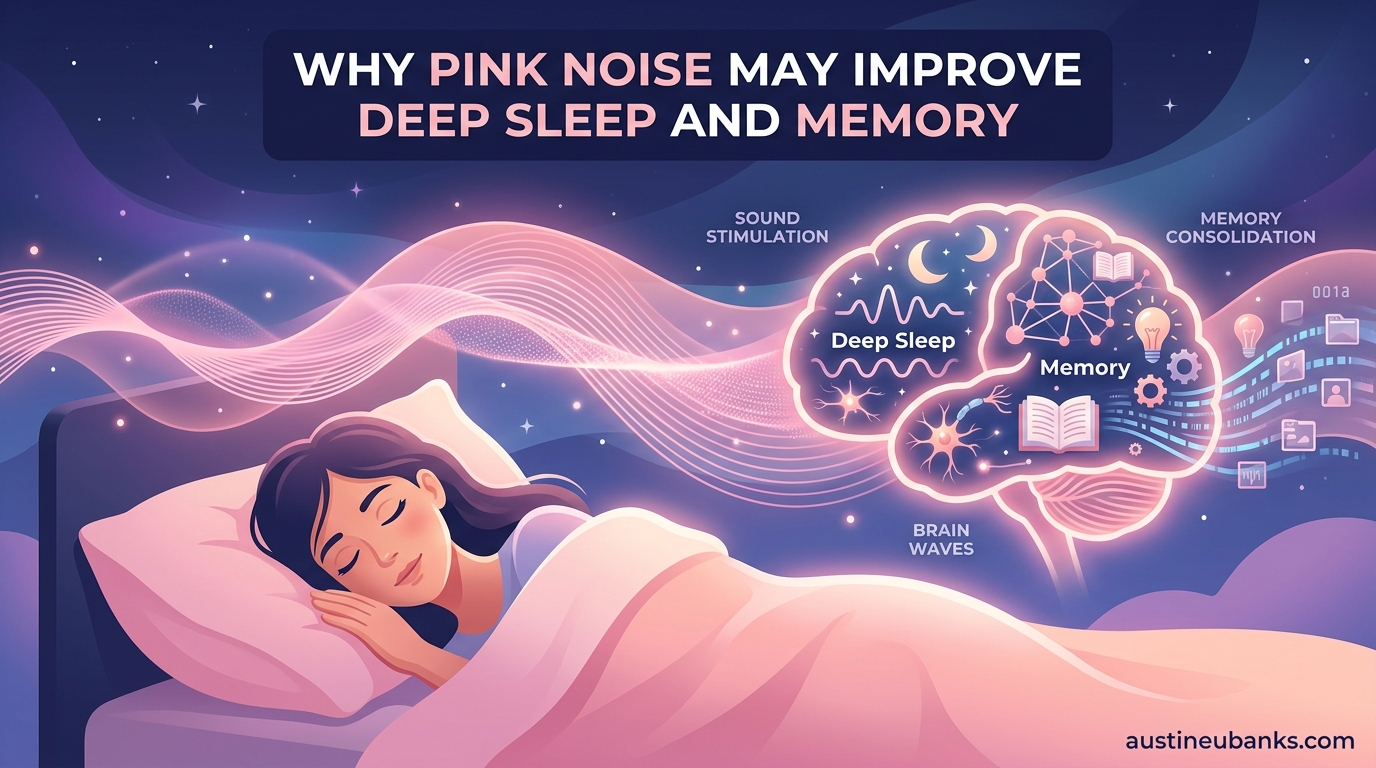
You have probably heard someone mention pink noise as a sleep hack. Maybe a friend swears by rain sounds for falling asleep, or a coworker mentioned a sound app that plays steady, low-frequency tones all night. The idea sounds simple enough, but the science behind it is surprisingly complex and still evolving.
Our team has spent weeks digging through sleep studies, Reddit discussions, and recent research to understand whether pink noise genuinely improves deep sleep and memory. What we found is a mix of promising results and important caveats that most articles gloss over.
This guide covers the connection between pink noise, deep sleep, and memory so you can decide whether it is worth trying. We will explain what pink noise actually is, how it interacts with your brain waves, the studies that show benefits, and the 2026 research that raises some concerns. If you are looking for a balanced, evidence-based look at pink noise deep sleep memory enhancement, you are in the right place.
Table of Contents
What Is Pink Noise?
Pink noise is a type of sound that contains all audible frequencies but delivers more power at lower frequencies, creating a deeper, softer, and more balanced sound than white noise. It occurs naturally in rain falling, wind rustling through trees, steady heartbeats, and ocean waves.
That definition packs a lot of technical detail into one sentence, so let us break it down. Sound is made up of frequencies, measured in Hertz (Hz). White noise plays every frequency at equal intensity, which is why it sounds harsh and hissy. Pink noise reduces the volume of higher frequencies by three decibels per octave as frequency increases. This creates a sound that feels deeper and more pleasant to most people.
Scientists call this pattern 1/f noise, meaning the power of the sound is inversely proportional to its frequency. The result is a sonic profile that mirrors many naturally occurring sounds in our environment. Your brain has evolved over millennia hearing these kinds of sounds in nature.
Think about the difference between television static (white noise) and a steady rainstorm (pink noise). Most people find the rainstorm far more relaxing. That preference is not just personal taste. It reflects how our auditory system processes different sound frequencies.
White Noise vs Pink Noise vs Brown Noise
The three most popular noise colors for sleep differ primarily in their frequency distribution. White noise contains all frequencies at equal intensity, producing a bright, hissing sound. Pink noise emphasizes lower frequencies, creating a balanced, rain-like tone. Brown noise pushes even more energy into the deepest frequencies, resulting in a rumbling, waterfall-like sound.
People on Reddit consistently report that white noise sounds too harsh or high-pitched for sleep. One user in r/YouShouldKnow wrote, “I can hear higher frequencies in the white noise, pink noise is more pleasant.” Brown noise has gained popularity more recently for focus and relaxation, but it sounds noticeably deeper and some find it overwhelming.
Pink noise tends to sit in the sweet spot for sleep. It has enough high-frequency content to mask disruptive sounds like traffic or snoring, but enough low-frequency warmth to feel soothing rather than irritating. That balance matters when you are choosing something to play for eight hours straight.
What Does Pink Noise Sound Like?
If you want to picture it, imagine a steady rain on a tin roof with the treble turned down slightly. Or think of a waterfall heard from a distance, where the sharp edges of the sound have been softened. Some people describe it as a deep hum or a constant shush.
Common natural sources of pink noise include steady rainfall, rustling leaves, ocean waves, and the sound of a fetal heartbeat. These sounds share the same fundamental frequency distribution, which may explain why they feel universally calming.
How Pink Noise Affects Your Brain During Sleep
To understand why pink noise might improve sleep, you need to understand what happens in your brain when you drift off. Sleep is not one uniform state. It cycles through distinct stages every 90 to 120 minutes, each serving a different purpose.
Sleep researchers divide sleep into two main categories: non-REM sleep and REM (rapid eye movement) sleep. Non-REM sleep has three stages, labeled N1, N2, and N3. N1 is light sleep, the transition from wakefulness. N2 is a slightly deeper stage where your body temperature drops and heart rate slows. N3 is the deepest stage of sleep, also called slow-wave sleep.
N3 is where the magic happens for both physical recovery and memory. During this stage, your brain produces slow, synchronized electrical signals called delta waves. This is also when your body releases growth hormone, repairs tissues, and consolidates memories from the day.
The Science of Slow-Wave Sleep Enhancement
Research suggests that pink noise may specifically enhance N3 sleep. A 2017 study published in Frontiers in Human Neuroscience found that participants who listened to pink noise during deep sleep showed increased slow-wave activity compared to those who slept in silence.
The mechanism behind this enhancement involves something called stochastic resonance. In physics, stochastic resonance occurs when adding a moderate amount of noise to a weak signal actually makes that signal easier to detect. Applied to sleep, the theory is that pink noise provides just enough auditory stimulation to boost the brain’s natural slow-wave activity without fully waking you up.
Think of it like a gentle push on a swing at exactly the right moment. The push is small, but if timed correctly with the swing’s natural rhythm, it amplifies the motion. Pink noise appears to work similarly with brain waves, amplifying the slow oscillations that define deep sleep.
Sleep Spindles and Brain Wave Synchronization
Sleep spindles are brief bursts of brain activity that occur during N2 sleep, the stage just before deep sleep. These spindles play a role in memory consolidation and protecting sleep from disruptions. Some studies have found that pink noise exposure is associated with increased sleep spindle density.
More sleep spindles may mean better memory processing and more resilient sleep. When your brain produces more spindles, you are less likely to wake up from minor disturbances. This could explain why some people report sleeping more soundly with pink noise playing.
The brain wave synchronization effect is still being studied, and individual responses vary significantly. Some people show clear increases in slow-wave activity, while others show minimal changes. We will discuss this individual variation in detail later.
The Deep Sleep and Memory Connection
Why does deep sleep matter for memory specifically? During N3 slow-wave sleep, your brain replays and strengthens neural connections formed during the day. This process, called memory consolidation, is when short-term memories get transferred to long-term storage.
Without adequate deep sleep, this consolidation process falters. You might struggle to remember new information, learn new skills, or recall names and details. Over time, chronic deep sleep deprivation may even contribute to cognitive decline.
The 2017 Word Recall Study
One of the most cited studies on pink noise and memory was published in 2017 in Frontiers in Human Neuroscience. Researchers had participants learn word pairs before sleeping. Some participants were exposed to pink noise during deep sleep, while others slept in silence.
The next morning, participants who heard pink noise showed a significant improvement in word recall compared to the control group. The researchers linked this improvement to enhanced slow-wave activity during the night. When deep sleep was boosted, memory consolidation improved along with it.
This study generated significant excitement because it suggested a simple, non-invasive way to support memory function. However, it was a small study with about a dozen participants. The results were promising but preliminary.
Sleep-Dependent Memory Consolidation
Memory consolidation during sleep is not a single process. Different types of memory are processed during different sleep stages. Declarative memory, which includes facts and events, depends heavily on slow-wave sleep. Procedural memory, which includes skills and habits, relies more on REM sleep.
Pink noise appears to primarily enhance slow-wave sleep, which means it may be most helpful for declarative memory. If you are studying for an exam or trying to remember a presentation, pink noise during the first half of the night, when N3 sleep is most concentrated, could theoretically help.
However, this benefit depends on the noise actually increasing your deep sleep. As we will see in the next section, that does not happen for everyone.
Pink Noise and Cognitive Decline
Researchers are also investigating whether pink noise could help older adults experiencing cognitive decline. A 2019 study published in the journal Frontiers in Aging Neuroscience examined the effects of acoustic stimulation during sleep in older adults. The results showed improvements in slow-wave sleep, though the effects were smaller than in younger participants.
The potential application for dementia and age-related memory loss is significant. If pink noise can safely enhance deep sleep in older adults, it might offer a low-cost, accessible intervention. However, this research is still in early stages, and larger clinical trials are needed before drawing firm conclusions.
The Conflicting Research: When Pink Noise May Hurt Sleep
Here is where the story gets more complicated. While early studies painted a rosy picture of pink noise benefits, recent research from 2026 has raised important questions about whether playing sound all night is truly harmless.
A 2026 study from Penn Medicine found that overnight pink noise exposure reduced REM sleep in some participants. This is significant because REM sleep is essential for emotional processing, creativity, and certain types of memory. Cutting into REM to boost deep sleep might trade one benefit for another problem.
The Penn Medicine Study Findings
The Penn Medicine study, which received attention from The Conversation and other science publications, measured sleep quality using polysomnography rather than relying on self-reported sleep diaries. This distinction matters because people are notoriously bad at judging their own sleep quality.
Researchers found that when pink noise was played throughout the night, participants spent less time in REM sleep. The reduction was notable enough to suggest that continuous pink noise might not be the harmless sleep aid many assume it to be.
Even more concerning, when pink noise was combined with aircraft noise, both deep sleep and REM sleep were significantly shorter. This suggests that pink noise might mask some disruptive sounds but could also interact poorly with environmental noise in ways researchers do not fully understand yet.
Self-Reported vs Measured Sleep Quality
One of the most interesting findings from recent research is the gap between how people feel they slept and how they actually slept. Participants in some studies reported feeling like they slept better with pink noise, even when objective measurements showed reduced REM sleep.
This disconnect is important. It means that pink noise might make falling asleep feel easier and more pleasant without necessarily improving the overall quality of your sleep architecture. The sound could be helping you relax into sleep while subtly disrupting later sleep stages.
This does not mean pink noise is bad. It means the picture is more nuanced than “pink noise equals better sleep.” The timing, duration, and individual factors all matter.
Individual Variation: Why Pink Noise Works for Some but Not Others
No competitor we reviewed addresses the fact that individual responses to pink noise vary dramatically. Some people experience clear improvements in deep sleep, while others see no change or even negative effects.
Factors that may influence your response include your baseline sleep quality, age, sensitivity to sound, existing sleep disorders, and even your typical sleep environment. Someone who lives in a noisy apartment may benefit more from pink noise’s masking effect than someone in a quiet rural home.
Reddit discussions confirm this variation. Users in r/LifeProTips share stories of dramatic improvement, while others in r/science point out that the evidence is mixed. The reality is that pink noise is a tool, not a guarantee. It works for many people, but not for everyone.
If you have existing sleep issues, particularly REM-related disorders or sleep apnea, talk to a doctor before relying on any sound therapy. Pink noise should complement good sleep hygiene, not replace medical treatment.
Pink Noise vs White Noise vs Brown Noise: Which Is Best?
People searching for the best noise color for sleep often end up more confused than when they started. Each noise color has distinct characteristics that make it better suited for certain situations.
White noise is best for masking sudden, sharp sounds because it covers the full frequency spectrum evenly. It works well in environments with unpredictable noise, like hospitals or urban apartments. However, many people find it harsh over long periods.
Pink noise is generally considered the most pleasant for extended listening. Its emphasis on lower frequencies creates a warmer, more natural sound. Studies on sleep benefits have focused primarily on pink noise rather than white noise, though both can help with falling asleep.
Brown noise is the deepest of the three, with most of its energy concentrated in low frequencies. It sounds like a low rumble or distant thunder. Some people prefer brown noise for anxiety relief and focus, though it may be too heavy for sleep for some listeners.
Matching Noise Color to Your Goal
For memory and deep sleep enhancement, pink noise has the strongest research backing. For pure sound masking in noisy environments, white noise may edge it out. For relaxation and stress reduction, brown noise is worth trying.
The best approach is to experiment. Try each type for a few nights and pay attention to how you feel the next morning. Your subjective experience matters, even if objective measurements tell a slightly different story. If you wake up feeling rested and clear-headed, the noise is working for you regardless of what studies say about averages.
How to Use Pink Noise for Better Sleep: Practical Tips
If you want to try pink noise, a few practical guidelines can help you get the most benefit while minimizing potential drawbacks. The way you use it matters as much as whether you use it at all.
1. Keep the Volume Moderate
Aim for around 60 decibels, which is roughly the volume of normal conversation. Anything louder risks hearing damage over extended periods and may disrupt sleep rather than improve it. A simple sound meter app on your phone can help you calibrate.
If you are using earbuds, keep the volume even lower since the sound source is closer to your eardrum. Many sleep specialists recommend using a speaker placed across the room rather than in-ear devices for all-night listening.
2. Use a Timer Instead of Playing All Night
Given the 2026 research showing that continuous pink noise may reduce REM sleep, consider using a sleep timer. Set the sound to play for 30 to 60 minutes as you fall asleep, then automatically shut off. This approach delivers the relaxation and sleep-onset benefits without potentially disrupting later sleep stages.
Most sleep sound apps and sound machines have built-in timer functions. If yours does not, a smart plug on a regular schedule can achieve the same effect.
3. Choose Your Delivery Method Carefully
Options include dedicated sound machines, smartphone apps, smart speakers, and streaming services. Sound machines offer the advantage of not emitting blue light from a screen and often include high-quality pink noise tracks without compression artifacts.
Smartphone apps provide more variety and flexibility but keep your phone close to your bed, which introduces other sleep risks. If you use an app, put your phone face down or across the room to minimize light exposure.
4. Give It a Fair Trial Period
Try pink noise for at least one to two weeks before deciding whether it helps. A single night is not enough to judge, especially if your sleep varies day to day. Track how you feel each morning using a simple sleep diary.
If after two weeks you notice no improvement or feel worse, pink noise may not be right for you. That is perfectly fine. Sleep is highly individual, and what works for millions of others may not work for you.
Is Pink Noise Safe? Potential Side Effects
For most people, pink noise at moderate volumes is safe. The main concerns are volume-related hearing damage from prolonged loud exposure and the potential REM sleep disruption discussed earlier.
Some Reddit users report increased nighttime bathroom trips when using pink noise, though this may be coincidental rather than causal. Others mention a mild dependency, finding it harder to sleep without the sound after weeks of continuous use.
To minimize dependency risk, consider using pink noise only on nights when you have trouble falling asleep rather than every single night. This keeps it as a tool rather than a crutch.
Avoid pink noise if you have hyperacusis (increased sensitivity to sound) or certain sleep disorders without consulting a healthcare provider. And never use noise therapy as a substitute for addressing underlying sleep issues like sleep apnea or chronic insomnia.
FAQs
How does pink noise improve memory?
Pink noise may improve memory by enhancing slow-wave sleep, the deepest sleep stage during which the brain consolidates memories. Studies show that acoustic stimulation with pink noise can increase slow-wave activity and sleep spindle density, both of which are linked to better memory processing. A 2017 study found participants who heard pink noise during deep sleep showed improved word recall the next morning.
How does pink noise help with sleep?
Pink noise helps with sleep by providing a steady, low-frequency sound that masks disruptive environmental noise. Its frequency pattern resembles natural sounds like rainfall, which most people find relaxing. Research suggests it may also amplify slow brain wave activity during deep sleep through a process called stochastic resonance, potentially leading to more restorative rest.
What color noise is best for dementia?
Research into noise color and dementia is still in early stages, but pink noise has shown some promise for older adults. A 2019 study found that acoustic stimulation during sleep improved slow-wave sleep in older adults, though effects were smaller than in younger participants. Pink noise may support the deep sleep that becomes harder to achieve with age, but larger clinical trials are needed before making recommendations.
Is it healthy to sleep with pink noise?
For most people, sleeping with pink noise at moderate volumes (around 60 decibels) is safe. However, recent 2026 research from Penn Medicine suggests that playing pink noise all night may reduce REM sleep in some individuals. Using a timer to shut off the sound after 30 to 60 minutes can deliver the sleep-onset benefits while avoiding potential disruption to later sleep stages.
Does pink noise really help sleep?
Evidence is mixed. Early studies showed promising results for deep sleep enhancement and memory improvement, but recent research has found that continuous overnight pink noise may reduce REM sleep. Individual responses vary significantly. Many people report subjectively better sleep with pink noise, but objective measurements do not always confirm improvement. It is worth trying, but manage your expectations.
Is it okay to play pink noise all night?
Playing pink noise all night may not be ideal based on recent findings. A 2026 Penn Medicine study found that overnight pink noise exposure reduced REM sleep in some participants. Experts recommend using a timer to play pink noise for 30 to 60 minutes during sleep onset rather than continuously throughout the night, balancing the relaxation benefits with healthy sleep architecture.
Is pink noise bad for REM sleep?
Recent research suggests that continuous pink noise throughout the night may reduce REM sleep duration in some people. REM sleep is important for emotional processing and certain types of memory, so disrupting it could offset the benefits of enhanced deep sleep. However, using pink noise with a timer during the first part of the night appears to avoid this issue for most users.
What does pink noise sound like?
Pink noise sounds like a deep, steady shush with a warm quality. Common natural examples include steady rainfall, rustling leaves, distant ocean waves, and wind through trees. Compared to white noise, which sounds harsh and hissy like TV static, pink noise has a softer, more balanced tone because it reduces the volume of higher frequencies.
The Bottom Line on Pink Noise, Deep Sleep, and Memory
The connection between pink noise, deep sleep, and memory is real but more nuanced than most articles suggest. Early studies showed genuine promise for deep sleep enhancement and memory consolidation, and many people report subjective improvements in sleep quality. Those benefits are not imaginary.
At the same time, 2026 research reminds us that more is not always better. Playing pink noise all night might reduce REM sleep for some people, trading one type of restorative sleep for another. The wisest approach is to use pink noise strategically, with a timer, at moderate volume, for the first part of your night.
Our recommendation is simple. Try pink noise for two weeks with a 45-minute timer. Track how you feel each morning. If it helps, keep using it. If it does not, your sleep was already fine without it. Pink noise deep sleep memory enhancement is a promising area of research, but it is one tool among many for better rest, not a magic solution.