
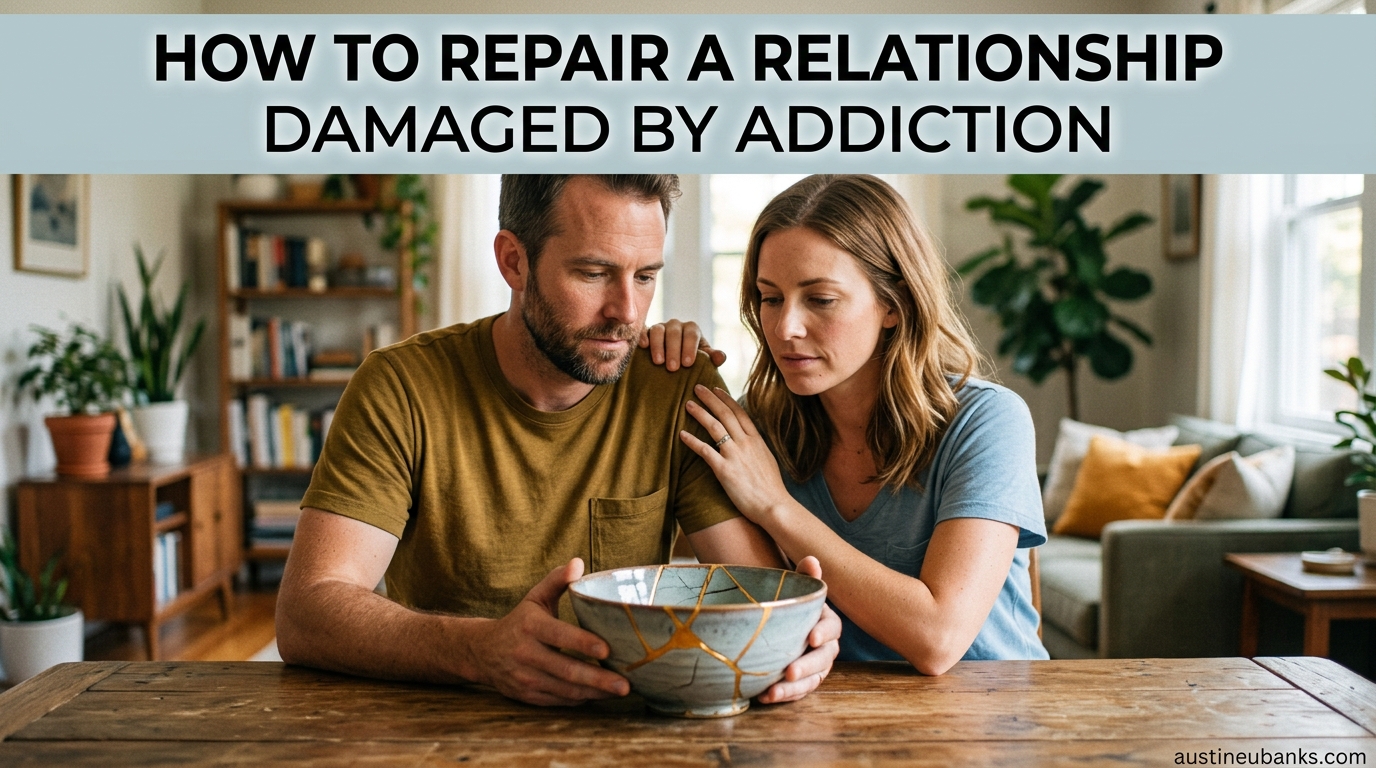
Learning how to repair a romantic relationship damaged by addiction is one of the hardest things two people can attempt together. The lies, broken promises, and emotional wreckage left by substance use disorder can make love feel impossible to recover. But relationships can and do heal when both partners commit to honesty, professional support, and consistent action over time.
I have spent years researching addiction recovery and relationship dynamics, studying everything from SAMHSA guidelines to real stories shared in recovery communities. What I have learned is that most advice online only tells half the story. The recovering partner gets pages of guidance while the partner who stayed gets a paragraph of generic encouragement.
This guide changes that. I cover both perspectives with equal depth, because a relationship is not a one-person repair project. You will find a step-by-step rebuilding process, a realistic timeline for trust recovery, communication strategies that actually work in tense moments, and a dedicated section for the partner who is not in recovery.
Whether you are the person in early recovery trying to make amends, the partner who has been hurt and is deciding whether to stay, or a couple working through this together, the steps ahead are practical and proven. No vague platitudes. No empty promises. Just real, actionable guidance for one of the most important rebuilds of your life.
Table of Contents
Quick Summary: The Path to Repair
Before diving into the full guide, here is the short version. Repairing a relationship damaged by addiction requires seven core elements: sustained recovery from the addicted partner, honest acknowledgment of the damage caused, full accountability without defensiveness, open and consistent communication, demonstrated behavioral change over time, mutually agreed-upon boundaries, and professional support through therapy or counseling.
Trust does not return because you say you are sorry. It returns because your actions consistently match your words, day after day, month after month. The partner who was hurt needs space to grieve, process, and heal at their own pace. Pressuring them to move faster will only slow the process down.
If both partners are willing to do the work, relationships not only survive addiction but often become stronger, deeper, and more honest than they were before. Let me walk you through exactly how that happens.
How Addiction Erodes Romantic Relationships
Understanding what broke is the first step in knowing how to fix it. Addiction does not just damage one part of a relationship. It attacks the foundation from multiple angles simultaneously, often before either partner fully realizes what is happening.
The Destruction of Trust
Trust is the first casualty of addiction, and it dies through a thousand small cuts rather than a single blow. Hidden bottles, unexplained absences, money that disappears, and promises that evaporate by morning. Each lie, no matter how small the addicted person thinks it is, chips away at the partner’s ability to believe anything they hear.
Over time, the partner learns to expect deception. They start checking phones, counting pills, tracking mileage, and searching for evidence. This hypervigilance is exhausting and corrosive. Even after the addicted partner enters recovery, the hypervigilance does not simply switch off. The brain has been trained to anticipate betrayal, and that training takes months or years to unlearn.
Communication Breakdown
Active addiction makes honest communication nearly impossible. The addicted partner hides, minimizes, and deflects to protect their substance use. The sober partner adapts by either confronting aggressively or withdrawing entirely. Neither pattern is healthy, and both become deeply ingrained habits that persist into recovery.
Many couples enter recovery with communication patterns that are actively hostile. One partner expects lies and interrogates accordingly. The other expects criticism and responds defensively. Breaking this cycle requires learning entirely new ways of speaking and listening, which is why professional help is so important.
The Loss of Emotional Safety
Emotional safety is the feeling that you can be vulnerable with your partner without being hurt, judged, or betrayed. Addiction destroys this safety systematically. The addicted partner might lash out during intoxication or withdrawal, say cruel things they do not remember, or disappear emotionally when their partner needs them most.
The partner who was hurt carries these wounds long into recovery. They may flinch at certain tones of voice, feel anxious when their partner is late, or struggle to share feelings because the last time they tried, they were dismissed or attacked. Rebuilding emotional safety is not about erasing these memories. It is about creating enough new, positive experiences that the old wounds begin to lose their grip.
Codependency and Enabling
Codependency is a pattern where one partner bases their self-worth and identity on taking care of the other, often at great personal cost. Enabling is when well-meaning actions accidentally make it easier for the addiction to continue. Both are extremely common in relationships affected by substance use disorder, and both must be recognized and addressed for genuine repair to happen.
Codependent partners often struggle with boundaries because saying no feels like abandonment. They cover for their partner, make excuses, bail them out, and prioritize the addicted partner’s needs above their own. In recovery, this dynamic does not automatically disappear. Without intentional work, the codependent partner may simply shift from enabling the addiction to managing the recovery, which keeps the unhealthy power dynamic alive.
Signs the Relationship Can Be Repaired vs. When to Walk Away
Not every relationship damaged by addiction can or should be saved. Knowing the difference between a relationship that is struggling but viable and one that is dangerous or fundamentally broken is essential for both partners’ wellbeing.
Positive Signs the Relationship Can Be Repaired
The relationship has a real chance if the recovering partner has committed to sustained recovery, not just a detox or a single stint in rehab. They take responsibility for their actions without blaming circumstances or other people. They are willing to answer questions about the past honestly, even when it is uncomfortable. They actively seek professional help rather than resisting it.
The relationship also has potential if the partner who was hurt is willing to work toward forgiveness, even if they are not there yet. Both partners can have difficult conversations without things escalating into screaming matches or emotional shutdown. There is a shared commitment to the process, even when progress feels slow.
Red Flags and Warning Signs
The relationship may not be repairable if the addicted partner is in denial about the severity of the problem. If they keep relapsing without changing their approach, refuse to attend treatment or meetings, or blame the relationship for their substance use, these are serious warning signs.
Other red flags include minimizing the damage done, refusing to discuss the past, or expecting trust to return on a timeline they dictate. If the recovering partner uses recovery jargon to manipulate their partner into dropping boundaries, that is a form of control, not recovery.
When to Walk Away
You should seriously consider leaving if there is any form of physical abuse, regardless of whether the person was intoxicated at the time. Emotional abuse that continues into recovery is another clear signal. If the addicted partner repeatedly relapses and refuses to adjust their recovery plan, you are under no obligation to stay and watch.
If you have children, their safety and wellbeing must come first. A home environment destabilized by active addiction is not safe for children, and staying in a dangerous situation teaches them damaging lessons about what relationships should look like. The National Domestic Violence Hotline at 1-800-799-7233 is available 24 hours a day if you need support.
Walking away does not mean you do not love the person. Sometimes the most loving thing you can do, for both of you, is to step away. You cannot save someone who is not ready to save themselves, and staying in a dangerous or toxic situation only deepens the damage for everyone involved.
How to Repair a Romantic Relationship Damaged by Addiction: Step by Step
This is the core of the guide. Each step builds on the one before it, and skipping ahead usually leads to setbacks. Take your time with each phase, and remember that progress is rarely linear.
Step 1: Commit to Sustained Recovery First
Recovery must come before relationship repair. This is non-negotiable. If the addicted partner is not actively engaged in treatment, therapy, a support program, or some combination of these, relationship repair is premature. Building a relationship on unstable sobriety is like building a house on quicksand.
This is hard to hear for people who want to save their relationship immediately. But getting sober specifically for a partner, rather than for yourself, is one of the most common mistakes people make. Reddit users in recovery communities repeatedly share stories of getting clean for someone else, only to relapse when the relationship hits turbulence. Recovery has to be intrinsically motivated to be sustainable.
If you are the recovering partner, your primary relationship right now is with your recovery program. That might mean meetings, a sponsor, therapy, medication-assisted treatment, or inpatient care. The relationship repair work comes after you have established a stable foundation of sobriety.
Step 2: Acknowledge the Hurt Without Defensiveness
Your partner needs to hear you name the damage without excuses, explanations, or justifications. This does not mean a blanket apology. It means sitting with your partner and acknowledging specific things you did and how they hurt. I lied about where I was. I spent our savings. I said things that were cruel and unforgivable in the moment.
The natural instinct is to explain. To say yes, but I was using, or I did not mean it. Resist that instinct. When your partner is sharing their pain, your job is to listen, not to defend. Defensiveness tells your partner that you are more interested in protecting your self-image than in understanding their experience.
This step may need to happen multiple times. Your partner will process the hurt in layers, and new emotions will surface as they feel safer sharing. Each time, your response should be the same: listen, acknowledge, and validate. The acknowledgment phase is not a one-time event but an ongoing practice.
Step 3: Take Full Responsibility
Full responsibility means owning every choice you made during active addiction without distributing blame. Yes, addiction is a disease. Yes, it changes brain chemistry and impairs decision-making. But the people you hurt experienced your actions as choices, and they need to hear you own those actions as choices before they can begin to trust you again.
This is where many recovering partners get stuck. They want to separate themselves from the person they were during active addiction, as if that person was someone else entirely. But your partner lived through those actions. They experienced them in real time. You cannot distance yourself from that version of you and expect your partner to do the same.
Step 4: Communicate Openly and Consistently
Open communication in recovery means radical transparency. Where you are, who you are with, what you are feeling, and when you are struggling. This is not about surveillance or punishment. It is about rebuilding the habit of honesty so deeply that your partner stops expecting deception.
Consistency matters more than intensity. A partner who checks in daily with brief, honest updates builds more trust than one who writes a long letter once and then goes quiet. Small, reliable actions repeated over weeks and months are the currency of trust rebuilding.
Step 5: Demonstrate Change Through Actions
Words are cheap in addiction recovery. Your partner has heard promises before, probably many times, and watched them evaporate. What rebuilds trust is not what you say but what you do, repeatedly, even when no one is watching.
Show up on time. Follow through on commitments, no matter how small. Attend your meetings or appointments without being reminded. Handle difficult emotions without reaching for a substance. Be present during conversations instead of checking out. Each of these actions is a small deposit in the trust account, and over time, the balance grows.
Step 6: Set and Respect Boundaries
Boundaries are not walls. They are agreements that protect both partners and the relationship itself. The partner who was hurt may set boundaries around certain topics, behaviors, or situations that feel triggering. The recovering partner may set boundaries around conversations that feel like interrogation rather than dialogue.
Both partners need to respect each other’s boundaries even when they disagree with them. If your partner says they need a phone call when you are going to be thirty minutes late, that is not controlling behavior. That is a reasonable request from someone whose trust has been broken. Respecting it without complaint is how trust gets rebuilt.
Step 7: Seek Professional Help
Couples therapy is strongly recommended for any couple attempting to repair a relationship after addiction. A trained therapist can mediate difficult conversations, teach communication skills, and help both partners recognize unhealthy patterns they may not see themselves.
Individual therapy is equally important for both partners. The recovering partner needs support processing guilt, shame, and the emotional work of amends. The partner who was hurt needs support processing betrayal, grief, and the decision to stay. Expecting one therapist or one therapy format to address everything is unrealistic.
Communication Strategies That Actually Work
Communication is where most couples in recovery get stuck. Old patterns are deeply entrenched, and new ones feel awkward and artificial at first. These specific techniques can help you break through.
Use I-Statements Instead of You-Statements
When you feel hurt, the instinct is to say you did this or you always do that. These statements feel like attacks, and they trigger defensiveness. Instead, frame your feelings from your own perspective. I feel scared when you come home late without calling because of what happened during your addiction.
This sounds simple, but it changes the entire dynamic of the conversation. I-statements invite empathy. You-statements invite combat. Practice this technique deliberately until it becomes second nature, because it will not happen on its own.
Practice Active Listening
Active listening means giving your full attention to what your partner is saying without planning your response while they speak. Put your phone down. Make eye contact. When they finish, reflect back what you heard before responding. What I am hearing is that you felt abandoned when I missed our anniversary. Is that right?
This technique feels slow at first, but it prevents the misunderstandings that spiral into arguments. Many couples in recovery discover that a significant portion of their conflicts come from simply not hearing each other accurately.
Handle Triggers With a Plan
Certain topics, times of day, or situations will trigger strong emotions for both partners. Maybe it is the anniversary of a particularly bad incident. Maybe it is the neighborhood where your partner used to buy drugs. Identify these triggers in advance, during a calm moment, and agree on a plan for how to handle them.
A trigger plan might include a safe word that signals I need a break, a pre-agreed timeout period before resuming a conversation, or a specific grounding technique like the 3-3-3 anxiety method. Having a plan in place before the trigger hits prevents the kind of reactive escalation that derails recovery.
Set Digital Communication Boundaries
Modern relationships face unique challenges that competitors rarely address. Social media can be a minefield for recovering couples. Old contacts from active addiction days, photos that trigger memories, or location sharing that feels like surveillance to one partner and safety to the other.
Discuss these boundaries openly. You might agree to unfollow certain people, share location only during specific hours, or avoid discussing relationship issues over text where tone gets lost. Digital boundaries are just as real and important as physical ones, and they deserve explicit conversation rather than assumption.
Rebuilding Trust: A Realistic Timeline
One of the biggest gaps in existing advice is the absence of a realistic timeline. People searching for how long it takes to rebuild trust after addiction deserve more than the vague response that it takes time. Based on recovery research and patterns reported by couples who have been through this process, here is what a general timeline often looks like.
Keep in mind that every relationship is different. These milestones are approximate, not guarantees. Some couples move faster, some slower, and both can be perfectly normal.
First 30 Days: Establishing Safety
The first month is not about relationship repair. It is about establishing stability. The recovering partner focuses on their recovery program, and the partner who was hurt focuses on their own wellbeing. Relationship conversations during this period should be brief, honest, and focused on logistics rather than deep emotional processing.
During this phase, expect raw emotions from both sides. Anger, grief, relief, fear, and hope can all surface within the same day. This is normal. The goal is not to resolve these feelings but to create a safe container for them to exist without destroying the progress being made.
Days 30 to 90: Beginning the Conversation
Once initial stability is established, deeper conversations can begin. This is when the acknowledgment work starts, when the recovering partner begins naming specific harms, and when the partner who was hurt begins articulating their experience. Couples therapy typically starts during this window.
Trust gains during this phase are small but real. Showing up consistently, being honest about struggles, and following through on commitments starts to build a fragile foundation. Expect setbacks. Old triggers will resurface, and conversations will sometimes go sideways. What matters is the commitment to keep trying.
Days 90 to 180: Building Momentum
Three to six months in, patterns start to solidify. The new communication habits become more natural. The recovering partner has demonstrated enough consistency that the partner who was hurt begins to relax, slowly. This does not mean trust is restored, but the constant hypervigilance begins to ease.
This is also when deeper work happens. Codependency patterns get addressed. Grief over what was lost gets processed. The couple starts imagining a future together that is not defined by addiction. These conversations are hard but necessary for moving from survival mode into actual rebuilding.
Days 180 to 365: Deepening Trust
Six months to a year of sustained recovery and consistent relationship work is where most couples start to feel genuinely hopeful. Trust is not fully restored, but it is meaningfully present. The relationship has new traditions, new communication patterns, and new shared experiences that are not contaminated by active addiction.
This does not mean the work is done. Triggers will still arise. Old wounds will still ache. But the relationship has demonstrated resilience, and both partners have evidence that repair is possible. The second year of recovery is often when couples reflect and realize how far they have come.
Making Amends: How and When
Making amends is a concept most people know from 12-step programs, but it applies to any relationship repair process. An amends is fundamentally different from an apology, and understanding that difference matters enormously.
Amends vs. Apology
An apology says I am sorry for what I did. An amends says I am sorry for what I did, here is how I am going to make it right, and here is the changed behavior that proves I mean it. The amends is about action, not just words. It requires the recovering partner to demonstrate, through ongoing behavior, that they understand the harm and are committed to not repeating it.
Direct vs. Indirect Amends
Direct amends involve face-to-face acknowledgment and behavioral change. This is appropriate when the partner is open to receiving it and when the conversation will not cause further harm. The recovering partner names the specific damage, takes full responsibility, and commits to specific changes.
Indirect amends are used when direct contact would be harmful or unwelcome. If the partner is not ready to talk, or if the relationship has ended, the recovering partner makes living amends by changing their behavior in all relationships going forward. The work is the same, even if the audience is different.
Timing Matters Enormously
Making amends too early, before the partner is ready to receive them, can cause more harm than good. The partner needs to see sustained behavioral change before hearing a formal amends, or the words will feel hollow. Most addiction counselors recommend waiting until the recovering partner has at least several months of stable sobriety before attempting formal amends.
Self-Care for the Partner Who Stayed
This section exists because no competitor I found addresses the non-addicted partner’s needs with real depth. If you are the partner who stayed, who was hurt, who is trying to decide whether to rebuild or walk away, this is for you.
Recognize Compassion Fatigue
You have likely been carrying the emotional weight of this relationship for months or years before your partner entered recovery. That takes a massive toll. Compassion fatigue is real, and it can manifest as emotional numbness, irritability, physical exhaustion, or a sense that you simply cannot do this anymore.
These feelings do not make you a bad partner. They make you a human being who has been under extraordinary stress for a long time. Acknowledging compassion fatigue is the first step toward addressing it, and addressing it is essential if you want to continue participating in the relationship repair process.
Find Your Own Support System
Al-Anon is the most widely known support group for partners and family members of people with alcohol use disorder. Nar-Anon serves those affected by drug addiction. SMART Recovery Family and Friends offers a science-based alternative. Finding a group where you can talk to people who have been in your shoes can be life-changing.
You need a space where you can express anger, frustration, and grief without worrying about how it affects your partner’s recovery. Individual therapy serves a similar purpose. The point is that your emotional needs are not secondary to the recovering partner’s needs, and they require their own dedicated attention.
Process the Grief
Grief is one of the most under-discussed emotions in relationship repair after addiction. You are grieving the relationship you thought you had. You are grieving the years consumed by addiction. You may be grieving the version of your partner that existed before substances took over. You might even be grieving the version of yourself you lost while trying to manage someone else’s addiction.
This grief is normal. It does not mean you do not love your partner or that the relationship is doomed. It means you are processing real losses, and that processing takes time. Give yourself permission to feel sad, angry, and disoriented without judging yourself for it.
Protect Your Own Recovery
Just as the addicted partner needs to prioritize their recovery, you need to prioritize your own healing. That means maintaining friendships outside the relationship, pursuing your own interests, and setting boundaries that protect your mental health. Codependency recovery is real work, and it often requires as much attention as addiction recovery.
You cannot be the sole source of your partner’s support, and they cannot be the sole focus of your energy. Healthy relationships require two whole people, each with their own support systems, interests, and identity. Rebuilding that individual identity is not selfish. It is necessary.
What to Do If Relapse Happens During Repair
No competitor I found addresses this critical scenario, yet forum discussions reveal it is one of the most feared and common challenges couples face. Relapse is a statistically common part of recovery, and having a plan for it can prevent a single relapse from destroying all the trust you have rebuilt.
The Immediate Response
If relapse occurs, the recovering partner must communicate it as soon as possible. Hiding a relapse does far more damage than the relapse itself because it resurrects the pattern of deception that destroyed trust in the first place. Even if the partner is angry, telling them immediately is always the right call.
The partner who was hurt is entitled to their reaction. Anger, fear, devastation, and disappointment are all normal. The recovering partner should listen without defending, validate those feelings, and immediately re-engage with their recovery program.
Reassess Boundaries and Safety
After a relapse, the existing boundaries may need adjustment. The partner who was hurt may need more transparency or different safety measures. The recovering partner may need a more intensive treatment approach. Both partners should revisit their agreements with their therapist and adjust as needed.
If relapses become repeated, a harder conversation about whether the relationship can continue is necessary. A single relapse addressed honestly can be a bump in the road. A pattern of relapse and concealment is a different situation entirely, and it may signal that the relationship needs to pause while the addicted partner gets more intensive help.
Maintaining the Relationship Long-Term
Once the initial repair work is done, maintaining the relationship becomes the focus. This is about building a new relationship on the foundation you have rebuilt, one that is healthier and more resilient than what came before.
Create Shared Goals and a Vision
Couples who recover together often find that their pre-addiction relationship had problems that contributed to the environment where addiction thrived. Now is the time to build something better. Talk about what you both want the relationship to look like in one year, five years, and beyond.
Shared goals create forward momentum. Whether it is a travel plan, a home project, a fitness goal, or a shared hobby, having something you are working toward together reminds both partners that the relationship is about more than recovery. The addiction chapter is part of your story, but it does not have to be the whole story.
Schedule Regular Check-Ins
Weekly or biweekly relationship check-ins provide a structured space to discuss how things are going. What is working, what is not, what feels triggering, and what needs adjustment. These conversations should be calm, scheduled, and separate from conflict resolution.
Without structured check-ins, problems tend to accumulate until they explode. Regular, low-stakes conversations prevent that buildup and keep both partners attuned to each other’s emotional states.
Celebrate Milestones Together
Sobriety milestones, therapy achievements, relationship anniversaries, and personal victories all deserve recognition. Celebrating these moments together reinforces that the hard work is worth it and that both partners are invested in the journey. These positive shared experiences are the new memories that gradually overwrite the painful ones.
Frequently Asked Questions
Can you have a healthy relationship with an addict?
Yes, a healthy relationship is possible, but it requires the addicted partner to be in active, sustained recovery rather than early sobriety. Most addiction counselors recommend waiting at least one year into recovery before pursuing a new relationship. For existing relationships, both partners need honesty, professional support, boundaries, and patience. A healthy relationship with someone in recovery is built on transparency, mutual respect, and consistent action, not promises.
What is the 3 3 3 rule for addiction?
The 3-3-3 rule is a grounding technique used to manage anxiety, which is common during early recovery. You name three things you can see, three sounds you can hear, and move three parts of your body. This brings your attention back to the present moment and helps regulate the nervous system when triggers or cravings arise. While not specific to relationship repair, it is a useful tool for both partners during stressful conversations.
How to rebuild relationships after addiction?
Rebuilding relationships after addiction requires seven steps: commit to sustained recovery first, acknowledge the hurt without defensiveness, take full responsibility, communicate openly and consistently, demonstrate change through daily actions, set and respect mutual boundaries, and seek professional help through couples and individual therapy. Trust returns through consistent behavior over months and years, not through apologies alone.
When to walk away from an alcoholic partner?
You should consider walking away if there is any physical or emotional abuse, if your partner refuses to seek treatment, if they repeatedly relapse without adjusting their recovery approach, or if your safety or your children’s safety is at risk. Other signs include neglect of responsibilities, inability to maintain employment, and withdrawal symptoms when attempting to stop. Walking away is painful but sometimes necessary for your own survival and wellbeing.
How long does it take to rebuild trust after addiction?
There is no universal timeline, but many couples report meaningful progress at the 90-day mark of sustained recovery, significant improvement around 6 months, and a genuine sense of restored trust between 12 and 18 months. This assumes the recovering partner maintains sobriety, attends therapy, and demonstrates consistent behavioral change throughout. Every relationship moves at its own pace, and comparing your timeline to others can create unnecessary pressure.
Is it normal to grieve during relationship repair after addiction?
Yes, grief is one of the most common and least discussed emotions during relationship repair. Both partners may grieve the relationship they thought they had, the years lost to addiction, and the versions of themselves that existed before the damage. This grief is a normal part of the healing process and does not mean the relationship is failing. Processing grief with a therapist can help both partners move through it without getting stuck.
Conclusion
Learning how to repair a romantic relationship damaged by addiction is not a linear process. It requires sustained recovery, honest communication, professional support, and consistent action from both partners. The steps in this guide are proven, but they demand real commitment and patience.
If you take away one thing, let it be this: trust is rebuilt through daily, small, consistent actions, not through grand gestures or single apologies. Whether you are the recovering partner making amends or the partner who stayed and is choosing to rebuild, the work is worth it. Relationships that survive addiction often emerge stronger, deeper, and more honest than they were before. Start with one step today.