
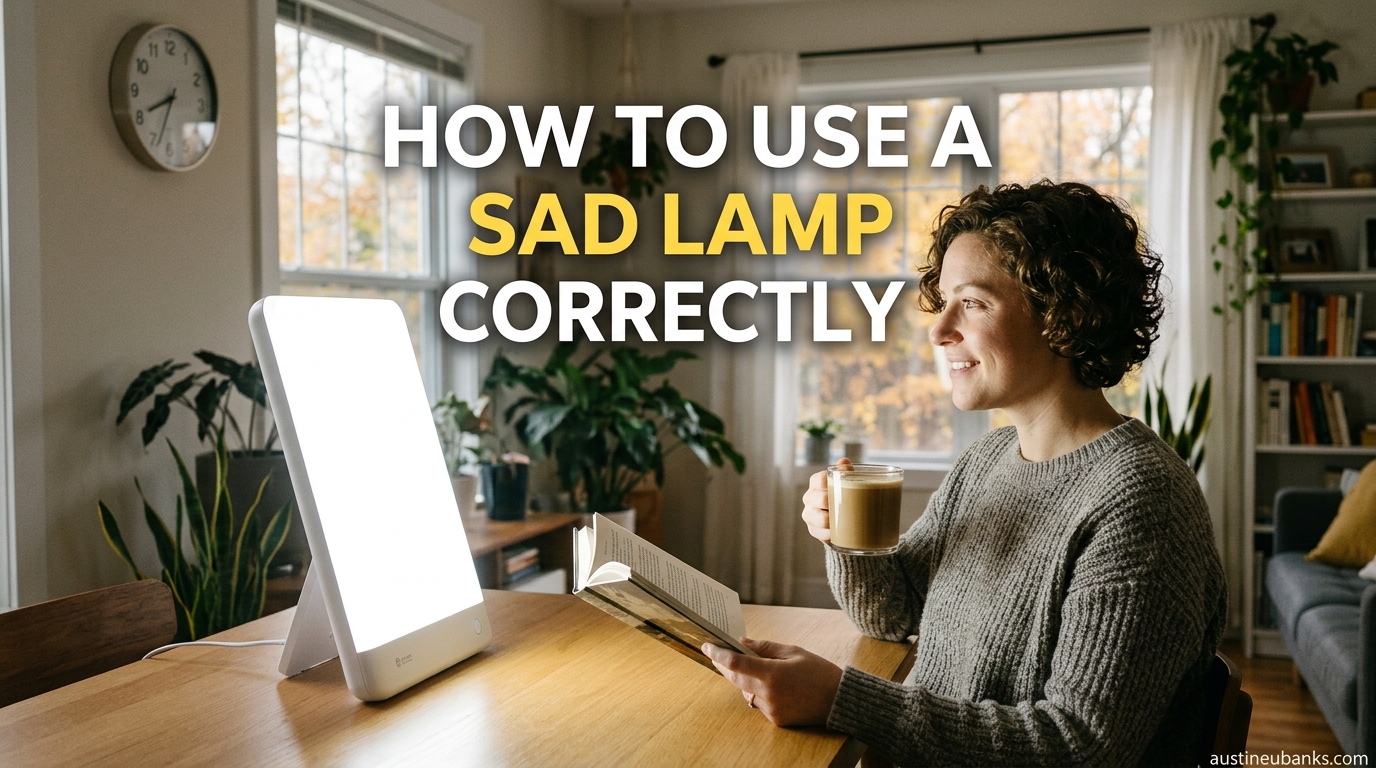
Knowing how to use a SAD lamp correctly makes the difference between feeling noticeably better in two weeks and wondering whether you wasted your money. A surprising number of people buy a 10,000 lux light box, set it across the room, and expect results that never come. The positioning, distance, timing, and daily consistency all matter far more than most people realize.
I have spent years researching and testing light therapy practices, drawing on clinical guidelines from institutions like UBC’s Mood Disorders Centre and the Mayo Clinic. In this guide, I will walk you through exactly how to set up, position, time, and maintain your SAD lamp routine so you get the maximum therapeutic benefit from every session.
Whether you just unpacked your first light box or you have been using one for months without results, this guide covers everything from the correct distance and angle to practical morning routine hacks that no one else is talking about. By the end, you will have a complete, science-backed plan for using your SAD lamp the right way.
Table of Contents
What You Need Before You Start: SAD Lamp Requirements
Not all light therapy lamps are created equal, and using the wrong type of device is the first mistake people make. To get results, you need a lamp that meets specific clinical criteria established through decades of bright light therapy research. Here is what matters most.
Light Intensity: Why 10,000 Lux Is the Standard
The single most important specification is light intensity, measured in lux. Clinical research consistently shows that 10,000 lux is the optimal intensity for treating Seasonal Affective Disorder. At this brightness, most people need just 30 minutes per day to see results. Lamps with lower output (2,500 to 5,000 lux) can work, but they require significantly longer sessions, often 1 to 2 hours daily.
Think of it this way: the total therapeutic dose equals intensity multiplied by time. A 10,000 lux lamp for 30 minutes delivers roughly the same light energy as a 5,000 lux lamp for 60 minutes. Most people find it far easier to commit to 30 minutes than to sit for an hour or more each morning.
Light Spectrum: Full Spectrum vs Natural Spectrum
SAD lamps typically use either cool-white fluorescent or LED bulbs that produce a broad spectrum of visible light. The important thing is that the light appears white or slightly bluish-white, simulating natural daylight. You do not need a lamp that produces ultraviolet (UV) light. In fact, you specifically want a lamp that filters UV rays out.
Some manufacturers advertise “full spectrum” or “natural spectrum” light, but these marketing terms matter less than the actual lux output. The therapeutic benefit comes from the brightness reaching your eyes, not from any particular color temperature. A good SAD lamp will have a color temperature between 3,000K and 6,500K.
UV Filter: A Non-Negotiable Safety Feature
Your SAD lamp must filter out UV radiation. Reputable light therapy devices are designed to block UV-A and UV-B rays because prolonged UV exposure damages skin and eyes. The Mayo Clinic specifically warns consumers to verify that any light therapy box filters UV light before purchasing.
UV light plays no role in the mood-boosting effects of light therapy. The benefit comes entirely from visible light stimulating receptors in your eyes that communicate with your brain’s circadian rhythm system. If a lamp advertises UV output as a feature, avoid it.
SAD Lamp vs Regular Lamp: What Is the Difference?
A regular desk lamp or household light fixture typically produces 250 to 500 lux. Even a brightly lit office rarely exceeds 500 lux. A proper SAD therapy lamp produces 10,000 lux or more, which is roughly 20 times brighter than typical indoor lighting. This massive difference in intensity is what makes light therapy effective. No standard household lamp can deliver a therapeutic dose of light.
How to Use a SAD Lamp Correctly: Step-by-Step Guide
This is the core of what you came here for. Follow these steps every morning to get the full therapeutic benefit from your light therapy lamp. I have broken down each step based on clinical protocols from UBC’s Mood Disorders Centre and peer-reviewed research on optimal light therapy implementation.
Step 1: Choose the Right Location
Place your SAD lamp on a stable surface like a desk, kitchen counter, or table where you spend your mornings. The surface should be at roughly the same height as your seated head position or slightly above. A desk or tabletop works well for most people because it positions the light at or just above eye level.
Avoid placing the lamp on the floor or on a very high shelf. Floor placement puts the light too far below your eyes, and high shelves create awkward upward angles that reduce effectiveness. The ideal setup puts the lamp 2 to 3 inches above your natural eye line when you are seated comfortably.
Step 2: Set the Correct Distance
Position yourself approximately 16 to 24 inches (about 41 to 61 centimeters) from the lamp. This distance is critical because light intensity follows the inverse square law, meaning that doubling your distance from the lamp reduces the light reaching your eyes by roughly 75 percent.
If you sit 16 inches away from a 10,000 lux lamp, your eyes receive approximately 10,000 lux. Move back to 32 inches and you receive only about 2,500 lux. At that reduced intensity, you would need to sit for 2 hours instead of 30 minutes to get the same therapeutic dose. Distance is the single biggest factor that determines whether your lamp works.
Step 3: Angle the Light Correctly
The lamp should be positioned at eye level or slightly above, tilted downward toward your face at an angle of about 15 to 30 degrees. This angle follows the cosine law of light incidence, which means light hitting your eyes straight on delivers maximum energy while light coming from an extreme angle delivers much less.
You should not stare directly into the lamp. Instead, the light should reach your eyes indirectly while you look at a book, a phone, a computer screen, or your breakfast. Think of it like sitting near a bright window on a sunny morning. The light bathes your face and eyes without you needing to look directly at the source.
Step 4: Keep Your Eyes Open
Light therapy requires your eyes to be open because the therapeutic effect depends on light entering your retinas. You do not need to stare at the lamp, but you should not sleep or keep your eyes closed during a session. Reading, eating, working on a laptop, or scrolling through your phone are all perfectly fine activities during light therapy.
Many people on Reddit and mental health forums report success using their lamp while eating breakfast or catching up on email. As long as your eyes are open and the lamp is positioned correctly in your peripheral vision, the light does its work.
Step 5: Use It Every Morning
Consistency is the make-or-break factor for light therapy. Research shows that daily use produces significantly better results than sporadic use. Set a specific time each morning, ideally within the first hour of waking, and treat it as a non-negotiable part of your routine. Missing one day will not erase your progress, but consistency over weeks and months is what produces lasting improvement.
Optimal Timing: When and How Long to Use Your SAD Lamp
Timing is just as important as positioning. Using your lamp at the wrong time of day can actually make symptoms worse, particularly if you use it in the late evening. Here is what the research says about getting your timing right.
The Best Time of Day: Early Morning
The optimal time to use a SAD lamp is first thing in the morning, ideally between 6:00 AM and 9:00 AM. Morning light exposure helps regulate your circadian rhythm by signaling to your brain that it is time to be awake and alert. This morning signal suppresses melatonin production, the hormone that makes you sleepy, and stimulates serotonin production, which boosts mood.
UBC’s Mood Disorders Centre recommends starting light therapy as soon as possible after waking up. If you naturally wake at 7:00 AM, aim to begin your session by 7:15 or 7:30. The closer to waking, the more effective the circadian signal.
How Long Each Session Should Last
For a 10,000 lux lamp, the standard session length is 20 to 30 minutes per day. Most clinical studies use 30-minute sessions, and this duration works well for the majority of users. Some people find they need slightly more time, especially during the darkest winter months, and can safely increase to 45 or even 60 minutes if they do not experience side effects.
If your lamp produces less than 10,000 lux, you will need proportionally more time. A 5,000 lux lamp typically requires 60 minutes, and a 2,500 lux lamp may require up to 2 hours. This is why investing in a proper 10,000 lux device saves time and improves compliance.
What Happens If You Use It at Night
Using your SAD lamp in the evening can disrupt your sleep by suppressing melatonin production when your body needs it most. Evening light exposure tricks your brain into thinking the sun is still up, which delays your natural sleep cycle and can worsen the very symptoms you are trying to treat. Avoid using your lamp within 2 to 3 hours of your intended bedtime.
If you work night shifts or have an unusual schedule, you may need to adjust your timing. Shift workers should use the lamp at the start of their active period, whenever that falls. Consult a sleep specialist if you have a non-standard schedule to find the optimal timing for your situation.
Building a Morning Light Therapy Routine
This is something no competitor covers, yet it is one of the most common questions people ask on Reddit and mental health forums. How do you actually fit a 30-minute lamp session into a busy morning? The answer is simple: multitask with activities you already do every morning.
Pair Your Lamp With Existing Morning Habits
The easiest approach is to combine light therapy with something you already do each morning. Eating breakfast is the most popular pairing. Set the lamp on your kitchen table about 18 inches from where you sit, and turn it on while you eat. By the time you finish your meal and coffee, your session is complete.
Other effective pairings include checking email, reading the news, doing your makeup, meditating, stretching, or planning your day. The key is choosing an activity that keeps you in one position for 20 to 30 minutes with your eyes open and the lamp properly positioned.
Working at Your Desk During Light Therapy
If you work from home, position your SAD lamp just above and behind your computer monitor or off to one side at the correct distance. Many remote workers place the lamp behind their keyboard, angled up slightly toward their face. This lets you get your light therapy in during the first 30 minutes of your workday while you check emails or review your calendar.
One Reddit user described placing their lamp directly behind their laptop while doing their morning work routine. This is a practical approach that requires no extra time out of your day. The important thing is making sure the distance and angle follow the guidelines above.
Using Phone Reminders and Habit Stacking
Set a daily phone alarm for your light therapy time, especially during the first few weeks when the habit is still forming. After about two to three weeks of consistent use, the habit becomes automatic for most people. Link the new habit to an existing one using a technique called habit stacking: “After I pour my morning coffee, I will turn on my SAD lamp.”
What to Do on Weekends
Weekend mornings often throw off routines, but consistency matters. Try to use your lamp within an hour of your usual weekday wake time. If you sleep in slightly on weekends, that is fine. Just do not skip the session entirely. Many users find that maintaining the routine on weekends actually helps them feel more energized for weekend activities.
Common Mistakes to Avoid When Using a SAD Lamp
Even with the best intentions, certain mistakes can dramatically reduce the effectiveness of your light therapy. Here are the most common errors people make and how to fix each one.
Mistake 1: Sitting Too Far From the Lamp
This is the number one mistake. As I explained earlier, the inverse square law means that sitting twice as far from the lamp cuts the light intensity by roughly 75 percent. If you place the lamp on a shelf across the room or on a kitchen counter while you sit at the table several feet away, you are getting a fraction of the therapeutic dose. Always measure your distance: 16 to 24 inches is the target range for a 10,000 lux lamp.
Mistake 2: Staring Directly at the Light
Some people believe they need to look directly at the lamp for it to work. This is both unnecessary and uncomfortable. Staring at a bright light for 30 minutes can cause eye strain, headaches, and visual disturbances. The therapeutic effect comes from ambient light entering your eyes while you go about your morning activities. Keep your eyes open but focused on something else.
Mistake 3: Using the Lamp at the Wrong Angle
If the lamp is positioned below your eye level, like on a low coffee table while you sit on a couch, the angle of incidence reduces the amount of light reaching your retinas. Similarly, placing the lamp directly to your side rather than in front of you reduces effectiveness. The cosine law dictates that light striking your eyes at a steep angle delivers much less energy than light coming from slightly above and in front.
Mistake 4: Inconsistent Use
Skip a day here and there and you will probably be fine. But skipping several days a week, or using the lamp only when you feel particularly bad, undermines the therapeutic effect. Light therapy works by providing a consistent daily signal to your circadian rhythm system. Irregular use confuses that signal. Commit to daily use during your treatment season.
Mistake 5: Using the Lamp Too Late in the Day
Using your SAD lamp in the afternoon or evening can push your circadian rhythm in the wrong direction, making it harder to fall asleep and potentially worsening your symptoms. Stick to the morning window of 6:00 AM to 9:00 AM. If you absolutely must do a second session, keep it before 2:00 PM to avoid sleep disruption.
Mistake 6: Expecting Instant Results and Giving Up
Many people try light therapy for three or four days, feel no different, and conclude it does not work. Clinical research shows that improvement typically begins within the first week but significant results usually take 10 to 14 days of consistent daily use. If you stop before the two-week mark, you may never experience the benefit.
Mistake 7: Using the Wrong Type of Lamp
Not every bright light is a therapy light. Some people try using grow lights, sun lamps, or tanning lamps, none of which are designed for therapeutic use. Tanning lamps emit dangerous UV radiation and should never be used for light therapy. Only use a lamp specifically designed and tested for SAD treatment with a verified 10,000 lux output and UV filtration.
How to Use a SAD Lamp While Working From Home or at the Office
Using a SAD lamp in a shared or professional environment comes with unique challenges. Here is how to make it work whether you are at a home office or in a workplace.
Home Office Setup
The simplest setup for remote workers is a compact SAD lamp positioned on your desk, just above or beside your monitor. Angle it toward your face from about 18 inches away. Turn it on during your first 30 minutes at the computer each morning. Many people report that this morning light exposure helps them feel more alert and focused for the rest of the workday.
Using a SAD Lamp in a Shared Office
In a shared or open-plan office, using a SAD lamp requires some consideration for coworkers. A small, compact light therapy lamp placed on your desk is generally unobtrusive. Position it angled toward you rather than outward toward colleagues. Most modern SAD lamps are designed to be directional, projecting light forward rather than scattering it in all directions.
If you are concerned about appearance, look for SAD lamps designed to look like modern desk lights or monitors. Several manufacturers produce aesthetically neutral devices that blend into a professional workspace. Using it during your first 30 minutes at your desk, before the office gets busy, is often the most practical approach.
Lamp Types for Different Work Environments
Desktop light boxes are the most versatile option for both home and office use. They are compact, portable, and easy to position. Floor-standing light therapy lamps work well in home offices where space allows. Light therapy visors, which you wear on your head like a cap, are an option for people who move around a lot during the morning or commute. Dawn simulators, which gradually brighten your bedroom before your alarm sounds, can complement but not replace a standard light box.
Safety and Side Effects of SAD Lamp Use
Light therapy is generally safe when used correctly, but like any treatment, it can cause side effects and is not appropriate for everyone. Here is what you need to know to use your SAD lamp safely.
Common Side Effects
Most side effects are mild and tend to resolve within the first few days as your body adjusts. The most frequently reported side effects include mild headaches, eye strain or eye irritation, nausea, and feeling jittery or irritable. If these symptoms persist beyond the first week, try reducing your session time to 15 minutes, sitting slightly farther from the lamp, or using the lamp earlier in the morning.
Some users report feeling a slight headache during the first few sessions. This is usually caused by sitting too close to the light or using the lamp for too long initially. Starting with 15-minute sessions and gradually increasing to 30 minutes can help your eyes and brain adjust to the bright light.
Bipolar Disorder: A Critical Warning
If you have bipolar disorder or any condition involving manic or hypomanic episodes, you must consult your doctor before starting light therapy. Bright light exposure can trigger manic episodes in some individuals with bipolar disorder. This risk is well-documented across all the clinical sources I reviewed, including UBC, the Mayo Clinic, and the Sterling Institute.
This does not mean light therapy is impossible for people with bipolar disorder. It means the treatment must be carefully supervised by a healthcare provider who may recommend shorter sessions, specific timing protocols, or adjustments to your medication.
Eye Health Considerations
People with existing eye conditions such as retinal disease, macular degeneration, diabetic retinopathy, or a history of cataract surgery should consult an eye doctor before starting light therapy. While SAD lamps filter out harmful UV rays, the bright visible light may still pose risks for certain pre-existing conditions. An ophthalmologist can advise whether light therapy is safe for your specific situation.
Medication Interactions
Certain medications can increase your sensitivity to light, making light therapy more likely to cause side effects. These include some antibiotics, anti-inflammatory drugs, diuretics, and acne medications. If you take any prescription medications, check with your pharmacist or doctor about potential photosensitivity before beginning light therapy.
When to Contact a Doctor
Contact your healthcare provider if you experience severe headaches, persistent eye pain, vision changes, unusual mood elevation, irritability that does not resolve, or any symptoms of a hypomanic or manic episode. Also consult a doctor if your depression symptoms do not improve after two weeks of consistent, correctly performed light therapy.
What to Expect: Results Timeline and Troubleshooting
Understanding the expected timeline helps you stay motivated and know when to make adjustments. Here is what the research and user experiences tell us about what to expect from light therapy.
The First Few Days
Some people notice subtle improvements within the first 2 to 3 days, typically described as slightly more energy, easier time waking up, or a marginally better mood. These early changes are usually related to circadian rhythm shifts rather than full therapeutic effects. The lamp is already starting to regulate your internal clock, which can improve morning alertness fairly quickly.
Week One to Two
This is when significant improvement typically begins. UBC’s clinical protocol states that response usually starts within a few days, and by two weeks symptoms should be definitely improving. Most users on Reddit and mental health forums report that the one to two week mark is when they really notice a difference in mood, energy, and motivation.
What to Do If You Are Not Seeing Results
If you have been using your lamp correctly for two weeks with no improvement, several things could be happening. First, verify your distance and angle. Many people drift farther from the lamp over time without realizing it. Re-measure your distance to confirm you are within the 16 to 24 inch range.
Second, consider increasing your session duration. UBC recommends escalating from 30 minutes to 45 or even 60 minutes if no improvement occurs after the initial two-week period. This dose escalation is a standard clinical approach.
Third, check your timing. Make sure you are using the lamp within the first hour of waking. If your schedule has shifted or you are using it later in the morning, moving it earlier may help. Finally, if you have been consistent for three to four weeks with correct technique and still see no benefit, consult your doctor. Light therapy is effective for many people but not everyone, and some individuals may need to combine it with other treatments.
Combining Light Therapy With Other Treatments
Light therapy works well alongside other approaches to managing seasonal depression. Regular exercise, particularly in the morning, complements the mood-boosting effects of light therapy. Maintaining a consistent sleep schedule enhances circadian rhythm regulation. Some people find that combining light therapy with talk therapy, medication, or vitamin D supplementation (which light therapy does not provide) produces the best results. Always discuss combination approaches with your healthcare provider.
Travel Tips, Daylight Saving Time, and Year-Round Use
Real life involves travel, schedule disruptions, and seasonal changes. Here is how to adapt your light therapy routine to keep it working no matter what comes up.
Using a SAD Lamp While Traveling
If you travel during the darker months, consider bringing a portable SAD lamp. Compact light therapy devices are available that fold flat and weigh under 2 pounds, making them easy to pack. Use your portable lamp in your hotel room or accommodation during your first 30 minutes of being awake, just as you would at home.
If you are traveling across time zones, align your light therapy session with local morning time at your destination. This can actually help you adjust to the new time zone faster, since morning light exposure is one of the most effective ways to reset your circadian rhythm. If you cannot bring a lamp, try to get outside for natural sunlight within an hour of waking in your new location.
Adjusting for Daylight Saving Time
Daylight saving time changes can disrupt your circadian rhythm, which may actually increase your need for light therapy. When clocks fall back in autumn, the earlier darkness can trigger SAD symptoms to begin or worsen. This is an ideal time to start or ramp up your light therapy routine.
When clocks spring forward in spring, you may be able to gradually reduce your sessions. Do not stop abruptly. Instead, reduce your session time by 5 minutes every few days and see how you feel. If symptoms return, resume your previous schedule.
Seasonal Schedule: When to Start and Stop
Most people begin light therapy in early autumn, around late September to October, before symptoms become severe. Starting before the darkest months gives your brain a head start on maintaining balanced serotonin and melatonin levels. Continue daily use through the winter until natural daylight hours increase sufficiently in spring, typically around late March to April.
Some people benefit from year-round use, particularly those living in northern climates with long, dark winters. Others find that stopping in spring and resuming in autumn works well. Pay attention to your mood and energy patterns to determine your personal seasonal schedule. If symptoms return after stopping, resume use immediately.
Quick-Reference: Correct SAD Lamp Parameters
Here is a summary of the key parameters for using your SAD lamp correctly. Keep this handy as a daily checklist.
Light intensity: 10,000 lux minimum
Distance from face: 16 to 24 inches (41 to 61 cm)
Lamp height: At eye level or slightly above (2 to 3 inches above eye line)
Angle: Tilted downward toward your face at 15 to 30 degrees
Timing: Within the first hour of waking, between 6:00 AM and 9:00 AM
Duration: 20 to 30 minutes per day (increase to 45 to 60 minutes if needed)
Frequency: Every day, consistently
Eyes: Open, but not staring directly at the light
UV filter: Required, no UV output
FAQs
How long does it take to see results from a SAD lamp?
Most people begin noticing improvements in mood and energy within the first few days of consistent use. Significant symptom improvement typically occurs within two weeks of daily 30-minute morning sessions. If no improvement is seen after 10 to 14 days, try increasing to 45 to 60 minutes per day or consult your doctor about adjusting your approach.
Can you overdo a SAD lamp?
Yes, it is possible to overdo SAD lamp use. Excessive exposure can cause headaches, eye strain, irritability, or even trigger hypomanic episodes in people with bipolar disorder. Stick to 30 minutes per day for 10,000 lux lamps. If you experience side effects, reduce exposure time or sit slightly farther away. Never use the lamp within 2 to 3 hours of bedtime as it can disrupt sleep.
Do you get vitamin D from a SAD lamp?
No, SAD lamps do not provide vitamin D. SAD lamps deliver bright visible light to stimulate your circadian rhythm and boost serotonin levels. Vitamin D is produced when your skin is exposed to UVB rays from sunlight. Most SAD lamps actively filter out UV light for eye safety. To get vitamin D, you need direct sun exposure on your skin or a vitamin D supplement.
When is the best time to use a SAD lamp?
The best time to use a SAD lamp is first thing in the morning, ideally within the first hour of waking up between 6:00 AM and 9:00 AM. Morning exposure is most effective because it helps regulate your circadian rhythm and suppresses melatonin production at the right time. Use it for 20 to 30 minutes daily with a 10,000 lux lamp. Avoid using it within 2 to 3 hours of bedtime.
Conclusion: Getting the Most From Your SAD Lamp
Learning how to use a SAD lamp correctly comes down to a few key principles: the right distance (16 to 24 inches), the right angle (slightly above eye level, tilted toward your face), the right timing (first thing in the morning), and the right consistency (every single day). Get these fundamentals right and you give yourself the best chance of seeing meaningful improvement within two weeks.
The details matter enormously. Sitting an extra foot away from your lamp can cut its effectiveness by 75 percent. Using it in the evening instead of the morning can make symptoms worse. Skipping sessions regularly undermines the circadian signal your brain needs. But when you follow the guidelines in this article, light therapy becomes one of the most effective, non-medication treatments available for seasonal depression.
Start tomorrow morning. Set your lamp up tonight so it is ready to go the moment you wake up. Give it a full two weeks of daily use before judging the results. If you stick with it and follow the positioning, timing, and routine strategies outlined here, you will give yourself every advantage for getting through the dark months feeling energized, positive, and like yourself again.