
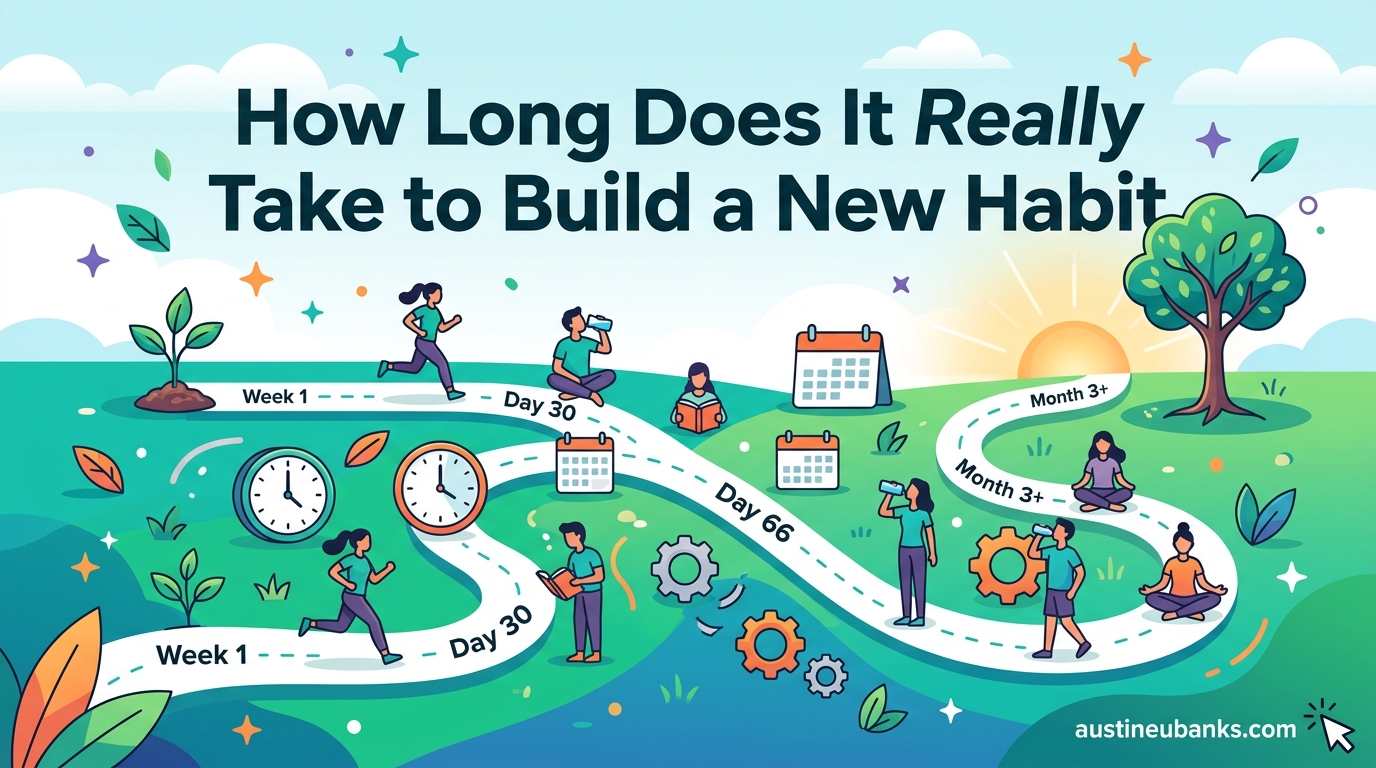
You have probably heard that it takes 21 days to build a new habit. Maybe a friend told you, or you read it in a self-help book, or saw it on social media. It sounds clean, simple, and achievable. But it is also completely wrong.
When I first started researching how long it really takes to build a new habit, I was surprised by what the actual science says. The real average is 66 days, and the full range runs from 18 days to 254 days depending on what you are trying to do. That is a massive difference from the neat three-week timeline most people believe.
If you have ever felt discouraged because your new habit did not stick after 21 days, you are not alone. Thousands of people on forums like Reddit’s r/selfimprovement and r/Habits report the same frustration. The problem is not your willpower. The problem is that you were given a timeline based on a myth, not evidence.
In this article, I am going to walk you through what the research actually says about habit formation. We will cover where the 21-day myth came from, what the latest studies reveal, the factors that speed up or slow down the process, and practical strategies you can use to build habits that last.
Table of Contents
Quick Answer: How Long It Really Takes to Build a New Habit
On average, it takes 66 days to build a new habit, according to the most widely cited research from University College London. But that is just the average. The actual range spans from 18 days to 254 days depending on the complexity of the behavior, your consistency, and individual differences.
A 2024 systematic review and meta-analysis published in the medical literature found similar results. The median time to reach habit formation was 59 to 66 days across multiple studies. The mean time was longer, ranging from 106 to 154 days.
What does this mean for you? Simple habits like drinking a glass of water each morning might become automatic in 3 to 4 weeks. Complex habits like a daily gym routine can take 6 months or more. There is no universal timeline, but the science is clear: expecting a habit to form in exactly 21 days sets you up for disappointment.
Where the 21-Day Myth Came From
The 21-day habit myth is one of the most persistent ideas in the self-help world. It has been repeated in books, blogs, podcasts, and motivational speeches for decades. But it traces back to a single source, and that source never actually made the claim people think it did.
The Maxwell Maltz Origin Story
In 1960, a plastic surgeon named Maxwell Maltz published a book called Psycho-Cybernetics. In it, he observed something interesting about his patients. After surgery, it typically took them about 21 days to adjust to their new appearance. Patients who received nose jobs or had a leg amputated seemed to need roughly three weeks to get used to their changed physical reality.
Maltz also noticed a similar pattern with phantom limb sensations. Amputees tended to experience phantom limb feelings for about 21 days before the sensations faded. He wrote about these observations as interesting patterns in psychological adjustment.
Here is the critical part: Maltz never said it takes 21 days to form a habit. He said it takes a minimum of 21 days for people to adjust to changes in their self-image. That is a very different claim.
How the Myth Spread
Over the following decades, self-help authors latched onto the number 21 and stripped away the nuance. The “minimum of 21 days to adjust to a new self-image” became “21 days to form a habit.” Then it became “21 days to change your life.” Each retelling simplified the original observation further.
By the time the internet arrived, the 21-day rule had become conventional wisdom. Blog posts, infographics, and social media quotes repeated it endlessly. The idea was appealing because it felt both scientific (it came from a doctor) and achievable (three weeks is not that long).
The problem is that Maltz was observing adjustment to physical changes, not behavioral habit formation. He was a plastic surgeon noting how long patients took to mentally adapt to a new nose or a missing limb. That has nothing to do with how long it takes your brain to automate a new daily behavior.
Why the Myth Is Harmful
The 21-day myth creates unrealistic expectations. When day 22 arrives and your new habit still feels like a chore, you assume something is wrong with you. Many people quit at this point, thinking they have failed.
I have seen this pattern described repeatedly on Reddit forums. People in r/getdisciplined and r/Habits share stories of abandoning their goals because the habit did not feel automatic after three weeks. They blame their willpower, their motivation, or their character. In reality, they just needed more time.
The self-help industry bears a lot of responsibility here. Selling the idea that change takes only 21 days is good marketing. It is easy, fast, and sounds achievable. But it sets people up for a cycle of starting and quitting that erodes confidence over time.
Understanding the real timeline is the first step toward actually building lasting habits. When you know that 66 days is the average, not 21, you can approach habit formation with realistic expectations and a plan that works.
The Science Behind Habit Formation
Now that we have debunked the myth, let us look at what research actually tells us about how long it takes to build a new habit. Over the past two decades, several key studies have examined this question with rigorous methodology.
The Landmark Lally Study (2009)
The most influential study on habit formation was conducted by researcher Phillippa Lally and her team at University College London. Published in the European Journal of Social Psychology in 2010, this study tracked 96 participants as they chose a new health-related behavior and attempted to perform it daily for 84 days.
Participants chose simple habits like drinking water at lunch, doing 50 sit-ups after morning coffee, or eating a piece of fruit with breakfast. Each day, they reported whether they performed the behavior and how automatic it felt.
The results were striking. On average, it took participants 66 days for a behavior to feel automatic. But the variation was enormous. Some participants reached automaticity in as few as 18 days. Others needed up to 254 days, which is over 8 months.
Lally also found that simpler behaviors became automatic faster than complex ones. Drinking water at lunch was quicker to automate than doing 50 sit-ups. This finding aligns with what Reddit users in r/selfimprovement consistently report: simple habits stick faster than effortful ones.
Importantly, the study found that missing a single day did not meaningfully affect the habit formation process. Participants who occasionally skipped a day still developed habits at roughly the same rate as those who were perfectly consistent.
The 2024 Systematic Review and Meta-Analysis
In 2024, researchers published a systematic review and meta-analysis that pooled data from multiple habit formation studies. This is the most comprehensive look at the question to date, and no top-ranking article has fully integrated these findings into their narrative.
The review found that across studies, the median time to reach habit formation was 59 to 66 days. This means that half of participants formed habits faster than this, and half took longer.
The mean time was longer: 106 to 154 days across studies. The difference between the median and the mean matters. It tells us that a significant number of people take much longer than the median, pulling the average upward.
This review confirmed that the 66-day average from Lally’s original study holds up across multiple research settings. It also reinforced the wide variability in habit formation timelines. There is no single answer that applies to everyone.
Key Habit Formation Studies Compared
Here is how the major studies stack up against each other:
Lally et al. (2009/2010): 96 participants, health behaviors, average of 66 days, range of 18 to 254 days. Published in the European Journal of Social Psychology. The most widely cited study in this field.
2024 Systematic Review and Meta-Analysis: Pooled multiple studies, median of 59-66 days, mean of 106-154 days. Confirmed the 66-day benchmark while showing that averages mask significant variation.
2021 Study: Found that it takes approximately 59 to 70 days to create a reliable habit. This narrower range suggests that moderate-complexity behaviors may cluster around the 2-month mark.
Gym Attendance Study (2015): Tracked gym-goers over time and found that exercise habits took significantly longer to form than simpler health behaviors. Many participants needed 3 to 6 months before gym attendance felt automatic.
Machine Learning Study (2023/2024): Behavioral economist Colin Camerer and colleagues at Caltech used machine learning to analyze habit formation patterns. This research found that habits form in different ways depending on the behavior type and context, with some forming quickly and others plateauing before reaching full automaticity.
Understanding Automaticity
Before we go further, it helps to understand what researchers actually mean when they say a habit is “formed.” In the scientific literature, this is called automaticity, and it has four key components.
First, the behavior happens with little to no conscious thought. You do not have to remind yourself to do it. Second, it happens efficiently, without requiring mental effort or deliberation.
Third, the behavior occurs in response to specific cues in your environment. You see the cue, and the behavior follows automatically. Fourth, you experience a sense of not being fully in control, meaning the behavior happens even when you are not actively choosing to do it.
When researchers measure habit formation, they are measuring how long it takes for a behavior to reach high automaticity on these four dimensions. This is why the timeline is longer than most people expect. You are not just doing something repeatedly. You are rewiring your brain to do it without thinking.
The Habit Loop: Cue, Routine, Reward
Understanding the habit loop helps explain why habit formation takes time. Every habit has three components: a cue that triggers the behavior, the routine or behavior itself, and a reward that reinforces it.
For example, your morning alarm is the cue. Drinking a glass of water is the routine. Feeling hydrated and refreshed is the reward. Over time, the cue becomes strongly associated with the routine and reward, so the behavior starts happening automatically.
This loop needs to repeat many times before it becomes automatic. That is why consistency matters more than intensity. Doing something every single day for 30 days is more effective than doing it intensely for a week and then stopping.
Researcher Wendy Wood, author of Good Habits, Bad Habits, has found that about 43% of daily behaviors are performed out of habit rather than conscious decision. Building a new habit means competing with existing automatic behaviors, which is another reason it takes time.
Factors That Affect How Long Habit Formation Takes
The 18-to-254-day range exists because many variables influence how quickly a habit forms. Understanding these factors helps you predict your own timeline and identify ways to speed up the process.
Complexity of the Behavior
This is the biggest factor. Simple behaviors that take seconds to complete become automatic quickly. Drinking a glass of water, taking a vitamin, or flossing one tooth can become habitual in 3 to 4 weeks.
Complex behaviors that require planning, effort, or equipment take much longer. A full gym workout, a 30-minute meditation session, or a complex morning routine can take 3 to 6 months or more to feel automatic.
This matches what Reddit users consistently report. People in r/Habits note that simple habits like drinking water form within weeks, while exercise habits often take several months to stop feeling like a chore.
Consistency of Repetition
Repetition in a consistent context is the engine of habit formation. The more consistently you perform the behavior in the same situation, the faster it becomes automatic.
This means doing the behavior at the same time, in the same place, or after the same trigger. If you always meditate after pouring your morning coffee, the coffee becomes the cue. Inconsistent timing or context slows the process significantly.
Individual Differences
People vary in how quickly they form habits. Some individuals naturally reach automaticity faster than others. Factors like age, stress levels, sleep quality, and existing routines all play a role.
Research also suggests that people who already have strong existing habits in related areas may form new habits faster. If you already have a solid morning routine, adding a new element to it is easier than building a routine from scratch.
Environmental Cues and Design
Your environment plays a massive role in habit formation. When cues are obvious and accessible, habits form faster. When the behavior requires overcoming friction, it takes longer.
If your goal is to eat healthier snacks, having fruit on the counter makes the habit easier. If you have to dig through a pantry past bags of chips, the habit faces more resistance. Environment design can shave weeks off your habit formation timeline.
Type of Reward
Behaviors with immediate rewards become automatic faster than those with delayed rewards. This is one reason exercise is hard to habitualize. The benefits (better health, weight loss) come weeks or months later, while the effort is immediate.
Researcher Ayelet Fishbach has found that adding immediate rewards to behaviors with delayed payoffs can significantly speed up habit formation. For example, listening to a favorite podcast only while exercising gives you an immediate reason to work out today.
Instigation Habits vs Execution Habits
There is an important distinction that most articles miss. An instigation habit is the automatic trigger to start a behavior. An execution habit is the automatic performance of the behavior itself.
Instigation habits form faster than execution habits. You might automatically feel the urge to go to the gym after work within a few weeks, but the execution of the workout itself (choosing exercises, deciding reps, maintaining form) may take months to feel fully automatic.
The Habit Formation Timeline: What to Expect Week by Week
One thing missing from every top-ranking article is a clear picture of what to expect during the habit formation process. Based on the research and real-world reports, here is a general timeline of what you might experience.
Week 1 (Days 1-7): Everything feels new and requires significant conscious effort. You are relying on motivation and willpower. It is normal to feel energized but also uncertain. Your brain is just starting to map the neural pathways for this behavior.
Week 2 (Days 8-14): The novelty wears off. Motivation may dip. This is where many people quit, because the behavior still feels effortful and the automaticity has not kicked in yet. Push through this phase.
Week 3 (Days 15-21): This is where the 21-day myth creates problems. You might expect the habit to feel automatic, but for most behaviors, it still does not. The behavior is becoming more familiar, but it still requires deliberate choice. Do not interpret this as failure.
Weeks 4-5 (Days 22-35): The cue-behavior link starts strengthening. You may catch yourself starting the behavior without consciously deciding to. Small moments of automaticity begin to appear, especially for simpler habits.
Weeks 6-8 (Days 36-56): This is where many habits cross the threshold. The behavior starts feeling more natural. You think about it less. The effort required decreases noticeably. For simpler habits, full automaticity may be reached during this window.
Weeks 9-10 (Days 57-70): You are now around the 66-day average. Many people find that the habit is significantly easier to perform at this point. It still may not be fully automatic, but it requires much less mental energy than it did in week 1.
Days 70+: For simple habits, you have likely reached automaticity. For complex habits, the process continues. Exercise habits, dietary changes, and complex routines may need another 1 to 4 months before they feel truly effortless.
Remember, this timeline is a general guide, not a guarantee. Your experience will vary based on the factors we discussed above. The key takeaway is that feeling effort at day 21 or even day 40 is completely normal.
Popular Habit Frameworks Explained
Beyond the 21-day myth, several other habit frameworks circulate in popular culture. Some are useful as motivational tools, even if they are not scientifically precise. Here is what you need to know about the most common ones.
The 21/90 Rule
The 21/90 rule says it takes 21 days to build a habit and 90 days to turn that habit into a lifestyle change. This framework is popular in self-help circles and recovery communities.
The 21-day portion is based on the myth we already debunked. But the 90-day extension has some merit. While science does not support a hard 90-day threshold, the idea that habits need continued reinforcement well beyond their initial formation is accurate.
Think of 21/90 as a motivational framework rather than a scientific one. It encourages you to keep going past the initial habit formation phase and reinforce the behavior long-term.
The 21/90/180/365 Rule
This extended framework assigns timeframes to four stages of personal transformation. 21 days to build a new habit. 90 days to establish a new skill. 180 days to see physical body changes. 365 days to create a completely new lifestyle.
None of these specific numbers come from scientific research. However, the general principle of progressive commitment is sound. Longer timeframes do produce more permanent changes, and the idea of building from habit to skill to physical change to lifestyle is a reasonable progression.
I would treat this framework as a way to think about long-term goals rather than a precise timeline. The key insight is that lasting change requires commitment far beyond what most people expect.
The 3-3-3 Rule
The 3-3-3 rule for habits suggests dedicating 3 minutes to a new behavior, repeating it 3 times per day, for 3 weeks. This approach focuses on making the habit extremely easy to start while building consistency through frequent repetition.
While not based on formal research, the 3-3-3 rule aligns with several evidence-based principles. It uses small commitments (3 minutes) to reduce resistance. It uses frequent repetition (3 times per day) to strengthen neural pathways faster. And it provides a clear time horizon (3 weeks) for initial commitment.
The main limitation is the 3-week timeframe, which, as we know, is generally too short for full automaticity. But as a strategy for getting started, the 3-3-3 rule is a reasonable approach.
How to Build a New Habit Faster: 7 Practical Tips
While you cannot rush the neurological process of habit formation, you can optimize your approach to build habits as efficiently as possible. These tips are grounded in behavioral science and consistent with what real people report working in practice.
1. Start Ridiculously Small
The smaller the behavior, the faster it becomes automatic. If you want to build a daily exercise habit, do not start with an hour-long workout. Start with 5 minutes of stretching or a single push-up.
This approach, popularized by BJ Fogg in his book Tiny Habits, works because small behaviors require almost no willpower. You are more likely to do them consistently, and consistency is what drives habit formation. You can always scale up once the behavior is automatic.
2. Use Habit Stacking
Habit stacking means attaching a new habit to an existing one. Instead of trying to remember to floss, you stack it on top of brushing your teeth. “After I brush my teeth, I will floss one tooth.”
This strategy works because the existing habit serves as an automatic cue for the new behavior. You do not have to remember to do it. The established habit does the reminding for you. Habit stacking can significantly reduce the time it takes for a new behavior to become automatic.
3. Design Your Environment
Make the right behavior easier and the wrong behavior harder. If you want to read more, put a book on your pillow each morning. If you want to eat less junk food, keep it out of the house entirely.
Environmental design reduces the willpower required to perform your habit. The less friction between you and the behavior, the more consistently you will do it, and the faster it will become automatic.
4. Use If-Then Planning
Also called implementation intentions, if-then planning involves deciding in advance exactly when and where you will perform your habit. The format is: “If [situation occurs], then I will [perform behavior].”
For example: “If it is 7:00 AM, then I will meditate for 10 minutes in my bedroom.” Research shows that people who use if-then planning are significantly more likely to follow through on their intentions compared to those who simply set a goal.
This strategy works because it pre-decides the cue, the context, and the behavior. You remove the need for in-the-moment decision-making, which is where most habit attempts fail.
5. Create Immediate Rewards
As we discussed, behaviors with immediate rewards form habits faster. If your habit has a delayed payoff (like exercise or healthy eating), add an immediate reward to bridge the gap.
This could be listening to a favorite podcast only during workouts, enjoying a special tea after meditation, or checking off a habit tracker that gives you a dopamine hit. The reward does not need to be big. It just needs to be immediate and consistent.
6. Track Your Progress
Visual tracking serves two purposes. First, it provides immediate satisfaction from seeing your streak grow. Second, it keeps the behavior top of mind during the weeks when it still requires conscious effort.
Use a physical calendar, a habit tracking app, or a simple notebook. The method matters less than the act of recording each successful repetition. Research shows that people who track their habits are more consistent and reach automaticity faster.
7. Never Skip Twice
This is the single most practical tip I can share, and it comes directly from Reddit’s r/Habits community. Missing one day is normal and does not significantly affect habit formation. Missing two days in a row starts to erode the habit.
The “never skip twice” rule gives you permission to be human while preventing a single slip-up from becoming a total abandonment. If you miss a day, make it your top priority to get back on track the next day. No guilt, no drama, just resume.
This rule addresses the most common reason people fail at habit building: the all-or-nothing mindset. One missed day triggers guilt, which triggers avoidance, which triggers quitting. Never skip twice short-circuits this destructive cycle.
What Happens If You Miss a Day?
This question comes up constantly in forums, and it is one of the biggest sources of anxiety for people building new habits. The fear of breaking a streak causes enormous stress, and a single missed day often triggers a complete abandonment of the goal.
Here is the good news: research from the Lally study found that missing a single day did not meaningfully affect the habit formation process. Participants who occasionally skipped a day developed habits at roughly the same rate as those who were perfectly consistent.
Think about it this way. Habit formation is about building neural pathways through repeated behavior. One missed repetition out of 66 or 100 does not erase the connections your brain has already made. The pathway is still there.
What does matter is how you respond to the missed day. If you treat it as a catastrophe and quit, the habit dies. If you treat it as a normal part of the process and resume the next day, the habit continues forming.
The key shift is moving from an all-or-nothing mindset to a consistency-over-perfection mindset. Aiming for 80% consistency over 90 days is far more effective than aiming for 100% consistency over 21 days and quitting when you miss a day.
Breaking Bad Habits vs Building New Ones
People often ask whether it takes the same amount of time to break a bad habit as it does to build a new one. The short answer is no. Breaking a bad habit is generally harder and can take longer.
This makes sense when you think about it. A bad habit is already automatic. Your brain has already built strong neural pathways for it. Breaking it means not just stopping the behavior but also weakening those existing pathways.
Research suggests that breaking a bad habit works best when you replace it with a new behavior. Instead of trying to simply stop checking your phone in bed, replace that behavior with reading a book for 5 minutes.
The timeline for breaking habits varies even more widely than for building them. Some simple bad habits can be disrupted in weeks. Deeply ingrained behaviors may take many months of consistent effort to overcome. The same principle applies: consistency and patience are more important than any specific number of days.
FAQs
What is the 3-3-3 rule for habits?
The 3-3-3 rule for habits is a framework that suggests dedicating 3 minutes to a new behavior, repeating it 3 times per day, for 3 weeks. This approach focuses on making the habit extremely easy to start while building consistency through frequent repetition. While the 3-week timeframe is shorter than the scientifically supported 66-day average, the principles of small commitments and frequent practice align well with behavioral research.
How long does it take to truly build a habit?
Research shows it takes an average of 66 days to truly build a habit, but the real range spans from 18 to 254 days depending on the complexity of the behavior, the individual, and their consistency. Simple habits like drinking water form faster, while complex habits like a daily gym routine can take 6 months or more to feel fully automatic. A 2024 systematic review confirmed the 59-66 day median across multiple studies.
What is the 21-90 rule in psychology?
The 21-90 rule in psychology states that it takes 21 days to build a new habit and 90 days to turn that habit into a lifestyle change. While popular in self-help circles, the 21-day timeframe is a myth based on a misquote from plastic surgeon Maxwell Maltz’s 1960 book Psycho-Cybernetics, who observed that patients took about 21 days to adjust to their new appearance after surgery. Scientific research suggests the actual average is 66 days, not 21.
What is the 21 90 180 365 rule?
The 21/90/180/365 rule is a popular self-help framework that assigns specific timeframes to personal growth stages: 21 days to build a new habit, 90 days to establish a new skill, 180 days to see physical body changes, and 365 days to create a completely new lifestyle. While motivational and useful for long-term goal planning, these specific timelines are not backed by rigorous scientific research.
Does it really take 21 days to create a habit?
No, it does not really take 21 days to create a habit. The 21-day myth originated from a misquote of plastic surgeon Maxwell Maltz in his 1960 book Psycho-Cybernetics, who observed that his patients took about 21 days to adjust to their new appearance after surgery. Scientific research published in the European Journal of Social Psychology found the actual average is 66 days, with a range of 18 to 254 days depending on the behavior and individual.
Conclusion: How Long It Really Takes to Build a New Habit
The answer to how long it really takes to build a new habit is not 21 days. It is 66 days on average, with a realistic range of 18 to 254 days. Simple habits form in weeks. Complex habits take months. And your individual timeline depends on consistency, complexity, environment, and the type of reward.
If there is one thing I want you to take away from this article, it is this: feeling effort at day 21, day 40, or even day 60 is completely normal. It does not mean you have failed. It means your brain is still building the neural pathways that will eventually make the behavior automatic.
The most important thing you can do is keep going. Use the strategies we covered: start small, stack your habits, design your environment, track your progress, and never skip twice. Give yourself the time the science says you need, not the time the myth promised.
Your new habit will form. It just takes longer than the self-help industry told you. Now that you know the real timeline, you can approach habit formation with the patience and strategy that actually works.