
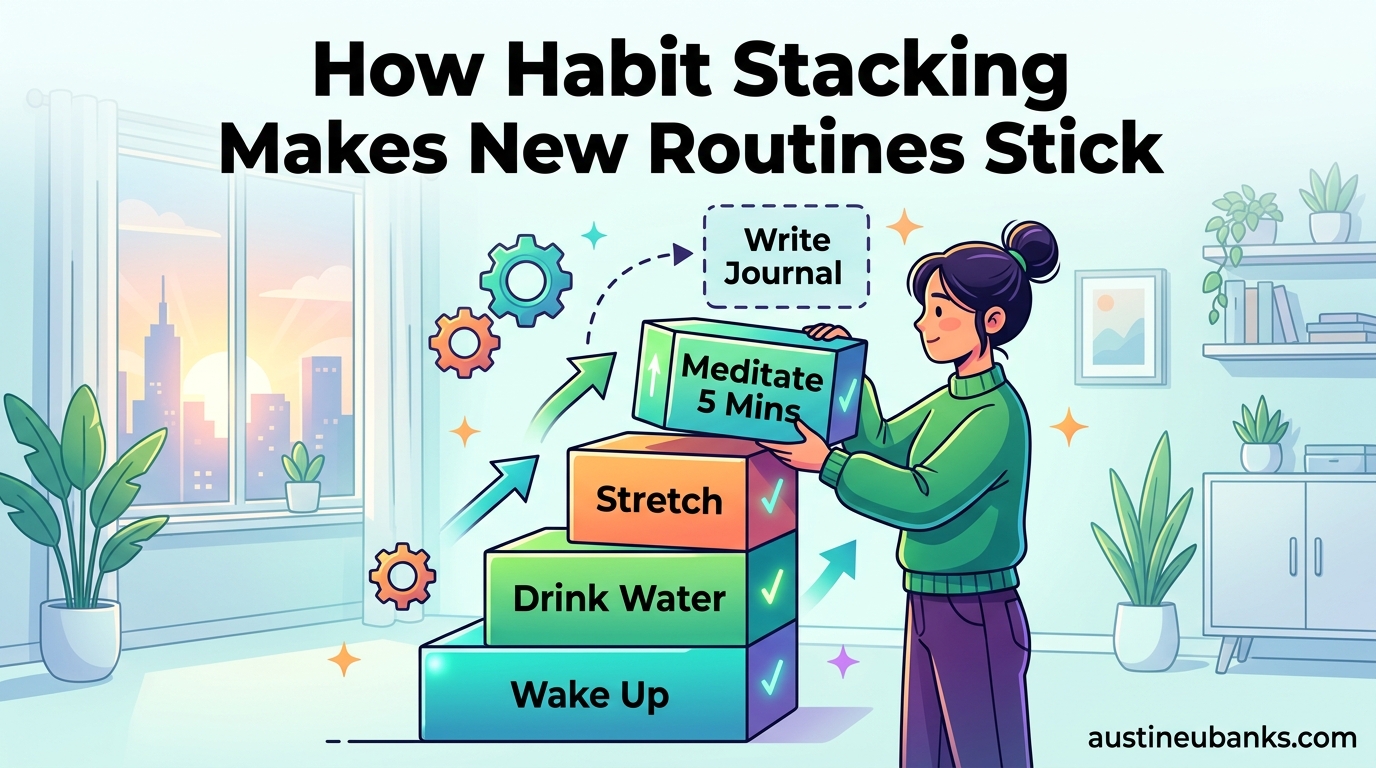
You started a new habit on a Monday morning, full of motivation. By Wednesday, you forgot about it entirely. Sound familiar? Most people blame willpower, but the real problem is strategy. Understanding how habit stacking makes new routines stick could be the missing piece you have been looking for.
Habit stacking is a simple but powerful approach: you attach a new behavior to something you already do every day. Instead of relying on motivation or memory, you piggyback on an existing routine that is already wired into your brain. The result is that new habits form faster, feel easier, and actually last.
In this guide, I will walk you through exactly how habit stacking works, the science behind it, and a step-by-step process you can use today. I have pulled insights from behavioral psychology research, real user experiences from communities like Reddit’s r/productivity, and the frameworks popularized by James Clear and BJ Fogg.
By the end, you will have everything you need to build your first habit stack and make it stick for good.
Table of Contents
What Is Habit Stacking?
Habit stacking is a behavioral technique where you attach a new habit to an existing routine you already perform consistently. Your established habit becomes the cue or trigger for the new behavior. The formula is simple and memorable: “After I [current habit], I will [new habit].”
The term was popularized by James Clear in his book Atomic Habits, though he credits behavioral scientist BJ Fogg and his Tiny Habits method as the foundation. Fogg spent years at Stanford researching how tiny behaviors, when anchored to existing routines, could create lasting change without requiring massive willpower.
The core idea is that you already have dozens of habits running on autopilot every single day. Brushing your teeth, pouring your morning coffee, starting your computer, sitting down for lunch. These are your anchor habits. Each one is a built-in trigger waiting to be used.
Here is the habit stacking formula broken down:
- After/Before [an existing habit you do every day]
- I will [your new desired habit]
For example: “After I pour my morning coffee, I will write down three priorities for the day.” The coffee pouring is already automatic. The new habit rides along for free.
This approach matters because most new habits fail for one simple reason: they lack a clear trigger. You tell yourself you want to meditate daily, but you never specify when, where, or what comes right before it. Habit stacking solves this by borrowing the trigger from an existing routine.
How Habit Stacking Works: The Science Behind Why Routines Stick
Habit stacking works because it takes advantage of neural pathways your brain has already built and strengthened through years of repetition. When you perform a behavior thousands of times, your brain creates efficient neural connections that make that behavior nearly automatic. This process is called synaptic pruning.
Synaptic pruning is your brain’s way of becoming more efficient. Neurons that fire together wire together, and connections that are not used get pruned away. Research from Oxford University shows that your brain constantly strengthens pathways for frequently used behaviors while eliminating those you no longer need. This is why brushing your teeth feels effortless but learning a new language feels exhausting.
When you stack a new habit onto an existing one, you are essentially borrowing the neural pathway of the old habit to power the new one. The established habit acts as a well-worn trail in your brain, and the new behavior simply branches off from it. This is far easier than building a completely new neural pathway from scratch.
The process is closely tied to neuroplasticity, your brain’s ability to reorganize itself by forming new neural connections. Self-directed neuroplasticity means you can intentionally shape these connections through repetition. Every time you perform your habit stack, you strengthen the link between the anchor habit and the new behavior.
Two key neurotransmitters play a role in making this work:
- Dopamine fires when you complete a behavior, creating a reward signal that reinforces the habit loop. Each time you finish your stacked habit, dopamine helps your brain tag it as something worth repeating.
- Norepinephrine helps with attention and memory retrieval, making it easier for your brain to associate the new habit with the existing cue.
Together, these neurotransmitters help convert a conscious effort into an automatic behavior. Over time, the new habit stops requiring active thought and simply becomes part of the routine.
This is also why habit stacking beats willpower. Willpower is a finite resource that depletes throughout the day, leading to decision fatigue. By the afternoon, your ability to make good choices is diminished. Habit stacking bypasses this problem entirely because it removes the need for a decision. The cue triggers the behavior automatically, no willpower required.
Reddit users in r/productivity frequently confirm this. One user wrote: “I tried meditating every morning for months and failed. Then I stacked it onto my coffee routine. After two weeks, I was doing it without thinking. The trigger did all the work.”
How Habit Stacking Makes New Routines Stick: A Step-by-Step Guide
Building a habit stack that actually sticks comes down to following a clear process. Here is the exact step-by-step method I recommend, based on the research and real-world experience from thousands of habit builders.
Step 1: Identify Your Anchor Habits
Start by listing habits you already do every single day without fail. These are your anchor habits, and they form the foundation of your stack. The more consistent the anchor, the stronger your new habit will be.
Good anchor habits include things like brushing your teeth, making coffee, checking your phone, sitting at your desk, or putting on your shoes. Write down 10 to 15 of these daily behaviors. Be honest with yourself about which ones truly happen every day.
A common mistake people make is choosing an anchor that is not actually consistent. If you only shower four days a week, it is a poor anchor. Pick something that happens seven days a week.
Step 2: Choose One Small New Habit
Pick exactly one new habit you want to build. Keep it small. BJ Fogg recommends starting with what he calls “tiny habits,” behaviors so small they feel almost too easy. If you want to start journaling, begin with writing one sentence. If you want to stretch, start with 30 seconds.
The smaller the new habit, the faster it becomes automatic. Reddit users consistently report that stacks work best when the new habit takes under one minute to complete. You can always expand the habit later once it is established.
Step 3: Match the Frequency
Your new habit should match the frequency of your anchor habit. If your anchor happens once a day, stack a once-a-day habit. If your anchor happens multiple times (like sitting at your desk), you can stack a habit that repeats throughout the day.
This concept, called frequency matching, ensures the new behavior gets enough repetition to become automatic. James Clear emphasizes this in his work. A habit you want to do daily needs a daily anchor, not a weekly one.
Step 4: Write the Formula and Make It Specific
Write out your habit stack using the exact formula: “After I [current habit], I will [new habit].” Specificity is what makes this work. Do not write “After I wake up, I will exercise.” That is too vague and too large.
Instead write: “After I turn on my coffee maker, I will do five push-ups.” The trigger is specific (turning on the coffee maker), and the new habit is small and clearly defined (five push-ups).
Put this written formula somewhere visible. Many Reddit users report that writing the stack on a sticky note and placing it near the anchor habit location dramatically improves consistency during the first few weeks.
Step 5: Practice the Stack Daily and Track It
Perform your habit stack every single day. Track your progress with a simple checkmark on a calendar or a habit tracking app. Visual cues reinforce the behavior and give you a small dopamine hit each time you check it off.
During the first two to three weeks, the hardest part is simply remembering to do the stack. This is normal. Your brain has not yet built the neural connection between the anchor and the new behavior. Each repetition strengthens that connection.
Step 6: Expand Slowly Once the Stack Is Automatic
Once your new habit feels automatic (you do it without thinking), you can add another habit to the stack or increase the size of the existing one. The key word here is slowly. Add one behavior at a time and wait until it feels effortless before stacking another.
Reddit users in r/Habits strongly recommend this approach. As one user put it: “I started with one push-up after brushing my teeth. After a month, I naturally started doing more. Six months later, I am doing 30. Never would have happened if I started with 30.”
Habit Stacking Examples for Every Part of Your Day
One of the best ways to understand habit stacking is to see real examples. Here are practical habit stacks organized by time of day and category. Each one uses the formula of attaching a new behavior to an existing anchor.
Morning Habit Stacking Examples
- After I turn off my alarm, I will drink a glass of water.
- After I brush my teeth, I will do 30 seconds of stretching.
- After I pour my morning coffee, I will write three priorities for the day.
- After I sit down with my coffee, I will journal one sentence about what I am grateful for.
Workday and Productivity Habit Stacks
- After I open my laptop, I will review my top three tasks before checking email.
- After I sit in a meeting, I will write one key takeaway before leaving.
- After I finish a task, I will clear my desk before starting the next one.
- After I check my email, I will stand up and stretch for 30 seconds.
Evening Habit Stacking Examples
- After I finish dinner, I will lay out my clothes for tomorrow.
- After I plug in my phone to charge, I will read one page of a book.
- After I get into bed, I will name three things that went well today.
- After I wash my face, I will take my evening vitamins.
Wellness and Mental Health Habit Stacks
- After I start the shower, I will take three deep breaths before getting in.
- After I pour my water bottle, I will take my daily medication.
- After I sit on the couch to watch TV, I will do a quick body scan for tension.
These examples work because each new habit is small, specific, and tied to something you already do. Pick one that resonates with you and start there. Reddit users consistently emphasize that one solid habit stack beats ten ambitious plans that never get off the ground.
Common Habit Stacking Mistakes to Avoid
Habit stacking is simple, but that does not mean it is foolproof. Here are the most common mistakes people make and how to avoid them.
1. Stacking too many habits at once. This is the number one reason habit stacks fail. People get excited and try to stack five new behaviors onto one anchor on day one. By day three, they are overwhelmed and quit. Start with one small habit per anchor.
2. Using vague cues. “After I wake up” is not specific enough. “After I turn off my alarm and put my feet on the floor” is a clear, unambiguous trigger. The more specific your cue, the more reliable your stack.
3. Choosing an inconsistent anchor. If your anchor habit does not happen every day, your new habit will not either. Pick an anchor that is truly rock-solid. Test it for a week before attaching a new habit to it.
4. Making the new habit too big. If your new habit takes more than two minutes to start, it is probably too large. Shrink it down until it feels almost ridiculously easy. You can scale up later.
5. Expecting immediate results. Habit formation takes time. Research shows the average is 66 days, but it can range from 18 to 254 days depending on the person and the behavior. If your stack does not feel automatic after a week, that is normal. Keep going.
6. Beating yourself up after missing a day. Missing one day does not erase your progress. The biggest mistake is not the missed day but the reaction to it. Get back to your stack the next day without guilt. Consistency over time matters far more than perfection.
What to Do When Your Habit Stack Breaks
Even the best habit stacks break sometimes. Travel, illness, schedule changes, and life events can disrupt your routine and break the chain. What matters is how you respond.
When your stack breaks, do not start over from scratch. Simply reconnect your new habit to the anchor as soon as your routine normalizes. If your anchor habit itself changed (for example, you switched from working in an office to working from home), find a new anchor in your updated routine and rebuild the stack around it.
Reddit users in r/DecidingToBeBetter share a useful strategy: the “never miss twice” rule. If you miss your habit stack one day, make it your top priority the next day. One missed day is an accident. Two missed days is the start of a new (unwanted) habit.
For people with ADHD or neurodivergent conditions, habit stacking can be especially helpful but may require adjustments. Working memory challenges make external cues even more important. Visual reminders, phone alarms, and body doubling (doing the habit alongside another person) can all strengthen the stack. Some people find that linking habits to physical locations rather than times works better. As one Reddit user noted: “My brain ignores time-based reminders, but if I put my vitamins next to my coffee maker, I never forget.”
Frequently Asked Questions About Habit Stacking
What is the 3-3-3 rule for habits?
The 3-3-3 rule for habits suggests focusing on three habits, each taking three minutes or less, done three times per day. This approach works well with habit stacking because each small action is easy to anchor to an existing routine. The rule keeps things simple and prevents overwhelm.
What are the benefits of habit stacking?
Habit stacking offers several key benefits: it provides a built-in cue so you do not have to remember to start, reduces decision fatigue by automating routines, builds confidence through small daily wins, leverages existing neural pathways so new habits form faster, and removes the need for willpower since the trigger is automatic.
What are the common mistakes in habit stacking?
Common mistakes include stacking too many habits at once, using vague cues instead of specific triggers, choosing an inconsistent anchor habit, making the new habit too large, expecting results too quickly, and quitting entirely after missing one day. The fix is to start with one tiny habit tied to a specific, reliable anchor.
What is the science behind habit stacking?
Habit stacking works through synaptic pruning and neuroplasticity. Your brain strengthens neural pathways for behaviors you repeat regularly. By pairing a new habit with an established one, you piggyback on existing neural connections. Dopamine reinforces the completed behavior while norepinephrine helps your brain link the new habit to the existing cue, automating it over time.
How long does habit stacking take to work?
Research from University College London shows habit formation takes an average of 66 days, with a range of 18 to 254 days depending on the person and the behavior. The 21-day myth is not supported by science. Habit stacking can speed up the process because the existing anchor provides a consistent trigger, but you should still expect several weeks of conscious effort before the new behavior feels automatic.
Does habit stacking work for people with ADHD?
Yes, habit stacking can be especially effective for people with ADHD because it externalizes cues. Instead of relying on working memory, the anchor habit serves as a physical trigger. Visual reminders, placing items near the anchor location, and keeping habits very small all help. Some people with ADHD find location-based cues work better than time-based ones.
Can I stack more than one new habit at a time?
It is best to stack only one new habit per anchor at a time. Once that habit feels automatic, you can either expand it or add another habit to the stack. Stacking multiple new habits at once is the most common reason habit stacks fail. Build slowly and let each habit become effortless before adding the next one.
Start Your First Habit Stack Today
Understanding how habit stacking makes new routines stick comes down to one core principle: you do not need more willpower, you need better triggers. By attaching a small new behavior to a habit you already do every day, you give your brain a reliable cue and an existing neural pathway to build on.
Pick one anchor habit from your daily routine right now. Choose one tiny new behavior to stack onto it. Write it down using the formula. Then start tomorrow morning. That is it.
The beauty of habit stacking is its simplicity. You do not need a complicated system, an expensive app, or a complete lifestyle overhaul. You just need one existing habit, one new behavior, and the willingness to show up daily until it becomes automatic.