
If you have ever sat down with a notebook hoping to feel better, only to freeze because you did not know what to write, you are not alone. Two of the most popular journaling techniques people turn to are the worry dump and reflective journaling. But understanding the difference between a worry dump and reflective journaling can make or break your journaling practice.
These two approaches look similar on the surface. Both involve putting pen to paper and writing out what is on your mind. However, they serve completely different purposes, follow different structures, and produce different outcomes.
In this guide, we break down exactly what sets them apart. You will learn what each technique is, when to use it, and how to combine them for better mental clarity and self-awareness.
Whether you are dealing with racing thoughts at midnight or trying to make sense of a tough week, choosing the right method matters more than you might think.
Table of Contents
What Is a Worry Dump?
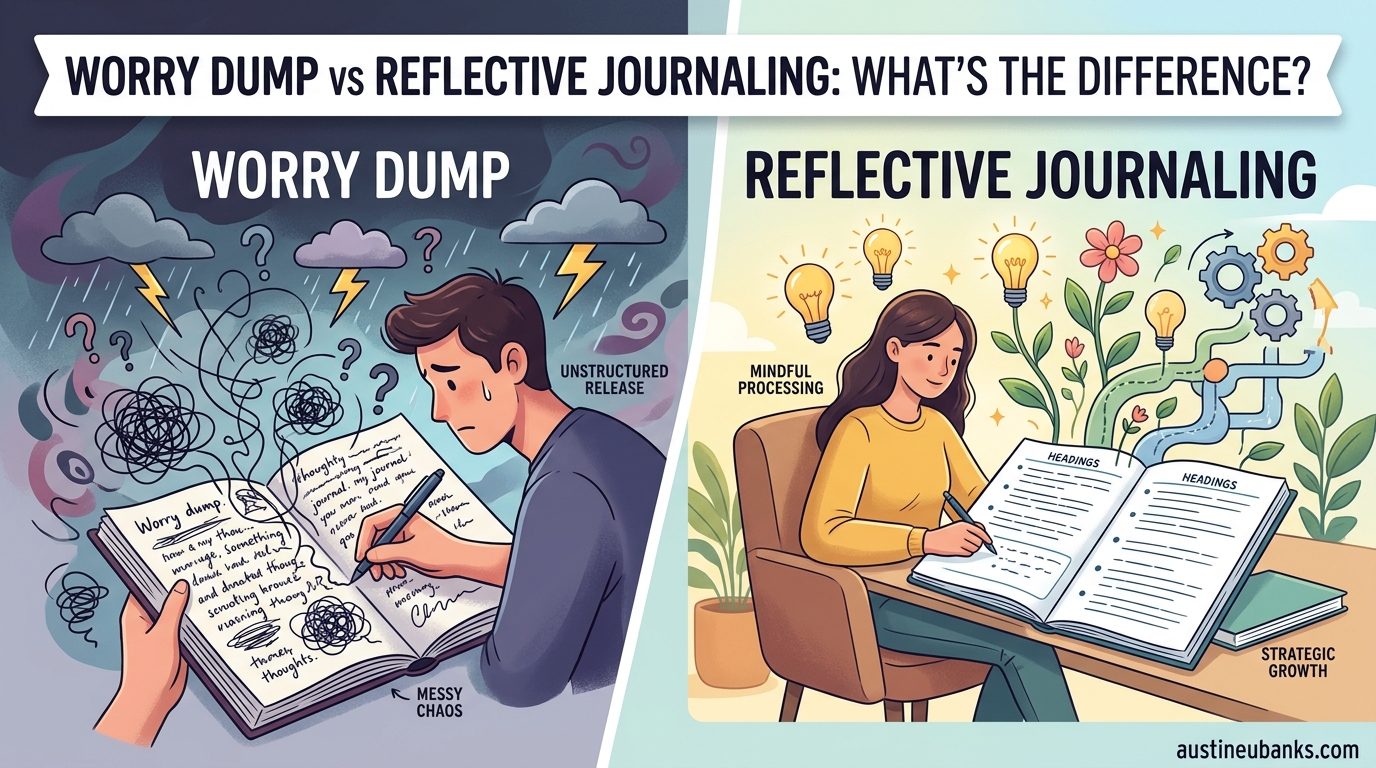
A worry dump is a rapid, unstructured writing exercise where you get every anxious thought, concern, and mental to-do list item out of your head and onto paper. There is no organization, no editing, and no reflection. You simply write until the noise in your mind quiets down.
Think of it as opening a pressure valve. When your brain is overloaded with worries, tasks, and what-ifs, that mental clutter creates cognitive overload. A worry dump releases that pressure by offloading thoughts from your working memory onto the page.
The term “worry dump” is closely related to “brain dump,” but it has a more specific focus. While a brain dump can include anything on your mind, a worry dump zeroes in specifically on anxieties, fears, and stressful thoughts. It is a targeted tool for anxiety management rather than a general productivity hack.
Here is what a typical worry dump looks like in practice. You set a timer for 5 to 10 minutes, grab a pen, and write down every single worry without stopping. The thoughts do not need to be logical, connected, or even complete sentences. You might jump from “did I send that email?” to “what if the presentation goes badly?” to “I need milk from the store.” The point is not coherence. The point is release.
Research supports this approach. Studies on expressive writing show that putting anxious thoughts into words reduces their intensity. By externalizing worries, you reduce the cognitive load on your working memory, which frees up mental bandwidth for problem-solving and emotional regulation.
People often notice an immediate sense of relief after a worry dump. The thoughts that felt overwhelming inside their head suddenly look smaller and more manageable on paper. Some worries even seem trivial once written down, which helps you gain perspective without any deep analysis.
What Is Reflective Journaling?
Reflective journaling is a slower, more intentional practice where you explore your thoughts, feelings, and experiences in depth. Instead of dumping everything at once, you focus on a specific event, emotion, or pattern and examine it thoughtfully. The goal is insight, not just release.
This technique draws from the principles of reflective practice, which professionals in fields like healthcare, education, and psychology use to learn from their experiences. When applied to personal journaling, it becomes a tool for building self-awareness and understanding your emotional landscape over time.
A reflective journaling session typically follows a loose structure. You might start with a prompt like “What was the most challenging part of my day and why?” or “How did I handle conflict this week?” Then you write slowly, pausing to consider your responses. You ask yourself follow-up questions. You notice patterns in your behavior and reactions.
The process is closer to having a conversation with yourself than to freewriting. You are not just recording what happened. You are asking why it happened, how it made you feel, what it reveals about your values, and what you might do differently next time.
Reflective journaling requires more mental energy and focus than a worry dump. You need a quiet space, a clear mind, and enough time to sit with uncomfortable thoughts. A single session might last 20 to 30 minutes, and the benefits compound over weeks and months rather than hitting you instantly.
Research on reflective journaling shows it improves emotional processing, reduces symptoms of depression and anxiety over time, and helps people identify recurring thought patterns that may be holding them back. It is particularly effective for people working through grief, life transitions, or recurring relationship conflicts.
The Difference Between a Worry Dump and Reflective Journaling
The core difference between a worry dump and reflective journaling comes down to purpose and process. A worry dump is about emptying your mind. Reflective journaling is about understanding it.
Let us break down the key distinctions so you can see exactly how they compare.
Purpose and Goal
A worry dump exists to reduce mental pressure. You use it when your mind feels cluttered, anxious, or overloaded. The goal is to get thoughts out of your head so you can function, sleep, or focus.
Reflective journaling exists to create self-understanding. You use it when you want to process an experience, explore an emotion, or identify a pattern. The goal is insight that leads to personal growth.
Structure and Approach
Worry dumps are completely unstructured. You write fast, you do not edit, and you do not analyze. The writing can jump between topics with no logical connection. Stream of consciousness is the norm.
Reflective journaling follows a loose but intentional structure. You usually start with a prompt or question, write thoughtfully, and circle back to examine your own responses. The writing stays focused on a single topic or theme.
Time and Effort
A worry dump is fast. Most sessions take 5 to 15 minutes. You can do one anywhere, anytime, with minimal mental effort. It is a low-barrier practice that works even when you are exhausted or stressed.
Reflective journaling takes longer. Sessions typically run 15 to 45 minutes. The practice requires mental focus and emotional willingness to sit with difficult feelings. It is more demanding but also more rewarding in the long run.
Immediate vs Long-Term Results
A worry dump delivers immediate relief. You feel lighter, calmer, and more focused within minutes. However, the relief can be temporary if you do not address the underlying issues behind your worries.
Reflective journaling builds cumulative benefits. A single session might not feel transformative, but over weeks and months, you develop a deeper understanding of yourself. The insights you gain can permanently shift how you handle stress and emotions.
Emotional State Required
You can do a worry dump in almost any emotional state. In fact, it works best when you are overwhelmed, anxious, or mentally scattered. The technique requires zero emotional readiness because you are not engaging with the content. You are just moving it.
Reflective journaling requires a baseline of emotional stability. If you are in the middle of a panic attack or a severe anxiety spiral, trying to reflect deeply can sometimes make things worse. You need enough calm to observe your thoughts without being consumed by them.
What Happens After Writing
After a worry dump, you might review the list, pick out actionable items, and discard the rest. The paper itself becomes a holding container for mental clutter. Many people throw away or delete their worry dumps once the session is over.
After reflective journaling, you keep the entries. Over time, these pages become a record of your inner life. You can reread them to track patterns, celebrate growth, and revisit insights that emerged during earlier sessions.
Benefits of Each Technique
Both approaches offer significant mental health benefits, but they shine in different areas. Here is what you can expect from each one.
Benefits of a Worry Dump
The biggest benefit of a worry dump is rapid anxiety relief. When racing thoughts keep you awake at night or make it impossible to concentrate, a 10-minute worry dump can break the cycle. Research on working memory shows that holding too many thoughts simultaneously creates cognitive overload. Writing them down directly relieves that overload.
A worry dump also improves focus. Once your concerns are on paper, your brain stops trying to rehearse them mentally. This frees up cognitive resources for the task at hand, whether that is work, a conversation, or falling asleep.
Another benefit is accessibility. You do not need any special skill, prompt, or emotional readiness. You just write. This makes the worry dump one of the easiest mental health tools to use consistently, even on bad days.
Finally, a worry dump helps with decision-making. When your mind is cluttered, choices feel paralyzing. Seeing everything laid out on paper lets you prioritize, delegate, or simply let go of worries that do not actually matter.
Benefits of Reflective Journaling
Reflective journaling builds self-awareness over time. As you write regularly, you start noticing recurring themes in your emotional life. You might realize that certain situations consistently trigger anxiety, or that you tend to suppress anger until it erupts. These patterns are invisible in the moment but become clear when you have months of entries to review.
This practice also improves emotional regulation. By regularly examining your feelings in a structured way, you train your brain to respond to emotions rather than react to them. Over time, reflective journalers report feeling more in control of their emotional responses.
Reflective journaling is particularly powerful for processing difficult experiences. Whether you are navigating a breakup, a career change, or a period of grief, writing reflectively helps you make meaning from painful events. Studies on expressive writing show that this kind of structured emotional processing can improve both mental and physical health outcomes.
It also sharpens critical thinking. When you reflect on your decisions and their outcomes, you build a mental library of lessons learned. This makes you a better decision-maker over time, because you are constantly learning from your own experience.
When to Use a Worry Dump vs Reflective Journaling
Choosing between these two techniques does not have to be complicated. The right choice depends on your current mental state and what you are trying to achieve.
Use a Worry Dump When
You feel overwhelmed by racing thoughts and need immediate relief. This is the classic use case. If your mind is spinning at 2 AM or you cannot focus because too many concerns are competing for attention, a worry dump is your first line of defense.
You are starting your day and need to clear mental clutter before focusing. A morning worry dump can surface overnight anxieties and to-do items so they do not linger in the background all day.
You are about to do a task that requires deep concentration. Dumping your worries beforehand ensures they will not interrupt your flow. Think of it as clearing the cache before opening a demanding application.
You feel anxious but do not know why. Sometimes worry shows up as a general sense of dread without a clear cause. Dumping whatever comes to mind can surface the specific triggers hiding beneath the vague discomfort.
Use Reflective Journaling When
You want to understand why you feel a certain way. If you have noticed a recurring emotion, like persistent frustration or recurring sadness, reflective journaling helps you trace it back to its source.
You have experienced a significant event and want to process it. Whether it is a conflict at work, a meaningful conversation, or a major life transition, reflective writing helps you extract lessons and process emotions.
You keep repeating the same patterns and want to break the cycle. Reflective journaling is one of the best tools for identifying self-defeating behavior patterns and designing new responses.
You feel relatively calm and have the mental bandwidth to go deeper. Reflective work requires emotional capacity. Save it for moments when you have the energy to sit with your thoughts honestly.
Combine Both for Maximum Benefit
The most effective journalers use both techniques together. Start with a worry dump to clear surface-level noise and reduce cognitive overload. Once your mind feels lighter, transition into reflective journaling to explore whatever topic feels most important.
This two-step approach works because it respects how your brain processes information. You cannot reflect deeply when your working memory is full of unresolved worries. Clearing that mental space first creates the conditions for meaningful self-reflection.
A practical routine might look like this. Do a 5-minute worry dump every morning to clear overnight mental clutter. Then, once or twice a week, spend 20 to 30 minutes on reflective journaling to go deeper into whatever themes emerged during your worry dumps.
How to Get Started With Both Techniques
Getting started is easier than you might think. Here are simple step-by-step instructions for each technique, along with prompts you can use today.
How to Do a Worry Dump
Step 1: Grab a pen and paper or open a blank document on your device. Set a timer for 5 to 10 minutes.
Step 2: Write down every single thought, worry, task, or concern that crosses your mind. Do not stop, do not edit, and do not judge what comes up. Keep your pen moving the entire time.
Step 3: When the timer goes off, stop writing. Take a deep breath and notice how your mind feels. You should notice a sense of lightness or reduced mental pressure.
Step 4: Scan what you wrote. Identify any actionable items and add them to a task list. Cross out worries that are outside your control. Let the rest go.
Sample worry dump prompts: What is worrying me right now? What tasks am I afraid of forgetting? What is keeping my mind busy?
How to Do Reflective Journaling
Step 1: Choose a quiet space where you will not be interrupted. Give yourself at least 20 minutes.
Step 2: Pick a prompt or topic to focus on. Write it at the top of your page to anchor your session.
Step 3: Write slowly and thoughtfully. Pause between sentences to check in with your feelings. When you notice something interesting, ask yourself follow-up questions like “Why did I react that way?” or “What does this tell me about what I value?”
Step 4: When you finish, read back over what you wrote. Note any insights or patterns that surprised you. These observations are the gold of reflective journaling.
Sample reflective journaling prompts: What was the most emotionally significant moment of my week and why? How did I handle stress differently than I usually do? What is a pattern I keep repeating, and what might be driving it? What did I learn about myself today?
A quick tip: date every reflective journaling entry. Months from now, you will want to look back and see how your thinking has evolved.
FAQs
What is the difference between brain dump and journaling?
A brain dump (or worry dump) is a fast, unstructured exercise designed to empty your mind of racing thoughts and reduce cognitive overload. Journaling, especially reflective journaling, is a slower, more intentional practice focused on understanding your emotions and identifying patterns over time. The brain dump clears mental space; reflective journaling fills it with insight.
What is worry journaling?
Worry journaling is the practice of writing down your anxieties, fears, and stressful thoughts to reduce their intensity. It is closely related to the worry dump technique. By externalizing worries onto paper, you relieve cognitive overload on your working memory, which can lower anxiety and improve focus.
What is reflective journaling?
Reflective journaling is a structured writing practice where you explore your thoughts, feelings, and experiences in depth to build self-awareness. Unlike a worry dump, reflective journaling focuses on a single topic or event, uses prompts to guide deeper thinking, and aims for long-term personal insight rather than immediate relief.
What are the three types of journaling?
The three most common types of journaling are worry dumps (or brain dumps) for rapid mental decluttering, reflective journaling for deep self-exploration, and gratitude journaling for cultivating positive emotions. Each serves a different purpose and works best in different situations.
Conclusion
Understanding the difference between a worry dump and reflective journaling gives you two powerful tools instead of one. The worry dump is your pressure valve for moments of overwhelm, using rapid freewriting to clear cognitive overload and quiet racing thoughts. Reflective journaling is your mirror for moments of curiosity, using structured self-reflection to build self-awareness and process emotions over time.
You do not have to choose one forever. Most people benefit from using both. Reach for a worry dump when you need fast relief and mental clarity. Turn to reflective journaling when you are ready to go deeper and understand yourself better. Together, they cover the full spectrum of mental and emotional well-being.
If you are new to journaling, start simple. Try a 5-minute worry dump tonight before bed. Then, this weekend, spend 20 minutes on a reflective prompt. Notice how each one feels. The right approach is the one that actually helps you, and the only way to find out is to start writing.