
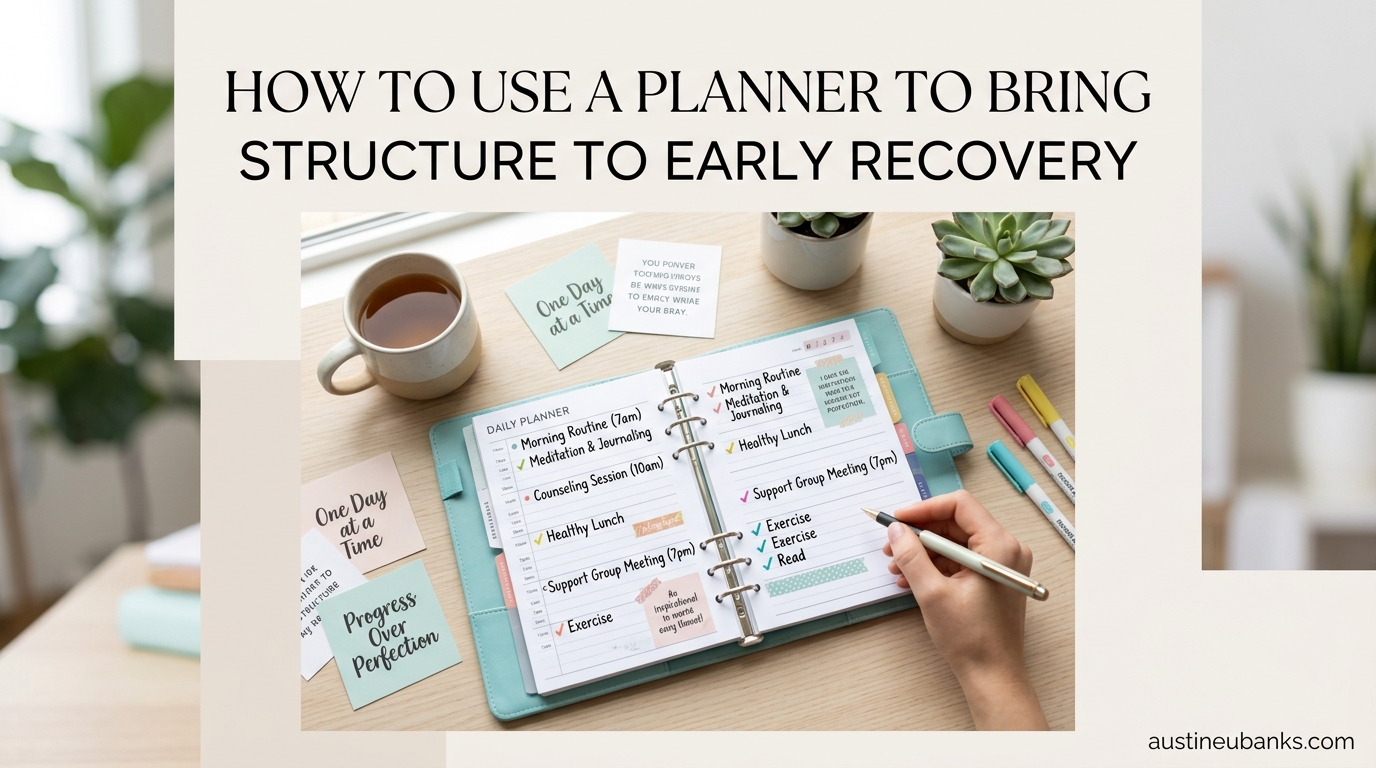
Early recovery can feel like standing in the middle of a wide-open field with no paths, no signs, and no idea which direction to walk. When you remove substances from your life, you also remove the structure they provided, however damaging that structure was. Suddenly you have hours of time that need filling, decisions that need making, and emotions that need processing, all without a roadmap.
That is where a planner becomes one of the most underrated tools in your recovery toolkit. Learning how to use a planner to bring structure to early recovery is not about becoming a productivity machine. It is about giving your days a shape so that you do not have to figure everything out from scratch each morning. A planner takes the chaos of early sobriety and turns it into something manageable, one page at a time.
In this guide, I will walk you through exactly why planners help, how to choose the right one, and how to set it up step by step for your recovery journey. Whether you are three days sober or three months in, you will find practical, compassionate guidance you can start using today.
Table of Contents
Why Structure Matters in Early Recovery
Structure is not just a nice-to-have in early recovery. It is one of the most protective factors against relapse that exists. When you look at the research from organizations like SAMHSA (Substance Abuse and Mental Health Services Administration) and NIDA (National Institute on Drug Abuse), routine and predictability show up again and again as cornerstones of sustained recovery.
Here is what happens in early recovery: your brain is healing. The neural pathways that were wired around substance use do not disappear overnight. During post-acute withdrawal syndrome (PAWS), which can last weeks or months, you may experience brain fog, emotional swings, memory issues, and difficulty concentrating. A structured routine helps compensate for these cognitive challenges by reducing the number of decisions you have to make each day.
Think about decision fatigue. Every single choice you make, from what to eat for breakfast to whether to attend a meeting, drains a small amount of your mental energy. By the time evening rolls around and cravings typically hit hardest, your decision-making reserves are depleted. A planner removes that friction by pre-deciding your day. You already know what comes next because you wrote it down.
Unstructured time is the other danger zone. Boredom in recovery is not just uncomfortable; it is a genuine relapse trigger. When you have empty hours stretching ahead of you with nothing planned, your brain defaults to familiar patterns. A planner helps you fill that time intentionally with recovery-supportive activities before the boredom has a chance to take hold.
Predictability also calms your nervous system. Early recovery often comes with a constant undercurrent of anxiety and uncertainty. When you know what your day looks like, when your meetings are, and when you have time for self-care, your brain gets the message that you are safe. That sense of safety is something many people in recovery have not felt in a long time.
How a Planner Specifically Helps in Recovery
Plenty of articles talk about the importance of structure in recovery. But almost none of them explain how a planner, as a specific physical or digital tool, makes that structure real and actionable. That is the gap I want to fill here.
A recovery planner works as an external brain. When you are dealing with recovery brain fog, trying to keep track of appointments, meeting schedules, medication timing, therapy sessions, and self-care tasks in your head is a recipe for overwhelm. Writing things down frees up cognitive space. You stop carrying the mental weight of remembering everything and start trusting the page to hold it for you.
Accountability is another powerful benefit. When you write down that you will attend a 7 PM meeting, that commitment becomes more concrete than a passing thought. Many people in recovery describe the act of crossing something off a list as genuinely satisfying. It creates a small but meaningful sense of accomplishment, something that is incredibly valuable when big achievements still feel far away.
Tracking your progress matters too. In early recovery, it is easy to lose sight of how far you have come because each day can feel like a grind. A planner that tracks sober days, meetings attended, or habits maintained gives you visible proof of your effort. On hard days, flipping back through weeks of completed pages can be the reminder you need that you are capable of this.
There is also something deeply grounding about the physical act of writing. Forum communities like r/planners are filled with people who describe the tactile comfort of pen on paper. Writing engages different parts of your brain than typing does, and that sensory experience can be calming in moments of anxiety or restlessness. For many people in recovery, a paper planner becomes a comfort object, something tangible they can hold onto when everything else feels uncertain.
Mood tracking is another feature that makes planners especially suited to recovery. Being able to look back and see patterns in your emotional state helps you identify triggers before they spiral. You might notice that your anxiety spikes every Tuesday, which happens to be the day before your therapy appointment. Or that your cravings intensify in the late afternoon when your schedule has a gap. These insights are hard to see in the moment but become obvious when you have weeks of data written down.
Choosing the Right Planner for Your Recovery
One of the biggest content gaps I found while researching this topic is that no recovery resource actually helps you choose a planner. They talk about structure in the abstract but never address the practical question of what to write in. Let me fix that.
Paper vs Digital Planners
Both formats work, but they serve different needs. Paper planners offer the tactile experience many people in recovery find grounding. There is no screen to distract you, no notification to pull you off track, and no temptation to open an app that leads somewhere you should not go. Writing by hand also reinforces memory and commitment more effectively than typing, according to multiple cognitive psychology studies.
Digital planners, on the other hand, offer reminders and alerts that paper simply cannot match. If you struggle with forgetting appointments or need a nudge to leave for a meeting, a phone-based calendar with push notifications might serve you better. Some people use both, a paper planner for daily reflection and habit tracking, and a phone calendar for appointment reminders.
For people dealing with recovery brain fog specifically, I generally recommend starting with paper. The act of physically writing helps with memory consolidation and cognitive grounding in ways that tapping a screen does not. But the best planner is the one you will actually use consistently, so trust your instincts here.
Structured vs Flexible Layouts
Structured planners have pre-printed hourly schedules, fixed daily sections, and clear categories. These work well if you thrive on predictability and want a framework that tells you exactly what to fill in. The downside is that they can feel rigid, and if you miss a day, the empty page can trigger feelings of failure.
Flexible planners, like dot-grid or blank-page formats, give you total freedom to design your own layout each day. These are ideal if your schedule varies a lot or if you want to adapt your planning style as your recovery evolves. The trade-off is that too much freedom can lead to decision fatigue, which is exactly what you are trying to avoid.
A middle-ground option is a planner with daily sections for key recovery elements like meetings, self-care, mood, and gratitude, but without rigid hourly time slots. This gives you structure without pressure.
Recovery-Specific Features to Look For
If you are shopping for a planner or designing your own, here are the features that matter most for recovery:
Meeting and appointment scheduling is the foundation. You need space to record support group meetings, therapy sessions, and medical appointments. Habit tracking pages help you visualize consistency with things like exercise, journaling, or meditation. A mood tracker lets you spot emotional patterns over time. Gratitude sections rewire your brain toward noticing positive things, which research shows is particularly powerful in early recovery.
A reflection or journaling area gives you space to process emotions without needing a separate notebook. And crisis planning pages, where you write down your triggers, coping strategies, and emergency contacts, can be genuinely life-saving on the hardest days.
How to Use a Planner in Early Recovery: Step-by-Step Setup
Now let me walk you through the actual setup process. This is the practical, hands-on part that no competitor article covers. Take this one step at a time. You do not need to do all of this on day one.
Step 1: Anchor Your Day with Recovery Commitments
Start by writing down your non-negotiable recovery activities. These are the things that keep you sober: support group meetings, therapy appointments, check-ins with your sponsor or accountability partner, and any medication schedules. These go into your planner first because they are the structural pillars everything else is built around.
Be specific. Instead of writing “meeting,” write “Tuesday 7 PM, St. Mark’s Church, speaker meeting.” The more detail you include, the less mental energy you spend later trying to remember the specifics.
Step 2: Add Self-Care Blocks
Self-care in recovery is not optional. It is maintenance. Block out time for sleep, meals, exercise, and personal hygiene. Many people in early recovery are surprised by how much of their day used to revolve around substances and how empty the hours feel without them. Intentionally scheduling self-care fills some of that space and sends yourself the message that your well-being matters.
You might schedule a morning walk, a 20-minute meditation after lunch, and an evening reading session. These do not have to be long blocks. Even 15 minutes of intentional self-care, written down and crossed off, builds your sense of self-worth over time.
Step 3: Fill Idle Time Intentionally
This is where the magic happens. Look at the gaps in your schedule, those stretches of unstructured time that could become dangerous. Now fill them with something specific. Not just “free time” or “relax,” but actual activities: call a friend, go to the library, work on a hobby, volunteer, take a nap, cook a meal.
The goal is not to schedule every minute of your day. That would be exhausting and unsustainable. The goal is to make sure that your most vulnerable hours, typically late afternoon and evening for many people, have something planned. When you have a specific activity written down, you are far less likely to drift into dangerous territory.
Step 4: Include Mood and Trigger Tracking
Dedicate a small section of your daily page to recording your emotional state and any triggers you encountered. This does not need to be a long journal entry. A simple mood rating from 1 to 10, a few words about how you felt, and a note about anything that triggered a craving is enough.
Over weeks and months, this data becomes incredibly valuable. You will start to see patterns that help you prepare for difficult moments before they happen. Maybe you notice that lack of sleep consistently leads to worse moods the next day, or that certain social situations spike your anxiety. Knowledge is power in recovery, and tracking gives you that knowledge.
Step 5: Add Reflection and Gratitude Sections
End each day with a brief reflection. Write down one thing you are grateful for, one thing that went well, and one thing you want to approach differently tomorrow. This practice is not just feel-good advice. Research on gratitude consistently shows that people who regularly practice gratitude report lower stress levels, better sleep, and greater emotional resilience.
In recovery, gratitude is especially powerful because it counteracts the negativity bias that often comes with early sobriety. When your brain is used to focusing on what is wrong, actively writing down what is right helps rewire that tendency over time.
Step 6: Build In Flexibility and Buffer Time
Do not pack your schedule so tightly that one disruption derails your whole day. Leave buffer time between activities. Plan for things to take longer than expected. And most importantly, build in blank space where nothing is scheduled at all.
Flexibility is not the opposite of structure. It is part of healthy structure. Rigid, inflexible plans break the moment life does not cooperate, and in early recovery, life will not always cooperate. A planner that has some breathing room is one you can actually stick with.
Building Your Daily Recovery Structure
Let me give you a concrete example of what a recovery-focused daily schedule might look like in your planner. This is not a template you must follow exactly. It is a starting point you can adapt to your own life, commitments, and energy levels.
Morning
Start with a consistent wake-up time, even on weekends. Consistency in your sleep schedule helps regulate your circadian rhythm, which in turn stabilizes your mood. After waking, take 10 to 15 minutes for a morning grounding practice. This could be meditation, prayer, stretching, or simply sitting quietly with a cup of coffee. Write in your planner what you did and how you felt.
Next comes breakfast and any morning medication. Then, if you are not working, schedule a recovery-focused activity: read recovery literature, journal, or complete a workbook exercise. If you are working, your job provides structure for the middle of your day, which is one of the unspoken benefits of employment in early recovery.
Midday
Lunch at a consistent time helps maintain blood sugar stability, which affects mood and craving intensity. After lunch, schedule something that gets you out of the house or changes your environment. A walk, a trip to the library, or time at a coffee shop. Many people in recovery find that a change of scenery in the afternoon helps prevent the restlessness that can lead to cravings.
If your afternoon has a gap, this is a good time for a support group meeting, a check-in call with your sponsor, or time spent on a hobby. Write it all down so the time does not become a void.
Evening
Dinner, then evening activities. This is when many people in recovery are most vulnerable, so plan your evenings carefully. An evening meeting is ideal if one is available. If not, schedule a phone call with someone from your support network, a recovery-related activity, or a structured hobby.
Wind down with a screen-free hour before bed. Use this time for your evening reflection: rate your mood, note any triggers, write your gratitude entry, and review tomorrow’s plan. Going to bed knowing what tomorrow looks like reduces morning anxiety and helps you sleep better.
Recovery Essentials to Track
Beyond your daily schedule, certain recovery elements deserve their own tracking system in your planner:
Track your sober days or milestones. Celebrate them, even the small ones. Seven days is an achievement. Thirty days is an achievement. Write them down and acknowledge them. Track meetings attended each week. Track therapy sessions and any homework or insights from them. Track physical health indicators like sleep quality, exercise, and nutrition, because physical health directly impacts emotional resilience in recovery.
Also track your connections. How many recovery-supportive people did you talk to this week? Social connection is one of the strongest protective factors against relapse, and a planner can help you make sure you are not isolating.
Weekly and Monthly Planning for Long-Term Recovery
Daily planning is the heartbeat of your recovery structure, but weekly and monthly planning give you the bigger picture. Once a week, sit down with your planner for 20 to 30 minutes and review the week behind you while planning the week ahead.
During your weekly review, look at what worked and what did not. Did you attend all your scheduled meetings? Were there days that felt harder than others? Did any triggers catch you off guard? Use these insights to adjust the coming week. Maybe you need to add an extra meeting on a day that consistently feels difficult, or schedule a phone call with your sponsor on a day when cravings tend to spike.
Write down your sober milestones at the start of each week. Seeing “Day 45” or “Day 90” growing week by week is a powerful visual reminder of your progress. It also gives you something to look forward to and celebrate.
Monthly planning is about zooming out further. Set one or two recovery goals for the month. These might include finding a new support group, starting a volunteer commitment, or working through a specific recovery workbook. Monthly goals give your recovery forward momentum and prevent the stagnation that can set in after the initial intensity of early sobriety fades.
Remember to adjust your plan as your recovery evolves. What works in your first 30 days will likely need tweaking by day 90. Your planner is a living document, not a static set of rules. Let it grow and change with you.
When You Miss Days: Self-Compassion in Planning
Here is something I want you to hear clearly: you will miss days in your planner. You will have days when you do not write anything down, when you skip your reflection, when your planner sits unopened on the nightstand. This is normal. This is human. And it does not mean you have failed.
The perfectionism trap is one of the most common reasons people abandon planners in recovery. They miss two days, feel guilty, and then stop using the planner entirely because the empty pages feel like evidence of failure. I have seen this pattern described in recovery forums over and over again.
Here is how to handle missed days differently. First, normalize it. Everyone misses days. The goal is consistency over time, not perfection every single day. Second, when you miss a day, do not try to go back and fill it in. Just start fresh with today’s page. Third, acknowledge the miss without judgment. Write “missed yesterday, starting again today” if it helps. That simple act of honesty keeps you connected to your planner and your recovery.
Be gentle with yourself. Recovery is hard work, and some days just surviving is enough of an achievement. If the only thing you write in your planner on a bad day is “I stayed sober,” that counts. That is a complete and valid entry.
If you find yourself missing days frequently, that is information, not failure. Maybe your planner is too complex and needs simplifying. Maybe you are over-scheduling and need more blank space. Maybe the format does not work for you and you need to switch from paper to digital or vice versa. Treat it as data and adjust accordingly.
The most important thing is that you keep coming back to your planner, just like you keep coming back to your recovery. It is not about never falling off track. It is about getting back on, over and over, for as long as it takes.
FAQs
What are the 5 C’s of recovery?
The 5 C’s of recovery are: Connection (building supportive relationships), Coping (developing healthy strategies for stress and triggers), Competence (building skills and confidence), Control (regaining agency over your choices), and Confidence (developing trust in your ability to stay sober). These five elements work together to create a foundation for lasting recovery.
How to create a recovery plan?
To create a recovery plan, start by identifying your recovery goals and what sobriety means to you. Next, list your triggers and the coping strategies you will use for each one. Include a schedule of recovery commitments like meetings, therapy, and check-ins with support people. Add self-care activities, emergency contact numbers, and a relapse prevention strategy. Write all of this in a planner or document you review regularly, and adjust it as your recovery evolves.
What are the 3 C’s of recovery?
The 3 C’s of recovery are: I didn’t Cause it, I can’t Control it, and I can’t Cure it. These principles, rooted in Al-Anon and adapted across recovery communities, remind individuals that addiction is a disease, not a moral failing. They help people focus on what they can change, their own actions, thoughts, and behaviors, rather than trying to control outcomes beyond their power.
What are the 7 R’s of recovery?
The 7 R’s of recovery are: Recognition (acknowledging the problem), Responsibility (taking ownership of your recovery), Repair (making amends and healing relationships), Resolution (developing coping strategies), Resilience (building emotional strength), Renewal (creating a new identity and purpose), and Recreation (finding joy and meaning in sober life). These stages provide a roadmap for the recovery journey from early sobriety through long-term healing.
Bringing It All Together
Learning how to use a planner to bring structure to early recovery is not about perfection. It is about progress, one page at a time. A planner gives you a place to anchor your days, track your growth, process your emotions, and build the kind of consistent routine that makes lasting sobriety possible.
Start small. Grab any notebook or planner you have and begin with just your recovery commitments and a daily gratitude entry. As you get comfortable, add mood tracking, trigger logging, and weekly reviews. Let your planner evolve alongside your recovery.
You are doing something extraordinarily difficult. Every day you stay sober is an accomplishment worth recording. Your planner can become the quiet, steady companion that walks beside you through this journey, page by page, day by day. Be patient with yourself, keep showing up, and trust that the structure you build now will support the life you are creating.