
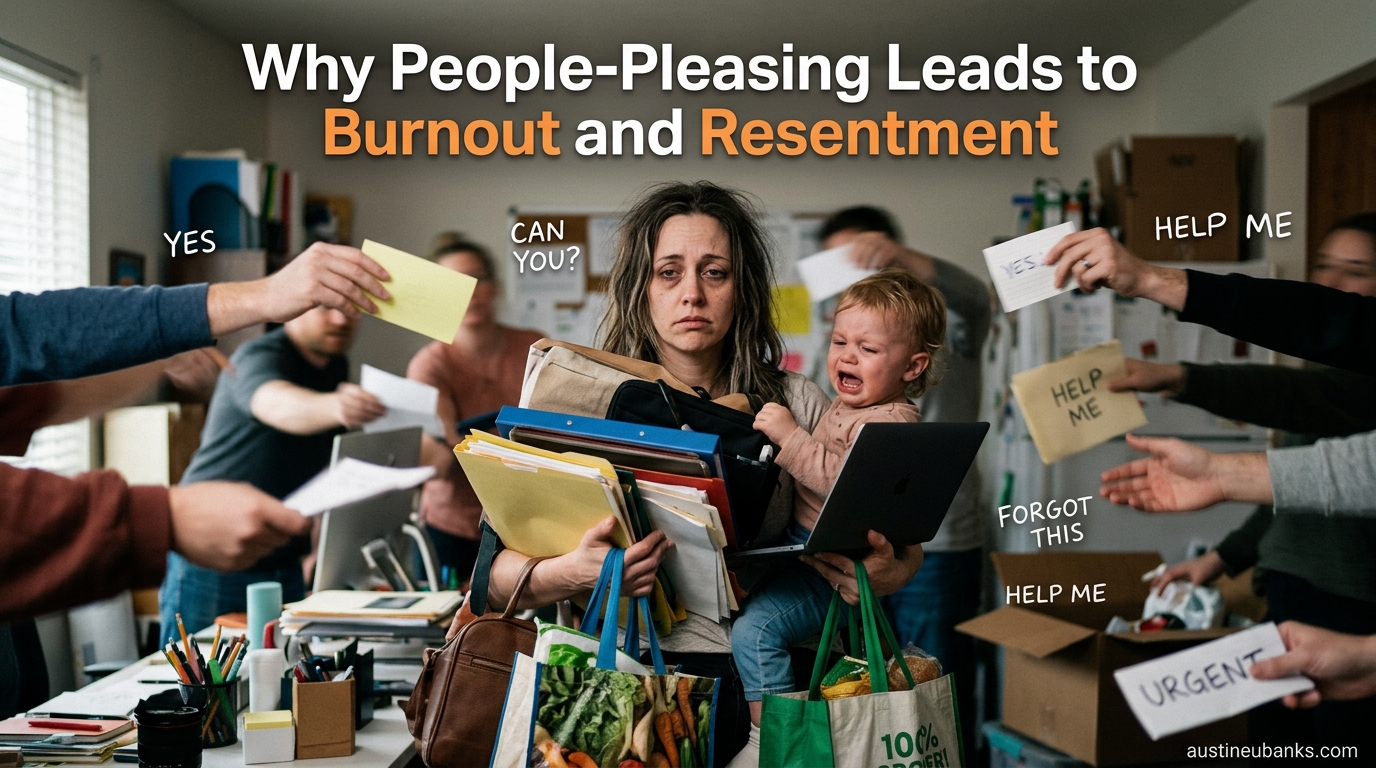
You said yes to covering a coworker’s shift. You agreed to host the family dinner. You volunteered for the committee nobody wanted. And now it is 11 PM, you are staring at the ceiling, and a quiet rage is building inside you that you cannot quite explain.
If that scenario feels familiar, you are not alone. Millions of people fall into the same trap every single day. Understanding why people-pleasing leads to burnout and resentment is the first step toward breaking a pattern that quietly destroys relationships, careers, and mental health.
I have been there myself. For years, I said yes to everything because I thought being agreeable would make people value me. Instead, I lost myself completely. The irony of people-pleasing is that the harder you try to make everyone happy, the more exhausted and bitter you become.
People-pleasing leads to five major consequences:
- Burnout from chronic overcommitment and emotional depletion
- Resentment from unreciprocated effort and unexpressed needs
- Lost identity from constantly centering others’ preferences over your own
- Weakened relationships as authenticity erodes and distance grows
- Increased anxiety and stress from living in constant fear of disappointing others
In other words, the strategy designed to keep you safe and connected ends up doing the exact opposite. This article breaks down exactly why that happens, what the psychology and neuroscience tell us, and how to start breaking free.
Table of Contents
What Is People-Pleasing?
People-pleasing is a behavioral pattern where an individual consistently prioritizes other people’s needs, expectations, and approval over their own well-being. It goes beyond simple kindness. A people pleaser will often sacrifice their time, energy, values, and boundaries to avoid conflict or rejection.
The line between being kind and being a people pleaser comes down to motivation. Kindness is a choice made from a place of fullness. People-pleasing is a compulsion driven by fear. One feels generous. The other feels like survival.
Here is a quick behavioral checklist. If you resonate with several of these, people-pleasing may be running your life:
- You say yes when you mean no
- You apologize for things that are not your fault
- You over-explain your decisions to justify them
- You avoid conflict even when something matters to you
- You take responsibility for other people’s emotions
- You feel anxious when someone seems upset with you
- You cannot identify what you want because you always defer to others
- You feel exhausted but cannot explain why
- You attract people who constantly ask for favors
- You feel guilty when you do something for yourself
People-Pleasing vs. Healthy Accommodation
Not every act of putting someone else first is people-pleasing. The difference matters enormously. Here is how to tell them apart:
People-Pleasing: Driven by fear of rejection. Feels like an obligation. Causes resentment. Involves ignoring your own needs. You cannot say no without guilt.
Healthy Accommodation: Driven by care and choice. Feels like generosity. Causes connection. Involves considering both people’s needs. You can say no without guilt when needed.
One Reddit user described the distinction perfectly: “Being a people pleaser is a form of self-neglect. Being kind is a form of self-expression.”
Why People-Pleasing Leads to Burnout and Resentment
Understanding the connection between people-pleasing and its two most destructive outcomes requires examining the psychological, neurological, and social mechanisms at play. Burnout and resentment do not happen by accident. They are the predictable results of a system designed to suppress your needs in favor of everyone else’s.
The Psychology Behind People-Pleasing
People-pleasing does not come out of nowhere. It is almost always rooted in early life experiences, nervous system conditioning, and deeply held beliefs about what makes a person worthy of love and safety.
Childhood Origins and Trauma
Many people-pleasers learned the pattern in childhood. If you grew up in a home where love was conditional, where conflict was dangerous, or where you were praised primarily for being “good” and “easy,” you likely internalized a core message: your worth depends on keeping others happy.
Some children become the peacekeepers in volatile households. They learn to read emotional signals constantly and adjust their behavior to prevent explosions. This hypervigilance becomes wired into the nervous system. As adults, they automatically scan for disapproval and rush to fix it.
Research in developmental psychology shows that children who experience emotional neglect often develop what psychologists call sociotropy, a personality style characterized by excessive investment in social approval and fear of independent action. This becomes the foundation for lifelong people-pleasing.
The Fawn Response: A Survival Mechanism
You have probably heard of fight, flight, and freeze. But there is a fourth stress response that explains a massive amount of people-pleasing behavior: the fawn response.
Coined by therapist Pete Walker, the fawn response describes a survival strategy where a person attempts to avoid danger by appeasing the source of threat. Instead of fighting, running, or shutting down, they try to become so helpful, so agreeable, and so non-threatening that the dangerous person has no reason to attack.
The fawn response is especially common in survivors of childhood abuse, complex trauma, and narcissistic family systems. It is not a character flaw. It is a brilliant survival adaptation that simply outlived its usefulness.
Fear of Rejection and Abandonment
At its core, people-pleasing is powered by fear. The two biggest fears driving it are rejection and abandonment. Every yes becomes a shield. Every act of self-sacrifice becomes an insurance policy against being cast out.
Attachment theory helps explain this. People with anxious attachment styles often develop people-pleasing patterns because they learned early that closeness is fragile. They believe, often unconsciously, that if they stop performing, the people they love will leave.
The problem is that this fear never gets satisfied. No amount of pleasing is ever enough to silence it permanently. The people pleaser keeps raising the stakes, giving more and more, while the fear stays exactly the same.
The Neuroscience: Why Saying Yes Feels Addictive
There is a biological reason people-pleasing feels so hard to stop. When you do something that earns approval, your brain releases dopamine, the same neurotransmitter involved in reward and addiction. Each yes, each compliment earned, each avoided conflict delivers a small hit of relief.
Simultaneously, the brain’s social threat detection system, centered in the amygdala, treats the possibility of someone being upset with you as an actual danger. For a chronic people pleaser, disappointing someone activates the same neural pathways as physical pain.
This is why saying no can feel physically uncomfortable. Your brain is interpreting the risk of social disapproval as a threat to your survival. Understanding this biology helps remove the shame. You are not weak. Your nervous system learned a pattern, and patterns can be rewired.
How People-Pleasing Leads to Burnout
Burnout is the natural endpoint of chronic people-pleasing. When you continuously give more energy than you replenish, depletion is inevitable. Here is how the mechanism works.
The Depletion Mechanism
Every yes you give costs something. Time, attention, emotional bandwidth, physical energy. When you are a people pleaser, you are constantly making withdrawals from an account that never gets replenished because you never stop to deposit anything back into yourself.
The math is simple and brutal. If you give 100 percent of your energy to others and keep zero for yourself, you will run dry. It is not a question of if, but when. Most people pleasers hit the wall somewhere between their late twenties and early forties, though it can happen at any age.
Emotional Labor Overload
Beyond the practical tasks of overcommitting, people pleasers carry a heavier invisible burden: emotional labor. This is the work of managing feelings, anticipating needs, smoothing over conflicts, and monitoring everyone else’s comfort.
One Reddit user captured it perfectly: “At work, I am constantly bombarded with others’ admin tasks. I have to do this immediately. I am unable to relax or focus on other things until those favors are done.”
Emotional labor is exhausting precisely because it is invisible. Nobody thanks you for the energy you spent worrying about whether your tone in that email was too harsh. Nobody sees the mental load of tracking everyone’s preferences. But your body feels it all.
Overcommitting and Physical Exhaustion
People pleasers suffer from what I call “impulsive yes syndrome.” Before their conscious mind catches up, they have already agreed to something. The word yes comes out automatically, driven by that dopamine-fueled approval-seeking and the threat-avoidance response.
This leads to impossible schedules. Double-booked evenings. Weekends consumed by obligations that belong to other people. The body responds with the classic signs of burnout: chronic fatigue, brain fog, disrupted sleep, weakened immunity, and a creeping sense of dread about the day ahead.
People-Pleasing at Work: A Burnout Accelerator
The workplace is where people-pleasing burnout reaches its most intense. In professional settings, people pleasers become the default fixers. They volunteer for the tasks nobody wants. They cover for colleagues. They never push back on unrealistic deadlines.
This pattern does not just cause exhaustion. It actively damages careers. When you are known as the person who always says yes, you get assigned the low-value, high-effort work that never gets promoted. Meanwhile, the colleagues who set boundaries get the strategic projects that lead to advancement.
A pattern I see repeatedly: the hardest worker in the room is often the one passed over for promotion because they are too valuable in their current role. Their people-pleasing has made them indispensable in a position that keeps them stuck.
How People-Pleasing Leads to Resentment
If burnout is the physical cost of people-pleasing, resentment is the emotional cost. And resentment is arguably the more dangerous of the two because it poisons relationships from the inside out.
The Unfairness Mechanism
Resentment builds when you give consistently and receive inconsistently. You stayed late to help a friend move. They canceled on you last week. You listened to your partner vent for an hour. They checked their phone when you started talking about your day.
The problem is that people pleasers rarely communicate what they need in return. They give freely, expecting reciprocity to happen automatically. When it does not, they feel cheated, but they cannot say anything because conflict feels too dangerous.
So the resentment accumulates in silence. Each unreciprocated favor, each ignored need, each taken-for-granted sacrifice adds another layer to a wall that slowly grows between the people pleaser and everyone they know.
Unexpressed Needs Accumulate
The core driver of resentment is unexpressed needs. When you never tell people what you want, what you feel, or what would make you feel valued, you set up an impossible test. You expect people to read your mind and meet your needs without you ever having to ask.
Nobody passes that test. Not because people are selfish, but because mind-reading is not real. Yet the people pleaser interprets each failure as proof that nobody cares, which deepens the resentment and confirms the belief that asking for what you need is pointless.
This creates a bitter internal monologue. “After everything I have done for them, they cannot even…” That sentence ends a thousand different ways, but the structure is always the same. Silent sacrifice followed by silent disappointment.
The Passive-Aggressive Pipeline
Here is where it gets uncomfortable. Yes, people pleasers can absolutely become passive-aggressive. When you are unable to express anger or frustration directly, that energy does not disappear. It leaks out sideways.
Passive-aggressive behavior in people pleasers looks like sarcasm disguised as humor. It looks like procrastinating on a favor you resented being asked for. It looks like giving someone the silent treatment while insisting everything is “fine.” It looks like subtle digs wrapped in a smile.
The very behavior designed to avoid conflict ends up creating it, just in a covert, harder-to-address form. This is one of the cruelest ironies of people-pleasing. The strategy for maintaining peace becomes a source of tension and confusion.
How Resentment Damages Relationships
Unchecked resentment erodes intimacy. You cannot feel close to someone you secretly resent. The warmth gets replaced by a performance of warmth. You go through the motions of caring while underneath, a cold current of frustration runs.
Over time, people pleasers lose relationships not because they were too giving, but because they became emotionally invisible. One Reddit thread put it bluntly: “Some people will get upset when you stop people-pleasing. Good. Those are the people who were only around because you were convenient.”
The resentment does not just hurt the people pleaser. It confuses the people around them who never knew there was a problem because the people pleaser never said a word. By the time the resentment boils over, the damage is often severe.
The Vicious Cycle: How Burnout and Resentment Feed Each Other
Burnout and resentment are not separate outcomes of people-pleasing. They form a self-reinforcing cycle that gets worse over time unless something breaks the loop.
Here is how it works. People-pleasing leads to burnout. Burnout depletes your emotional reserves. With depleted reserves, every request feels heavier, every unreciprocated effort stings more. The burnout amplifies the resentment.
Meanwhile, resentment makes you withdraw emotionally. You stop enjoying the relationships you are working so hard to maintain. This emotional withdrawal is itself exhausting. It takes enormous energy to perform warmth you do not feel, which deepens the burnout.
The two feed each other in a downward spiral. More burnout means more resentment. More resentment means more burnout. And underneath both, the people-pleasing continues because the fear driving it, the fear of rejection and abandonment, has not been addressed.
This is why willpower alone rarely fixes people-pleasing. You can resolve to say no more often, but if the underlying fear and the depleted nervous system are not addressed, the cycle restarts within weeks. Breaking free requires understanding the pattern and interrupting it at multiple points simultaneously.
People-Pleasing, ADHD, and Gender: What the Research Shows
Two factors make people-pleasing significantly worse for certain populations: ADHD and gendered social conditioning. Most articles skip these entirely, but the research and lived experiences are too significant to ignore.
The ADHD Connection
If you have ADHD, your risk for people-pleasing is substantially higher. This connection is vastly under-discussed but widely experienced. ADHD forums are filled with people describing compulsive people-pleasing that leads to severe burnout.
One reason is rejection sensitive dysphoria (RSD), a condition commonly associated with ADHD where perceived rejection or criticism triggers intense emotional pain. For someone with RSD, the prospect of disappointing another person is not just uncomfortable. It is agonizing. People-pleasing becomes a desperate strategy to avoid that pain.
Additionally, many people with ADHD developed masking behaviors in childhood to hide their symptoms and fit in. Masking and people-pleasing are close cousins. Both involve suppressing your authentic self to meet external expectations. Both are exhausting. And both lead to the same destination: identity loss and burnout.
The Gender Dimension
Society conditions women and girls to people-please at rates far exceeding men and boys. From childhood, girls are praised for being “good,” “quiet,” “helpful,” and “considerate.” Boys are encouraged to be assertive, confident, and direct.
By adulthood, this conditioning becomes a structural problem. Women are expected to perform more emotional labor in every setting: at home, in friendships, and especially at work. Research consistently shows that female employees are assigned more administrative tasks, more note-taking duties, more committee work, and more emotional support roles than their male colleagues.
One woman on Reddit described the workplace dynamic plainly: “People tend to respect the boundaries of the men around me more so than the women and definitely me.” This is not imagined. Studies on workplace behavior confirm that women face social penalties for assertiveness that men do not.
This means women who people-please are fighting two battles: their internal psychological patterns and a external system that rewards their self-sacrifice. Breaking free requires recognizing both layers.
Signs You Are Caught in the People-Pleasing Cycle
Before you can break free, you need to recognize the pattern. See how many of these warning signs resonate with you.
Self-Assessment Checklist
- You feel responsible for other people’s happiness
- You cannot remember the last time you did something purely for yourself
- You feel anxious or guilty when someone is disappointed in you
- Your schedule is full of commitments you did not actually want
- You feel invisible in your relationships, like nobody really knows you
- You have growing resentment toward people you used to enjoy
- You feel physically tired all the time but your doctor says nothing is wrong
- You say sorry automatically, even when you did nothing wrong
- You avoid sharing opinions because it might cause friction
- You feel like your life is happening to you rather than being directed by you
If you checked five or more, you are likely deep in the people-pleasing cycle. If you checked eight or more, burnout and resentment are probably already affecting your daily life. The good news is that recognizing the pattern is the first step to changing it.
Warning Signs of People-Pleasing Burnout
Burnout from people-pleasing looks slightly different from work-related burnout. Watch for these specific indicators:
- Dreading social plans you previously looked forward to
- Feeling irritable or short-tempered with people you love
- Emotional numbness or detachment from your own feelings
- Fantasizing about disappearing or running away
- Physical symptoms with no medical cause: headaches, stomach issues, tension
- Feeling like you are performing your life rather than living it
- A growing sense of cynicism about relationships in general
These are not signs of weakness. They are signs that your system is overloaded and asking for change.
How to Break Free from People-Pleasing
Breaking the cycle is possible. It does not happen overnight, and it requires consistent effort, but the freedom on the other side is worth every uncomfortable conversation. Here is a step-by-step approach based on what research and lived experience show actually works.
Step 1: Recognize the Pattern Without Shame
You cannot change a pattern you are ashamed of. Shame keeps people-pleasing hidden, and what is hidden cannot be examined. Start by acknowledging that your people-pleasing developed as a survival strategy. It made sense in the context where you learned it.
Your nervous system learned that keeping others happy was the safest path. That was an intelligent adaptation. It simply no longer serves you. Framing it this way removes self-blame and opens space for change.
Step 2: Practice the Pause Before Saying Yes
People pleasers suffer from impulsive yes syndrome. The yes comes out before the brain has time to evaluate whether the commitment is something they actually want or can handle. The most powerful intervention is simple: insert a pause.
When someone asks you for something, do not answer immediately. Use a standard phrase like:
- “Let me check my schedule and get back to you.”
- “I need to think about that before I commit.”
- “Can I let you know by tomorrow?”
- “I want to give you a real answer, so let me take a day to think about it.”
This pause gives your prefrontal cortex time to catch up with your nervous system. In that space, you can actually ask yourself: do I want to do this? Do I have the capacity? What will this cost me?
Step 3: Start With Low-Stakes Boundaries
Do not start by setting a boundary with the most difficult person in your life. That is like trying to deadlift 300 pounds on your first day at the gym. Start small.
Say no to a minor request from a safe person. Decline a social invitation you do not want. Express a food preference when someone asks where to eat. These tiny acts of self-advocacy build the neural pathways for bigger boundaries later.
Each small no proves to your nervous system that you can survive someone being mildly disappointed. That proof, repeated over time, is what weakens the fear response driving people-pleasing.
Step 4: Learn Boundary-Setting Scripts
One of the biggest reasons people struggle with boundaries is that they simply do not know what to say. Having scripts ready removes the pressure of inventing a response in the moment. Here are practical phrases you can use:
Declining a request:
- “I wish I could help with that, but I do not have the capacity right now.”
- “I am not able to take that on, but thank you for thinking of me.”
- “That does not work for me, but I hope it works out.”
Setting a limit:
- “I can help with X, but I will not be able to do Y.”
- “I am available until 5 PM. After that, I will be offline.”
- “I am happy to discuss this, but not right now. Can we schedule a time?”
Handling pushback:
- “I understand you are disappointed, and my answer is still no.”
- “I know this is different from how I usually respond. I am making some changes.”
- “This is not up for negotiation.”
Step 5: Expect and Survive Pushback
Here is the part nobody warns you about. When you start setting boundaries, some people will push back hard. They liked the old version of you. The one who never said no. The one who was always available. When you change, it disrupts their expectations.
This pushback is not proof that you are doing something wrong. It is proof that the boundary was necessary. People who respect you will adjust, even if they are initially surprised. People who only valued your compliance will reveal themselves through their reaction.
As one Reddit contributor wisely put it: “Some people will get upset when you stop people-pleasing. Good. Those are the people who were only around because you were convenient.”
Step 6: Build Self-Compassion
Self-compassion is not optional in this process. It is the foundation. People pleasers are often their own harshest critics. They extend endless grace to others and zero to themselves. That imbalance is part of the pattern.
Practice talking to yourself the way you would talk to a good friend going through the same situation. When you set a boundary and feel guilty, remind yourself that guilt does not mean you did something wrong. It means you did something unfamiliar. There is a difference.
Step 7: Seek Professional Support
For many people, especially those with deep-rooted trauma or long-standing patterns, therapy is the most effective path to lasting change. Cognitive behavioral therapy helps identify and restructure the beliefs driving people-pleasing. Trauma-focused therapies like EMDR can address the nervous system patterns at a deeper level.
There is no shame in getting help. In fact, recognizing that you cannot do this alone is itself an act of self-advocacy. A skilled therapist can help you map your patterns, practice new responses in a safe environment, and process the underlying fears that keep the cycle running.
FAQs
Why does people pleasing lead to resentment?
People pleasing leads to resentment because the people pleaser consistently gives without communicating their own needs, creating an expectation of reciprocity that others cannot meet. Over time, the accumulation of unreciprocated effort, ignored needs, and taken-for-granted sacrifices builds into silent bitterness. Because people pleasers rarely express frustration directly, the resentment grows underground until it poisons the relationship from within.
What are the negative effects of being a people pleaser?
The negative effects of being a people pleaser include chronic burnout from overcommitment, deep resentment from unreciprocated effort, loss of personal identity, weakened relationships due to inauthenticity, increased anxiety and depression, physical health problems from chronic stress, career stagnation from being assigned low-value work, and attracting manipulative people who exploit the pattern.
Are people pleasers passive aggressive?
Yes, people pleasers can become passive aggressive. When someone is unable to express anger or frustration directly because conflict feels too dangerous, that emotional energy does not disappear. It leaks out sideways through sarcasm, procrastination on resented tasks, the silent treatment disguised as being fine, subtle digs wrapped in politeness, and covert withdrawal of affection. This is one of the most painful ironies of people-pleasing: the strategy designed to maintain harmony becomes a hidden source of conflict.
How to heal from people pleasing?
Healing from people pleasing involves seven key steps: recognize the pattern without shame, practice pausing before saying yes, start setting boundaries in low-stakes situations, learn and rehearse boundary-setting scripts, expect and survive pushback from people who benefited from your compliance, build self-compassion to counter the guilt of setting boundaries, and seek professional therapy such as CBT or trauma-focused treatment to address the root causes.
Can people-pleasing cause depression?
Yes, people-pleasing can contribute to depression. Chronic self-neglect, emotional exhaustion, identity loss, and the accumulation of unexpressed emotions all create conditions where depression can develop. Research shows that individuals who consistently suppress their own needs and prioritize others at their own expense are at significantly higher risk for depressive symptoms. The link between people-pleasing and depression is well documented in clinical psychology literature.
Is people-pleasing a trauma response?
Yes, people-pleasing is often a trauma response, specifically known as the fawn response. Coined by therapist Pete Walker, the fawn response is a survival mechanism where a person attempts to avoid danger by appeasing the source of threat. It is especially common in survivors of childhood abuse, emotional neglect, and narcissistic family systems. The behavior developed as a protective strategy and can be unlearned through therapy and self-awareness work.
Conclusion
Understanding why people-pleasing leads to burnout and resentment is about reclaiming your life from a pattern that was never serving you. People-pleasing promises connection and safety, but it delivers exhaustion and bitterness. The harder you try to please everyone, the more depleted and resentful you become.
We have walked through the full picture: the psychology and neuroscience behind the pattern, how it drains your energy into burnout, how unexpressed needs curdle into resentment, how the two feed each other in a vicious cycle, and how factors like ADHD and gendered conditioning make the trap even harder to escape.
The path forward is not about becoming selfish or cold. It is about becoming honest. Honest about what you can give. Honest about what you need. Honest about the fact that your worth is not measured by how much you sacrifice for others.
Start small. Practice the pause. Say no to one thing this week. Notice that the world does not end. Then say no to something slightly bigger. Each boundary you set is a vote for the version of yourself you actually want to be.
You deserve the same care you give to everyone else. And the people worth keeping in your life will celebrate, not resent, your decision to finally include yourself.