
If you have ever stared at the ceiling at 2 a.m. wondering why you cannot fall asleep, you are not alone. Millions of people struggle with nighttime noise, racing thoughts, and disrupted sleep cycles. One of the most effective and accessible tools for better rest is colored noise, which creates a consistent sound backdrop that masks disruptions.
But here is where it gets confusing. You keep hearing about white noise, pink noise, and brown noise, and everyone seems to have a different favorite. The difference between white, pink, and brown noise for sleep comes down to how each type distributes sound frequencies, which changes how your brain processes the sound while you drift off.
I have spent months researching sleep science, reading peer-reviewed studies, and digging through hundreds of forum discussions from real users who have tested these noise types. What I found is that choosing the right color noise can genuinely change how quickly you fall asleep and how deeply you stay asleep.
In this guide, I will break down exactly what each noise type is, how they sound, what the research says, and which one is best for your specific sleep situation. Whether you are a light sleeper, dealing with anxiety, managing ADHD symptoms, or just tired of your partner’s snoring, there is a color noise that fits your needs.
Table of Contents
Quick Answer: The Difference Between White, Pink, and Brown Noise for Sleep
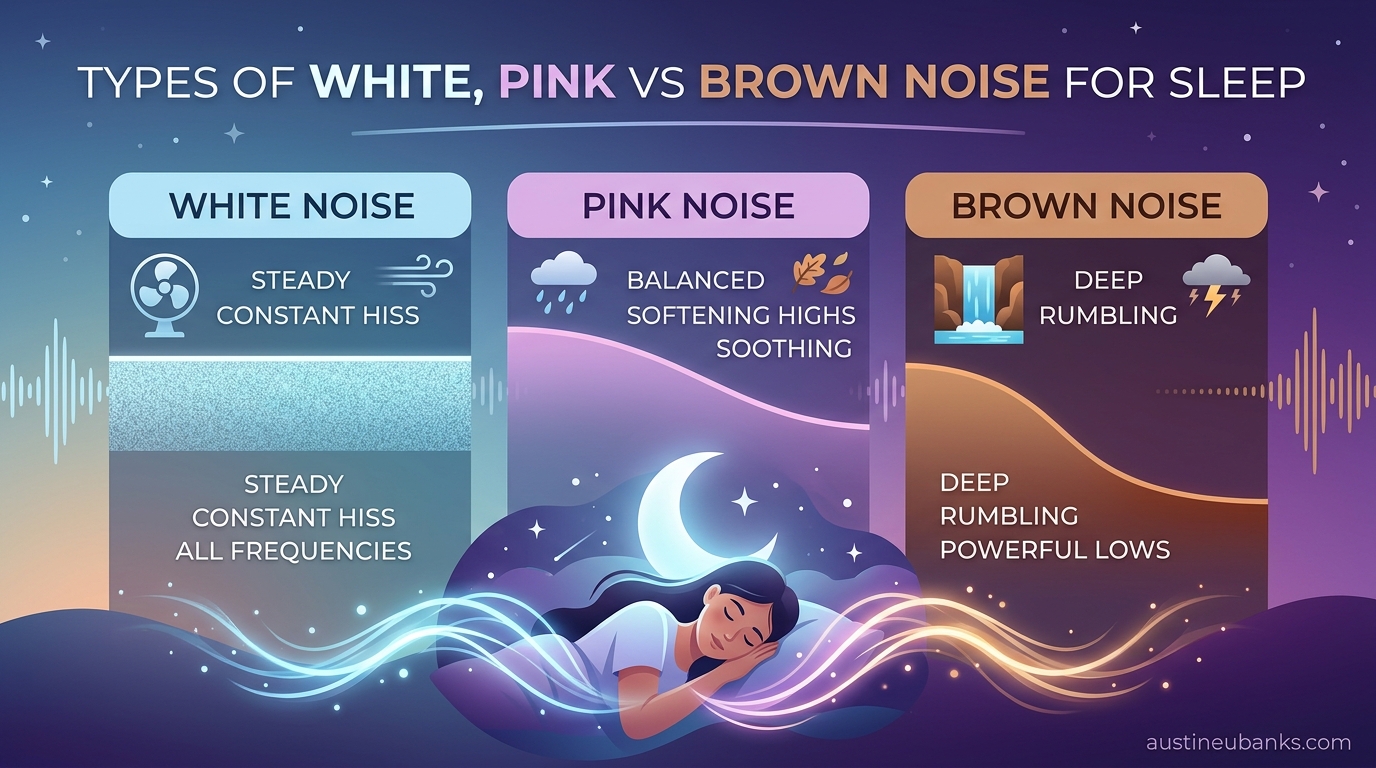
The core difference between white, pink, and brown noise comes down to frequency distribution. White noise contains all audible frequencies at equal intensity, producing a sharp hissing sound like TV static. Pink noise decreases power by 3 decibels per octave as frequency increases, creating a softer, more balanced sound similar to steady rainfall. Brown noise decreases power by 6 decibels per octave, producing a deep, rumbling bass like a distant waterfall or distant thunder.
For sleep specifically, pink noise and brown noise are generally preferred over white noise because they are less harsh and more soothing to the human ear. White noise masks sounds more aggressively, while pink and brown noise create a gentler, more relaxing auditory environment that promotes deeper sleep stages.
What Is Color Noise?
Color noise refers to sound that contains a specific distribution of frequencies across the audible spectrum. The term borrows from color theory in light, where “white light” contains all visible frequencies equally. Similarly, “white noise” contains all audible sound frequencies at equal intensity.
The “color” label tells you how power is distributed across the frequency spectrum. White noise gives equal power to all frequencies. Pink noise gives more power to lower frequencies. Brown noise gives even more power to the lowest frequencies. This distribution is what changes the character of the sound you hear.
Your ears do not perceive all frequencies equally. Human hearing is more sensitive to higher frequencies (around 2,000 to 5,000 Hz), which means that white noise, despite having equal power everywhere, sounds like it emphasizes high-pitched hissing. Pink noise and brown noise compensate for this natural bias by boosting lower frequencies, creating sounds that feel warmer and more natural.
This matters for sleep because your brain continues processing sounds while you sleep. Sudden noises, changes in pitch, and even the quality of background sound can trigger micro-arousals that pull you out of deep sleep without you knowing it. The right color noise creates a consistent, non-disruptive sound barrier that keeps your sleep environment stable all night long.
What Is White Noise?
White noise is a broadband sound that contains every audible frequency from roughly 20 Hz to 20,000 Hz, all playing at equal intensity. The result is a bright, hissing sound that many people compare to a detuned television, an air conditioner humming, or radio static between stations.
Because white noise includes all frequencies simultaneously, it is excellent at masking sudden sounds. A car door slamming outside, a dog barking, or a roommate talking, all get absorbed into the wall of sound that white noise creates. This is why white noise has been the go-to sleep aid for decades.
White Noise Benefits for Sleep
White noise is particularly effective for people who are easily startled awake by sudden environmental sounds. The consistent, dense sound barrier it creates can reduce the number of times you wake up during the night. Studies have shown that white noise can help people fall asleep faster by reducing the contrast between background silence and disruptive noises.
White noise has also been studied for its effects on sleep in hospital environments, where machines, alarms, and conversations create constant disruptions. Research published in medical journals has found that white noise can help mask these hospital sounds and improve subjective sleep quality for patients.
Who White Noise Is Best For
White noise works best for light sleepers who need strong sound masking to block out a noisy environment. If you live on a busy street, have roommates with different schedules, or are traveling and dealing with unfamiliar hotel sounds, white noise provides the most aggressive masking of the three types.
However, many people find pure white noise to be too harsh or grating over time. The emphasis on high frequencies can become irritating, especially if you are sensitive to treble-heavy sounds. If white noise makes you feel on edge rather than relaxed, pink or brown noise may be a better fit.
The White Noise Machine Misconception
Here is something that trips up a lot of people. Many products marketed as “white noise machines” do not actually produce true white noise. They generate pink noise or a variation of it, because manufacturers know that most people find pink noise more pleasant. This is one of the most common points of confusion I found across dozens of Reddit threads and forum discussions.
If you have been using a sound machine labeled as “white noise” and find it soothing rather than harsh, there is a good chance it is actually playing pink noise. This is not a bad thing. It just means you may already be benefiting from pink noise without realizing it.
What Is Pink Noise?
Pink noise is a broadband sound that contains all audible frequencies, but with more power concentrated in the lower frequencies. Specifically, the power decreases by 3 decibels per octave as frequency increases. This creates a sound that is perceptually balanced, meaning it sounds even or flat to the human ear rather than weighted toward high-pitched hissing.
Natural sounds that closely resemble pink noise include steady rainfall, leaves rustling in the wind, ocean waves at a moderate distance, and a heart beating steadily. Because pink noise mirrors many naturally occurring sounds in nature, it tends to feel more soothing and familiar than white noise.
Pink Noise Benefits for Sleep
Pink noise has gained significant attention in sleep research over the past decade. A landmark 2017 study published in Frontiers in Human Neuroscience found that participants who listened to pink noise during specific sleep stages experienced dramatically improved memory consolidation. Participants in the pink noise group showed up to three times better memory performance on word recall tests compared to their baseline.
That study used a technique called acoustic stimulation, which timed short bursts of pink noise to coincide with slow-wave sleep, the deepest stage of non-REM sleep. The results suggested that pink noise does not just mask disruptive sounds. It may actively enhance the quality of deep sleep, the stage most associated with physical restoration and memory processing.
A 2020 study expanded on these findings by comparing different types of noise and their effects on cognitive performance. The researchers measured psychomotor speed, continuous performance, executive function, and working memory. Pink noise consistently outperformed other noise types in promoting restorative sleep and next-day cognitive function.
Who Pink Noise Is Best For
Pink noise is ideal for people who find white noise too harsh but still want effective sound masking. If steady rain sounds relax you, if you enjoy the sound of wind through trees, or if ocean waves put you at ease, pink noise is likely your best match.
Pink noise is also the strongest choice if you are interested in the potential memory and cognitive benefits of sound therapy during sleep. The research on pink noise and deep sleep enhancement is more developed than for white or brown noise, making it the most evidence-backed option for people who want sleep sounds that do more than just block noise.
What Is Brown Noise?
Brown noise, sometimes called red noise or Brownian noise, is the deepest of the three main color noise types. Its power decreases by 6 decibels per octave as frequency increases, which is twice the rate of pink noise. This means the vast majority of its acoustic energy is concentrated in the lowest audible frequencies.
The name “Brownian” comes from Brownian motion, the random movement of particles suspended in a fluid, which is the mathematical model that describes this type of sound distribution. It is named after Scottish botanist Robert Brown, not the color brown, although the deep, warm character of the sound does feel “brown” in a poetic sense.
Brown noise sounds like a low, constant rumble. People commonly compare it to a distant waterfall, the low roar of a jet engine heard from far away, heavy rainfall on a roof, or deep thunder rolling in the distance. It is noticeably deeper and bass-heavier than both white and pink noise.
Brown Noise Benefits for Sleep
Brown noise has surged in popularity over the past few years, particularly in online communities focused on ADHD, anxiety, and stress management. Its deep, consistent low frequencies create a cocoon-like sound environment that many people describe as physically soothing.
For sleep, brown noise is especially effective at creating a sense of calm. The low-frequency emphasis mimics sounds that humans have evolved to associate with safety and enclosure, such as the muffled sounds heard from inside a shelter during a storm. This may explain why many users report that brown noise feels more relaxing than white or pink noise for falling asleep.
While brown noise has less direct sleep research compared to pink noise, user experiences are overwhelmingly positive. Many people who abandoned white noise because it was too irritating have found brown noise to be the perfect alternative. It provides strong sound masking without any high-frequency harshness.
Who Brown Noise Is Best For
Brown noise is the top choice for people with anxiety, ADHD, or an overactive mind at bedtime. Across multiple Reddit communities, including r/adhdwomen, r/Biohackers, and r/misophonia, users consistently report that brown noise helps quiet racing thoughts in ways that white and pink noise do not.
Brown noise is also excellent for people who are sensitive to higher frequencies. If high-pitched sounds bother you, if you find rain sounds too sharp, or if you prefer bass-heavy audio in general, brown noise will likely be the most comfortable option for sleep.
Parents in forums like r/NewParents frequently report that brown noise is the most effective sleep aid for babies and young children. The deep, rumbling quality seems to mimic the low-frequency sounds babies heard in the womb, which may explain its calming effect on infants.
White vs Pink vs Brown Noise: Side-by-Side Comparison
Understanding the difference between white, pink, and brown noise is easier when you can see how they stack up.
| Feature | White Noise | Pink Noise | Brown Noise |
|---|---|---|---|
| Frequency range | 20 Hz to 20,000 Hz | 20 Hz to 20,000 Hz | 20 Hz to 20,000 Hz |
| Power distribution | Equal at all frequencies | Decreases 3 dB per octave | Decreases 6 dB per octave |
| What it sounds like | TV static, hissing | Steady rainfall, wind | Distant waterfall, low rumble |
| Pitch character | Bright and sharp | Balanced and warm | Deep and bass-heavy |
| Sound masking strength | Strongest overall | Strong and pleasant | Strong in low frequencies |
| Primary sleep benefit | Blocks sudden noises | Enhances deep sleep and memory | Reduces anxiety, calms racing mind |
| Best for | Light sleepers, noisy environments | Memory, deep sleep, natural feel | ADHD, anxiety, babies |
| Harshness level | High | Low | Very low |
| Research backing | Moderate (hospital studies) | Strong (memory, deep sleep) | Emerging (user reports, ADHD) |
The table shows that while all three noise types can help with sleep, they serve different purposes. White noise wins on raw masking power. Pink noise has the strongest scientific evidence for improving sleep quality and memory. Brown noise is the most soothing for people dealing with stress, anxiety, or sensory sensitivities.
What Science Says About Colored Noise and Sleep
The scientific research on colored noise and sleep has grown significantly since 2017. Let me walk through the key studies that matter most for anyone deciding which noise type to try.
The 2017 Pink Noise and Memory Study
The most frequently cited study on pink noise was published in 2017 in Frontiers in Human Neuroscience. Researchers at Northwestern University used a technique called “pink noise acoustic stimulation” timed to coincide with slow-wave sleep, the deepest stage of non-REM sleep.
The results were striking. Participants who received pink noise stimulation during deep sleep showed a significant increase in slow-wave activity and demonstrated up to three times better performance on overnight memory recall tests. This study was one of the first to show that specific types of sound could actively enhance sleep quality rather than just masking disruptive noise.
The 2020 Noise Types and Cognitive Performance Study
A 2020 study published through PMC (PubMed Central) compared the effects of different noise types on sleep and next-day cognitive performance. The researchers measured four specific cognitive domains: psychomotor speed, continuous performance, executive function, and working memory.
The findings showed that participants who slept with pink noise performed better across multiple cognitive measures the following day. This suggested that the deep sleep enhancement effect of pink noise translates into real, measurable improvements in how well your brain functions when you wake up.
White Noise Research
White noise has been studied primarily in clinical and environmental noise contexts. Research has shown that white noise can help mask the disruptive sounds common in hospital settings, improving sleep quality for patients dealing with alarms, conversations, and equipment noise.
White noise has also been studied for infant sleep. Several studies have found that white noise can help newborns fall asleep faster and stay asleep longer, likely because it mimics the consistent, loud environment of the womb.
Brown Noise Research
Brown noise has less formal research compared to white and pink noise. However, anecdotal evidence from large online communities is compelling. Thousands of users across Reddit, sleep forums, and ADHD support groups report that brown noise helps calm racing thoughts, improves focus, and creates a more relaxing sleep environment.
The emerging understanding is that brown noise’s deep, low-frequency character may activate the parasympathetic nervous system, which controls the body’s rest and relaxation response. More research is needed to confirm this, but the pattern of user reports is consistent and strong.
CDC Safety Guidelines
The Centers for Disease Control and Prevention (CDC) recommends keeping environmental noise below 70 decibels for prolonged exposure to prevent hearing damage. For sleep specifically, experts recommend keeping colored noise between 40 and 60 decibels at the ear. This is roughly the volume of a quiet conversation or light rainfall.
Dr. Roneil Malkani, a sleep medicine specialist at Northwestern Medicine, recommends setting noise to a volume that is “just low enough to be audible, not so high that it would cause arousal.” In other words, you should be able to hear it faintly, but it should not dominate your auditory awareness.
Which Color Noise Is Best for You?
Choosing the right color noise depends on your specific sleep challenges, personal sound preferences, and what you are trying to achieve. Based on forum discussions, expert recommendations, and research findings, here is a breakdown by use case.
Best Noise for Light Sleepers
White noise is the strongest choice for light sleepers who wake up easily. Its dense, broadband sound provides the most aggressive masking of sudden noises like doors closing, cars passing, or neighbors moving around. If your primary problem is waking up because of environmental sounds, white noise gives you the thickest sound barrier.
If white noise is too harsh for your ears, pink noise is the next best option. It provides strong masking while being noticeably gentler. Many former white noise users switch to pink noise permanently once they discover it.
Best Noise for Anxiety and Stress
Brown noise is the top recommendation for anxiety-related sleep difficulties. Its deep, low-frequency rumble creates a cocoon of sound that many users describe as physically comforting. The bass-heavy character of brown noise tends to calm an overactive nervous system more effectively than higher-frequency sounds.
Pink noise is a strong second choice. Natural sounds that resemble pink noise, like rainfall and wind, have been used for relaxation across cultures for centuries. If brown noise feels too heavy or overwhelming, pink noise offers a lighter but still soothing alternative.
Best Noise for ADHD Sleep
Brown noise has become the go-to sound in ADHD communities. Across Reddit forums like r/adhdwomen and r/Biohackers, users consistently report that brown noise helps quiet the constant internal chatter that makes falling asleep difficult for people with ADHD.
The deep, steady sound appears to help regulate attention by providing a consistent sensory input that occupies the part of the brain that would otherwise jump from thought to thought. Pink noise may also help by promoting deeper, more restorative sleep, which can improve daytime ADHD symptoms.
Best Noise for Tinnitus
All three noise types can help with tinnitus, but the best choice depends on your specific tinnitus frequency. If your tinnitus is high-pitched, white noise or pink noise can help mask it effectively. If your tinnitus is lower in pitch, brown noise may provide better relief.
The American Tinnitus Association recognizes sound therapy as a useful tool for tinnitus management. The goal is not to drown out the tinnitus completely, but to reduce the contrast between the tinnitus sound and your background environment.
Best Noise for Babies
Brown noise and white noise are both popular choices for infant sleep. Parents frequently report that brown noise, with its deep, womb-like quality, is particularly effective for newborns. White noise has more research backing for infant sleep and is widely recommended by pediatric sleep specialists.
For babies, volume should be kept lower than for adults. Keep the sound source at least 7 feet away from the crib, and never exceed 50 decibels measured at the baby’s position. Always consult your pediatrician about using sound machines for infants.
Best Noise for Shift Workers and Travel
Shift workers who sleep during the day face unique challenges from daytime noise. White noise provides the strongest masking for daytime traffic, lawn mowers, and household activity. For travel, pink noise is a good all-around choice because it is effective without being intrusive in hotel rooms and unfamiliar environments.
How to Use Colored Noise Safely
Using colored noise for sleep is generally safe, but there are important guidelines to follow to protect your hearing and get the best results.
Volume Matters Most
The single most important safety consideration is volume. The CDC recommends keeping prolonged noise exposure below 70 decibels. For sleep, aim for 40 to 60 decibels measured at your ear position. This is about the volume of soft rainfall or a quiet conversation.
If you are using a phone speaker or a bedside sound machine, start at a low volume and increase gradually until disruptive sounds are masked. You should be able to hear the colored noise, but it should feel like background, not the main event.
Duration and Overnight Use
You can safely leave colored noise running all night. In fact, consistency is one of the main benefits. If the sound turns off in the middle of the night, you may wake up from the sudden change in your auditory environment. Many sleep apps and sound machines are specifically designed for overnight use.
If you prefer not to run sound all night, use a timer that fades the sound out gradually over 15 to 30 minutes rather than cutting off abruptly. A gradual fade reduces the chance of a sudden silence waking you up.
Distance and Placement
Place your sound source across the room rather than right next to your bed. This naturally reduces the volume at your ear and creates a more even, room-filling sound. If you use earbuds or headphones, keep the volume even lower since the sound is delivered directly into your ear canal.
Baby Safety Considerations
For infants, keep sound machines at least 7 feet from the crib and never above 50 decibels at the baby’s position. A 2014 study published in Pediatrics found that some infant sound machines can produce sound levels that exceed safe limits for infant hearing when placed too close. Always check the decibel output and distance before using any sound device with a baby.
Common Misconceptions About Colored Noise
During my research, I came across several misconceptions that keep popping up in forums and even in some articles. Let me clear these up.
Misconception 1: “White Noise Machines Play White Noise”
This is the most common misunderstanding. As I mentioned earlier, many sound machines marketed as “white noise” actually produce pink noise or a blended sound closer to pink noise. Manufacturers do this because true white noise is too harsh for most people. If your machine sounds like rain or wind rather than static, it is likely producing pink noise.
Misconception 2: “One Color Noise Is Objectively Best”
There is no universally superior color noise. The best choice depends entirely on your personal preference, sensitivity to different frequencies, and what sleep problem you are trying to solve. The science supports pink noise for memory and deep sleep enhancement, but user experiences show that all three types work well for different people.
Misconception 3: “Looping vs Non-Looping Does Not Matter”
It absolutely matters. Many free colored noise tracks on YouTube and some budget apps loop a short audio clip. Your brain can detect the seam where the loop restarts, and this micro-disruption can pull you out of deep sleep without you realizing it. Look for non-looping sources, which generate sound continuously rather than repeating a clip.
Misconception 4: “Higher Volume Means Better Sleep”
More noise does not equal better sleep. In fact, volume that is too high can disrupt your sleep architecture and potentially cause hearing damage over time. The goal is the minimum effective volume that masks disruptive sounds without overwhelming your auditory system.
How to Get Started with Colored Noise Tonight
Getting started with colored noise is simple and does not require any expensive equipment. Here is a step-by-step approach.
Step 1: Try All Three Types
Search for “white noise,” “pink noise,” and “brown noise” on YouTube or your preferred music streaming app. Listen to each one for 2 to 3 minutes at a comfortable volume. Pay attention to which one feels most relaxing to you. Your instinctive preference is usually a reliable starting point.
Step 2: Set Up Your Sleep Environment
Place your phone, tablet, or sound machine across the room from your bed. Start the colored noise at a low volume. Lie in your sleeping position and adjust the volume until you can hear the sound faintly but it does not dominate your attention.
Step 3: Give It a Fair Trial
Try each noise type for at least 3 to 5 nights before deciding. Your brain needs time to adjust to sleeping with a consistent sound background. Some people notice benefits on the first night. Others need a week before their sleep improves.
Step 4: Combine with Other Sleep Hygiene Practices
Colored noise works best as part of a broader sleep routine. Keep your room cool (around 65 degrees Fahrenheit), minimize screen time in the hour before bed, and maintain a consistent sleep schedule. Colored noise is a tool that enhances good sleep hygiene, not a replacement for it.
Step 5: Consider a Dedicated Sound Machine
If you find that colored noise helps, consider investing in a dedicated sound machine. These devices are designed for overnight use, do not rely on streaming, and typically offer multiple noise types including white, pink, and brown. They also avoid the notifications, blue light, and battery drain issues that come with using your phone.
FAQs
Which color noise is best for sleep?
The best color noise for sleep depends on your personal preference and sleep challenges. White noise works well for light sleepers who need strong sound masking. Pink noise is ideal for those who find white noise too harsh and want deeper, more restorative sleep with potential memory benefits. Brown noise suits people seeking a deep, rumbling sound for anxiety relief, stress reduction, or ADHD support. Try each type for a few nights to find your best match.
Is it better to sleep with white noise or brown noise?
White noise is better for light sleepers who need the strongest possible sound masking of sudden noises like traffic or snoring. Brown noise is better for people who find white noise too harsh and prefer a deep, bass-heavy sound that promotes relaxation and calms racing thoughts. Many people who try both end up preferring brown noise because it is gentler on the ears while still providing effective masking.
Can I leave pink noise on all night?
Yes, you can safely leave pink noise on all night. In fact, consistency is one of the main benefits of colored noise for sleep, as sudden changes in your sound environment can trigger micro-arousals. Keep the volume between 40 and 60 decibels at your ear position, which is roughly the level of soft rainfall. Many sleep apps and sound machines are specifically designed for continuous overnight use.
What color noise is best for ADHD sleep?
Brown noise is often the preferred choice for people with ADHD. Its deep, consistent low frequencies help regulate attention and minimize the internal distractions that make falling asleep difficult. Many users in ADHD communities report that brown noise quiets racing thoughts more effectively than white or pink noise. Pink noise may also help by promoting deeper, more restorative sleep that improves daytime ADHD symptoms.
Final Thoughts on the Difference Between White, Pink, and Brown Noise for Sleep
The difference between white, pink, and brown noise for sleep comes down to frequency distribution, which directly affects how the sound feels to your ears and brain. White noise masks aggressively with its full-spectrum hiss. Pink noise balances warmth and masking power with strong evidence for enhancing deep sleep and memory. Brown noise delivers the deepest, most soothing rumble for anxiety and ADHD support.
My recommendation is simple. Try all three for at least a few nights each. Your ears and your sleep quality will tell you which one works best. Start with free sources like YouTube or a sleep app, keep the volume low, and give your brain time to adjust to sleeping with a consistent sound background.
Better sleep is not about finding the one perfect solution. It is about building a routine that works for your body, your environment, and your mind. Colored noise is one of the easiest, lowest-cost tools you can add to that routine tonight.