
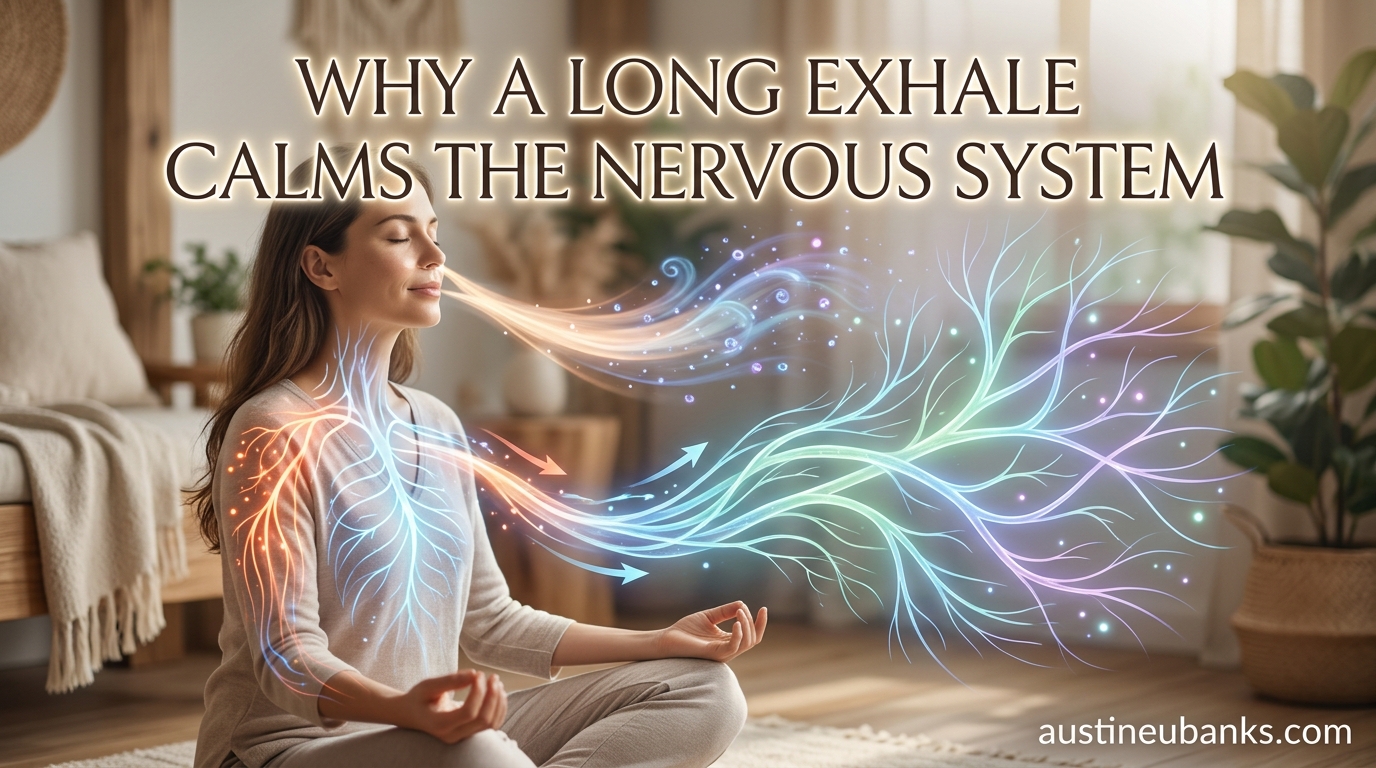
A long exhale calms the nervous system by stimulating the vagus nerve, which activates your parasympathetic “rest and digest” response and slows your heart rate. When you extend your exhale beyond your inhale, your body receives a direct physiological signal that it is safe, shifting you out of fight-or-flight mode and into a state of calm within seconds.
I have spent years studying how breathing affects the body, and the mechanism behind this is both simple and powerful. Your breath is the only autonomic function you can consciously control, and the exhale is where the magic happens. Understanding why a long exhale calms the nervous system gives you a free, drug-free tool you can use anywhere to manage stress, reduce anxiety, and regain focus.
In this guide, we break down the exact science of what happens in your body during a prolonged exhalation. We also cover five specific breathing techniques with ratios you can start using today, common mistakes to avoid, and what you can realistically expect when you practice consistently.
Table of Contents
The Science: Why a Long Exhale Calms the Nervous System
The core reason a long exhale calms your nervous system comes down to one critical nerve: the vagus nerve. This is the longest cranial nerve in your body, running from your brainstem all the way down to your colon. It acts as a two-way communication highway between your brain and your major organs, including your heart and lungs.
The Vagus Nerve: Your Built-In Calming System
The vagus nerve is the main driver of your parasympathetic nervous system, which controls the rest-and-digest response. When the vagus nerve is stimulated, it sends signals throughout your body that reduce inflammation, lower heart rate, and promote relaxation. Scientists refer to the strength of this calming pathway as your “vagal tone.”
People with higher vagal tone recover from stress more quickly. They bounce back from challenging situations with less lingering anxiety. The good news is that you can actively strengthen your vagal tone through breathing exercises, particularly ones that emphasize a prolonged exhale.
Here is the key insight that most people miss: every time you exhale, your vagus nerve becomes more active. Every time you inhale, it becomes slightly less active. This means that by simply making your exhale longer than your inhale, you are tipping the balance toward calm with every single breath cycle.
What Happens in Your Body During a Long Exhale
When you extend your exhale, several measurable changes happen in your body almost immediately. Your heart rate slows down during the exhale phase, a phenomenon scientists call respiratory sinus arrhythmia. This is why doctors ask you to breathe out slowly when they are trying to get an accurate resting heart rate reading.
At the same time, your diaphragm moves upward in a controlled, gentle motion. This diaphragmatic movement serves as a mechanical stimulus for the vagus nerve, which passes right through the same area. The prolonged exhalation literally massages the nerve into greater activity.
As the vagus nerve activates more strongly, it releases a neurotransmitter called acetylcholine. This chemical messenger tells your heart to beat more slowly and tells your blood vessels to relax. The result is a measurable drop in both heart rate and blood pressure, often within just 30 to 60 seconds of starting focused exhale breathing.
The Acetylcholine Connection
Acetylcholine is the chemical that bridges your nervous system and your physical relaxation response. When the vagus nerve releases acetylcholine during a long exhale, it acts like a natural brake pedal for your body. Your heart muscle receives the signal to decelerate. Your digestive system receives the signal to resume normal function. Your stress hormones begin to taper off.
This is the same chemical that the Nobel Prize-winning scientist Otto Loewi discovered in 1921. Loewi called it “vagusstoff,” which translates to “vagus substance.” He proved that stimulating the vagus nerve releases a chemical that slows the heart, and that discovery laid the foundation for everything we now know about the parasympathetic nervous system.
There is also an interesting angle that many sources overlook: carbon dioxide. During a prolonged exhale, your CO2 levels actually rise slightly because you are not rushing to take your next breath. A mild increase in CO2 has a calming effect on the brain, which is one reason why controlled breathing techniques that emphasize slow, complete exhalations tend to produce deeper relaxation than fast, shallow breathing.
Parasympathetic vs Sympathetic: The Two Gears of Your Nervous System
To fully understand why a long exhale calms the nervous system, you need to know about the two branches of your autonomic nervous system. Think of them as two gears that your body shifts between throughout the day.
The sympathetic nervous system is your fight-or-flight gear. It kicks in when you face a threat, whether that threat is a physical danger, a work deadline, or a difficult conversation. Your heart rate increases, your muscles tense, your pupils dilate, and your body dumps stress hormones like cortisol and adrenaline into your bloodstream. This response is useful in genuine emergencies, but it becomes a problem when it stays activated all day.
The parasympathetic nervous system is your rest-and-digest gear. It handles recovery, digestion, immune function, and cellular repair. When this system is active, your heart rate drops, your blood pressure decreases, your muscles relax, and your mind settles. The parasympathetic response is what allows your body to heal and recharge.
The problem in modern life is that many of us get stuck in sympathetic mode. Constant notifications, packed schedules, financial stress, and information overload keep the fight-or-flight system engaged at a low level throughout the day. Over time, this chronic sympathetic activation contributes to anxiety, high blood pressure, poor sleep, and burnout.
This is where breathing becomes your most accessible tool. Your breath is the only part of the autonomic nervous system you can consciously control. A short, shallow inhale-dominant breathing pattern signals that you are under threat. A long, slow exhale-dominant pattern signals that you are safe. By consciously extending your exhale, you are manually shifting your nervous system from sympathetic overdrive into parasympathetic recovery.
The Benefits of Long Exhale Breathing
The benefits of long exhale breathing go well beyond just feeling relaxed. Research and clinical experience show that consistent practice produces real, measurable improvements in both mental and physical health. Let’s look at what the science says.
Mental Health Benefits
Long exhale breathing is one of the fastest ways to interrupt an anxiety spiral. When anxiety hits, your breathing typically becomes rapid and shallow, which feeds the stress response and makes the anxiety worse. Extending your exhale breaks this cycle by sending a direct signal to your brain that the threat has passed.
A landmark 2023 study from Stanford University tested a technique called cyclic sighing, which emphasizes prolonged exhalations. Participants who practiced cyclic sighing for just five minutes a day reported greater anxiety reduction than those who did other forms of breathing or traditional mindfulness meditation. The researchers found that the exhale-focused approach produced faster and more sustained results.
Beyond anxiety, long exhale breathing improves emotional regulation. When your nervous system is in parasympathetic mode, you have better access to your prefrontal cortex, the part of your brain responsible for rational thinking and impulse control. This means that after a few minutes of extended exhale breathing, you are more likely to respond thoughtfully to a stressful situation rather than reacting impulsively.
Many people also report improved sleep when they practice long exhale breathing before bed. The parasympathetic activation helps quiet the mental chatter that keeps you awake, and the slower heart rate prepares your body for restorative sleep.
Physical Health Benefits
The physical benefits of long exhale breathing are well-documented. Regular practice has been shown to lower resting heart rate, reduce blood pressure, and improve overall cardiovascular health. The American Heart Association has highlighted controlled breathing as a complementary approach for managing hypertension.
One of the most important markers of physical health related to breathing is heart rate variability, or HRV. HRV measures the variation in time between your heartbeats, and higher HRV is associated with better stress resilience, cardiovascular fitness, and overall health. Long exhale breathing directly trains your HRV by strengthening the vagus nerve’s influence on your heart.
Additional physical benefits include reduced muscle tension, improved digestion through parasympathetic activation, and lowered levels of inflammatory markers in the blood. The vagus nerve plays a role in controlling inflammation through what scientists call the cholinergic anti-inflammatory pathway, so regular vagal stimulation through breathing may help reduce systemic inflammation over time.
Cognitive and Decision-Making Benefits
Here is a benefit that surprised me when I first encountered it in the research. A study highlighted by Psychology Today found that people with higher heart rate variability, which you can develop through long exhale breathing, make better decisions under pressure. They process information more effectively, weigh options more carefully, and are less likely to act on impulse.
This makes sense when you think about it. When your nervous system is in sympathetic overdrive, your brain prioritizes speed over accuracy. It wants you to react quickly to survive. But when you shift into parasympathetic mode through extended exhale breathing, your brain has the bandwidth to think clearly, consider consequences, and make deliberate choices.
Many professionals now use long exhale breathing techniques before high-stakes meetings, public speaking engagements, or complex problem-solving sessions. The practice takes just two to three minutes and produces a measurable improvement in focus and mental clarity.
Five Breathing Techniques That Use Long Exhales
Now that you understand the science, let’s get practical. Here are five specific breathing techniques that leverage the power of a prolonged exhale. Each one has a different ratio and purpose, so you can choose the one that fits your situation.
The 4-7-8 Breathing Technique
Developed by Dr. Andrew Weil, the 4-7-8 technique is one of the most popular exhale-focused breathing exercises. The ratio is simple: inhale through your nose for 4 seconds, hold your breath for 7 seconds, and exhale through your mouth for 8 seconds. The exhale is twice as long as the inhale, which maximizes vagus nerve stimulation.
Dr. Weil describes this technique as a natural tranquilizer for the nervous system. The 7-second breath hold allows CO2 to build up slightly, which enhances the calming effect when you finally exhale. The 8-second exhale through the mouth, ideally with a whooshing sound, fully activates the parasympathetic response.
How it feels: Most people report a wave of relaxation starting in their chest and spreading outward after just three or four cycles. Some people feel slightly lightheaded at first, which is normal and passes quickly. If you feel dizzy, reduce the counts to 3-5-6 until you build tolerance.
Best for: Falling asleep, managing acute anxiety spikes, and winding down after an intense day. Practice 4 cycles to start and build up to 8 cycles twice daily.
Box Breathing (4-4-4-4)
Box breathing, also known as square breathing, was popularized by Navy SEALs as a way to stay calm under extreme pressure. The pattern is even on all sides: inhale for 4 seconds, hold for 4 seconds, exhale for 4 seconds, and hold empty for 4 seconds. While the exhale is not longer than the inhale, the slow pace and the held exhale still stimulate the vagus nerve.
This technique is particularly effective for maintaining focus and composure in stressful situations. The equal counts create a rhythmic, almost meditative quality that helps quiet a racing mind. It is less intensely relaxing than 4-7-8, which makes it better suited for daytime use when you need to stay alert.
How it feels: Box breathing produces a grounded, centered sensation rather than a heavy relaxation. You will likely notice your mental chatter quieting after about 5 cycles, with a subtle drop in shoulder tension.
Best for: Pre-meeting preparation, public speaking, athletic performance, and any situation where you need calm focus rather than deep relaxation.
Pursed-Lip Breathing
Pursed-lip breathing is exactly what it sounds like. You inhale through your nose for 2 seconds, then exhale slowly through tightly pursed lips for 4 or more seconds. The pursed lips create natural resistance, which slows the exhale and keeps your airways open longer.
This technique is widely recommended by respiratory therapists, particularly for people with asthma or COPD, because it helps empty the lungs more completely. But it is equally effective for nervous system regulation in healthy individuals. The gentle resistance against the pursed lips enhances vagal stimulation.
How it feels: Pursed-lip breathing feels very natural and easy to sustain. The resistance gives you something tangible to focus on, which helps keep your mind from wandering. Most people feel a gentle relaxation spread through their chest and shoulders within a minute.
Best for: Managing breathing during physical activity, asthma symptom relief, and on-the-go stress reduction. It is the most discreet technique on this list.
Diaphragmatic Breathing
Diaphragmatic breathing, also called belly breathing, focuses on using your diaphragm muscle fully rather than breathing shallowly from your chest. You place one hand on your chest and one on your belly. As you inhale through your nose for about 4 seconds, your belly should rise while your chest stays relatively still. Then you exhale slowly through your mouth for 6 to 8 seconds, letting your belly fall.
This technique is foundational because most people breathe shallowly from their chest when stressed, which keeps the sympathetic nervous system activated. Diaphragmatic breathing directly counteracts this pattern by engaging the diaphragm fully, which provides the strongest mechanical stimulation to the vagus nerve.
How it feels: The sensation is deeply grounding. You will feel your belly expanding and contracting, and the slow exhale produces a profound sense of letting go. Many practitioners describe it as feeling like tension is physically draining from their body.
Best for: Daily practice, building baseline vagal tone, and as a foundation for all other breathing techniques. Practice for 5 to 10 minutes daily for maximum benefit.
Cyclic Sighing: The Stanford Technique
Cyclic sighing is the technique that outperformed other breathing methods in the 2023 Stanford study. The pattern involves two quick inhales through the nose (the second one a short top-off breath to fully expand the alveoli in your lungs) followed by a long, slow exhale through the mouth that lasts at least 8 seconds.
The double inhale is key. The first breath fills most of your lung capacity, and the second shorter breath pops open the tiny air sacs at the base of your lungs that may have collapsed. The extended exhale then provides the powerful vagus nerve stimulation that makes this technique so effective for rapid anxiety reduction.
How it feels: Cyclic sighing produces a very noticeable shift, often faster than other techniques. The deep exhale feels like a release valve opening, and many people report a wave of calm washing over them after just two or three sighs.
Best for: Rapid anxiety relief, breaking a stress spiral, and as a quick reset during a busy day. Just five minutes daily was enough to produce significant anxiety reduction in the Stanford study.
How to Practice Long Exhale Breathing: A Step-by-Step Guide
If you want to start experiencing the benefits of long exhale breathing today, here is a simple step-by-step guide that works for beginners. You do not need any equipment, and you can do it anywhere.
Step 1: Find a comfortable position. Sit upright in a chair with your feet flat on the floor, or lie down on your back. Let your shoulders drop away from your ears. Place one hand on your belly so you can feel it rising and falling.
Step 2: Start with an exhale. Before you begin counting, breathe out fully through your mouth to empty your lungs. This resets your breathing pattern and gives you a clean starting point.
Step 3: Inhale through your nose for 4 seconds. Breathe slowly and smoothly, letting your belly expand rather than your chest rising. The inhale should feel easy, not forced.
Step 4: Exhale through your mouth for 6 to 8 seconds. This is the critical part. Let the air out slowly, as if you are blowing through a straw. Your belly should fall gently as you empty your lungs. The exhale should always be longer than the inhale.
Step 5: Repeat for 5 to 10 cycles. Continue this 4-second-in, 6-to-8-second-out pattern for at least five full breath cycles. Most people feel a noticeable shift in their state within three to five minutes.
Step 6: Notice the shift. Pay attention to how your body feels. Your heart rate should slow down. Your shoulders should feel heavier and more relaxed. Your mind should feel clearer. If you do not feel these changes, try lengthening your exhale to 8 full seconds.
Optimal ratios: The most commonly recommended ratios for nervous system calming are 4:6 (inhale 4, exhale 6) for gentle relaxation, and 4:8 (inhale 4, exhale 8) for deeper calming effects. Community practitioners across breathwork forums consistently recommend aiming for 2 to 4 seconds in and 4 to 8 seconds out. The key principle is always the same: make the exhale longer than the inhale.
How to Know You’re Doing It Right
One of the most common concerns people share on forums is whether they are practicing correctly. Here is what to look for. If you are doing long exhale breathing properly, you should notice your heart rate slowing within the first few cycles. You may feel a slight tingling in your hands or face, which is a normal sign of increased blood flow and relaxation.
You should also notice a reduction in muscle tension, particularly in your jaw, shoulders, and forehead. Many people experience a sense of heaviness or warmth spreading through their body. If you feel no changes at all, the most likely cause is breathing too quickly or not fully emptying your lungs on the exhale.
Common Mistakes to Avoid
The most common mistake is forcing the breath. If you are straining to hold your exhale for 8 seconds, you are creating tension rather than releasing it. Start with a 6-second exhale if 8 feels like too much, and build up gradually. The goal is ease, not effort.
Another frequent error is breathing from the chest instead of the belly. Chest breathing is a stress pattern, and it actually reinforces sympathetic activation rather than calming it. If your shoulders are rising and falling, you are chest breathing. Keep your focus on your belly expanding on the inhale and falling on the exhale.
Finally, do not overthink it. Some people become so focused on counting perfectly that they create more stress than they relieve. The exact numbers matter less than the principle: exhale slowly, exhale fully, and make the exhale longer than the inhale.
How Quickly to Expect Results
This is another question that comes up constantly in breathwork communities. The honest answer is that you can expect immediate results in terms of feeling calmer after a single session of 5 to 10 breaths. Your heart rate will slow, your blood pressure may drop slightly, and you will feel a shift in your mental state.
For longer-term benefits like improved baseline vagal tone, better sleep, reduced daily anxiety, and higher heart rate variability, consistent daily practice for at least two to four weeks is needed. The Stanford cyclic sighing study showed measurable improvements in anxiety and mood after just one month of practicing five minutes per day.
Think of it like exercise for your nervous system. One workout feels good, but the real transformation comes from consistent practice over time. Even five minutes a day can produce meaningful, lasting changes in how your body responds to stress.
Safety Considerations
Long exhale breathing is safe for the vast majority of people, but there are a few things to keep in mind. If you feel dizzy or lightheaded, stop and breathe normally for a minute before resuming. Mild lightheadedness is common at first as your body adjusts to changes in CO2 levels, but it should never feel extreme.
If you have a history of panic disorder, start with very gentle techniques like pursed-lip breathing before trying more intense methods like 4-7-8. Some people with anxiety conditions find that focusing too intensely on their breath can initially increase anxiety, so go slowly and stop if it feels uncomfortable.
Anyone with cardiovascular conditions, respiratory diseases, or who is pregnant should consult their doctor before starting a structured breathing practice. While breathing exercises are generally safe, it is always wise to get professional guidance for your specific situation.
FAQs
What is the quickest way to calm the nervous system?
The quickest way to calm the nervous system is to take a slow, full exhale that lasts longer than your inhale. A simple approach is to inhale through your nose for 4 seconds, then exhale through your mouth for 6 to 8 seconds. This activates the vagus nerve and shifts your body into parasympathetic mode within seconds, slowing your heart rate and reducing stress hormones.
Why do deep breaths calm anxiety?
Deep breaths with a long exhale calm anxiety by stimulating the vagus nerve, which releases acetylcholine and activates the parasympathetic nervous system. This directly counteracts the sympathetic fight-or-flight response that drives anxiety. When your exhale is longer than your inhale, your heart rate slows, your blood pressure drops, and your brain receives a clear signal that you are safe, which interrupts the anxiety cycle.
What are the benefits of a fully exhale?
A full exhale activates the parasympathetic nervous system, slows your heart rate, lowers blood pressure, reduces stress hormones, improves heart rate variability, and promotes mental clarity. It also helps empty your lungs more completely, which improves oxygen exchange on your next breath and can reduce feelings of chest tightness associated with anxiety.
Is it better to exhale longer than inhale?
Yes, for calming purposes it is significantly better to exhale longer than you inhale. During the exhale phase, your vagus nerve activity increases and your heart rate naturally slows. By making the exhale longer, you extend the calming phase of each breath cycle. The most commonly recommended ratios are 4:6 or 4:8, meaning inhale for 4 seconds and exhale for 6 to 8 seconds.
How long should my exhale be to reduce anxiety?
For anxiety reduction, aim for an exhale of 6 to 8 seconds with an inhale of about 4 seconds. A 2023 Stanford University study found that cyclic sighing, which uses an extended exhale of 8 seconds or more, produced the greatest anxiety reduction among tested breathing techniques. Even just five minutes of practice per day can produce noticeable results within a few weeks.
Can breathwork train my nervous system to stay calm?
Yes, consistent breathwork practice can strengthen your vagal tone over time, which means your body becomes better at naturally shifting into a calm state. Regular long exhale breathing trains your nervous system to recover from stress more quickly and spend less time stuck in sympathetic fight-or-flight mode. Most people see meaningful improvements in baseline stress resilience after two to four weeks of daily practice.
Conclusion
Understanding why a long exhale calms the nervous system gives you one of the most practical and accessible health tools available. Every extended exhale you take stimulates your vagus nerve, releases acetylcholine, and shifts your body from fight-or-flight into rest-and-digest mode. This is not pseudoscience or wellness hype. It is a measurable physiological mechanism backed by decades of research.
Start with just five minutes of long exhale breathing today. Pick one technique from this guide, find a comfortable seat, and breathe out slowly. Your nervous system will thank you, and with consistent practice, you will build a calmer, more resilient foundation that carries into every part of your life.