
Fidget items are everywhere right now. You see them in classrooms, on office desks, in checkout lines at grocery stores. Kids trade them at recess. Adults click them through long Zoom calls. But not every fidget item does the same job, and the difference between a fidget tool and a fidget toy has real consequences for focus, learning, and emotional regulation.
Our team has spent months researching how fidgets are actually used in classrooms, therapy settings, and workplaces. We talked to teachers on Reddit who confiscate them daily. We read what occupational therapists say about sensory regulation. We looked at the research on attention and executive function. What we found is that the distinction is not about the object at all. It is about how, why, and when someone uses it.
If you are a parent trying to decide whether to send a fidget to school, a teacher setting classroom rules, or an adult wondering whether that desk toy is actually helping you focus, this guide will walk you through everything you need to know.
Table of Contents
Quick Answer: The Difference Between a Fidget Tool and a Fidget Toy
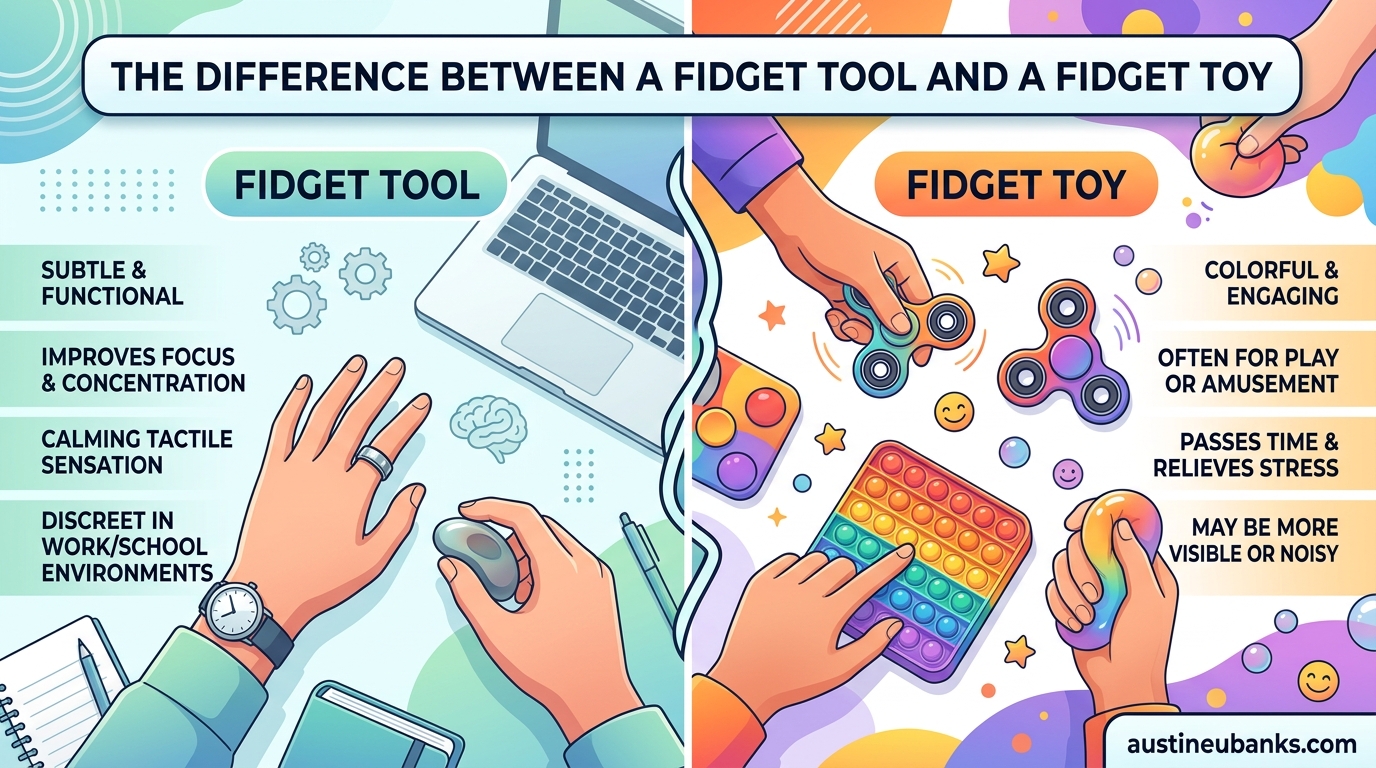
The difference between a fidget tool and a fidget toy comes down to one thing: usage pattern. The exact same object can be a tool in one moment and a toy in another. Here is how to tell them apart using three simple criteria:
- Focus Management: A fidget tool keeps the user’s primary attention on the main task (listening, reading, working). A fidget toy pulls attention away and becomes the main event.
- Eye Direction: With a fidget tool, eyes stay on the teacher, the screen, or the book. With a fidget toy, eyes drift down to watch the fidget itself.
- Usage Pattern: A fidget tool involves mindless, repetitive manipulation that runs in the background. A fidget toy involves active play, showing off, or exploring new ways to use it.
If someone is using an item and still engaged with their primary task, it is a tool. If the item has become the task, it is a toy.
What Exactly Is a Fidget Tool?
A fidget tool is any handheld object used to provide sensory input (squeezing, twisting, clicking, stretching) that helps the user maintain focus, regulate emotions, or manage restless energy while performing another primary task. Think of it as background noise for your hands. The movement is automatic and barely conscious.
Occupational therapists often describe fidget tools as instruments for self-regulation. They provide tactile input or proprioceptive input that helps calm a nervous system running in overdrive. For someone with ADHD, that low-level physical engagement can free up cognitive resources for the task that actually matters.
Fidget tools are also called sensory tools, focus tools, regulation tools, or stress tools. In occupational therapy contexts, you might hear them referred to as sensory input devices or tactile regulation tools. The name shifts depending on the setting, but the core purpose stays the same: support the primary activity, not replace it.
What Is a Fidget Toy?
A fidget toy is any object used primarily for entertainment, where the fidgeting activity itself becomes the main focus. The user is actively engaged with the item rather than the task they should be doing. Play, exploration, and social sharing take over.
This is where the trend factor comes in. When fidget spinners went viral, they stopped being tools for almost everyone who used them. Kids spun them, compared them, traded them, and watched them instead of listening in class. The same thing happened with Pop Its. The object became a status symbol and a source of novelty, which is the exact opposite of what a focus tool is supposed to do.
Here is the tricky part: there is nothing inherently wrong with fidget toys. They can be fun, relaxing, and even socially valuable. The problem arises when someone calls a toy a tool and expects it to improve focus. That mismatch leads to frustration for the user, the teacher, and the parent.
Fidget Tool vs Fidget Toy: Side-by-Side Comparison
Here is a breakdown of how fidget tools and fidget toys differ across the characteristics that matter most:
- Primary Focus: A fidget tool stays in the background while the user focuses on their main task. A fidget toy demands attention and becomes the main activity.
- Noise Level: Fidget tools are quiet or silent. They produce minimal sound that does not bother others. Fidget toys often click, pop, whir, or make noise that draws attention.
- Visual Demand: A good fidget tool is visually neutral. You do not need to look at it to use it. Fidget toys are often brightly colored, visually stimulating, and designed to be looked at.
- Social Dynamics: Fidget tools are discreet and ideally identical across users so no one feels singled out. Fidget toys tend to become collector’s items that create competition and social distraction.
- Portability: Both can be portable, but a fidget tool is designed to stay in one hand or on a desk during use. A fidget toy gets passed around, shown off, and shared.
- Novelty Factor: Fidget tools have a low novelty ceiling. Once you learn how to use one, it becomes automatic. Fidget toys rely on novelty to stay interesting, which means the engagement fades over time.
- Durability Needs: Fidget tools need to withstand daily, repetitive use for months. Fidget toys often break or get abandoned once the novelty wears off.
The biggest takeaway from this comparison is that the same object can land in either column depending on how it is used. A fidget cube can be a tool if used quietly during a meeting. That same cube becomes a toy if the user is exploring every button and showing it to their neighbor.
The Science: Why Fidgeting Actually Helps
To understand why fidget tools work (and why toys do not), it helps to understand what is happening in the brain when someone fidgets.
Executive Function and Attention
Executive function is the brain’s management system. It handles working memory, flexible thinking, and self-control. For people with ADHD and some other neurodivergent conditions, executive function works differently. The brain may struggle to filter out distractions, sustain attention on low-stimulation tasks, or regulate impulsive behavior.
Fidget tools address this by giving the brain a secondary stream of sensory input to process. This is called secondary attention. When your hands are busy with a familiar, repetitive motion, the part of your brain that would otherwise get restless and seek distraction has something to do. That frees up your primary attention to stay locked on the lecture, the book, or the conversation.
Sensory Regulation and the Nervous System
From an occupational therapy perspective, fidget tools work because they provide specific types of sensory input. Tactile input comes from touch and texture. Proprioceptive input comes from pressure and resistance, like squeezing a firm ball or pushing against something. Both types of input help regulate the nervous system.
For someone who is sensory seeking, this input is calming. It tells the brain that the body is grounded and safe. For someone experiencing anxiety, the repetitive motion of a fidget tool can serve as a grounding technique that brings attention back to the present moment.
This is why the type of fidget matters. A soft, squeezable stress ball provides deep pressure input that can be calming. A clicking fidget cube provides tactile and auditory feedback that can help with alertness. The right tool matches the sensory need.
The Novelty Problem
Research on fidget effectiveness consistently highlights one problem: the novelty effect. When a fidget is new, the brain treats it as interesting and engaging. That is great for a toy but terrible for a tool. A tool needs to become boring quickly so it fades into the background and lets the primary task take over.
This is why trendy fidgets often fail as tools. They are designed to be exciting, and excitement is the enemy of background focus. The best fidget tools are simple, unremarkable objects that the user barely notices they are holding.
Types of Fidget Tools (and Which Are Most Often Misused)
Fidget tools can be grouped into categories based on the type of sensory input they provide. Understanding these categories helps you choose the right tool for the right need and avoid items that tend to drift into toy territory.
Kinetic Fidgets
Kinetic fidgets involve movement and motion. Examples include spinner rings, roller chains, marble mesh fidgets, and Ono Rollers. These are good for people who need to keep their hands moving to stay alert. The risk is that kinetic fidgets with visible spinning motion can become visually distracting, drawing eyes away from the task. Spinner rings and marble mesh fidgets tend to work best because the movement is small and contained.
Tactile and Click-Based Fidgets
These fidgets focus on touch, texture, and clicking sensations. Fidget cubes, textured pencil grips, kneadable erasers, and silicone pads fall into this category. They are generally effective tools because the input is subtle and the motion is repetitive. However, click-based fidgets can produce noise that bothers others, so silent or near-silent options are best for shared spaces.
Sensory and Squeeze Fidgets
Sensory fidgets include stress balls, therapy putty (also called thinking putty), and squishy items. These provide proprioceptive input through squeezing and resistance. They are among the most reliable tools because they are quiet, visually neutral, and provide deep pressure input that is calming. Therapy putty is a favorite among occupational therapists because it is versatile and discreet.
Oral and Proprioceptive Fidgets
Some people regulate through oral input. Chewelry (chewable jewelry), oral chews, and chewable pencil toppers serve this need. These are specialized tools often recommended by occupational therapists for children who bite, chew on clothing, or need oral sensory input to stay regulated. They are less commonly misused as toys because their purpose is specific and therapeutic.
Foot and Body Fidgets
Not all fidgets are handheld. Foot fidget bands that attach to desk legs, foot rollers, and wobble cushions let users move larger muscle groups while staying seated. These are especially useful in classrooms where students need to move but cannot leave their seats. They are almost never misused as toys because the movement is integrated into the seating arrangement.
Who Benefits Most From Fidget Tools
Fidget tools are not just for kids. They can help a wide range of people across different settings.
Children and adults with ADHD are among the most common beneficiaries. The secondary sensory input helps their brain maintain attention on tasks that are not inherently stimulating. Many people with ADHD report that having something in their hands during meetings, lectures, or long reading sessions makes a noticeable difference in their ability to stay engaged.
Individuals on the autism spectrum often use fidget tools as part of a broader sensory diet. The predictable, repetitive input from a familiar tool can help with self-regulation, reduce anxiety, and provide a sense of control in overwhelming environments.
People with anxiety can benefit from the grounding effect of tactile input. Squeezing a stress ball or manipulating a textured object during a stressful situation activates the body’s calming systems and brings attention back to the present.
Adults in professional settings are an often-overlooked group. Fidget tools for the workplace are a growing category. Quiet items like spinner rings, therapy putty, and textured stones can help adults stay focused during long meetings, phone calls, or deep work sessions. The key is choosing discreet options that do not draw attention or create noise in a shared office.
Neurotypical students and professionals can also benefit. Research suggests that mild, non-distracting fidgeting can improve focus for anyone during sedentary tasks. The benefit is not exclusive to people with diagnosed conditions.
Is This a Tool or a Toy? A Quick Decision Checklist
One of the biggest pain points parents and teachers share is the difficulty of telling whether a fidget is actually functioning as a tool in the moment. Here is a practical checklist you can use to evaluate any fidget situation:
- Is the user still engaged with their primary task? If yes, it is likely a tool. If their attention has shifted entirely to the fidget, it has become a toy.
- Are the user’s eyes on the task (screen, book, teacher) or on the fidget? Eyes on the task means tool. Eyes on the fidget means toy.
- Can the user answer a question about what they were just doing? If they can summarize the lesson or meeting content, the fidget is working as a tool. If they have no idea what just happened, it has become a toy.
- Is the fidget making noise that others can hear? Quiet use suggests tool behavior. Noisy, attention-grabbing use suggests toy behavior.
- Is the user trying to show the fidget to someone else? Sharing and showing are social behaviors associated with toys, not tools.
- Has the user been using the same type of fidget for weeks, or is this a brand-new item? Long-term use of a familiar item suggests it has settled into tool status. Constant switching to new items suggests novelty-seeking toy behavior.
- Does removing the fidget cause the user to seek another form of distraction? If yes, the fidget was serving a genuine regulatory purpose. If removing it causes no change, it was not doing much either way.
This checklist works for parents at homework time, teachers in the classroom, and adults self-monitoring during work. The goal is not to ban fidgets but to make sure they are serving their intended purpose.
The Language Debate: Why Calling Them Tools Matters
Words shape behavior. When adults call fidget items “toys,” children hear that these objects are meant for play. When adults call them “tools,” children understand that these objects have a specific, purposeful job.
This is not just semantics. Multiple occupational therapists and educators have pointed out that the language we use around fidgets directly affects how children use them. If a teacher introduces a fidget as “a tool to help your brain focus,” students approach it differently than if it is handed out as “a fun toy to play with.”
The same principle applies to adults. Thinking of your desk putty as a focus tool creates a different relationship with it than thinking of it as a toy. The framing sets expectations for how, when, and why you reach for it.
Calling them tools also validates the people who genuinely need them. For a child with sensory processing differences, hearing their fidget described as a tool (not a toy) communicates that their regulatory needs are real and legitimate. It removes the stigma and makes the fidget a normal, accepted part of their learning environment.
Guidelines for Proper Fidget Use in Any Setting
Whether you are a teacher, parent, or self-regulating adult, clear rules make the difference between a fidget that works and one that causes problems. Teachers on Reddit consistently say the same thing: vague rules like “use it responsibly” do not work. They want specific, enforceable boundaries.
Here are practical guidelines that work across settings:
- Establish the purpose upfront. Before introducing a fidget, explain that it is a tool for focus, not a toy for play. Set the expectation clearly.
- Make fidgets universally available. In classrooms, offer the same fidget to everyone. This prevents the social dynamics of some kids having cool items and others not. When everyone has access, the novelty factor drops.
- Choose quiet and discreet options. If a fidget can be heard across the room, it is not appropriate for a shared space. Silent items like therapy putty, marble mesh, and spinner rings are ideal.
- Set a one-fidget rule. One item per person at a time. This prevents the collector dynamic where students accumulate and trade multiple fidgets.
- Define what counts as misuse. Be specific. Showing the fidget to a friend, making noise with it, or looking at it instead of the teacher are all signs it has become a toy.
- Have a clear consequence. If a fidget becomes a distraction, the consequence is temporary removal. The student can try again later. This keeps the focus on behavior, not punishment.
- Check in regularly. Ask the user (or yourself) whether the fidget is helping. If focus has not improved or has gotten worse, it is time to try a different approach.
Red Flags: When a Fidget Is Doing More Harm Than Good
Sometimes a fidget that started as a genuine tool slides into toy territory over time. Watch for these warning signs:
- The user is spending more time engaged with the fidget than with the primary task.
- The fidget has become a topic of social conversation or a trading commodity.
- The user has accumulated multiple fidgets and is constantly seeking new ones.
- Other people in the environment (classmates, coworkers, family members) are being distracted by the fidget.
- The user becomes upset or agitated when asked to put the fidget away, suggesting an unhealthy attachment rather than regulatory use.
If you notice these signs, it is time to reset. Take a break from the current fidget, reassess the sensory need, and possibly try a different type of tool that better matches the user’s regulatory requirements.
FAQs
What is a fidget tool?
A fidget tool is any handheld object used to provide sensory input, such as squeezing, twisting, or clicking, that helps the user maintain focus, regulate emotions, or manage excess energy while performing another primary task. Unlike a toy, a fidget tool stays in the background and supports the main activity rather than becoming the focus.
What is another name for a fidget tool?
Fidget tools are also called sensory tools, focus tools, regulation tools, stress tools, or sensory fidgets. In occupational therapy contexts, they may be referred to as sensory input devices or tactile regulation tools. The different names all point to the same purpose: supporting attention and self-regulation.
What are different types of fidgets?
Common types of fidgets include kinetic fidgets (spinner rings, rollers, marble mesh), tactile and click-based fidgets (fidget cubes, textured grips, kneadable erasers), sensory and squeeze fidgets (stress balls, therapy putty, squishy items), oral and proprioceptive fidgets (chewelry, oral chews), and foot and body fidgets (foot bands, wobble cushions). Each type provides different sensory input to match different regulatory needs.
Do fidgets help with PTSD?
Fidget tools can help some people with PTSD by providing grounding sensory input during moments of anxiety or dissociation. The repetitive tactile engagement can serve as a grounding technique that brings attention back to the present moment. However, fidgets are not a treatment for PTSD on their own. They are best used as a supplementary coping tool alongside professional mental health support.
Conclusion
Understanding the difference between a fidget tool and a fidget toy comes down to one core principle: it is all about how the item is used, not what the item is. The same stress ball can be a powerful focus tool in one moment and a distracting toy in another. The criteria are simple. If the fidget stays in the background, supports the primary task, and can be used without looking at it, it is functioning as a tool.
For parents, teachers, and adults alike, the goal is intentionality. Choose fidgets that are quiet, discreet, and matched to genuine sensory needs. Set clear rules about what proper use looks like. Pay attention to the warning signs that a tool has drifted into toy territory. And remember that calling them tools is not just wordplay. It sets the expectation that these items have a purpose.
Whether you are supporting a child with ADHD in the classroom, helping a teenager manage anxiety during homework, or keeping your own hands busy through a long work meeting, the right fidget used the right way can make a real difference. The wrong one used the wrong way just becomes another distraction.