
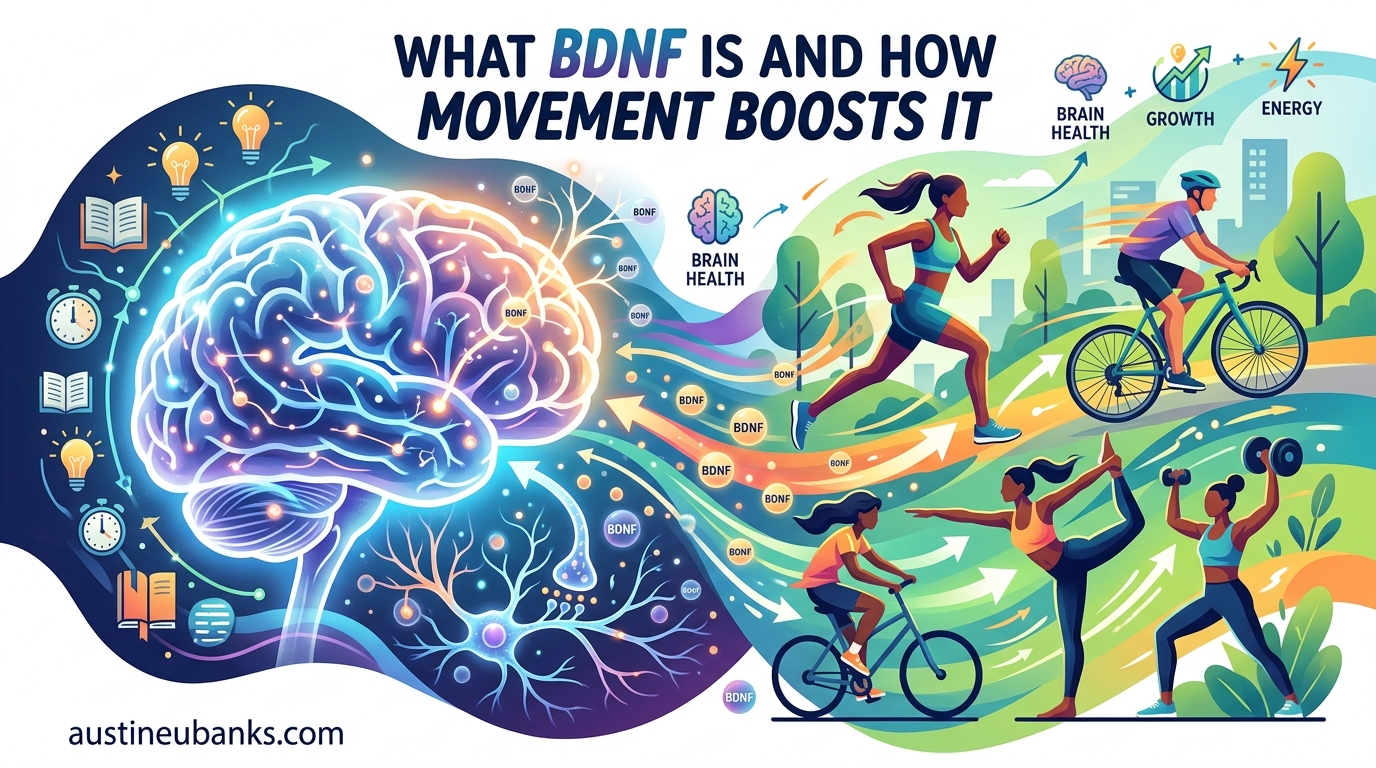
Have you ever finished a brisk walk, a run, or a quick set of sprints and noticed your mind felt sharper, clearer, and more focused? That is not a coincidence. Your brain was riding a wave of a powerful protein called BDNF, and it is one of the most important molecules for learning, memory, and long-term brain health.
If you want to understand what BDNF is and how movement boosts it, you are in the right place. In this guide, I will break down the science of brain-derived neurotrophic factor in plain language, explain exactly how different types of exercise trigger its release, and give you specific, actionable protocols you can use today.
Our team dug into peer-reviewed studies from institutions like NYU Langone, the University of Otago, and the National Institutes of Health to bring you clear, evidence-based answers. No fluff, no hype, just what the research actually shows about how your body builds a better brain through movement.
Table of Contents
What Is BDNF? (Brain-Derived Neurotrophic Factor Explained)
BDNF stands for Brain-Derived Neurotrophic Factor. It is a protein produced inside your nerve cells that promotes the survival, growth, and maintenance of neurons. Think of it as fertilizer for your brain, helping neurons sprout new connections, strengthen existing ones, and resist damage over time.
The term “neurotrophic” literally means “nerve-nourishing.” BDNF belongs to a family of proteins called neurotrophins, and it is the most active one in your brain. Dr. John Ratey, a Harvard psychiatrist, famously called BDNF “Miracle-Gro for the brain” because of how powerfully it stimulates neural growth.
Your brain produces BDNF primarily in the hippocampus (the memory center), the cerebral cortex (the thinking center), and the basal forebrain. These regions govern learning, memory consolidation, emotional regulation, and higher-order reasoning. When BDNF levels are healthy, these areas function at their best.
How BDNF Works at the Cellular Level
BDNF works by binding to a specific receptor on the surface of neurons called the TrkB receptor (tropomyosin receptor kinase B). When BDNF locks onto this receptor, it sets off a cascade of intracellular signals that promote neuronal survival, encourage the growth of new dendritic branches, and strengthen synaptic connections between neurons.
This process is what scientists call synaptic plasticity. When synapses get stronger and more numerous, your brain can process information faster, store memories more reliably, and adapt to new challenges. Without sufficient BDNF, these synapses weaken and prune back, leading to slower thinking and poorer memory.
BDNF also supports neurogenesis, the birth of entirely new neurons. For decades, scientists believed adults could not grow new brain cells. Research over the past 25 years has proven otherwise, and BDNF is one of the key drivers of this process, particularly in the dentate gyrus of the hippocampus.
Where Does BDNF Come From?
BDNF is produced both centrally (inside the brain) and peripherally (in tissues outside the brain, including skeletal muscle, platelets, and vascular endothelial cells). When researchers measure BDNF in a blood sample, they are measuring circulating BDNF, which includes both sources. This distinction matters because exercise increases both central and peripheral BDNF, and the two interact in complex ways.
Your genetics also play a role. A common variation in the BDNF gene, known as the Val66Met polymorphism, affects how efficiently some people produce and release BDNF. About 25 to 30 percent of people carry at least one copy of this variant, which can reduce activity-dependent BDNF secretion and is associated with slightly higher risks for anxiety and reduced memory performance.
What BDNF Does: Key Benefits for Your Brain
BDNF influences nearly every aspect of brain function that matters for daily life. Here is what the research shows it does when levels are optimal.
1. Enhances Learning and Memory
BDNF strengthens the synapses involved in forming new memories. Studies show that individuals with higher BDNF levels perform better on memory tasks, and animals with experimentally increased BDNF show faster learning in maze tests. The hippocampus, which is critical for converting short-term memories into long-term ones, depends heavily on BDNF to function properly.
2. Supports Neuroplasticity
Neuroplasticity is your brain’s ability to rewire itself in response to experience. Every time you learn a new skill, adapt to a new environment, or recover from an injury, neuroplasticity is at work. BDNF makes this possible by promoting the structural changes neurons need to form new circuits and abandon old, unhelpful ones.
3. Protects Against Cognitive Decline
BDNF is neuroprotective, meaning it helps neurons resist stress, inflammation, and toxic damage. Low BDNF levels have been linked to accelerated cognitive aging and a higher risk of neurodegenerative conditions, including Alzheimer’s disease and Parkinson’s disease. Higher circulating BDNF is associated with better cognitive performance in older adults.
4. Regulates Mood and Motivation
BDNF interacts closely with the dopamine system, the brain’s reward and motivation pathway. A landmark NYU Langone study found that running increased BDNF levels by about 60 percent and dopamine release by about 40 percent in the dorsal striatum, a brain region involved in movement and motivation. This BDNF-dopamine connection helps explain why exercise is such a powerful mood elevator.
Low BDNF has been consistently associated with depression. Many antidepressant medications, including SSRIs, are thought to work partly by increasing BDNF levels over time. Exercise may produce similar effects naturally, often faster.
What Happens When BDNF Is Low
Low BDNF is not just a theoretical concern. It produces real, noticeable effects on how you think and feel. Here are the most common signs and risks associated with insufficient BDNF.
Common Symptoms of Low BDNF
People with low BDNF often report persistent brain fog, difficulty concentrating, slower recall, and reduced mental stamina. Memory complaints, particularly with recent events or new information, are common. Mood symptoms include irritability, low motivation, and a tendency toward depressive feelings.
It is worth noting that you cannot get your BDNF levels checked with a standard blood test at your doctor’s office. Serum BDNF can be measured in research settings, but there is no clinically established “normal” range for diagnostic purposes. Instead, most people gauge their BDNF status by how mentally sharp and emotionally resilient they feel.
Age-Related BDNF Decline
BDNF levels naturally decline with age. Research shows that older adults typically have 20 to 30 percent less circulating BDNF than younger adults. This decline tracks closely with the cognitive changes many people experience as they get older, including slower processing speed and mild memory lapses.
The good news is that this decline is not inevitable or irreversible. Regular physical activity is the single most effective known way to counteract age-related BDNF loss, which is one reason why exercise is so strongly associated with healthy cognitive aging.
Links to Neurodegenerative Disease
Severely low BDNF has been observed in individuals with Alzheimer’s disease, Parkinson’s disease, and major depressive disorder. While low BDNF is not necessarily the sole cause of these conditions, it is considered a contributing factor. This is why researchers are actively investigating BDNF-boosting interventions as potential preventive and therapeutic strategies.
How Movement Boosts BDNF: The Science Explained
Understanding what BDNF is and how movement boosts it requires looking at the chain of events that connects your muscles to your brain. When you exercise, your body does not just burn calories. It launches a signaling cascade that tells your brain to produce more of its most important growth factor.
Step 1: Muscle Contraction Releases Signaling Molecules
When your muscles contract during exercise, they release several molecules that travel through the bloodstream to the brain. These include lactate (produced when muscles work hard), irisin (a hormone generated from muscle tissue), and cathepsin B (a protein that crosses the blood-brain barrier). Each of these has been shown to stimulate BDNF production.
Lactate deserves special attention. For a long time, it was seen as just a waste product that made your muscles burn. Researchers now understand that lactate is a critical signaling molecule. When it reaches the brain, it directly triggers BDNF gene expression in the hippocampus. This is one reason high-intensity exercise, which produces more lactate, tends to raise BDNF more effectively than low-intensity activity.
Step 2: BDNF Gene Expression Increases
Once those signaling molecules arrive at the brain, they activate genetic pathways that ramp up BDNF production. The BDNF gene is turned on more actively, and neurons begin synthesizing and packaging the protein for release. This process can begin within minutes of starting exercise and continues throughout the activity.
A 2016 study published in Cell Metabolism by Sleiman and colleagues showed that exercise induces BDNF expression through a specific genetic pathway involving a protein called PGC-1alpha, which is also linked to mitochondrial health and metabolic fitness. This means the same molecular events that make your muscles more efficient also make your brain more resilient.
Step 3: BDNF Is Released and Binds to Neurons
Newly synthesized BDNF is released at synapses, where it binds to TrkB receptors on neighboring neurons. This binding triggers the downstream effects I described earlier: stronger synapses, new dendritic branches, improved signal transmission, and in some cases, the creation of entirely new neurons.
The magnitude of this effect can be striking. The University of Otago study popularized by AlzInfo found that just six minutes of high-intensity cycling increased circulating BDNF four- to five-fold compared to resting levels. That is a massive, rapid change in a key brain-protective protein, achieved in less time than it takes to make coffee.
How Long Does the BDNF Boost Last?
This is one of the most common questions in fitness and neuroscience forums, and the answer is encouraging. BDNF does not spike and crash within minutes. Research suggests that elevated BDNF can persist for hours after a single exercise session, and the benefits of regular exercise compound over time.
The NYU Langone study delivered particularly striking findings. After a period of running, BDNF levels and dopamine release remained elevated even after a full week of rest. This suggests that the brain-protective effects of exercise are not limited to the hours immediately following a workout. Consistent training builds a sustained BDNF reservoir that protects your brain between sessions.
The BDNF-Dopamine Connection During Exercise
The NYU Langone research added a crucial piece to the puzzle by showing that BDNF and dopamine rise together during exercise. The dorsal striatum, a brain region central to motor control and reward processing, showed increased dopamine release that was directly linked to elevated BDNF.
This connection helps explain something many exercisers experience intuitively: the longer and more consistently you exercise, the more motivated and energized you feel, not just physically but mentally. You are not just building cardiovascular fitness. You are training your brain’s reward system to function better.
This finding has major implications for conditions involving dopamine deficiency, including Parkinson’s disease and certain forms of depression. Exercise-based BDNF elevation may offer a natural way to support dopamine function alongside traditional treatments.
Best Types of Exercise to Increase BDNF
Not all exercise is created equal when it comes to BDNF. The research points to clear winners, and understanding the differences can help you choose the right activities for your brain-boosting goals. Here is what the evidence shows, ranked by effectiveness.
1. High-Intensity Interval Training (HIIT)
HIIT is the most efficient BDNF booster we know of. The University of Otago study found that six minutes of all-out cycling on a stationary bike produced a four- to five-fold increase in circulating BDNF. That is a bigger spike than what was seen with prolonged low-intensity exercise or even intermittent fasting.
The mechanism comes down to lactate. High-intensity effort produces large amounts of lactate quickly, and that lactate travels to the brain and switches on BDNF production. If you want maximum BDNF in minimum time, HIIT is hard to beat.
A simple HIIT protocol for BDNF: warm up for 3 to 5 minutes, then do 6 to 8 rounds of 30 seconds of maximum-effort cycling, sprinting, or rowing followed by 30 to 60 seconds of rest. The entire session takes about 15 to 20 minutes, and the BDNF payoff can last for hours.
2. Aerobic and Steady-State Cardio
Steady-state aerobic exercise, including distance running, cycling, swimming, and brisk walking, is the most thoroughly studied BDNF booster. A massive body of research, including the highly cited 2016 review in Cell Metabolism, confirms that sustained aerobic activity reliably raises both circulating and brain BDNF levels.
One intriguing finding from research discussed in neuroscience communities is that distance running, specifically, may be uniquely effective for promoting adult neurogenesis (the growth of new neurons). While HIIT raises BDNF acutely, sustained aerobic exercise may produce more durable structural changes in the hippocampus over time.
For BDNF optimization, aim for 30 to 45 minutes of moderate-intensity aerobic exercise (about 60 to 75 percent of your maximum heart rate) at least 3 to 4 times per week. Running, cycling, rowing, and swimming all work well.
3. Incline and Uphill Walking
Forum discussions on r/Fitness and r/neuro have highlighted something interesting: uphill and incline walking appears to produce a stronger BDNF response than flat walking at the same speed. This makes physiological sense because incline walking recruits more muscle mass and generates more lactate than flat walking, even at relatively low speeds.
If you cannot run or do HIIT due to joint issues or fitness level, incline walking is an excellent alternative. Set a treadmill to a 10 to 15 percent grade and walk at a brisk pace for 30 to 45 minutes. You will elevate your heart rate, engage large muscle groups, and stimulate BDNF production without the impact of running.
4. Resistance Training
Resistance training increases BDNF, though the effect is generally smaller than what you get from aerobic or high-intensity exercise. However, resistance training offers unique benefits: it builds muscle mass, which serves as a reservoir for myokines (signaling molecules released by muscle), and it improves insulin sensitivity, which indirectly supports brain health.
A balanced approach is best. Combine resistance training 2 to 3 times per week with aerobic or HIIT sessions for the broadest BDNF benefit. The two modes of exercise complement each other, addressing different aspects of the muscle-brain signaling pipeline.
5. Dance and Complex Motor Activities
Activities that combine physical movement with cognitive challenge, such as dance, martial arts, and team sports, may offer an additional BDNF advantage. These activities require you to learn and remember movement patterns, which independently stimulates BDNF production through the learning pathway. You get the exercise-induced BDNF spike plus the learning-induced spike, a double benefit.
If you enjoy structured workouts, consider adding a dance class, tennis, or a martial arts session to your routine once or twice a week. The combination of physical exertion and mental engagement is uniquely powerful for brain health.
How to Build a Daily Movement Routine for BDNF
Knowing what works is only half the battle. The other half is putting it into practice. Here are three practical protocols designed for different fitness levels, each optimized for BDNF production.
Beginner Protocol (If You Are Sedentary or Returning to Exercise)
Start with 20 to 30 minutes of brisk walking, 5 days per week. If possible, include hills, stairs, or an incline treadmill setting to increase the BDNF stimulus. After two weeks, add one session of light interval training: alternate 1 minute of fast walking with 1 minute of normal walking for 15 minutes.
The goal at this stage is consistency over intensity. BDNF responds to regular movement more than occasional heroic efforts. A daily 20-minute walk will raise your BDNF more reliably than a single exhausting workout once a week.
Intermediate Protocol (If You Exercise Occasionally)
Aim for 3 to 4 sessions of moderate aerobic exercise (30 to 45 minutes each) plus 1 to 2 HIIT sessions per week. This combination gives you both the acute BDNF spike from HIIT and the sustained neurogenesis benefits of steady-state cardio.
For your HIIT sessions, try the 6-minute protocol from the Otago study as a starting point: after a brief warm-up, do 6 rounds of 20 seconds of maximum effort on a stationary bike followed by 40 seconds of easy pedaling. Gradually increase to 8 to 10 rounds as your fitness improves.
Advanced Protocol (If You Are Already Fit)
Combine 3 to 4 aerobic sessions, 2 HIIT sessions, and 2 to 3 resistance training sessions per week. Include at least one longer aerobic session (60+ minutes) to maximize neurogenesis, and one ultra-short, ultra-intense session (10 to 15 minutes of HIIT) to maximize acute BDNF output.
Advanced exercisers can also experiment with exercising in a fasted state. Some research suggests that combining fasting with exercise may amplify BDNF production, though the evidence is less robust than for exercise alone. If you try this, start with a short, low-intensity session and listen to your body.
Frequency and Duration Guidelines
The research consensus is clear: more frequent exercise is better for BDNF than less frequent, longer sessions. Three 20-minute sessions per week will outperform one 60-minute session. Aim to move daily, even if some days are just a 15-minute walk. Your brain thrives on the regular BDNF signal that consistent movement provides.
As a general framework, target 150 to 300 minutes of moderate-intensity exercise or 75 to 150 minutes of vigorous-intensity exercise per week, consistent with major health guidelines. Spread these minutes across at least 4 to 5 days for maximum BDNF benefit.
Beyond Movement: Other Ways to Support BDNF
Exercise is the most powerful BDNF booster, but it is not the only one. Several lifestyle factors influence BDNF production, and addressing them can amplify the benefits of your movement routine.
Sleep
Sleep deprivation significantly reduces BDNF levels. Studies show that even a single night of poor sleep can lower circulating BDNF by 10 to 20 percent. Prioritize 7 to 9 hours of quality sleep per night to give your brain the recovery time it needs to maintain healthy BDNF production.
Diet
Omega-3 fatty acids (particularly EPA and DHA from fish or high-quality supplements) have been shown to support BDNF production. Flavonoid-rich foods like blueberries, dark chocolate, and green tea may also help. Some research suggests that mild caloric restriction or intermittent fasting can increase BDNF, though the effects are smaller than those of exercise.
Heat Therapy
Sauna use and hot baths have been linked to increased BDNF. The mechanism may involve heat shock proteins, which are produced when your body temperature rises and have been shown to support neuronal health. A session in a sauna at 175 to 180 degrees Fahrenheit for 15 to 20 minutes may provide an additional BDNF boost.
Meditation and Mental Training
Regular mindfulness meditation has been associated with increased BDNF levels in some studies. The effect is smaller than exercise but meaningful, especially when combined with physical activity. Even 10 to 15 minutes of daily meditation can contribute to overall brain health.
Frequently Asked Questions
What exercise increases BDNF the most?
High-intensity interval training (HIIT) increases BDNF the most efficiently. A University of Otago study found that just six minutes of all-out cycling raised circulating BDNF four- to five-fold. Distance running and sustained aerobic exercise also produce strong BDNF increases and may be uniquely effective for promoting long-term neurogenesis in the hippocampus.
What are the symptoms of low BDNF?
Common symptoms of low BDNF include persistent brain fog, difficulty concentrating, slower memory recall, reduced mental stamina, irritability, low motivation, and a tendency toward depressive feelings. Low BDNF is also associated with faster age-related cognitive decline and a higher risk of neurodegenerative diseases like Alzheimer’s and Parkinson’s.
How can I increase my BDNF naturally?
The most effective way to increase BDNF naturally is through regular physical exercise, particularly high-intensity interval training and sustained aerobic activity. Other natural BDNF boosters include getting 7 to 9 hours of quality sleep, consuming omega-3 fatty acids and flavonoid-rich foods, using a sauna, practicing meditation, and exercising consistently 4 to 5 days per week.
How to stimulate BDNF in the brain?
You can stimulate BDNF production in the brain through aerobic and high-intensity exercise, which triggers muscle-derived signaling molecules like lactate and irisin to cross into the brain and activate BDNF gene expression. Learning new skills, getting adequate sleep, managing stress through meditation, and eating a nutrient-rich diet also support BDNF production in the brain.
Conclusion: Move Today, Think Better Tomorrow
Understanding what BDNF is and how movement boosts it comes down to one simple truth: your brain was designed to be nourished by physical activity. Every time you walk, run, sprint, or lift, you are sending a signal that tells your brain to build stronger connections, protect existing neurons, and grow new ones.
You do not need to be an athlete to benefit. Start where you are. A 20-minute walk today is better than a perfect plan you never execute. Build consistency first, add intensity second, and your brain will reward you with sharper thinking, better memory, and greater resilience for years to come.