
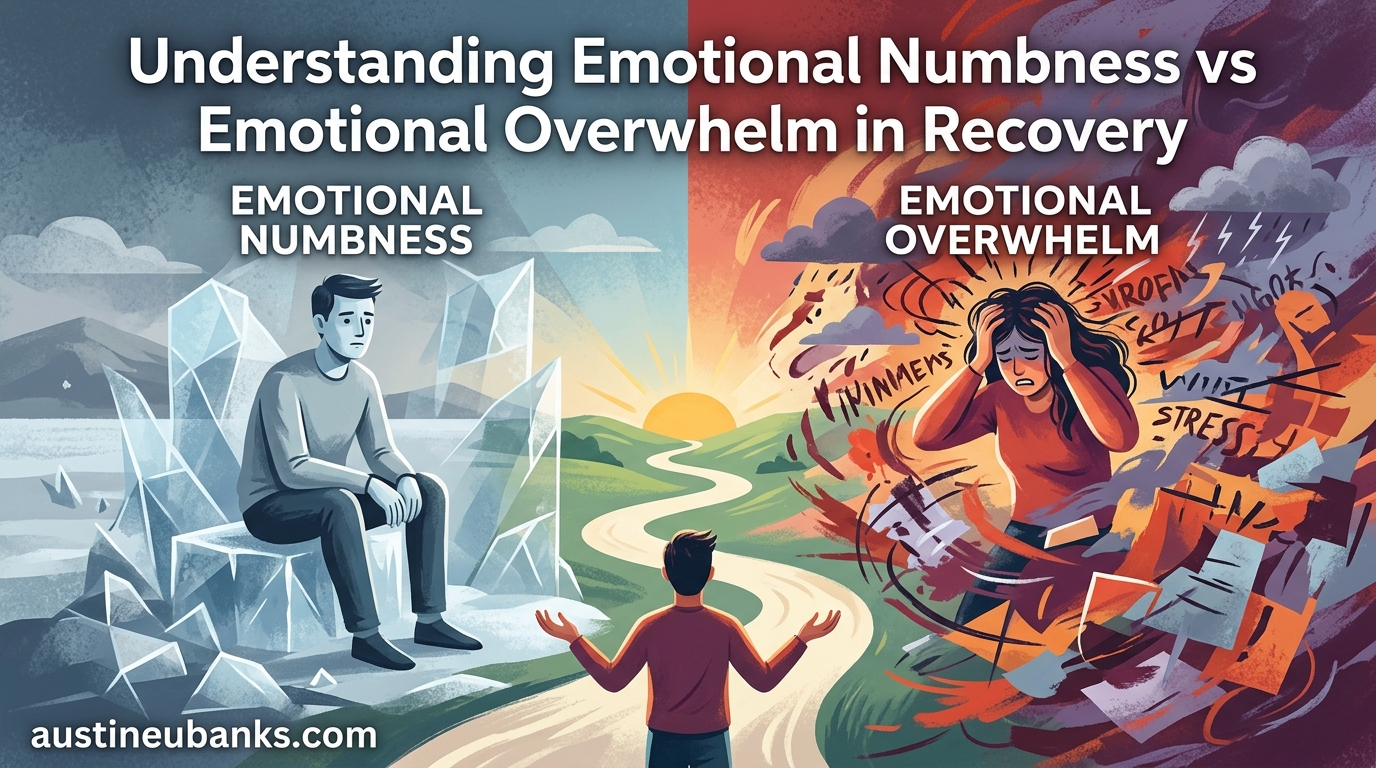
If you are in recovery, you might have noticed something confusing. Some days you cannot feel anything at all, like you are watching your life through glass. Other days every emotion hits you at full volume and you cannot turn it down.
This is the experience of emotional numbness vs emotional overwhelm in recovery, and it is one of the most disorienting parts of healing. You might wonder if something is wrong with you. You might question whether the numbness means you are failing, or whether the overwhelm means you are getting worse.
Neither is true. Both states are normal, predictable, and treatable. Understanding the difference between them, and more importantly understanding why you bounce between them, can change how you experience recovery entirely.
In this guide, we will break down what each state feels like, why they happen, and how to navigate the tricky transition between feeling nothing and feeling everything. We will also share practical tools you can use right now, including the Notice-Ground-Name-Allow-Connect framework that helps with both ends of the spectrum.
Whether you are newly sober, years into recovery, or supporting someone who is, this information can help you make sense of what is happening in your nervous system and give you concrete steps toward emotional balance.
Table of Contents
What Is Emotional Numbness in Recovery?
Emotional numbness is a protective state where you feel disconnected from your emotions, often as a response to trauma, overwhelming stress, or the early stages of recovery from addiction. It is not a character flaw or a sign that you are broken. It is your nervous system hitting the brakes when things become too much to process.
People describe it differently. Some say it feels like being underwater, where sounds and sensations reach them muffled and distant. Others say it is like watching a movie of their own life rather than living it. You might know intellectually that something should make you happy or sad, but the feeling does not arrive.
This state has clinical names. Therapists may call it affective blunting, emotional detachment, or a form of dissociation. In trauma psychology, it is understood as a shutdown response, the nervous system’s way of conserving energy when it perceives that emotional processing would be too costly.
In recovery, emotional numbness often shows up in the first weeks and months after stopping substances. Your brain has been relying on chemicals to regulate emotions, and without that artificial regulation, it defaults to a low-power mode. This can feel alarming, especially if you expected recovery to feel vivid and alive.
Some people also experience numbness later in recovery, particularly during stressful periods or when old trauma surfaces. It can return in waves, sometimes after months of feeling connected and present. This does not mean you are relapsing or going backward.
What Is Emotional Overwhelm in Recovery?
Emotional overwhelm is the opposite end of the spectrum, a state where emotions arrive with such intensity that they feel unmanageable. Instead of feeling nothing, you feel everything, sometimes all at once, with no clear way to sort or regulate the experience.
People in recovery often describe emotional overwhelm as a flood. Sadness, anger, fear, joy, shame, and grief can hit simultaneously or in rapid succession. You might cry without knowing why, feel rage that seems disproportionate to the situation, or experience anxiety so intense it feels like a physical threat.
This state is sometimes called emotional flooding. It happens when your nervous system is hyperactivated, pushed past its capacity to process and organize emotional information. Your body responds as though every feeling is an emergency, which makes it difficult to think clearly or make good decisions.
In early recovery, emotional overwhelm is common because the emotional dam has been held back by substances for months or years. When that dam breaks, everything that was suppressed can rush forward. This is not a sign of weakness. It is what happens when a system that was artificially silenced starts to come back online.
Emotional overwhelm can also be triggered by specific events: anniversaries, conflicts, grief, or even positive experiences that feel too big to hold. The nervous system, still learning to self-regulate without chemical support, can overreact to stimuli that it will eventually learn to handle with ease.
Emotional Numbness vs Emotional Overwhelm: Key Differences
Recognizing which state you are in is the first step toward managing it effectively. While numbness and overwhelm feel completely different, they are actually two sides of the same coin, your nervous system’s attempt to protect you from more than you can handle.
Here is a breakdown of how these two states differ across key dimensions:
- Emotional experience: Numbness feels like emptiness, flatness, or absence of feeling. Overwhelm feels like too much feeling, intensity, and flooding.
- Nervous system state: Numbness corresponds to shutdown, hypoarousal, or the dorsal vagal response. Overwhelm corresponds to hyperarousal, fight-or-flight, or sympathetic nervous system activation.
- Body sensations: Numbness often comes with physical heaviness, slow movement, coldness, or feeling disconnected from the body. Overwhelm comes with racing heart, muscle tension, shallow breathing, or feeling like you might explode.
- Thoughts: Numbness brings foggy thinking, disinterest, or blank mind. Overwhelm brings racing thoughts, rumination, or catastrophizing.
- Common triggers: Numbness is triggered by prolonged stress, trauma reminders, or early recovery adjustment. Overwhelm is triggered by sudden emotional demands, unexpected events, or accumulated unprocessed feelings.
- Recovery risk: Numbness can lead to seeking intensity or substances to feel something. Overwhelm can lead to seeking numbness or substances to turn things down.
- What helps: Numbness responds to gentle activation, sensory engagement, and gradual reconnection. Overwhelm responds to grounding, slowing down, and self-soothing.
Understanding these differences matters because the strategies that help with one state can actually make the other worse. If you are numb and you try grounding techniques designed to calm an overactive nervous system, you may feel even more disconnected. If you are overwhelmed and someone tells you to lean into your feelings, you may flood further.
The key is accurate identification first, then matching your response to what your nervous system actually needs.
Why Both States Occur in Recovery
Recovery from addiction is not just about stopping substance use. It is about retraining a nervous system that learned to rely on external chemicals for emotional regulation. When you remove those chemicals, your brain has to rebuild its natural regulatory capacity from scratch.
During active addiction, substances act as a buffer between you and your emotions. They amplify certain feelings, suppress others, and provide an on-demand mechanism for emotional control. Without that buffer, raw emotions have nowhere to hide.
Your nervous system responds to this sudden exposure in one of two ways. It can shut down to limit the emotional input, producing numbness. Or it can become overactivated as long-suppressed feelings surge forward, producing overwhelm. Most people in recovery experience both, often in alternation.
This is connected to what therapists call the window of tolerance, a concept developed by Dr. Dan Siegel. The window of tolerance is the zone where you can process emotions without shutting down or flooding. Inside the window, you feel things but can still think clearly and make good decisions.
In early recovery, that window is narrow. Very little emotional input fits inside it. Small stressors can push you into overwhelm, and the exhaustion that follows can collapse you into numbness. As recovery progresses, the window widens. You build capacity to feel more without losing your balance.
Trauma plays a significant role here too. Many people who develop substance use disorders have underlying trauma, and trauma narrows the window of tolerance dramatically. The nervous system becomes sensitized, oscillating between shutdown and hyperarousal as it tries to manage threat signals that no longer require a survival response.
The Numbness-Overwhelm Cycle: Why You Bounce Between Both
One of the most confusing experiences in recovery is the cycle between numbness and overwhelm. You might feel completely flat for weeks, then suddenly find yourself crying over a commercial or exploding at a minor inconvenience. Then just as quickly, the numbness returns.
This pendulum swing is not random. It is a predictable pattern that reflects your nervous system trying to find equilibrium. When numbness has gone on too long, the accumulated unprocessed emotions build pressure. Eventually that pressure releases, often suddenly and without warning, creating a state of overwhelm.
The overwhelm is so uncomfortable that your nervous system may shut back down to protect you. This creates a loop: numb leads to overwhelm, overwhelm leads to numb, and the cycle repeats. Many people in recovery describe feeling trapped in this pattern without understanding what is driving it.
The transition phase is particularly difficult. People on forums like Reddit’s r/CPTSD and r/hsp describe going from years of emotional numbness to suddenly feeling like a raw nerve, where every sensation is amplified and overwhelming. This transition can last days, weeks, or even months, and it is often when people are most vulnerable to relapse.
Why? Because when you have been numb for a long time, any feeling can seem like proof that something is wrong. The intensity of newly returning emotions can feel unmanageable, and the old solution, substances, starts to look appealing as a way to dial things back down.
There is also the issue of intensity-seeking. Some people in recovery notice that they only feel emotions in extreme situations or when engaging in high-risk behavior. This is because the nervous system, accustomed to the intensity of substances, requires more stimulation to register feelings. Chasing that intensity to feel something is a well-known relapse trigger.
Breaking this cycle requires understanding that both numbness and overwhelm are temporary states, not permanent conditions. The goal is not to eliminate either one. The goal is to widen your window of tolerance so that you spend more time in the middle, where you can feel without flooding and connect without shutting down.
How to Cope with Emotional Numbness in Recovery
When you are numb, the instinct might be to force yourself to feel something. That approach usually backfires, creating more pressure and deeper shutdown. Instead, the goal is gentle activation, inviting emotions back online without overwhelming the system.
Here are practical strategies that help with emotional numbness:
- Engage your senses deliberately. Hold an ice cube, smell something strong like peppermint or coffee, or take a cold shower. Sensory input signals to your nervous system that it is safe to come online.
- Move your body. Walk, stretch, dance, or do yoga. Physical movement increases blood flow and nervous system activation, which can gently wake up emotional processing.
- Use temperature changes. Splashing cold water on your face activates the mammalian dive reflex, which can shift your nervous system state and create a small window of emotional access.
- Try bilateral stimulation. Tapping alternating sides of your body or walking while focusing on your surroundings can help reprocess stuck emotional material. This technique comes from EMDR therapy.
- Journal without pressure. Write whatever comes to mind without trying to produce deep emotional content. Sometimes the act of putting words on a page unlocks feelings you did not know were there.
- Consume emotional content. Watch a movie known to be moving, listen to music that used to make you feel something, or read something emotionally rich. Let the content do the work of generating emotion.
- Practice body scanning. Slowly move your attention through your body from head to toe, noticing any sensations without trying to change them. This rebuilds the connection between your mind and body that numbness disrupts.
The key with all of these is patience. Numbness took time to develop and it takes time to thaw. Pushing too hard can send you back into shutdown. Small, consistent efforts work better than intense, sporadic ones.
How to Manage Emotional Overwhelm in Recovery
When you are overwhelmed, the priority is different. You do not need more activation. You need regulation, slowing the nervous system down so that emotional processing becomes manageable.
These strategies help with emotional overwhelm:
- Use the 5-4-3-2-1 grounding technique. Name 5 things you see, 4 things you hear, 3 things you feel, 2 things you smell, and 1 thing you taste. This pulls your attention into the present moment and away from emotional flooding.
- Breathe slowly and deeply. Extend your exhale longer than your inhale. A pattern like inhale for 4 counts, exhale for 8 counts activates the parasympathetic nervous system and signals safety.
- Change your temperature. Cold water on your face or an ice pack on your chest can interrupt emotional flooding by activating the dive reflex and slowing your heart rate.
- Move the energy physically. Go for a run, do jumping jacks, or shake your body. Emotional overwhelm comes with physical energy that needs somewhere to go.
- Name what you are feeling. Saying “I am experiencing intense sadness right now” creates distance between you and the emotion. You become the observer rather than being consumed by the feeling.
- Limit stimulus. Step away from the situation, find a quiet room, dim the lights, and reduce sensory input. Overwhelm feeds on excess stimulation.
- Reach out to someone. Call a sponsor, a trusted friend, or a support line. Human connection regulates the nervous system more powerfully than almost any individual technique.
Remember that overwhelm, like numbness, is temporary. It will pass. The goal is not to make the feelings disappear but to ride the wave without acting on destructive impulses.
The Notice-Ground-Name-Allow-Connect Framework
One of the most effective tools for managing both numbness and overwhelm is a simple five-step framework: Notice, Ground, Name, Allow, Connect. This approach works because it meets your nervous system wherever it is and gently guides it toward regulation.
Step 1: Notice. The first step is simply becoming aware of your current state. Ask yourself: Am I numb right now, or am I overwhelmed? Am I somewhere in between? Notice without judgment. You are gathering information, not diagnosing a problem.
Step 2: Ground. Bring your attention to your body and your immediate environment. Feel your feet on the floor. Notice the temperature of the air. Press your hands together firmly. Grounding anchors you in the present moment so that emotional states feel less consuming.
Step 3: Name. Put words to what you are experiencing. If you are numb, say “I am noticing numbness right now.” If you are overwhelmed, say “I am feeling flooded.” If you can identify specific emotions, name those too: “There is sadness here. There is fear.” Naming activates the prefrontal cortex, which helps regulate emotional intensity.
Step 4: Allow. This is often the hardest step. Instead of fighting the state you are in, let it be there. If you are numb, do not force feelings. If you are overwhelmed, do not try to suppress the flood. Allowing creates space for the nervous system to do what it needs to do without added resistance.
Step 5: Connect. Reach for something outside yourself. This could be a person, a pet, a place, or a practice. Connection reminds your nervous system that you are not alone and that the current state, whatever it is, will shift.
This framework takes practice. At first it may feel awkward or ineffective. But with repetition, it becomes a reliable tool for navigating the full spectrum of emotional experience in recovery. You can use it in the moment when you notice yourself shifting between states, or as a daily check-in practice.
Finding Balance Between Numbness and Overwhelm
The long-term goal in recovery is not to never feel numb or never feel overwhelmed. It is to build enough emotional regulation capacity that you spend more time in the middle zone, the window of tolerance where you can feel your feelings and still function.
Building this capacity is gradual. Think of it like strength training for your nervous system. You do not start by lifting the heaviest weight. You start small, build consistency, and progressively increase the load your system can handle.
Here are daily practices that help widen your window of tolerance over time:
- Regular check-ins. Two or three times a day, pause and ask yourself where you are on the numbness-to-overwhelm spectrum. Awareness builds the foundation for regulation.
- Consistent sleep and nutrition. Your nervous system cannot regulate well when it is physically depleted. Basic self-care has a direct impact on emotional capacity.
- Mindfulness or meditation. Even 5 minutes a day of focused attention builds the neural pathways that support emotional regulation. Apps and guided practices can help if sitting in silence feels too difficult.
- Somatic practices. Yoga, tai chi, or simple body-based exercises help rebuild the connection between mind and body that addiction and trauma disrupt.
- Community connection. Regular contact with supportive people, whether through meetings, therapy, or friendships, provides external regulation that strengthens your internal capacity over time.
- Limit unnecessary stressors. In early recovery, protect your nervous system. Say no to non-essential demands and give yourself permission to move slowly.
Progress is not linear. You will have days of numbness, days of overwhelm, and increasingly, days of balanced presence. That is what recovery looks like in practice.
When to Seek Professional Help
While emotional numbness and overwhelm are normal in recovery, certain signs indicate it is time to bring in professional support. You do not need to hit a crisis point before reaching out.
Consider seeking help if numbness persists for extended periods without any shifting, if overwhelm regularly leads to thoughts of using substances, or if either state is accompanied by thoughts of self-harm. These are signals that your nervous system needs more support than self-help strategies can provide.
It is also worth noting that emotional numbness can sometimes indicate conditions beyond standard recovery adjustment. If numbness is accompanied by persistent loss of interest in all activities, changes in appetite or sleep, or feelings of hopelessness, it may be a sign of depression that warrants clinical attention.
Similarly, if overwhelm includes flashbacks, nightmares, or intense startle responses, it may point to PTSD or complex trauma that benefits from specialized treatment. These conditions are common among people in recovery and are treatable with the right therapeutic approach.
Therapies that have shown strong results for emotional numbness and overwhelm in recovery include EMDR (Eye Movement Desensitization and Reprocessing), Somatic Experiencing, Dialectical Behavior Therapy (DBT), and trauma-focused cognitive behavioral therapy. A qualified therapist can help you determine which approach fits your situation.
There is no weakness in seeking help. In fact, recognizing when you need more support is one of the strongest signs of recovery maturity.
FAQs
What does emotional numbness feel like?
Emotional numbness feels like being disconnected from your emotions, as if you are watching your life through glass rather than living it. You might know intellectually that something should make you happy or sad, but the actual feeling does not arrive. Many people describe it as emptiness, flatness, or feeling underwater.
How to cure emotional numbness?
Emotional numbness is not a disease to cure but a protective response to work through. Strategies that help include sensory engagement like holding ice or taking a cold shower, physical movement, body scanning, journaling, consuming emotionally rich content, and bilateral stimulation. Working with a trauma-informed therapist, especially one trained in EMDR or Somatic Experiencing, can accelerate the process. Patience is essential, as numbness takes time to thaw.
Is being numb a trauma response?
Yes, emotional numbness is a well-documented trauma response. It is a form of dissociation where the nervous system shuts down emotional processing to protect you from overwhelming input. In trauma psychology this is called the dorsal vagal response or shutdown state. It is the same mechanism that causes animals to freeze when threatened.
Can emotional numbness be permanent?
No, emotional numbness is not permanent, even when it has lasted for years. People who have experienced numbness for extended periods do recover their emotional range with consistent effort and appropriate support. Recovery involves gradually rebuilding the connection between mind and body through grounding practices, therapy, and patient nervous system regulation.
Why do I go from numb to overwhelmed in recovery?
This happens because numbness and overwhelm are two ends of the same spectrum. When numbness persists, unprocessed emotions build pressure underneath. Eventually that pressure releases suddenly, creating overwhelm. The discomfort of overwhelm then triggers shutdown again, restarting the cycle. Breaking this pattern involves widening your window of tolerance so you can feel emotions without flooding or shutting down.
How long does emotional numbness last in recovery?
The duration varies widely. Some people experience numbness for a few weeks in early recovery, while others, especially those with significant trauma history, may experience it for months or longer. The key factor is not how long it lasts but whether it is gradually shifting. With consistent grounding practices, therapy, and nervous system regulation work, most people notice incremental improvements over time.
Moving Forward: You Are Not Broken
If there is one thing to take away from this guide, it is this: emotional numbness and emotional overwhelm in recovery are not signs that something is wrong with you. They are signs that your nervous system is doing exactly what it was designed to do, protect you, sometimes too aggressively.
The cycle between feeling nothing and feeling everything is one of the most challenging aspects of recovery, but it is also one of the most well-understood. Therapists, researchers, and thousands of people who have walked this path before you have mapped the territory. You are not the first person to feel this way, and you will not be the last.
The tools in this article, from sensory grounding to the Notice-Ground-Name-Allow-Connect framework, are starting points. Use them. Practice them. Adjust them to fit your life. And when you need more support, reach for it without hesitation.
Recovery is not about never struggling. It is about building the capacity to move through struggle without losing yourself. Each day you stay present, even in numbness, even in overwhelm, you are doing the work. Your emotional range will return. Your window of tolerance will widen. And one day, you will notice that you feel something, a real feeling, at a manageable intensity, and you will know that all of this was worth it.