
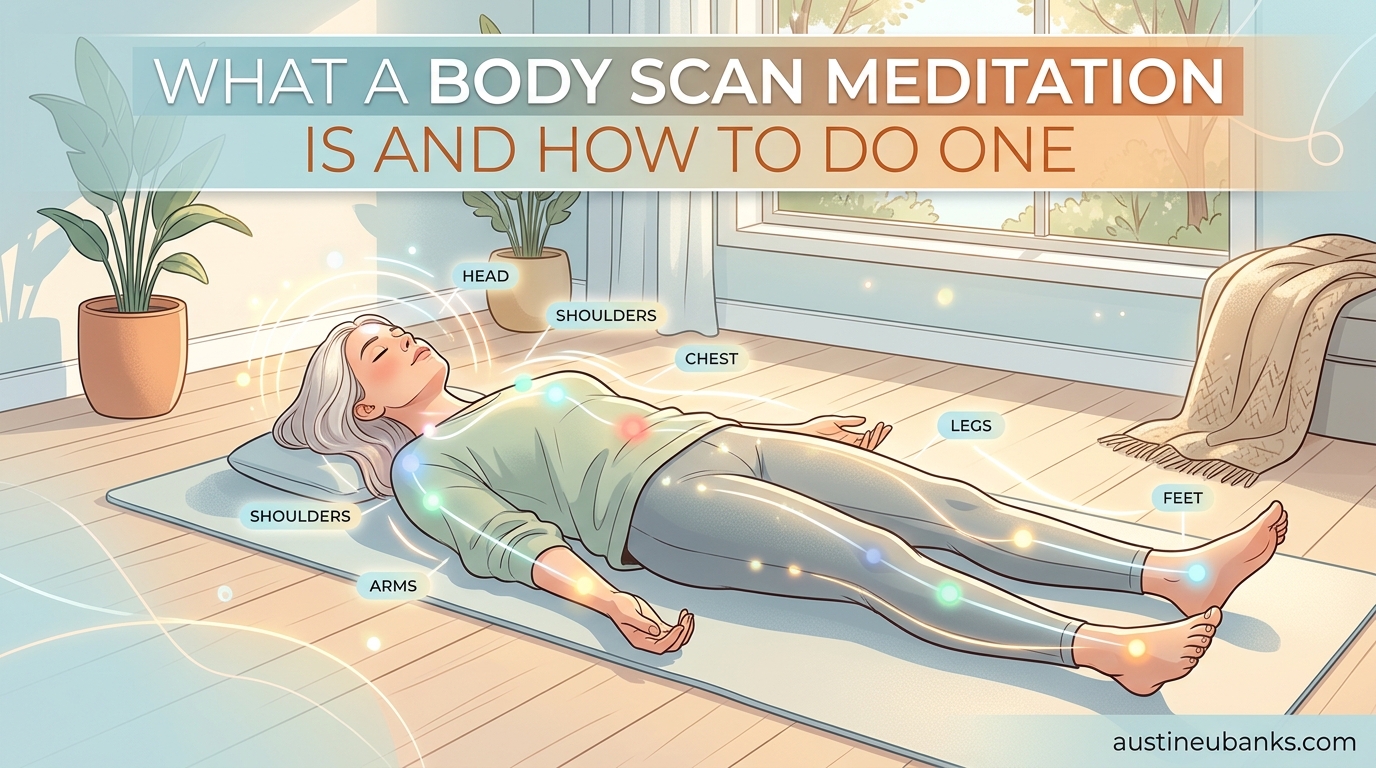
Have you ever noticed how much tension you carry in your body without realizing it? Maybe your jaw is clenched right now, or your shoulders have crept up toward your ears. Body scan meditation is a mindfulness practice that helps you notice exactly those things, and then gently let them go.
At its core, body scan meditation involves mentally sweeping your attention from the top of your head down to your toes, noticing sensations without trying to change them. It is one of the most approachable meditation techniques for beginners, and it requires nothing more than a few minutes and a quiet spot.
In this guide, we will walk through what a body scan meditation is, where it comes from, the science behind it, and a detailed step-by-step process so you can try one yourself tonight. Whether you are dealing with stress, poor sleep, or just want to feel more grounded in your day, this practice can help.
Table of Contents
What Is Body Scan Meditation?
Body scan meditation is a mindfulness technique where you mentally move your attention through different parts of your body, noticing physical sensations without judgment. The goal is not to relax on command or force anything to happen. Instead, you are simply building awareness of what your body is telling you in the present moment.
Think of it as taking inventory. You are scanning for tension, warmth, tingling, tightness, heaviness, or even a sense of ease in each area. Some parts might feel neutral, and that is perfectly fine. The practice is about noticing, not fixing.
This technique has its roots in the Mindfulness-Based Stress Reduction (MBSR) program developed by Dr. Jon Kabat-Zinn at the University of Massachusetts Medical Center in 1979. Kabat-Zinn adapted traditional Buddhist mindfulness practices into a secular, structured format that could be used in clinical settings. The body scan became one of the foundational exercises in that program, and decades of research have since validated its effectiveness.
The practice works by strengthening what researchers call interoception, which is your ability to sense internal signals from your body. When you tune into physical sensations with regular practice, you become better at recognizing early signs of stress, anxiety, or emotional disturbance before they spiral.
Body scan meditation also activates the parasympathetic nervous system, often called the rest-and-digest response. This is the opposite of the fight-or-flight reaction that kicks in when you are stressed. By deliberately bringing calm attention to your body, you signal to your nervous system that you are safe, which lowers cortisol levels and reduces physiological tension.
Over time, this mind-body connection becomes stronger. You start catching yourself holding tension in your neck after a long meeting, or clenching your fists during a difficult conversation. That awareness gives you the power to release it.
How Body Scan Meditation Differs From Other Practices
If you have explored meditation before, you might wonder how body scan meditation compares to other techniques you have tried. The differences are more practical than philosophical, but they matter when you are choosing a practice that fits your needs.
Breath meditation, for example, asks you to focus on the rhythm of your breathing and return to it whenever your mind wanders. It is excellent for building concentration. Body scan meditation, by contrast, spreads your attention across your entire physical form, which can feel more engaging for people who find watching the breath too abstract or frustrating.
Guided visualization involves imagining peaceful scenes or following a narrator through imagined environments. While visualization pulls your attention outward into imagination, a body scan keeps you anchored in what is actually happening inside you right now. Both can reduce stress, but body scan meditation builds a specific skill: tuning into real, present-moment physical experience.
Transcendental meditation and mantra-based practices involve silently repeating a word or phrase to settle the mind. These are more about transcending thought entirely. A body scan does not try to empty the mind. Instead, it redirects attention to something tangible and physical, which many beginners find much more accessible.
For anyone who struggles with racing thoughts or feels disconnected from their body, body scan meditation is often the best starting point. It gives your mind a concrete task that is hard to overthink.
How to Do a Body Scan Meditation: Step by Step
Learning how to do body scan meditation is straightforward, but the details matter. Below is a complete walkthrough you can follow from start to finish. Read through all the steps once before you begin so you know what to expect.
Before You Begin: Set Up Your Space
Find a quiet place where you will not be interrupted for at least 10 to 15 minutes. You can practice sitting in a chair with your feet flat on the floor, lying on your back on a yoga mat or bed, or reclining in any comfortable position. Lying down is popular because it lets your body fully relax, though it also increases the chance of falling asleep.
Loosen tight clothing, remove your shoes, and settle in. You can close your eyes or keep them open with a soft, unfocused gaze. If you are using a guided body scan meditation audio, queue it up now. Otherwise, you can follow the steps below at your own pace.
Step 1: Settle In and Breathe
Take three slow, deep breaths. Inhale through your nose for a count of four, hold briefly, and exhale through your mouth for a count of six. Let each exhale be longer than the inhale. This signals your nervous system to begin shifting into a relaxed state.
After those three breaths, let your breathing return to its natural rhythm. There is no need to control it from this point forward. Just let your body breathe on its own.
Step 2: Bring Awareness to Your Body as a Whole
Before scanning individual areas, take a moment to sense your body as a complete picture. Notice the feeling of the surface beneath you, the temperature of the air on your skin, and the weight of your body resting. This grounds you in the present moment before you zoom in on specific regions.
Step 3: Start at the Top of Your Head
Bring your attention to the crown of your head. Notice any sensations there. You might feel warmth, tingling, or nothing at all. Whatever you find is exactly right. There is no wrong way to experience your body.
Spend about 15 to 20 seconds on each area unless you feel drawn to linger somewhere longer. Some people prefer to move faster, others slower. Both are valid approaches.
Step 4: Scan Your Face and Neck
Slowly move your attention down to your forehead. Is it smooth or furrowed? Then notice your eyes, your cheekbones, your jaw. Many people discover tension in the jaw that they were completely unaware of. If you find tightness, simply acknowledge it. You do not need to force it to release.
Move to your neck and throat. Notice whether your head feels balanced or whether you are holding tension where your neck meets your shoulders.
Step 5: Move to Your Shoulders and Arms
Direct your awareness to your shoulders. Are they raised toward your ears? Dropping? Asymmetric? Just observe. Then move your attention slowly down your left arm, feeling your upper arm, elbow, forearm, wrist, and hand. Notice each finger individually if you have time.
Return to your shoulders and repeat the process down your right arm. Pay attention to any differences between the left and right sides. It is completely normal for one side to feel different from the other.
Step 6: Notice Your Chest and Back
Bring attention to your chest. Feel the gentle rise and fall of your breathing. Notice whether your chest feels open or constricted. Then shift your awareness to your upper back, the area between your shoulder blades, and your lower back. Notice where your body makes contact with the surface beneath you.
Step 7: Bring Attention to Your Stomach and Hips
Move your focus to your abdomen. Many people carry stress here without realizing it. Notice whether your stomach feels tight, soft, knotted, or relaxed. Then bring awareness to your hips and pelvis, the base of your body. Feel the weight of this area resting on whatever surface supports you.
Step 8: Move Down Your Legs
Shift your attention to your left thigh, then your knee, calf, shin, and ankle. Notice sensations in each area. Some areas might feel heavy, others light. Some might feel warm or cool. Then return to your hips and scan down your right leg in the same way.
Step 9: Reach Your Feet
Finally, bring your awareness to your feet. Notice your heels, the arches, the balls of your feet, and each toe. Feet are often overlooked, yet they carry the weight of your entire body all day. Give them a moment of appreciation and attention.
Step 10: Full-Body Awareness
Now zoom back out. Sense your entire body from crown to toes as one connected whole. Notice the flow of energy, the rhythm of your breath, and the feeling of being completely present in your body. Rest here for 30 seconds to a minute, simply being with whatever you feel.
Step 11: Gently Return
When you are ready to finish, do not rush. Slowly deepen your breath. Wiggle your fingers and toes. Roll your shoulders gently. When you feel ready, open your eyes and take a moment before standing up. Notice if anything feels different from when you started.
That is a complete body scan meditation. The entire process typically takes 10 to 20 minutes, but even a 5-minute version can be powerful when you are short on time.
Benefits of Body Scan Meditation
The benefits of body scan meditation extend well beyond feeling relaxed in the moment. Research has shown that regular practice produces measurable changes in both mental and physical health. Here is what the evidence tells us.
Reduces Stress and Anxiety
Body scan meditation directly counteracts the fight-or-flight stress response. By activating the parasympathetic nervous system, it lowers heart rate, reduces blood pressure, and decreases cortisol production. Multiple studies have shown that participants in MBSR programs, where the body scan is a core practice, report significant reductions in perceived stress and anxiety after just eight weeks.
The key mechanism is awareness. When you can detect tension early, you can address it before it escalates into a full stress response. Over time, this builds emotional resilience.
Improves Sleep Quality
If you struggle with falling asleep or staying asleep, body scan meditation can be a game-changer. Racing thoughts are one of the most common barriers to sleep, and the structured, body-focused attention of a scan gives your mind something calming to do instead of worry.
Practicing in bed as part of your wind-down routine helps signal to your body that it is time to rest. Many people report falling asleep faster and waking up feeling more refreshed after making body scan meditation a regular nighttime habit.
Helps Manage Chronic Pain
Living with chronic pain can feel like being trapped in a body that is working against you. Body scan meditation does not eliminate pain, but it changes your relationship with it. By observing painful sensations without judgment or resistance, you reduce the emotional suffering that often amplifies physical pain.
Clinical research on mindfulness-based interventions has demonstrated meaningful improvements in pain management, particularly for conditions like fibromyalgia, lower back pain, and arthritis-related discomfort. The practice helps you distinguish between the raw physical sensation and the mental story you tell about it.
Enhances Emotional Regulation
Your body often registers emotions before your conscious mind catches up. A tightening chest might signal anxiety. A churning stomach could indicate fear. When you practice body scan meditation regularly, you become more attuned to these early physical signals.
This heightened interoception gives you a head start on managing your emotions. Instead of being blindsided by a reaction, you can notice the physical signs building and choose how to respond. This is one reason mindfulness practices are increasingly used in therapy for emotional regulation.
Builds Self-Awareness and Self-Compassion
Body scan meditation cultivates a non-judgmental relationship with yourself. When you observe tension or discomfort without criticizing yourself for having it, you practice self-compassion in real time. This attitude tends to extend beyond meditation into daily life.
Many practitioners report that they become more patient and kind with themselves overall. They stop treating their bodies as problems to be fixed and start treating them as sources of valuable information.
Supported by Science
These benefits are not just anecdotal. The MBSR program, which features body scan meditation prominently, has been studied in hundreds of peer-reviewed trials. Research published in journals like JAMA Internal Medicine has shown that mindfulness meditation programs, including body scan work, produce moderate improvements in anxiety, depression, and pain that are comparable to some pharmacological treatments.
Brain imaging studies have also shown that regular meditation practice changes the structure of the brain itself, increasing gray matter density in areas related to learning, memory, and emotional regulation while shrinking the amygdala, the brain region associated with fear and stress.
When to Practice Body Scan Meditation
One of the best things about body scan meditation is its flexibility. There is no single right time to practice. Here are some of the most effective times to try it, depending on what you need.
Morning
Starting your day with a short body scan helps you check in with yourself before external demands take over. A 5-minute scan while still in bed can reveal how well you slept and whether you are carrying tension from the previous day into this one. It sets a grounded, intentional tone for the hours ahead.
Midday Reset
If you spend your workday at a desk or in high-pressure situations, a midday body scan can interrupt the stress cycle before it compounds. Even three minutes of scanning your shoulders, jaw, and neck while sitting at your desk can release accumulated tension and improve focus for the afternoon.
Evening and Before Sleep
This is the most popular time for body scan meditation, and for good reason. A longer scan as part of your evening routine helps transition your nervous system from active mode to rest mode. It clears the mental clutter of the day and prepares your body for deeper, more restorative sleep.
During Stressful Moments
You do not need to wait for a scheduled session. If you feel overwhelmed, anxious, or physically tense during the day, a quick informal scan of your body can bring you back to center. Focus on the area where you feel the most tension, breathe into it, and let yourself simply notice what is there.
Common Mistakes to Avoid
Body scan meditation is simple, but that does not mean it is always easy. Here are the most common mistakes beginners make and how to avoid them.
Trying to empty your mind. This is the number one misconception about all meditation. Your mind will wander during a body scan, and that is completely normal. The practice is not about stopping thoughts but about gently returning your attention to your body each time you notice you have drifted.
Judging sensations as bad. If you find tension, tightness, or discomfort, your instinct might be to label it as wrong or something to fix. Instead, try to observe it with curiosity. Tension is information, not a failure. Simply noticing it without judgment is the entire point.
Rushing through the scan. Moving too quickly defeats the purpose. Each area of your body deserves a few breaths of attention. If you catch yourself sprinting from head to toe, slow down and give yourself permission to take the full time.
Falling asleep every time. If you always practice lying down and always fall asleep, try sitting upright in a chair instead. Falling asleep during a body scan is not harmful, but if your goal is to build mindfulness rather than nap, adjusting your posture can help you stay alert.
Being too rigid. Some days your mind will be busy and scattered. Other days you will feel deeply relaxed after just a few minutes. Both are fine. Consistency matters more than perfection. Show up, do the practice, and let the results be what they are.
Tips for Beginners Getting Started
If you are new to body scan meditation, these tips will help you build a sustainable practice from day one.
Start With Just 5 Minutes
You do not need to commit to a 45-minute session right away. Start with 5 minutes and focus on just a few body parts. As you get more comfortable, naturally extend the time. Five minutes done consistently is far more valuable than one 30-minute session per month.
Use Guided Audio
Having a narrator guide you through the scan is incredibly helpful when you are starting out. It removes the pressure of remembering what comes next and keeps you on track. There are many free guided body scan meditations available through apps, podcasts, and YouTube. Try a few different voices and styles until you find one that resonates with you.
Be Patient With Your Wandering Mind
Your mind will wander. That is not a sign that you are bad at meditating. Every time you notice your mind has drifted and you bring it back to your body, you are doing the practice correctly. That moment of noticing and returning is where the real training happens.
Practice Consistently Rather Than Perfectly
Daily practice, even if short, builds the skill far more effectively than occasional long sessions. Aim for consistency over duration. Ten minutes a day for a week will teach you more about your body than one hour on a Sunday.
Prioritize Comfort
Wear comfortable clothing, choose a supportive surface, and make sure the room temperature feels right. Physical discomfort is a distraction you can control. The more comfortable you are, the easier it is to focus inward.
Keep a Simple Notes Habit
After each session, jot down one or two things you noticed. Maybe you discovered tension in your left shoulder, or maybe your feet felt surprisingly warm. Over time, these notes reveal patterns and help you track how your awareness deepens with practice.
Frequently Asked Questions
Is body scan meditation good for beginners?
Yes, body scan meditation is one of the best meditation techniques for beginners. It gives your mind a concrete, tangible task, noticing physical sensations, which is easier than trying to empty your mind or focus on abstract concepts. You can start with just 5 minutes and build from there.
What is the first step in the body scan meditation process?
The first step is to settle into a comfortable position and take three slow, deep breaths. This signals your nervous system to begin relaxing and grounds you in the present moment before you start scanning your body. After those breaths, let your breathing return to natural rhythm.
How long does a body scan meditation take?
A body scan meditation can take anywhere from 5 to 45 minutes. For beginners, 5 to 10 minutes is a great starting point. A full scan covering every body part typically takes 15 to 20 minutes. Even a quick 3-minute informal scan during a stressful moment can be effective.
Can body scan meditation help with anxiety?
Yes, research shows that body scan meditation reduces anxiety by activating the parasympathetic nervous system and lowering cortisol levels. It also builds interoception, the ability to sense early physical signs of anxiety, which lets you address stress before it escalates.
Should I do body scan meditation sitting or lying down?
Both positions work well. Lying down allows for deeper relaxation and is ideal for evening or sleep-focused sessions. Sitting upright in a chair helps you stay alert and is better if you tend to fall asleep. Choose the position that fits your goal for each session.
Wrapping Up
Body scan meditation is a simple but powerful practice that builds awareness of your body, calms your nervous system, and helps you feel more grounded in everyday life. It requires no equipment, no experience, and no special setting. All you need is a few minutes and a willingness to pay attention.
Understanding what a body scan meditation is and how to do one is just the beginning. The real benefits come from practicing consistently. Start small, be patient with yourself, and notice how your relationship with your body changes over time. Your body has been talking to you for years. This practice simply teaches you how to listen.