
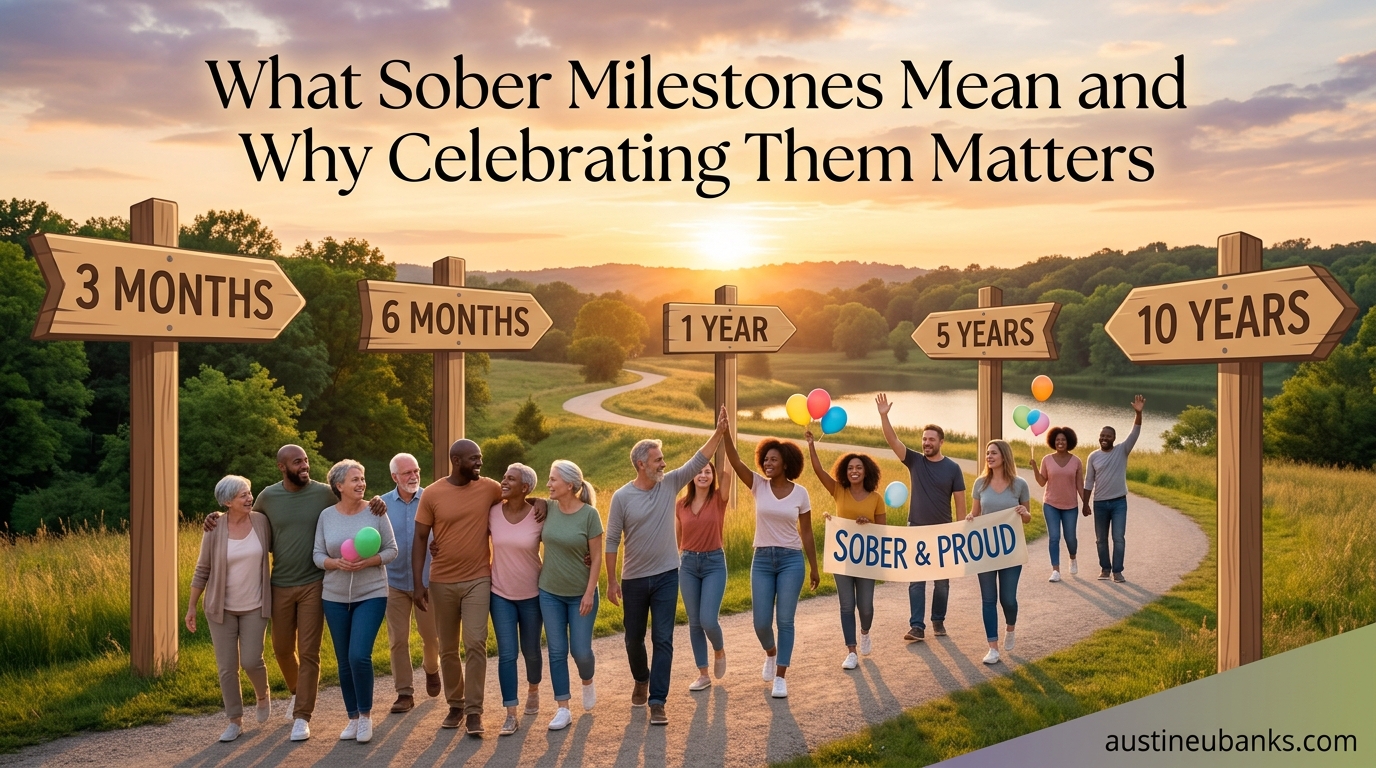
Sober milestones are personal markers that represent time spent free from alcohol or drugs, serving as reminders that healing is happening and progress is being made. In recovery, every day without substance use is a real achievement, but certain markers carry special weight because they signal measurable growth. These checkpoints, often called sobriety milestones or recovery milestones, give people in recovery something tangible to point to when the work feels invisible.
Understanding sober milestones matters because recovery can feel like walking through fog. You know you are moving, but without markers along the path, it is hard to tell how far you have come. Milestones make that progress visible. They also serve a deeper psychological purpose that we will explore throughout this guide, including how celebration actually rewires the brain to support long-term sobriety.
In this article, we will break down what sober milestones really mean, why celebrating them matters more than most people realize, and practical ways to honor them, whether you are marking 24 hours or 10 years. We will also address what happens when a milestone feels anticlimactic, a surprisingly common experience that almost no one talks about.
Table of Contents
What Are Sobriety Milestones, Really?
Sober milestones are specific points in time that mark how long someone has been free from alcohol or drug use. They can be as small as the first 24 hours or as significant as a decade of sustained recovery. The word “milestone” comes from ancient stone markers placed along roads to tell travelers how far they had come and how far remained, and that image fits recovery perfectly.
What makes sober milestones different from ordinary anniversaries is the personal weight they carry. A one-year soberversary is not just a date on a calendar. It represents roughly 365 mornings of choosing differently, hundreds of cravings resisted, relationships rebuilt, and a version of yourself that did not exist a year ago. That is why so many people in recovery treat these dates with genuine reverence.
The term “soberversary” has gained popularity in recent years as a more celebratory alternative to clinical language. Some people mark the date they last drank or used. Others count from the day they entered treatment or committed to change. There is no wrong starting point, and choosing the date that feels most meaningful to you is part of making recovery your own.
Many mutual aid programs, including Alcoholics Anonymous and other 12-step fellowships, use tokens or chips to mark milestones. A bronze chip might represent 24 hours, a silver one 30 days, and a gold or colored token one year. These physical objects give abstract progress a shape and weight you can hold in your hand, which is part of why they remain so powerful.
Why Celebrating Milestones Matters in Recovery
Celebrating sober milestones matters because recovery is largely invisible work. Unlike building a house or training for a marathon, the results of staying sober are not always something you can see in a mirror or measure with a tape. Celebration makes that hidden effort tangible.
Here is what happens when you pause to honor a milestone: you make progress visible, you build self-worth by acknowledging what you have accomplished, you strengthen the social bonds that protect against relapse, and you create positive memories that compete with old associations tied to substance use. Each of those effects has a direct link to long-term outcomes.
Recovery also tends to be a long stretch of doing hard, unglamorous things. Without moments of recognition, the day-to-day effort can start to feel pointless. Celebration interrupts that drift by reminding you why the work is worth it. It is not about throwing a party every week. It is about refusing to let growth pass unacknowledged.
Community connection is another reason celebration matters. When you share a milestone at a meeting, with a sponsor, or with supportive friends, you give other people permission to hope. People newer to recovery often tell us that watching someone pick up a one-year chip was the moment they first believed sustained sobriety was possible for them.
The Brain Science Behind Celebration
The reason celebration feels good is not just sentimental. It is neurological. When you pause to recognize an achievement, your brain releases dopamine, the same neurotransmitter that substances artificially flood. The difference is that celebration-triggered dopamine reinforces healthy behaviors rather than destructive ones.
Substance use hijacks the brain’s reward system by delivering massive, unnatural dopamine spikes. Over time, everyday pleasures stop registering because the brain’s baseline shifts. Recovery involves slowly recalibrating that system, and celebration is one of the tools that helps. Each time you acknowledge a milestone, you are giving your brain a natural reward signal that says this path is worth staying on.
Psychologists call this process “savoring,” and it has been studied extensively outside of addiction research. Savoring means intentionally prolonging and deepening a positive experience rather than letting it pass quickly. People who practice savoring report higher life satisfaction and greater emotional resilience, two qualities that matter enormously in recovery.
There is also the concept of self-efficacy, which is psychologist Albert Bandura’s term for belief in your ability to succeed at a specific task. Every milestone you reach and recognize adds evidence to your internal case that you can stay sober. That growing confidence is not just feel-good psychology. Research links higher self-efficacy to lower relapse rates and better long-term recovery outcomes.
Common Sober Milestones Markers
While every recovery journey is unique, certain timeframes tend to carry shared meaning across the recovery community. Here is what people commonly experience at each major marker, based on what we have heard from countless individuals walking this path.
24 Hours to 7 Days: The Beginning
The first 24 hours are enormous. If you are reading this on day one, that achievement is real and worth honoring, even if no one else notices yet. The first week is often the hardest physically and emotionally. Cravings peak, sleep is disrupted, and the brain is still recalibrating. Reaching seven days means you have made it through the steepest part of the climb.
Forum discussions in recovery communities frequently mention day three as particularly tough. That is often when the voice that says “I can have just one drink and be fine” gets loudest. If you have passed that point, you have already done something genuinely difficult.
30 Days: Finding Your Footing
One month sober is often when people start to feel physical changes. Sleep begins to normalize, energy levels improve, and the fog starts lifting. Emotionally, this is also when the early pink cloud can hit, a period of feeling unexpectedly good, followed sometimes by a crash as reality sets back in.
Thirty days is also typically when daily routines start to feel like actual habits rather than forced effort. That shift matters because habits require less willpower than raw discipline. The work is becoming part of who you are.
90 Days: Building Resilience
Three months is widely considered a turning point. People report feeling more patient, more emotionally regulated, and better equipped to handle stress without substances. Normal problem-solving skills resurface. You start trusting yourself in situations that would have been dangerous a few months earlier.
This is also when many people begin rebuilding relationships and taking on new responsibilities. The foundation is solid enough to support real life again, not just survival mode.
6 Months: A Major Shift
Six months comes up again and again in recovery conversations as a genuinely big milestone. People describe it as the point where sobriety stops feeling like a daily battle and starts feeling like simply how they live. The identity shift from “someone trying to stay sober” to “someone who does not drink or use” often solidifies here.
Physically, mentally, and in terms of personal achievement, six months tends to be when the cumulative effect of all those small daily choices becomes undeniable.
1 Year and Beyond
One year sober is the milestone most people know about, and it deserves the attention it gets. A full trip around the sun without substances means you have faced every season, every holiday, every trigger the calendar can throw at you, and you are still here.
Beyond one year, milestones tend to become more personal. Some people mark multiple years with the same reverence. Others shift focus from time-based markers to life-based ones: first sober vacation, first healthy relationship, first time handling a crisis without relapsing. All of them count.
Small Wins vs Big Anniversaries
One of the biggest gaps in how people talk about sober milestones is the assumption that only the big ones matter. That could not be further from the truth. Research on what Harvard Business School professor Teresa Amabile calls the “progress principle” shows that small, everyday wins are the single strongest predictor of motivation and wellbeing in difficult work.
Recovery is difficult work. The principle applies directly. Choosing not to drink at a stressful work event is a win. Calling a friend instead of reaching for a substance is a win. Getting through a difficult emotion without numbing is a win. These micro-milestones do not come with chips or cakes, but they are the actual building blocks of long-term sobriety.
The risk of focusing only on major milestones is that the long stretches between them can feel like a desert. If you only celebrate at 30 days, 90 days, and one year, what happens on day 47 when everything feels hard and no recognition is coming? Small wins fill those gaps. They keep dopamine flowing and self-efficacy building on the days when no one else is watching.
This is why many recovery programs encourage daily check-ins, gratitude lists, and end-of-day reflections. These practices are essentially structured ways of catching and celebrating small wins before they disappear into the stream of ordinary life.
Ways to Celebrate Sobriety Milestones
There is no single right way to celebrate a sober milestone. The best approach is whatever feels genuine to you. Here are some ideas that people in recovery have shared with us over the years.
- Write a letter to your past self describing what life looks like now and what you wish you had known then.
- Share your milestone at a support meeting, even if you are nervous, because someone in that room needs to hear it.
- Treat yourself to something meaningful, a meal at a favorite restaurant, a book you have wanted, a day trip somewhere new.
- Make a list of things recovery has given you that substances never could.
- Spend time in nature, walking, hiking, or simply sitting somewhere quiet to reflect on how far you have come.
- Connect with someone who supported you early on and thank them specifically for what they did.
- Buy or make a physical token, a chip, bracelet, piece of jewelry, or even a stone, that you can carry as a reminder.
- Start a new tradition that you repeat at every milestone going forward.
- Donate to or volunteer with an organization that supports recovery, turning your milestone into someone else’s hope.
- Spend the day in quiet personal recognition if public celebration does not feel right for you. That counts too.
The most important thing is intention. A milestone celebrated with genuine attention, even privately, does more for your recovery than a large party thrown out of obligation.
Supporting a Loved One’s Milestones
If someone you care about is in recovery, knowing how to acknowledge their milestones can strengthen your relationship and support their journey. The key is to let them lead. Some people want recognition. Others would rather mark the day quietly. Ask what feels right rather than assuming.
Simple, specific acknowledgments tend to land best. Saying “I am proud of you for six months, and I have seen how hard you have worked” means more than a generic congratulations. Avoid framing it as surprise, which can unintentionally communicate low expectations. Instead of “I can’t believe you made it a year,” try “A year. That is real, and I see it.”
Gifts are not required, but if you want to give something, make it meaningful rather than generic. A handwritten note, a book that relates to their journey, or a small symbolic object often carries more weight than something expensive. And never, under any circumstances, suggest celebrating with a drink.
When Milestones Feel Anticlimactic
Here is something almost no one talks about: sometimes a milestone arrives and it feels like nothing. You hit 90 days or one year and the day passes and you feel empty, let down, or even more vulnerable than before. This experience is common enough that recovery communities have a name for it. Post-milestone letdown.
One reason this happens is anticipation. You build up a date in your mind for weeks or months, and when it finally arrives, reality cannot match the expectation. Another reason is that milestones can trigger reflection on everything lost to addiction, which brings grief alongside pride.
There is also a vulnerability factor. After reaching a major milestone, some people unconsciously relax their guard, feeling they have proven they can stay sober. That loosening can open the door to old patterns. Being aware of this risk is itself protective.
If a milestone falls flat for you, that does not mean your recovery is failing. It means you are human. Talk to someone in your support network about it. Give yourself permission to feel whatever you feel. And remember that the milestone still counts, regardless of how the day itself felt. The work behind it was real even if the celebration was not what you imagined.
FAQs
What are the sober milestones?
Sober milestones are specific time-based markers that represent how long someone has been free from alcohol or drugs. Common milestones include 24 hours, 7 days, 30 days, 90 days, 6 months, 1 year, and multi-year anniversaries. They serve as visible proof of progress and give people in recovery concrete moments to reflect, celebrate, and stay motivated.
Why is it important to celebrate milestones?
Celebrating milestones matters because it makes invisible recovery progress visible, reinforces healthy behaviors through natural dopamine release, builds self-efficacy and confidence, strengthens support networks, and reduces relapse risk by creating positive associations with sobriety. Without celebration, the daily effort of recovery can feel unending and unacknowledged.
How to celebrate a sobriety milestone?
You can celebrate a sobriety milestone by sharing it at a support meeting, writing a reflective letter to your past self, treating yourself to something meaningful, spending time in nature, thanking people who supported you, creating or carrying a physical token like a chip or bracelet, volunteering in the recovery community, or simply spending the day in quiet personal recognition. The best method is whatever feels genuine to you.
What does it mean to celebrate milestones?
Celebrating milestones means intentionally pausing to acknowledge and honor progress rather than letting it pass unnoticed. In recovery, it involves recognizing the work, growth, and courage behind a period of sustained sobriety. It is not about extravagance but about giving meaning to effort, reinforcing the path you are on, and creating positive memories that support long-term healing.
Conclusion
Sober milestones are far more than dates on a calendar. They are evidence that change is real, that the brain can heal, and that a different life is possible. Whether you are honoring 24 hours or 10 years, each marker represents countless decisions made in the direction of health.
Celebrating these milestones matters because it wires your brain for continued success, builds the confidence that protects against relapse, and reminds you that recovery is not just about what you stopped doing but about what you are building instead. The science is clear: acknowledged progress sustains progress.
If you take one thing from this guide, let it be this: do not wait for the big milestones to start celebrating. Catch the small wins. Savor them. Share them. Because in the end, long-term sobriety is built one recognized step at a time, and every single one of those steps deserves to be seen.