
Recovery from addiction is not a straight line. According to the National Institute on Drug Abuse (NIDA), the relapse rate for substance use disorders falls between 40% and 60% — comparable to relapse rates for other chronic conditions like asthma or hypertension. That statistic is not meant to discourage you. It is meant to reframe how we think about recovery: as a chronic condition that requires ongoing management, not a one-time fix.
This is where a relapse prevention plan comes in. Think of it as a personalized roadmap that helps you recognize warning signs early, take specific actions when cravings hit, and lean on the right people at the right time. Without one, you are navigating recovery blindfolded. With one, you have a concrete set of tools ready before the storm hits.
When our team dug into the research — from NIH and SAMHSA publications to real recovery community discussions on Reddit’s r/recovery and r/REDDITORSINRECOVERY — we found a clear pattern. People who stay sober long-term almost always have a written plan. They know their triggers by name. They have coping strategies rehearsed. And they treat a slip-up as data, not as proof of failure.
In this guide, we will walk through exactly what a relapse prevention plan should actually include. You will learn the three stages of relapse, the five rules that research links to long-term success, how to identify your personal triggers, practical coping techniques like the 3-3-3 rule and the 4 D’s, and what to do if you experience a lapse. Whether you just completed treatment or you are years into sobriety, this information can help you build — or strengthen — your plan.
Table of Contents
What Is a Relapse Prevention Plan?
A relapse prevention plan is a written document that identifies your personal triggers, outlines coping strategies for cravings, and lists the support resources you will use to maintain sobriety. It is not a vague intention or a mental commitment. It is a specific, actionable plan you can pull out when things get difficult.
The concept originated with the work of Dr. G. Alan Marlatt in the 1980s, who developed a cognitive-behavioral approach to understanding why people return to substance use. Marlatt’s model emphasized that relapse is not a sudden event — it is a process that unfolds over time. A good relapse prevention plan interrupts that process before it reaches the point of use.
Who needs a relapse prevention plan? Anyone in recovery from a substance use disorder. This includes people who recently completed inpatient or outpatient treatment, people in medication-assisted recovery, people working a 12-step program, and people maintaining sobriety on their own. Even if you have been sober for years, a written plan keeps you accountable and prepared.
It helps to understand the difference between a lapse and a relapse. A lapse is a single instance of use — a slip, a one-time event. A relapse is a return to regular substance use. A lapse does not have to become a relapse. In fact, research from the Substance Abuse and Mental Health Services Administration (SAMHSA) shows that how a person responds to a lapse often determines whether it escalates into a full relapse. Your plan should address both scenarios.
The Three Stages of Relapse
One of the most important concepts in relapse prevention is that relapse does not start with picking up a drink or a drug. It begins weeks, sometimes months, earlier. Dr. Steven Melemis, whose work is published by the National Institutes of Health, identified three distinct stages: emotional relapse, mental relapse, and physical relapse. Understanding these stages is the foundation of any effective relapse prevention plan.
Stage 1: Emotional Relapse
During emotional relapse, you are not thinking about using. You are not consciously craving substances. But your emotions and behaviors are setting the stage for future trouble. The warning signs are subtle, which is exactly why they are so dangerous.
Common signs of emotional relapse include anxiety, irritability, mood swings, poor sleep, isolating from friends and support groups, skipping meetings, and neglecting self-care. You might feel angry, defensive, or resentful without understanding why. Your eating habits may change. You might stop exercising or doing the things that normally keep you grounded.
The key insight here is that emotional relapse is reversible with simple interventions. Getting back to meetings, calling a friend, prioritizing sleep, and talking to a therapist can pull you back from the edge. This is why your relapse prevention plan should include a checklist of emotional warning signs — so you can catch the drift early.
Stage 2: Mental Relapse
Mental relapse is the war inside your mind. Part of you wants to stay sober. Part of you is arguing for using. As this stage progresses, the internal battle intensifies, and the part arguing for use gets louder.
Signs of mental relapse include fantasizing about past use, reminiscing about the “good times” associated with substances, hanging out with old using friends, lying about your whereabouts, and thinking about how you could use “just once” without anyone knowing. You might start bargaining with yourself: “I will only drink on weekends” or “I can handle just one.”
This stage is where a relapse prevention plan earns its value. If you have already identified your mental warning signs and rehearsed specific responses, you have a fighting chance. Techniques like playing the tape forward — thinking through the full consequences of using, not just the first few minutes — can interrupt the spiral. Reaching out to your sponsor or support network at this stage is critical.
Stage 3: Physical Relapse
Physical relapse is the act of using substances. By the time most people reach this stage, the emotional and mental stages have worn down their defenses. The decision to use often feels like it happened suddenly, but in retrospect, the warning signs were there all along.
Once physical relapse occurs, the goal shifts from prevention to damage control. This is where the lapse-versus-relapse distinction matters. A single use does not erase months or years of progress. But without a plan for what to do immediately after, a lapse can quickly spiral into a full return to active use.
Your relapse prevention plan should include a section titled “What I Do Immediately After a Slip.” This might include calling your sponsor within one hour, getting to a meeting within 24 hours, scheduling an appointment with your therapist, and removing yourself from the environment where the lapse occurred. Having these steps written down in advance removes the need to think clearly in a crisis.
The 5 Rules of Relapse Prevention
Research published by the NIH through PMC (PubMed Central) identifies five rules of relapse prevention that are strongly associated with long-term recovery success. These rules distill decades of clinical research into five straightforward principles. They should form the backbone of your relapse prevention plan.
Rule 1: Change your life. Recovery is not about willpower. It is about creating a life where it is easier to stay sober than to use. This means restructuring your environment, your routines, your social circle, and your daily habits. If everything around you stays the same, the gravitational pull toward old behaviors remains strong. Change your life so that sobriety becomes the path of least resistance.
Rule 2: Be completely honest. Addiction thrives in dishonesty — with others and with yourself. Recovery requires radical honesty. This means being honest with your therapist, your sponsor, your support group, and yourself. If you are struggling, say so. If you are having cravings, share them. Secrets keep you sick, and honesty is the antidote.
Rule 3: Ask for help. Self-reliance is one of the biggest traps in recovery. The disease of addiction convinces people that they can handle it alone, that asking for help is weakness, and that no one would understand anyway. The research is clear: people who ask for help stay sober longer. Build a support network before you need it, and use it the moment you sense trouble.
Rule 4: Practice self-care. The connection between poor self-care and relapse is well documented. When you are exhausted, hungry, angry, and lonely — the classic HALT triggers — your defenses drop. Self-care is not selfish. It is a relapse prevention strategy. This includes getting enough sleep, eating well, exercising, managing stress, and making time for activities that bring you joy.
Rule 5: Do not bend the rules. This rule addresses what researchers call “abstinence violation effect” — the tendency to abandon all progress after a single slip. The thinking goes: “I already broke my sobriety, so I might as keep going.” This is the disease talking. The rules apply even after a lapse. Do not bend them, do not negotiate with them, and do not abandon them when things get hard. Bending the rules is the first step on the path back to active addiction.
Key Components of a Relapse Prevention Plan
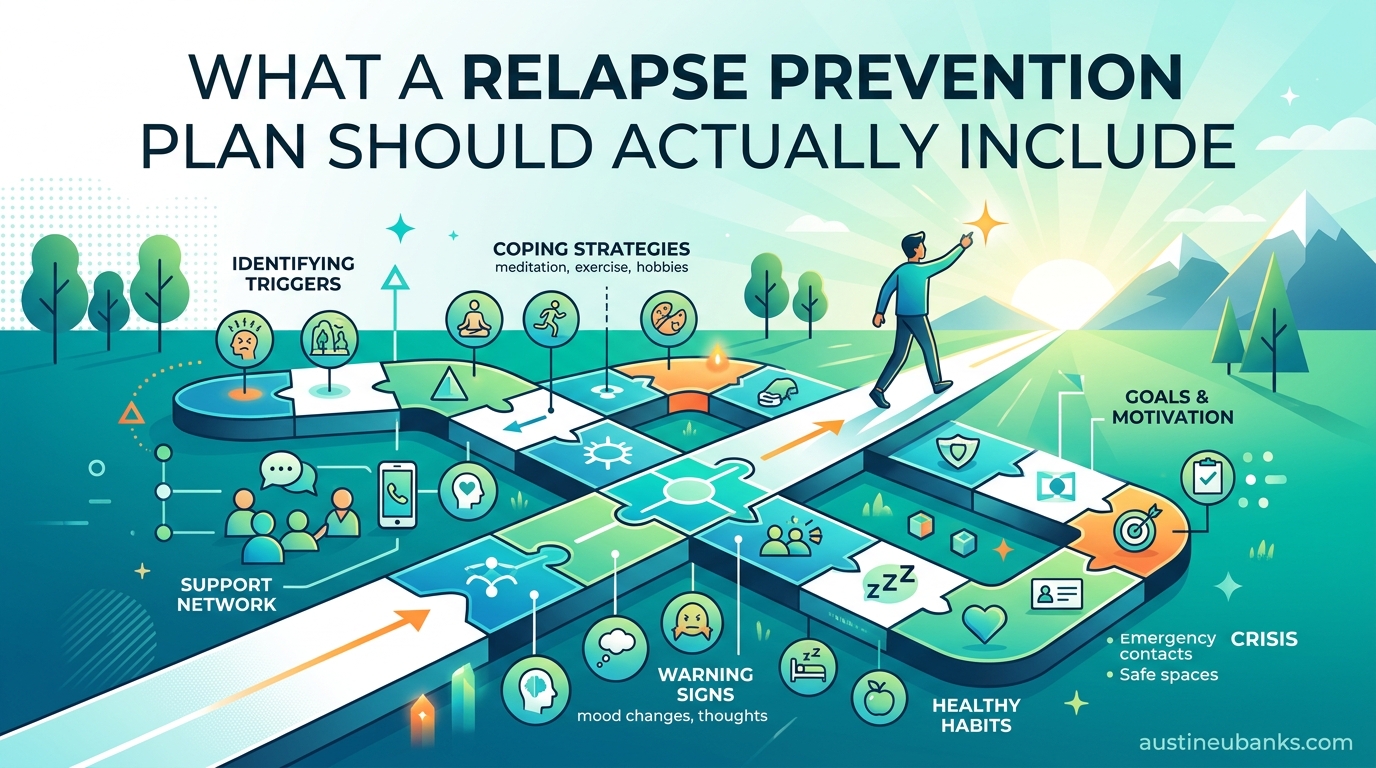
A relapse prevention plan is more than a list of good intentions. It is a structured document with specific sections, each serving a distinct purpose. Here is what your plan should actually include.
1. Your Personal Trigger List
This is a written inventory of every person, place, emotion, situation, and time of day that increases your urge to use. Be specific. “Stress” is too vague. “Stress from work deadlines on Monday mornings” is a trigger you can plan around. Your trigger list should be living document that you update as you learn more about yourself in recovery.
2. Early Warning Signs Checklist
List the emotional and mental signs that precede your cravings. Draw from the three stages of relapse above. Examples might include: skipping meetings, staying up too late, arguing with family, romanticizing past use, or isolating in your room. Review this checklist weekly. If you notice two or more warning signs, it is time to activate the next section of your plan.
3. Coping Strategies Toolbox
This section lists specific actions you will take when a craving hits. The more concrete, the better. “Take a walk” is okay. “Walk the 2-mile loop around the park while listening to my recovery playlist” is better. Include multiple strategies because what works on Tuesday might not work on Friday. We will cover specific techniques like the 3-3-3 rule and the 4 D’s later in this guide.
4. Emergency Contact List
Write down the names and phone numbers of at least three people you can call at any time. Include your sponsor, a close friend in recovery, a family member, and a crisis line. Program these numbers into your phone under a label like “Call First” so they are easy to find when your mind is racing. Do not rely on memory during a crisis.
5. Daily Recovery Routine
Structure is one of the strongest predictors of sustained sobriety. Your plan should outline a daily routine that includes recovery-oriented activities: morning reflection or meditation, attending a meeting or checking in with your support network, exercise, journaling, and an evening review. Boredom and unstructured time are major relapse triggers, so fill your schedule intentionally.
6. What to Do After a Lapse
This section is your safety net. Write out the exact steps you will take if you slip: call your sponsor within one hour, get to a meeting within 24 hours, contact your therapist, remove yourself from the triggering environment, and recommit to your plan. Having this written in advance removes the burden of decision-making when your judgment is clouded.
How to Identify Your Personal Triggers
Triggers are the cues — internal or external — that activate cravings and push you toward relapse. No two people have identical trigger profiles, which is why generic advice only goes so far. You need to map your own triggers with honesty and specificity. Your relapse prevention plan depends on this step.
Triggers generally fall into two categories: internal and external.
Internal triggers are emotions, thoughts, and physical sensations that precede cravings. Common ones include anger, loneliness, boredom, anxiety, sadness, excitement, fatigue, and even happiness. Many people are surprised to learn that positive emotions can be triggers — celebrations and achievements are common relapse scenarios. Physical sensations like pain, hunger, or exhaustion can also trigger the desire to use.
External triggers are people, places, things, and situations associated with past use. This includes specific neighborhoods, bars, certain friends, paydays, holidays, family gatherings, the time of day you used to use, and even sensory cues like certain smells or songs. Pay attention to what your body does when you encounter these cues. A knot in your stomach, a sudden change in mood, or an unexplained urge are all data points.
One effective exercise is trigger mapping. Take a piece of paper and write “My Triggers” in the center. Draw branches for internal and external triggers. Under each branch, list specific examples from your life. Rate each trigger as high, medium, or low risk. This visual map becomes the foundation of your relapse prevention plan and reveals patterns you might not have noticed.
Pay special attention to high-risk situations. These are scenarios where multiple triggers converge — for example, attending a wedding where alcohol is served, you feel anxious, and an old using friend is present. Your plan should include specific strategies for each high-risk situation, including whether you attend at all. Sometimes the smartest move is to avoid the situation entirely until your recovery is strong enough to handle it.
Coping Strategies for Cravings
Cravings are intense, but they are also temporary. Research shows that most cravings peak within 10 to 15 minutes and then subside. The goal of coping strategies is to get through that window without using. Your relapse prevention plan should include several techniques, because different strategies work for different situations.
The 3-3-3 Rule for Anxiety and Cravings
The 3-3-3 rule is a grounding technique borrowed from anxiety management that works exceptionally well for cravings. It forces your brain out of the craving spiral and back into the present moment.
Here is how it works. Name three things you can see. Look around and identify three specific objects — a coffee cup, a tree outside the window, a book on the shelf. Name three sounds you can hear. Focus on the hum of the refrigerator, traffic in the distance, your own breathing. Move three parts of your body. Roll your shoulders, wiggle your toes, clench and release your fists.
This exercise works because cravings pull your mind into an imagined future (what it would feel like to use) or an imagined past (how good it used to feel). Grounding snaps you back to the present, where the craving is just a sensation — uncomfortable, but not dangerous. Practice this technique when you are calm so it becomes automatic when you are not.
The 4 D’s of Relapse Prevention
The 4 D’s are a simple mnemonic that gives you four quick actions when a craving hits.
Delay. Wait at least 15 minutes before taking any action. Cravings are waves — they rise, peak, and fall. Simply waiting out the peak reduces the craving’s intensity.
Distance. Physically remove yourself from the trigger. If you are in a bar, leave. If you are home alone, go for a walk. Changing your environment disrupts the craving cycle.
Distract. Do something that requires your full attention. Call a friend, exercise, cook a meal, play a video game, or work on a project. The craving cannot hold your attention if something else has it.
Deep breathing. Slow, deep breaths activate your parasympathetic nervous system, which counteracts the fight-or-flight response that cravings trigger. Breathe in for four counts, hold for four, exhale for four. Repeat until the wave passes.
The 5 D’s Expanded
Some programs add a fifth D to the list: Discuss. Talk to someone about what you are experiencing. Call your sponsor, text a friend in recovery, or speak up at a meeting. Saying the craving out loud reduces its power. What felt overwhelming in your head often feels manageable once spoken.
Urge Surfing
Urge surfing is a technique developed by Dr. Alan Marlatt. Instead of fighting the craving, you observe it. Imagine the craving as an ocean wave. You are a surfer riding on top of it, watching it rise and fall without being pulled under. Notice where you feel the craving in your body. Notice the thoughts that accompany it. Do not judge them. Do not act on them. Just watch them pass.
This technique is counterintuitive because most recovery advice tells you to fight cravings. But fighting a craving can actually intensify it — the mental battle exhausts you and the craving becomes the center of your attention. Urge surfing works because it removes the struggle. The craving is just another experience, and like all experiences, it is temporary.
Cognitive Behavioral Techniques
Cognitive behavioral therapy (CBT) provides several tools worth including in your relapse prevention plan. One is “playing the tape forward.” When you romanticize using, force yourself to think through what happens next — not just the first moment, but the hours, days, and weeks that follow. Where does one drink or one hit lead?
Another CBT technique is cognitive restructuring. When you catch yourself thinking “I deserve this” or “Just one won’t hurt,” challenge that thought. Ask yourself: Is this thought accurate? What evidence supports it? What evidence contradicts it? What would I tell a friend who had this thought? These questions help you see the distortion in addictive thinking.
Building Your Support Network
Recovery is not a solo endeavor. The people who maintain long-term sobriety almost universally have a strong support network. In forum discussions we reviewed, one theme came up again and again: isolation is the enemy of recovery. People who let themselves become disconnected from their support systems are far more vulnerable to relapse.
Your support network should include several layers. Here is what to include in your relapse prevention plan.
A sponsor or recovery mentor. This is someone further along in recovery who can offer guidance, hold you accountable, and be available when cravings hit. In 12-step programs, your sponsor is a lifeline. In non-12-step approaches like SMART Recovery, a mentor or trusted group member can serve a similar role.
A support group. Regular meeting attendance — whether AA, NA, SMART Recovery, Refuge Recovery, or another program — provides structure, accountability, and a sense of belonging. The specific program matters less than the consistency of attendance. Research shows that people who attend meetings regularly have significantly better outcomes than those who go it alone.
A therapist or counselor. A licensed therapist who specializes in addiction can help you work through underlying issues like trauma, depression, anxiety, or grief that may be driving your substance use. Cognitive behavioral therapy in particular has strong evidence supporting its effectiveness in relapse prevention.
Sober friends. You need people in your life who do not use substances and who support your recovery. Building this network takes time, especially if your previous social circle was built around using. Be patient. Recovery communities, hobby groups, fitness classes, and volunteer organizations are all places to meet people who share your values.
Family members with clear boundaries. Family can be a tremendous source of support, but relationships may need recalibration in early recovery. Your plan should address how you handle family gatherings, what you share about your recovery, and what boundaries you need to maintain. Some family members may be supportive; others may be triggers. Knowing the difference matters.
Self-Care Strategies for Long-Term Sobriety
Self-care is not a luxury in recovery. It is a clinical intervention. The HALT acronym — never let yourself get too Hungry, Angry, Lonely, or Tired — captures the essence of why self-care prevents relapse. When your basic needs go unmet, your brain starts looking for quick fixes, and substances are the quickest fix it knows.
Sleep
Poor sleep is one of the most common relapse triggers. Sleep deprivation impairs decision-making, increases emotional reactivity, and weakens your ability to resist cravings. Aim for seven to nine hours per night. If sleep problems persist beyond the early recovery period, talk to your doctor — there are non-addictive interventions that can help.
Nutrition and the Dopamine Reset
Substance use disrupts your brain’s dopamine system, and recovery involves allowing it to reset. While individual timelines vary, research suggests that dopamine receptors begin to normalize within 90 days of abstinence for most people. During this period, nutrition plays a key role.
Eat regular meals with adequate protein, healthy fats, and complex carbohydrates. Avoid the trap of replacing one addiction with another — sugar addiction is common in early recovery and can cause mood swings that mimic cravings. Stay hydrated. Consider working with a nutritionist who understands recovery if your eating habits need a reset.
Exercise
Exercise is one of the most effective natural dopamine boosters available. It reduces stress, improves sleep, increases self-esteem, and provides a healthy outlet for the restlessness that often accompanies early sobriety. You do not need to run marathons. Even 30 minutes of moderate activity — walking, swimming, cycling, weight training — five times a week makes a measurable difference.
Exercise also provides structure, which we have already identified as a key relapse prevention factor. A morning run or an evening gym session anchors your day and fills time that might otherwise be unstructured and risky.
Mind-Body Relaxation
Stress is a primary relapse trigger, and chronic stress wears down your recovery defenses. Mind-body techniques like meditation, progressive muscle relaxation, yoga, and deep breathing exercises have strong research support for reducing relapse risk.
Start small. Five minutes of daily meditation is more valuable than an occasional hour-long session. Apps like Headspace, Calm, and Insight Timer offer guided meditations specifically designed for recovery. The goal is not to eliminate stress entirely — that is impossible. The goal is to build a consistent practice that helps you respond to stress rather than react to it.
Shame, Stigma, and What to Do After a Lapse
Shame is one of the most destructive forces in recovery. It is the voice that says “I am a failure” after a slip. It is the feeling that keeps people from going back to meetings. It is the reason many people hide their struggles until it is too late. If your relapse prevention plan does not address shame, it is incomplete.
In the recovery forums we reviewed, this pain point surfaced repeatedly. People described feeling like failures after a relapse. They felt ashamed to face their sponsors, their families, and their support groups. Some stopped attending meetings entirely. The shame became a bigger obstacle than the substance use itself.
Here is what the research tells us about shame and relapse. Shame and guilt are not the same thing. Guilt says “I did something bad.” Shame says “I am bad.” Guilt can motivate change. Shame drives people deeper into addiction. The abstinence violation effect we discussed earlier is fueled by shame — the belief that a single lapse proves you are fundamentally broken.
The antidote to shame is self-compassion, connection, and reframing. Here is how to put that into practice.
Reframe relapse as part of the journey. NIDA defines addiction as a chronic, relapsing disease. The word “relapsing” is right there in the clinical definition. A lapse does not mean your recovery has failed. It means you are dealing with a chronic condition that requires ongoing management. People with asthma sometimes have attacks. That does not mean their treatment failed — it means they need to adjust their approach.
Get back to connection immediately. The worst thing you can do after a lapse is isolate. The shame will tell you to hide. Do the opposite. Call your sponsor. Go to a meeting. Tell someone what happened. The moment you speak the truth, shame begins to lose its grip.
Review and adjust your plan. A lapse is data. It tells you something about your triggers, your coping strategies, or your support system that you did not know before. Use it. What was happening in the days and weeks before the lapse? Which warning signs did you miss? What coping strategy failed? What needs to change in your plan?
Forgive yourself. This is easier said than done, but it is essential. Beating yourself up does not prevent future relapses — it increases the risk. Treat yourself with the same compassion you would offer a friend in the same situation. Then recommit to your recovery and move forward.
How to Create and Update Your Relapse Prevention Plan
Creating a relapse prevention plan is a process, not a one-time event. Here is a step-by-step approach.
Step 1: Set aside focused time. Creating a thorough plan takes at least an hour. Find a quiet space where you will not be interrupted. Have a notebook or a document ready.
Step 2: Work through each section. Start with your trigger list, then your warning signs checklist, then your coping strategies, then your emergency contacts, then your daily routine, and finally your post-lapse action plan. Be honest and specific at every step.
Step 3: Review it with someone. Take your draft to your sponsor, therapist, or counselor. They will see blind spots you missed and suggest strategies based on their experience. A plan reviewed by a professional or mentor is stronger than one created alone.
Step 4: Keep it accessible. Your plan should be easy to access when you need it. Keep a copy on your phone, a printed copy at home, and share it with at least one person in your support network.
Step 5: Review and update regularly. Your triggers will change as recovery progresses. Your coping strategies will evolve. Set a schedule to review your plan — monthly in early recovery, quarterly once you are stable. Update it after any major life change, after a lapse, or whenever you notice new patterns.
Many treatment centers provide relapse prevention plan templates. Free worksheets are also available through SAMHSA and various recovery organizations. Templates are helpful starting points, but the value comes from personalization. A generic plan is better than no plan. A personalized plan is far better than a generic one.
Relapse Prevention Models: Gorski-Cenaps and Marlatt
Two clinical models have shaped how professionals understand and treat relapse. Understanding the basics of each can help you build a more informed plan.
The Marlatt Model
Dr. Alan Marlatt’s model, developed in the 1980s, frames relapse as a process influenced by both distal (background) and proximal (immediate) factors. Distal factors include your overall stress level, lifestyle balance, and the strength of your coping skills. Proximal factors are the specific high-risk situations you encounter day to day.
Marlatt also introduced the concept of the abstinence violation effect, which we have discussed. He emphasized that a single lapse does not inevitably lead to relapse. What matters is the person’s interpretation of the lapse. If they view it as a catastrophic failure, they are likely to continue using. If they view it as a temporary setback, they are more likely to recommit to recovery.
The Gorski-Cenaps Model
Terence Gorski’s CENAPS model focuses on identifying predictable relapse warning signs. Gorski identified that relapse follows a progression — what he called “relapse progression” — with specific, identifiable stages. His approach emphasizes creating a detailed relapse prevention plan that accounts for each person’s unique pattern of warning signs.
The Gorski model also stresses the importance of recovery maintenance. Rather than focusing solely on avoiding relapse, it emphasizes building a positive life in recovery. This includes developing meaningful relationships, pursuing goals, managing stress, and finding purpose. The idea is that a fulfilling sober life is the best protection against relapse.
Both models inform modern relapse prevention planning. Your plan does not need to explicitly follow one model or the other. But understanding that relapse is a predictable, identifiable process — not a random event — gives you a powerful advantage. You can learn your own warning signs, interrupt the progression, and stay sober one day at a time.
FAQs
What are the 5 rules of relapse prevention?
The 5 rules of relapse prevention are: (1) Change your life to make sobriety easier than using. (2) Be completely honest with yourself and others. (3) Ask for help when you need it. (4) Practice self-care including sleep, nutrition, and exercise. (5) Do not bend the rules or abandon your plan after a slip. These rules are based on NIH research and are strongly associated with long-term recovery success.
What is the 3 3 3 rule for addiction?
The 3-3-3 rule is a grounding technique for managing cravings and anxiety. You name three things you can see, identify three sounds you can hear, and move three parts of your body. This exercise forces your brain out of the craving spiral and back into the present moment, where the craving is just a temporary sensation that will pass.
What are the 5 D’s of relapse prevention?
The 5 D’s of relapse prevention are Delay (wait at least 15 minutes for the craving to pass), Distance (remove yourself from the trigger), Distract (do something that requires your full attention), Deep breathing (slow breaths to calm your nervous system), and Discuss (talk to someone about what you are experiencing).
What are the 4 D’s of relapse prevention?
The 4 D’s are Delay, Distance, Distract, and Deep breathing. Some programs add a fifth D — Discuss — to create the 5 D’s. The 4 D’s give you four quick, memorable actions to take the moment a craving hits, helping you ride out the craving wave without using.
What is the shame of relapse?
The shame of relapse is the deep feeling of being fundamentally flawed or broken after a slip. Unlike guilt (which says I did something bad), shame says I am bad. Shame drives isolation, which increases relapse risk. The antidote is connection — talking to your sponsor, attending a meeting, and reframing the lapse as data rather than proof of failure.
How long does it take to reset dopamine?
Dopamine receptors begin to normalize within approximately 90 days of abstinence for most people, though individual timelines vary based on the substance, duration of use, and individual factors. During this period, self-care through nutrition, exercise, and adequate sleep supports the brain’s natural recovery process.
Conclusion
A relapse prevention plan is one of the most powerful tools you have in recovery. It is not a document you write once and forget. It is a living strategy that grows and changes as you do. The best plans are honest, specific, and reviewed regularly with input from the people who support your recovery.
Remember the core elements. Know your three stages of relapse — emotional, mental, and physical — and catch the warning signs early. Follow the five rules: change your life, be honest, ask for help, practice self-care, and do not bend the rules. Keep your coping strategies toolbox stocked with techniques like the 3-3-3 rule, the 4 D’s, and urge surfing. Build a support network before you need it. And if you lapse, treat it as data, not as a verdict on your worth.
Understanding what a relapse prevention plan should actually include is the first step. Building one is the second. Using it — every day, especially on the hard days — is what makes the difference. Start with a notebook and an hour of focused time. Write your trigger list. Draft your coping strategies. Fill in your emergency contacts. Then share it with someone you trust. Your future self will thank you for the preparation you do today.
If you are in crisis or considering using, call the SAMHSA National Helpline at 1-800-662-4357. It is free, confidential, and available 24 hours a day, 7 days a week. You do not have to face this alone.