
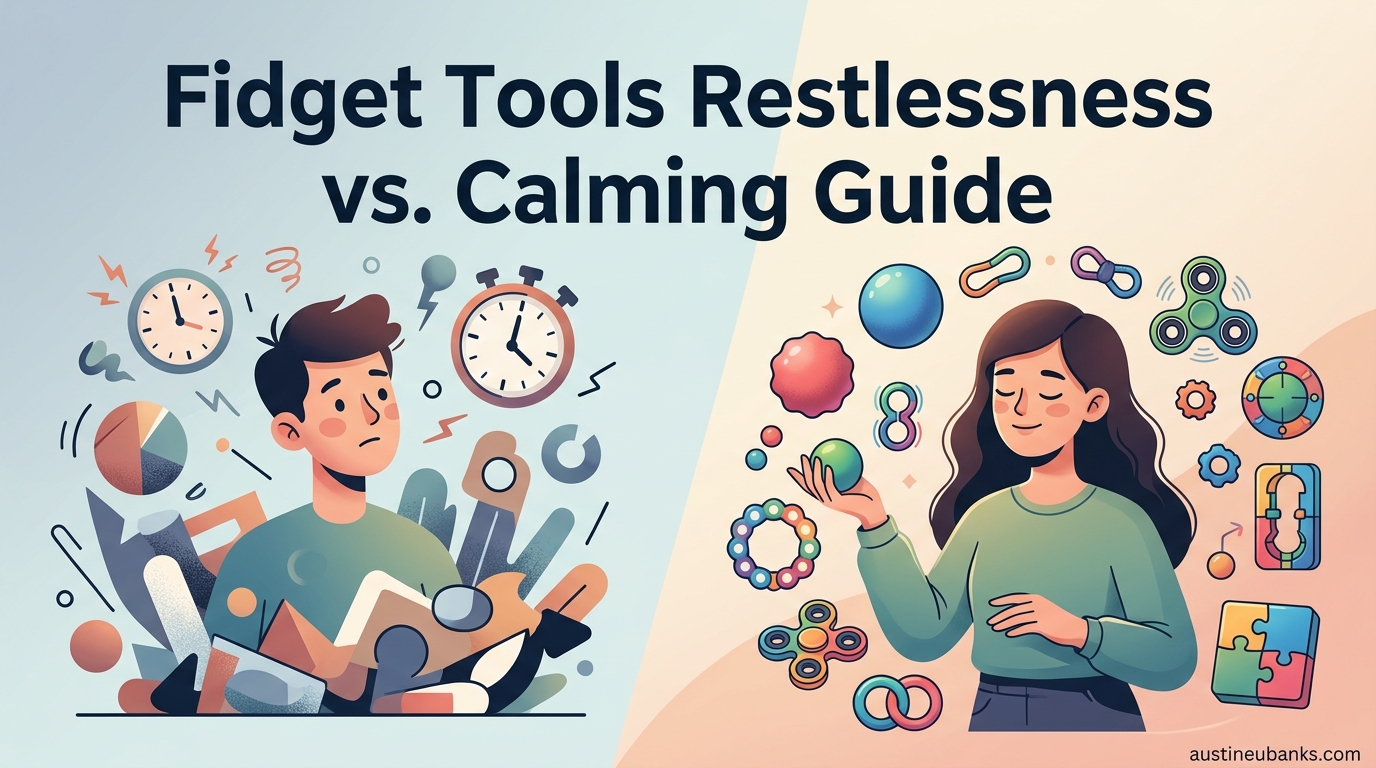
Not all fidget tools do the same thing. If you have ever grabbed a fidget spinner hoping to calm down and instead felt more wound up, you already know this. The tool you choose matters more than most people realize, and understanding which fidget tools are best for restlessness versus calming can completely change how effective they are for you.
I spent months comparing fidget tools across different nervous system states, talking with occupational therapists, and digging through forum discussions from adults with ADHD and anxiety. What I found is that almost nobody explains the difference between a fidget that burns restless energy and one that soothes an overloaded nervous system. That gap leaves people frustrated, thinking fidgets do not work when really they just picked the wrong type.
This guide breaks it all down. You will learn the neuroscience behind why fidgeting works, which specific tools serve restlessness versus calming, and a step-by-step framework for choosing the right fidget for your current state. Whether you are dealing with hyperactive energy that will not quit, anxiety that makes your chest tight, or both at different times of day, the right tool exists for each moment.
Do fidget toys help with restlessness? Yes. Fidget toys help with restlessness by providing a sensory outlet that channels excess physical energy into controlled, repetitive movement. This allows the brain to redirect focus from the urge to move toward the task at hand, reducing distracting behaviors like leg-shaking or finger-drumming while improving sustained attention.
Table of Contents
Quick Answer: Fidget Tools for Restlessness vs Calming at a Glance
The fastest way to think about this is through two categories. Restlessness needs dynamic fidgets that provide continuous motion and energy release. Calming needs static fidgets that provide deep pressure and sustained sensory input.
Best fidget tools for restlessness (dynamic, energy-burning):
- Magnetic fidgets and magnetic rings for continuous, silent motion
- Fidget spinners for fast kinetic energy release
- Tangle toys for endless manipulation and hand movement
- Wacky tracks for snapping, bending, and patterning
- Infinity cubes for folding, flipping, and rhythmic action
- Fidget cubes with multiple interactive sides
- Roller fidgets for smooth, repetitive finger motion
Best fidget tools for calming (static, pressure-based):
- Therapy putty for sustained resistance and deep pressure
- Slow-rise squishy toys for rhythmic squeezing
- Gel-filled stress balls for grounding tactile input
- Squishy animal fidgets for soft, comforting texture
- Mochi stress balls for gentle squeeze-and-release cycles
- Sequin fidgets for soothing tactile repetition
- Spikey bracelets for discrete sensory grounding
One Reddit user in r/ADHD put it perfectly: “I need different fidgets for different states. A spinner when I am restless and bouncing off the walls, and therapy putty when I am anxious and need to ground myself. Using the wrong one makes things worse.”
The Science Behind Why Fidgeting Works
Fidgeting is not a bad habit. It is your nervous system trying to regulate itself. When you understand the sensory systems involved, choosing between fidget tools for restlessness versus calming becomes much easier.
Your brain constantly processes sensory input from your environment and your body. When that input is too low, your brain seeks stimulation through movement, which we experience as restlessness. When input is too high or overwhelming, your brain needs calming, grounding input to settle down. Fidget tools work by providing exactly the right type and amount of sensory input your nervous system is craving.
Research supports this. A study from the University of Central Florida found that allowing children with ADHD to fidget improved their working memory performance by 10 to 15 percent. The movement was not a distraction. It was a functional self-regulation strategy.
Proprioceptive Input: The Deep Pressure System
Proprioception is your body’s sense of where it is in space, communicated through receptors in your muscles, joints, and tendons. When you push, pull, squeeze, or apply resistance, you activate this system. Proprioceptive input is widely considered the most organizing and calming sensory input by occupational therapists.
This is why therapy putty, stress balls, and resistance-based fidgets calm anxiety so effectively. The sustained pressure tells your nervous system that you are safe and grounded. It activates the parasympathetic nervous system, which slows your heart rate and reduces cortisol production. This is the same mechanism behind weighted blankets and deep pressure therapy.
If you are seeking fidget tools for calming, prioritize proprioceptive options. Anything that requires sustained squeezing, pulling, or resistance will deliver this calming input.
Tactile Input: The Touch System
The tactile system processes touch, texture, temperature, and pressure through your skin. Tactile input can be either alerting or calming depending on the texture and intensity. Light, unpredictable touch tends to be alerting (think tickling or a bug crawling on your arm). Firm, predictable, textured touch tends to be calming.
This is why squishy toys with interesting textures, sequin fidgets you can flip back and forth, and spikey bracelets provide grounding input. The texture gives your brain something consistent to process, which helps anchor your attention when your thoughts are racing.
For restlessness, tactile input works best when combined with movement. Magnetic fidgets that click together, tangle toys you can twist, and fidget cubes with different tactile surfaces all keep your hands busy while your brain focuses on the task at hand.
Vestibular Input: The Movement System
The vestibular system, located in your inner ear, detects movement and changes in head position. It is the system most people overlook when thinking about fidget tools, but it is directly relevant to restlessness. Vestibular input comes from any movement of your head through space, including the small movements involved in using kinetic fidgets.
Fidget spinners, magnetic rings that rotate around your finger, and tools that involve visual tracking of movement all engage the vestibular system. This type of input tends to be alerting, which is why these tools are better for restlessness and energy release than for calming.
Be careful here. For someone who is already overstimulated, too much vestibular and visual input can increase arousal rather than reduce it. Multiple forum users reported that fidget spinners made their anxiety worse, not better. That is because spinners provide alerting input when the person actually needed calming input.
Dopamine, Norepinephrine, and Focus
People with ADHD typically have lower baseline levels of dopamine and norepinephrine, two neurotransmitters essential for sustained attention and focus. Fidgeting increases the release of these neurotransmitters, which helps the brain maintain alertness and engagement.
Research published in the Journal of Attention Disorders (Schecter et al., 2017) and follow-up studies (Kriescher et al., 2023; Zimmerman et al., 2024) have shown that strategic fidget use can improve attention and reduce hyperactive behavior in both children and adults.
For restlessness specifically, dynamic fidgets work because they provide the dopamine-seeking stimulation the ADHD brain craves. The continuous movement keeps dopamine flowing, which reduces the need to seek stimulation through disruptive behaviors like getting up, talking out of turn, or bouncing a leg hard enough to shake the desk.
Best Fidget Tools for Restlessness
Restlessness is your body demanding movement. The right fidget tool for restlessness provides dynamic, continuous motion that satisfies that demand without pulling your attention away from what you are doing. These are the tools that channel hyperactive energy into controlled, repetitive action.
The key principle: restlessness fidgets should move. They should spin, click, snap, bend, or roll. Static pressure is not enough when your nervous system is asking for kinetic output.
Magnetic Fidgets and Magnetic Rings
Magnetic fidgets are arguably the best restlessness tool for adults. Small magnetic pieces click together and pull apart in satisfying ways that keep your hands fully engaged. Magnetic rings take this a step further by sitting on your finger and spinning freely, which means you can fidget while typing, writing, or holding a pen.
Reddit users in r/fidgettoys and r/ADHD consistently rank magnetic fidgets as their top choice for office use. They are completely silent, look like jewelry or a ring, and provide endless combinations of clicking, stacking, and spinning motions. The continuous motion satisfies the restless brain without creating noise that bothers coworkers.
What makes magnetic fidgets especially good for restlessness is the combination of tactile input (the smooth, cool surface of the magnets) and vestibular input (the visual tracking of spinning and clicking). Your hands stay busy, your eyes have something to track, and your brain gets the stimulation it needs to stay focused.
One important note from forum discussions: magnetic fidgets work best when you have at least 5 to 10 pieces. Two or three magnets get boring quickly and do not provide enough variety to sustain engagement during long tasks.
Fidget Spinners and Kinetic Toys
Fidget spinners earned a reputation as a fad, but they serve a real purpose for restlessness. The spinning motion provides continuous visual and tactile feedback that helps channel excess energy. For people whose restlessness manifests as a need to see something move, spinners deliver exactly that.
However, spinners are polarizing. Many users report that they work great for the first few minutes and then become distracting. Others find that the visual stimulation of the spinning increases their arousal rather than settling it. This is why spinners belong in the restlessness category, not the calming category. They are alerting tools, not soothing ones.
If you want to try a spinner for restlessness, look for high-quality bearings that produce smooth, long spins. Cheap spinners that stop after three seconds are frustrating and counterproductive. The satisfying quality of the spin itself is part of what makes it effective.
Kinetic toys like magnetic orbiters (where a magnetic ball rolls around a track) provide similar benefits. The continuous motion satisfies the restless urge while requiring just enough attention to keep your hands occupied without hijacking your focus.
Tangle Toys and Wacky Tracks
Tangle toys are articulated plastic pieces that twist and curve endlessly. You can manipulate them into infinite shapes, which keeps your hands moving for as long as you need. For restless hands that need something to do during meetings, classes, or long phone calls, tangles are hard to beat.
Wacky tracks take the same concept further with snap-together plastic links that you can bend into geometric patterns. The clicking sound and tactile feedback of snapping the links adds an extra layer of sensory input that many users find satisfying for high-energy states.
Both of these tools share a key advantage for restlessness: they are infinitely variable. Unlike a spinner that does the same thing every time, tangles and wacky tracks let you create new patterns and shapes. That novelty keeps the brain engaged, which is especially helpful for ADHD brains that crave new stimulation.
For classroom use, tangle toys are popular because they are relatively quiet and can be used under a desk without drawing attention. Teachers who understand sensory regulation tend to be more accepting of tangles than spinners because they are less visually distracting to other students.
Infinity Cubes and Fidget Cubes
Infinity cubes fold open and closed in a continuous loop. The satisfying fold-and-flip motion keeps restless hands busy with rhythmic, repetitive action. Many users describe infinity cubes as meditative once they get into the rhythm of folding.
Fidget cubes, the small cube-shaped toys with a different tactile feature on each side (a switch, buttons, a joystick, a dial, a rolling ball, and a textured indentation), offer variety that prevents boredom. Having six different fidget options in one tool means you can switch activities whenever one gets stale.
For restlessness specifically, the switch and clicking buttons on a fidget cube provide the rapid, repetitive action that restless hands crave. The downside is that these clicking sounds can be disruptive in quiet environments. Look for silent or low-noise fidget cubes if you plan to use one in an office or classroom.
The infinity cube is better for sustained restlessness because the folding motion never gets old. The fidget cube is better for shorter bursts of restlessness where variety matters more than sustained engagement.
Best Fidget Tools for Calming Anxiety and Stress
Calming requires a different approach entirely. When you are anxious, stressed, or overstimulated, your nervous system is in overdrive. You do not need more stimulation. You need grounding, soothing input that tells your brain it is safe to relax. The best fidget tools for calming provide static, pressure-based sensory input that activates the parasympathetic nervous system.
The key principle: calming fidgets should resist. They should require sustained squeezing, pulling, or pressing. Fast motion and visual stimulation are counterproductive here.
Therapy Putty and Thinking Putty
Therapy putty is the gold standard for calming fidgets. It comes in different resistance levels, from extra-soft to extra-firm, so you can match the resistance to exactly what your nervous system needs. Squeezing, stretching, and kneading putty provides sustained proprioceptive input that grounds you and reduces anxiety.
Occupational therapists recommend therapy putty more than almost any other fidget tool. It is effective, durable, affordable, and versatile. You can use it during a panic attack to ground yourself, during a stressful meeting to keep your hands occupied, or before bed to wind down.
Thinking putty (sometimes called crazy Aaron’s putty) adds visual interest with color-shifting, magnetic, or glow-in-the-dark properties. For some users, the visual element enhances the calming effect. For others, it is overstimulating. Pay attention to your own response.
Forum users who have replaced nail-biting, skin-picking, and pen-clicking habits frequently cite therapy putty as the tool that finally worked. The resistance gives your hands something meaningful to do, which redirects the nervous energy that drives those habits.
Slow-Rise Squishy Toys and Gel Balls
Slow-rise squishies are soft foam toys that slowly return to their original shape after you squeeze them. The slow rise is meditative and rhythmic, which creates a calming effect similar to watching a lava lamp or breathing exercises. Many users describe the slow rise as inherently soothing.
Gel-filled stress balls offer a different but complementary experience. The gel inside provides a unique tactile sensation that is both firm and yielding. Squeezing a gel ball engages your hand muscles fully, which provides the proprioceptive input your nervous system needs to calm down.
Both of these tools work because they combine sustained pressure (calming) with a slow, predictable rhythm (also calming). There is nothing alerting about a slow-rise squishy. It is designed entirely around the principle of gentle, repeated sensory input that settles the nervous system.
For anxiety specifically, slow-rise toys are effective because they encourage slower breathing. The natural tendency is to match your breathing to the rise of the toy, which unconsciously slows your respiratory rate and activates the calming branch of your nervous system.
Stress Balls and Deep Pressure Fidgets
Classic stress balls remain popular for good reason. They provide straightforward, reliable proprioceptive input through squeezing. The firm resistance activates the deep pressure receptors in your hands, which sends calming signals to your brain.
Deep pressure fidgets go a step further. These include weighted lap pads with fidget attachments, compression wristbands, and spikey acupressure bracelets that provide consistent pressure on pressure points. The sustained input from these tools mimics the calming effect of a firm handshake or a hug.
For someone experiencing acute anxiety, deep pressure input is one of the fastest ways to reduce physiological symptoms. Squeezing a firm stress ball for two to three minutes can noticeably lower your heart rate and reduce the feeling of a racing chest.
The key is choosing a stress ball with the right resistance. Too soft and it provides no calming input. Too firm and it creates frustration. Medium-firm resistance works for most people, but experiment to find your preference.
Pop-It Toys: Calming or Distracting?
Pop-it toys (silicone sheets with bubbles you press in and pop out) are polarizing in the fidget community. Some users find the rhythmic popping genuinely calming. The repetitive motion and soft popping sound create a meditative quality that helps settle anxious thoughts.
Others find pop-its juvenile, too loud for quiet environments, or simply not enough sensory input to be effective. The popping sound can bother coworkers and classmates, and the repetitive nature can become a distraction rather than a regulation tool.
The truth is that pop-its fall somewhere between restlessness and calming tools. They provide moderate tactile input and some rhythmic motion, but they lack the deep pressure that makes therapy putty and stress balls so effective for anxiety. If you try a pop-it and find it calming, great. If it feels insufficient or distracting, switch to a pressure-based tool.
For best results with pop-its, choose silicone versions with a satisfying resistance. Cheap, thin pop-its that pop too easily do not provide enough sensory feedback to be effective regulation tools.
Restlessness vs Calming: Key Differences Explained
This is where most fidget guides fail. They list tools without explaining when to use each one. Understanding the difference between fidget tools for restlessness versus calming is the single most important factor in whether your fidget actually helps or makes things worse.
The core distinction comes down to dynamic versus static input. Restlessness needs dynamic, high-motion input. Calming needs static, high-pressure input. Mixing these up is the most common reason people conclude that fidgets do not work.
Dynamic vs Static Fidgets: The Core Classification
Dynamic fidgets move continuously. They spin, click, flip, bend, or roll. They provide vestibular and fast-paced tactile input that stimulates the brain and channels restless energy. Use dynamic fidgets when you feel physically restless, hyperactive, or unable to sit still.
Static fidgets resist movement. They require sustained squeezing, pressing, or kneading. They provide proprioceptive and slow tactile input that calms the nervous system and grounds an anxious mind. Use static fidgets when you feel anxious, stressed, overwhelmed, or overstimulated.
Here is a quick comparison of how these two categories differ:
Dynamic fidgets (for restlessness): High motion, alerting input, energy release, continuous action, often involve visual tracking, best for hyperactivity and excess energy, dopamine-stimulating.
Static fidgets (for calming): Low motion, soothing input, nervous system grounding, sustained pressure, minimal visual stimulation, best for anxiety and stress, parasympathetic activation.
A simple test: if your fidget is moving fast and you are watching it, it is a dynamic tool for restlessness. If your fidget is staying in your hand and you are squeezing it slowly, it is a static tool for calming.
Tools That Bridge Restlessness and Calming
Some fidget tools can serve both purposes depending on how you use them. This is valuable because many people experience both restlessness and anxiety, sometimes simultaneously or in rapid succession.
Therapy putty bridges both categories. Squeeze it rapidly and aggressively to channel restless energy. Knead it slowly and steadily to calm anxiety. The same tool serves completely different nervous system needs depending on the pace and intensity of use.
Magnetic fidgets also bridge the gap. Fast clicking and stacking satisfies restlessness. Slow, methodical arrangement and gentle pulling provides a grounding, meditative quality that can calm racing thoughts.
Fidget rings (spinner rings that rotate around a stationary band) work for both states. Spin them fast for restless energy. Rotate them slowly and feel the smooth motion for calming. They are also one of the most discreet fidget options available, which makes them ideal for workplace use.
Having at least one bridging tool in your collection gives you flexibility when you are not sure which state you are in. Many experienced fidget users keep a bridging tool as their everyday carry specifically for this reason.
When Restlessness Shifts to Calming: Sequential Fidget Use
One advanced strategy that no competitor discusses is sequential fidget use. Restlessness and anxiety are often linked. You might start the day feeling restless and hyperactive, then transition into anxiety as stress builds. Your fidget needs change with your nervous system state.
The pattern many users describe works like this: Start with a dynamic fidget (like magnetic rings or a tangle toy) to burn off excess physical energy during the restless phase. Once your body settles but your mind is still racing, transition to a static fidget (like therapy putty or a stress ball) to ground your nervous system and calm your thoughts.
This sequential approach mirrors how occupational therapists build sensory diets. A sensory diet is a personalized plan of sensory activities throughout the day. The idea is to provide alerting input when the nervous system needs it and calming input when it needs that instead.
If you only own one fidget tool, consider investing in a bridging tool first. If you can own two, pair one dynamic tool (for restlessness) with one static tool (for calming). This combination covers the vast majority of nervous system states you will encounter.
How to Choose the Right Fidget for Your Needs
Choosing the right fidget tool does not have to be complicated. The following framework walks you through the decision step by step, considering your current state, your environment, and your personal sensory preferences.
Step-by-Step Sensory Self-Assessment
Step 1: Identify your current state. Are you physically restless, mentally anxious, or both? Restlessness feels like you cannot sit still, your legs bounce, and your hands need something to do. Anxiety feels like your thoughts are racing, your chest is tight, and you cannot focus on one thing.
Step 2: Match your state to a fidget category. Restlessness points to dynamic fidgets (spinners, magnets, tangles). Anxiety points to static fidgets (putty, stress balls, squishies). Both states point to a bridging tool (therapy putty, magnetic fidgets, or fidget rings).
Step 3: Consider your sensory preferences. Do you prefer texture, resistance, sound, or visual stimulation? Texture seekers should look at squishies and textured fidgets. Resistance seekers should choose putty and stress balls. Sound seekers (in appropriate settings) may prefer wacky tracks or click cubes. Visual seekers should consider spinners and magnetic orbiters.
Step 4: Test before committing. Buy two or three different types and see which one your hands naturally reach for. The best fidget tool is the one you actually use. If you have to remind yourself to use it, it is not the right tool for you.
Best Fidgets by Setting: Classroom, Office, Home
Your environment constrains your fidget choice more than any other factor. A tool that works perfectly at home might be a disaster in a classroom or office. Here is how to match your fidget to your setting.
For the classroom: Silent operation is non-negotiable. Tangle toys, therapy putty, and fidget rings work well because they make no noise and can be used under a desk. Avoid spinners, clicking cubes, and pop-its unless you have explicit teacher permission. If you are a parent introducing a fidget tool to your child’s classroom, talk to the teacher first and frame it as a regulation tool, not a toy.
For the office: Discretion matters as much as silence. Magnetic rings, fidget rings, and therapy putty all look professional and make no noise. Avoid anything that draws visual attention to you during meetings. A stress ball kept in your desk drawer is a good backup for high-stress moments.
For home: Anything goes. This is where you can use spinners, pop-its, wacky tracks, and any other tool without worrying about noise or appearance. Keep a small collection at your desk or workspace so you can switch tools as your needs change throughout the day.
For travel: Compact and durable is key. Magnetic fidgets, fidget rings, and small tangle toys travel well. Avoid putty (it can get messy in a bag) and large or fragile items.
Workplace Fidget Etiquette for Adults
Many adults feel self-conscious about using fidget tools at work. This is a real pain point that comes up constantly in forum discussions. The good news is that workplace culture has shifted significantly, and most people are more understanding than you might expect.
Here are practical tips for using fidgets professionally. Choose tools that look like office supplies or jewelry (fidget rings, magnetic rings that resemble regular rings, and stress balls that look like desk accessories). Keep your fidget below desk level during meetings. If someone asks about it, explain briefly that it helps you focus. Most people will nod and move on.
Avoid anything that makes noise during calls, video meetings, or quiet work periods. If you work in an open office, be especially mindful of your neighbors. A clicking fidget cube that you cannot hear through your own headphones might be clearly audible to the person sitting next to you.
Remote workers have more freedom but should still be mindful during video calls. A fidget that you use off-camera is invisible to your colleagues. Just be careful not to look distracted or disengaged while using it.
One final point: you do not owe anyone an explanation for using a fidget tool. If it helps you focus, manage anxiety, or regulate your nervous system, that is a legitimate workplace accommodation. Frame it confidently as a productivity tool and most people will respect it without question.
Do fidget toys help with restlessness?
Yes. Fidget toys help with restlessness by providing a controlled sensory outlet that channels excess physical energy into repetitive hand movement. Dynamic fidgets like spinners, magnetic fidgets, and tangle toys are most effective because they provide continuous motion that satisfies the brain’s demand for stimulation while freeing up mental resources for focus.
What is the most stress relieving toy?
The most stress-relieving fidget toys are slow-rise squeeze toys, therapy putty, and firm stress balls. These provide sustained deep pressure input that activates the proprioceptive system, which has a calming effect on the nervous system and can lower cortisol levels within minutes of use.
What is the best fidget toy for stress?
The best fidget toys for stress are slow-rise squishies, therapy putty, silent magnetic fidgets, and gel-filled stress balls. Choose silent options like magnetic fidgets for the workplace, and softer tools like putty or stress balls for home use where noise is not a concern.
What is the best device for anxiety?
The best fidget devices for anxiety are tools that provide deep pressure input through squeezing or resistance, such as therapy putty, slow-rise squishy toys, and medium-firm stress balls. These activate the proprioceptive system, which triggers calming neurochemicals and helps reduce the physical symptoms of anxiety within minutes.
Can fidget tools replace medication for ADHD?
No. Fidget tools are a supportive strategy that can complement ADHD treatment, but they cannot replace prescribed medication or therapy. Research shows fidgeting can improve working memory by 10 to 15 percent in people with ADHD, which is meaningful but not a substitute for medical treatment. Always consult your doctor about your full treatment plan.
Are fidget spinners effective or just a fad?
Fidget spinners can be effective for restlessness because the spinning motion provides continuous visual and tactile stimulation that channels excess energy. However, they are alerting tools, not calming tools. Using a spinner when you need calming input can actually increase arousal and make anxiety worse. Spinners work for some people and not others.
Conclusion
Choosing the right fidget tools for restlessness versus calming comes down to one simple principle: match the tool to your nervous system state. Dynamic fidgets that move continuously serve restlessness by channeling excess energy. Static fidgets that resist pressure serve calming by grounding an anxious nervous system. Getting this match right is the difference between a fidget that helps and one that makes things worse.
Start with the self-assessment framework above to identify whether you need a dynamic or static tool. Invest in at least one bridging tool like therapy putty that can serve both states. And remember that your needs will change throughout the day, so having a small rotation of fidgets is normal and effective.
The right fidget tool can genuinely change how you focus, feel, and function. Now that you know which tools serve restlessness versus calming, you are equipped to choose with confidence and stop wasting money on tools that were never right for your needs in the first place.