
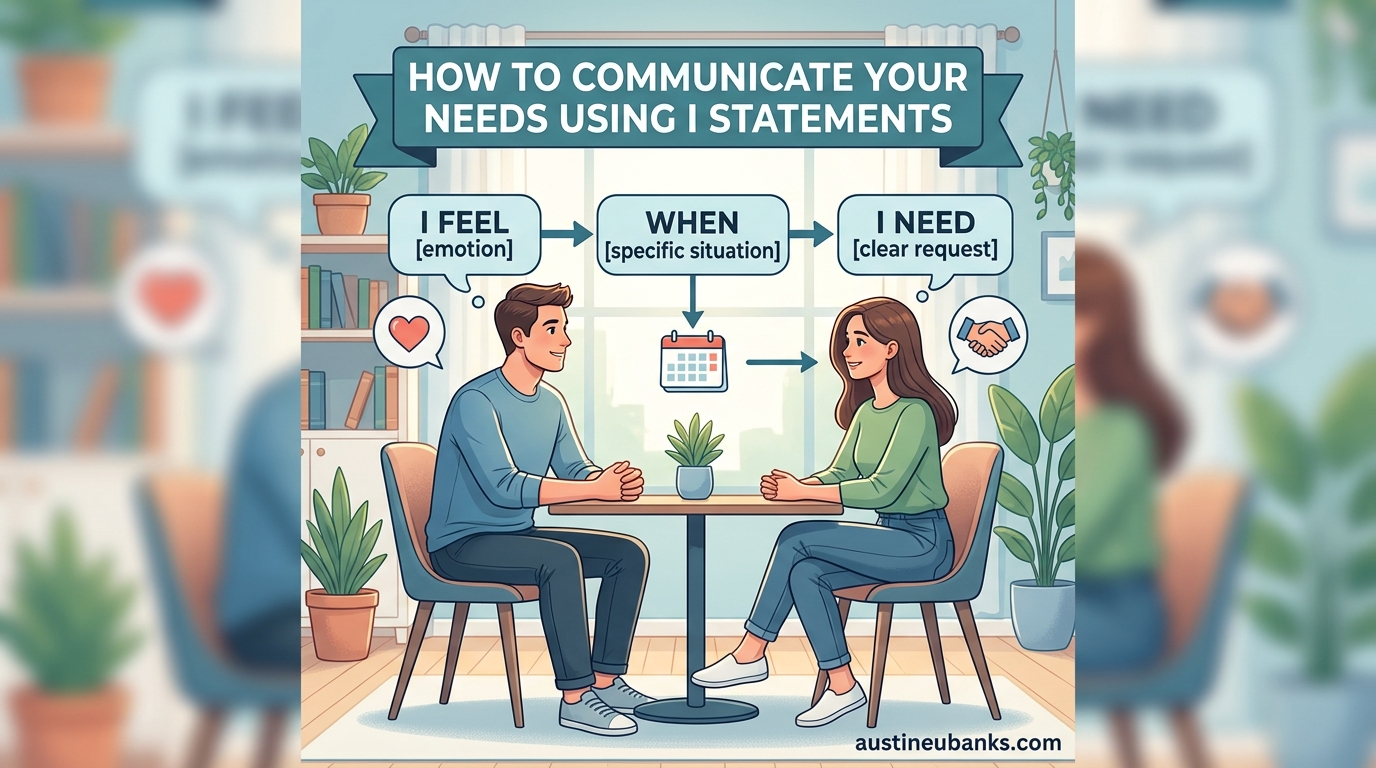
Every argument you have ever had probably started the same way. Someone said “You always” or “You never,” and within seconds the conversation turned into a defensive standoff. Learning how to communicate your needs using I statements can change that pattern almost immediately.
I have used this technique in my own relationships and watched it defuse arguments that would have spiraled for hours. An I-statement shifts the focus from blaming the other person to describing your own experience. The result is a conversation where both people actually listen instead of preparing their next attack.
In this guide, you will learn the exact formula behind I-statements, see before-and-after examples for both relationships and the workplace, discover the most common mistakes people make, and get practical tips for building the habit. By the end, you will have everything you need to start expressing your feelings without triggering defensiveness.
Table of Contents
What Is an I-Statement?
An I-statement is a communication technique that puts the focus on your own feelings and needs rather than the other person’s behavior. Instead of accusing or blaming, you describe what you are experiencing and what would help. This simple shift in framing is the core of assertive communication.
The formula is straightforward: I feel [X] when [Y]. I need [Z]. In that sentence, X is a feeling word, Y is the specific situation, and Z is a clear, positive need. We will break down each component in detail in the next section.
I-statements work because they signal safety. When you start a sentence with “You,” the other person’s brain often registers a threat and kicks into defensive mode. When you start with “I,” you are taking responsibility for your own emotional experience instead of projecting blame. Research in attachment science and conflict resolution backs this up — people are far more likely to respond with empathy when they do not feel attacked.
How to Communicate Your Needs Using I Statements: The Formula
The I-statement formula has three components, and getting each one right matters. Let me walk you through them.
Component X: The Feeling
The first part is naming your emotion. This is harder than it sounds because many people confuse feelings with thoughts. “I feel like you do not care” is not a feeling — it is a disguised accusation. Real feeling words include hurt, frustrated, overwhelmed, anxious, lonely, dismissed, and unappreciated.
A good test: if you can replace “I feel” with “I think” and the sentence still makes sense, it is a thought, not a feeling. Keep searching for the actual emotion underneath.
Component Y: The Specific Situation
The second part describes the behavior or situation that triggered the feeling. The key word here is specific. Vague statements like “when you do that” leave the other person guessing. Instead, describe the concrete action.
For example, instead of “when you ignore me,” try “when you look at your phone while I am talking.” The more precise you are, the easier it is for the other person to understand and respond.
Component Z: The Positive Need
The final component is stating what you need. This should be a positive request, not a complaint. “I need you to stop being on your phone” is a complaint disguised as a need. “I need us to have phone-free conversations at dinner” is a clear, actionable request.
Think of it this way: tell the person what to do, not what to stop doing. Positive needs give the other person a roadmap to meet your request.
Here is the complete formula in action: “I feel unappreciated when the dishes are left in the sink overnight. I need us to take turns cleaning up after dinner.”
I-Statements vs You-Statements: What Changes
The difference between I-statements and you-statements is not just grammatical. It changes the entire emotional trajectory of a conversation. Let me show you what I mean with direct comparisons.
You-statement: “You never listen to me when I talk about my day.”
I-statement: “I feel disconnected when we do not talk about our days. I need us to spend ten minutes catching up after work.”
Notice how the you-statement is general, blames the other person, and offers no solution. The I-statement is specific, takes ownership of the feeling, and proposes a clear path forward.
Here are the key differences at a glance:
- Specificity: You-statements are vague (“You always do this”). I-statements describe a concrete situation.
- Responsibility: You-statements blame. I-statements take ownership of your own emotions.
- Orientation: You-statements focus on the problem. I-statements focus on the solution.
- Tone: You-statements name-call or label. I-statements name feelings.
- Perspective: You-statements present opinions as facts. I-statements leave room for the other person’s viewpoint.
- Time focus: You-statements rely on “should” and past grievances. I-statements focus on the present moment.
- Emotional impact: You-statements trigger defensiveness and counterattack. I-statements invite empathy and collaboration.
On a neurobiological level, you-statements can activate the other person’s stress response, flooding their system with defensive energy. I-statements do the opposite. They signal that you are not a threat, which allows the other person’s emotional centers to stay calm enough to actually hear you.
I-Statement Examples in Personal Relationships
Relationships are where I-statements shine the most. Let me walk you through real before-and-after dialogue examples that I have seen transform conversations.
Scenario 1: Feeling unheard in conversations.
Before: “You always interrupt me. You do not care about what I have to say.”
After: “I feel frustrated when I get interrupted before finishing my thought. I need space to complete my sentences before you respond.”
Scenario 2: Handling household responsibilities.
Before: “You are so lazy. You never help around the house.”
After: “I feel overwhelmed when I handle all the cleaning on weekends. I need us to split the household chores so we both get downtime.”
Scenario 3: Spending quality time together.
Before: “You care more about your friends than me. You never make time for us.”
After: “I feel lonely when we go several days without dedicated time together. I need us to plan one evening a week that is just for us.”
Notice a pattern in each transformation. The before versions use absolutes like “always” and “never,” which immediately put the other person on the defensive. The after versions describe a specific feeling, point to a concrete trigger, and request something positive and actionable.
Using I-Statements at Work
I-statements are just as valuable in professional settings. Whether you are dealing with a difficult coworker, giving feedback, or advocating for yourself with a manager, blame-free communication keeps conversations productive.
Scenario 1: A coworker keeps missing deadlines.
Before: “You never submit your reports on time. You are holding up the whole project.”
After: “I feel stressed when reports arrive after the deadline because it compresses my review window. I need the data by Thursday afternoon to meet our Friday delivery.”
Scenario 2: Being interrupted in meetings.
Before: “Stop talking over me. You are being disrespectful.”
After: “I feel dismissed when I am interrupted during presentations. I need the chance to finish my points before others jump in.”
Scenario 3: Asking for support from a manager.
Before: “You gave me too much work. This is impossible.”
After: “I feel overwhelmed with the current project load. I need help prioritizing which tasks are most urgent so I can deliver quality work on the top items.”
The workplace versions work because they stay professional, name the impact on your work, and propose a solution. No one feels attacked, and the conversation stays focused on fixing the problem.
Common Mistakes When Using I-Statements
No competitor covers this topic in depth, and it is where most people stumble. I have made every one of these mistakes myself, so let me save you the trial and error.
Mistake 1: Disguising a you-statement as an I-statement. Saying “I feel that you are being selfish” is not an I-statement. It is a you-statement wearing a costume. The feeling word must describe your emotion, not your judgment of the other person.
Mistake 2: Using absolutes. Even within an I-statement, words like “always” and “never” trigger defensiveness. Instead of “I feel ignored when you always look at your phone,” try “I feel ignored when you look at your phone during dinner.”
Mistake 3: Forgetting the need. Many people nail the feeling and the situation but stop there. Without stating what you need, the other person knows something is wrong but has no idea what to do about it. Always include component Z.
Mistake 4: Using I-statements as a weapon. If your tone is angry and accusatory, the words do not matter. The formula only works when delivered with genuine openness. If you are furious, take a breath before speaking.
Mistake 5: Expecting instant compliance. An I-statement is not a magic command. It opens the door for a productive conversation. The other person still gets to respond, and you may need to negotiate.
Mistake 6: Overusing the formula. If every sentence out of your mouth follows the I-feel-when-need structure, it starts to sound robotic and rehearsed. Use the formula as a framework, not a script.
When I-Statements May Not Work
I want to be honest about limitations. Forum discussions on Reddit reveal that I-statements do not work in every situation, and pretending otherwise does a disservice to anyone trying to use them.
I-statements work best with well-meaning people who care about your feelings but may not realize they are hurting you. They are far less effective with manipulative or toxic individuals. In those cases, sharing your feelings can actually give the other person ammunition to use against you.
If someone consistently uses your vulnerability against you, direct boundary-setting may be more appropriate than I-statements. Knowing your audience matters just as much as knowing the formula.
How to Practice I-Statements
Like any skill, I-statements feel awkward at first. The good news is that with a little practice, they become second nature.
One technique I recommend comes from therapy communities: spend three to five minutes talking about a topic you love using only I-statements. Describe what you enjoy about it, how it makes you feel, and what you want from it. This trains your brain to frame thoughts in the I-statement structure without the pressure of a real conflict.
Another approach is to write down your I-statements before delivering them. When emotions run high, the formula is the first thing your brain forgets. Having a written version keeps you grounded and helps you refine your wording.
Practice during low-stakes conversations too. Tell a friend “I feel energized when we take walks together. I need more of that in my week.” The more you use the structure in positive moments, the more naturally it will flow when tensions rise.
FAQs
How to communicate using I-statements?
To communicate using I-statements, follow the formula: I feel [emotion] when [specific situation]. I need [positive, actionable request]. This keeps the focus on your experience rather than blaming the other person, which reduces defensiveness and opens the door for productive conversation.
How do I effectively communicate my needs?
To communicate your needs effectively, start by identifying your actual feeling (not a thought disguised as a feeling), describe the specific situation that triggered it, and make a clear positive request for what would help. Avoid absolutes like always or never, and deliver your message with a calm, open tone.
What is an example of an I message statement?
An example of an I-message statement is: I feel unappreciated when my contributions go unacknowledged in team meetings. I need my work to be recognized so I feel like a valued part of the team. This names the feeling, points to a specific trigger, and states a clear need.
What are the 4 steps of the I-statement?
The four steps are: (1) name your feeling using a real emotion word, (2) describe the specific situation that triggered it, (3) explain the impact on you, and (4) state a positive need or request. Together these form: I feel X when Y because [impact]. I need Z.
Conclusion
Learning how to communicate your needs using I statements is one of the highest-impact skills you can build for every relationship in your life. Start with the formula, practice in low-stakes moments, and remember that honesty about limitations is just as important as the technique itself.