
That sudden, almost physical pull toward a cigarette, a pint of ice cream, or a drink can feel impossible to resist. You know it is not good for you, yet your brain screams for relief right now. This tension between what you want long-term and what your body demands in the moment is one of the most frustrating human experiences.
The good news is that cravings are not commands. They are temporary neurological events that rise, peak, and fall on their own if you let them. Understanding why cravings happen in the brain and how urge surfing works gives you a practical, science-backed tool to ride out those waves without giving in.
In this guide, we break down the neuroscience behind cravings, explain what urge surfing is, and walk you through a step-by-step practice you can use today. Whether you are working on addiction recovery, emotional eating, smoking cessation, or simply want better impulse control, these techniques can help.
Table of Contents
Why Cravings Happen in the Brain
Cravings are not a sign of weakness or poor character. They are the result of deeply wired brain circuitry designed to keep us alive and repeating rewarding behaviors.
The Dopamine Reward System
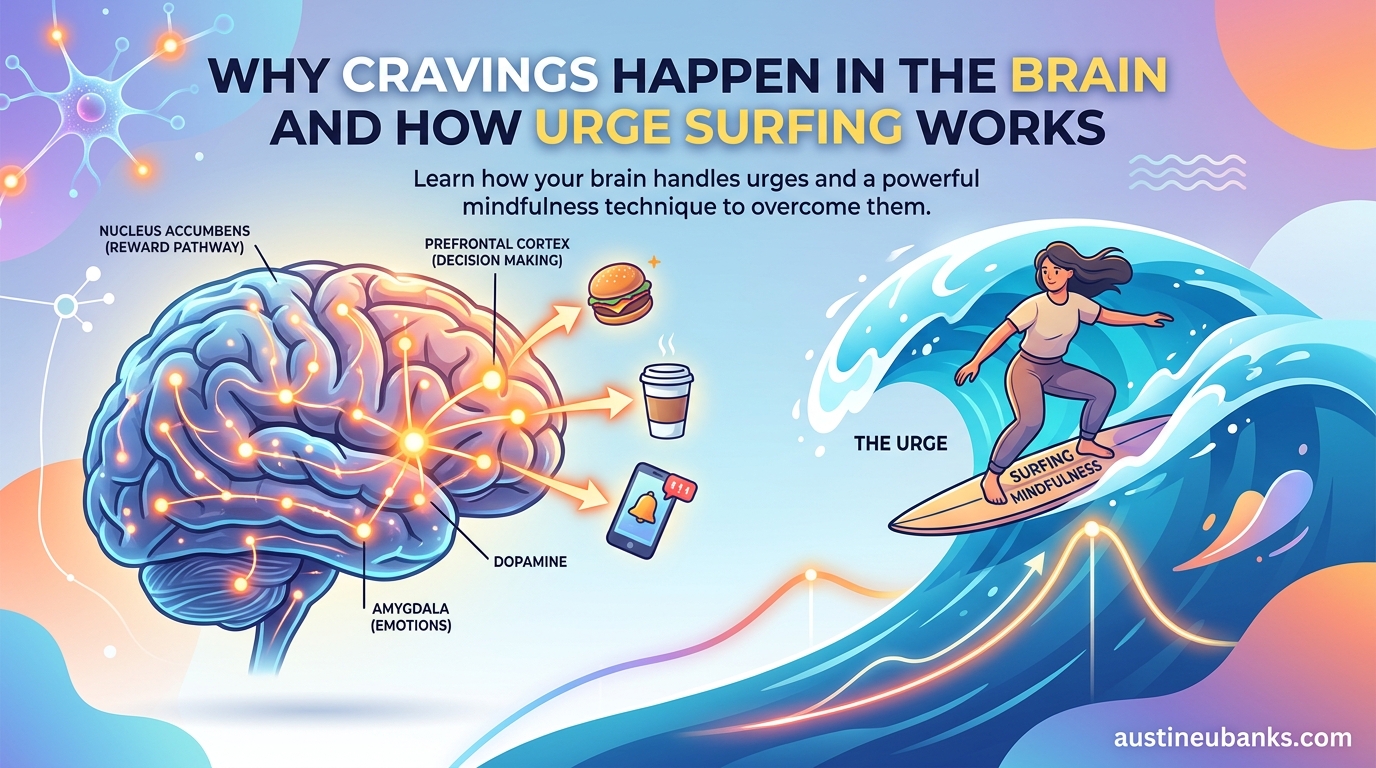
At the center of every craving is dopamine, a neurotransmitter that drives motivation and reward-seeking behavior. When you eat something sweet, have a drink, or check social media, your brain releases dopamine in the nucleus accumbens, a region often called the reward center.
Over time, the brain learns to associate specific triggers with that dopamine hit. A certain time of day, a particular emotion, or even a smell can activate the same circuit before you even act on it. This is the habit loop in action: a trigger leads to a behavior, which delivers a reward, and the cycle reinforces itself.
The problem is that modern temptations hijack this system far beyond what it evolved to handle. Processed foods, alcohol, nicotine, and digital media deliver dopamine spikes that dwarf anything found in nature. Your brain responds by building stronger neural pathways around those rewards.
Key Brain Regions Involved in Cravings
Cravings do not happen in one spot. They involve a network of brain regions working together:
- Prefrontal cortex: Responsible for decision-making, planning, and self-control. This region tries to override impulsive urges, but it gets overpowered when stress or fatigue weakens it.
- Nucleus accumbens: The reward-processing hub where dopamine creates the feeling of wanting and seeking.
- Amygdala: Processes emotions like anxiety and stress, which can amplify cravings significantly.
- Hippocampus: Stores memories linked to past rewards. Walking past a favorite bakery triggers this region to replay the pleasure of eating that pastry.
- Insula: Interoceptive awareness center that reads bodily signals. It is what makes a craving feel physical, like tension in your chest or a knot in your stomach.
How Conditioning and Reinforcement Build Cravings
Every time you give in to an urge, you strengthen the neural pathway connecting the trigger to the reward. This process, called reinforcement, is the same mechanism behind classical conditioning. The brain becomes more efficient at predicting when a reward is coming and generating the craving in anticipation.
This is why cravings can strike at specific times or in particular situations. If you always smoke after dinner, your brain starts releasing craving signals after dinner whether you want it to or not. The trigger-behavior-reward loop has been wired in through repetition.
Why Emotions Amplify Cravings
Strong emotions like anxiety, grief, shame, boredom, and loneliness make cravings significantly worse. When the amygdala detects emotional distress, it signals the reward system to seek relief. If substances or behaviors have been your primary coping tool, the brain reaches for those first.
This is why stress is one of the most common triggers for relapse. The emotional brain essentially overrides the logical brain, and the craving feels urgent and impossible to ignore. Understanding this mechanism is the first step toward breaking the pattern.
Why Urges Are Temporary: The 20 to 30 Minute Window
Here is something most people do not realize: cravings have a natural shelf life. Research and clinical experience consistently show that an individual urge typically peaks and begins to subside within 20 to 30 minutes.
This happens because the neurochemical surge that powers a craving is not sustainable. Dopamine and stress hormones spike, create intense wanting, and then gradually recede as the body seeks homeostasis. The craving feels permanent in the moment, but it is actually a temporary wave.
Think of it like a text message notification. It grabs your attention forcefully, but if you do not respond, the urgency fades. The craving will not keep intensifying forever. It peaks, plateaus, and falls away on its own.
This biological reality is the foundation of urge surfing. If you can ride out those 20 to 30 minutes without acting on the urge, the wave will break on its own. You do not need to fight it. You just need to outlast it.
What Is Urge Surfing?
Urge surfing is a mindfulness-based technique that helps you manage cravings by observing them without acting on them, allowing urges to rise and fall naturally like ocean waves. Instead of fighting, suppressing, or giving in to a craving, you watch it with curiosity and let it pass on its own.
The technique was developed by Dr. Alan Marlatt, a clinical psychologist and pioneer in relapse prevention research. Dr. Marlatt recognized that traditional approaches like willpower and suppression often backfired, leading to stronger rebounds. He drew on mindfulness principles to create a method that works with the brain rather than against it.
The Wave Metaphor Explained
Picture yourself as a surfer sitting on a board, watching swells form on the horizon. A wave appears and starts building. You do not try to stop it, and you do not let it knock you off. You climb on, ride it to its peak, and stay balanced as it carries you forward and eventually breaks.
A craving works the same way. It starts small, builds to a peak of intensity, and then subsides. Urge surfing teaches you to stay present and balanced through the entire cycle. You observe the physical sensations, the thoughts, and the emotions without being swept away by any of them.
The key insight is that you are not the wave. You are the surfer. The craving is something happening to you, not something you must obey.
How Urge Surfing Differs From Willpower
Willpower is a battle. It involves clenching your jaw, gritting your teeth, and white-knuckling your way through a craving until you either win or collapse. The problem is that willpower is a finite resource that depletes throughout the day, especially under stress.
Urge surfing takes a fundamentally different approach. Instead of resisting the craving, you turn toward it with mindful awareness. You investigate it like a scientist studying a phenomenon. This shift from resistance to observation is what makes the technique sustainable over the long term.
Urge Surfing vs. Urge Suppression
One of the biggest mistakes people make is confusing urge surfing with urge suppression. These two approaches produce very different outcomes.
Urge suppression means trying to push the craving away, distract yourself hard, or pretend it does not exist. You tell yourself to stop thinking about it, avoid the feeling, and power through. Research consistently shows that suppression backfires through a rebound effect. The harder you push a thought or craving away, the more forcefully it returns.
Urge surfing does the opposite. You acknowledge the craving exists, turn toward it, and observe it closely. This mindful approach prevents the rebound effect because you are not creating resistance. You are simply allowing the experience to be what it is without adding fuel to the fire.
Here is a quick comparison to make the distinction clear:
- Suppression: “I cannot think about this, stop it, go away” leads to stronger rebounds.
- Urge surfing: “I notice this craving, I observe it, I let it be” leads to natural subsiding.
- Suppression: Creates tension and mental exhaustion.
- Urge surfing: Creates calm awareness and builds long-term resilience.
How to Practice Urge Surfing: A Step-by-Step Guide
Now that you understand the science and philosophy, here is a practical guide to urge surfing you can use the next time a craving hits. These six steps are designed to be simple enough to remember in the heat of the moment.
Step 1: Recognize and Name the Urge
The moment you feel a craving building, pause and acknowledge it. Say to yourself silently or out loud, “I am experiencing an urge right now.” Naming it creates immediate distance between you and the craving. You are no longer consumed by it. You are observing it.
This act of recognition engages the prefrontal cortex, your brain’s reasoning center. It shifts you out of autopilot mode and into conscious awareness. That shift alone can reduce the intensity of the craving.
Step 2: Pause and Center Yourself
Before doing anything else, take three slow breaths. Inhale through your nose for four counts, hold briefly, and exhale through your mouth for six counts. This activates the parasympathetic nervous system, which counters the stress response and calms the body.
You are not trying to make the craving disappear. You are simply creating a stable foundation from which to observe it. Think of this as planting your feet firmly on the surfboard.
Step 3: Observe the Physical Sensations
Turn your attention to your body. Where do you feel the craving? Is it tightness in your chest, a hollow feeling in your stomach, tension in your jaw, or a buzzing sensation in your hands? Describe the sensations to yourself as if you were reporting on them for a scientific study.
Notice whether the sensations are constant or changing. Are they getting stronger, staying the same, or already beginning to fade? This curious observation keeps your awareness engaged and prevents you from being swept into automatic behavior.
Step 4: Visualize the Wave
Picture the craving as a wave in the ocean. See it building, rising, and cresting. Imagine yourself riding on top of it, balanced and steady. You are not beneath the wave being crushed by it. You are on top, moving with it.
This visualization is not just a mental trick. It provides your brain with a framework for understanding what is happening. The craving is temporary, it follows a predictable pattern, and you can navigate it without drowning.
Step 5: Breathe Through the Peak
The peak of the craving is the most intense moment, and it is also the point where most people give in. This is where your breathing practice matters most. Keep breathing slowly and steadily, maintaining your observational stance.
Remind yourself that you do not have to act on this urge. You only need to stay present with it. Each breath carries you closer to the moment when the wave begins to subside. You are not fighting the craving. You are simply outlasting it.
Step 6: Notice the Urge Subside
Eventually, always, the craving begins to weaken. The wave starts to break and roll toward shore. Pay attention to this moment. Notice how the physical sensations soften, the mental urgency quiets, and the emotional charge dissipates.
This step is powerful because it teaches your brain something critical: cravings end on their own. Each time you ride a wave to completion, you weaken the neural pathway of the habit loop and strengthen the pathway of mindful awareness. Over time, with neuroplasticity on your side, the cravings become less frequent and less intense.
The SOBER Technique as a Shortcut
If remembering six steps feels overwhelming in the moment, try the SOBER technique, a shorter mindfulness mnemonic that pairs perfectly with urge surfing:
- Stop what you are doing.
- Observe what is happening in your body and mind.
- Breathe slowly and deliberately.
- Evaluate your options with curiosity, not judgment.
- Respond consciously instead of reacting automatically.
SOBER distills the urge surfing process into five memorable actions. Many practitioners in Reddit communities report that this mnemonic is easier to recall during high-intensity cravings.
Complementary Techniques to Strengthen Your Practice
Urge surfing becomes more powerful when you combine it with other evidence-based self-regulation tools. Two techniques stand out for their compatibility and simplicity.
The 4-7-8 Breathing Method
Developed by Dr. Andrew Weil, the 4-7-8 breathing technique is a rapid calm-down tool you can use during Step 2 of urge surfing. Inhale through your nose for four counts, hold your breath for seven counts, and exhale through your mouth for eight counts. Repeat this cycle four times.
The extended exhale activates the vagus nerve, which triggers the parasympathetic nervous system and slows your heart rate. This creates a physiological state of calm that makes it easier to observe cravings without being overwhelmed by them. The 4-7-8 method works especially well during the peak of an urge when tension is highest.
Mindfulness Meditation as a Foundation
Urge surfing is easier when you already have a mindfulness practice. Even five to ten minutes of daily meditation trains your brain to observe thoughts and sensations without reacting. This skill transfers directly to craving management.
Over time, regular meditation increases the gray matter density in the prefrontal cortex, the region responsible for self-control. It also shrinks the amygdala’s reactivity to stress. These structural changes make urge surfing feel more natural and less effortful.
Benefits of Urge Surfing
The benefits of urge surfing extend far beyond the moment of a single craving. This technique creates lasting changes in how your brain processes desire, stress, and self-control.
It Rewires Your Brain Through Neuroplasticity
Every time you ride an urge to completion without acting on it, you weaken the old habit loop and strengthen a new neural pathway. This is neuroplasticity in action. The brain physically reorganizes itself based on repeated experience.
After weeks or months of consistent practice, cravings genuinely become less intense and less frequent. Your brain learns that the trigger does not automatically lead to the old reward. The wiring that once felt unbreakable starts to loosen.
It Builds Real Self-Control and Resilience
Unlike willpower, which depletes, urge surfing builds a skill that compounds over time. Each successful session increases your confidence and your capacity to handle the next wave. You develop something psychologists call distress tolerance, the ability to sit with discomfort without escaping it.
This resilience transfers to other areas of life. People who practice urge surfing report better emotional regulation, improved stress management, and a greater sense of agency over their choices.
It Breaks the Habit Loop at Its Root
Most approaches to breaking bad habits focus on the behavior itself. Urge surfing targets the loop that drives the behavior. By inserting mindful awareness between the trigger and the action, you interrupt the automatic sequence that has been running for months or years.
Once the loop is broken repeatedly, the brain stops expecting the reward in response to the trigger. The craving signal weakens because it is no longer being reinforced. This is why urge surfing produces lasting change rather than temporary suppression.
It Addresses the Emotional Component
Many cravings are rooted in emotional distress, anxiety, boredom, loneliness, shame, or grief. Urge surfing teaches you to sit with those emotions instead of numbing them. This is uncomfortable at first, but it leads to genuine emotional processing rather than avoidance.
Over time, you develop a healthier relationship with difficult feelings. You learn that emotions, like cravings, are temporary waves that you can observe and survive. This emotional regulation skill is one of the most valuable outcomes of the practice.
When Urge Surfing Might Not Be Enough
Urge surfing is a powerful tool, but it is not a complete solution for every situation. Being honest about its limitations helps you use it effectively and know when to seek additional support.
For severe substance use disorders, deeply entrenched addictions, or co-occurring mental health conditions, urge surfing works best as part of a broader treatment plan. Professional therapy, medical support, and structured programs like Mindfulness-Based Relapse Prevention (MBRP) or Acceptance and Commitment Therapy (ACT) provide the framework within which urge surfing thrives.
If you find that cravings are overwhelming despite consistent practice, or if you are dealing with withdrawal symptoms, please reach out to a qualified addiction specialist or mental health professional. There is no shame in needing more support, and the right combination of tools can make all the difference.
Some people also find that urge surfing feels impossible during their first few attempts. This is normal. Forum discussions across recovery communities reveal that nearly everyone struggles initially. The technique gets easier with practice, and even partial successes build momentum.
Tips for Success With Urge Surfing
Based on clinical research and real-world experiences from recovery communities, here are the most effective strategies for making urge surfing work in your life.
Start With Small Urges
Do not wait for a category-five craving to try urge surfing for the first time. Practice on mild urges, like the impulse to check your phone or grab a snack when you are not hungry. Building the skill on small waves prepares you for the bigger ones.
Track Your Sessions
Keep a simple log of each urge you surf. Note the trigger, the intensity on a scale of one to ten, how long it lasted, and what happened. Seeing your successes accumulate builds confidence and reveals patterns in your triggers.
Lean on Community Support
Personal success stories and shared experiences are incredibly motivating. Whether it is a Reddit community, a therapy group, or a trusted friend, having people who understand what you are going through makes a measurable difference. You do not have to ride every wave alone.
Avoid the All-or-Nothing Trap
If you give in to a craving, that is not a failure. It is data. What triggered the urge? At which step did you lose balance? What can you adjust next time? Every experience, successful or not, teaches your brain something useful.
Consistency matters more than perfection. Surfing 70 percent of your urges successfully will produce dramatic changes over time. The goal is progress, not flawless execution.
FAQs
What is the science behind urge surfing?
Urge surfing works by leveraging mindfulness and neuroplasticity. When you observe a craving without acting on it, you engage the prefrontal cortex (responsible for self-control) while allowing the dopamine-driven reward signal to peak and subside naturally. Each time you ride an urge to completion, you weaken the old habit loop and strengthen new neural pathways, physically rewiring your brain over time.
How do cravings work in the brain?
Cravings are driven by the brain’s reward system, primarily involving dopamine release in the nucleus accumbens. When you repeatedly pair a trigger with a rewarding behavior, neural pathways form through conditioning and reinforcement. Brain regions like the amygdala (emotions), hippocampus (memory), and insula (body awareness) all contribute, making cravings feel urgent and physical. Stress and strong emotions amplify this signal by overwhelming the prefrontal cortex’s ability to regulate impulses.
How long do urges last in urge surfing?
Most individual urges peak and begin to subside within 20 to 30 minutes. This is because the neurochemical surge powering the craving is not sustainable and the body naturally seeks balance. The craving feels permanent in the moment, but it follows a predictable wave pattern of building, peaking, and fading. If you can stay present and observe the urge without acting on it, it will pass on its own.
How to beat a craving?
To beat a craving, use the urge surfing method: (1) Recognize and name the urge, (2) Pause and take three slow breaths, (3) Observe the physical sensations in your body without judgment, (4) Visualize the craving as a wave you are riding, (5) Breathe steadily through the peak intensity, and (6) Notice the urge naturally subside. Remember that cravings are temporary and will pass within 20 to 30 minutes if you do not act on them.
Conclusion
Cravings are not character flaws. They are predictable neurological events driven by dopamine, the reward system, and deeply wired habit loops. Understanding why cravings happen in the brain and how urge surfing works gives you a concrete, science-backed method for managing them.
The next time a craving hits, remember the wave. It will build, it will peak, and it will pass. Your only job is to stay on the board, breathe, and observe. Each wave you ride makes the next one easier to navigate. Over time, your brain rewires itself for greater self-control, resilience, and freedom from automatic habits.
Start small, be consistent, and give yourself grace along the way. The ocean of cravings is vast, but you now have the skills to surf it.