
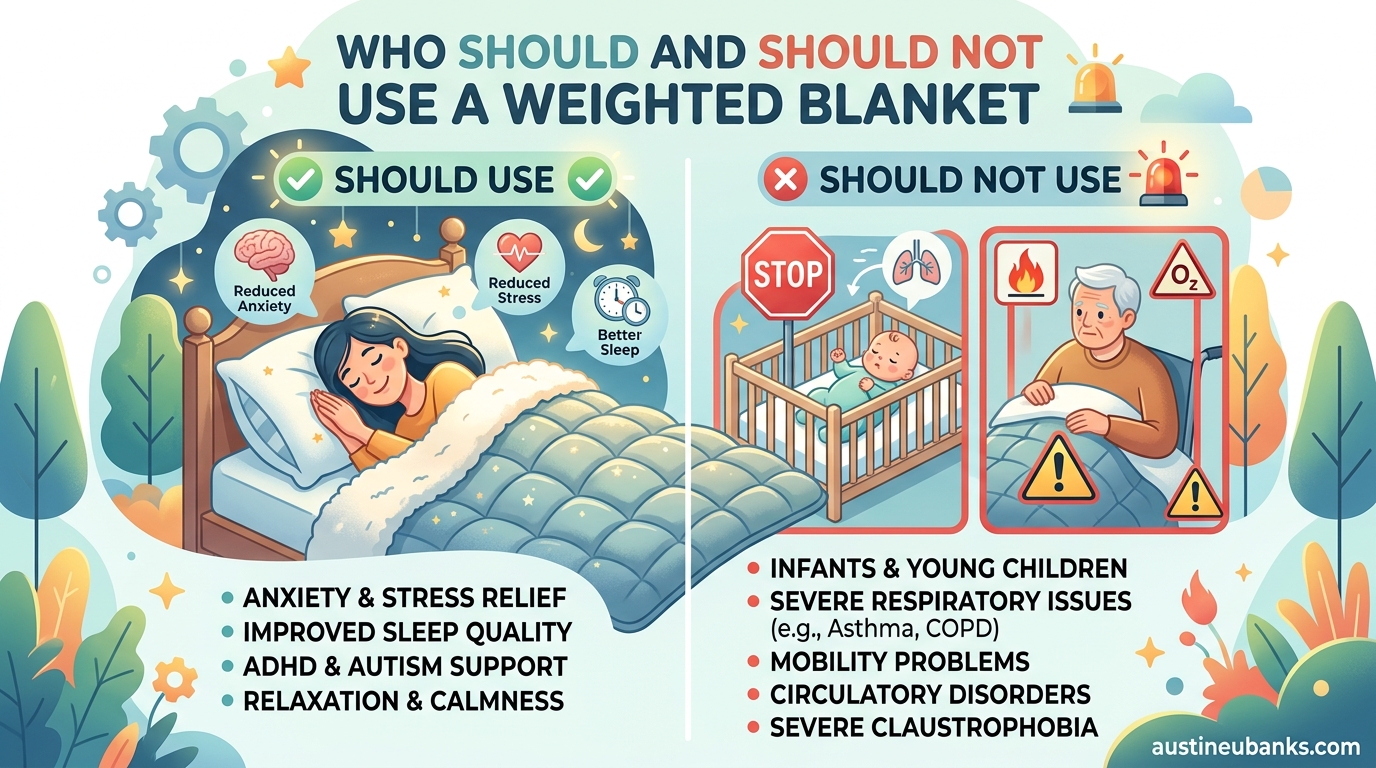
Most healthy adults and older children can safely use a weighted blanket, but infants under age 2, people with sleep apnea, asthma, COPD, claustrophobia, serious heart conditions, or limited mobility should avoid them. Knowing who should and should not use a weighted blanket prevents serious health risks while helping the right people get better sleep.
Weighted blankets have exploded in popularity over the last few years, and for good reason. Many people swear by the calming, grounding pressure these blankets provide. But they are not right for everyone, and using one when you should not can lead to breathing difficulties, panic, or worse.
I have spent months researching weighted blanket safety guidelines, reviewing clinical studies, and reading through hundreds of real user experiences on forums like Reddit’s r/WeightedBlankets and r/ADHD. This guide breaks down exactly who benefits from weighted blankets, who should stay away from them, and how to choose the right one if you are in the clear.
Whether you are dealing with anxiety, insomnia, autism, or just curious whether a weighted blanket might help you sleep better, this article will give you a clear answer. Let me walk you through everything you need to know to make a safe, informed decision.
Table of Contents
How Weighted Blankets Work: Deep Pressure Stimulation
Weighted blankets work through a process called deep pressure stimulation, or DPS. This is the same type of gentle, distributed pressure you feel during a firm hug or a massage. When a weighted blanket rests on your body, it applies what researchers call deep touch pressure across your skin and joints.
That pressure does something remarkable inside your nervous system. It activates the parasympathetic nervous system, which is your body’s rest-and-digest mode. This is the opposite of the fight-or-flight response that keeps you tense and alert. When DPS kicks in, your body shifts into a calmer state.
Here is where the chemistry gets interesting. Deep pressure stimulation has been shown to lower cortisol, which is your primary stress hormone. At the same time, it boosts production of serotonin and dopamine, two neurotransmitters associated with feelings of well-being and happiness. DPS also increases melatonin, the hormone that regulates your sleep-wake cycle.
This combination of lower stress hormones and higher calming hormones is why so many people report falling asleep faster and staying asleep longer under a weighted blanket. A 2024 study on surgical patients found that even a 15-pound weighted blanket significantly reduced preoperative anxiety compared to standard care.
It is worth noting that DPS is not a new concept. Occupational therapists have used deep pressure therapy for decades to help children with autism and sensory processing disorders. The weighted blanket simply brings this well-established therapeutic technique into your bedroom in an accessible, everyday form.
Understanding this mechanism matters because it explains both who benefits and who could be harmed. If the pressure helps calm your nervous system, that is good news. But if you have a condition where added pressure on your chest or body is dangerous, that same mechanism becomes a liability.
Who SHOULD Use a Weighted Blanket
Many people can benefit enormously from weighted blankets. Research and user reports consistently point to several groups who see the most dramatic improvements in sleep quality, anxiety levels, and overall comfort. Let me break down the specific conditions and situations where weighted blankets tend to shine.
People With Anxiety Disorders
Anxiety relief is the number one reason people buy weighted blankets, and the research backs this up. The deep pressure stimulation helps quiet an overactive nervous system, which is exactly what happens during an anxiety episode. Users on Reddit frequently describe weighted blankets as a game-changer for nighttime anxiety and racing thoughts.
If you lie awake with your mind spinning through worst-case scenarios, the grounding pressure of a weighted blanket can help anchor you. Many users say it feels like being held, which triggers a sense of safety that makes it easier to let go of anxious thoughts and drift off.
People With Insomnia and Sleep Difficulties
Studies show that weighted blankets can improve sleep onset time and overall sleep quality. The melatonin boost from DPS helps regulate your circadian rhythm, making it easier to fall asleep at a consistent time. Several users in Reddit’s r/WeightedBlankets community report sleeping through the night for the first time in years after starting to use one.
If you have chronic insomnia, a weighted blanket is not a cure-all, but it can be a useful tool in your sleep hygiene toolkit. Many people combine it with other sleep strategies like blackout curtains, consistent bedtimes, and reducing screen time before bed.
People on the Autism Spectrum
Deep pressure therapy has been used in occupational therapy for autistic individuals for decades. Many people on the autism spectrum experience proprioceptive dysfunction, meaning their brains process sensory input differently. Weighted blankets provide the kind of deep, predictable pressure that can feel calming and regulating.
The autistic community has a range of experiences with weighted blankets. Some find them deeply comforting and essential for sleep. Others find the sensation overwhelming. It is very much a personal preference, and I always recommend trying one with a return policy if you are uncertain.
Reddit’s r/evilautism and related communities have active discussions about weighted blankets. Many autistic adults say they cannot sleep without one after getting used to the pressure. The key is starting with an appropriate weight and giving your body time to adjust.
People With ADHD
ADHD brains often struggle with racing thoughts, restlessness, and difficulty winding down. Weighted blankets can help by providing sensory input that grounds the body and calms the mind. Many ADHD users on Reddit describe their weighted blanket as essential for falling asleep.
The deep pressure stimulation seems to help quiet the internal noise that makes bedtime so challenging for people with ADHD. If your mind tends to go into overdrive the moment your head hits the pillow, a weighted blanket might provide the physical grounding you need.
People With Chronic Pain and Osteoarthritis
Living with chronic pain makes sleep incredibly difficult. Weighted blankets can help by reducing the perception of pain through the release of serotonin and dopamine. Healthline’s research highlights osteoarthritis as a specific condition that may benefit, which is an angle most other sources miss.
The gentle, even pressure seems to help distract the nervous system from pain signals. This is not about blocking pain entirely but about shifting your body into a state where pain feels more manageable and sleep comes more easily.
People With Restless Leg Syndrome
Restless leg syndrome causes an irresistible urge to move your legs, especially at night. Many RLS sufferers find that the distributed pressure of a weighted blanket helps reduce the urge to move. The deep pressure stimulation appears to calm the neurological signals driving the restlessness.
People asking whether a weighted blanket will help with RLS are one of the most common questions in search data, and the answer for many users is a resounding yes. The pressure on the legs seems to provide the same type of relief that compression or firm massage offers.
People Facing Medical Procedures
A fascinating angle from recent research involves using weighted blankets to manage medical anxiety. The 2024 study on surgical patients showed measurable anxiety reduction when participants used a weighted blanket before their procedures. This has implications for dental anxiety, MRI claustrophobia management, and other stressful medical situations.
Who Should NOT Use a Weighted Blanket
This is the section that matters most. While weighted blankets are safe for the majority of healthy adults, certain groups face real, documented risks. I have organized these by severity so you can quickly identify whether you or a loved one fall into a category that requires caution or complete avoidance.
Let me be clear: some of these are absolute contraindications, meaning you should not use a weighted blanket at all. Others are situations where you should talk to a doctor first. I will make the distinction clear in each section.
Infants and Children Under 2 Years Old
This is the most critical safety warning in this entire article. Infants and children under 2 years old should never use a weighted blanket. The risk is suffocation and Sudden Infant Death Syndrome (SIDS).
Babies do not have the motor skills or strength to push a heavy blanket off their face. Even a relatively light weighted blanket can restrict an infant’s breathing or prevent them from repositioning themselves safely. Pediatricians and safety organizations are unanimous on this point.
If you are a parent reading this, please take this warning seriously. A weighted blanket is not a sleep aid for babies, toddlers, or any child who cannot easily remove the blanket on their own. Some manufacturers recommend waiting until age 4 or older before introducing any weighted product, and even then, adult supervision is strongly advised.
For children over 4 who may benefit from deep pressure therapy, always consult a pediatrician or occupational therapist first. They can recommend an appropriate weight and provide guidance on safe usage specific to your child’s needs.
People With Sleep Apnea
Sleep apnea causes your breathing to stop and start repeatedly during the night. Adding weight to your chest and torso can make this condition significantly worse by restricting your ability to breathe deeply and expanding your lungs.
If you have obstructive sleep apnea, the most common form, a weighted blanket adds physical resistance to your already compromised airway. This can increase the frequency and severity of your apnea episodes. If you use a CPAP machine, talk to your sleep specialist before adding a weighted blanket to your sleep setup.
This is one of the most searched questions about weighted blanket safety, and the answer is clear. Can you use a weighted blanket with sleep apnea? For most people with diagnosed sleep apnea, the answer is no, or at least not without explicit medical approval.
People With Asthma, COPD, or Other Respiratory Conditions
Any condition that affects your breathing is a red flag for weighted blanket use. Asthma, chronic obstructive pulmonary disease (COPD), and other respiratory disorders can be aggravated by the extra weight on your chest.
The pressure that feels calming to a healthy person can feel suffocating to someone with compromised lung function. Even if you are not currently having symptoms, the added weight can subtly reduce your breathing efficiency throughout the night. This is especially dangerous because you may not notice it while sleeping.
If you have a respiratory condition and are determined to try a weighted blanket, start with the lightest option available and monitor how you feel. But honestly, the safest approach is to skip it entirely and explore other anxiety or sleep aids that do not put pressure on your chest.
People With Claustrophobia
This one might seem obvious, but it is worth stating clearly. If you experience claustrophobia or panic responses to feeling trapped, a weighted blanket can trigger a serious anxiety attack rather than relieve one.
The entire mechanism of a weighted blanket is distributed pressure that holds you in place. For someone with claustrophobia, that same pressure can feel like being pinned down. Several Reddit users in r/ADHD and other communities have shared stories of waking up in a panic after trying weighted blankets.
If you have mild claustrophobia and want to try, start with a very light blanket and use it for short periods while awake and watching television. Never start with nighttime use, because waking up under heavy weight in a dark room can be deeply disorienting for someone prone to claustrophobic episodes.
People With Heart Conditions
Serious cardiac conditions are a reason to be cautious with weighted blankets. The added pressure on your chest can affect blood flow and potentially strain a heart that is already compromised. While there is less research on this specific contraindication compared to respiratory issues, cardiologists generally advise caution.
If you have congestive heart failure, recent heart surgery, arrhythmias, or any condition where your cardiac function is impaired, talk to your cardiologist before using a weighted blanket. The pressure that promotes relaxation in healthy individuals may create unnecessary strain on a weakened heart.
People With Mobility Issues or Limited Strength
This is a contraindication that most competitors gloss over, but it is critically important. If you have limited mobility due to injury, disability, age, or any other factor, a weighted blanket can trap you in bed.
Imagine needing to get up to use the bathroom at 3 AM and not being able to push a 20-pound blanket off your body. For someone with arthritis, muscle weakness, or a recent surgery, this is a real and frightening scenario. The weight that feels comforting when you are falling asleep becomes a barrier when you need to move.
Reddit users have specifically raised this concern, and it is one of the least discussed risks of weighted blankets. If you have any condition that limits your ability to move quickly or independently, a weighted blanket may not be safe for unsupervised nighttime use.
People With Circulation Issues, Diabetes, or Neuropathy
Poor circulation and diabetes-related nerve damage (neuropathy) create additional concerns with weighted blankets. Extra weight on your extremities can further restrict already compromised blood flow. For people with diabetic neuropathy, you may not feel the blanket causing problems because of reduced sensation in your limbs.
This is dangerous because you could develop circulation problems, pressure sores, or other complications without realizing it. The weighted blanket asks whether it will help with neuropathy is common, and the honest answer for most people with this condition is to consult a doctor first.
If you have diabetes, peripheral artery disease, or any condition affecting circulation, a lighter alternative like a compression garment or a very light lap pad might be safer than a full weighted blanket. Always check with your healthcare provider.
Pregnant Women
Pregnancy adds a layer of complexity to the weighted blanket question. Most competitors barely touch on this topic, which is surprising given how many pregnant women struggle with sleep.
The general consensus among obstetricians is that a weighted blanket is not inherently dangerous during pregnancy, but you should run it by your doctor first. The main concerns are overheating, restricted movement, and the fact that pregnancy already puts extra strain on your breathing and circulation.
If your doctor gives the green light, choose a lighter blanket than you normally would. Many pregnant women find relief with a 10 to 12 pound blanket rather than the standard 15 to 20 pound options. Pay attention to body temperature, since pregnant women tend to run hotter, and avoid sleeping on your back with heavy weight on your torso.
Pets
This might sound odd, but pet safety is a real concern with weighted blankets. Dogs and cats love to burrow under blankets, and a weighted blanket can trap or suffocate a small pet. This is especially dangerous for small dogs, cats, and puppies or kittens.
YNM, a major weighted blanket manufacturer, specifically lists pets in their safety warnings. If your pet sleeps in your bed, make sure the weighted blanket is not accessible to them when you are not around. A small animal cannot push a 15-pound blanket off if it gets trapped underneath.
Quick Reference: Who Should Use vs Who Should Avoid
Here is a quick at-a-glance summary to help you decide. This comparison covers the most common scenarios.
Who should consider a weighted blanket: Healthy adults with anxiety, adults with insomnia, people on the autism spectrum who enjoy deep pressure, people with ADHD, adults with chronic pain, people with restless leg syndrome, and those dealing with medical procedure anxiety.
Who should avoid or consult a doctor first: Infants and children under 2, anyone with sleep apnea, people with asthma or COPD, those with claustrophobia, people with serious heart conditions, individuals with mobility limitations, people with severe circulation issues or neuropathy, and pregnant women without medical clearance.
Weight Guidelines: How to Choose the Right Weighted Blanket
If you have determined that a weighted blanket is safe for you, choosing the right weight is the next critical step. Get this wrong, and you will either feel nothing or feel trapped.
The 10% Body Weight Rule
The golden rule of weighted blankets is simple: choose a blanket that weighs approximately 10% of your body weight. This guideline comes from occupational therapy research and has been adopted by virtually every reputable manufacturer and health resource.
For example, if you weigh 150 pounds, a 15-pound blanket is your target. If you weigh 200 pounds, look for a 20-pound blanket. This ratio provides enough pressure to trigger deep pressure stimulation without being so heavy that it becomes uncomfortable or restricts movement.
Weight Reference by Body Weight
Here is a quick reference to help you find your ideal blanket weight. If you fall between two options, most experts recommend choosing the lighter one for your first blanket.
For a body weight of 80 to 100 pounds, choose a 10-pound blanket. For 100 to 120 pounds, a 10 to 12-pound blanket works well. At 120 to 150 pounds, go with 12 to 15 pounds. For 150 to 180 pounds, a 15 to 18-pound blanket is ideal. At 180 to 200 pounds, try 18 to 20 pounds. For 200 to 230 pounds, a 20 to 23-pound blanket provides good pressure. Above 230 pounds, look for blankets in the 25 to 30-pound range.
Special Considerations for Children
For children old enough to safely use a weighted blanket (generally age 4 and up, with doctor approval), the weight calculation is different. A child’s blanket should be much lighter, typically 5 to 10% of their body weight, and never more than they can easily push off on their own.
Always choose the lighter option for children. A blanket that is too heavy is not just uncomfortable, it is a genuine safety risk. When in doubt, consult an occupational therapist who specializes in pediatric sensory needs.
Step-by-Step: Choosing Your Blanket
Step 1: Weigh yourself and calculate 10% of your body weight. Step 2: Round to the nearest available blanket weight (most come in 5-pound increments). Step 3: If you are between two weights, choose the lighter one for your first blanket. Step 4: Consider a cooling or breathable cover if you tend to sleep hot. Step 5: Check the return policy before buying, since personal preference plays a big role in what feels right.
Safety Tips for First-Time Users
Even if you are in the clear to use a weighted blanket, there are some practical tips that will make your experience safer and more comfortable. I have gathered these from user forums, manufacturer guidelines, and common pain points people report.
Start Slowly
Your body needs time to adjust to sleeping under extra weight. Start by using the blanket for 20 to 30 minutes while relaxing on the couch. Do this for a few days before trying it in bed. This helps your body get used to the sensation without the pressure of trying to fall asleep.
Many Reddit users mention that the blanket felt strange or too heavy at first, but after a week or two, they could not imagine sleeping without it. Give yourself an adjustment period of at least a week before deciding whether weighted blankets work for you.
Never Cover Your Head or Face
This sounds obvious, but it is a critical safety rule. A weighted blanket should rest on your body from approximately the chest down. Never pull it over your head or face, and make sure it cannot slide up over your airway during the night.
Be Mindful of Temperature
One of the most common complaints about weighted blankets is that they are too hot. The density that makes them effective also traps body heat. If you are a hot sleeper, look for cooling weighted blankets made with breathable materials like bamboo or moisture-wicking fabrics.
Glass bead fillings tend to be cooler than plastic pellets because the beads are smaller and allow more airflow. Consider a removable, washable cover made of breathable cotton or bamboo to help regulate temperature.
Consider Your Sleeping Partner
If you share a bed, a weighted blanket can create problems. Your partner might find the weight uncomfortable, or the blanket might not distribute evenly across a larger bed. Many couples solve this by using a smaller weighted blanket on just one side, or by using two separate blankets.
This is a surprisingly common issue that forum users raise. The weighted blanket that helps you sleep might keep your partner awake. Communication and compromise are key here.
Plan for Washing and Maintenance
Weighted blankets are heavy, and they get heavier when wet. Washing one is a genuine logistical challenge. Many are too heavy for standard washing machines and require commercial-grade equipment or spot cleaning.
Before buying, check the care instructions. Look for blankets with removable, machine-washable covers. The inner weighted portion should only need occasional cleaning. This practical consideration gets overlooked constantly but matters a lot for long-term use.
Listen to Your Body
If you wake up feeling sore, claustrophobic, or short of breath, stop using the blanket immediately. These are signs that either the weight is wrong for you or you have an underlying sensitivity you were not aware of. Do not push through discomfort hoping it will go away.
Is a Weighted Blanket Right for You? A Quick Checklist
Answer these yes or no questions to help decide whether a weighted blanket is a good fit for your situation.
1. Are you a healthy adult or older child (over age 4) without respiratory conditions? 2. Do you struggle with anxiety, insomnia, ADHD, or sensory processing differences? 3. Can you easily push 15 to 20 pounds off your body? 4. Does the idea of firm, even pressure sound comforting rather than suffocating? 5. Are you willing to try a blanket with a return policy in case it does not work for you? 6. Have you checked with your doctor about any medical conditions you have?
If you answered yes to most of these, a weighted blanket is likely worth trying. If you answered no to any of the first three questions, proceed with caution or avoid weighted blankets entirely.
FAQs
Who should avoid weighted blankets?
Infants and children under 2, people with sleep apnea, asthma, COPD, or other respiratory conditions, individuals with claustrophobia, those with serious heart conditions, people with limited mobility, and individuals with severe circulation issues or neuropathy should avoid weighted blankets. Pregnant women and parents of young children should consult a doctor before use.
Will a weighted blanket help with RLS?
Many people with restless leg syndrome report significant relief from weighted blankets. The deep pressure stimulation appears to calm the neurological signals that cause the urge to move your legs. While individual results vary, RLS is one of the conditions most commonly cited as benefiting from weighted blanket use.
Do weighted blankets help with bipolar?
Weighted blankets may help with the sleep and anxiety symptoms associated with bipolar disorder, but they are not a treatment for the condition itself. The calming effect of deep pressure stimulation can improve sleep quality, which is important for mood stability. Always consult your psychiatrist before adding any new sleep intervention.
Will a weighted blanket help with neuropathy?
Neuropathy requires caution with weighted blankets. While some users report that gentle pressure provides comfort, the reduced sensation caused by nerve damage means you may not feel if the blanket is restricting circulation or causing pressure issues. Talk to your doctor before using a weighted blanket if you have neuropathy, especially diabetic neuropathy.
Can you use a weighted blanket with sleep apnea?
In most cases, no. The added weight on your chest and torso can worsen breathing difficulties and increase the frequency of apnea episodes. If you have sleep apnea and use a CPAP machine, talk to your sleep specialist before trying a weighted blanket. The risks generally outweigh the potential benefits for people with this condition.
Can you become dependent on a weighted blanket?
Many regular users say they have trouble sleeping without their weighted blanket after getting used to it, which is a form of psychological preference rather than true addiction. You will not experience withdrawal symptoms, but you may find it harder to fall asleep when traveling or without the blanket. Most users consider this a minor inconvenience rather than a serious problem.
The Bottom Line on Weighted Blanket Safety
Figuring out who should and should not use a weighted blanket comes down to one simple principle. If your body and breathing are healthy enough to handle extra pressure safely, a weighted blanket can be a genuinely transformative sleep aid. If you have any condition where added weight could restrict breathing, blood flow, or movement, the risks are not worth taking.
The people who benefit most are adults dealing with anxiety, insomnia, ADHD, autism, chronic pain, or restless leg syndrome. The people who should absolutely avoid weighted blankets include infants under 2, anyone with sleep apnea or respiratory conditions, people with claustrophobia, and those with limited mobility or severe circulation problems.
If you are uncertain where you fall, talk to your doctor. A five-minute conversation with a healthcare provider can save you from a potentially dangerous mistake and give you confidence that you are making the right choice for your body.
Start light, give your body time to adjust, and always buy from a retailer with a good return policy. Your perfect weighted blanket is out there if it is safe for you to use one.
Disclaimer: This article is for informational purposes only and does not constitute medical advice. Always consult with a qualified healthcare provider before starting any new therapeutic intervention, especially if you have existing medical conditions.