
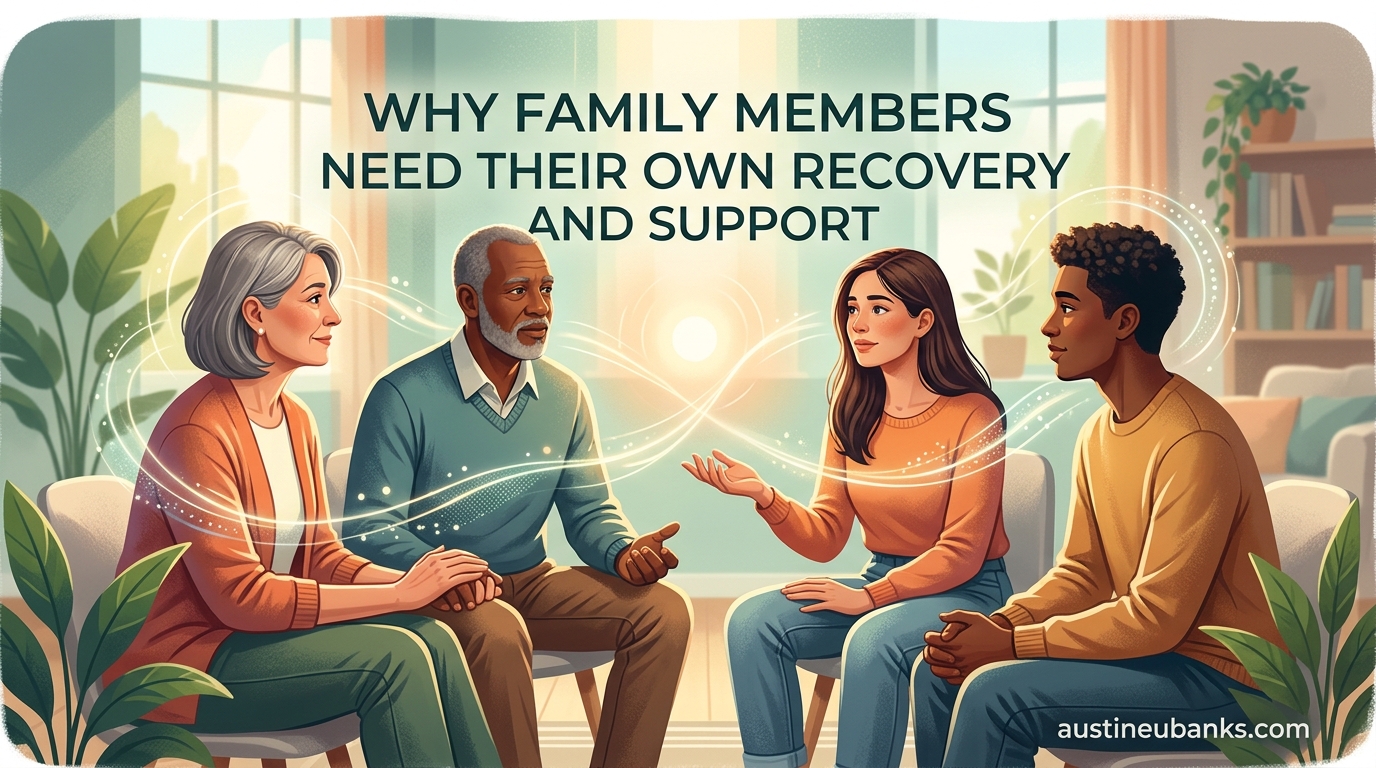
Family members need their own recovery and support because addiction is widely recognized as a family disease. When one person struggles with substance use, the emotional and psychological impact ripples outward to everyone close to them. Spouses, parents, siblings, and children all absorb stress, trauma, and behavioral shifts that can last for years.
If you have ever felt like all the attention goes to your loved one in recovery while your own exhaustion goes unnoticed, you are not alone. We have heard this same sentiment echoed across countless support forums and private conversations. One person put it bluntly: “Endless support for addicts, none for me. Where do I turn?”
That question sits at the heart of this article. By the time you finish reading, you will understand exactly why family members need their own recovery support, how to recognize when you need help, and what specific resources exist for you. You will also learn the difference between supporting someone and losing yourself in the process.
Table of Contents
Why Family Members Need Their Own Recovery and Support
Family members need their own recovery and support because living with or close to someone battling addiction creates real psychological wounds. The clinical term for this is “family systems theory” and it recognizes that no member of a household exists in isolation. When one person’s behavior becomes chaotic or unpredictable, every other person adapts to survive.
Those adaptations are not always healthy. Family members often develop coping mechanisms like hypervigilance, people-pleasing, emotional numbing, or controlling behavior. Over months and years, these patterns become deeply ingrained habits that do not simply disappear when the addicted person enters treatment.
The Substance Abuse and Mental Health Services Administration (SAMHSA) has documented that families affected by substance use disorders experience elevated rates of anxiety, depression, chronic stress, and trauma symptoms. These are measurable mental health effects, not character weaknesses. Without dedicated support, family members carry these burdens indefinitely.
Recovery for the family member is not the same as recovery for the person with the addiction. Both are real. Both matter. And both require intentional work.
Addiction Is a Family Disease
The phrase “addiction is a family disease” gets used a lot in treatment settings, and for good reason. It describes how substance use disorder reshapes the entire household ecosystem. Roles shift, communication breaks down, and unspoken rules emerge to manage the chaos.
One parent may overcompensate by becoming hyper-responsible while the other withdraws. Children often take on adult responsibilities far too early, a pattern mental health professionals call “parentification.” Siblings may feel invisible because all the family energy funnels toward the person in crisis.
These dynamics do not reset automatically when the addicted person gets sober. In fact, families sometimes struggle more during early recovery because the predictable chaos they adapted to suddenly changes. The rigid roles everyone adopted during active addiction can feel impossible to shake.
This is why so many therapists emphasize that families need their own recovery process. Treating only the individual with the addiction is like treating one patient in a household where everyone is sick. Real healing requires addressing the system, not just the symptom.
The Emotional Toll on Different Family Members
Addiction does not affect every family member the same way. Your role in the family shapes how the experience lands on you, what coping patterns you develop, and what kind of support will help most.
Spouses and Partners
Partners of people with addiction often carry the heaviest day-to-day burden. They manage finances, households, childcare, and emotional stability while trying to hold the relationship together. Trust erodes through broken promises and repeated disappointments.
Many spouses develop codependent patterns without realizing it. They begin organizing their entire lives around the addicted partner’s moods, behaviors, and needs. Over time, they lose connection with their own interests, friendships, and sense of identity. Recovery for a spouse often means rebuilding a self that was set aside.
Parents of Addicted Children
Parents face a unique form of grief. They watched their child grow, had hopes and dreams for their future, and now witness someone they love slipping into destructive patterns. Guilt is nearly universal among parents in this situation, even when they had no role in causing the addiction.
The drive to protect your child does not turn off when they become an adult. Parents frequently drain savings accounts, sacrifice retirement plans, and jeopardize their own health trying to fix the situation. The hardest lesson for many parents is learning that you cannot do the recovery work for someone else.
Children of Addicts
Children are the most vulnerable affected group and often the most overlooked. Growing up with an addicted parent shapes development in profound ways. Children learn to read subtle mood shifts for danger, suppress their own needs to avoid conflict, and often blame themselves for things outside their control.
Research consistently shows that children of addicts face higher risks of anxiety, depression, substance use, and relationship difficulties in adulthood. Adult Children of Alcoholics (ACA) and similar programs exist precisely because these effects can persist for decades without intervention.
Siblings
Siblings frequently describe feeling invisible. When parents focus all their energy on the addicted sibling, the others learn to minimize their own needs. Siblings may also feel caught between loyalty to their brother or sister and frustration with the damage being done to the family.
Some siblings carry anger that goes unexpressed for years because expressing it feels like betrayal. Giving siblings permission to feel the full range of their emotions, including resentment, is an important part of their own recovery.
Signs You Need Your Own Recovery Support
Many family members do not realize how deeply they have been affected until they reach a breaking point. The signs are easy to dismiss when you are in survival mode. Here are clear indicators that you would benefit from your own support:
- You think about the addicted person constantly. Their mood, their whereabouts, and their next move occupy your mind from morning until night.
- You have abandoned your own interests and friendships. Activities that once brought you joy now feel irrelevant or impossible to fit into your schedule.
- Your physical health is declining. Sleep problems, weight changes, headaches, and chronic fatigue are common responses to prolonged stress.
- You feel responsible for their recovery. If they relapse, you blame yourself. If they succeed, you feel like it depended on your efforts.
- You cannot relax even when things are going well. You live in a state of waiting for the next crisis, unable to trust periods of calm.
- Your other relationships are suffering. Friends, coworkers, and other family members feel the strain of your exhaustion and emotional depletion.
- You feel numb, hopeless, or chronically angry. These are signs of emotional burnout and possible trauma that deserve professional attention.
If even two or three of these resonate with you, that is a clear signal. You are carrying a load that was never meant to be carried alone.
Codependency, Enabling, and Detachment Explained
Three concepts come up repeatedly in family recovery conversations. Understanding them is essential because they describe patterns that keep both the family member and the addicted person stuck.
What Is Codependency?
Codependency is a pattern of behavior where you become so focused on another person that you lose track of your own needs, identity, and wellbeing. Codependent individuals often derive their sense of self-worth from helping or fixing someone else. The relationship becomes unbalanced, with one person always giving and the other always taking.
Codependency is not a moral failing. It is a learned coping response, often rooted in childhood, that becomes amplified in relationships with addiction. Recovery from codependency involves learning to identify your own needs, set boundaries, and develop a stable sense of self that does not depend on someone else’s behavior.
Enabling vs. Helping: What Is the Difference?
This distinction causes enormous confusion and guilt for family members. Helping supports someone’s recovery and growth. Enabling shields them from the natural consequences of their actions, which actually makes it easier for the addiction to continue.
Helping looks like driving your loved one to a treatment appointment, listening when they want to talk, and encouraging healthy choices. Enabling looks like paying their rent when they spent their money on substances, calling in sick to their employer, or repeatedly bailing them out of situations they created.
The line is not always obvious, and well-meaning family members cross it all the time. If your help consistently removes the discomfort that might motivate change, it may be enabling rather than supporting.
The 3 C’s of Recovery
One of the most helpful frameworks for family members comes from Al-Anon. The 3 C’s remind you of what is and is not within your control:
- I didn’t Cause it. You did not create your loved one’s addiction, no matter what role family dynamics played.
- I can’t Control it. No amount of monitoring, arguing, or managing will control another person’s substance use.
- I can’t Cure it. Addiction is a complex disease, and recovery is the work of the person who has it, supported by professionals.
These three statements are simple but powerful. Many family members spend years trying to do all three and burning themselves out in the process.
Types of Support Available for Family Members
You do not have to figure this out alone. Multiple established support systems exist specifically for family members affected by someone else’s addiction. Each has a different approach, and what works depends on your personality, beliefs, and circumstances.
Al-Anon and Nar-Anon
Al-Anon is the most widely known support group for family members of people with alcohol use disorder. Nar-Anon serves the same role for families affected by other drug addictions. Both are based on the 12-step model and are free, widely available, and offer both in-person and online meetings.
Many family members describe Al-Anon as life-changing. It provides a community of people who understand exactly what you are going through, plus a structured framework for working through codependency and detachment. However, it is not for everyone. Some people find the spiritual emphasis uncomfortable or feel that certain meetings dwell too heavily on victimhood. If one meeting does not feel right, try a different one before giving up on the program entirely.
SMART Family Friends
SMART Family Friends is the family support arm of SMART Recovery, which uses a science-based, cognitive behavioral approach rather than a 12-step model. It focuses on practical tools for managing emotions, improving communication, and setting boundaries.
For people who prefer an evidence-based approach without spiritual or religious elements, SMART Family Friends is often a strong fit. Meetings are available online and in person.
The CRAFT Method
Community Reinforcement and Family Training (CRAFT) is an evidence-based approach developed by researchers Robert Meyers and Jane Smith. Rather than telling family members to detach, CRAFT teaches them specific communication and behavioral strategies that can actually influence their loved one toward treatment.
Studies have shown CRAFT to be significantly more effective than traditional intervention methods at getting people into treatment. It also reduces family members’ depression and anxiety. CRAFT is typically learned through a trained therapist or the book “Beyond Addiction,” which forum members frequently recommend.
Individual Therapy and Family Counseling
Sometimes the most effective support is one-on-one work with a therapist who specializes in addiction and family dynamics. A skilled therapist can help you identify codependent patterns, process grief and trauma, and develop a personalized plan for self-care and boundary setting.
Family therapy can also be valuable, especially if the person in recovery is willing to participate. It provides a structured environment to rebuild trust, improve communication, and address the family dynamics that contributed to or resulted from the addiction.
Self-Care and Setting Healthy Boundaries
Self-care is not a luxury for family members in recovery. It is a necessity. You cannot pour from an empty cup, and chronic stress has real physical and mental health consequences.
Practical self-care starts with the basics. Prioritize sleep, regular meals, and physical activity. Reconnect with friends you have lost touch with. Resume hobbies and interests that fell by the wayside. These may sound simple, but they are the foundation of emotional recovery.
Setting boundaries is the harder and more important work. A boundary is a clear statement of what you will and will not accept, along with the action you will take if it is crossed. For example: “I will not lend you money. If you ask, I will end the conversation.” Boundaries are not about controlling the other person. They are about protecting yourself.
Expect resistance when you start setting boundaries, especially if your family has operated without them for years. Stay consistent. Enforcing a boundary once and then abandoning it teaches the other person that your limits are negotiable.
Remember that detaching with love is not the same as abandoning someone. It means stepping back from their destructive patterns while maintaining your own wellbeing. Sometimes the most loving thing you can do for a family member is to stop rescuing them.
FAQs
Why is family support important in recovery?
Family support is important in recovery because addiction affects the entire family system. Family members who receive their own support are better equipped to maintain healthy boundaries, avoid enabling behaviors, and provide constructive encouragement. Research from SAMHSA shows that family involvement in recovery improves outcomes for the person with addiction while reducing stress and mental health issues among family members.
What are the 3 C’s of recovery?
The 3 C’s of recovery are: I didn’t Cause it, I can’t Control it, and I can’t Cure it. This framework, popularized by Al-Anon, reminds family members that they are not responsible for their loved one’s addiction, cannot manage another person’s substance use, and cannot fix the disease themselves. The 3 C’s help release the guilt and false responsibility that family members often carry.
Are there support groups for families of addicts?
Yes. The most common support groups for families of addicts include Al-Anon and Nar-Anon (12-step based), SMART Family Friends (science-based and cognitive behavioral), and Learn to Cope (focused on opioid addiction). Additionally, the CRAFT method offers a structured, evidence-based approach through trained therapists. Adult Children of Alcoholics (ACA) serves adults who grew up with addicted parents.
Can dysfunctional families heal?
Yes, dysfunctional families can heal. Recovery is possible when family members commit to addressing unhealthy patterns through therapy, support groups, and honest communication. Healing takes time and requires each willing member to do individual work on their own coping behaviors, boundaries, and emotional responses. Not every family member will participate, but individuals can still heal regardless of what others choose to do.
How to help a drug addict family member without enabling?
To help without enabling, focus on supporting recovery rather than shielding your loved one from consequences. Drive them to treatment appointments, listen without judgment, and encourage healthy choices. Avoid giving money, covering for mistakes, lying on their behalf, or solving problems they created. Learn the difference between helping and enabling, set clear boundaries, and consider working with a therapist trained in the CRAFT method.
How do I deal with ungrateful family members in recovery?
Dealing with ungrateful behavior starts with accepting that you cannot control another person’s response to your support. Set clear boundaries around what you will and will not do. Communicate your expectations calmly and consistently. Recognize that ingratitude often stems from the person’s own guilt, shame, or emotional immaturity. Focus on your own recovery and wellbeing rather than seeking validation from someone who may not be capable of providing it yet.
Conclusion
Understanding why family members need their own recovery and support is the first step toward actually getting it. Addiction reshapes entire households, and the people closest to the crisis carry wounds that deserve attention, validation, and professional care.
You did not cause the addiction, you cannot control it, and you cannot cure it. What you can do is take responsibility for your own healing. Whether that means attending an Al-Anon meeting, finding a therapist, reading “Beyond Addiction,” or simply reconnecting with parts of yourself that got lost along the way, the important thing is to start.
Your recovery matters just as much as anyone else’s. If you have been waiting for permission to prioritize your own wellbeing, consider this it.