
Have you ever noticed that some days a critical comment from your boss barely registers, while on other days the same words send you into a spiral? That difference has everything to do with your window of tolerance. It is the zone where you can think clearly, feel your emotions, and respond to life without losing your footing.
The concept, originally developed by Dr. Dan Siegel in 1999, has become one of the most practical frameworks in trauma therapy and stress management. Understanding what the window of tolerance is and how to widen it gives you a roadmap for emotional regulation that no amount of willpower alone can provide.
In this guide, I will walk you through exactly how this concept works, why your window may have become narrow, and the specific strategies that genuinely help you expand it. Whether you are dealing with anxiety, recovering from trauma, or simply wanting to handle stress better, these tools can change how you respond to the world around you.
I have spent years studying nervous system regulation and speaking with people in therapy communities about what actually moves the needle. What follows blends clinical understanding with real-world application. Let us start with the basics.
Table of Contents
What Is the Window of Tolerance?
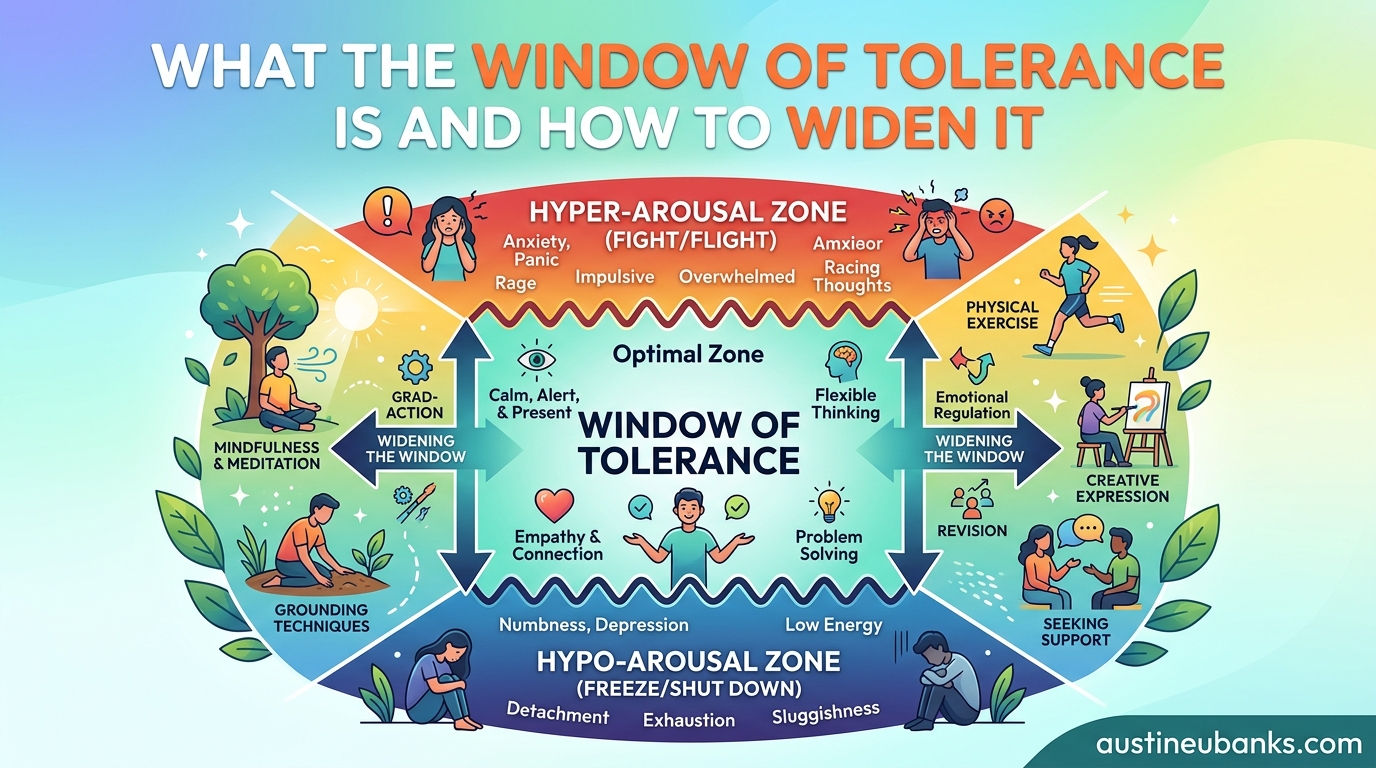
The window of tolerance is the optimal zone of emotional arousal where you can function effectively, think rationally, and manage your emotions without becoming overwhelmed or shutting down. When you are inside this zone, life feels manageable even when it is difficult. You can have a hard conversation, absorb bad news, or deal with a stressful deadline without spiraling.
Dr. Dan Siegel, a clinical professor of psychiatry at UCLA, introduced this model to help people understand how the nervous system responds to stress. He described the window as a band of arousal where the brain integrates information smoothly. Below that band, you drop into numbness. Above it, you surge into chaos.
Think of it like a thermostat in your home. When the temperature stays within the range you set, everything is comfortable. But if the heat spikes too high or drops too low, the system struggles. Your nervous system works the same way with emotional input.
Several factors influence the width of your window. Genetics play a role, but so does your lived experience. People who grew up in safe, supportive environments tend to develop wider windows. Those who experienced chronic stress, neglect, or trauma often develop narrower ones. This is not a character flaw. It is a nervous system adaptation.
The autonomic nervous system governs this entire process. Your sympathetic nervous system activates when you face a threat, raising heart rate and sharpening focus. Your parasympathetic nervous system does the opposite, helping you rest and digest. The window of tolerance sits in the balance between these two forces.
Polyvagal theory, developed by Dr. Stephen Porges, adds another layer to this picture. It explains how the ventral vagus nerve supports social engagement and a sense of safety. When this system is online, you feel connected and present. When it goes offline, you drop into survival mode.
The prefrontal cortex, the part of your brain responsible for reasoning and decision-making, stays active when you are within your window. The amygdala, your threat detection center, stays quiet. The moment you leave your window, that balance flips. The amygdala takes over, and the prefrontal cortex goes dark.
Hyperarousal and Hypoarousal: The Two States Outside Your Window
When you step outside your window of tolerance, your nervous system shifts into one of two states. Understanding both is essential because they require different responses to bring you back.
Hyperarousal: The Fight-or-Flight State
Hyperarousal happens when your sympathetic nervous system overactivates. You feel too much, too fast. Your body is primed for action, even when there is no actual danger. This is the fight-or-flight response in overdrive.
Common signs of hyperarousal include a racing heart, shallow breathing, muscle tension, irritability, anxiety, and an inability to slow down. Your thoughts may race. You might feel angry, panicky, or on edge. People in this state often describe feeling like a tightly wound spring.
In everyday life, hyperarousal can look like snapping at your partner over something small. It can show up as lying awake at 2 a.m. with your mind spinning through worst-case scenarios. It might appear as a surge of road rage when someone cuts you off in traffic.
The amygdala drives this state. Once it detects a threat, whether real or perceived, it floods your body with adrenaline and cortisol. Your prefrontal cortex effectively goes offline. You react from instinct rather than reflection.
People with trauma histories often live near the upper edge of their window. Their nervous system stays on high alert, scanning for danger even in safe situations. This is exhausting. It drains energy and makes it hard to relax, connect with others, or enjoy the present moment.
Hypoarousal: The Freeze and Shutdown State
Hypoarousal is the opposite extreme. Instead of too much energy, there is too little. Your parasympathetic nervous system overactivates, specifically through the dorsal vagus nerve. You feel numb, disconnected, or shut down.
Signs of hypoarousal include emotional flatness, brain fog, dissociation, heavy limbs, slow thinking, and a sense of being far away from your body. People in this state often describe feeling like they are watching life through glass.
In daily life, hypoarousal might look like staring at your phone for an hour without absorbing anything. It can show up as feeling emotionally blank when a friend shares difficult news. You might find yourself unable to speak up in a meeting even though you have something to say.
Dissociation is a hallmark of hypoarousal. It is a protective mechanism. When a situation feels too overwhelming to process, the nervous system pulls the plug. This can be mild, like daydreaming through a stressful conversation, or severe, as in dissociative episodes associated with PTSD.
Quick Comparison: Hyperarousal vs Hypoarousal
Hyperarousal feels like fire. Your body is activated, your emotions are intense, and your thoughts move fast. The nervous system is in fight-or-flight mode, driven by the sympathetic branch.
Hypoarousal feels like ice. Your body is sluggish, your emotions are muted, and your thoughts move slowly. The nervous system is in freeze or shutdown, driven by the dorsal vagus.
Both states pull you out of your window of tolerance. Both make it impossible to think clearly or connect with others. And both require different tools to return. For hyperarousal, you need calming techniques. For hypoarousal, you need gentle activation.
Some people bounce between the two. They surge into anxiety, crash into numbness, and repeat the cycle. This pattern is common in complex PTSD and chronic stress conditions.
Why Your Window of Tolerance Becomes Narrow
A narrow window of tolerance is not a personal failing. It is a measurable nervous system response shaped by your history. Several factors can shrink your window, often working together over time.
Trauma is the most significant factor. When you experience a traumatic event, your nervous system learns that the world is dangerous. It narrows the window to keep you on alert. This is adaptive in the short term but destructive over years. Single-incident trauma, like a car accident, can narrow the window. Developmental trauma, which happens repeatedly over childhood, can compress it dramatically.
Adverse childhood experiences, known as ACEs, play an outsized role. Research shows that higher ACE scores correlate with narrower windows of tolerance. Children who grow up with abuse, neglect, household dysfunction, or instability learn to survive in survival mode. Their nervous systems become wired for threat detection rather than relaxation.
Chronic stress also narrows the window over time. If you have been under sustained pressure for months or years, whether from work, relationships, financial strain, or health issues, your nervous system adapts. It tightens the window to conserve energy for perceived threats.
Certain life stages and conditions contribute as well. Postpartum hormones, grief, chronic illness, and sleep deprivation all tax the nervous system. Each one narrows the window a little more.
Some people develop what therapists call a faux window of tolerance. From the outside, they appear regulated and functional. Internally, they feel dysregulated, disconnected, or barely holding on. This often happens in people who learned to mask their distress in childhood. They perform calmness without actually experiencing it. Recognizing this pattern matters because genuine widening requires honesty about your internal state, not just the appearance of composure.
The good news is that the nervous system is plastic. It can change. What narrowed your window does not have to be permanent. With the right practices, you can widen it again.
How to Widen Your Window of Tolerance
Widening your window of tolerance is not about forcing yourself to tolerate more discomfort. It is about training your nervous system to stay regulated under increasing levels of stress. This takes time, repetition, and patience. Here are seven strategies that genuinely work, drawn from trauma therapy research and the lived experience of people who have done this work.
1. Practice Slow, Deep Breathing
Breathing is the most direct lever you have over your autonomic nervous system. When you exhale longer than you inhale, you activate the parasympathetic system. This sends a signal to your brain that you are safe.
Try box breathing. Inhale for four counts, hold for four, exhale for four, hold for four. Repeat for at least two minutes. Or try the 4-7-8 method. Inhale for four counts, hold for seven, exhale for eight. This longer exhale is especially effective for hyperarousal.
The key is consistency. Five minutes of slow breathing every day will retrain your nervous system over time far more effectively than an occasional hour-long session when you are already overwhelmed.
2. Use Grounding Techniques
Grounding brings your attention back to the present moment when your nervous system starts to spiral. These techniques work because they interrupt the amygdala threat response and reactivate the prefrontal cortex.
The 5-4-3-2-1 technique is one of the most popular grounding exercises. Name five things you can see, four things you can physically feel, three things you can hear, two things you can smell, and one thing you can taste. This engages your senses and pulls you out of your head.
Physical grounding works too. Press your feet into the floor. Hold an ice cube. Splash cold water on your face. These sensations give your nervous system something concrete to focus on, which interrupts the spiral of dysregulation.
3. Try Progressive Muscle Relaxation
Stress lives in your body as muscle tension. Progressive muscle relaxation involves deliberately tensing and then releasing each muscle group, starting from your feet and moving up to your face. This teaches your nervous system the difference between tension and relaxation.
Many people do not realize how much tension they carry until they do this exercise. Once your body learns what relaxation feels like, it becomes easier to access that state when stress rises. Practicing for ten minutes before bed can dramatically improve sleep quality.
4. Build Titrated Exposure
This is the strategy that people in therapy communities say changed the most for them. Titrated exposure means gently approaching uncomfortable emotions or situations in small, manageable doses, then returning to safety before you become overwhelmed.
Think of it like weightlifting. You do not start with the heaviest weight. You start light, build capacity, and gradually increase. The same applies to emotional tolerance. If a crowded grocery store triggers anxiety, you might start by visiting during a quiet hour for five minutes. Over weeks, you extend the time.
The trick is to stay just slightly outside your window, feel the discomfort, and then self-soothe back inside. This is where the window actually widens. Too little challenge and nothing changes. Too much and you flood. Finding that sweet spot takes practice.
5. Develop Safe-Place Imagery
Your brain responds to imagined scenarios almost as strongly as real ones. Safe-place imagery leverages this. You build a detailed mental image of a place where you feel completely calm and secure. It can be real or imaginary.
Spend time fleshing out the details. What do you see, hear, smell, and feel in this place? Who is there, if anyone? What time of day is it? The more vivid the image, the more effectively it calms your nervous system.
When you feel yourself approaching the edge of your window, you can close your eyes and visit this place for thirty seconds. It acts as an internal reset button. With practice, this becomes faster and more powerful.
6. Prioritize Sleep and Physical Movement
Sleep deprivation shrinks your window overnight. When you are exhausted, your emotional regulation drops significantly. Small irritations feel enormous. Situations you could normally handle send you spiraling. Protecting your sleep is not self-care fluff. It is nervous system engineering.
Physical movement widens the window by completing the stress cycle. When your body enters fight-or-flight, it needs a physical release to signal that the threat has passed. Walking, running, dancing, stretching, or shaking out your limbs all help discharge that energy. Even five minutes of movement after a stressful event makes a measurable difference.
7. Work With a Trauma-Informed Therapist
Some windows are narrow because of deep trauma that requires professional support to address. Modalities like EMDR, Somatic Experiencing, Accelerated Resolution Therapy, and trauma-focused cognitive behavioral therapy are specifically designed to help the nervous system reprocess traumatic memories.
A skilled therapist can help you map your window, identify your triggers, and practice regulation skills in a safe environment. They can also help you recognize if you are operating in a faux window of tolerance, where you appear fine but are actually disconnected from your internal state.
You do not have to do this alone. In fact, some wounds cannot be healed alone. Reaching out for professional help is one of the most effective ways to widen your window permanently.
Daily Practices to Keep Your Window Wide
Widening your window is not a one-time achievement. It requires ongoing maintenance. The people who see the most lasting change build small practices into their daily routines rather than waiting until they are in crisis.
The 3-3-3 Rule for Mental Health
You may have heard of the 3-3-3 rule, which is a popular grounding technique used in anxiety management. It is simple but effective. Name three things you can see, name three sounds you can hear, and move three parts of your body.
This exercise works because it pulls your attention out of anxious thought loops and anchors it in the present moment through your senses and body. It takes less than a minute and can be done anywhere. Many people use it during panic attacks, before stressful meetings, or when they notice their mind racing at night.
Morning Practice
Start your day with two minutes of slow breathing before you check your phone. This sets a regulated baseline for your nervous system. Add a brief body scan to notice where you are holding tension. Even thirty seconds of intentional awareness makes a difference.
If you can, spend a few minutes outside. Natural light in the morning helps regulate your circadian rhythm, which supports better sleep and a more stable nervous system. A short walk combines light, movement, and fresh air.
Throughout the Day
Check in with yourself every few hours. Ask: Am I inside my window right now? What is my arousal level on a scale of one to ten? If you notice yourself creeping toward the edges, use a quick grounding technique before you get pushed out.
Build micro-breaks into your day. Stand up and stretch every hour. Step outside for two minutes between meetings. Drink water. These small actions prevent stress from accumulating to the point where it overwhelms your window.
Evening Wind-Down
End your day with progressive muscle relaxation or a guided body scan. This releases the tension you accumulated and signals to your nervous system that the day is done. Avoid screens for the last thirty minutes before bed, as blue light interferes with melatonin production and keeps your nervous system activated.
Journaling can help too. Write down anything that is circling in your mind. Getting thoughts on paper reduces their intensity and frees your nervous system from the work of holding them.
Consistency matters more than intensity. Ten minutes of daily practice will widen your window more than a weekend retreat that you never follow up on. Small steps, repeated regularly, rewire the nervous system over time.
FAQs
How to enlarge window of tolerance?
You can enlarge your window of tolerance through consistent practice of nervous system regulation techniques. The most effective strategies include slow deep breathing, grounding exercises, progressive muscle relaxation, titrated exposure to uncomfortable situations, safe-place imagery, prioritizing sleep and physical movement, and working with a trauma-informed therapist. Widening takes time and repetition, not willpower alone.
What is the 3-3-3 rule in mental health?
The 3-3-3 rule is a grounding technique for managing anxiety. You name three things you can see, name three sounds you can hear, and move three parts of your body. This exercise pulls your attention out of anxious thought loops and anchors it in the present moment through your senses and physical awareness. It takes less than a minute and works during panic attacks, stressful situations, or racing thoughts at bedtime.
What exercises expand the window of tolerance?
Exercises that expand the window of tolerance include slow breathing techniques like box breathing and the 4-7-8 method, grounding exercises such as 5-4-3-2-1 sensory awareness, progressive muscle relaxation, titrated exposure where you gently approach discomfort in small doses, safe-place imagery, and regular physical movement that completes the stress cycle. Consistency with these practices matters more than duration.
Why is my window of tolerance so small?
Your window of tolerance may be small due to trauma, chronic stress, adverse childhood experiences, ongoing life pressures, sleep deprivation, or a combination of these factors. Trauma teaches the nervous system to stay on high alert, which narrows the window as a protective mechanism. Chronic stress compounds this effect over time. The nervous system is adaptable, so with consistent regulation practices, your window can widen regardless of what narrowed it.
How does trauma affect the window of tolerance?
Trauma directly narrows the window of tolerance by wiring the nervous system for threat detection. After a traumatic experience, the amygdala becomes more reactive and the prefrontal cortex goes offline more easily under stress. This makes it harder to stay regulated. Developmental trauma, which occurs repeatedly during childhood, tends to compress the window more severely than single-incident trauma. Trauma-focused therapies like EMDR and Somatic Experiencing can help reprocess these responses and widen the window.
What causes a narrow window of tolerance?
Common causes of a narrow window include trauma and PTSD, adverse childhood experiences, chronic stress from work or relationships, grief, chronic illness, sleep deprivation, and postpartum hormonal changes. Some people also develop a faux window of tolerance where they appear regulated externally but feel dysregulated internally. Understanding the cause helps determine which strategies will be most effective for widening your window.
Conclusion
Understanding what the window of tolerance is and how to widen it gives you a practical framework for emotional regulation that goes far beyond simple stress management tips. The window is not fixed. It narrows under pressure and widens with consistent practice.
Start small. Pick one technique from this guide and practice it daily for two weeks. Notice what shifts. Then add another. Over time, these small steps compound into real nervous system change. You are not broken if your window feels narrow right now. You are adapted. And adaptation, as your nervous system already knows, can go in both directions.