
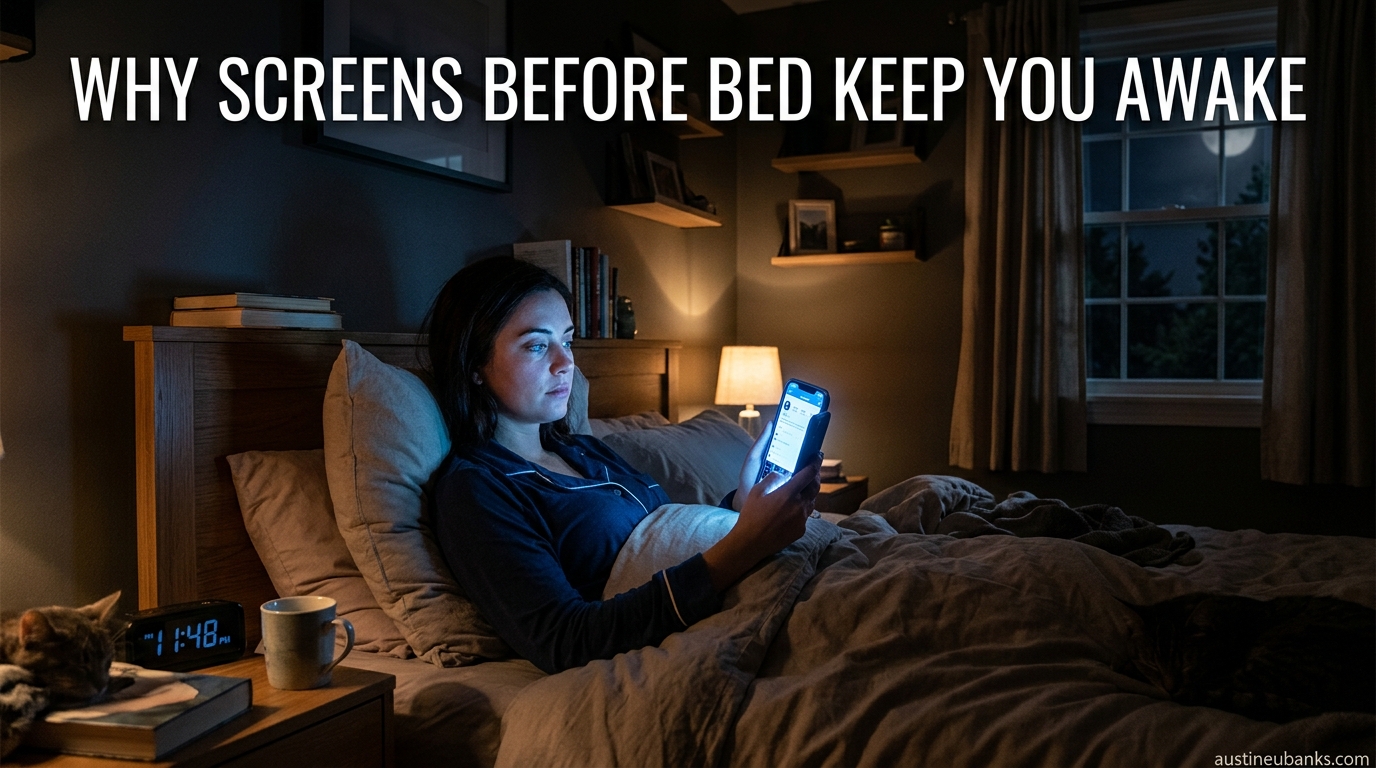
It is 11:30 PM. You tell yourself you will just check one more thing on your phone. Suddenly it is 1:15 AM, you have fallen down a rabbit hole of videos and articles, and you cannot fall asleep. If this sounds familiar, you are experiencing exactly why screens before bed keep you awake.
Screens keep you awake through two main mechanisms: they emit blue light that suppresses melatonin (the hormone that makes you sleepy), and they stimulate your brain with engaging content that prevents mental relaxation. Together, these effects trick your body into thinking it is still daytime while keeping your mind too active to wind down.
In this article, our team breaks down the science behind blue light, melatonin suppression, circadian rhythm disruption, and mental stimulation from screens. We also share practical tips, screen time guidelines like the 3-6-9-12 rule, and realistic strategies to help you sleep better tonight.
Table of Contents
How Blue Light Tricks Your Brain Into Thinking It Is Daytime
Blue light is the main reason screens before bed keep you awake. But not all light affects your brain the same way.
Light travels in waves of different lengths. Blue light sits in the 380 to 500 nanometer range on the visible light spectrum, with the most disruptive wavelengths around 460 to 480 nanometers. Your phone screen, tablet, computer monitor, and television all emit high concentrations of light in exactly this range.
The sun also produces blue light, which is why exposure to natural daylight helps you feel alert and awake. The problem is that your brain cannot tell the difference between sunlight and the artificial blue light from your devices. When you scroll through your phone at 10 PM, your eyes absorb that blue light and send a clear signal to your brain: it is still daytime, so stay awake.
A Harvard Medical School study found that blue light exposure at night suppresses melatonin production for up to twice as long as green light exposure. The same study showed that blue light shifts circadian rhythms by twice as much. This means even brief screen sessions before bed can have a measurable impact on your body’s internal clock.
Blue light is not inherently harmful. During the day, it boosts attention, reaction times, and mood. The danger comes from exposing yourself to concentrated blue light at night, when your body is trying to prepare for sleep.
Melatonin Suppression: The Hormone That Tells You It Is Sleep Time
To understand why screens before bed keep you awake, you need to understand melatonin. Melatonin is a hormone produced by the pineal gland, a small structure deep in your brain. It acts as your body’s chemical signal that it is time to sleep.
Under normal conditions, melatonin production begins to rise about two hours before your usual bedtime. This gradual increase makes you feel drowsy and prepares your body for sleep onset. Levels peak during the night and drop off as morning approaches, helping you wake up naturally.
Here is where screens cause trouble. When blue light from your phone or tablet enters your eyes, it hits specialized cells called photosensitive retinal ganglion cells. These cells send a direct message to the suprachiasmatic nucleus, the master clock in your brain. That master clock then tells the pineal gland to stop producing melatonin.
Research from the National Sleep Foundation shows that even dim screen light can reduce melatonin production. A study published in the Journal of Applied Physiology found that exposure to a backlit screen for just two hours at night suppressed melatonin levels by approximately 22 percent compared to reading a printed book.
The less melatonin your body produces, the harder it becomes to fall asleep. You might feel tired but find yourself lying awake, unable to drift off. This is your brain running low on the exact hormone it needs to initiate sleep.
How Screens Disrupt Your Circadian Rhythm
Your circadian rhythm is your body’s internal 24-hour clock. It regulates not just sleep but also body temperature, hormone release, digestion, and immune function. When screens before bed keep you awake, they are actively pushing your circadian rhythm out of alignment.
The suprachiasmatic nucleus, located in the hypothalamus, serves as the conductor of this internal orchestra. It uses light signals from your eyes to keep everything in sync with the natural day-night cycle. Bright light during the day reinforces healthy rhythms. Artificial light at night scrambles them.
When you use screens late at night, you essentially feed your master clock false information. Your brain adjusts its timing based on the light it receives. If you regularly scroll your phone until midnight, your circadian rhythm shifts later. Your body starts treating midnight as the beginning of evening rather than the middle of the night.
This shift creates a cascading effect. You fall asleep later, wake up later, and feel groggy in the morning. Over time, chronic circadian rhythm disruption has been linked to serious health issues including increased risk of depression, metabolic disorders, weakened immune function, and cardiovascular problems.
Dr. Michelle Drerup, a sleep specialist at the Cleveland Clinic, notes that people who consistently use screens before bed often develop a delayed sleep phase. Their bodies simply do not feel sleepy at a normal hour anymore because the circadian clock has been pushed back.
The good news is that circadian rhythms can be reset. But it requires consistency. One screen-free night will not fix weeks of late-night scrolling.
Why Screens Keep Your Mind Racing at Night
Blue light is only half the story. The other major reason screens before bed keep you awake is cognitive and emotional stimulation. Even if you dim your screen and turn on night mode, what you do on that screen matters enormously.
Sleep researchers distinguish between active and passive screen use. Active use involves interaction: scrolling social media, playing games, responding to emails, texting friends, or reading news articles. Passive use includes watching a movie or listening to a podcast. Active screen use is far more disruptive to sleep because it keeps your brain engaged and processing information.
Doomscrolling is perhaps the worst offender. The term describes the habit of endlessly scrolling through negative news, social media arguments, or anxiety-inducing content. Each post, headline, or video gives your brain a small hit of dopamine and cortisol. These are alertness chemicals, not relaxation chemicals.
Emotional content plays a significant role too. Seeing a stressful work email, reading distressing news, or getting into a heated social media debate triggers your body’s fight-or-flight response. Your heart rate increases, your breathing quickens, and cortisol levels spike. None of this is compatible with falling asleep.
Even seemingly harmless activities like watching an exciting show or playing a casual game can keep you awake. Your brain treats engaging content as stimulation. The more invested you are in what is on your screen, the harder it becomes for your mind to transition into a calm, sleep-ready state.
Users on Reddit’s r/sleep community frequently share that doomscrolling keeps them awake for hours beyond their intended bedtime. Many report that the hardest part of breaking the habit is the loop of tiredness followed by a dopamine hit that temporarily masks the fatigue.
The 3-6-9-12 Rule and Other Screen Time Guidelines
If you are wondering how to apply this science to your daily life, several established guidelines can help. One of the most referenced frameworks is the 3-6-9-12 rule for screen time, developed by Dr. Dimitri Christakis and promoted by the American Academy of Pediatrics.
The 3-6-9-12 rule works as follows. No screen time at all for children under 18 months (the first 3 represents avoiding screens in early infancy). No more than one hour of quality screen time per day for children ages 2 to 5 (the 6 represents kindergarten age). No more than two hours of recreational screen time per day for children ages 6 to 9. And for children 12 and older, parents should establish individualized limits based on the child’s needs and responsibilities.
For adults, the most widely recommended guideline is to stop using all screens at least one hour before bed. Some sleep specialists recommend two hours for maximum benefit. This gives your brain time to produce melatonin naturally and begin the transition into sleep mode.
Is seven hours of total screen time per day healthy? Most research suggests no. Studies show that adults who exceed six hours of daily screen time report lower sleep quality, more difficulty falling asleep, and shorter total sleep duration. The issue is not just evening use but the cumulative effect of constant light exposure throughout the day.
Children are particularly vulnerable to the effects of screens before bed. Their developing brains are more sensitive to blue light, and their circadian rhythms are still being established. A study from the Penn State College of Medicine found that children who used screens before bed got less total sleep, had poorer sleep quality, and reported more excessive daytime sleepiness compared to children with no screen use before bed.
The key takeaway is that both the amount of screen time and the timing matter. An hour of phone use at noon will not disrupt your sleep. That same hour at 11 PM almost certainly will.
Do All Screens Affect Sleep Equally?
Not all screens have the same impact on your sleep. The type of device, its distance from your face, and the content you consume all influence how much it disrupts your rest.
Smartphones are generally the worst offenders. They are held close to your face, which means more concentrated blue light reaches your eyes. They are also the device most commonly used for active engagement: social media, texting, and browsing. This combination of intense light exposure and interactive content makes phones the most sleep-disruptive screen.
Tablets and laptops have similar effects because they also use backlit LED displays. The distance is slightly greater than a phone, but the blue light emission is comparable.
Televisions are interesting. They emit blue light, but they are typically positioned farther from your eyes. Watching a familiar, calming show on TV tends to be less disruptive than scrolling your phone in bed. However, watching exciting or stressful content close to bedtime can still cause problems.
What about e-readers? This is a common question on forums like r/sleep and r/IsItBullshit. E-ink devices like the basic Amazon Kindle do not emit blue light because they do not use backlit displays. They reflect ambient light, similar to a printed page. Reading on an e-ink device before bed is much less likely to disrupt sleep than reading on a phone or tablet.
Backlit e-readers, tablets, and phones with blue light filters or night mode are a middle ground. These features shift the display to warmer tones, reducing blue light emission. However, research shows they do not fully eliminate the problem. A study from the University of Houston found that blue-blocking glasses improved sleep for nighttime screen users, but melatonin suppression was still measurable compared to no screen use at all.
7 Practical Tips to Reduce Screen Time Before Bed
Knowing why screens before bed keep you awake is one thing. Actually changing the habit is another. Here are seven strategies that forum users and sleep experts consistently recommend.
1. Set a digital curfew. Pick a specific time each night to put away all devices. Start with 30 minutes before bed if one hour feels too ambitious. Gradually extend it as the habit sticks.
2. Charge your phone in another room. If your phone is on your nightstand, the temptation to check it is constant. Moving it across the room or to another part of the house removes the trigger entirely.
3. Replace screen time with a wind-down activity. Read a physical book, do light stretching, listen to calming music or a sleep podcast, journal, or practice deep breathing. Having a replacement activity makes the transition much easier.
4. Use night mode and do not disturb settings. If you must use a screen, enable night shift or blue light filter mode to warm the display. Turn on do not disturb to silence notifications. These are compromises, not solutions, but they reduce the damage.
5. Create a screen-free bedroom. Make your bedroom a device-free zone. This trains your brain to associate the space with sleep rather than stimulation. Keep a book on your nightstand instead of a phone.
6. Set a content boundary. If you do use screens before bed, avoid anything emotionally charged. No work emails, no news, no social media debates. Stick to familiar, low-stakes content.
7. Dim the lights in your home. Reduce overall light exposure in the hour before bed. Lower the brightness on overhead lights and lamps. This signals to your brain that evening is arriving and melatonin production should begin.
Reddit users who have successfully reduced nighttime screen time emphasize that the first week is the hardest. After that, most people report falling asleep faster, sleeping more deeply, and waking up feeling more refreshed. Consistency matters more than perfection.
FAQs
Do screens before bed really affect sleep?
Yes. Screens emit blue light that suppresses melatonin production and stimulate the brain with engaging content, both of which delay sleep onset and reduce sleep quality. Multiple peer-reviewed studies confirm that people who use screens before bed take longer to fall asleep and report poorer sleep than those who do not.
What is the 3 6 9 12 rule for screen time?
The 3-6-9-12 rule is a guideline for children: no screens before 18 months, no more than one hour daily for ages 2 to 5, no more than two hours of recreational screen time for ages 6 to 9, and individualized limits for children 12 and older. It was developed by Dr. Dimitri Christakis and promoted by the American Academy of Pediatrics.
What is the 3-3-3 rule for sleep?
The 3-3-3 sleep rule is a simplified wind-down guideline: avoid screens 3 hours before bed is too strict for most people, so a common practical version is to stop eating 3 hours before bed, avoid caffeine for at least 3 hours before sleep, and spend the last 30 minutes before bed on calming, screen-free activities.
Is 7 hours of screen time healthy?
Seven hours of daily screen time exceeds what most sleep and health experts recommend. Studies show adults who exceed six hours of screen time per day report lower sleep quality, more difficulty falling asleep, and shorter total sleep duration. Reducing overall screen time, especially in the evening, is linked to better sleep outcomes.
Take Control of Your Sleep Tonight
Screens before bed keep you awake through a combination of blue light exposure, melatonin suppression, circadian rhythm disruption, and mental stimulation. The science is clear and the research is consistent: what you do on your devices in the evening directly impacts how well you sleep.
You do not need to eliminate screens entirely to see benefits. Start with a 30-minute screen-free window before bed, move your phone out of the bedroom, and replace that scrolling habit with a calming activity. Small, consistent changes lead to measurable improvements in how fast you fall asleep and how rested you feel in the morning.
Your sleep is too important to sacrifice to a screen. Tonight might be the perfect night to try something different.