
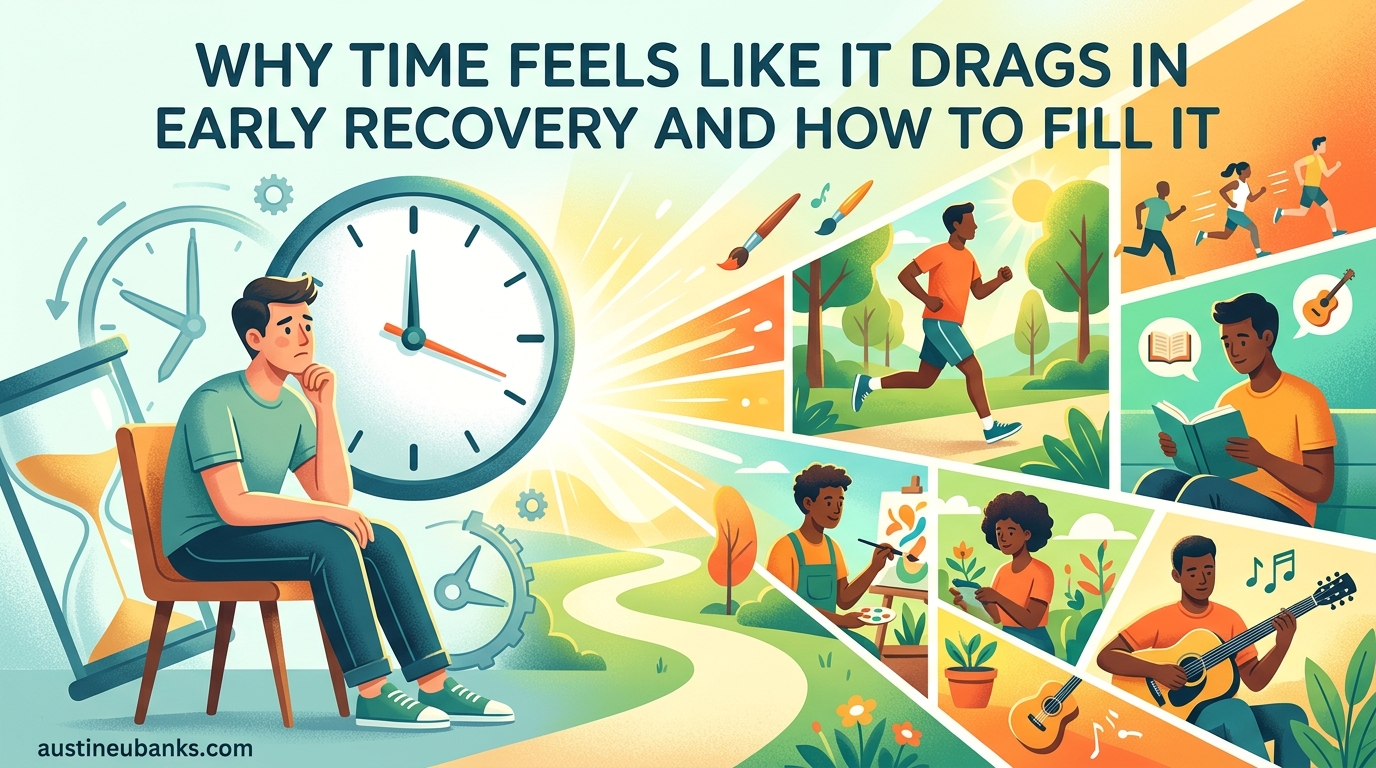
If you are in early recovery and it feels like every single day lasts a week, you are not imagining it. Time genuinely moves differently when you stop using substances, and the reason comes down to brain chemistry. Your dopamine system, which was artificially stimulated by drugs or alcohol, is recalibrating to normal levels. This recalibration makes everyday activities feel less rewarding, stretching out your subjective experience of each moment.
Why time feels like it drags in early recovery and how to fill it is one of the most common questions people ask in their first weeks of sobriety. On Reddit forums like r/stopdrinking and r/alcoholism, this experience comes up constantly. One person described waking up just four hours ago but feeling like an entire day had already passed. Another said that every time they get sober, time drags so badly that it becomes its own form of torture.
Here is what I want you to know: this feeling is real, it is biological, and it is temporary. In this article, our team breaks down exactly why time perception shifts during early recovery, what is happening in your brain, and practical strategies to fill those long hours without losing your mind. We also cover how to tell the difference between normal boredom and a relapse warning sign, plus daily routine templates you can start using today.
The boredom and restlessness that come with slow time in recovery are among the most common triggers for relapse. Left unaddressed, they can lead to isolation, rumination, and eventually returning to substance use just to escape the discomfort. Understanding what is happening in your brain and having a plan to fill your time is not just about comfort. It is about protecting your recovery.
Table of Contents
Why Does Time Feel Like It’s Dragging in Early Recovery?
The short answer is that your brain is paying more attention to time itself. When you remove substances that previously filled your hours, you become hyper-aware of the gaps. This heightened awareness literally changes how your brain processes the passage of time.
To understand this, it helps to know about two different ways your brain perceives time. Psychologists call these prospective time and retrospective time. Prospective time is what you experience in the moment, while you are waiting for something or paying attention to how long something is taking. Retrospective time is how long something feels after it has passed, based on how many memories you formed during that period.
In early recovery, your prospective time perception goes into overdrive. Without substances to blur the edges of your day, you feel every minute more sharply. You are essentially watching the clock, even when you do not mean to. Research over the past three decades has found that there is no single brain structure where time resides. Instead, time perception emerges from a complex interaction between attention, emotion, memory, and neural processing.
Several factors combine to make time drag specifically during early sobriety. First, the removal of substances means you have large blocks of unstructured time that were previously consumed by acquiring, using, or recovering from substances. Second, the emotional discomfort of withdrawal and craving makes each moment feel more intense and drawn out. Third, without the dopamine hits from substances, your brain is not getting the same level of stimulation that made time seem to fly by.
One Reddit user in r/Sober described a breakthrough moment: realizing that normal people do not feel excitement all the time. Normal life is boring sometimes, and that is okay. This insight matters because it reframes the experience. Time is not dragging because something is wrong with you. It is dragging because you are experiencing unfiltered reality for the first time in a while.
The Brain Chemistry Behind Time Perception in Recovery
Dopamine is the central player in this story. It is a neurotransmitter that regulates motivation, reward, pleasure, and motor function. When you use substances, whether alcohol, opioids, stimulants, or others, they artificially flood your brain with dopamine or interfere with its reuptake. This creates intense feelings of pleasure and reward that your brain does not naturally produce on its own at those levels.
Over time, your brain adapts to this artificial flooding by reducing its own dopamine production and reducing the number of dopamine receptors. This is called downregulation. When you stop using substances, your dopamine system is suddenly operating at a deficit. Your brain is producing less dopamine naturally, and it has fewer receptors available to receive what little dopamine exists.
This dopamine deficit is why normal activities feel unrewarding in early recovery. Things that used to bring you pleasure, like watching a movie, eating a good meal, or spending time with friends, suddenly feel flat and uninteresting. Your brain literally cannot process these experiences as rewarding because the chemical infrastructure for doing so has been suppressed.
One person in r/stopdrinking put it perfectly: early sobriety feels boring, but it is not because life actually is boring. It is because your brain’s dopamine system is still out of whack. The world has not changed. Your ability to experience it as rewarding has temporarily diminished.
How long this dopamine deficit lasts depends on the substance, the duration and intensity of use, and individual factors like genetics and overall health. Generally, dopamine receptor levels begin to normalize within a few weeks of abstinence, but full recovery of the reward system can take anywhere from several months to over a year. During this window, time perception remains altered because your brain is still recalibrating what feels rewarding.
Withdrawal symptoms also play a role in stretching time. Physical discomfort, anxiety, irritability, and sleep disturbances make each hour feel longer because they demand your constant attention. Your brain cannot ignore these signals, so it processes them continuously, which makes time feel like it is crawling.
The Dopamine Recovery Timeline: What to Expect
Understanding the dopamine recovery timeline helps you know what to expect and when. Time perception does not reset overnight. It shifts gradually as your brain heals, and knowing the rough stages can help you endure the slow periods.
During days 1 to 7, dopamine levels are at their lowest. This is the acute withdrawal phase, where time feels the slowest and most painful. Most people describe this period as the hardest. Every hour feels significant, and the lack of reward from normal activities is at its peak. Your brain is essentially running on empty.
From weeks 2 to 4, dopamine receptor density begins to slowly increase. The acute physical withdrawal symptoms typically subside, but the emotional flatness and boredom remain. Time still drags, but the worst of the physical discomfort starts to fade. Many people describe this phase as a gray zone where they feel physically better but emotionally numb.
During months 2 to 6, the brain’s reward system continues rebuilding. You may start noticing small moments of genuine pleasure returning. A song sounds good again. Food tastes better. A conversation feels meaningful. These moments are signs that your dopamine system is recovering, and they mark a shift in time perception. Time starts to feel a little more normal because your brain has more reference points for rewarding experiences.
From months 6 to 12, most people experience significant improvement in how they perceive time. The brain’s reward pathways have largely normalized, and everyday activities feel genuinely rewarding again. Days begin to pass at what feels like a normal pace. This does not mean every day is exciting, but the excruciating slowness of early recovery has faded.
It is worth noting that different substances affect this timeline differently. Stimulants like cocaine and methamphetamine cause more severe dopamine disruption, meaning recovery can take longer. Alcohol and opioids also significantly impact dopamine, but the timeline tends to be somewhat shorter. Regardless of the substance, the trend is the same: time perception normalizes as the brain heals.
Boredom as a Relapse Trigger: Why It Matters
Boredom is not just uncomfortable in early recovery. It is one of the most dangerous relapse triggers. Multiple studies and clinical observations have identified boredom as a primary factor in relapse, especially during the first 90 days of sobriety. The reason is straightforward: when your brain is craving dopamine and everyday activities cannot provide it, the urge to return to substances becomes overwhelming.
But not all boredom is the same. Understanding the difference between healthy boredom and dangerous boredom can help you know when to push through and when to take action.
Healthy boredom is the natural gap between activities. It is the quiet moment when you are between tasks, waiting for something, or simply resting. This type of boredom is normal and even beneficial. It gives your brain space to rest, process, and reset. Everyone experiences this, not just people in recovery. Learning to tolerate this kind of boredom is actually a skill that strengthens your recovery over time.
Dangerous boredom is different. It is persistent, pervasive, and accompanied by restlessness that you cannot seem to shake. It feels like you are crawling out of your skin. This type of boredom is often accompanied by isolation, rumination about past substance use, and a growing sense that sobriety is not worth it. Left unaddressed, dangerous boredom can quickly escalate into craving and relapse.
Here are seven warning signs that boredom is becoming a relapse risk. First, you start romanticizing your past substance use, remembering only the good times. Second, you withdraw from social contact and stop attending meetings or support groups. Third, you feel irritable and restless no matter what activity you try. Fourth, you start justifying why one drink or one use would not be a big deal.
Fifth, you lose interest in activities that previously brought you some satisfaction. Sixth, you find yourself spending excessive time alone with your thoughts, replaying negative memories. Seventh, you stop following your recovery routine and start making impulsive decisions. If you notice three or more of these signs simultaneously, treat it as a warning that your boredom has crossed from uncomfortable to dangerous.
The good news is that dangerous boredom is preventable and addressable. The strategies in the next sections are designed specifically to interrupt the cycle before it leads to relapse.
How to Make Time Pass More Quickly: Science-Backed Strategies
There are five science-backed strategies that genuinely change how your brain perceives time in early recovery. These are not just distractions. They work by engaging the same neural mechanisms that substances hijacked, but in healthy and sustainable ways.
Strategy one is to create flow states. Flow is the psychological state where you become so absorbed in an activity that you lose track of time entirely. The researcher Mihaly Csikszentmihalyi documented this extensively. Flow happens when a task is challenging enough to require your full attention but not so difficult that it causes anxiety. In early recovery, finding activities that produce flow is one of the most effective ways to make time pass. Building models, painting, coding, playing an instrument, woodworking, and writing are all activities that commonly produce flow states.
Strategy two is to seek novelty. Your brain pays more attention to new experiences, which is why time seems to pass faster when you are doing something for the first time. This is also why time seemed to fly by during active addiction, because substance use cycles were filled with unpredictable experiences. In recovery, you can recreate this effect by deliberately trying new things. Take a different route home. Try a food you have never eaten. Visit a neighborhood you have never explored. Each new experience gives your brain fresh data to process, which helps time move more quickly in the moment and creates more memories, which helps retrospectively as well.
Strategy three is to build social connection. Time passes faster when you are with other people. This is not just a feeling. Studies on time perception consistently show that social interaction reduces attention to the passage of time. When you are engaged in conversation, shared activity, or even just sitting with someone you trust, your brain shifts its focus from internal time monitoring to external social engagement. This is why support groups, recovery meetings, and sober social events are so valuable. They do not just provide accountability. They change how you experience time.
Strategy four is mindfulness practice. This might sound contradictory, since paying attention to the present moment can make time feel slower in the short term. But mindfulness also reduces the emotional suffering that makes slow time feel unbearable. By accepting the present moment without fighting it, you reduce the anxiety and restlessness that amplify time distortion. Over time, regular mindfulness practice helps your brain become less reactive to boredom, which means slow periods stop feeling like emergencies.
Strategy five is physical engagement. Exercise, particularly activities that elevate your heart rate and require coordination, engages multiple brain systems simultaneously. Running, swimming, rock climbing, martial arts, dancing, and team sports all demand sustained attention that crowds out time monitoring. Exercise also boosts dopamine and endorphin levels naturally, which directly addresses the chemical deficit driving your discomfort. One Reddit user in r/stopdrinking shared that finding a sport that gave them a rush was what kept drug use in check. Physical activity provides a healthy substitute for the intensity that substances offered.
Filling Time with Purpose: Activity Ideas for Early Recovery
Not all activities are equally effective at filling time in recovery. Some merely kill time while leaving you feeling empty. Others genuinely engage your brain and help rebuild your reward system. Based on forum discussions, clinical recommendations, and the science of flow and dopamine, here are the most effective activities for filling time in early recovery.
Exercise and physical activity rank at the top because they directly address the dopamine deficit while also producing flow states. This includes gym workouts, running, hiking, swimming, cycling, yoga, and team sports. The key is consistency and choosing something you can stick with.
Creative hobbies are second on the list because they engage your brain deeply enough to produce flow. Painting, drawing, writing, playing music, knitting, woodworking, cooking, and photography all qualify. The specific activity matters less than the fact that it absorbs your attention and produces something tangible.
Learning a new skill ranks third because novelty accelerates time perception. Online courses, language learning, coding, woodworking, gardening, or anything that challenges you to acquire new competence works well. The learning process itself is rewarding because it provides small dopamine hits with each new milestone.
Volunteering ranks fourth because it combines social connection with a sense of purpose. Animal shelters, food banks, community gardens, and recovery organizations all need help. Volunteering shifts your focus from your own discomfort to someone else’s needs, which provides immediate relief from the self-focused boredom cycle.
Support group attendance ranks fifth. This includes 12-step meetings, SMART Recovery, Refuge Recovery, or any community-based recovery group. Meetings provide structure, social connection, and accountability all at once. The traditional suggestion of 90 meetings in 90 days exists precisely because it fills time with something meaningful during the hardest period.
Outdoor activities rank sixth. Nature changes your sensory environment, which provides novelty and reduces the mental loop of boredom. Hiking, fishing, camping, bird watching, or simply walking in a park can shift your perspective enough to break the slow-time cycle.
Reading and journaling rank seventh. Books absorb attention and produce flow, while journaling helps process the emotions that amplify time distortion. Many people in recovery credit journaling with helping them survive the first few months.
Connection with loved ones ranks eighth. Rebuilding relationships damaged by addiction takes time, and that time is well spent. Phone calls, visits, shared meals, and honest conversations all qualify.
Home projects rank ninth. Cleaning, organizing, repairing, or redecorating your living space provides visible progress and a sense of accomplishment. It also improves your environment, which supports overall well-being.
Meditation and breathwork rank tenth. While meditation may not make time pass quickly in the moment, it builds the tolerance for stillness that reduces the suffering of slow time over the long run.
It is also important to recognize that introverts and extroverts need different approaches. Extroverts recharge through social interaction, so group activities, meetings, team sports, and volunteering will be most effective. Introverts recharge through solo engagement, so creative hobbies, reading, journaling, and individual exercise may work better. Neither approach is wrong. The key is matching the activity to your personality type so that it actually engages you rather than draining you further.
One Reddit user shared their personal toolkit: watching shows, writing in a journal, working on their business, coloring, doing crossword puzzles, cleaning, working out, doing laundry, and walking. The variety matters. No single activity will fill every gap, so having a diverse toolkit is essential.
It is also worth acknowledging the truth that one forum user pointed out: being wasted all the time was mostly boring too. Sitting on a couch or barstool drinking is not actually exciting. Sobriety does not take away an exciting life. It reveals that the life was not as exciting as the substances made it feel. Normal life for normal people is boring sometimes, and that is not a problem to be solved. It is a reality to be accepted.
Building a Structured Daily Routine in Early Recovery
Structure is the single most effective weapon against the slow-time problem. When your days have a predictable shape, your brain stops constantly checking what time it is. Structure reduces decision fatigue, which is especially important in early recovery when your cognitive resources are already depleted by withdrawal and emotional processing.
Here is a sample routine for the first 7 days of recovery, when time feels the slowest and cravings are strongest. Morning starts with waking at the same time each day, followed by a simple breakfast and hydration. Mid-morning, attend a meeting, call your sponsor or a support person, or join an online recovery group. Lunch is at a set time, followed by a walk or light exercise. Afternoon includes a structured activity like reading, journaling, or a creative hobby. Late afternoon is another meeting or support call. Evening dinner is at a consistent time, followed by a relaxing activity like watching a show or listening to music. Bedtime should be early and consistent, since sleep is critical for brain recovery. The goal of this routine is not productivity. It is survival and structure.
For weeks 2 to 4, the routine can expand to include more variety and personal development. Morning might include exercise before breakfast. Mid-morning could involve work, volunteering, or a class. Afternoon activities can become more ambitious, like starting a new hobby or skill. Evening might include sober social activities rather than just solo relaxation. This is also when you can start building relationships with people in recovery, attending regular meetings, and establishing a network of sober friends.
For months 2 to 6, the routine should start feeling more like a normal life rather than a recovery program. Work or school should be a central part of the day. Hobbies should be well-established and producing tangible results. Social life should include regular contact with sober friends and ongoing involvement in a recovery community. Exercise should be a consistent habit, not an occasional effort. The routine at this stage should feel sustainable and even enjoyable, reflecting the fact that your brain is healing and normal activities are becoming genuinely rewarding again.
One critical tip for nighttime specifically: evenings are when time drags the most for most people in early recovery. The structure of the day is gone, meetings are over, and the quiet can feel unbearable. Having a specific evening routine is essential. This might include a set dinner time, a walk after dinner, a specific show or book to engage with, a journaling practice, and a consistent bedtime. Some people find that having a phone call scheduled with a supportive person every evening provides the structure they need to get through the hardest hours.
It is also worth addressing phone and screen usage. Scrolling social media may feel like filling time, but it often increases restlessness and dissatisfaction. Instead of passively scrolling, use your phone deliberately. Call someone. Listen to a recovery podcast. Use a meditation app. Follow a guided workout. The phone itself is neutral. How you use it determines whether it helps or hurts your recovery.
The watching-the-clock paradox deserves special attention. The more you check the time, the slower it feels. This creates a feedback loop where boredom leads to clock-checking, which increases awareness of slow time, which increases boredom. The solution is to remove clocks from your immediate view when possible, avoid checking your phone for the time, and trust your routine to carry you through the day. If you know your schedule, you do not need to check what time it is. You simply move to the next activity when the current one is done.
FAQs
How long does it take for time to feel normal in recovery?
Time perception typically begins normalizing within 2 to 4 weeks as acute withdrawal subsides and dopamine receptors start recovering. Most people notice a significant improvement by month 3, and by month 6, days generally pass at what feels like a normal pace. Full normalization of the brain’s reward system can take up to 12 months, depending on the substance, duration of use, and individual factors.
Is boredom normal in early recovery?
Yes, boredom is completely normal in early recovery. Your brain’s dopamine system is recalibrating after being artificially stimulated by substances, which makes everyday activities feel less rewarding. This creates a temporary period where life feels flat and uninteresting. As your dopamine receptors recover over the first few months, normal activities will begin to feel rewarding again.
Why does sobriety feel boring at first?
Sobriety feels boring at first because substances artificially flooded your brain with dopamine, making everything feel more intense and exciting. Without that artificial stimulation, your underperforming dopamine system cannot process everyday experiences as rewarding. The boredom is not a sign that sobriety is wrong. It is a sign that your brain is healing and needs time to recalibrate its reward pathways.
What activities help fill time in early recovery?
The most effective activities for filling time in early recovery include exercise, creative hobbies that produce flow states, learning new skills, volunteering, attending support groups, outdoor activities, reading and journaling, and rebuilding relationships. The key is choosing activities that engage your brain deeply enough to reduce attention to the passage of time while also supporting your recovery goals.
Is boredom a sign of relapse in recovery?
Boredom itself is not a sign of relapse, but persistent boredom accompanied by restlessness, isolation, romanticizing past substance use, and withdrawing from support systems can indicate escalating relapse risk. The key distinction is between healthy boredom, which is tolerable and temporary, and dangerous boredom, which feels unbearable and comes with thoughts about using. If boredom crosses into dangerous territory, reach out to your support network immediately.
How do you deal with nights when time drags the most?
Nights are the hardest because structure disappears and you are alone with your thoughts. Build a specific evening routine that includes a set dinner time, a walk or light activity, an engaging activity like reading or watching a show, journaling, and a consistent bedtime. Having a scheduled phone call with a supportive person each evening can provide the structure needed to get through the hardest hours.
How can I make time pass faster in early sobriety?
Time passes fastest when your brain is fully engaged. Create flow states through challenging creative activities, seek novelty by trying new things, build social connection through meetings and sober events, exercise to boost dopamine naturally, and maintain a structured daily routine that eliminates decision fatigue. Avoid checking the clock repeatedly, as this creates a feedback loop that makes time feel even slower.
Conclusion: The Slow Time Will Pass
If there is one thing to take away from all of this, it is that the slow time of early recovery is not permanent. It is a symptom of your brain healing, and it will pass. Understanding why time feels like it drags in early recovery and how to fill it gives you a roadmap for one of the hardest parts of getting sober.
The strategies that work are not complicated, but they require consistency. Build a structured daily routine. Find activities that create flow states. Exercise to boost your dopamine naturally. Stay connected to other people. Stop checking the clock. And learn to tolerate the healthy boredom that comes with normal life, because that tolerance is itself a recovery skill.
Most importantly, remember that the people who have been through this before you report the same thing: it gets better. The days that currently feel like weeks will eventually pass like normal days again. Your brain will recover. Activities will feel rewarding again. And the time you spent enduring the slowness will have built a foundation of resilience that no substance can provide.
Your next step is simple. Pick one strategy from this article and try it today. Not next week, not when you feel ready, but today. Call someone. Go for a walk. Start a journal. Attend a meeting. The slow time loses its power the moment you fill it with something that matters.