
Have you ever found yourself reacting to something small with a wave of emotion that felt way too big for the moment? Maybe a coworker gave you mild feedback and you spiraled for hours. Or a friend took a few hours to text back and suddenly your chest was tight with panic.
If this sounds familiar, you are far from alone. Thousands of people search every month trying to understand why their emotional reactions feel disproportionate to what just happened. The answer often goes deeper than the present moment.
Understanding why people overreact emotionally trauma connections is key to making sense of these experiences. When past painful experiences are stored in your nervous system, present situations can trigger responses that feel confusing, overwhelming, and out of your control.
This article breaks down what emotional overreaction actually is, how trauma reshapes the nervous system, and why your reactions make more sense than you might think. You will also find practical strategies for working with your emotional responses rather than against them.
Whether you are trying to understand yourself better or make sense of a loved one’s reactions, what follows can help you approach emotional reactivity with clarity and compassion.
Table of Contents
What Does It Mean to Overreact Emotionally?
An emotional overreaction is a response that feels out of proportion to the situation that triggered it. The reaction may be stronger, last longer, or feel harder to control than what the moment seems to call for.
Here is the important distinction: what looks like an overreaction from the outside is rarely about what is happening right now. In the context of past painful experiences, your nervous system may be reacting to a reminder of something that once felt threatening. The present situation is simply the trigger that activated an older, stored response.
People who experience this often describe feeling confused or even embarrassed afterward. They know their reaction was bigger than the moment warranted, but they could not stop it in real time. This gap between knowing and doing is one of the clearest signs that the nervous system, not conscious choice, is driving the response.
It is also worth noting that everyone overreacts sometimes. A bad night of sleep, ongoing stress, or a difficult week can amplify any person’s emotional responses. The difference with trauma-related reactivity is the pattern: reactions happen frequently, feel automatic, and seem impossible to regulate in the moment.
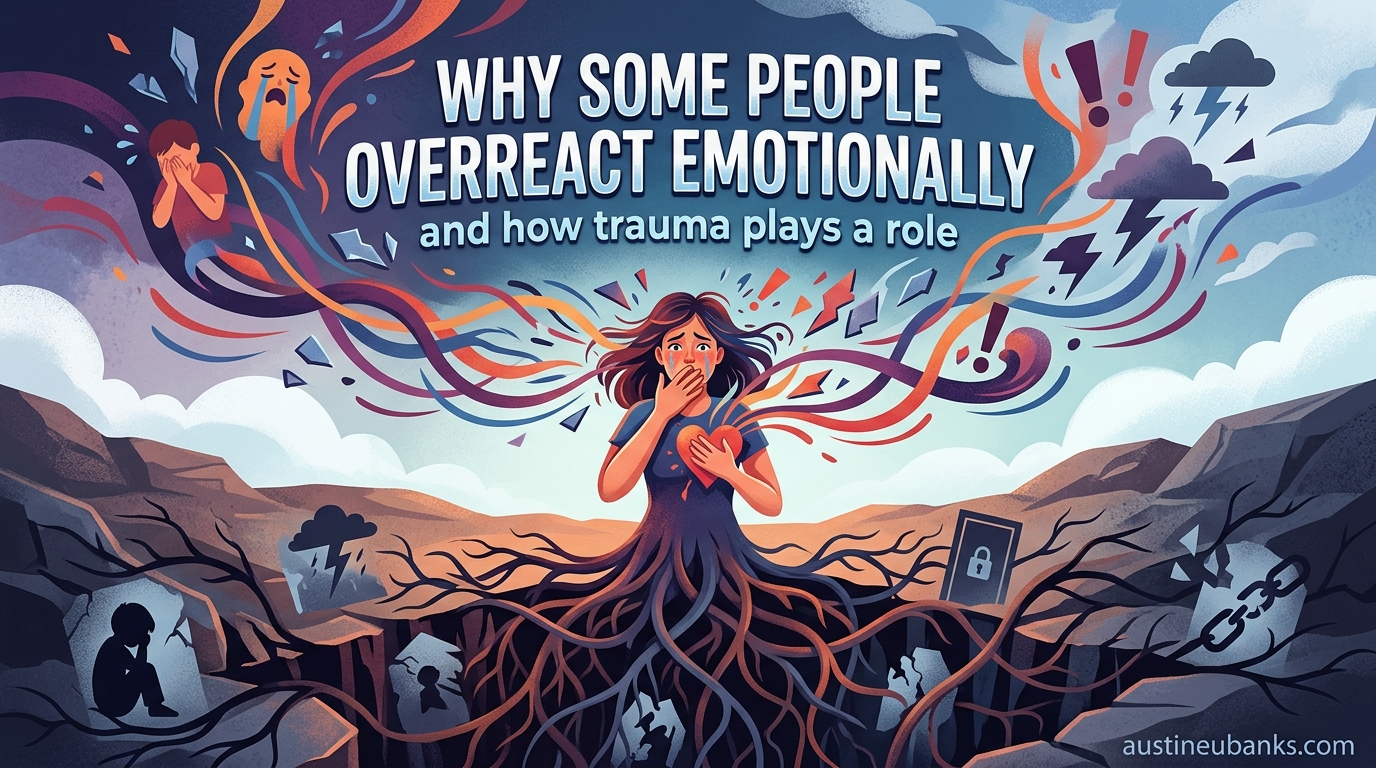
Why Some People Overreact Emotionally and How Trauma Plays a Role
When we talk about why people overreact emotionally trauma is usually a central factor. Painful experiences, especially ones that were overwhelming or happened without enough support, change how the brain and nervous system process threat and safety.
Here is what happens at a basic level. When you go through something that feels dangerous, either physically or emotionally, your nervous system records that experience as a threat to watch for in the future. It becomes hypervigilant, scanning your environment for anything that resembles the original situation. When it finds even a vague match, it triggers a protective response.
This protective response is what can look like overreacting. A raised voice might activate the same alarm system that a genuine threat once did. A delayed text reply might trigger abandonment fear rooted in past rejection. The nervous system is not broken; it is doing exactly what it was designed to do, which is keep you safe. The problem is that it is responding to ghosts of past danger rather than the reality of the present moment.
What makes this especially confusing is that you may not consciously connect your reaction to anything from your past. The memory driving the response may be implicit, meaning it lives in your body and nervous system rather than in your conscious awareness. You feel the emotion intensely, but you may not know why.
The Nervous System and Emotional Overreaction
To really understand emotional overreaction, it helps to look at what is happening in the nervous system. Two key brain regions play central roles: the amygdala and the prefrontal cortex.
The amygdala acts as your brain’s threat detection system. It scans constantly for danger and can trigger a fight-or-flight response in milliseconds, long before your conscious mind has time to evaluate the situation. After painful experiences, the amygdala can become hypersensitive, meaning it starts seeing threats even where none exist.
The prefrontal cortex is your brain’s reasoning center. It helps you evaluate situations, regulate impulses, and make thoughtful decisions. When the amygdala triggers a threat response, it effectively overrides the prefrontal cortex. This is why, in the middle of an emotional overreaction, you may not be able to think clearly or talk yourself down. Your thinking brain has been temporarily sidelined by your survival brain.
The hippocampus also plays a role. It helps contextualize memories, telling your brain whether a current situation is truly dangerous or just reminds you of something that was. In people with trauma histories, the hippocampus can become less effective at this contextualizing work, which means the nervous system has a harder time distinguishing between past danger and present safety.
Nervous System Dysregulation
Nervous system dysregulation happens when your autonomic nervous system gets stuck in a state of activation. Instead of moving fluidly between alert and calm states, your system stays locked in fight, flight, freeze, or fawn mode.
This state of chronic activation is sometimes called hyperarousal. You might feel on edge, startle easily, or find it impossible to fully relax. When your baseline is already elevated, even minor stressors can push you over your threshold into a full emotional response.
The Window of Tolerance
Psychologist Dan Siegel coined the term “window of tolerance” to describe the zone of nervous system arousal where you can function, think clearly, and respond to life flexibly. Inside this window, you can handle stress and process emotions without becoming overwhelmed.
Painful experiences narrow this window. What used to feel manageable suddenly feels intolerable. Situations you could previously handle with ease begin pushing you outside your window, either into hyperarousal (anxiety, anger, panic) or hypoarousal (numbness, dissociation, shutdown).
The good news is that the window of tolerance is not fixed. With consistent practice, therapeutic support, and nervous system regulation techniques, it can be widened over time. Expanding your window means you can handle more without tipping into an overreaction.
5 Common Signs Your Reaction May Be Trauma-Related
Not every intense emotional reaction comes from past painful experiences. But certain patterns suggest your nervous system may be responding to more than just the current moment. Here are five common signs.
1. The reaction feels automatic and hard to stop. You may feel the emotion rising and know it does not match the situation, but you cannot slow it down or talk yourself out of it in real time. This happens because the response is being driven by your nervous system, not your conscious mind.
2. Small triggers set off large responses. A minor criticism, a change in plans, or an ambiguous text message can trigger a wave of emotion that feels completely out of scale. If you frequently notice that small things upset you in a big way, your nervous system may be responding to older material.
3. The emotion lasts much longer than the situation warrants. A stressful moment at 10 in the morning might still be affecting you at 10 at night. When your nervous system is activated by past experiences, it takes longer to return to baseline.
4. You experience physical symptoms along with emotional ones. Racing heart, tight chest, shallow breathing, sweating, or a sudden urge to flee are all signs that your body has entered a threat response. These physical sensations are driven by the autonomic nervous system, not by your conscious choice.
5. You feel shame or confusion after the reaction passes. Once the nervous system calms down and your prefrontal cortex comes back online, you may feel embarrassed, guilty, or confused about the intensity of your response. This shame cycle is extremely common and actually reinforces the pattern by adding more stress to your system.
How Childhood Trauma Shapes Adult Emotional Reactivity
Some of the most powerful drivers of adult emotional overreaction trace back to childhood. This does not only mean severe abuse or neglect. Emotional patterns established early in life, even in families that looked fine from the outside, can profoundly shape how your nervous system responds decades later.
Children are entirely dependent on their caregivers for survival. When a child’s emotional needs are consistently unmet, when they feel unsafe expressing certain feelings, or when they experience unpredictable or frightening behavior from adults around them, their nervous system adapts. It learns to stay on high alert, to suppress certain emotions, or to mobilize quickly in response to perceived threats.
These adaptations are intelligent survival strategies. The problem is that they were designed for a specific environment, usually one the person no longer lives in. An adult who learned as a child that criticism meant rejection may still react to mild workplace feedback as though their survival is at stake.
Attachment patterns also play a significant role. If a child did not consistently experience that their emotions were welcomed, validated, and soothed by a caregiver, they may not have developed the internal skills for self-regulation. As an adult, emotional triggers can feel especially overwhelming because there is no internal template for moving through them.
The Stress Bucket Concept
Think of your nervous system as having a bucket that collects stress. Each difficult experience, each unmet need, each overwhelming moment adds water to the bucket. When the bucket is nearly full, it takes only a few drops to make it overflow.
This is why you might handle a stressful situation fine one day and fall apart over something similar the next. The difference is not the trigger. It is how full your bucket was when the trigger arrived. Past painful experiences fill the bucket significantly, leaving less room for everyday stressors before overflow happens.
Emotional Flashbacks: When the Past Shows Up in the Present
One concept that helps explain many emotional overreactions is the emotional flashback. Unlike a visual flashback, which involves seeing or reliving a specific memory, an emotional flashback is the sudden re-experiencing of a feeling from the past without the visual component.
You might suddenly feel overwhelming shame, fear, abandonment, or rage that seems to come out of nowhere. The feeling is intense, immediate, and feels completely real, because to your nervous system, it is real. Your body is re-experiencing an emotional state from a past moment of danger or pain.
This is why emotional flashbacks are so often mistaken for overreactions. From the outside, the person seems to be reacting to something small. From the inside, they are flooded with emotion from a much larger, older experience.
People who frequent trauma support communities often describe this exact experience. They talk about reactions that feel disproportionate, confusion about why they cannot control their emotions, and the relief of learning that these responses have a name and a cause. Knowing that an emotional flashback is happening, even in the middle of one, can be the first step toward regulating it.
Practical Strategies to Regulate Emotional Reactivity
Understanding why you overreact is important, but you also need tools for what to do in the moment. The goal is not to never have strong emotions again. That is neither possible nor desirable. The goal is to widen your window of tolerance so you can experience emotions without being completely hijacked by them.
Here are five strategies that work directly with the nervous system.
1. Slow your exhale to signal safety. Your breath is the most direct tool you have for influencing your nervous system. When you are in fight-or-flight, your breathing becomes quick and shallow. To send a safety signal, make your exhale longer than your inhale. Try breathing in for four counts and out for six or eight counts. Do this for two to three minutes. The longer exhale activates your parasympathetic nervous system, which is responsible for calming the body down.
2. Use the 5-4-3-2-1 grounding technique. When you notice an emotional reaction building, bring your attention to your physical surroundings. Name five things you can see, four things you can touch, three things you can hear, two things you can smell, and one thing you can taste. This pulls your brain out of the emotional memory and into the present moment, where you are actually safe.
3. orient to your environment. Slowly look around the room you are in. Let your eyes and head move to take in the space. Notice the exits, the colors, the objects. This orienting response tells your nervous system that there is no predator in the room and no immediate threat. It is a subtle but powerful mammalian safety signal.
4. Name what is happening. When you can put words to your experience, you activate the prefrontal cortex and help it come back online. Try saying to yourself: “I am having a strong emotional reaction right now. My nervous system has been triggered. This feeling is real, and it is also from the past. I am safe in this moment.” Naming the experience creates just enough distance to prevent the emotion from completely taking over.
5. Practice self-compassion, not self-criticism. Shame about your emotional reactions actually reinforces the pattern. When you beat yourself up for overreacting, you add stress to an already activated system. Instead, try speaking to yourself the way you would speak to a friend. Remind yourself that your reactions make sense given what you have been through. Self-compassion is not letting yourself off the hook. It is creating the emotional safety your nervous system needs to calm down.
When to Seek Professional Help
Self-help strategies are valuable, but they are not always enough on their own. If emotional overreactions are frequent, intense, interfering with your relationships or work, or causing you significant distress, working with a therapist can make a meaningful difference.
Several therapy approaches are specifically designed to address nervous system dysregulation and trauma-related emotional reactivity. Somatic experiencing focuses on resolving stored stress responses through body awareness. EMDR (Eye Movement Desensitization and Reprocessing) helps the brain reprocess painful memories so they no longer trigger intense reactions. Dialectical Behavior Therapy (DBT) teaches specific emotional regulation skills. Internal Family Systems (IFS) works with the different parts of yourself that carry pain.
You do not need to have a formal diagnosis to benefit from therapy. If your emotional reactions are causing you pain, that is a valid reason to seek support. Many people wait years to get help because they think their experiences were not “bad enough” to warrant it. That waiting comes at a cost.
A qualified therapist can help you understand your specific patterns, identify your triggers, and build a personalized toolkit for regulation. They can also help you process the underlying experiences driving your reactions so that over time, the triggers lose their charge.
FAQs
Is overreacting a trauma response?
Yes, overreacting can be a trauma response. When your nervous system has been shaped by past painful experiences, it can react to present situations as though the old threat is happening again. What looks like an overreaction is often your body’s protective response being triggered by an emotional memory rather than the current moment.
How do you heal the brain after emotional trauma?
Healing the brain after emotional trauma involves helping the nervous system reprocess stored threat responses and expand its window of tolerance. Effective approaches include trauma-focused therapies like EMDR, somatic experiencing, and IFS. Consistent nervous system regulation practices like breathwork, grounding, and body awareness also support healing. Healing is a gradual process that requires patience, self-compassion, and often professional guidance.
What are five common signs a person is reacting to trauma?
Five common signs include: reactions that feel automatic and difficult to control, strong emotional responses to minor triggers, emotions that last much longer than the situation warrants, physical symptoms like racing heart or shallow breathing during emotional responses, and feelings of shame or confusion after the reaction passes.
What should you not say to someone with trauma?
Avoid dismissive statements like ‘you are overreacting,’ ‘it happened a long time ago,’ or ‘other people have it worse.’ Do not pressure them to share details before they are ready. Avoid saying ‘just get over it’ or suggesting they should be grateful the situation was not worse. Instead, validate their experience, ask what they need, and let them know their reactions make sense.
Can emotional trauma damage the nervous system?
Emotional trauma does not exactly damage the nervous system, but it does change how the nervous system functions. Trauma can cause the amygdala to become hypersensitive, weaken the hippocampus’s ability to contextualize memories, and reduce prefrontal cortex engagement during stress. These changes lead to nervous system dysregulation, but they are reversible with appropriate treatment and regulation practices.
What causes your nervous system to overreact?
Your nervous system overreacts when it perceives a threat, even if that threat is only a reminder of past danger rather than an actual present threat. Causes include unresolved painful experiences, chronic stress that fills your stress bucket, a narrowed window of tolerance from past adversity, and triggers that activate stored emotional memories. The overreaction is a protective mechanism, not a character flaw.
You Are Not Too Emotional
If there is one thing to take away from this article, it is this: your emotional reactions make sense. Understanding why some people overreact emotionally and how trauma plays a role reveals that these responses are not character flaws, signs of weakness, or evidence that something is wrong with you.
Your nervous system learned to protect you, and it is still trying to do that job. The patterns may no longer serve you, but they started as intelligent survival strategies. Approaching them with curiosity and compassion rather than judgment opens the door to real change.
Healing from emotional reactivity takes time, patience, and often support. But the window of tolerance can be widened. The stress bucket can be drained. Your nervous system can learn new patterns. Start where you are, use the strategies that resonate, and reach out for professional help if you need it. You deserve to feel in control of your own emotional life.