
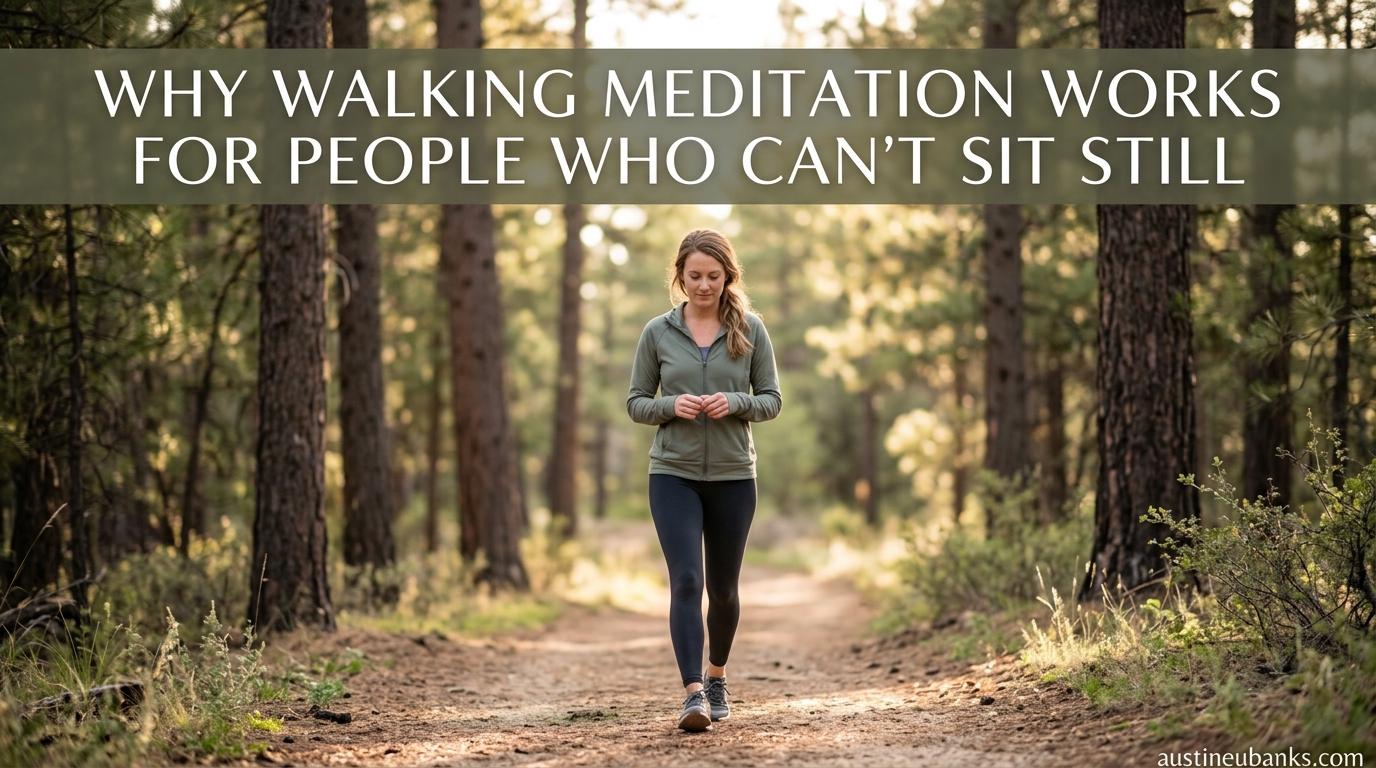
You close your eyes. You sit up straight. You try to focus on your breath.
Thirty seconds later, your left foot starts bouncing. Your shoulders feel tense. Your mind is replaying a conversation from three days ago. You shift position, trying again, but the restlessness only gets worse. By minute five, you are more stressed than when you started.
If this sounds familiar, you are not broken. You are not bad at meditation. And you are definitely not alone. Millions of people who try traditional sitting meditation give up within the first few sessions because sitting still feels physically uncomfortable, mentally agonizing, or both. Therapists recommend meditation for stress relief, but for people with ADHD, anxiety, or a naturally active nervous system, sitting meditation can backfire completely.
That is exactly why walking meditation works for people who can’t sit still. It takes the core benefits of mindfulness and pairs them with gentle movement, giving your body something to do while your mind settles. Instead of fighting your restlessness, you use it as the very tool that keeps you present.
In this guide, we will break down exactly why walking meditation works when sitting fails, what the science says, how to do it step by step, and which specific approaches help people with ADHD, anxiety, and overactive minds. We will also cover common mistakes, how to combine walking and sitting practice, and real experiences from people who finally found a meditation style that fits them.
Table of Contents
Why Walking Meditation Works for People Who Can’t Sit Still
Walking meditation works for people who can’t sit still because it gives your body continuous, purposeful movement while your mind stays anchored in present-moment awareness. Instead of asking a restless nervous system to freeze in place, walking meditation channels that physical energy into the practice itself.
There are three core reasons this approach succeeds where sitting meditation fails. First, movement regulates the nervous system, reducing the physical tension and psychomotor agitation that make sitting unbearable. Second, walking provides constant sensory input, which keeps an overactive mind engaged rather than spiraling into anxious thought loops. Third, the physical act of walking serves as a built-in anchor, giving your attention something tangible to return to every time it wanders.
For people with ADHD, anxiety, or neurodivergent traits, this combination of movement plus mindfulness is not just a workaround. It is often a more effective entry point into meditation than sitting ever was.
Why Sitting Meditation Feels Impossible for Some People
Sitting meditation is presented as the default, but it is not the only way to practice mindfulness, and it is certainly not the easiest for everyone. Understanding why sitting feels so hard can help you stop blaming yourself and start finding approaches that actually work for your brain and body.
Physical Discomfort and Psychomotor Agitation
For many people, sitting still is not just boring. It is physically uncomfortable. Psychomotor agitation, a state where your body feels driven to move, makes holding a seated position feel like holding your breath. Your legs want to move. Your hands want to fidget. Every small sensation, an itch, a slight ache, the feeling of fabric on skin, becomes amplified when you have nothing else to focus on.
One Reddit user in the r/Meditation community described it this way: “Every attempt at sitting meditation makes me more upset and anxious. It is not relaxing, it is torture.” This is not an exaggeration. For someone with a highly reactive nervous system, the stillness of seated meditation can trigger a stress response rather than a relaxation response.
The ADHD Brain and Dopamine Seeking
If you have ADHD or a neurodivergent profile, your brain is wired to seek stimulation. Sitting in silence with your eyes closed deprives your brain of the input it needs to stay regulated. Instead of settling into calm, your mind starts generating its own stimulation in the form of racing thoughts, mental replays, and physical restlessness.
This is why meditation for ADHD often fails with traditional approaches. The instruction to “just sit and observe your breath” asks an under-stimulated brain to do the one thing it struggles with most: sustaining attention in a low-stimulation environment. As one person on r/ADHD put it, “My psychologist, who also has ADHD, recommended walking meditation because instead of trying to shut out stimulation, we channel it.”
Anxiety Amplification During Stillness
For people with anxiety disorders, sitting still removes the external distractions that normally keep anxious thoughts at a manageable distance. When the body stops moving, the mind often shifts into overdrive. Thoughts about the future, past conversations, worst-case scenarios, and physical sensations like heartbeat and breathing become louder and more intrusive.
This creates a frustrating cycle. You sit down to meditate for anxiety relief. The stillness triggers more anxiety. You feel worse. You conclude meditation does not work for you. But the issue is not meditation itself. The issue is the specific format of seated stillness being a poor match for your nervous system.
The Guilt of Not Meditating “Properly”
Perhaps the most damaging effect of the sitting meditation default is the guilt it produces. People who struggle with seated practice often internalize the difficulty as a personal failure. They think they lack discipline, willpower, or spiritual aptitude. They watch others sit peacefully in meditation classes or on apps and assume something is wrong with them.
Nothing is wrong with you. There is no single correct way to meditate. The Buddha himself taught four primary meditation postures: sitting, standing, walking, and lying down. Walking meditation has been a core practice in Buddhist monasteries for over 2,500 years. It is not a lesser alternative. It is a complete and legitimate practice on its own.
The Science: How Movement Enables Meditation
To understand why walking meditation works for people who can’t sit still, it helps to look at what is happening in the brain and nervous system when we combine movement with mindfulness. The answer involves nervous system regulation, sensory anchoring, and bilateral stimulation.
Nervous System Regulation Through Gentle Movement
Your autonomic nervous system has two main branches: the sympathetic nervous system, which governs the fight-or-flight response, and the parasympathetic nervous system, which governs rest-and-digest functions. When you sit still and try to meditate with an already activated nervous system, you are essentially asking your body to calm down while giving it no physical signal that it is safe.
Gentle walking sends the opposite signal. Movement at a relaxed pace tells your nervous system that you are not in danger. You are mobile, you are in control, and you are safe. This helps shift the body out of sympathetic activation and into a more regulated state. A 2026 review published in JMIR Public Health analyzed 75 studies on mindful movement practices and found consistent evidence that combining gentle physical activity with present-moment awareness reduces stress, anxiety, and depressive symptoms more effectively than passive approaches for many practitioners.
This is why walking meditation for anxiety can work when sitting meditation does not. The movement itself is doing part of the regulatory work, making it easier for the mind to follow.
Sensory Input as an Anchor
In sitting meditation, the primary anchor is the breath. You focus on the sensation of air moving in and out of your nostrils or the rise and fall of your abdomen. This is a subtle anchor, and for many restless meditators, it is too faint to hold their attention.
Walking meditation offers a much richer sensory anchor. With every step, you feel your foot lifting, moving through the air, touching the ground, pressing into the earth, and then lifting again. You feel the temperature of the air, the texture of the ground, the movement of your legs, the sway of your arms. There is constant, varied sensory input that keeps an overactive mind engaged.
For the ADHD brain especially, this abundance of sensory data is not a distraction. It is exactly what the brain needs to stay interested and present. Instead of fighting to maintain focus on a single faint sensation, the mind has a steady stream of real, physical input to work with.
Bilateral Stimulation and Hemispheric Processing
Walking is a bilateral movement, meaning it alternates between the left and right sides of the body. This left-right alternation, similar to the mechanism behind EMDR therapy, may help the brain process emotions and reduce the intensity of anxious or intrusive thoughts.
While more research is needed specifically on walking meditation and bilateral processing, the clinical use of bilateral stimulation in trauma therapy suggests that rhythmic alternating movement has a calming, organizing effect on the brain. This may explain why so many people report that walking meditation feels more naturally calming than sitting, even before they have developed strong concentration skills.
Why the ADHD Brain Needs External Stimulation
Research on ADHD consistently shows differences in dopamine signaling and reward processing. The ADHD brain tends to have lower baseline levels of available dopamine, which means it craves stimulation to reach the levels of engagement that neurotypical brains achieve more easily.
Sitting meditation, with its emphasis on stillness and minimal stimulation, is essentially asking an ADHD brain to operate in its weakest conditions. Walking meditation, by contrast, provides continuous proprioceptive feedback, visual input, auditory input, and vestibular information. The brain gets the stimulation it needs, and mindfulness becomes sustainable rather than agonizing.
One Reddit user from the ADHD community shared: “Walking meditation has been really helpful with my anxiety and spiralling thoughts. Having some peaceful sensory input just calms me right back down.” This experience reflects exactly what the neuroscience would predict.
Walking Meditation vs Sitting Meditation: Key Differences
Neither walking nor sitting meditation is universally better than the other. They serve different purposes, work better for different nervous systems, and develop different aspects of mindfulness. Understanding the differences helps you choose the right approach for your needs, or combine both effectively.
| Feature | Sitting Meditation | Walking Meditation |
|---|---|---|
| Primary anchor | Breath or body sensations | Movement of feet and legs |
| Physical position | Seated, still | Standing, moving slowly |
| Sensory input | Minimal, internal focus | Rich, continuous external input |
| Difficulty for restless people | High, can trigger agitation | Low, movement soothes restlessness |
| Best for | Deep concentration, stillness | Nervous system regulation, grounding |
| ADHD suitability | Often challenging | Highly suitable |
| Anxiety suitability | Can amplify anxious thoughts | Calming, grounding effect |
| Energy level | Conserves energy | Gentle physical activity |
| Skill developed | Concentration (samadhi) | Present-moment awareness |
| Beginner friendliness | Moderate to difficult | High, accessible entry point |
When to Choose Sitting vs Walking
Choose walking meditation when you feel restless, anxious, physically uncomfortable, or mentally foggy. Choose sitting meditation when you feel relatively settled and want to develop deeper concentration. Many experienced practitioners alternate between the two, using walking to regulate their nervous system and sitting to deepen stillness.
Can Walking Replace Sitting Entirely?
Yes. Walking meditation is a complete practice on its own. Buddhist monastics have used walking as their primary meditation form for thousands of years. If sitting never works for you, you can build a meaningful, effective daily meditation practice using walking alone. There is no requirement to sit in order to get the benefits of mindfulness.
Who Benefits Most from Walking Meditation
Walking meditation is not just for one type of person. It serves several specific groups particularly well, and understanding where you fit can help you get the most from the practice.
People with ADHD and Neurodivergent Brains
For people with ADHD, walking meditation is often the first form of mindfulness that actually works. The combination of physical movement, continuous sensory input, and an external anchor gives the ADHD brain exactly what it needs to stay engaged without becoming overwhelmed.
Traditional meditation instruction treats restlessness as a beginner problem that fades with practice. For the ADHD brain, restlessness is not a phase. It is a neurological trait. Trying to power through it with seated meditation often leads to frustration and abandonment of the practice entirely. Walking meditation respects the way your brain actually works instead of asking it to operate against its natural design.
As one mental health professional on Reddit explained: “My psychologist, who also has ADHD, recommended walking meditation as something that can work well for us because instead of trying to shut out stimulation, we channel it.” This is the key insight. Walking meditation does not ask you to fight your neurology. It uses it.
People with Anxiety Disorders
Anxiety and meditation have a complicated relationship. While mindfulness is one of the most evidence-backed tools for anxiety relief, the specific practice of sitting still can trigger more anxiety, not less. When the body stops moving, the mind often accelerates to fill the void with worry, rumination, and hypervigilance.
Walking meditation short-circuits this pattern. The physical act of walking provides a grounding sensory experience that interrupts anxious thought loops. The bilateral movement of walking helps the brain process emotions more effectively. And the connection to the physical environment, feeling the ground, noticing the air, hearing sounds, keeps you anchored in the present rather than lost in future-oriented worry.
Meditation Beginners
If you are new to meditation, walking is the most forgiving entry point. Sitting meditation requires you to manage physical discomfort, mental restlessness, and the unfamiliar discipline of stillness all at once. Walking meditation spreads that cognitive load across multiple channels, making the basic skills of mindfulness, noticing when your mind has wandered and gently bringing it back, much easier to develop.
Most beginners who start with walking meditation find that sitting becomes more accessible later. Walking teaches the fundamental skill of present-moment awareness in a low-pressure format, and once that skill is established, it transfers to other postures naturally.
People with Physical Discomfort During Sitting
Joint pain, back problems, sciatica, and general physical discomfort make seated meditation a miserable experience for many people. If your knees ache after five minutes of sitting or your back starts throbbing halfway through a session, your meditation is dominated by pain management rather than awareness.
Walking meditation eliminates this barrier entirely. The gentle movement keeps joints mobile, improves circulation, and prevents the stiffness that makes sitting painful. One experienced meditator on r/Meditation described their approach: “I sit for about 15 minutes, walk for 5 or 10, sit for 15, walk for a few, then sit for longer. The walking meditation helps my body not hurt during longer periods of sitting.”
How to Do Walking Meditation: Step-by-Step Guide
Learning how to meditate if you can’t sit still starts with understanding that walking meditation is simple, practical, and forgiving. You do not need special equipment, a quiet room, or years of training. You just need a place to walk and a willingness to pay attention.
Step 1: Choose Your Location
Pick a place where you can walk back and forth without interruption. This could be a hallway in your home, a quiet path in a park, your backyard, or even a room large enough to pace in. The ideal spot is relatively flat, free from traffic or obstacles, and somewhere you feel safe and undisturbed.
You can walk a path of 10 to 30 steps in one direction, then turn around and walk back. The repetition is intentional. It removes the need to make decisions about where to go, freeing your attention for the meditation itself.
Step 2: Stand and Settle
Before you start walking, stand still for a moment. Feel your feet on the ground. Take two or three deep breaths. Notice the sensation of your body standing, the weight in your legs, the air on your skin. This brief pause helps you transition from whatever you were doing before into a more mindful state.
Set a simple intention. You might silently say to yourself, “I am going to walk mindfully for the next 10 minutes.” There is no need for elaborate rituals. Just a clear, simple commitment.
Step 3: Begin Walking Slowly
Start walking at a pace that is noticeably slower than your normal walking speed. Not a crawl, but slow enough that you can feel every phase of each step. In the Theravada Buddhist tradition, practitioners walk so slowly that each step takes several seconds, breaking the movement into distinct phases: lifting, moving, placing.
For beginners, a moderate slow walk is fine. You do not need to match a monastic pace. The key is to walk slowly enough that you can feel your feet clearly but not so slowly that you feel awkward or unbalanced.
Step 4: Focus on Your Feet
Direct your attention to the sensations in your feet. Notice the moment your heel lifts off the ground. Feel your foot moving through the air. Notice the moment it makes contact with the ground again. Feel the weight transferring from one foot to the other.
This is your anchor, the same role the breath plays in sitting meditation. Every time you notice your mind has wandered, and it will wander, gently bring your attention back to the sensation of your feet. You do not need to scold yourself or feel frustrated. The act of noticing and returning is the meditation.
Step 5: Expand Your Awareness Gradually
After a few minutes of focusing on your feet, you can begin to expand your awareness. Notice the movement in your legs, the sway of your hips, the position of your arms. Feel the air on your skin. Notice sounds around you without following the story behind them.
If you encounter strong emotions, physical sensations, or persistent thoughts, acknowledge them without judgment and return to the feeling of walking. You are not trying to suppress anything. You are simply choosing to keep your primary attention on the physical experience of movement.
Step 6: Turn Around Mindfully
When you reach the end of your walking path, pause for a moment before turning around. Feel yourself standing. Notice the intention to turn. Then turn slowly, feeling each phase of the movement. Begin walking back.
This pause at each end is not a break in the meditation. It is part of it. The transitions between walking and stopping, between one direction and another, are rich moments for awareness.
Step 7: End with Intention
When your chosen time is up, stop walking and stand still for a moment. Take a breath. Notice how you feel compared to when you started. There is no need to analyze or judge the session. Simply acknowledge that you practiced, and transition back into your day.
For beginners, 10 to 15 minutes is a great starting point. You can gradually increase to 20 or 30 minutes as the practice becomes more comfortable. Consistency matters more than duration. Ten minutes every day will serve you far better than an hour once a week.
Indoor vs Outdoor Practice
Indoor walking meditation offers fewer distractions and a more controlled environment, making it ideal for beginners. Outdoor walking meditation provides richer sensory input, fresh air, and natural light, which can enhance the calming effect. Both are valid. Experiment with each to see which feels better for you.
Different Styles of Walking Meditation You Can Try
Walking meditation is not a single technique. Multiple traditions have developed their own approaches, each with a different emphasis and flavor. Trying different styles helps you find the one that resonates with your mind and nervous system.
Theravada Slow Walking (Vipassana Style)
This is the style most commonly taught in Insight Meditation centers and Vipassana retreats. You walk extremely slowly, breaking each step into distinct phases: lifting the foot, moving it forward, placing it down. The focus is on precise physical sensation and developing insight into the moment-to-moment experience of movement.
This style is excellent for developing concentration and body awareness. The extreme slowness can feel strange at first, but many practitioners find it deeply grounding once they settle into the rhythm. It works well in small indoor spaces because you can cover a very short distance over a long period of time.
Zen Walking (Kinhin)
In the Zen Buddhist tradition, kinhin is walking meditation practiced in a formal monastic setting. Practitioners walk in a single-file line at a measured pace, usually around the meditation hall, maintaining a specific hand position with hands held at the abdomen and eyes cast downward.
Kinhin is typically practiced in alternation with sitting meditation (zazen), with periods of sitting interrupted by shorter periods of walking. This sit-walk-sit rhythm is designed to keep the body comfortable and the mind alert during long meditation sessions. The pace is faster than Theravada walking but slower than normal walking.
Mindful Walking in Nature
This is the most accessible style for beginners. You simply walk in a natural setting, a park, a trail, a garden, or your backyard, at a comfortable pace while maintaining mindful awareness. Your anchor can be the sensation of walking, the sights around you, the sounds of nature, or the feeling of the air.
Nature walking meditation combines the benefits of mindfulness with the well-documented stress-reducing effects of spending time in green spaces. Research consistently shows that walking in natural environments lowers cortisol levels, reduces rumination, and improves mood more than walking in urban settings.
Walking Loving-Kindness (Metta)
In this style, you combine walking with the practice of metta, or loving-kindness meditation. As you walk, you silently repeat phrases of well-wishing, such as “May I be happy, may I be peaceful, may I be at ease.” You can direct these phrases toward yourself, toward people you love, toward neutral people, or even toward people you find difficult.
Walking metta is particularly helpful for people dealing with self-criticism, anger, or difficult emotions. The movement keeps the body regulated while the phrases gently shift the mind toward compassion and connection.
Which Style Should You Choose?
If you want precise body awareness and concentration, try Theravada slow walking. If you want a calming, grounding experience, try mindful walking in nature. If you struggle with self-criticism or difficult emotions, try walking metta. If you want a structured, traditional approach, try Zen kinhin. There is no wrong choice. Try each one and notice which feels most natural for your mind and body.
Common Walking Meditation Mistakes and How to Fix Them
Walking meditation is forgiving, but a few common mistakes can undermine your practice and make it harder than it needs to be. Here are the most frequent issues and how to address them.
Walking Too Fast
The most common mistake is walking at a normal pace. At normal speed, your feet move too quickly for detailed awareness, and your mind is more likely to slip into planning, daydreaming, or storytelling. Slow down deliberately. If you notice you have sped up without meaning to, that speeding up is actually valuable information. It tells you your mind has drifted. Slow down and start again.
One experienced practitioner noted: “When my mind begins wandering, I nonconsciously start speeding up. The speed at which we are moving can serve as a sign of our presence.” Use your walking speed as a built-in mindfulness check.
Trying to Empty Your Mind
Many people believe the goal of meditation is to stop thinking entirely. This is a myth. The mind produces thoughts the way the heart produces beats. You cannot and should not try to shut it off. The goal of walking meditation is not to eliminate thoughts but to change your relationship with them.
When a thought arises, simply notice it, label it gently as “thinking,” and return your attention to the sensation of walking. The thought will come back. That is fine. Notice it again, and return again. This cycle of noticing and returning is not a failure. It is the practice.
Judging Yourself for Distraction
Self-judgment is the enemy of meditation. Every time you catch yourself distracted and then criticize yourself for it, you add a layer of suffering that was not there before. The distraction was just a moment of mind-wandering. The judgment turns it into evidence that you are bad at meditation.
The fix is simple but not easy: be gentle with yourself. When you notice your mind has wandered, treat it the way you would treat a good friend who lost focus, with kindness and patience. Say to yourself, “Ah, my mind wandered. That is okay. Let me return to walking.” Over time, this self-compassion transforms the practice.
Inconsistent Practice
Meditation benefits compound with consistency. Practicing for 10 minutes every day will produce dramatically better results than practicing for an hour once a week. The nervous system responds to regular, repeated signals of safety and regulation. Sporadic practice does not give it enough repetition to create lasting change.
Start with a commitment so small it feels almost too easy. Five minutes a day. Once that feels sustainable, increase to ten. Build the habit first, then expand the duration. The goal is a practice you can maintain for months and years, not a heroic effort that burns out after two weeks.
Choosing the Wrong Environment
Where you walk matters. A noisy, crowded, or visually chaotic environment will make meditation much harder, especially for beginners. A calm, quiet, familiar space will support your practice. If you live in a busy city, indoor walking or early morning outdoor walks may work best.
That said, some people with ADHD or sensory-seeking profiles actually do better in environments with mild ambient stimulation. A park with birdsong and gentle breezes may provide the perfect level of background input. Experiment with different locations and notice which ones support your practice.
Integrating Walking Meditation With Your Existing Practice
If you already have a sitting meditation practice, you do not have to choose between sitting and walking. The two approaches complement each other beautifully, and alternating between them is a time-tested method used in meditation retreats and monasteries worldwide.
The Sit-Walk-Sit Rhythm
The most common integration approach is the sit-walk-sit rhythm used in Buddhist meditation centers and Vipassana retreats. You begin with a period of sitting meditation, typically 20 to 40 minutes. When you notice restlessness, physical discomfort, or drowsiness arising, you transition to walking meditation for 10 to 15 minutes. Then you return to sitting for another period.
This rhythm addresses the two biggest challenges of sitting meditation: physical discomfort and mental dullness. Walking relieves the accumulated tension in your body and re-energizes your mind, making the next sitting period more comfortable and alert. Many practitioners find that their sitting deepens significantly when it is punctuated by walking.
When to Use Walking as Your Primary Practice
If sitting meditation has consistently failed for you despite multiple attempts over weeks or months, consider making walking your primary practice. There is no hierarchy. Walking meditation develops the same fundamental skills of present-moment awareness, concentration, and equanimity as sitting. The Buddha taught both equally.
Make walking meditation your daily baseline. If you eventually want to revisit sitting, you can add short seated periods before or after your walks. But there is no pressure. A lifelong walking meditation practice is complete, legitimate, and profoundly beneficial.
Building a Sustainable Daily Routine
The best meditation routine is one you actually do. Here is a simple framework for building a sustainable walking meditation practice. Start with 10 minutes per day, five days a week. Choose a consistent time, morning is ideal for many people, but any time that fits your life works. Pick one location and stick with it initially, consistency of place supports consistency of practice. After two weeks, evaluate how you feel. If 10 minutes feels good, try increasing to 15 or 20.
Track your practice loosely, not obsessively. A simple checkmark on a calendar is enough. The goal is not perfection. If you miss a day, just resume the next day without guilt. Over weeks and months, the accumulated effect of regular practice is significant, even if individual sessions feel unremarkable.
How long does it take to see benefits? Most people notice subtle changes within the first week: slightly calmer reactions, better focus, improved mood. More substantial changes in anxiety levels, emotional regulation, and overall well-being typically emerge after 4 to 8 weeks of consistent practice.
FAQs
Is walking meditation as effective as sitting meditation?
Yes, walking meditation is as effective as sitting meditation for developing mindfulness, present-moment awareness, and emotional regulation. Research from a 2026 review of 75 studies published in JMIR Public Health found that mindful movement practices produce comparable stress reduction and mental health benefits to seated meditation. For people with ADHD, anxiety, or restlessness, walking meditation is often more effective because it provides the sensory input and physical movement their nervous systems need.
How do you meditate if you can’t sit still?
If you can’t sit still, try walking meditation. Find a quiet path of 10 to 30 steps, stand and take a few deep breaths, then walk slowly while focusing on the sensations in your feet. Notice each phase of every step: lifting, moving, and placing. When your mind wanders, gently bring it back to the feeling of walking. Start with 10 minutes per day and build from there. Walking meditation gives your body the movement it craves while training the same mindfulness skills as sitting.
Why can’t I sit still during meditation?
Sitting still during meditation is difficult for several reasons. Psychomotor agitation makes your body feel physically driven to move. ADHD and neurodivergent brains need external stimulation that seated meditation lacks. Anxiety can intensify when the body stops moving because the mind fills the silence with worry. Physical discomfort, joint pain, and muscle tension also make sitting painful for many people. These are neurological and physiological responses, not personal failures.
What is the point of walking meditation?
The point of walking meditation is to develop present-moment awareness and mindfulness while your body is in motion. It uses the physical sensations of walking as an anchor for attention, the same way sitting meditation uses the breath. Walking meditation regulates the nervous system, reduces anxiety and restlessness, improves body awareness, and makes mindfulness accessible to people who find sitting meditation uncomfortable or impossible. It has been practiced in Buddhist traditions for over 2,500 years.
How long does walking meditation take to work?
Most people notice subtle benefits like calmer reactions and improved focus within the first week of consistent practice. More significant changes in anxiety levels, emotional regulation, and overall well-being typically emerge after 4 to 8 weeks of daily practice. Consistency matters more than duration. Ten minutes every day will produce better results than an hour once a week.
Final Thoughts: Why Walking Meditation Works
If there is one thing to take away from this guide, it is this: the fact that you cannot sit still does not mean you cannot meditate. It means your nervous system needs a different approach, and walking meditation provides exactly that approach.
Walking meditation works for people who can’t sit still because it works with your restlessness instead of against it. The movement regulates your nervous system. The sensory input keeps your mind engaged. The physical act of walking gives you an anchor that is vivid and reliable. For ADHD brains, anxious minds, and bodies that refuse to stay put, walking meditation is not a compromise. It is often the better choice.
You do not need to feel guilty about abandoning sitting meditation. You do not need to force yourself through another agonizing session on a cushion. And you do not need to wait until you have somehow trained yourself to be still before you can experience the benefits of mindfulness. Walking meditation has been a complete, respected practice for thousands of years, and it is available to you right now.
Start small. Find a place to walk. Slow down. Pay attention to your feet. Ten minutes a day is enough to begin. The benefits will come not from heroic effort but from gentle, consistent practice. Your restless body is not an obstacle to meditation. It is the very thing that makes walking meditation work.