
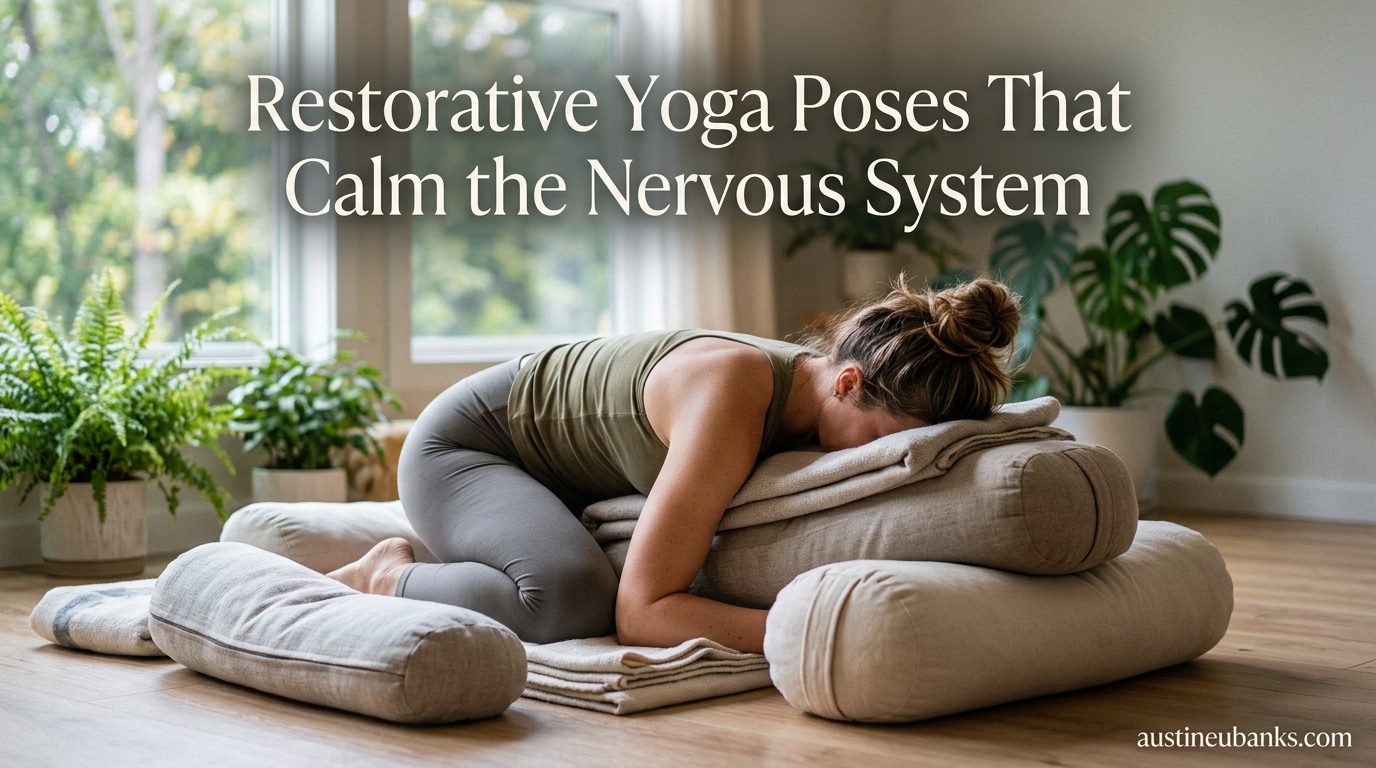
If you have ever finished a long day feeling like your brain would not shut off, you are not alone. Chronic stress has become so common that many people accept feeling wired, exhausted, and on edge as normal. But your body was not designed to live in a constant state of alert. Restorative yoga poses that calm the nervous system offer one of the most accessible ways to shift out of stress mode and into genuine relaxation.
I discovered restorative yoga during a particularly overwhelming period in my life when nothing else seemed to quiet the mental chatter. Within the first few sessions, I noticed something I had not felt in months: my shoulders dropped away from my ears, my breathing slowed on its own, and my mind stopped racing. What I learned is that this practice works not through effort, but through the opposite: complete, supported surrender.
In this guide, we will explore what restorative yoga is, exactly how it interacts with your nervous system at a physiological level, and ten specific poses you can practice at home tonight. You will also find guidance on props, common beginner mistakes to avoid, and a complete 30-minute sample routine you can follow step by step.
Whether you deal with daily anxiety, have trouble sleeping, or simply feel stuck in overdrive, restorative yoga gives your body the signal it needs to rest, heal, and reset. Let us start with the foundations.
Table of Contents
What Is Restorative Yoga?
Restorative yoga is a gentle, slow-paced style of yoga that uses props like bolsters, blankets, blocks, and straps to fully support the body in passive stretches held for five to twenty minutes at a time. Unlike more active yoga styles that build heat, strength, and flexibility through movement, restorative yoga asks you to do almost nothing. The props bear the weight of your body so your muscles can release completely.
The practice was developed by B.K.S. Iyengar, who pioneered the therapeutic use of props to make yoga accessible to people recovering from illness or injury. He found that when the body is fully supported, the nervous system receives a powerful signal of safety. That signal triggers a cascade of physiological changes that promote deep healing and relaxation.
Restorative yoga differs from other popular styles in several important ways. Vinyasa and Ashtanga are heat-building, movement-based practices that flow from one pose to the next synchronized with breath. Yin yoga involves long holds like restorative yoga, but Yin targets the deep connective tissues through gentle stress rather than complete relaxation. Restorative yoga, by contrast, aims for zero muscular effort and total comfort.
Think of it this way: in most yoga classes, you are actively doing something. In restorative yoga, you are actively allowing something. You set up the pose with props, settle in, and let gravity and time do the work. This passive approach is precisely what makes restorative yoga poses so effective at calming the nervous system.
A typical restorative session includes only five to eight poses, each held for extended periods. You might spend fifteen minutes in a single supported position. This may sound easy, but for people accustomed to constant activity, the stillness can be surprisingly challenging at first. With practice, though, it becomes a profound tool for self-regulation and stress relief.
The key insight is that relaxation is not something you can force. You cannot try your way into being calm. But when you give your body complete support and stay still long enough, your nervous system begins to shift on its own. That is the genius of restorative yoga: it creates the conditions for relaxation to arise naturally.
How Restorative Yoga Calms the Nervous System
To understand why restorative yoga works so well for nervous system regulation, you need to understand the two branches of your autonomic nervous system: the sympathetic and the parasympathetic.
The Sympathetic Nervous System (Fight-or-Flight)
Your sympathetic nervous system is the body’s alarm system. When you encounter a threat, whether physical or psychological, it floods your body with stress hormones like cortisol and adrenaline. Your heart rate increases, your breathing becomes shallow, your muscles tense, and blood flow shifts away from digestion and toward your limbs so you can fight or run.
This response evolved to keep us alive in genuine danger. The problem is that modern life triggers it constantly. A demanding email, a traffic jam, a news headline, or even the blue light from your phone can activate this same fight-or-flight cascade. When this happens day after day, your nervous system gets stuck in a state of chronic activation.
Over time, living in sympathetic overdrive leads to anxiety, insomnia, digestive issues, high blood pressure, weakened immunity, and burnout. You might feel like you cannot relax even when you want to. Many people describe this as feeling wired but tired, unable to wind down at night but exhausted during the day.
The Parasympathetic Nervous System (Rest-and-Digest)
The parasympathetic nervous system is the counterbalance. Often called the rest-and-digest state, it is responsible for recovery, repair, and relaxation. When this system is active, your heart rate slows, your breathing deepens, your muscles release tension, and your body shifts resources toward digestion, healing, and immune function.
You cannot turn off the sympathetic system through willpower alone. But you can activate the parasympathetic system by giving your body specific signals of safety. This is exactly what restorative yoga does. The long, supported holds, the deep breathing, and the physical stillness all tell your brain that you are safe and can let go.
The Vagus Nerve Connection
One of the key players in this process is the vagus nerve, the longest cranial nerve in your body. The vagus nerve runs from your brainstem through your neck and into your chest and abdomen, and it serves as the primary highway for parasympathetic signals. When the vagus nerve is stimulated, it slows your heart rate, reduces inflammation, and promotes calm.
Restorative yoga stimulates the vagus nerve through several mechanisms. Deep, slow breathing activates vagal tone through receptors in the lungs and diaphragm. Gentle pressure on the chest and abdomen from bolsters and blankets stimulates the nerve directly. Forward folds and gentle inversions also increase blood flow to the vagus nerve pathway.
Research has shown that people with higher vagal tone recover from stress more quickly and experience less anxiety overall. Regular restorative yoga practice is one of the most effective ways to improve your vagal tone over time, making your nervous system more resilient to future stressors.
What Happens in the Brain
When you hold a restorative pose for five to twenty minutes, measurable changes occur in your brain. The amygdala, your brain’s threat detection center, becomes less active. Cortisol levels begin to drop. Meanwhile, activity increases in areas associated with relaxation and emotional regulation, such as the prefrontal cortex.
Studies have shown that after twelve weeks of regular restorative yoga practice, participants experience significant reductions in stress hormones, improved sleep quality, and lower reports of anxiety. The practice literally rewires how your nervous system responds to stress, making calm your baseline rather than the exception.
This is why practitioners on forums like Reddit’s r/yoga and r/CPTSDNextSteps consistently describe restorative yoga as one of the most effective tools for nervous system regulation. As one user put it: this single practice helped me with nervous system regulation more than anything else I have tried. The props eliminate muscular effort so you can completely surrender.
10 Restorative Yoga Poses That Calm Your Nervous System
Here are ten restorative yoga poses that calm the nervous system, arranged from gentle breathing practices to fully supported floor poses. You do not need to do all ten in one session. Even two or three of these poses, held for ten minutes each, can dramatically shift how you feel.
1. Alternate Nostril Breathing (Nadi Shodhana Pranayama)
While technically a breathing practice rather than a pose, alternate nostril breathing is the perfect way to begin any restorative sequence. This technique balances the left and right hemispheres of your brain, lowers heart rate, and directly stimulates the vagus nerve through slow exhales.
How to do it: Sit comfortably with your spine tall. Bring your right thumb to your right nostril and gently close it. Inhale slowly through your left nostril for a count of four. Close your left nostril with your ring finger, release your thumb, and exhale through your right nostril for a count of six. Inhale through the right nostril for four, then switch and exhale through the left for six. This completes one round. Continue for five to ten rounds.
Why it calms the nervous system: The extended exhales are the key. When your exhale is longer than your inhale, you directly activate the parasympathetic nervous system. This is one of the fastest ways to shift out of fight-or-flight mode, often within just a few breaths.
Props needed: None. You can do this seated in a chair, on a cushion, or even lying down.
2. Supported Child’s Pose (Balasana)
Child’s Pose is the quintessential resting pose in yoga, and when fully supported with props, it becomes a powerful tool for nervous system regulation. The forward-folding position gently compresses the abdomen, which stimulates the vagus nerve and encourages deep belly breathing.
How to do it: Place a bolster lengthwise on your mat. Kneel on the floor with your knees wide apart and big toes touching. Lower your torso over the bolster so it supports your chest, belly, and head. Turn your head to one side and rest it on the bolster. Let your arms relax on either side. Stay for five to ten minutes, turning your head halfway through.
Why it calms the nervous system: The compression of the belly against the bolster stimulates the vagus nerve. The enclosed shape of the pose creates a felt sense of safety, similar to being held. Many people feel an almost immediate drop in anxiety levels in this position.
Props needed: One bolster, optionally a blanket under your hips or knees for extra cushioning.
3. Legs Up the Wall (Viparita Karani)
Legs Up the Wall is widely considered one of the best restorative yoga poses for calming the nervous system. It is a gentle inversion that reverses blood flow, reduces swelling in the legs, and promotes an immediate sense of calm. Many practitioners use this pose specifically for anxiety at night and insomnia.
How to do it: Sit sideways next to a wall with one hip touching it. Swing your legs up the wall as you lower your back to the floor. Your sitting bones should be close to or touching the wall. Let your arms rest at your sides with palms facing up. Close your eyes and breathe naturally. Stay for ten to fifteen minutes.
Why it calms the nervous system: The mild inversion signals the baroreceptors in your neck, which detect changes in blood pressure and trigger parasympathetic activation. Gravity helps venous blood return from your legs to your heart, reducing the workload on your cardiovascular system. The pose is deeply restful and many people fall asleep in it.
Props needed: A wall, optionally a folded blanket under your hips or a small pillow under your head.
4. Supported Bridge Pose (Setu Bandha Sarvangasana)
Supported Bridge Pose is a gentle backbend that opens the chest and throat while reversing the effects of slouching over a screen all day. The supported version uses a block or bolster under the sacrum so you can rest completely without muscular effort.
How to do it: Lie on your back with your knees bent and feet flat on the floor, hip-width apart. Press into your feet to lift your hips. Slide a yoga block (set to its lowest or medium height) or a bolster under your sacrum. Lower your weight onto the prop. Let your arms rest at your sides. Stay for five to ten minutes.
Why it calms the nervous system: The gentle chest opening expands your breathing capacity, encouraging slower, deeper breaths. The mild inversion of the torso stimulates venous return and activates the baroreflex. The throat opening can stimulate the vagus nerve as it passes through the neck.
Props needed: One yoga block or a firm bolster. Optionally a blanket under your shoulders.
5. Supported Fish Pose (Matsyasana)
Supported Fish Pose is a heart-opening restorative pose that counteracts the forward-rounded posture most of us hold throughout the day. By gently arching the upper back over a bolster, this pose opens the chest, shoulders, and throat simultaneously.
How to do it: Place a bolster lengthwise on your mat. Sit at one end of the bolster with your sacrum at its base. Slowly lie back so the bolster runs along your spine and supports the back of your head. Let your arms open out to the sides like a T or cactus shape. Keep your legs extended or let them fall into a butterfly position. Stay for five to ten minutes.
Why it calms the nervous system: The chest opening counteracts the physical pattern of fear and protection that accompanies chronic stress (hunched shoulders, collapsed chest). This pose physically demonstrates openness and vulnerability to your nervous system, which it interprets as safety. The throat opening also stimulates vagal tone.
Props needed: One bolster, optionally a blanket under your head if the stretch feels too intense in your neck.
6. Reclined Bound Angle Pose (Supta Baddha Konasana)
Reclined Bound Angle Pose, sometimes called Goddess Pose, is a deeply restful position that opens the hips and chest at the same time. It is one of the most popular restorative poses for anxiety relief because the fully supported position allows for complete surrender.
How to do it: Place a bolster lengthwise on your mat. Sit at the short end with the bolster behind you. Bring the soles of your feet together and let your knees fall open to the sides. Place blocks or folded blankets under each knee for support. Lie back onto the bolster. Rest your arms at your sides with palms facing up. Stay for ten to fifteen minutes.
Why it calms the nervous system: The combination of a supported backbend over the bolster and the hip opening creates a profound sense of physical release. The palms-up arm position is the classical gesture of receptivity and openness. This pose is often described as feeling like being cradled, which directly communicates safety to the nervous system.
Props needed: One bolster, two blocks or folded blankets for under the knees, optionally a blanket to cover yourself for warmth.
7. Supported Seated Forward Bend (Paschimottanasana)
Forward bends are naturally calming because they turn your awareness inward and create a feeling of enclosure. In the restorative version, a bolster placed on your legs allows you to fold forward without straining your back or hamstrings.
How to do it: Sit on the floor with your legs extended straight in front of you. Place a bolster lengthwise on top of your legs. On an exhale, slowly fold forward, resting your torso and head on the bolster. If your hamstrings are tight, bend your knees slightly or sit on a folded blanket. Let your arms rest alongside the bolster. Stay for five to ten minutes.
Why it calms the nervous system: Forward bends are universally recognized as calming poses in yoga tradition. The compression of the abdomen stimulates the vagus nerve. The inward-folding position reduces sensory input, which is especially helpful when you feel overstimulated or overwhelmed.
Props needed: One bolster, optionally a folded blanket under your sit bones.
8. Supine Spinal Twist (Supta Matsyendrasana)
A gentle spinal twist releases tension throughout the back, shoulders, and hips. In restorative form, the twist is held passively with the support of the floor and optionally blankets or bolsters, allowing for a deep release without effort.
How to do it: Lie on your back. Draw your right knee toward your chest. Extend your right arm out to the side. Guide your right knee across your body to the left side. You can place a bolster or folded blankets under your right knee for support so it does not hang in midair. Turn your head to look toward your right hand. Stay for five minutes, then switch sides.
Why it calms the nervous system: Twists compress and then release the abdominal organs, which can stimulate digestion and vagal tone. The gentle rotation of the spine releases physical tension that often accumulates during stress. Many people find twists especially helpful for quieting racing thoughts at bedtime.
Props needed: One bolster or stacked blankets under the dropped knee, optionally a pillow under your head.
9. Crocodile Pose (Makarasana)
Crocodile Pose is a lesser-known but deeply effective restorative pose for nervous system regulation. It is a prone position (lying face down) that uses the floor to create gentle pressure on the belly and chest, making it nearly impossible to take shallow, anxious breaths.
How to do it: Lie face down on your mat. Fold your arms in front of you and rest your forehead on your stacked forearms. Let your elbows splay slightly outward. Your legs can be straight or slightly apart. Focus on feeling your belly expand against the floor with each inhale. Stay for five to ten minutes.
Why it calms the nervous system: The belly-down position forces diaphragmatic breathing because the floor resists belly expansion, making you more aware of your breath. The gentle pressure on the front of the body has a calming, grounding effect similar to a weighted blanket. This pose is excellent for people who feel jittery or physically unable to settle.
Props needed: None, optionally a thin folded blanket under your forehead or chest for comfort.
10. Savasana with Props (Supported Corpse Pose)
Savasana is the final resting pose in virtually every yoga class, and for good reason. It is the pose of complete stillness and integration. When practiced with props in a restorative context, Savasana becomes a powerful practice for resetting the nervous system.
How to do it: Lie flat on your back. Place a rolled blanket under your knees to release your lower back. Put a folded blanket under your head as a thin pillow. Optionally place an eye pillow or folded cloth over your eyes. Let your arms rest at your sides with palms facing up. Let your feet fall open naturally. Breathe naturally and do not try to control anything. Stay for ten to twenty minutes.
Why it calms the nervous system: Savasana is the ultimate pose of surrender. By lying completely still in a comfortable position with nothing to do, you give your nervous system permission to down-regulate. The eye pillow provides gentle weight on the eyes, which stimulates the vagus nerve through the ophthalmic branch. This pose is the cornerstone of any restorative practice for nervous system health.
Props needed: One blanket rolled for under the knees, one folded blanket for the head, optionally an eye pillow or small towel.
Props You Need (And Household Alternatives)
One of the most common questions from beginners is whether you need to buy expensive yoga props to practice restorative yoga at home. The answer is no. While professional props are nice, you can create a fully functional restorative yoga setup with items you already have around the house.
Bolsters
A yoga bolster is a firm, cylindrical or rectangular cushion that provides support in restorative poses. If you do not have one, tightly roll two or three firm blankets into a cylinder shape and secure them with a strap or string. A firm bed pillow can work for some poses, though it may not provide enough support for poses that require more density. Body pillows are a great alternative for poses like Supported Fish and Reclined Bound Angle.
Blankets
Yoga blankets are typically made of sturdy Mexican-style cotton or wool. At home, any firm blanket will work. Avoid overly soft or fluffy blankets, as they compress too much under body weight. Fold blankets neatly to create firm, flat surfaces for sitting on, or roll them to create bolsters. Having three to five blankets of varying thickness gives you the most versatility.
Blocks
Yoga blocks are firm foam, cork, or wooden rectangles used to bring the floor closer to you. Sturdy hardcover books make excellent substitutes. Stack them to the height you need, and wrap them in a blanket if the hard edges are uncomfortable. A folded towel can substitute for a block in poses that require less height.
Straps
Yoga straps help extend your reach in poses where your flexibility is limited. A belt, necktie, scarf, or rolled towel can serve the same purpose. Look for something sturdy with minimal stretch. If you need a loop, a belt with a buckle or a resistance band works well.
Eye Pillows
Eye pillows are small, weighted pillows that rest over closed eyes during Savasana and other reclined poses. Fill a clean sock with rice or flaxseed and tie it shut for a perfect DIY version. You can add dried lavender or chamomile flowers for an aromatherapy bonus. The gentle weight on the eyes stimulates the vagus nerve and blocks out light, making it easier to drop into deep relaxation.
Common Mistakes Beginners Make
Restorative yoga looks deceptively simple, but beginners often encounter a few common pitfalls that can limit the effectiveness of the practice. Here are the mistakes I see most often and how to avoid them.
Trying Too Hard to Relax
The most common mistake is treating relaxation as a task to accomplish. When you think I need to relax, you create tension in the very act of trying. Instead, approach each pose with the attitude of allowing whatever happens. If your mind races, let it race. If you feel restless, observe the restlessness. Relaxation comes as a byproduct of acceptance, not from forcing it.
Skipping or Skimping on Props
Many beginners feel that using props is cheating or that they should be able to do without them. In restorative yoga, props are the entire point. Without adequate support, your muscles will stay engaged to maintain the position, which keeps your nervous system in a mild state of activation. Use more props than you think you need, especially in the beginning. The more supported you feel, the deeper your relaxation will be.
Holding Unconscious Tension
Even when fully supported, many people unconsciously grip certain muscle groups. Common areas include the jaw, shoulders, forehead, and hip flexors. Periodically scan your body from head to toe during each pose and consciously release any tension you find. A simple instruction I give students: soften your tongue away from the roof of your mouth. This one action alone can trigger a cascade of relaxation throughout the body.
Rushing Between Poses
The transition between poses is just as important as the poses themselves. When you come out of a restorative pose, move slowly and deliberately. Roll to one side first, rest for a breath or two, then use your arms to press up. Rushing to the next pose can re-activate your sympathetic nervous system and undo the calming effects you just built.
Expecting Immediate Results
Some people feel profound calm after their first restorative session. Others feel restless, frustrated, or even more aware of their anxiety. Both reactions are normal. If you have been living in chronic stress for months or years, your nervous system may need time to remember how to relax. Commit to practicing regularly for at least two weeks before judging the results.
Sample 30-Minute Restorative Yoga Routine
Here is a complete restorative yoga sequence you can practice at home. This routine is designed to progressively calm your nervous system from active breathing to complete rest. Set a timer for each pose so you are not checking the clock.
Minutes 1 to 5: Alternate Nostril Breathing. Sit comfortably and practice ten rounds of Nadi Shodhana with a four-count inhale and six-count exhale. Focus on the sensation of air moving through your nostrils.
Minutes 5 to 12: Supported Child’s Pose. Set up your bolster and settle in. Turn your head to one side for three minutes, then switch. Let your weight sink into the bolster with each exhale.
Minutes 12 to 20: Legs Up the Wall. Transition slowly to the wall position. Place a folded blanket under your hips if you like. Let your arms rest open with palms up. This is the centerpiece of the sequence for nervous system regulation.
Minutes 20 to 26: Supine Spinal Twist. Roll away from the wall onto your back. Draw one knee across your body and support it with blankets or a bolster. Stay for three minutes on each side.
Minutes 26 to 30: Savasana with Props. Extend your legs, place a rolled blanket under your knees, and cover your eyes with an eye pillow or small towel. Rest completely for the final four minutes. When your timer sounds, roll to your right side and press up slowly.
When to Practice
Evening is the most popular time for restorative yoga because it helps transition the body from the activity of the day into a calm state conducive to sleep. Practicing thirty to sixty minutes before bed can significantly improve sleep quality and reduce the time it takes to fall asleep.
However, restorative yoga is also valuable in the morning if you wake up feeling anxious or physically tense. A short session of Legs Up the Wall or Supported Child’s Pose can set a calmer tone for your entire day. Some people find that a midday session helps them reset between periods of focused work.
How Often to Practice
For nervous system regulation, consistency matters more than duration. Ten minutes daily is more effective than a single ninety-minute session per week. Aim for at least three sessions per week, ideally practicing for twenty to thirty minutes each time. As you build the habit, you may find that restorative yoga becomes something your body craves.
Many practitioners report that after two to three weeks of consistent practice, they notice a baseline shift. They react less strongly to daily stressors, sleep more deeply, and recover faster from emotionally difficult events. This is the result of improved vagal tone and a nervous system that has learned to access the parasympathetic state more easily.
FAQs
How does restorative yoga benefit the nervous system?
Restorative yoga activates the parasympathetic nervous system, also known as the rest-and-digest state, through long supported holds, deep breathing, and physical stillness. This reduces stress hormones like cortisol, stimulates the vagus nerve, lowers heart rate and blood pressure, and promotes deep relaxation. Regular practice improves vagal tone, making your nervous system more resilient to stress over time.
Can yoga reset your nervous system?
Yes, regular restorative yoga practice can effectively reset a chronically stressed nervous system. By repeatedly activating the parasympathetic state through supported poses and extended exhales, you train your nervous system to return to calm more easily. Studies show that after twelve weeks of consistent practice, participants experience significant reductions in cortisol levels, improved sleep, and lower anxiety.
What are the disadvantages of restorative yoga?
Restorative yoga has few disadvantages, but some people may feel restless or frustrated during the long holds, especially at first. It is not a substitute for cardiovascular exercise or strength training. People with certain conditions like severe acid reflux should avoid flat-back poses like Savasana right after meals. Some beginners may also experience emotional release during deep relaxation, which can feel overwhelming without proper support.
What type of yoga is best for the nervous system?
Restorative yoga is considered the best yoga style for calming the nervous system because it uses props to fully support the body, allowing for complete muscular release and parasympathetic activation. Yin yoga is a close second for its long holds. Gentle Hatha and slow Vinyasa can also help, but restorative yoga is the most effective for direct nervous system regulation because it requires zero muscular effort.
Bringing It All Together
Restorative yoga poses that calm the nervous system are not a luxury or a wellness trend. They are a practical, scientifically backed tool for counteracting the chronic stress that so many of us carry every day. By using props to support your body in stillness and holding each pose long enough for your nervous system to shift, you give yourself access to a state of deep calm that no amount of effort can produce.
The ten poses in this guide, practiced consistently, can help you move out of fight-or-flight mode and into rest-and-digest on demand. You do not need expensive equipment, a studio membership, or years of yoga experience. A few blankets, a quiet space, and ten to thirty minutes are enough to begin.
Start with just one or two poses from the sample routine above. Notice how you feel before and after each session. Over time, you will likely discover what so many practitioners report: that restorative yoga does not just feel good in the moment, it changes how your nervous system responds to stress for the rest of the day. That is the real power of this practice.